The Keeper by Tana French Summary, Characters and Themes
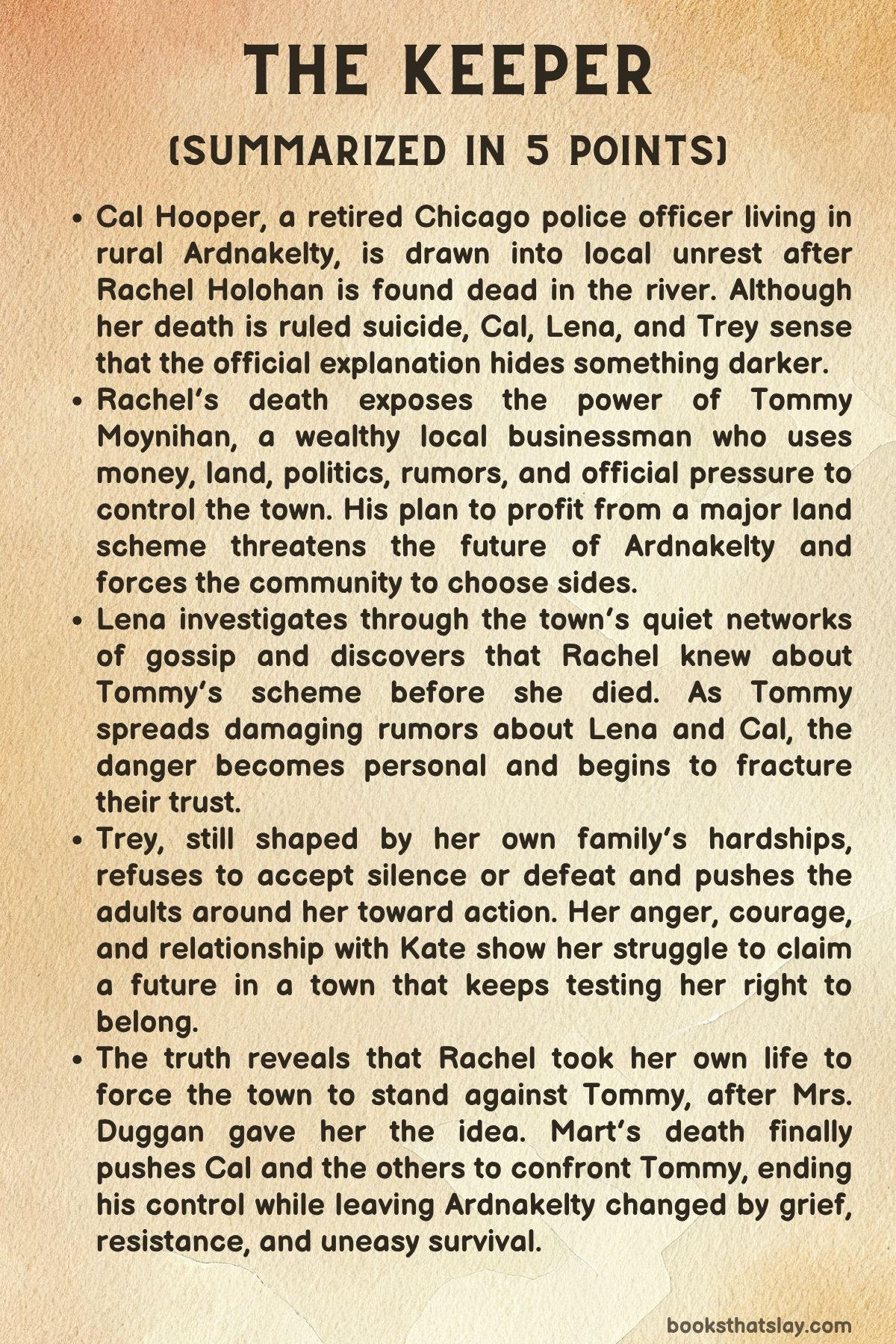
The Keeper is a psychological mystery by Tana French set in the rural Irish townland of Ardnakelty, where quiet lives are shaped by gossip, loyalty, land, and old grudges. The book follows retired Chicago police officer Cal Hooper, who has built a guarded new life with Lena Dunne and Trey Reddy, only to be drawn into a local crisis after a young woman’s death.
What begins as a question of suicide or murder becomes a story about power, community pressure, belonging, and the cost of protecting a place that can both shelter and harm its people. It’s the 3rd book of the Cal Hooper series.
Summary
Cal Hooper has spent three and a half years in Ardnakelty, a rural Irish community that still treats him as somewhat outside its inner circle. A retired Chicago police officer, he has built a careful life there with his fiancée, Lena Dunne, and the teenage Trey Reddy, whom he has taken under his wing.
His engagement to Lena began as a convenient fiction, but the town has accepted it as real, and people keep demanding wedding plans. The calm surface of this life is disrupted when Cal notices the unease surrounding the Moynihan family, especially wealthy businessman Tommy Moynihan and his son Eugene, who is visiting from Dublin and dating a local girl named Rachel Holohan.
Rachel appears at Lena’s house with a cat, using the animal as an excuse to talk. She asks Lena strange, personal questions about Lena’s late husband and about whether he controlled her.
Lena corrects her, making it clear that her solitude has always been her own choice. Rachel then breaks down, upset about Eugene and about the possibility that people will hate her.
Lena cannot fully understand what Rachel is trying to say, but she senses that the girl is under pressure. Soon after, Rachel disappears.
Cal, Trey, and other locals join the search, and Cal helps recover Rachel’s body from the river. The official conclusion is suicide by antifreeze poisoning, but the circumstances leave too many questions unresolved.
Rachel’s death unsettles Ardnakelty. People avoid speaking openly to Cal, though it is clear that they are talking among themselves.
At the pub, the men silently condemn Eugene by singing a ballad about a betrayed girl who dies by suicide. Tommy Moynihan tries to act above it all, but his power over the town becomes impossible to ignore.
Mart Lavin, Cal’s sharp and manipulative neighbor, explains that Tommy has built influence through money, jobs, land, politics, and official channels. If someone crosses Tommy, inspectors or authorities can appear at their door.
Cal begins to understand that Tommy’s control is not merely social; it is built into the way the town now functions.
Tommy visits Cal and asks him to investigate Rachel’s death, claiming he wants to know why she killed herself. Cal refuses, sensing that Tommy wants him for reasons that have little to do with truth.
Later, Trey hears that Rachel’s death was officially ruled suicide, but she does not believe it. The method seems too slow and uncertain to her, and she suspects Rachel was silenced.
Lena, disturbed by Trey’s cynicism and aware that she has taught the girl to expect Ardnakelty to bury its truths, decides to investigate quietly. She begins visiting women with jars of jam as polite excuses and traces a rumor about Rachel having an affair back to Clodagh Moynihan.
Lena concludes that the Moynihans are spreading the affair story to distract the town.
The conflict becomes more personal when Trey and her friends catch Donie McGrath harassing the Reddy family. He has been throwing rocks, damaging property, and leaving threats.
Cal forces the truth from Donie: Eugene hired him on Tommy’s orders to scare Sheila Reddy and her children into leaving their home. Cal and Trey dump Donie on Tommy’s doorstep as a warning, but the incident proves that Tommy is willing to attack vulnerable people to get what he wants.
Lena visits Sheila, who reveals that Rachel came to her the evening she died. Rachel was distressed because Tommy and Eugene were involved in a plan that would hurt Ardnakelty, and she feared Tommy would ruin her if she opposed them.
Cal gets more details from Garda Dennis O’Malley. Rachel ingested antifreeze less than an hour before death, meaning there is a crucial gap in her movements.
Eugene called her repeatedly that evening, but the Guards did not treat the case as suspicious enough to examine her phone location. Cal realizes Tommy’s activities connect: the land purchases, harassment of the Reddys, Eugene’s political future, and the rush to control the story of Rachel’s death.
He decides the Moynihans are a threat to Ardnakelty.
At Rachel’s funeral, the community’s divisions become visible. The Holohans and Moynihans stay apart, and Eugene is both mourned over and judged.
Lena gathers information from old acquaintances, while Cal finds Eugene drunk and shaken. Eugene claims he was home with his parents all evening but admits Rachel knew about his and Tommy’s plan.
Cal senses that Eugene suspects his father. Lena is summoned by Mrs. Dymphna Duggan, a powerful local information keeper, who reveals the plan that terrified Rachel.
A factory near Kilhone is expanding, and Tommy has been buying scattered parcels of land. With Eugene on the county council, Tommy intends to use compulsory purchase orders to acquire the remaining land between those parcels, making himself rich and reshaping Ardnakelty.
Lena leaves Mrs. Duggan determined to expose Tommy, but Tommy is waiting for her. He threatens her indirectly, implying he can make people believe she is unstable.
Around the same time, Cal is warned through official channels when an anonymous complaint falsely claims he struck Lena. Trey’s family is threatened with eviction through housing inspections.
Rumors begin spreading that Lena killed Rachel out of jealousy over a supposed affair between Rachel and Cal. Tommy’s strategy is clear: he will use rumor, authority, and fear to isolate anyone who stands against him.
Trey wants direct revenge, but Cal knows they need leverage. When Lena finally tells Trey everything, Trey passes the information to Cal.
Cal brings it to Mart, who understands at once that Tommy’s plan could destroy the farming community for generations. Mart organizes a masked march to Tommy’s house, where dozens of men chant that the land is theirs.
Cal joins them, feeling the pull of collective anger. Lena, watching from afar, is horrified that Cal has given her information to Mart and become part of the town’s mob logic.
Tommy retaliates more subtly than expected. Rumors against Lena grow worse, and Guard Breege visits Lena under the pretense of concern that she might harm herself.
Lena recognizes the trap: Tommy wants her seen either as suicidal or as a murderer. Cal and Mart decide to fight publicly.
At the pub, Mart announces that Tommy murdered Rachel and is framing Lena. A brawl erupts, deepening the town’s divide.
Mart later admits to Cal that even if they stop Tommy, larger economic forces may someday take the land anyway. What matters to him is that the community resists instead of surrendering quietly.
Evidence begins to surface. Trey and Kate learn from friends that Tommy was seen walking toward the old bridge around the time Rachel died, contradicting his alibi.
Cal confronts Eugene with this information, pushing him to question his father. Meanwhile, women from the town visit Lena with gin and cake, giving her support and a false alibi for Rachel’s death.
Lena realizes she is not as alone as she believed.
The truth shifts when Lena returns to Mrs. Duggan. Mrs. Duggan admits that Rachel came to her looking for a way to stop Tommy.
Mrs. Duggan told Rachel that only a young, innocent death on Tommy’s hands would rouse Ardnakelty against him and pointed her toward antifreeze and writing materials. She claims she did not think Rachel would actually do it.
Rachel, it turns out, killed herself deliberately to stop Tommy’s plan.
Before this truth becomes widely known, Tommy strikes again. Mart is found crushed beneath his overturned tractor, trapped by an accident caused by a deliberately dug hole.
As he dies, he makes Cal promise to use his death to stop Tommy. Cal photographs the evidence but knows that going to the Guards may not be enough.
The men want revenge, but Cal persuades them that killing Tommy would waste Mart’s death and risk prison. Instead, they must use what they know to force Tommy to dismantle his own scheme.
Cal and the men confront Tommy at his house. Tommy denies everything, but Eugene finally breaks.
He says he told Rachel about the land plan, arranged to meet her, and was stopped by his father, who took his phone and went to the bridge himself. Eugene says Tommy later admitted he killed Rachel and also needed Mart stopped.
Tommy tries to regain control, but his authority collapses. Eugene agrees to testify if necessary.
Cal and the men give Tommy their terms: shut down the land scheme or face the Guards. Tommy capitulates.
Cal later goes to Lena, who tells him the real truth about Rachel’s suicide and Mrs. Duggan’s role. She has already told Eugene, allowing him to decide whether to pursue Mrs. Duggan or honor Rachel’s purpose.
Cal is hurt that Lena hid this from him, but they understand that Tommy’s threats and Ardnakelty’s pressures changed them both. Still, Lena lets him inside, and their relationship begins to repair.
After Mart’s death, the town starts tending to what he left behind. Cal helps with the farm, and Mart’s heir begins learning what must be done.
Cal tells Trey that Tommy is finished in Ardnakelty. Trey reveals that she and Kate are dating, and Cal accepts that she can begin her apprenticeship next year.
The book ends with Cal, Lena, Trey, and Kate sharing dinner as snow falls over Ardnakelty, suggesting not peace exactly, but a hard-won pause after fear, loss, and resistance.
Characters
Cal Hooper
In The Keeper, Cal Hooper is a retired Chicago police officer trying to live a quieter life in Ardnakelty, but his old instincts remain active beneath his desire for peace. He wants to build, repair, cook, care for his dogs, and create a home with Lena and Trey, yet the death of Rachel Holohan draws him back into patterns of investigation and protection.
Cal is a man who believes in responsibility, though his understanding of responsibility changes over the course of the book. At first, he thinks in practical, personal terms: protect Trey, protect Lena, avoid being manipulated by local feuds.
As Tommy Moynihan’s power becomes clearer, Cal begins to see that living in a place creates obligations beyond private loyalty. His attachment to Ardnakelty is complicated because he is still partly an outsider, but he becomes increasingly willing to defend the community as his own.
His weaknesses come from the same place as his strengths. He wants to fix problems, but he sometimes assumes that action, strategy, and disclosure are the best tools, even when Lena needs silence, safety, and control over her own knowledge.
His decision to give Lena’s information to Mart wounds their relationship because it shows that Cal can be absorbed into Ardnakelty’s collective logic without fully realizing the cost. By the end, he has not become a simple hero.
He has protected the town, but he has also learned that justice in this world is compromised, partial, and often achieved through morally uneasy choices.
Lena Dunne
Lena Dunne is one of the most self-contained and perceptive figures in the book. She has built her life around chosen distance, not because she is weak or wounded in a simple way, but because she understands the danger of being caught in Ardnakelty’s social machinery.
Her privacy is deliberate, and her resistance to local expectations is part of her strength. Rachel’s visit unsettles her because Lena senses distress but cannot immediately understand its shape.
After Rachel’s death, Lena’s guilt becomes tied to her care for Trey. She sees that Trey has learned to expect silence, cover-ups, and defeat from the adults around her, and Lena decides she must prove that inconvenient truths do not always have to disappear.
Her investigation through women’s gossip networks shows her intelligence and fluency in local codes. She knows how to ask without asking, how to offer jam as payment, and how to read what is being withheld.
At the same time, Lena’s greatest fear is being consumed by the town’s judgment. Tommy’s attack on her sanity is especially cruel because it targets the independence she has fought to preserve.
Her withdrawal from Cal is not coldness; it is survival. She has been pushed into a place where trust feels dangerous.
Her eventual acceptance of help from Sheila, Yvonne, and Julie marks an important shift. Lena learns that connection can expose her, but it can also protect her.
Trey Reddy
Trey Reddy is the emotional and moral pressure point of the story. Young, sharp, guarded, and often angry, she has grown up learning that adults fail, institutions ignore the vulnerable, and the powerful usually win.
Her relationship with Cal gives her steadiness, but it does not erase the harsh education Ardnakelty has already given her. Rachel’s death brings back the pain of her brother’s disappearance and strengthens her suspicion that official explanations are often convenient rather than true.
Trey’s desire to leave school for a woodworking apprenticeship shows her longing for a real future built with her hands, but it also shows her impatience with systems she does not trust. Her bond with Kate adds another layer to her growth, revealing vulnerability and a need for chosen companionship beneath her toughness.
Trey often wants direct action: ambushing Donie, threatening Eugene, imagining Tommy’s death. These impulses reveal both courage and danger.
She has a strong sense of justice, but she is still learning the difference between revenge and change. Cal and Lena both try to protect her, sometimes by withholding information, but Trey refuses to remain a child on the edge of events.
By the end, her acceptance into the shared domestic space with Cal, Lena, and Kate suggests a future where she can belong without surrendering her defiance.
Mart Lavin
Mart Lavin is one of the most complex forces in The Keeper, acting as neighbor, strategist, manipulator, comic presence, local historian, and tragic defender of the land. He often speaks through jokes, gossip, and sly hints, but beneath that style is a deep understanding of Ardnakelty’s power structures.
Mart sees Tommy Moynihan clearly because he understands the old rules of land, obligation, pride, and fear. He also knows that the town’s deference to Tommy is not innocent; people have accepted favors, ignored corruption, and allowed power to grow because resistance seemed too costly.
Mart’s motives are rarely pure in a simple sense. He uses people, including Cal, and he is willing to expose Lena’s information if it serves the town’s survival.
Yet he is not driven only by ego. His fear of dying childless and leaving his farm vulnerable gives his fight personal urgency.
His deeper sorrow is that the world he loves may be disappearing, not only because of Tommy but because of larger economic change. Mart knows he may not truly win, but he believes resistance matters because it preserves dignity.
His death under the tractor is both a personal loss and a political act forced upon the community. In dying, he gives Cal and the others a final obligation: make the death count.
Tommy Moynihan
Tommy Moynihan is the central embodiment of modern local power in the novel. He is not merely a bully; he is dangerous because he understands systems.
He uses money, jobs, land purchases, political connections, inspections, rumors, and social pressure as parts of one controlling method. Tommy rarely needs open violence because he can make official channels serve his interests.
He threatens Cal through undeclared income, pressures the Reddys through housing violations, attacks Lena through false concern for her mental health, and tries to shape Rachel’s death into a story that benefits his family. His land scheme shows the scale of his ambition.
He does not simply want profit; he wants to reorder Ardnakelty around his own power. Tommy’s most chilling quality is his emotional normality after harm.
Eugene’s final observation that his father returned from the river acting normal suggests a man whose conscience has been worn down or replaced by entitlement. Yet Tommy’s downfall comes from the limits of control.
He can manipulate institutions and divide neighbors, but he cannot fully control grief, guilt, or collective anger. By the end, he survives legally, but his authority in the town is broken, which in this book may be the most meaningful punishment available.
Eugene Moynihan
Eugene Moynihan is weak, privileged, frightened, and morally important because he becomes the crack in Tommy’s system. He benefits from his father’s plans and is prepared to enter politics as part of a larger scheme, but he does not have Tommy’s hardness.
His relationship with Rachel appears to contain real feeling, yet he lacks the courage to protect her when it matters. He tells her about the land plan, then allows his father to control the situation, taking his phone and preventing him from going to meet her.
After Rachel’s death, Eugene is trapped between loyalty to his father and horror at what may have happened. His drunken anger, evasions, and eventual confession show a person who has lived too long under a stronger will.
He is not innocent, because his passivity helps create the conditions that destroy Rachel and threaten Ardnakelty. Still, he retains enough conscience to break.
When he finally speaks against Tommy, he does not become noble in a complete sense, but he does perform one necessary act of truth. His decision to leave for Dublin suggests both escape and failure.
He cannot repair what happened, but he can stop being the obedient instrument his father needs.
Rachel Holohan
Rachel Holohan is physically absent for much of the story, yet her presence drives nearly every major conflict. Rachel is young, frightened, and morally overwhelmed by knowledge she cannot carry alone.
Her visits to Lena, Sheila, and Mrs. Duggan show that she is searching among women for a way to respond to wrongdoing. She wants guidance from people who have endured harm, compromised with it, or learned how to survive it.
What she receives instead is partial help, refusal, and finally a terrible idea. Rachel’s choice to die by suicide is not presented as simple despair.
It is an act shaped by fear, pressure, and the belief that only her death can make Ardnakelty confront Tommy. This makes her both tragic and unsettling.
She is not only a victim of Tommy’s scheme; she is also someone who turns herself into evidence because she sees no other effective tool. Rachel’s importance in The Keeper lies in how the living use, misread, and fight over her death.
Some turn her into gossip, some into a weapon, some into a ghost story, and some into a reason to resist. The painful truth is that Rachel wanted to matter enough to stop harm, and the town’s response proves both the power and the terrible cost of that wish.
Noreen Duggan
Noreen Duggan is a shop owner, Lena’s sister, and one of Ardnakelty’s everyday centers of information. She appears warm, teasing, anxious, and socially alert, often acting as the place where private lives become public knowledge.
Her teasing of Cal about the wedding shows how ordinary community pressure works in mild forms before the darker forms become visible. Noreen is not malicious, but she is deeply embedded in the town’s habits of watching, talking, and interpreting.
Her anxiety after Rachel’s death shows that she understands how quickly social balance can collapse. As Lena’s sister, she also reveals a more personal side of Lena’s history, especially through their reconciliation over shared memories of their mother.
Noreen’s position is complicated by her connection to Mrs. Duggan, who lives beneath her roof and holds far sharper power. Noreen keeps antifreeze and other household materials, unaware that Mrs. Duggan’s words to Rachel will make those ordinary objects part of the tragedy.
She represents the kind of person who circulates through the community’s social life without fully controlling the consequences of what that community produces.
Mrs. Dymphna Duggan
Mrs. Dymphna Duggan is one of the most formidable characters in the book because her power is almost entirely social and informational. She is old, physically limited, and confined to the ground floor of Noreen’s house, yet people come to her, fear her, and rely on her knowledge.
She understands Ardnakelty’s secrets, debts, scandals, and pressure points. Her meeting with Lena shows her method clearly: she does not give information freely, but extracts emotional payment first, forcing Lena to recount the death of her first husband.
Mrs. Duggan’s intelligence is severe and unsentimental. She sees Tommy’s land scheme clearly and understands that ordinary protest will not stop him.
Her advice to Rachel, however, reveals a horrifying moral failure. By suggesting that only a young innocent death could galvanize the town, and by directing Rachel toward the means, she transforms political insight into lethal manipulation.
She claims she did not think Rachel would act, but that excuse does not erase responsibility. Mrs. Duggan stands for an older form of Ardnakelty power: hidden, coded, ruthless, and built on knowing exactly how people can be moved.
Sheila Reddy
Sheila Reddy is Trey’s mother and a woman who has survived by making hard, imperfect choices. Her past with Johnny Reddy has left her with knowledge of fear, compromise, and guilt.
When Rachel comes to her asking how she dealt with Johnny’s harm to others, Sheila answers honestly: she did not stop him for moral reasons; she acted when she needed to protect herself. This honesty disappoints Rachel, who is looking for a braver model, but it makes Sheila one of the book’s more realistic figures.
Sheila is not idealized as a perfect mother or hero. She is practical, defensive, and sometimes worn down, but she is also capable of courage when her children are threatened.
Tommy’s attempt to drive the Reddys from their home reveals how vulnerable she is to official pressure, yet Sheila responds with a threat of her own: she is willing to accuse Eugene publicly if Tommy continues. Later, she joins the women who support Lena, helping create an alibi and refusing to let Tommy isolate her.
Sheila’s strength lies in survival turned outward into solidarity.
Bobby Feeney
Bobby Feeney begins as a seemingly light figure, a local man returning from France with romantic hopes and a sense of personal renewal. His sale of land to Tommy allowed him to travel and meet Róisín, which makes his connection to Tommy morally awkward.
Bobby is not a villain, but his dependence on Tommy’s money places him under suspicion once the town divides. His refusal to join the masked protest makes others see him as one of Tommy’s men, and he becomes socially shunned.
Bobby’s role shows how easily ordinary compromises become political in a small community. A personal decision, selling land to fund a trip, becomes part of a larger pattern of land control.
Yet Bobby is also capable of humility and loyalty. He comes to Cal, tells him what people are saying, and wants to return to the group.
Cal’s insistence that Bobby be included after Mart’s death is important because it resists Tommy’s divide-and-conquer strategy. Bobby represents the people who are not ideologically committed but must eventually choose where they stand.
Kate
Kate is Trey’s friend, football teammate, and eventual girlfriend. Although she is not as central as Trey, she plays an important role in showing Trey’s emotional life beyond anger and survival.
Kate’s presence gives Trey companionship, loyalty, and a space where affection can exist without adult control. She also proves brave and practical, joining Trey in investigating partygoers and watching the Moynihan house.
Her involvement shows that the younger generation is not separate from Ardnakelty’s conflicts; they absorb them, respond to them, and sometimes take dangerous risks because adults have left too much unresolved. Kate also helps reveal Trey’s vulnerability.
Through her, Trey is not only the hard-edged girl who wants revenge or an apprenticeship. She is someone learning love, trust, and partnership.
By joining Cal, Lena, and Trey for dinner at the end, Kate becomes part of a small chosen household that offers an alternative to the town’s harsher forms of belonging.
Donie McGrath
Donie McGrath is a minor but revealing figure because he shows how Tommy’s power operates through disposable agents. Donie harasses the Reddy family by throwing rocks, damaging their home, and leaving grotesque threats, but he is not acting from his own large plan.
He has been hired to frighten vulnerable people on Tommy’s behalf. His cowardice becomes clear once Cal intimidates him, and his confession exposes the chain of command behind the attacks.
Donie’s role matters because it turns suspicion into proof that Tommy is willing to outsource cruelty while keeping his own hands clean. He also brings out dangerous sides of both Trey and Cal.
Trey and her friends capture him, showing their courage but also their willingness to take justice into their own hands. Cal’s interrogation of Donie reveals how quickly his old police habits can move into intimidation when someone he loves is threatened.
Guard Breege
Guard Breege represents the softer face of official authority, which makes her role especially troubling. She is not presented as corrupt in a blunt way, and her earlier interviews after Rachel’s death appear routine and professional.
Later, however, she becomes the channel through which Tommy pressures Lena. Her visit under the pretense of concern that Lena might harm herself shows how care can be weaponized when institutions rely on rumor and social influence.
Breege may believe she is doing her duty, but the effect is to make Lena feel trapped between two narratives: unstable woman or murder suspect. This makes Breege important not because she is cruel, but because she shows how decent people inside systems can be used by someone like Tommy.
Her presence reminds the reader that power does not always need loyal servants; sometimes it only needs people willing to follow procedure without seeing who shaped the complaint.
Garda Dennis O’Malley
Garda Dennis O’Malley is another official figure caught between procedure, discomfort, and local pressure. He gives Cal useful information about Rachel’s death, including the timing of the antifreeze ingestion and the gaps in the investigation.
This shows that he is not entirely closed off or hostile. At the same time, his later visit to question Cal about a false accusation reveals how easily the Guards can be pulled into Tommy’s warning system.
Dennis is visibly uncomfortable, which matters because he understands that something is wrong but continues with the process anyway. His character reflects the limits of official justice in the story.
The law exists, evidence exists, and officers may have doubts, yet influence, assumptions, and lack of formal suspicion keep truth from being pursued properly. Dennis is not the enemy, but he is not strong enough to counter the enemy either.
P.J. Fallon
P.J. Fallon is one of the local men who stands with Mart and Cal during the conflict with Tommy. He is not as dominant as Mart or as analytical as Cal, but his loyalty is steady and practical.
P.J. joins the masked march, participates in the discussions after Mart’s death, and helps with the difficult work when Mart is killed beneath the tractor. His use of his tractor to lift Mart’s overturned machine is a quiet but powerful act of communal duty.
P.J. also defends Bobby when the others are ready to reject him, showing that his loyalty is not blind group anger. He understands the value of keeping people together when Tommy’s strategy depends on division.
P.J. represents the kind of local solidarity that is not flashy but becomes essential in a crisis.
Senan Maguire
Senan Maguire is one of the men whose anger rises as Tommy’s actions become clearer. At Rachel’s funeral reception, he nearly gets into a fight with a Moynihan supporter, and after Mart’s death he is among those who want direct revenge.
Senan’s response is emotional, loyal, and rooted in long-standing connection to Mart and the land. He shows how grief can quickly turn toward violence when official routes feel useless.
Yet Senan is also capable of being persuaded. Cal’s argument that killing Tommy would waste Mart’s death eventually reaches him because Senan cares about honoring Mart, not merely satisfying rage.
His later involvement in caring for Mart’s farm and bringing Ruairi into the work shows that his loyalty can become preservation rather than destruction.
Francie Gannon
Francie Gannon begins as part of the pub’s rough social world, capable of insults, mockery, and performance. His early insult toward Bobby’s girlfriend shows the casual cruelty that can pass as banter among the men.
Yet Francie is also one of the people who helps discover Rachel’s body, placing him at the beginning of the book’s central crisis. As events escalate, he becomes part of Mart and Cal’s circle of resistance.
Francie’s character helps show how ordinary locals can shift from passive gossip and pub talk into action when the stakes become impossible to ignore. He is not idealized, and he does not suddenly become noble in a grand way.
Instead, he reflects the uneven moral texture of the community: flawed, reactive, sometimes cruel, but capable of standing with others when fear finally turns into refusal.
Tommy Moynihan’s Father
Tommy’s father, remembered as the Boss Moynihan, is important even though he belongs to the past. Mart’s account of his impunity, including sexual violence against a local woman, places Tommy within a longer history of family power.
The point is not only that Tommy is individually corrupt, but that the Moynihans have benefited from generations of fear, silence, and social hierarchy. The father’s legacy helps explain why Tommy expects obedience.
He has inherited more than wealth; he has inherited a model of entitlement. This background deepens the book’s treatment of power by showing that current abuses rarely appear from nowhere.
They are often built on older acts that were never punished and older victims who were never protected.
Sean Dunne
Sean Dunne, Lena’s late husband, is absent from the present action but central to how others misunderstand Lena. Rumors describe him as controlling and isolating, but Lena rejects this version, insisting that her distance from others has always been her own choice.
Sean’s death by accidental overdose of alcohol and medication remains a painful memory that Mrs. Duggan forces Lena to recount as payment for information. Through Sean, the book shows how the dead can become material for gossip and leverage.
His memory also helps explain Lena’s guardedness. She has known private loss, public interpretation, and the danger of others claiming authority over her life.
Sean is less a developed active character than a pressure point in Lena’s history, shaping how she responds when Tommy tries to define her as unstable.
Clodagh Moynihan
Clodagh Moynihan’s role is brief but important because she appears to be the source of the rumor that Rachel was having an affair. Whether she acts independently or as part of the family’s broader defense, the effect is the same: Rachel’s fear and moral distress are replaced by a story of sexual scandal.
Clodagh’s rumor helps shift attention away from Tommy’s land plan and toward the kind of gossip Ardnakelty knows how to spread quickly. Her role shows how women, too, can participate in systems that protect male power, whether through loyalty, fear, or calculation.
She is not developed in depth, but her action has consequences, helping create the false narratives that later threaten Lena and Cal.
Dickie O’Shea
Dickie O’Shea, the local political figure seen with Tommy and Eugene, represents the public legitimacy Tommy seeks. His presence at Rachel’s funeral reception signals that Eugene’s political ambitions are real and that Tommy’s plan reaches beyond private business.
Dickie matters because he shows how local politics can become a tool for land control. Tommy does not want Eugene on the council for service or civic duty; he wants access to decisions that can turn private purchases into a much larger takeover.
Dickie’s social ease with the Moynihans helps confirm Mart’s warnings about connections and influence. He is a sign of the respectable surface beneath which exploitation can operate.
Bernard McHugh
Bernard McHugh is a Moynihan loyalist and plant manager who defends Tommy in the pub confrontation. His argument is important because it is not purely foolish.
He claims the factory will revive a dying town, bring work, and offer a future. Through Bernard, the book gives voice to the side of Ardnakelty willing to accept Tommy’s plan because it promises jobs and modernization.
He shows that Tommy’s power does not rest only on fear; it also rests on people’s hopes, economic anxiety, and willingness to believe that development will save them. Bernard’s defense of Tommy reveals the conflict at the heart of the town.
Some see land as inheritance and identity, while others see it as a chance for survival through change.
Mouth McHugh
Mouth McHugh plays a smaller but explosive role during the pub conflict. His insults toward Cal and Lena help push Cal into violence, triggering the brawl that turns public accusation into physical chaos.
Mouth represents the reckless edge of factional loyalty. Unlike Bernard, who offers an argument about jobs and development, Mouth acts through provocation and contempt.
His function in the story is to show how quickly political conflict becomes personal in Ardnakelty. Ideas about land, death, and power are not kept abstract; they become insults, punches, grudges, and public humiliation.
Yvonne McCabe
Yvonne McCabe is one of the women who visits Lena after Tommy’s campaign against her intensifies. Her arrival with Sheila and Julie is a careful act of support disguised as ordinary visiting.
By finding and throwing away the antifreeze left on Lena’s step, Yvonne helps remove both a threat and a symbol of Tommy’s attempt to push Lena toward despair or implication. Yvonne’s role highlights the power of women’s solidarity in the book.
Unlike the men’s masked march or pub brawl, the women’s resistance is domestic, coded, and socially precise, but it is no less brave. They give Lena company, protection, and a story that can shield her from accusation.
Julie Quinn
Julie Quinn joins Sheila and Yvonne in supporting Lena and helps shift Lena’s view of Rachel’s death. When Lena feels that people are exploiting Rachel, Julie suggests that Rachel might want her death used to bring Tommy down.
This is a morally difficult idea, but it forces Lena to consider Rachel’s intention rather than only the town’s misuse of tragedy. Julie’s role is small, yet she contributes to one of the book’s key emotional turns.
She helps Lena move from isolation and disgust toward participation, not because the situation is clean, but because refusing to act may serve Tommy more than it honors Rachel.
Father Eamonn
Father Eamonn appears at Rachel’s funeral as a voice urging the community not to assign blame or allow the death to divide them. His words sound compassionate on the surface, but in the context of the story they also reveal the limits of neutral peacekeeping.
By warning against blame before truth is known, he unintentionally supports the comfort of silence. His role is important because the book questions whether peace without accountability is truly peace.
Father Eamonn may want to protect the community from fracture, but the fracture already exists. His appeal shows how institutions can prefer calm even when calm protects the powerful.
Sam Murray
Sam Murray is the woodsman with whom Trey wants to begin a woodworking apprenticeship. Though he appears only indirectly, he represents a possible future for Trey: skilled work, independence, and a life shaped by craft rather than school or family chaos.
Trey’s desire to apprentice with him is not just teenage impatience. It is her attempt to claim a path that feels real and honest.
Cal’s eventual agreement that she can begin the apprenticeship next year shows his growing respect for her judgment. Sam’s role is therefore symbolic as much as practical.
He stands for a life Trey can build for herself.
Ruairi
Ruairi inherits Mart’s farm and appears near the end as the community begins deciding how to care for what Mart left behind. His role points toward continuity after loss.
Mart feared that his land would be sold or absorbed after his death, and Ruairi’s inheritance raises the question of whether the farm can remain alive in any meaningful way. When Senan brings him to begin learning the work, the scene suggests that land survives through practice, not sentiment alone.
Ruairi represents the uncertain future of Ardnakelty: someone must learn, tend, and choose responsibility, or the place Mart fought for will still be lost.
Róisín
Róisín is Bobby Feeney’s girlfriend from France, and although she never directly enters the main action, she influences Bobby’s position in the town. Bobby’s relationship with her is made possible because he sold land to Tommy, which gives him a sense of gratitude and makes him hesitate when others turn against the Moynihans.
Róisín represents the personal dreams that complicate political choices. Bobby’s love story is not wrong, but the money that allowed it came from a land sale tied to Tommy’s larger plan.
Through Róisín’s indirect presence, the book shows that people rarely compromise with power for abstract reasons. They do it for travel, romance, hope, and the chance to feel their lives expanding.
Themes
Land, Belonging, and the Cost of Defending Home
In The Keeper, land is not treated as simple property. It is memory, livelihood, family continuity, status, and identity.
Tommy Moynihan sees land as leverage and profit, something to be assembled into a larger scheme through purchases, political influence, and compulsory orders. Mart Lavin sees it as inheritance and responsibility, even though he knows the old way of farming may be disappearing.
Cal’s relationship to the land is more complicated because he is not from Ardnakelty. He has chosen the place rather than inherited it, which raises the question of when an outsider becomes responsible for a community’s survival.
Trey also claims belonging fiercely, especially when Tommy tries to drive her family out. She wants Ardnakelty to recognize that she has earned her place there.
The fight over land therefore becomes a fight over who gets to decide the future of the townland. The book does not present belonging as gentle or simple.
To belong is to be claimed by obligations, conflicts, histories, and dangers that began before one arrived. Defending home requires loyalty, but it also risks being absorbed by the same collective anger and secrecy that make the place harmful.
Power, Rumor, and Social Control
Tommy Moynihan’s power works because it rarely depends on one obvious act. He controls through money, favors, threats, jobs, inspections, politics, and stories.
Rumor is one of his most effective weapons because it does not need proof to cause damage. Once the idea spreads that Rachel had an affair, or that Lena killed Rachel from jealousy, the accusation becomes a kind of social weather.
People breathe it in, repeat it, reshape it, and let it cling to the accused. The book shows how dangerous gossip can be in a small community where reputation is tied to safety.
Lena understands this better than Cal at first because she has lived longer inside Ardnakelty’s codes. Tommy’s attack on her sanity is especially revealing.
He does not need to prove she is unstable; he only needs enough people to wonder. Official authority then becomes vulnerable to manipulation, as seen when Guards visit Cal and Lena based on false or distorted claims.
Rumor in the story is not casual talk. It is a tool that can isolate, punish, redirect blame, and make truth seem like just another version of events.
Fighting Tommy therefore means fighting not only a man, but the narratives he plants.
Justice, Revenge, and Moral Compromise
The book repeatedly asks what justice can look like when official systems are too weak, too slow, or too easily influenced. Rachel’s death is ruled suicide without deeper investigation.
Tommy’s threats travel through legal and bureaucratic channels. Mart’s death could be treated as an accident unless the community acts.
In this environment, characters are pushed toward private justice. Trey wants to beat answers out of people.
The men want to kill Tommy after Mart dies. Mart organizes intimidation because he believes subtle resistance is no longer enough.
Cal, with his police background, knows the dangers of revenge, but he also knows that a clean legal solution may not exist. His final strategy is morally uneasy: instead of delivering Tommy directly to justice for Rachel and Mart, he forces him to dismantle the land scheme.
This saves the town but leaves many wounds unresolved. The book does not celebrate compromise as purity.
It presents it as the painful shape justice can take when every available path is damaged. Revenge might satisfy grief, but it may also waste sacrifice.
Legal truth might be ideal, but without power it may fail. The characters must choose what outcome can still protect the living.
Women’s Knowledge, Silence, and Resistance
Much of the truth moves through women before Cal fully understands it. Rachel seeks out Lena, Sheila, and Mrs. Duggan because she is looking for guidance from women who know something about fear, control, and survival.
Lena investigates through jam visits, old friendships, pauses, hints, and coded exchanges. Mrs. Duggan holds information like currency.
Sheila, Yvonne, and Julie protect Lena not through public confrontation but through presence, alibi, and practical care. The book gives serious weight to these forms of knowledge, showing that women in Ardnakelty often understand danger earlier because they are used to reading indirect threats.
Yet this knowledge is not automatically healing. Mrs. Duggan’s advice to Rachel is devastating, and Lena’s silence nearly breaks her connection with Cal.
The same social codes that allow women to protect one another can also trap them in secrecy. Rachel’s tragedy comes partly from the absence of a safe path between knowing and acting.
Lena’s arc responds to that failure. She begins in chosen isolation, moves through fear and paralysis, and finally accepts that resistance may require connection.
Women’s silence in the story is complex: sometimes protective, sometimes harmful, and sometimes transformed into a quiet but powerful refusal to let Tommy define reality.