The Ruins by Scott Smith Summary, Characters and Themes
The Ruins by Scott Smith is a horror novel about ordinary tourists whose casual vacation decision turns into a brutal test of fear, survival, and human weakness. The story begins with the loose energy of young travelers in Mexico, but it slowly turns into something far more claustrophobic and cruel.
What makes the book unsettling is not only the threat of the vines, but also the way hunger, thirst, guilt, panic, and mistrust change the characters. It is a story about being trapped by nature, by other people, and by the worst parts of oneself.
Summary
Two American couples, Amy and Jeff, Stacy and Eric, are vacationing in Mexico for three weeks. Their trip is casual and careless at first, filled with swimming, drinking, and small tourist adventures.
They meet Mathias, a German traveler, while snorkeling near Cozumel. He helps them see a shipwreck by lending them his diving tank, and afterward he becomes part of their loose vacation circle.
They also repeatedly encounter three Greek travelers, whom they nickname Pablo, Juan, and Don Quixote because of the language barrier and their own inability to communicate properly with them.
The main trouble begins when Mathias tells Jeff and Amy that his brother, Henrich, has disappeared. Henrich had met a young archaeologist who was going to an excavation site, and he had followed her after claiming he was in love.
Mathias and Henrich had fought about it, but Henrich left anyway, leaving behind a note and a rough map. Jeff, who is interested in ruins and who tends to take charge, offers to go with Mathias to find him.
He persuades Amy, Stacy, and Eric to come along, even though there are warning signs from the start. Amy does not want to go, Eric is still recovering from drinking, and Stacy is badly dressed for a hike.
Pablo unexpectedly joins them after seeing the map and leaves a copied version behind for his friends.
Their journey quickly becomes uncomfortable. Stacy is harassed and robbed by two boys at the bus station, which unsettles her before the trip has even begun.
The group takes a bus to Cobá, then hires a man with a pickup truck to drive them closer to the site. The truck ride is tense, hot, and frightening, and several of them sense that they are making a mistake.
When they arrive, the driver warns Amy in broken English that the place is “no good” and urges them not to continue. He becomes angry when she does not understand or obey him, then drives away, leaving them with no reliable way back.
The group follows the map through the heat and into the trees. They miss the right path and end up at a small Mayan village.
The villagers do not greet them or respond normally. Jeff tries to explain their situation in English, Spanish, and gestures, but the man he speaks to gives them nothing useful.
The silence of the village feels hostile, and the group leaves. On the way back, they discover a hidden trail covered with palm fronds.
This detail makes the group nervous because the path seems deliberately concealed. They follow it anyway and reach a clearing where a hill is covered in green vines and bright red flowers.
The sight is beautiful at first, almost inviting, and Amy takes photographs.
The Mayan men soon arrive, led by the bald man from the village. Their horses refuse to enter the clearing, and the men are visibly frightened and angry.
They shout at the travelers and gesture for them to leave, but the situation changes when Amy accidentally steps into the vines. A vine wraps around her ankle, and the Mayan men grow more distressed.
Instead of letting the group leave, they force them at gunpoint and arrow-point onto the hill. The travelers do not understand at first that contact with the vines has trapped them.
Once they are on the hill, the Mayans will not allow them to come down.
At the top of the hill, the group finds tents and camping gear that belonged to earlier victims. They also find a deep shaft, probably linked to excavation work.
Soon they discover Henrich’s body hidden beneath the vines, with arrows in his chest and his face already damaged. Mathias is devastated, while Jeff tries to keep him calm so they can think clearly.
The group realizes that the Mayans are not simply threatening them for trespassing. They are guarding the hill and making sure no one who touches the vines leaves alive.
Jeff begins rationing water and trying to plan, while the others look for hope in the possibility that Pablo’s friends will come.
A ringing sound from the shaft gives them their first strong hope of rescue. They think a cell phone may be down there.
Pablo eagerly agrees to be lowered into the hole, but the vines have weakened the rope with their sap. The rope breaks, and Pablo falls badly, landing with a terrible injury that likely breaks his back.
Eric jumps down after him when the rope proves too short, injuring his own knee in the process. The others build a makeshift extension from tent fabric and lower Amy down to help secure Pablo to a backboard.
Pablo is eventually pulled out, but he is paralyzed and in terrible pain. The rescue attempt only worsens their situation and proves that the vines can set traps.
As the night passes, Jeff becomes the group’s practical leader. He organizes watches, rations supplies, and studies the Mayans’ behavior.
He attempts to sneak down the hill but finds that the Mayans have surrounded the area with fires and weapons. The vines also seem to react to movement, sound, and weakness.
Amy steals water in the night because she is thirsty, and Jeff catches her. His disappointment and her defensiveness expose cracks in their relationship.
The hill becomes not only a physical prison but also a place where private flaws become harder to hide.
The next morning, the horror of the vines becomes undeniable. Eric wakes to find the plant growing up his injured leg and into his wound.
At the same time, Pablo screams because the vines have covered his legs and eaten away the flesh beneath them. The vines move toward Stacy’s vomit and consume it through their flowers, showing that they are active and hungry.
Eric becomes obsessed with the idea that the vines are still inside him, and Mathias cuts into his leg to remove pieces that have burrowed under the skin. Jeff concludes that the vines are sentient, or at least intelligent enough to learn, lure, mimic, and plan.
The group’s supplies are meager. They have a little water, some tea, a can of Coke, rotting fruit, a sandwich, and some alcohol.
Jeff tries to ration everything, but hunger, thirst, fear, and denial make cooperation difficult. He and Mathias decide that Pablo’s ruined legs must be amputated if he is to have any chance of living.
The operation is brutal and improvised. Jeff cuts off Pablo’s lower legs and cauterizes the wounds with heated metal.
Amy arrives too late to stop it and is horrified, but the vines immediately try to drag away the severed limbs. The ringing sound returns from the shaft, and Jeff and Amy go down together, believing again that a phone may be there.
Inside the shaft, they discover that the ringing is not a phone at all. The vines are making the sound.
They have been luring the group toward a deeper hole hidden under growth. When Jeff and Amy realize the trap, the vines attack them, grabbing at their bodies and trying to pull them down.
Jeff fights them off, sends Amy up first, and uses tequila as a burning weapon against the vines. As Amy rises from the shaft, the flowers begin making a sound like laughter.
The enemy is no longer just dangerous; it is mocking them.
Afterward, the group begins to collapse emotionally. Eric cuts himself open again, convinced vines are growing inside his body.
Stacy, Amy, and Eric drink, talk wildly about surviving and becoming famous, and eat most of the remaining grapes. The vines then begin mimicking their voices and repeating their private words, using shame, suspicion, and fear against them.
When the rain comes, Jeff tries to catch water, but even this becomes another scene of failure and conflict. He fights bitterly with Amy, accusing her of not taking survival seriously.
Amy retreats to the edge of the clearing, sick and humiliated. Jeff watches her but refuses to comfort her because of pride and anger.
By morning, Amy is dead. The vines have covered her mouth and throat while she was vomiting, causing her to choke.
Jeff realizes too late that he saw signs of her distress during the night and did nothing. Her death breaks something in him.
Eric’s condition worsens as vines continue entering his wounds, and Jeff and Mathias cut into him again to remove them. The vines begin producing smells of food, such as bread, meat, and pie, tormenting the starving group.
Jeff suggests that they may eventually need to preserve Amy’s body for food, but Stacy refuses to accept the idea. Before long, the vines consume Amy’s body anyway, stripping it to bones and using her voice to torment Jeff.
Jeff eventually goes down the hill in the rain and decides to make a run for the forest. The mist makes him believe he has a chance, but the Mayans see him.
He is shot with arrows and collapses. As he dies, the vines pull him back onto the hill.
The others do not know exactly what happened at first and briefly imagine that he may have escaped to bring help. Mathias returns with Jeff’s hat and eventually understands that Jeff is dead.
The final survivors are Mathias, Eric, and Stacy. Eric is now consumed by the belief that vines are everywhere inside him.
He cuts into himself repeatedly, peeling away his own skin in a desperate attempt to remove them. When Mathias tries to stop him, Eric accidentally stabs him in the chest, killing him.
The vines quickly take Mathias’s body. Eric, weakened and ruined, begs Stacy to kill him.
She resists but finally helps drive the knife into him, ending his suffering. Afterward, Stacy is alone.
Stacy gathers what remains of the food and drink, takes tequila and the knife, and moves down toward the path. She waits for Pablo’s friends, giving them one more day in her mind.
When night comes and no rescue arrives, she cuts her wrists. The vines quickly reach out, seize her, and drag her body back into the hill.
Three days later, the Greek travelers arrive with three new Brazilian friends. They follow Pablo’s copied map to the hidden path.
A young Mayan girl tries silently to warn them away, but they do not understand. They reach the clearing, see the beautiful vines and flowers, and begin climbing the hill while calling Pablo’s name.
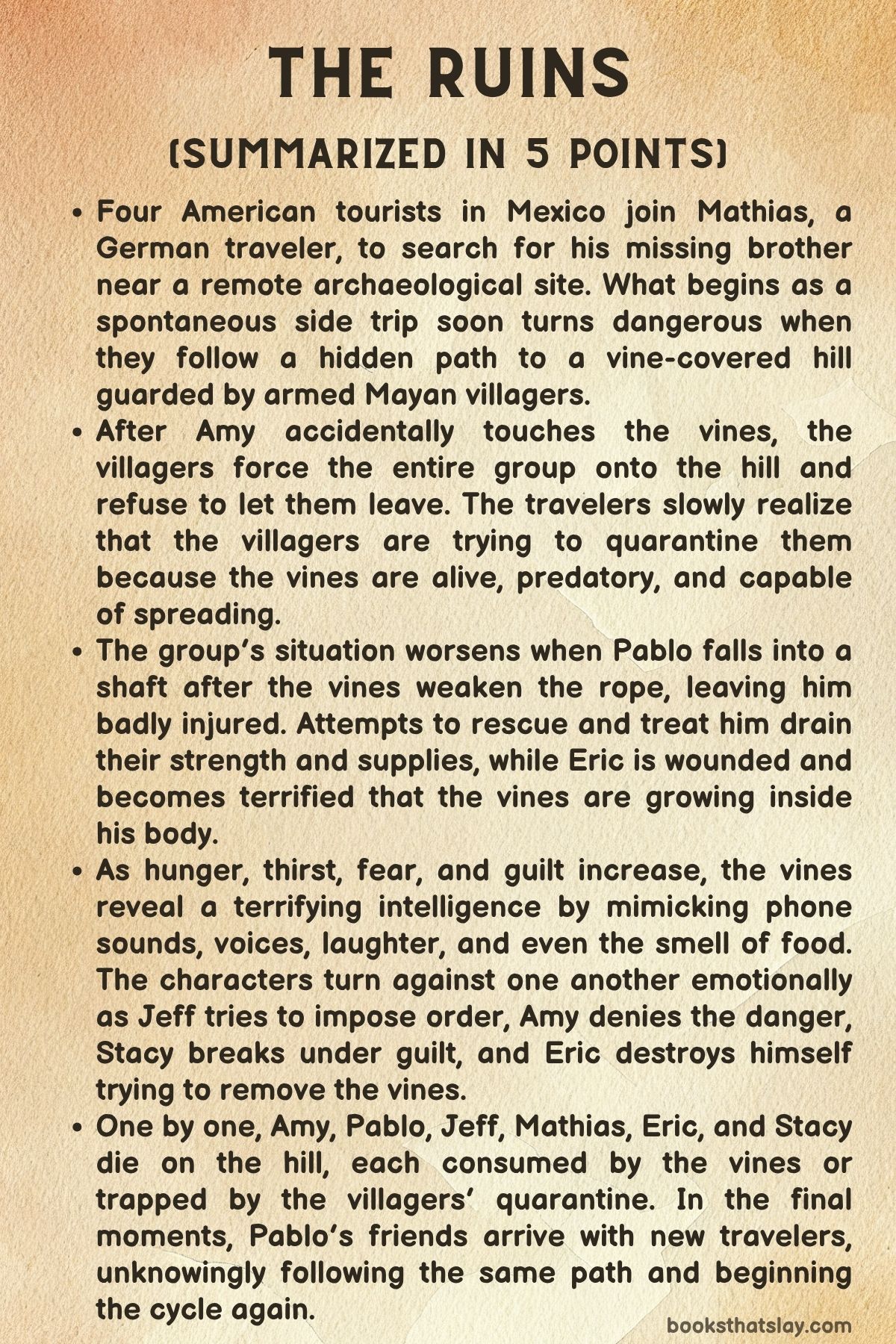
Characters
Jeff
Jeff is the character most closely associated with control, logic, and survival planning. In The Ruins, he is the person who turns first to maps, supplies, rationing, shelter, sanitation, and escape routes.
This makes him useful, and for a time he seems like the only person capable of keeping the group alive. Yet his strength also becomes his flaw.
Jeff believes that if he thinks clearly enough, he can master the crisis, but the hill exposes the limits of intelligence when the situation is designed to defeat human reason. His leadership is practical but emotionally rigid.
He expects discipline from people who are hungry, injured, terrified, and in shock, and he often treats weakness as failure. His conflict with Amy shows how pride can become deadly.
He sees her suffering but cannot make himself go to her because he wants her to apologize first. That delay costs her life and leaves Jeff with a guilt he cannot repair.
His death while trying to escape is fitting because it comes after he finally acts not from strategy but from desperation. He is brave and capable, but the book shows that competence without tenderness can become another form of blindness.
Amy
Amy begins as reluctant, uncomfortable, and resentful about the trip to the ruins. She does not truly want to go, and her early unease makes her one of the first characters to sense that the outing is wrong.
Her accidental step into the vines becomes the moment that seals the group’s fate, and although she is not morally responsible for what happens, she carries the emotional weight of that accident. Amy’s character is marked by denial and self-protection.
She wants to believe that rescue is near, that the Greeks will come, that Jeff is overreacting, and that the situation can still return to ordinary life. Her denial is understandable because accepting the truth would mean accepting almost certain death.
Her relationship with Jeff becomes one of the book’s most painful human conflicts. She wants comfort, forgiveness, and softness from him, while he wants discipline and obedience.
When she steals water, drinks, eats the grapes, and lashes out during the rain, she is not simply selfish; she is unraveling under fear. Her death by choking while Jeff watches from a distance is cruel because it turns an emotional argument into a fatal failure of care.
Amy represents the human need for reassurance in a world that offers none.
Stacy
Stacy is one of the most emotionally sensitive figures in the book, and her journey is especially disturbing because she begins as someone dependent on comfort, friendship, and ordinary social bonds. In The Ruins, she often reacts through feeling before logic: she is shaken by the assault at the bus station, comforted by Amy’s kindness, frightened by the village, and deeply disturbed by Pablo’s suffering.
Her empathy is real, but the hill gradually wears it down until she can no longer recognize herself. Stacy’s guilt grows from repeated failures that are understandable but devastating.
She falls asleep while watching Pablo, leaves him alone, fights with Eric while Pablo dies, and later helps Eric end his life. None of these acts are simple choices made in calm conditions; they are the actions of someone pushed beyond normal endurance.
Her relationship with Eric also changes under pressure. Love becomes mixed with disgust, fear, duty, and exhaustion.
By the end, Stacy’s question about whether she is still herself captures the full psychological cost of survival horror. She does not become cruel in a simple sense.
Instead, the story shows how terror can force a person to do things that make identity feel broken.
Eric
Eric is defined by physical vulnerability and psychological panic. At the beginning, he is hungover, casual, and not prepared for the journey, which makes him seem less alert than Jeff or Mathias.
His jump into the shaft to help Pablo is one of his most important actions because it shows that he is not cowardly. He acts from guilt and compassion, even when the choice is reckless.
After his knee injury, however, his body becomes the main site of horror in the book. The vines enter his wounds, and he becomes obsessed with the belief that they are still growing inside him.
His fear is not irrational in the ordinary sense because the vines really are invading him, but his panic pushes him into self-destruction. He cuts himself again and again, searching for hidden tendrils, and his body becomes a battleground between pain and terror.
Eric’s tragedy lies in the way he loses trust in everyone and even in his own senses. He cannot accept reassurance because the danger is too intimate.
His accidental killing of Mathias is not an act of malice, but it is the result of fear taking complete control. His final plea for Stacy to kill him shows a person who no longer sees life as survival, only as continued invasion.
Mathias
Mathias is the reason the group goes to the ruins, but he is not presented as a villain for that. He is driven by concern for Henrich and by the need to find out what happened to his brother.
In The Ruins, Mathias carries a quieter grief than the others. When Henrich’s body is found, he suffers deeply, yet he tries to remain composed because the situation leaves no room for mourning.
His temperament is more controlled than Eric’s and less commanding than Jeff’s. He often works beside Jeff, helping with practical tasks such as repairing the rope, building shelter, assisting with Pablo’s amputation, and cutting the vines out of Eric.
His warning to Stacy that she must become like an animal reveals his survival philosophy: emotion must shrink until only the body’s basic needs remain. Yet Mathias is not emotionless.
His grief for Henrich, his exhaustion, and his eventual helplessness show beneath his restraint. His death is especially bitter because it comes while trying to stop Eric from destroying himself.
Mathias’s role in the story is to show responsibility under pressure, but also the limits of endurance when grief, fear, and bodily danger keep multiplying.
Pablo
Pablo is separated from most of the group by language, which makes his suffering even more isolating. He joins the expedition with cheerful excitement, copying the map for his friends and treating the journey as an adventure.
Once he falls into the shaft, he becomes the most physically helpless character in the story. His broken body forces the others to confront decisions they are not prepared to make: whether to move him, how to treat him, whether to amputate his legs, and how much of their limited energy should be spent keeping him alive.
Because he cannot communicate clearly with the Americans or Mathias, his pain is filtered through screams, gestures, and repeated words no one fully understands. This makes him both present and unreachable.
Pablo also becomes a measure of the group’s moral collapse. Their treatment of him begins with rescue and care, but it becomes mixed with fear, frustration, avoidance, and guilt.
Stacy’s attachment to him is especially important because she sees his helplessness and feels responsible when he dies. Pablo’s fate shows how horror becomes worse when language fails and when a suffering person cannot explain what he needs.
Henrich
Henrich is absent for most of the story, but his choices shape everything that follows. He follows the archaeologist because he believes he is in love, and that romantic impulse leads him to the hill before the main group arrives.
His note and map become the pathway to disaster. Henrich’s death is discovered early enough to prove that the ruins are not merely strange or dangerous but fatal.
His body, marked by arrows and consumed by vines, also reveals the cooperation between two threats: the Mayans prevent escape, and the vines destroy what remains. Henrich functions as a warning that the characters understand too late.
To Mathias, he is not only a body but a brother, and that personal loss gives the story a grief that goes beyond survival. Henrich’s role is tragic because his longing, like the tourists’ curiosity, is ordinary.
He is not seeking danger for its own sake. He follows desire, and that desire leads him into a place where human motives no longer matter.
Themes
Survival and the Collapse of Civilized Behavior
Survival in The Ruins is not shown as heroic adventure. It is shown as a slow reduction of human life to water, food, wounds, sleep, fear, and bodily need.
The characters begin as tourists with ordinary expectations: buses, taxis, cameras, beaches, hotels, and rescue. Once trapped on the hill, those expectations become useless.
Jeff tries to build order through rationing, watches, shelter, and medical procedures, but the crisis keeps moving faster than his plans. The group’s behavior changes as the body takes command.
Amy steals water, Stacy rinses urine from her legs with precious supplies, Eric cuts himself open, and everyone becomes more willing to consider choices that would once have seemed impossible. The proposed preservation of Amy’s body is one of the clearest signs that survival has pushed the group beyond ordinary moral boundaries.
The book does not present this collapse as sudden evil. It happens through heat, thirst, pain, exhaustion, and the steady loss of hope.
The terrifying question is not whether the characters are good or bad, but how long goodness can remain stable when the body is desperate and death is close.
The Danger of Denial
Denial shapes many of the characters’ worst decisions. From the beginning, several of them sense that the trip is a mistake, yet they continue because turning back would feel awkward, disappointing, or cowardly.
The truck driver warns them, the hidden path looks suspicious, the village feels hostile, and the Mayans react with fear, but the group keeps trying to interpret these warnings through ordinary logic. Once trapped, denial becomes even more dangerous.
Amy insists that help will come soon and resists Jeff’s harsher view of their situation. Eric tries to believe the vines are not inside him, then swings to the opposite extreme and believes they are everywhere.
Stacy clings to care and routine even when those gestures can no longer save Pablo. The hope that the Greeks will arrive is emotionally necessary, but it also prevents the group from fully accepting the severity of their situation.
Denial is not presented as stupidity. It is a defense mechanism.
The mind protects itself by refusing unbearable facts. Yet the hill punishes that refusal.
Every delayed recognition gives the vines more time, and every comforting illusion becomes another weakness to exploit.
Nature as an Intelligent Threat
The vines are terrifying because they destroy the usual boundary between plant life and predatory intelligence. They do not merely grow over bodies; they react, learn, imitate, lure, and mock.
They weaken the rope just enough to create a trap. They mimic a cell phone to draw victims into the shaft.
They copy voices, reproduce private conversations, create the smell of food, and use the dead to torment the living. This makes the natural world feel not passive but watchful.
The characters struggle because their assumptions about nature are too limited. A plant should not laugh.
A flower should not speak. A vine should not understand shame, hunger, guilt, or hope.
Jeff’s suggestion that the vines may not even be a plant points to the deeper fear: the thing on the hill cannot be safely classified. The horror comes from intelligence without empathy.
Human cleverness is usually treated as an advantage, but here the nonhuman enemy is patient, adaptive, and cruel. The vines do not simply kill bodies.
They study the mind and use human emotion as part of the attack.
Guilt, Responsibility, and Moral Failure
Guilt spreads through the story almost as aggressively as the vines. Amy feels responsible because she stepped into the growth.
Jeff feels responsible for leading the group, for failing to comfort Amy, and for not recognizing that she was choking. Stacy feels responsible for leaving Pablo alone, for failing to protect Eric, and for helping end his life.
Mathias carries the guilt of bringing others to search for Henrich, even though his motive was love for his brother. The book makes responsibility difficult because many fatal choices are made under confusion, pain, and incomplete knowledge.
No one fully understands the rules of the hill until it is too late. Still, the characters judge themselves and each other because guilt is one of the few forms of meaning left to them.
Jeff’s strictness is partly an attempt to control guilt before it arrives. Stacy’s final question about whether she is still herself shows how moral injury can outlast fear.
The tragedy is not only that the characters die, but that before death they are forced to see versions of themselves they cannot accept. The hill turns survival into a series of compromises, and each compromise leaves a wound the body may not live long enough to heal.