Revelation Space Summary, Characters and Themes
Revelation Space is a science fiction novel by Alastair Reynolds, set in a far future where human civilization has spread across star systems but remains vulnerable to forces it barely understands. The book combines archaeology, space travel, cybernetics, alien mystery, and questions about identity and survival.
At its center is Daniel Sylveste, a driven scientist obsessed with the extinct Amarantin civilization and the disaster that destroyed them. Around him gather soldiers, assassins, ship captains, digital ghosts, and ancient intelligences, all pulled toward a secret that may explain why intelligent life in the galaxy is so rare. It’s the 1st book of the Inhibitor Sequence series.
Summary
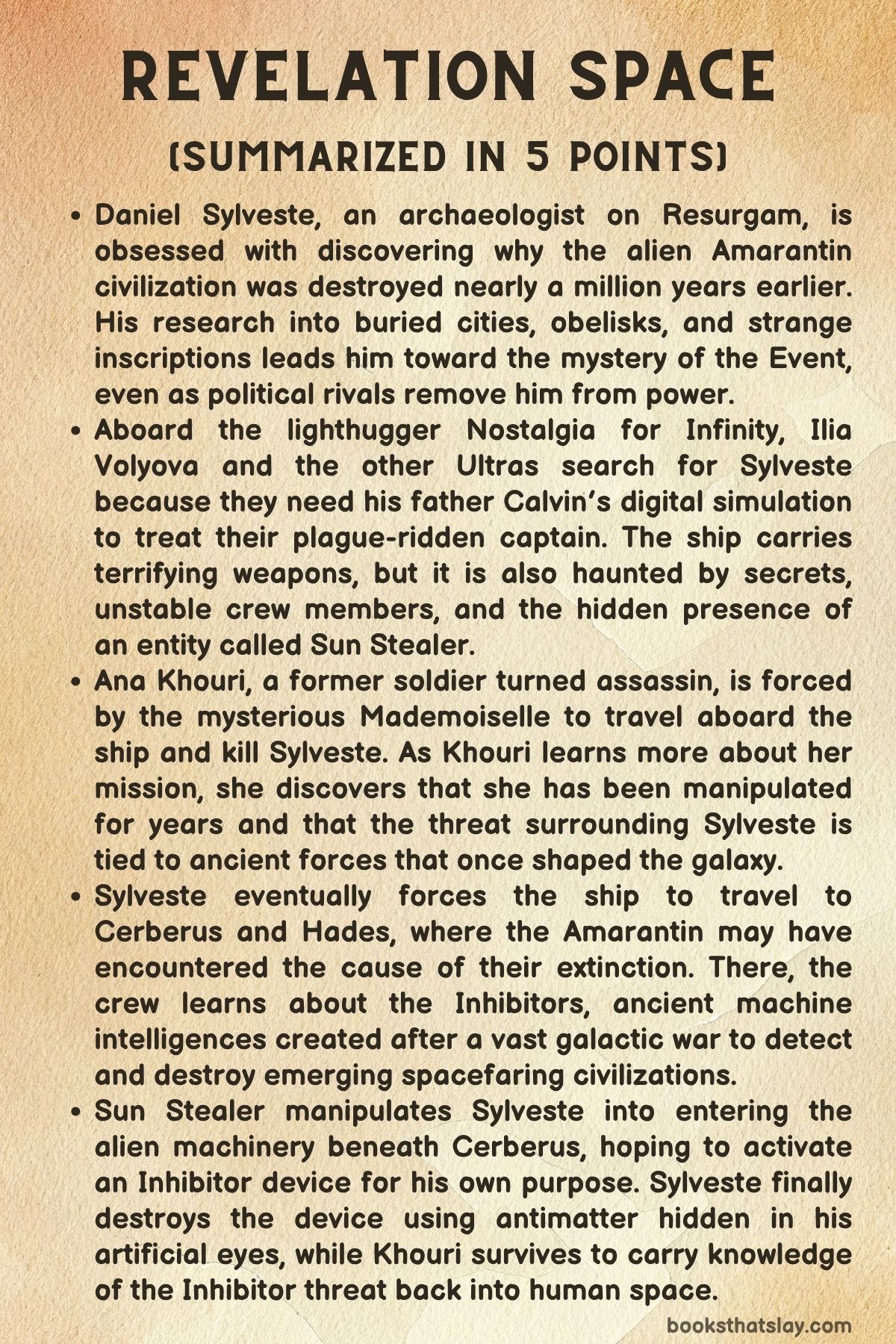
The story begins on Resurgam, a human colony where archaeologist Daniel Sylveste is leading a difficult excavation linked to the vanished Amarantin, an alien species that died out nearly a million years earlier. Sylveste believes their destruction was caused by something they did, and he is determined to understand the disaster he calls the Event.
His excavation team uncovers burial chambers, inscriptions, and an enormous obelisk that may hold clues to the Amarantin’s final days. Yet Sylveste’s authority is already weakening.
A political rival, Nils Girardieau, is preparing to overthrow him, and even members of the dig question his judgment when he refuses to halt work despite danger.
Far away, aboard the massive lighthugger Nostalgia for Infinity, Triumvir Ilia Volyova struggles with a different crisis. The ship is ancient, decaying, and ruled by a small group of Ultras, spacefarers changed by long voyages and repeated reefersleep.
Its captain, Brannigan, is trapped in cryogenic suspension while the Melding Plague consumes him, fusing flesh and machinery into a monstrous growth. Volyova is responsible for the ship’s arsenal of terrifying cache-weapons, devices powerful enough to destroy planets and stars.
She once trained a gunnery officer named Nagorny to operate them, but he became mentally unstable, speaking of a mysterious being called Sun Stealer before dying during a violent incident. Volyova removes the neural implants from his body and begins searching for a replacement.
On Yellowstone, Ana Khouri works as an assassin in Chasm City, killing wealthy clients who have arranged their own deaths. Khouri is a former soldier from Sky’s Edge, separated from her husband Fazil by a bureaucratic error that sent her into deep space while he remained behind.
Her anger and dislocation make her useful to a secretive woman known as the Mademoiselle, who coerces Khouri into accepting a mission: she must travel to Resurgam and kill Daniel Sylveste. The Mademoiselle has Fazil in reefersleep and uses him as leverage.
She also places a simulation of herself inside Khouri’s mind to monitor and guide her.
Years after Sylveste’s overthrow, he lives as Girardieau’s prisoner in Resurgam City. Girardieau wants to discredit him through a biography written by Pascale Dubois, who later turns out to be Girardieau’s daughter.
Sylveste cooperates because he wants access to new findings about the Amarantin. He learns that Girardieau has continued the research and uncovered a buried alien city sealed inside a vast sphere.
The city’s inscriptions describe the Amarantin’s ancient myths, especially the story of the Birdmaker, who gave them intelligence but forbade them from flying again. Yet the buried city contains references to the Banished Ones, a group that rejected this prohibition, and to their leader, whose name translates as Sun Stealer.
Meanwhile, Volyova recruits Khouri aboard the Nostalgia for Infinity, pretending that the ship will take her where she wants to go. In reality, the ship is bound for Resurgam because its crew needs Sylveste.
Decades earlier, the Ultras kidnapped him so that Calvin Sylveste, his father’s digital simulation, could use Daniel’s body to treat Captain Brannigan. Daniel himself is later revealed to be Calvin’s illegal clone, created without his knowledge.
The captain now needs another intervention, and the Ultras believe only Calvin, working through Daniel, can help.
On Resurgam, Sylveste and Pascale marry inside the buried Amarantin city, but the ceremony is attacked. Genetically altered peacocks release poisoned darts, armed conspirators enter, and Girardieau is killed.
Sylveste and Pascale escape but are captured by Gillian Sluka, a former colleague whom Sylveste believed dead. Sluka has become part of the True Path Inundationists, a violent faction fighting for control of Resurgam.
She holds Sylveste in Mantell while the colony collapses into political violence.
The Nostalgia for Infinity reaches Resurgam, and Volyova broadcasts a threat to the planet: Sylveste must surrender himself or settlements will be destroyed. When no one complies, she fires on Phoenix, a small outpost, proving that the ship’s threat is real.
Sylveste agrees to leave with Pascale, demanding that she accompany him. During the retrieval mission, Sudjic, another crew member, shoots Volyova in revenge for Nagorny’s death, but Khouri kills Sudjic before Sylveste is harmed.
Sylveste tries to destroy Calvin’s memory chip, but Sajaki reveals that another copy exists, hidden within Pascale’s biography. Calvin is restored, and Sylveste turns the situation around by claiming Sluka’s people implanted antimatter charges in his artificial eyes.
If he or Pascale is harmed, he says, the ship will be destroyed.
Sylveste forces the Ultras to travel to Cerberus and Hades, a mysterious pair near the edge of the Delta Pavonis system. He believes the Amarantin became obsessed with this region before the Event.
The crew discovers the wreck of the Lorean, a ship once stolen by Sylveste’s ex-wife Alicia. Its records show that Cerberus is not a normal planet.
Beneath its artificial crust lies enormous machinery, and something inside reacts violently to investigation. Sylveste insists on entering anyway, convinced that the truth lies within.
Khouri, Volyova, and Pascale begin to understand the greater danger. The Mademoiselle’s memories reveal a cosmic history: a billion years earlier, countless advanced civilizations fought in the Dawn War.
From that conflict emerged the Inhibitors, machine intelligences designed to prevent the rise of future starfaring species. They seed the galaxy with traps and surveillance systems, detecting intelligent life before it can become too powerful.
The Amarantin were destroyed because they attracted the attention of one such system. Sun Stealer, once an Amarantin leader of the Banished Ones, survived in some altered form and has been manipulating events ever since.
He entered Sylveste’s mind after Sylveste’s encounter with the Shrouders and later infiltrated the ship’s gunnery systems.
Volyova tries to prevent the attack on Cerberus, but Sun Stealer seizes control of the cache-weapons and fires them into the planet’s crust. A bridgehead is driven into the machinery beneath the surface.
Soon after, Sun Stealer spreads through the Nostalgia for Infinity, killing Sajaki and Hegazi and turning the ship’s systems against the survivors. Volyova, Khouri, and Pascale flee in a shuttle and the spider-room while Sylveste travels into Cerberus, believing Sajaki is with him.
He later discovers the second suit is empty; Sun Stealer has been guiding him through a remote suit all along.
Deep inside Cerberus, Sylveste reaches an immense chamber containing two extraordinary objects. One is a white opening connected to Hades, which is not truly a neutron star but a vast computational structure using extreme physics to store and process information.
The other is a jewel-like Inhibitor device designed to test and study organic intelligence before triggering extinction. Sun Stealer forces Sylveste toward the device, using him to solve its puzzles and activate it.
Inside the white light, Sylveste understands the truth of his origin and accepts that he is Calvin’s clone. He then detonates the antimatter charges in his artificial eyes, destroying himself and the Inhibitor machine before it can fully awaken.
Khouri and Pascale appear to die as the spider-room falls toward Hades, but they are recorded and reconstructed by the Hades matrix. Khouri wakes on the surface and meets Pascale, who has become partly integrated into the system.
Sylveste also exists there now, physically dead but preserved within the matrix, where he and Pascale intend to study a simulation of the Amarantin. Khouri chooses to return to the outside world.
She contacts Volyova, who has survived, and learns that the captain’s plague has transformed the Nostalgia for Infinity enough to break Sun Stealer’s control. The novel ends with Khouri leaving Hades, carrying knowledge of the Inhibitors and the uncertain hope that the immediate threat has been stopped.
Characters
Daniel Sylveste
Within Revelation Space, Daniel Sylveste is defined by intellectual hunger, arrogance, and a near-religious devotion to discovery. He is not merely curious about the Amarantin; he is obsessed with proving that their extinction holds a warning for humanity.
This obsession gives him courage, but it also makes him dangerous. He disregards storms, political instability, personal relationships, and even planetary safety when they interfere with his pursuit of knowledge.
Sylveste’s brilliance is never in doubt. He can read patterns that others miss, connect ancient inscriptions to astronomical anomalies, and maintain his nerve in situations where most people would surrender.
Yet the same qualities make him morally troubling. He treats people as instruments, withholds information, and repeatedly assumes that the pursuit of truth justifies almost any risk.
His connection to Calvin adds another layer to his character. Learning that he is his father’s clone forces him to reconsider his identity, but he does not collapse under the revelation.
His final act is both self-destructive and redemptive: after being used by Sun Stealer, he destroys the Inhibitor device from within. Sylveste remains difficult to admire without reservation, but he is central to the book’s moral tension because his flaws and strengths come from the same source.
Pascale Dubois Girardieau
Pascale begins as a journalist and biographer, someone whose role appears to be observation rather than action, but she becomes one of the book’s most important emotional and intellectual presences. Her relationship with Sylveste is built on curiosity, suspicion, and gradual trust.
At first, she is tied to Girardieau’s political project, writing a biography that may be used to expose and damage Sylveste. Yet she is never a simple agent of her father’s agenda.
She has her own intelligence and her own need to understand the truth. Her decision to hide Calvin’s copy inside the biography shows both technical ingenuity and emotional complexity; she preserves a dangerous consciousness because she understands its importance, even when doing so may place her at risk.
As Sylveste’s wife, she is not reduced to loyalty. She challenges his choices, warns him against entering Cerberus, and sees clearly that his curiosity may repeat the Amarantin’s fatal mistake.
Pascale’s final transformation within Hades gives her a strange form of survival. She becomes partly joined to the matrix, choosing knowledge and continuity over ordinary human life.
Her character balances love with judgment, making her one of the few people who can confront Sylveste without being overwhelmed by him.
Ilia Volyova
In Revelation Space, Ilia Volyova is one of the strongest examples of competence joined to moral compromise. She is practical, severe, and often ruthless, shaped by life aboard a decaying ship where hesitation can be fatal.
Her control of the cache-weapons gives her enormous destructive power, and she has an engineer’s fascination with them. This fascination is disturbing because it is not purely strategic; part of her wants to see what the weapons can do.
At the same time, Volyova is not careless. She understands consequences, plans for failure, builds safeguards, and repeatedly acts to limit disaster when others lose control.
Her treatment of Khouri is ethically troubling, especially the loyalty therapies and neural implants, yet her later bond with Khouri becomes one of the story’s most important alliances. Volyova’s suspicion of Sajaki, her eventual resistance to Sun Stealer, and her decision to abandon the ship show that she can change when reality demands it.
She survives because she is adaptable, unsentimental, and almost impossible to intimidate. Her character shows how survival in this universe often requires harshness, but also how harshness without responsibility becomes monstrous.
Ana Khouri
Ana Khouri is a soldier displaced by time, bureaucracy, and manipulation. Her life has been broken by forces larger than herself: war on Sky’s Edge, separation from Fazil, and the Mademoiselle’s long plan to use her as an assassin.
At first, Khouri appears to be a hired killer, but the book quickly shows that her violence has a history. She is angry, lonely, and detached because the world has treated her as expendable.
Her recruitment by the Mademoiselle deepens this loss of agency, turning her body and mind into tools for someone else’s mission. Yet Khouri’s character is marked by resistance.
Even with an implant in her head and altered memories inside her, she continues to question orders, judge the morality of what she is asked to do, and form her own loyalties. Her relationship with Volyova is especially important because it shifts from coercion to trust.
Khouri becomes a bridge between human-scale emotion and cosmic threat. Through her, the reader learns about the Inhibitors, but she never becomes only a vessel for exposition.
Her choices matter because she refuses to accept that being used means she has no responsibility.
Calvin Sylveste
Calvin Sylveste exists as memory, simulation, father, creator, and manipulator. His presence raises difficult questions about consciousness and personhood.
The beta-level version of Calvin is not originally presented as fully conscious, but the hidden copy embedded in Pascale’s biography reaches a point where it claims a more complete selfhood. Calvin’s relationship with Daniel is tense because it is both paternal and artificial.
He is Daniel’s father in a genetic and intellectual sense, but also the designer of Daniel’s existence. The revelation that Daniel is Calvin’s clone makes their relationship feel less like ordinary inheritance and more like an experiment that became a person.
Calvin is brilliant, sardonic, and useful, especially in matters of surgery and cybernetics, but he is also evasive. He knows more than he admits and often treats the boundaries between people, copies, and bodies as technical problems rather than moral ones.
Still, his final shared experience with Daniel inside Hades creates an unusual reconciliation. Daniel comes to understand what Calvin made him, and instead of hatred, there is a kind of acceptance.
Calvin’s character forces the book to ask whether a copied mind can carry guilt, love, ambition, and responsibility.
Sun Stealer
Across Revelation Space, Sun Stealer grows from a name in Amarantin inscriptions into one of the story’s central hidden forces. He was once an Amarantin associated with the Banished Ones, a faction that rejected the limits imposed by the Birdmaker myth and sought to reclaim flight, space, and forbidden knowledge.
In his later form, he is no longer simply an alien individual but a surviving intelligence capable of entering minds, machines, and weapons systems. His manipulation of Sylveste begins long before the main action, shaping Daniel’s interests and guiding him toward Resurgam, Cerberus, and Hades.
Sun Stealer is dangerous because he understands desire. He does not need to command Sylveste openly; he can use Sylveste’s existing ambition and curiosity as a path toward his own goal.
His hatred of or resistance to the Inhibitors may seem understandable, but he is willing to risk human extinction to pursue it. This makes him more than a villain.
He is a survivor of a destroyed species, a rebel against cosmic suppression, and a manipulator who treats newer civilizations as tools. His tragedy is real, but so is his cruelty.
The Mademoiselle / Carine Lefevre
The Mademoiselle is one of the book’s most secretive and morally ambiguous figures. She first appears as a powerful Hermetic who controls Khouri through threats, hidden technology, and possession of Fazil’s sleeping body.
Her treatment of Khouri is cruel, especially because she reshapes Khouri’s life in advance to make her useful. Yet the later revelation that she may be Carine Lefevre changes the reader’s understanding of her motives.
Lefevre’s connection to Sylveste’s disastrous Shrouder mission suggests that she, too, is a survivor of contact with forces beyond ordinary human comprehension. Her fear of Sylveste and Sun Stealer is not simple paranoia; she understands that his path may activate something catastrophic.
The Mademoiselle’s methods are indefensible, but her warnings are often correct. She is willing to sacrifice individuals, perhaps even settlements, to prevent a larger extinction-level disaster.
That makes her a troubling mirror of the people she opposes. Like Sylveste, she believes knowledge gives her the right to make decisions for others.
Like Sun Stealer, she uses hidden influence rather than open persuasion. Her character shows how fear of catastrophe can become its own form of violence.
Yuuji Sajaki
Yuuji Sajaki is a figure of authority whose calmness hides manipulation and decay. As a Triumvir of the Nostalgia for Infinity, he presents himself as disciplined, strategic, and committed to the captain’s survival.
Over time, it becomes clear that his loyalty is compromised. He may not truly want Brannigan cured because the captain’s illness gives the crew a permanent mission and keeps Sajaki’s authority intact.
The suggestion that Brannigan may have imprinted himself into Sajaki through the Pattern Jugglers makes Sajaki even more unsettling. He may be a man serving the captain, a partial copy of the captain, or a personality whose original self has already been overwritten.
His violence toward Volyova and his willingness to dominate the crew reveal his need for control. Yet Sajaki is not impulsive.
His danger comes from patience and calculation. He understands hierarchy and uses it effectively until the ship’s hidden powers exceed him.
His death inside the clinic, killed by machinery under Sun Stealer’s control, is fitting because he spends much of the novel treating people as instruments, only to become helpless inside a system that treats him the same way.
Captain Brannigan
Captain Brannigan is both a person and a setting, both ruler and ruin. His diseased body lies deep within the Nostalgia for Infinity, but his presence shapes nearly every decision the crew makes.
The Melding Plague has transformed him into a grotesque fusion of organic and mechanical growth, making him a living symbol of the book’s fear that technology and flesh may not remain separate. Brannigan’s authority survives even when his body cannot function normally.
The crew’s mission to heal him provides a reason for their actions, but it also traps them in a cycle of dependence. Volyova eventually suspects that Brannigan used the Pattern Jugglers to create a backup version of himself through Sajaki, suggesting a desperate and morally invasive hunger for survival.
His final transformation, when the plague spreads through the ship and helps displace Sun Stealer’s control, complicates his role. He is victim, manipulator, captain, disease carrier, and possible savior all at once.
Brannigan represents continuity taken to a frightening extreme, where survival may require abandoning the boundaries that once defined the self.
Nils Girardieau
Nils Girardieau begins as Sylveste’s political enemy, but the book does not treat him as a simple obstacle. He overthrows Sylveste and keeps him under pressure, using Pascale’s biography as a political instrument.
Yet Girardieau also continues research into the Amarantin, and his discoveries prove crucial. He understands that Sylveste is dangerous, but he also recognizes the value of Sylveste’s knowledge.
His conflict with Daniel is partly ideological and partly personal. Girardieau wants stability, legitimacy, and control over the colony, while Sylveste values discovery even when it threatens political order.
Through Pascale, Girardieau is also tied to the emotional center of the story. His death during the wedding attack marks the collapse of one political order and the rise of a more chaotic struggle on Resurgam.
Girardieau’s importance lies in showing that opposition to Sylveste is not always foolish. Many of his fears about Daniel are justified, even if his own methods are coercive.
He stands for the uneasy balance between scientific ambition and social survival.
Gillian Sluka
Gillian Sluka is introduced as a challenger to Sylveste’s authority at the dig site, warning him about danger, dissent, and Girardieau’s coup. Her apparent death in the crawler crash seems to remove her from the story, but her later return as part of the True Path shows how political violence reshapes survivors.
Sluka is practical, bitter, and hardened by years of hidden survival. She understands Sylveste’s weaknesses and refuses to treat him as a visionary beyond criticism.
At the same time, her faction’s use of antimatter weapons against Cuvier proves that she has become part of something morally extreme. Her decision to hand Sylveste over after Volyova destroys Phoenix shows that she is not irrational; she can recognize when the cost of resistance is too high.
Sluka’s character reflects the damaged politics of Resurgam. She begins as a voice of caution against Sylveste’s recklessness, but the world around her becomes so violent that caution itself is overtaken by militancy.
Abdul Hegazi
Abdul Hegazi is a supporting but significant member of the Triumvirate, marked by heavy augmentation and a loyalty to the ship’s existing power structure. He often appears beside Sajaki and Volyova, representing the older hierarchy aboard the Nostalgia for Infinity.
Unlike Volyova, he is less intellectually restless, and unlike Sajaki, he is less openly controlling. His role is quieter, but he still benefits from and upholds a system built on secrecy, coercion, and threat.
When Volyova suspects that he may have helped Sun Stealer regain access to communications, Khouri locks him away despite doubting his guilt. His death in the airlock, where ship-slime separates his organic and mechanical parts, is one of the book’s clearest images of technological horror.
Hegazi’s end also shows how quickly suspicion destroys trust aboard the ship. Even if he is not the central conspirator, he becomes a casualty of the paranoia created by Sun Stealer’s infiltration and by the crew’s long history of hidden crimes.
Sudjic
Sudjic is driven by grief, resentment, and a desire for revenge. Her bond with Nagorny gives her hostility toward Volyova a personal intensity.
She believes Volyova is responsible for Nagorny’s death, and this belief grows into betrayal during the retrieval mission on Resurgam. Sudjic’s chimeric identity and Ultra background make her part of the ship’s strange culture, but her emotional motives are direct and human.
She is not trying to solve the Amarantin mystery or understand the Inhibitors; she wants justice for someone she loved. That narrowness makes her dangerous because she acts at a moment when the larger situation is already unstable.
By shooting Volyova, she nearly destroys the fragile mission and forces Khouri into lethal action. Sudjic’s death is sudden, but it matters because it shows how old wounds aboard the Nostalgia for Infinity can erupt at the worst possible time.
She represents the personal costs hidden beneath the crew’s cold discipline.
Themes
Curiosity and Its Costs
Curiosity in Revelation Space is never treated as harmless. The desire to know drives archaeology, exploration, scientific reconstruction, and contact with alien systems, but it also leads characters toward decisions that endanger entire worlds.
Sylveste’s obsession with the Amarantin begins as scholarship, yet it becomes a force that overrides ordinary moral limits. He wants to know what destroyed them so humanity can avoid the same fate, but his need for proof makes him repeat the pattern he is trying to understand.
The Amarantin themselves seem to have been destroyed not because they were evil, but because they reached beyond the safe limits imposed by a hostile galaxy. Their movement toward space, their interest in Hades, and the actions of the Banished Ones all suggest that discovery can attract predators.
The theme is powerful because the book does not condemn curiosity outright. Without it, the truth about the Inhibitors would remain hidden.
Yet knowledge has a price, and the story asks whether intelligence naturally moves toward danger because it cannot stop asking questions.
Identity, Copies, and the Survival of the Self
Personal identity becomes unstable whenever minds can be copied, simulated, edited, transferred, or reconstructed. Calvin exists as a digital remnant, but he still speaks, reasons, remembers, and influences the living.
Daniel is Calvin’s clone, which complicates the difference between inheritance and design. Brannigan may have extended himself into Sajaki, turning survival into an act of replacement.
Pascale and Khouri die near Hades, yet they are rebuilt from preserved information, raising the question of whether continuity depends on matter, memory, pattern, or experience. The book repeatedly refuses easy answers.
A copied mind may be useful, but usefulness is not the same as personhood. A reconstructed body may behave like the original, but the fear remains that something has been lost in the transfer.
At the same time, the story suggests that identity has always been more fragile than people admit. Bodies change, memories fail, machines alter perception, and hidden influences shape desire.
The self is not a fixed object here; it is a pattern under pressure.
Power, Control, and Moral Compromise
Power in the story usually appears through control over bodies, ships, weapons, memories, or information. Volyova controls the cache-weapons and uses planetary destruction as a bargaining tool.
The Mademoiselle controls Khouri through implants, deception, and possession of Fazil. Sajaki controls the crew through hierarchy and secrecy.
Sylveste controls others by withholding knowledge and forcing them to follow his search for answers. Even political control on Resurgam shifts through coups, factions, and terror weapons.
The book’s world is not one where clean choices are easily available. Characters often justify coercion by appealing to necessity.
Volyova threatens settlements to save the captain. The Mademoiselle sacrifices Khouri’s freedom to prevent a larger catastrophe.
Sluka’s faction uses antimatter weapons in the name of political change. These compromises are not presented as noble simply because the stakes are high.
Instead, the story shows how easily emergency logic becomes a habit. Once people decide that survival or truth permits anything, they begin to resemble the forces they fear.
Extinction, Silence, and Cosmic Fear
The galaxy’s emptiness is one of the book’s deepest sources of fear. The absence of abundant intelligent life is not a peaceful mystery but evidence of repeated destruction.
The Dawn War explains that the galaxy once held many starfaring civilizations, and the Inhibitors explain why so few remain. Extinction is not random; it is organized, automated, and ancient.
This gives the Amarantin tragedy a terrifying scale. Their death is not just an archaeological puzzle but a local example of a galactic process.
The Inhibitors do not hate in a human sense. Their horror lies in their function.
They detect intelligence, study it, and remove it before it can become a threat. Against such an enemy, ordinary heroism seems small.
Yet the book also finds tension in that smallness. Sylveste’s final act may not end the Inhibitor threat, but it disrupts one mechanism.
Khouri’s survival means the warning can travel outward. Cosmic fear remains, but silence is no longer complete.
Someone has seen the pattern and returned with knowledge.