A Girl Like Her Summary, Characters and Themes
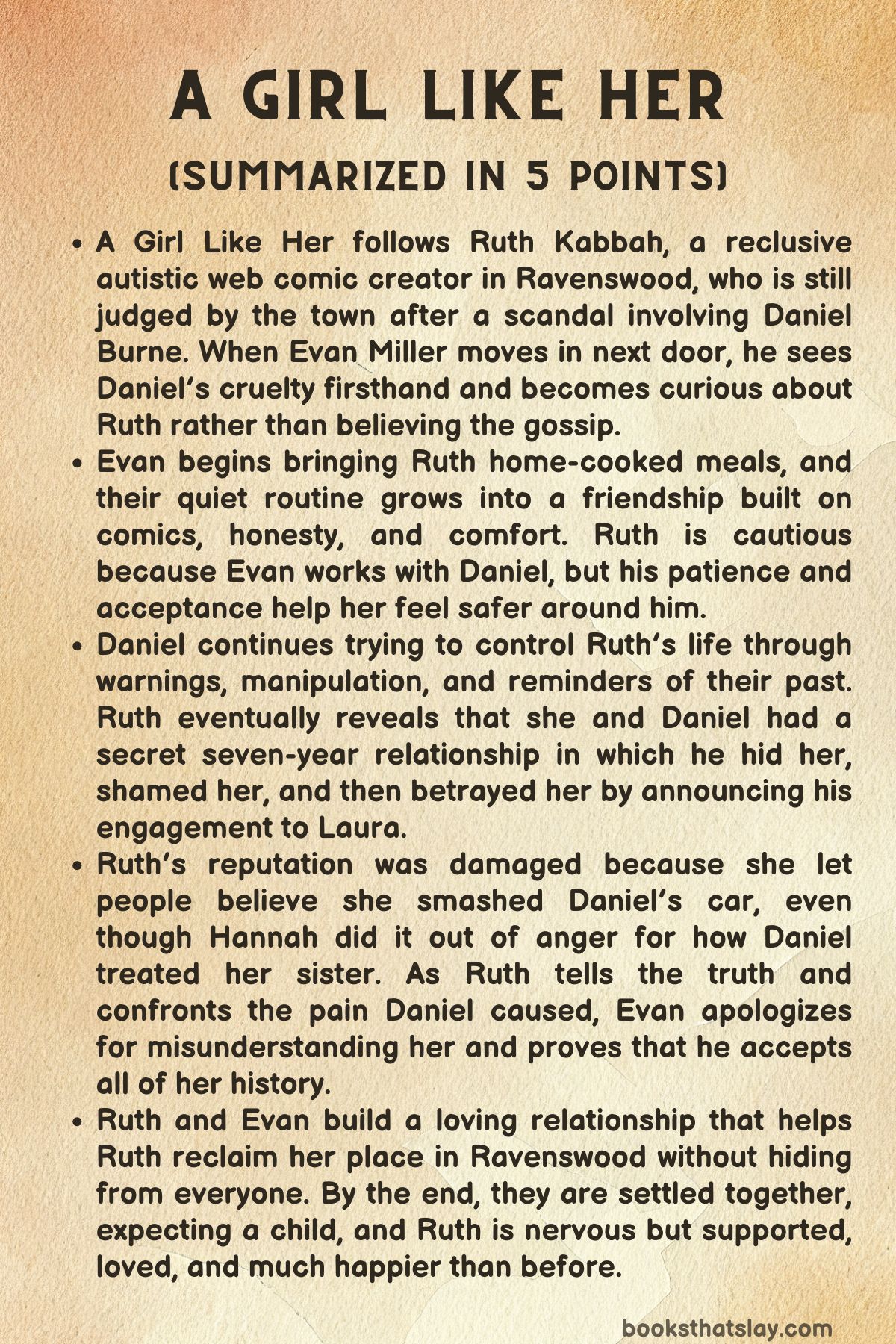
A Girl Like Her by Talia Hibbert is a contemporary romance about Ruth Kabbah, a guarded web comic creator who has been judged and isolated by her small town after a public scandal. When Evan Miller, a former soldier and blacksmith, moves in next door, his steady kindness begins to unsettle the walls Ruth has built around herself.
The novel explores trust, shame, gossip, emotional abuse, neurodivergence, and the slow work of being seen clearly by another person. At its center, the book is about a woman reclaiming her story after years of being misunderstood.
Summary
A Girl Like Her opens with a public celebration that hides a private cruelty. Daniel Burne, wealthy, polished, and admired in the town of Ravenswood, announces his engagement to Laura at a party.
To everyone else, the moment looks like the beginning of a respectable future. Beneath the surface, Daniel is tense because he knows Ruth Kabbah might appear.
When Ruth does arrive, she does not walk into the party or make a speech. Instead, she climbs onto Daniel’s Porsche and smashes it with a cricket bat.
The act shocks the people watching, but it also hints at a history Daniel would rather keep buried.
Nearly two years later, Ruth lives alone in a flat and keeps mostly to herself. She works on her web comic, orders takeout, avoids unnecessary social contact, and remains the subject of town gossip.
Ravenswood remembers her as the woman who caused trouble, damaged Daniel’s car, and supposedly ruined other people’s lives. Ruth has allowed much of that story to stand because explaining the truth would require more energy than she has, and because the town has never seemed interested in seeing her fairly.
Evan Miller enters her life when he moves into the flat next door. A former soldier, Evan has taken a job as a blacksmith at Burne & Co., the business connected to Daniel’s family.
His first meeting with Ruth happens in the car park, where she runs into him and Daniel. Daniel speaks to Ruth with open contempt, and Evan notices immediately.
He does not know the full history, but he can tell Daniel is being cruel. That first impression shapes how Evan views the situation, even before he understands Ruth’s side.
Soon, Evan realizes Ruth is his neighbour. He wants to be friendly, and his way of reaching out is practical: he brings her food.
First shepherd’s pie, then lasagne, and eventually a routine forms between them. Evan cooks for Ruth, and Ruth lends him comics.
Their arrangement begins almost casually, but it gives them both a reason to spend time together. Ruth is cautious.
She knows Evan works with Daniel, and she is used to people judging her before they know her. Evan, however, is calm, patient, and direct.
He does not force closeness or demand explanations. He simply shows up, listens, and treats her with care.
Their friendship grows through ordinary evenings. They talk about comics, Ruth’s work, Evan’s time in the army, and the ways their lives have shaped them.
Ruth tells Evan she is autistic, and his reaction matters because he accepts it without treating it as a problem to solve. He listens to what she says about herself and adjusts without making her feel like a burden.
For Ruth, who has often been mocked, dismissed, or misunderstood, this kind of acceptance is unfamiliar. It makes her want to trust him, even while part of her expects disappointment.
As Ruth and Evan grow closer, Daniel continues trying to control the story around her. He warns Evan that Ruth destroys relationships.
He sends Ruth flowers with manipulative notes. His actions suggest that he still believes he has some claim over her attention and emotions, even though their relationship ended long ago.
Evan hears the town’s version of Ruth’s past: that she smashed Daniel’s car, slept around, and caused damage between Daniel and Laura. Yet the more time Evan spends with Ruth, the less those stories fit the woman he knows.
Ruth’s sister Hannah is fiercely protective and does not trust Evan right away. From Hannah’s point of view, Ruth has already been hurt badly by a man connected to the Burne family, and Evan’s job at Burne & Co.
makes him suspicious by association. Ruth’s friend Marjaana offers a different kind of support, encouraging Ruth to be honest about what she wants and to stop pretending she feels nothing for Evan.
Between Hannah’s caution and Marjaana’s encouragement, Ruth is forced to face the truth that Evan is no longer just a friendly neighbour. She wants him, and that frightens her.
The attraction between Ruth and Evan eventually turns physical, but intimacy is not simple for Ruth. During their first physical encounter, things become too intense and she panics.
Evan does not shame her for it, but the moment leaves Ruth unsettled. She wants closeness, but wanting it means risking exposure.
It means allowing someone to see parts of her she has learned to hide.
The main conflict between them comes when Evan tries to reassure Ruth by saying he knows about Daniel. He intends to show that Daniel’s opinion has not changed how he sees her, but Ruth hears something else.
To her, it feels as if Evan has accepted a version of events without hearing the truth from her. She feels exposed, judged, and misunderstood.
This creates a painful distance between them because Ruth has spent years trapped inside other people’s stories about her, and Evan has accidentally touched that wound.
Eventually, Ruth tells him what really happened. She and Daniel had been in a secret relationship for seven years.
It began when Ruth saw Daniel being wounded by his father’s contempt and felt sorry for him. What started as pity and connection became a long relationship defined by secrecy and shame.
Daniel kept Ruth hidden from the world. He bought her expensive gifts, but also made her feel embarrassed about her clothes, her interests, and herself.
He treated her as someone to enjoy in private but not respect in public.
Then Daniel spent the night with Ruth and casually revealed that he was getting engaged to Laura. The cruelty of that moment broke something open.
The famous car-smashing incident was not Ruth’s act at all. Hannah, furious on Ruth’s behalf, was the one who destroyed Daniel’s Porsche.
Daniel involved the police, and the consequences damaged Hannah’s future. Ruth let everyone blame her because she was exhausted, guilty, and tired of defending herself to people who had already decided what kind of woman she was.
This truth changes the shape of everything. Evan understands that Ruth was not the reckless villain Ravenswood imagined.
She was someone who had been used, hidden, and humiliated by a man who cared more about his image than her pain. Ruth also confronts Daniel’s father, Mr. Burne.
Through that confrontation, Mr. Burne begins to see something of Daniel’s behaviour more clearly. Afterward, Daniel’s hold over Ruth weakens, and she is able to move forward with less fear of his interference.
Ruth and Evan reconcile by speaking honestly. They apologize, acknowledge the ways they hurt each other, and choose to begin again with more trust.
Evan tells Ruth he loves her, but Ruth does not accept that easily. She has been taught, through years of Daniel’s treatment and the town’s judgment, to doubt her own worth.
Evan’s love is steady, but the more important change is Ruth slowly allowing herself to believe she deserves it.
As their relationship becomes real, Ruth starts reclaiming her place in Ravenswood. She reconnects with people at the library and applies to volunteer again.
She goes out with Evan, Hannah, and Zach rather than hiding in her flat. These steps may look small from the outside, but for Ruth they matter.
Each one is a refusal to let shame decide the size of her life.
Ruth also tells Evan more about what happened after Daniel. Daniel’s lies cost her friendships with Hayley and Maria, and after the relationship ended, Ruth slept with other men partly because she was trying to undo the damage he left behind.
She wanted to feel free of his control and free of the shame he had planted in her. Evan does not punish her for the truth.
He accepts her history as part of her, not as evidence against her.
At Easter, Ruth brings Evan to meet her mother, Patience. The meeting shows that Evan is no longer only Ruth’s neighbour or secret comfort; he is becoming part of her family.
Patience welcomes him, and Ruth begins to feel the possibility of a future that is not ruled by Daniel or by Ravenswood’s gossip. Around the same time, Ruth receives a cautious text from Maria, suggesting that some old friendships may slowly begin to heal.
The message does not fix everything, but it offers hope that Ruth’s world can widen again.
The story closes five years later with Ruth and Evan still together, settled as a family and expecting a child. Ruth is nervous about becoming a mother, afraid of the changes and responsibilities ahead.
Evan reassures her with the same steady affection that first made him different from everyone else. Their relationship remains warm, teasing, and secure.
Ruth has not become a different person in order to be loved. Instead, she has found someone who sees her clearly, respects her fully, and helps her believe in the life she has built for herself.
Characters
Ruth Kabbah
Ruth Kabbah is the emotional center of A Girl Like Her, and her character is shaped by pain, isolation, intelligence, and gradual self-recovery. At the beginning of the book, Ruth is treated by Ravenswood as a scandal rather than as a person.
The town has reduced her to gossip, judging her for Daniel Burne’s damaged car, for her past relationships, and for the lies Daniel allowed people to believe. Ruth’s loneliness is not simply social awkwardness; it is the result of years of emotional harm, public shame, and being misunderstood by people who never cared enough to ask for the truth.
Her life in her flat, her work on her web comic, and her avoidance of most people show how she has built a protective world around herself.
Ruth’s autism is an important part of her character, but the book does not present it as her only defining feature. She is direct, observant, creative, guarded, and deeply sensitive, even when she appears blunt or detached to others.
Her love of comics and her work as a creator reveal her imagination and discipline, while her difficulty trusting people shows how badly Daniel’s manipulation damaged her sense of safety. Ruth often expects rejection because she has been taught to believe that her interests, clothes, needs, and personality make her difficult to love.
This makes her relationship with Evan especially meaningful, because he does not treat her as a problem to be fixed.
Ruth’s past with Daniel explains much of her emotional conflict. She spent seven years in a secret relationship with him, believing there was intimacy and loyalty between them, only to discover that he had been hiding her while preparing to marry Laura.
Daniel’s treatment made Ruth feel ashamed of herself, and his betrayal left her publicly blamed for a situation in which she was actually the injured person. Her decision to let the town blame her for smashing the car shows both exhaustion and guilt, especially because Hannah was the one who acted in rage on her behalf.
Ruth’s silence is not weakness; it is the response of someone who has been overwhelmed by humiliation and by the cost of telling the truth.
Ruth’s development lies in her slow movement from hiding to reclaiming her life. Through Evan’s patience and her own courage, she begins to speak honestly about what happened, reconnect with the community, consider volunteering again, and face people without letting their judgment define her.
Her romance with Evan matters because it helps her believe that she deserves tenderness, desire, respect, and permanence. By the end of the story, Ruth is not magically free from fear, but she has gained a stronger sense of her own worth.
Her nervousness about motherhood in the future shows that she remains human and vulnerable, while Evan’s support and her happiness show how far she has come.
Evan Miller
Evan Miller is one of the most compassionate and steady figures in the book, and his role is built around patience, respect, and emotional safety. As a former soldier and a newcomer to Ravenswood, Evan enters the story without sharing the town’s prejudice against Ruth.
This outsider position is important because it allows him to see Ruth more clearly than the people who have already decided who she is. His first impression of Daniel is negative because he immediately notices Daniel’s cruelty, and this instinctive dislike shows Evan’s moral clarity.
He is not easily persuaded by gossip when someone’s behavior in front of him tells a different story.
Evan’s kindness is practical rather than dramatic. He brings Ruth food, makes a simple bargain involving meals and comics, and gives her space to respond in her own way.
His cooking becomes a form of care, but he does not use it to control her or force closeness. He is genuinely interested in her comics, her work, her thoughts, and her boundaries.
This makes him very different from Daniel, who treated Ruth’s interests as embarrassing and tried to shape her into someone more acceptable to him. Evan’s affection is grounded in attention, and he earns Ruth’s trust by repeatedly showing that he listens.
Evan is not perfect, and that makes his character more realistic. His attempt to reassure Ruth by mentioning what he knows about Daniel hurts her because it makes her feel exposed and misunderstood.
This mistake shows that even a loving person can mishandle another person’s trauma if he assumes too much. However, Evan’s strength lies in his willingness to apologize, learn, and do better.
He does not respond to Ruth’s pain with defensiveness. Instead, he works toward honest communication, which allows their relationship to become healthier and more equal.
Evan’s love for Ruth is important because it is not based on rescuing her. He supports her, but he also respects her autonomy and allows her to decide when and how to reveal the truth.
His acceptance of her autism, her past, her anger, and her fears creates a relationship in which Ruth can begin to feel safe without having to hide parts of herself. In the future, his reassurance about motherhood shows that his steadiness remains central to their life together.
Evan represents a form of love that is patient, attentive, protective without being possessive, and strong enough to help Ruth believe in happiness again.
Daniel Burne
Daniel Burne is the main source of emotional damage in Ruth’s past and one of the most morally troubling characters in the story. On the surface, Daniel appears successful, wealthy, and socially acceptable, especially because he is connected to Burne & Co.
and moves within the respectable circles of Ravenswood. However, his public image hides a deeply manipulative and cowardly nature.
His engagement announcement to Laura while fearing Ruth’s arrival immediately reveals his double life. He wants the benefits of respectability while avoiding responsibility for the pain he has caused.
Daniel’s secret seven-year relationship with Ruth shows his selfishness and emotional control. He kept Ruth hidden, gave her expensive things, and made her feel ashamed of her appearance, interests, and personality.
His actions suggest that he wanted Ruth’s affection and loyalty without giving her public respect or emotional security. By making Ruth feel inferior, he maintained power over her.
His cruelty becomes even clearer when he casually reveals his engagement after spending the night with her, treating her devotion as something disposable. This is one of the clearest signs that Daniel values his convenience more than Ruth’s humanity.
Daniel’s behavior after the relationship ends shows that he still wants control. He warns Evan about Ruth, sends manipulative flowers, and allows the town to believe damaging lies about her.
He understands the power of reputation in Ravenswood and uses it to protect himself. His claim that Ruth destroys relationships is especially hypocritical because he is the one who betrayed both Ruth and Laura.
Daniel’s manipulation depends on making Ruth appear unstable, immoral, or dangerous so that no one will examine his own actions too closely.
Yet Daniel is not written as a simple villain without context. Ruth’s confrontation with Mr. Burne reveals that Daniel has also been shaped by his father’s contempt.
This does not excuse his abuse of Ruth, but it helps explain the insecurity and emotional weakness beneath his arrogance. Daniel is a man who has been hurt and then chooses to hurt someone more vulnerable.
His tragedy is that he understands humiliation but still inflicts it. In the book, he functions as a warning about how pain, privilege, and cowardice can combine to make a person destructive.
Hannah Kabbah
Hannah Kabbah is Ruth’s fiercely protective sister, and her character is driven by loyalty, anger, and love. Hannah’s most dramatic act is smashing Daniel’s car, but that action comes from her outrage at the way Daniel treated Ruth.
Unlike the town, Hannah knows Ruth as a person rather than as a rumor. She sees the damage Daniel caused and reacts with a fury that Ruth herself is too exhausted to express.
Her action is reckless, but it is also an expression of sisterly devotion.
Hannah’s protectiveness continues when Evan enters Ruth’s life. She is suspicious of him because she has seen how badly Ruth can be hurt by a man who seems trustworthy.
Her caution is not unfair; it comes from experience. Hannah understands that Ruth’s isolation and pain did not happen by accident, and she does not want Ruth to become vulnerable to another person who might misuse her trust.
This makes Hannah an important emotional shield around Ruth, even when her protectiveness may feel intense.
The consequences Hannah faces after the car incident also add complexity to her character. Daniel involving the police damages her future, which means Hannah pays a high price for defending Ruth.
Ruth’s guilt over this helps explain why she allows the town to blame her instead. The sisters’ bond is therefore marked by both love and sacrifice.
Hannah’s anger protects Ruth, while Ruth’s silence protects Hannah in return. Their relationship shows how family loyalty can be messy, costly, and deeply powerful.
Laura
Laura is important because her engagement to Daniel exposes the cruelty and dishonesty at the center of his life. She represents the respectable future Daniel wants to claim while hiding the woman he has been secretly involved with for years.
Although Laura is not developed as deeply as Ruth or Evan, her presence matters because she is also deceived by Daniel. His relationship with her is built on the same selfishness that defines his treatment of Ruth, even if Laura experiences that betrayal differently.
Laura’s role also reveals how Daniel uses women to support his public image. Ruth is hidden because Daniel is ashamed of being seen with her, while Laura is displayed because she fits the life he wants others to admire.
This contrast is not really about the women themselves; it is about Daniel’s desire for control, status, and approval. Laura becomes part of the social performance that allows Daniel to look respectable while behaving dishonestly in private.
In the larger story, Laura helps show why Ruth’s pain is so intense. Daniel does not simply end the relationship; he replaces Ruth publicly while acting as though Ruth’s years of loyalty meant nothing.
Laura’s engagement announcement is therefore not just a romantic betrayal but a public erasure of Ruth’s place in Daniel’s life. Through Laura, the story shows how lies can harm multiple people, even when one person is positioned as the socially acceptable choice.
Mr. Burne
Mr. Burne is a significant background force in the story because his contempt helps explain part of Daniel’s emotional damage. He appears as a harsh and powerful father figure whose treatment of Daniel has shaped Daniel’s insecurity.
When Ruth confronts him, the story reveals that Daniel’s cruelty did not emerge from nowhere. Mr. Burne’s coldness and judgment created wounds in Daniel that later influenced how Daniel treated others.
However, Mr. Burne’s role does not remove Daniel’s responsibility. Instead, it adds a generational dimension to the book’s exploration of harm.
Mr. Burne’s contempt damaged Daniel, but Daniel chose to pass that damage on to Ruth through secrecy, shame, and manipulation. This makes Mr. Burne important because he shows how emotional cruelty can move through families and social systems if no one stops it.
He represents the older authority behind Daniel’s insecurity and arrogance.
Mr. Burne also becomes a turning point for Ruth. When she confronts him, she forces someone connected to Daniel’s power to see part of the truth.
His eventual decision to leave her alone suggests that Ruth’s honesty has an effect, even on someone difficult. This moment helps Ruth regain some control over the narrative that has trapped her.
Mr. Burne’s character therefore matters not only because of his influence on Daniel, but also because Ruth’s confrontation with him becomes part of her recovery.
Patience Kabbah
Patience Kabbah, Ruth’s mother, represents family acceptance and emotional belonging. Her appearance later in the story is important because Ruth introducing Evan to her marks a serious step in Ruth and Evan’s relationship.
After years of secrecy with Daniel, Ruth is finally connected to someone who can enter her family life openly. This contrast is powerful because Daniel kept Ruth hidden, while Evan is welcomed into the family.
Patience’s warmth helps confirm that Evan is not simply a private comfort for Ruth but part of a healthier future. Her acceptance shows that Ruth’s relationship with Evan exists in the light, among people who care about her.
This matters because Ruth’s past relationship made her feel shame, while her family’s welcome helps reinforce that love should not require hiding. Patience’s role may be smaller than Ruth’s or Hannah’s, but it supports the book’s movement from secrecy toward openness.
Patience also helps show the importance of Ruth’s roots. Ruth has been rejected by much of Ravenswood, but she is not completely without love or connection.
Her family remains a source of identity and support, even if Ruth has often felt alone. Patience’s presence reminds readers that Ruth’s future is not built only through romance, but also through family acceptance and restored confidence.
Marjaana
Marjaana is Ruth’s friend and an important voice of encouragement. Her role is to push Ruth toward honesty about her feelings, especially regarding Evan.
Because Ruth is guarded and often unsure whether she is allowed to want love or intimacy, Marjaana’s encouragement matters. She helps Ruth recognize her own desires without shame.
In a story where Ruth has been made to feel wrong for wanting things, Marjaana supports her right to be honest with herself.
Marjaana also helps balance Ruth’s isolation. Even though Ruth avoids most people, Marjaana’s presence shows that Ruth is not incapable of friendship.
The problem is not that Ruth cannot connect with others; the problem is that the town has judged her unfairly and Daniel has made trust dangerous. Marjaana’s friendship gives Ruth a space where she can be more open, and that support helps her move toward emotional risk.
As a supporting character, Marjaana represents the value of friends who do not take over someone’s choices but still speak plainly. She does not force Ruth into a relationship with Evan, but she helps Ruth admit what she feels.
Her character adds warmth and realism to Ruth’s journey because healing rarely happens through romance alone. Friendship also gives Ruth strength.
Zach
Zach appears as part of the wider social circle that Ruth gradually begins to rejoin. His presence alongside Evan and Hannah helps show Ruth stepping outside the isolation that has defined much of her life.
When Ruth goes out with Evan, Hannah, and Zach, it signals that she is beginning to participate in life again rather than remaining hidden in her flat. Zach therefore contributes to the story’s theme of social re-entry.
Although Zach is not as central as Ruth, Evan, Daniel, or Hannah, his role still matters because he helps create a sense of ordinary companionship. For Ruth, ordinary social experiences are not simple; they require courage because Ravenswood has treated her with suspicion and judgment.
Zach’s inclusion in these moments helps show that Ruth’s world is expanding. She is not only building a romance with Evan but also learning to exist around others without letting shame control her.
Zach’s character also helps support Hannah’s place in the story. His connection to the group shows that Ruth’s healing involves more than one relationship.
By being part of Ruth’s renewed social life, he becomes a small but meaningful sign of normalcy, acceptance, and movement forward.
Hayley
Hayley is one of the friends Ruth lost because of Daniel’s lies, and her importance lies in what her absence reveals. Ruth’s relationship with Hayley was damaged not because Ruth was truly disloyal or destructive, but because Daniel controlled the story people heard.
Hayley represents the friendships that were broken by misinformation, judgment, and Daniel’s refusal to take responsibility. Through her, the book shows that Ruth’s suffering was not limited to romance; Daniel’s actions also damaged her social world.
Hayley’s role emphasizes how reputation can become a prison. Once the town accepted a false version of Ruth, people who might have cared about her became distant or hostile.
Ruth did not only lose Daniel; she lost trust, community, and friendships. Hayley therefore represents the emotional cost of public lies.
Her absence is a reminder that social harm can be just as painful as private betrayal.
Even though Hayley does not play a major active role in the events described, she remains important to Ruth’s backstory. She helps readers understand why Ruth is so guarded and why reconnecting with people is difficult.
Ruth’s pain comes not only from what Daniel did directly, but from the way his lies reshaped other people’s view of her.
Maria
Maria, like Hayley, represents the friendships Ruth lost after Daniel’s betrayal and the town’s judgment. However, Maria also becomes a sign of possible repair because she later sends Ruth a cautious text.
That message suggests that old connections may not be completely destroyed. Maria’s role therefore carries a small but meaningful sense of hope.
She represents the possibility that truth, time, and courage may allow Ruth to recover parts of her social life.
Maria’s caution is important because healing damaged relationships is rarely immediate. Her text does not erase what happened, and it does not instantly fix the pain Ruth experienced.
Instead, it opens a door. This fits the emotional realism of A Girl Like Her, where recovery happens gradually rather than through sudden transformation.
Maria’s attempt to reach out suggests that some people may begin to question the stories they believed about Ruth.
Through Maria, the book shows that Ruth’s future may include more than romantic happiness with Evan. It may also include restored friendships and a different relationship with the town that once judged her.
Maria’s character matters because she hints at social healing, not just personal healing. Her presence near the end helps show that Ruth is no longer entirely trapped by Daniel’s version of the past.
The People of Ravenswood
The people of Ravenswood function almost like a collective character because their judgment shapes Ruth’s life. They believe rumors, treat Ruth as a scandal, and allow Daniel’s version of events to define her.
Their behavior shows how a community can become cruel when gossip replaces empathy. Instead of asking what happened, they accept the easiest story, especially because Ruth does not defend herself publicly.
Ravenswood’s treatment of Ruth deepens her isolation. The town makes her feel watched, judged, and unwanted.
This social pressure explains why leaving her flat, returning to the library, and facing people again are such meaningful steps for her. Ruth is not simply overcoming private heartbreak; she is also confronting a community that has misunderstood and condemned her.
The town’s judgment becomes one of the forces she must survive.
At the same time, Ruth’s gradual return to public life suggests that Ravenswood is not unchangeable. Her decision to reconnect with people, volunteer, and stop hiding shows that she is reclaiming space in the very community that pushed her out.
The townspeople represent the harm caused by collective judgment, but Ruth’s growth shows that their opinion does not have the final authority over her identity.
Themes
Social Judgment and Reputation
In A Girl Like Her, Ruth’s life is shaped by a town that accepts gossip more easily than truth. Ravenswood treats her as a scandal without knowing the full story, and this public judgment forces her into isolation.
The damage is not only social but emotional, because Ruth becomes used to being misunderstood before she is even allowed to speak. Her reputation is built by Daniel’s lies, the town’s assumptions, and people’s willingness to punish a woman who does not behave in a way they consider acceptable.
Ruth’s silence also shows how exhausting it can be to defend oneself when the community has already chosen a version of events. Her gradual return to public life becomes important because it is not about winning everyone’s approval.
It is about refusing to let false stories decide where she belongs. The theme shows that reputation can become a prison when society values appearances over truth.
Emotional Abuse and Control
Daniel’s relationship with Ruth reveals how emotional abuse can work quietly through shame, secrecy, and manipulation. He keeps Ruth hidden while taking from her affection, loyalty, and sympathy.
His gifts and attention are not signs of love because they come with control; he makes her feel embarrassed about her clothes, interests, and personality. By treating her as someone who must be concealed, he teaches her to doubt her own worth.
His later attempts to send flowers, warn Evan, and control the narrative show that abuse does not always end when the relationship ends. Daniel wants Ruth to remain trapped in the role he created for her: unstable, dangerous, and undeserving of trust.
Ruth’s healing begins when she names what happened and allows someone to know the whole truth. This theme is powerful because it shows that control can survive through memory, fear, and public lies, but honesty helps weaken its hold.
Love, Patience, and Acceptance
Evan’s relationship with Ruth develops through patience rather than pressure. He does not try to force her into quick trust, dramatic confession, or easy emotional openness.
Instead, he shows care through steady actions: cooking for her, listening to her, respecting her boundaries, and accepting her autism without making it strange or burdensome. This kind of love matters because Ruth has been taught that affection comes with shame and conditions.
Evan offers something different: interest without judgment and closeness without control. Their relationship is not perfect, since misunderstandings still happen, especially when Evan thinks he understands more than he does.
However, their ability to apologize and speak honestly makes their bond stronger. Love here is not presented as a cure for trauma, but as a safe relationship in which healing becomes possible.
Ruth learns to believe that being known fully does not have to mean being rejected.
Reclaiming Identity and Self-Worth
Ruth’s journey is centered on reclaiming the parts of herself that Daniel and the town tried to diminish. Her comics, routines, sharp honesty, sexuality, and independence are all parts of her identity that others misunderstand or judge.
After Daniel, she carries guilt, anger, and shame, partly because she has been blamed for damage she did not cause and partly because she has tried to recover in ways others would also judge. Her growth comes from refusing to disappear.
She reconnects with the library, faces people in town, rebuilds old friendships, and lets her family and Evan see her vulnerability. This process is not sudden confidence but a slow return to herself.
Ruth’s self-worth grows when she stops measuring herself through Daniel’s treatment or Ravenswood’s gossip. The theme shows that healing often means taking back ordinary spaces, ordinary choices, and the right to exist without apology.