Cinder Vale Summary, Characters and Themes
Cinder Vale by Caroline Peckham and Susanne Valenti is a dark romantasy novel set in a war-torn world divided by rival kingdoms, ancient magic, royal ambition, and dangerous bonds. The story follows warriors, heirs, prisoners, rebels, and monsters as they struggle against the roles forced upon them.
Kaiser Brimtheon, Everest Arcadia, Vesper, Bastian, Ransom, and Septa each face choices that test loyalty, love, vengeance, and power. At its core, Cinder Vale is about people who have been shaped into weapons deciding whether they can become something more before a greater evil destroys them all. It’s the 3rd book of the Sins of the Zodiac series.
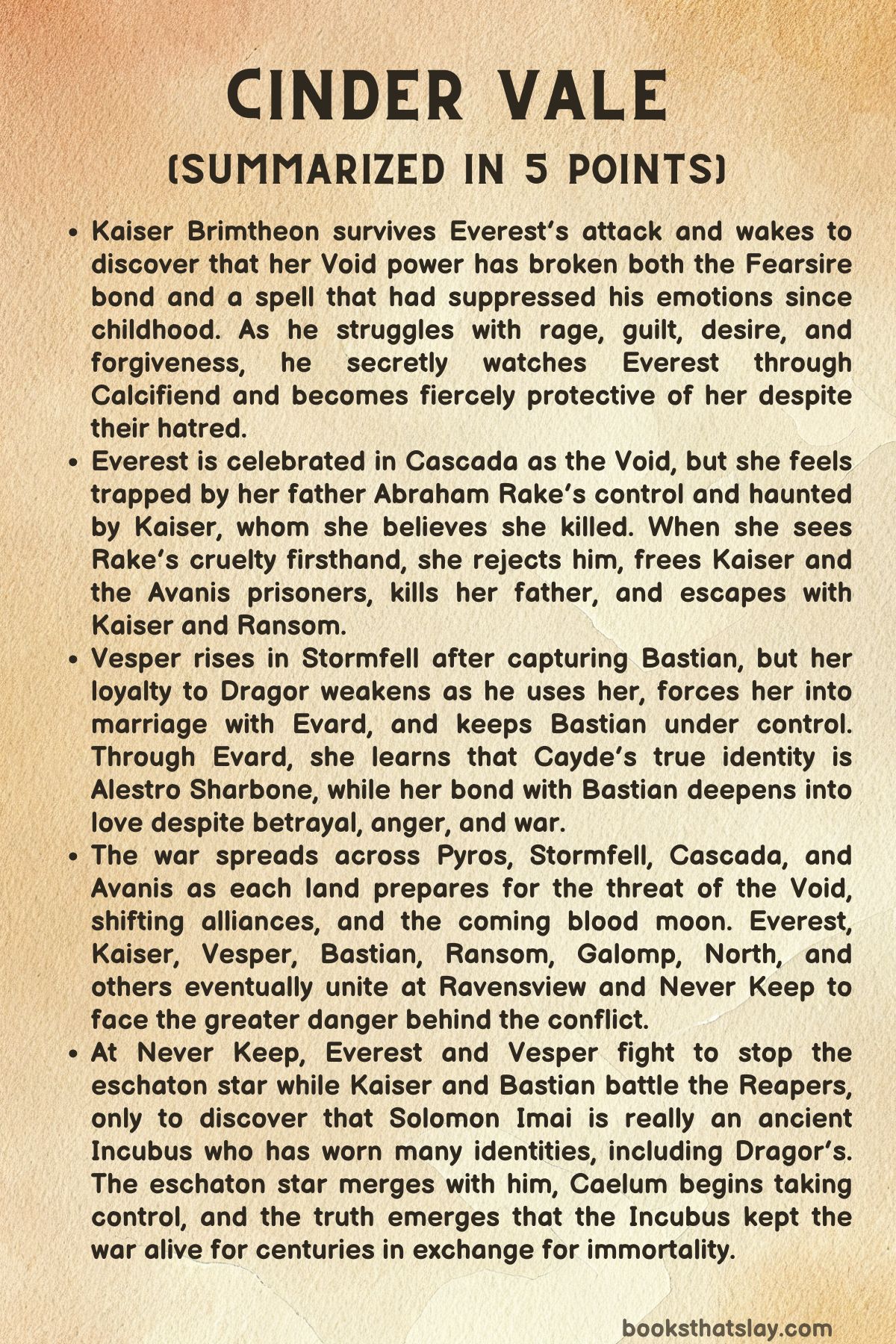
Summary
Kaiser Brimtheon wakes after the fall of Cinder Vale, left for dead on the battlefield by Everest Arcadia. Yet her attack has done more than nearly kill him.
Her Void power has broken the Fearsire bond and undone a secret spell placed on him as a child, a spell that had buried all his emotions for years. His werewolf brother North rescues him and brings him to the Pyros evacuation train, where healers save his life.
When Kaiser wakes, he is overwhelmed by anger, laughter, pain, guilt, and confusion. Mirelle confesses that after his family died, she took him to the Reapers and paid them to remove his grief.
Instead, they suppressed every feeling he had. Kaiser rages at her and nearly kills her before North stops him.
Mirelle asks North to teach Kaiser how emotions work, while Kaiser secretly sends his Sayer Dragon, Calcifiend, to find Everest.
In Stormfell, Vesper returns to Wrathbane Palace after capturing Bastian, the Dragon. She is rewarded with a new title and elevated rank, but she feels trapped by guilt and grief after the deaths of her sisters, Dalia and Moraine.
Prince Evard offers her an alliance and even marriage if she helps him understand Bastian. Vesper refuses to promise him anything.
King Dragor refuses to let her hunt Cayde, the man who murdered her sisters, until he is certain of her loyalty. He also reveals that the Void is a Fae woman from Cascada.
Vesper recognizes Everest but lies to protect her, even when Dragor threatens her.
Everest is celebrated in Cascada as Kysharna, the Void, but the praise feels like another cage. Her father, Abraham Rake, parades her before the people while delaying the war.
Everest believes Kaiser is dead and is troubled by the memory of him. Ransom urges her to stop waiting for her father’s permission.
Everest confronts Abraham and forces him to agree to march on Pyros, though he reminds her that he still controls the army.
Bastian remains imprisoned in Stormfell, chained and cut off from his magic by a gemstone embedded in his body. Dragor offers him land, riches, women, and status if Bastian agrees to serve him in battle and let Dragor ride him as a Dragon.
Bastian refuses, but Dragor brings in a hooded woman, making it clear he has other ways to force obedience.
In Ravensview, Pyros’s hidden refuge, Kaiser begins to recover under North’s guidance. He learns to name his emotions, but he still cannot control his attachment to Everest.
When Pyros leaders discuss destroying her, Kaiser hides her location and threatens anyone who tries to kill her, declaring that only he has the right to end her life.
Everest uses the Void to cut a path through the magical barrier so the Cascadian fleet can enter Pyros. Monsters attack, and although she kills one herself, her father’s commanders repeatedly hold her back.
The fleet reaches Coalmere and finds it abandoned, which makes Everest uneasy. During the celebration, she discovers Calcifiend has followed her.
She hides him and admits she is conflicted over Kaiser’s death.
Meanwhile, Septa travels with Alestro and other Avanis nobles to the conquered Cinder Vale, now controlled by Earl Tarlord. The old Flamebringer palace has been destroyed and replaced by a Stonebreaker castle.
Septa studies the danger posed by the Void and proposes a defensive strategy using traps, pits, lava channels, siege weapons, and undermined ground to slow Cascadian armies even when magic fails. Tarlord is impressed and believes her plan may save Avanis.
Vesper’s position in Stormfell becomes more unstable. Dragor orders her to spy on Evard, help capture the Void, and remain his weapon.
In return, he promises she may hunt Cayde. At Never Keep, Hadlin waits for Solomon Imai, but Solomon returns changed.
He claims the monstrous creature summoned by the Reapers is named Caelum and that the stars have chosen him as its master. Hadlin realizes Everest was right not to trust him and decides he will oppose Solomon if Everest is threatened.
The Cascadians continue through abandoned Pyros settlements. Everest reunites with Galomp, defends him, and makes him her personal sentinel.
Soon Rake leads the army into Stormfell and attacks Pomair. The Skyforgers are prepared with traps, arrows, catapults, windriders, and runic weapons.
Everest’s Void disrupts both sides. Vesper notices that the Void moves in straight lines.
Bastian appears in Dragon form, healed and ridden by Dragor, burning Cascadian ships. Vesper captures Everest but chooses not to deliver her to Dragor.
After speaking honestly with her, Vesper releases her and chooses treason over obedience.
After the battle, Ransom finds three young Flamebringer sisters hiding and tries to spare them. When Rake’s people catch them, Everest and Ransom secretly follow, fearing they will be harmed.
Elsewhere, Vesper is forced into marriage with Prince Evard. Evard reveals that Cayde was a false identity and that the killer’s real name is Alestro Sharbone, once betrothed to Septa Thorngrove.
Evard promises to help Vesper find him, and they seal a star bond that makes her princess of Stormfell.
Everest later wakes to find Kaiser alive in her cabin. He explains that her Void freed his emotions, leaving him overwhelmed, especially by what he feels for her.
Their confrontation is violent and charged, but Abraham interrupts. Kaiser attacks him and is captured.
Everest tells her father Kaiser is Voided, and Rake orders him tortured.
Vesper visits Bastian to explain that she married Evard to escape Dragor and gain help finding Alestro. Their anger gives way to desire, and they finally come together, though Bastian refuses to fully claim her until she trusts him.
Vesper tells him about her sisters, and he holds her through the night.
Everest goes below deck and finds Abraham torturing prisoners and pressuring Ransom to join him. When Rake threatens Kaiser’s mother and kills captives without remorse, Everest turns against him.
She cuts off his arm, kills his warriors, frees Kaiser, and together she and Kaiser kill Abraham Rake. Ransom chooses to flee with her.
Everest frees the Avanis prisoners, sinks the White Mare, and escapes.
Everest, Kaiser, Ransom, and the freed captives reach land. Everest releases the Avanis prisoners, including Septa, who thanks her before fleeing underground.
Cascadian forces pursue them, and Kaiser leads Everest toward a Pyros archway. They hide in an abandoned village for three days until Galomp is thrown into their hiding place.
He helps them create a distraction, but he and Ransom are captured while Everest and Kaiser escape. Awaiting execution, Ransom rejects his father’s name and chooses to call himself Ransom Arcadia.
In Stormfell, King Aquila dies, and his sealed heir is revealed to be Laurena. Before she can rule, Dragor murders her, sparking a battle between rival factions.
Dragor forces Bastian to shift into Dragon form, while Vesper protects Evard and makes him retreat. Septa reaches Cinder Vale and tells Earl Tarlord that Everest killed Abraham and betrayed Cascada.
Later, Vesper wakes in Ravensview after using dark magic to repair the keystone and delay the eschaton star. A captive Reaper heals most of her injuries, but the rune wounds remain because they were the cost of her magic.
Everest cares for her and reminds her that Bastian’s anger comes from fear of losing her. As the blood moon nears, Everest prepares for battle, forges metal deathless primrose pins, and shares one with each ally as a sign that they will resist death together.
The group travels to Never Keep to stop the eschaton star. Mavus meets them and reveals that Harlon has been captured.
Galomp, Ransom, and North go to rescue him, while Everest, Vesper, Kaiser, Bastian, and Mavus continue toward the summoning site. They swim through an icy cavern and reach a chamber where Reapers chant around green crystals beneath moonlight.
Lazarus and the Vampires create a distraction, and the battle begins.
Everest uses the Void to cut off the Reapers’ magic and fight the force of the blood moon. Vesper uses ether and blood sacrifice to hold back the monster, while Kaiser and Bastian fight beside each other.
Everest shatters the green crystals, but in doing so she cracks the ancient barrier separating The Waning Lands from the wider world. Mavus falls and is revealed as Solomon Imai, the Cardinal Reaper, then shifts through many stolen faces, including Dragor and Kaiser.
He is an Incubus who has manipulated kingdoms for centuries.
The eschaton star forces itself into the Incubus, merging with him. He reveals that he has kept the war alive to feed Caelum death in exchange for immortality.
Vesper sacrifices her sisters’ blood and nearly her own life to protect the others, confessing her love for Bastian as he returns it. Three powerful newcomers arrive with red and blue flames and a shield, but the possessed Incubus escapes.
In the end, Caelum begins taking control, and the Incubus realizes the bargain he made may now own him.
Characters
In Cinder Vale, Caroline Peckham presents a large cast of characters shaped by war, betrayal, loyalty, revenge, forbidden desire, and the struggle to reclaim agency from those who have turned them into weapons. The characters are not simple representatives of one land or one side of the conflict; most of them are torn between inherited loyalties and personal truths.
Their emotional journeys are closely tied to the larger war, but the book’s strongest character work comes from showing how power, grief, manipulation, and love reshape people who have been trained to survive rather than feel.
Kaiser Brimtheon
Kaiser Brimtheon is one of the most emotionally intense and complicated figures in the book because his character is defined by the sudden return of feelings that were stolen from him for years. At the beginning of his arc, he wakes after being stabbed by Everest and left for dead, only to discover that her Void power has broken both the Fearsire bond and the hidden spell that suppressed his emotions.
This transformation makes him frighteningly unstable at first. He laughs, rages, smiles, threatens, destroys, and reacts with the raw confusion of someone who has never been allowed to understand his own inner world.
His violence toward Mirelle after learning the truth about what she did to him reveals how deeply betrayed he feels, but his later apology shows that his anger is not empty cruelty. He is learning the difference between pain, blame, forgiveness, and control.
Kaiser’s relationship with North is central to his development because North becomes the person who teaches him how to name and manage emotion. Through North’s guidance, Kaiser begins to move from instinctive reaction toward self-awareness.
He remains dangerous, proud, and possessive, but he also becomes more honest with himself. His fixation on Everest is especially revealing.
He should see her only as an enemy, yet he secretly watches her through Calcifiend and threatens anyone who tries to kill her. His declaration that only he has the right to end her life is violent on the surface, but it also exposes his inability to separate hatred from desire, vengeance from attachment, and rivalry from longing.
By the later parts of the story, Kaiser becomes more than a wounded warrior seeking revenge. He begins to understand that he and Everest have both been shaped into weapons by forces larger than themselves.
His conversations with her about war, unity, hatred, and peace show a man gradually developing moral and emotional complexity. He is still harsh and volatile, but he is no longer hollow.
His arc is about recovering humanity after being denied it, and his struggle is not simply to control his emotions but to decide what kind of person he wants to become now that he can finally feel.
Everest Arcadia
Everest Arcadia is one of the central forces of the book, both politically and emotionally. Celebrated as the Void and renamed Kysharna in Cascada, she is treated like a divine weapon rather than a person.
Her father parades her as the crown of the war, and the people around her praise her power while ignoring her discomfort. This creates one of Everest’s deepest conflicts: she wants to act decisively and influence the war, but she also begins to realize that being powerful does not mean being free.
She is surrounded by admiration, yet she feels trapped by the role others have built around her.
Her relationship with Kaiser reveals her emotional confusion and moral struggle. She believes she killed him, yet she cannot stop thinking about him.
Her regret and desire are tangled with hostility, guilt, and fascination. When she later discovers he is alive, their confrontation becomes both violent and intimate, showing how deeply they affect each other.
Kaiser’s survival forces Everest to face the consequences of her power, but it also gives her a mirror. Like him, she has been used as a weapon and taught to define herself by destruction.
Their bond is dangerous because neither fully trusts the other, yet it is also transformative because each sees the other’s hidden pain.
Everest’s greatest growth comes through her rejection of Abraham Rake. At first, she tries to use her father’s authority to push the war forward, but she gradually witnesses the true brutality beneath his leadership.
His torture of prisoners, his casual murder, and his attempt to drag Ransom into cruelty force Everest to choose between blood loyalty and moral conviction. When she cuts off his arm, frees Kaiser, and helps kill him, she breaks from the identity Cascada tried to impose on her.
By forging deathless primrose pins and speaking of resilience and unity, Everest begins to imagine a future beyond conquest. She remains fierce and flawed, but her arc moves toward self-definition, compassion, and the possibility that power can protect rather than simply destroy.
Vesper
Vesper is one of the most tragic, fierce, and emotionally guarded characters in the book. She begins from a place of grief and isolation after the deaths of Dalia and Moraine, and much of her behavior is driven by the unresolved trauma of losing her sisters.
Her loyalty to Dragor is already strained because she has delivered Bastian into captivity, and the reward she receives for capturing him only deepens her sense of moral conflict. Being elevated as Lady Vesper Dragonsbane and later forced into political usefulness does not give her power in any true sense.
Instead, it exposes how Dragor sees her as a weapon to be aimed, controlled, and discarded.
Her relationship with Dragor is crucial because it reveals the collapse of her devotion to him. He mocks her grief, threatens her, suspends her over a balcony, orders her to spy and seduce, and treats her body and loyalty as possessions.
Vesper’s growing resistance to him marks one of the strongest acts of self-reclamation in the story. Her decision to protect Everest by lying about her identity, and later her choice to carry Everest away from the battlefield instead of handing her over, show that Vesper is no longer willing to obey simply because obedience has been demanded.
These moments are not easy betrayals; they are painful awakenings.
Vesper’s relationship with Bastian brings out a softer, more vulnerable side of her, though she resists it fiercely. She betrayed him, yet she is drawn to him and ultimately confesses her pain, desire, and fear.
Their love is built through anger, longing, and reluctant trust rather than simple romance. Her forced marriage to Evard also complicates her role, because it gives her political protection and a path toward finding Cayde, whose true identity is revealed as Alestro Sharbone.
By the end, Vesper’s willingness to use dark magic, carve into herself, and nearly die to protect others shows how far she will go for the people she loves. She is not merely a warrior seeking revenge; she is a woman learning that survival does not have to mean emotional isolation.
Bastian
Bastian is defined by captivity, pride, rage, and a refusal to be owned. As a Dragon imprisoned in Stormfell, chained and cut off from his magic, he represents a powerful being reduced to a trophy.
Dragor’s attempts to tempt him with lands, treasure, wives, status, and conditional freedom reveal how others view him: not as a person, but as a force to be harnessed. Bastian’s refusal to serve Dragor, even under brutal restraint, establishes his core trait.
He may be trapped physically, but his will remains deeply resistant.
His bond with Vesper is filled with anger because her betrayal hurts him on both personal and symbolic levels. She helped place him in captivity, yet she is also the person he cannot stop wanting.
Their relationship works because both of them are proud, wounded, and afraid of surrendering too much. Bastian’s jealousy over her forced marriage to Evard shows his possessiveness, but his refusal to fully claim her until she is ready to trust him reveals restraint and emotional maturity beneath his fury.
He wants her, but he also wants her choice to matter.
Bastian’s role in the final conflict shows the painful contradiction of his character. He is a creature of immense power, but he repeatedly faces situations where that power is controlled, redirected, or threatened by others.
When Dragor compels him into Dragon form during the palace conflict, Bastian becomes the very weapon he hates being made into. Yet alongside Kaiser, Everest, and Vesper, he fights not for rulers or titles but for survival, love, and freedom.
His love for Vesper becomes one of his defining truths, especially when he confesses it as she risks death. Bastian’s arc is about reclaiming personhood from captivity and proving that even the most dangerous creature in the room can be driven by loyalty and tenderness.
Ransom Arcadia
Ransom begins as someone connected to Cascada’s ruling power, but his arc moves steadily away from inherited brutality and toward chosen morality. He understands his father’s influence and the expectations placed on him, yet he is uneasy with the cruelty around him.
His suggestion that Everest should stop asking Abraham for permission and use her power to push the war forward initially makes him seem politically pragmatic, but later events reveal that he is not comfortable with violence for its own sake. He is ambitious and strategic, but not heartless.
His defining moral test comes when he finds the three young Flamebringer sisters and tries to let them escape. This moment shows that Ransom cannot fully accept the logic of war when it targets the vulnerable.
When Rake, Agatha, and Jacobin endanger the girls, Ransom’s instincts align with Everest’s suspicion and horror. Later, when Abraham tries to force him into participating in torture, Ransom’s rejection becomes clearer.
He is not simply afraid of becoming his father; he is actively choosing not to.
Ransom’s decision to flee with Everest after Abraham’s death marks his break from the old Cascadian order. His later renunciation of the Rake name and decision to call himself Ransom Arcadia is one of the clearest identity shifts in the book.
Names matter in this world because they carry legacy, loyalty, and power. By rejecting his father’s name, Ransom rejects cruelty as inheritance.
His arc is quieter than Everest’s or Kaiser’s, but it is deeply important because it shows that moral courage can exist even in someone raised close to power.
North
North serves as one of the most stabilizing characters in the book. As Kaiser’s werewolf brother, he is physically strong, loyal, and protective, but his real importance lies in his emotional steadiness.
When Kaiser wakes overwhelmed by newly restored emotions, North becomes the person tasked with helping him understand what he feels. This makes North more than a warrior or companion.
He becomes a guide through emotional territory Kaiser has never been allowed to enter.
North’s patience contrasts sharply with Kaiser’s volatility. He restrains Kaiser when necessary, but he does not simply condemn him.
He recognizes that Kaiser’s violence and confusion come from a deep psychological wound. This gives North a quiet wisdom.
He understands that control cannot be forced through suppression, because suppression is exactly what damaged Kaiser in the first place. Instead, he helps Kaiser identify feelings and survive them.
North also represents loyal family outside traditional bloodlines of power. His bond with Kaiser is based on devotion, responsibility, and honesty rather than political advantage.
When he joins Galomp and Ransom to rescue Harlon, he further proves that his loyalty extends into action. North may not dominate the political plot, but he is essential to the emotional structure of the story.
He reminds the reader that strength can mean patience, and that love sometimes appears as the willingness to stand beside someone at their most dangerous and confused.
Mirelle
Mirelle is a morally complicated figure because her actions toward Kaiser came from love, grief, desperation, and terrible judgment. When Kaiser was a child drowning in pain after losing his family, she took him to the Reapers and paid an agonizing magical price to remove his suffering.
Her intention was protective, but the result was devastating. Instead of healing him, the spell suppressed all his emotions for years.
This makes Mirelle both a caretaker and a violator of Kaiser’s inner life.
Her confession is one of the most emotionally charged moments connected to Kaiser’s arc. She does not try to pretend the result was harmless, but the damage cannot be undone through regret alone.
Kaiser’s rage toward her is frightening, especially when he chokes her, yet it is also understandable because he has discovered that a fundamental part of himself was stolen with her involvement. Mirelle’s pain lies in the fact that she acted to save him from grief but instead deprived him of humanity.
As a leader, Mirelle also shows firmness and political caution. At the war council, she refuses alliances she does not trust and tries to protect Pyros from desperate decisions.
Her role is defined by impossible choices: the choice she made for Kaiser as a child, and the choices she must make for her people during war. Mirelle is neither villain nor innocent guardian.
She is a character whose love caused harm, and whose arc depends on whether others can ever separate her intention from its consequences.
Abraham Rake
Abraham Rake is one of the clearest embodiments of corrupt power in the book. As Everest’s father and a leader of Cascada, he treats war as both destiny and possession.
He celebrates Everest as the Void, but his pride in her is deeply transactional. He sees her as the crown of the war, a symbol and weapon that can secure victory, not as a daughter with moral judgment of her own.
His willingness to parade her while controlling the army shows that he values her power but does not truly respect her autonomy.
His cruelty becomes undeniable through his treatment of prisoners and his attempt to involve Ransom in torture. Abraham’s violence is not presented as battlefield necessity; it is casual, controlling, and corrupting.
He threatens Kaiser’s mother, kills captives, and uses fear to enforce obedience. These actions strip away any illusion that his cause is morally pure.
He may fight for Cascada, but his methods reveal that victory under him would only replace one form of domination with another.
Everest’s decision to turn against him is therefore one of the most important moral ruptures in the story. Killing Abraham is not just an act of rebellion against a father; it is a rejection of a political and emotional legacy built on brutality.
Abraham functions as the force that tries to define Everest as a weapon, and his death allows her to begin choosing what her power will mean. He is a harsh, manipulative, and destructive figure whose downfall comes when the child he tried to use finally refuses to obey.
Dragor
Dragor is a manipulator who uses power, humiliation, desire, and fear to control those around him. His treatment of Vesper reveals his need to own loyalty rather than earn it.
He elevates her when she is useful, mocks her grief when she resists, threatens her life when she defies him, and tries to turn her into a weapon under the language of duty. His authority is theatrical and cruel, designed to make others feel that they exist only through his permission.
His treatment of Bastian is equally revealing. Dragor does not simply want to defeat the Dragon; he wants to ride him, display him, and absorb his symbolic power.
His offers of wealth, wives, status, and partial freedom show that he understands desire as a means of control. When persuasion fails, coercion remains.
This makes Dragor dangerous not only because he has political and magical power, but because he understands people’s wounds and tries to use those wounds against them.
Dragor’s eventual exposure as one of the faces used by the Incubus complicates the meaning of his role. Whether considered through his political actions or through the larger deception surrounding identity, Dragor represents the instability of authority in the book.
He is a face of domination, but he is also part of a wider pattern of manipulation that has shaped the war for centuries. His cruelty toward Vesper and Bastian remains personally significant because it pushes both of them toward defiance and toward choosing each other over obedience.
Prince Evard
Prince Evard is politically calculating, but he is not presented as a simple villain. His interest in Vesper begins as strategic, since he wants access to Bastian and influence within the shifting power structures of Stormfell.
He offers alliance and even marriage, but his approach is more controlled than Dragor’s. He understands that Vesper has value beyond brute force, and he tries to negotiate with her rather than merely command her.
His forced marriage to Vesper initially appears to trap her further inside Stormfell politics, but Evard’s private conduct complicates that impression. He makes it clear that he does not intend to force a sexual claim over her, which sharply separates him from the more possessive men around her.
His bargain with her regarding Cayde’s true identity shows that he is observant, informed, and willing to trade information for loyalty. The star bond between them turns their marriage into a political and magical arrangement rather than a romantic union.
Evard’s relationship with Vesper is built on cautious usefulness rather than love. Still, he gives her something she desperately needs: a path toward the truth about her sisters’ killer and a measure of protection from Dragor.
His weakness is that he remains embedded in political games, and his survival often depends on others, especially Vesper. He is intelligent and self-interested, but not needlessly cruel.
In a world full of open violence, Evard’s power lies in negotiation, secrets, and bargains.
Septa Thorngrove
Septa Thorngrove is one of the most intellectually capable characters in the book. Her strength does not come primarily from battlefield power, but from strategy, observation, and practical imagination.
When she arrives at the conquered capital and sees destruction, flooding, corpses, and the newly built Stonebreaker castle, she understands the symbolic importance of architecture and conquest. She is not naïve about war’s ugliness, but she also does not collapse under it.
Her defensive plan against the Void is one of her most impressive moments. Rather than relying only on magic, she proposes reshaping the land itself with pits, chasms, traps, lava channels, and mechanical siege weapons.
This shows her ability to think beyond conventional power. She understands that Everest’s Void changes the rules of war, so survival requires physical, structural, and tactical adaptation.
Earl Tarlord’s admiration for her plan confirms that Septa is a serious political and military mind.
Septa’s later escape after Everest frees the Avanis prisoners further reveals her resilience. She leads survivors through tunnels, finds underbeast transport, and returns to report Abraham Rake’s death and Everest’s betrayal of Cascada.
Her connection to Alestro through their former betrothal also ties her personal life to the wider web of espionage and revenge. Septa is dignified, perceptive, and underestimated by some around her, but her intelligence makes her vital to Avanis’s survival.
Earl Tarlord
Earl Tarlord represents conquest, authority, and calculated symbolism. His destruction of the old Flamebringer palace and construction of a Stonebreaker castle in its place is not merely architectural pride.
It is a statement that Avanis has rewritten the meaning of the conquered capital. He understands that power must be seen as well as exercised, and his castle becomes a physical declaration of victory.
His interaction with Septa reveals a more nuanced side of him. He greets her warmly, notices her discomfort, and takes her strategic ideas seriously.
This attentiveness does not erase his role in conquest, but it shows that he is capable of respect and political intelligence. Unlike characters who are driven mainly by cruelty or obsession, Tarlord appears pragmatic.
He values plans that may preserve his people and secure Avanis’s gains.
Tarlord’s importance lies in showing that Avanis is not a faceless enemy force. Through him, the book presents leadership that can be ruthless in conquest while still rational, protective of its own side, and open to counsel.
His approval of Septa’s plan suggests that he values competence, and this makes him a formidable figure. He is dangerous because he is not foolish; he understands both symbolism and strategy.
Alestro Sharbone / Cayde Avior
Alestro Sharbone is one of the most important hidden figures in Vesper’s personal arc because he is revealed to be the real identity behind Cayde Avior, the man she believes killed her sisters. Before this revelation, Cayde functions almost like a wound rather than a person.
He is the name attached to Vesper’s grief, rage, and need for revenge. Once Evard uncovers that Cayde was a false identity, the story reframes Vesper’s quest as part of a larger network of deception.
Alestro’s past betrothal to Septa Thorngrove adds political and emotional complexity to his character. He is not just an isolated assassin or infiltrator; he has ties to Avanis society and to Septa’s life.
His infiltration of Stormfell suggests intelligence, patience, and a willingness to live behind a mask. This makes him thematically connected to the book’s broader concern with false faces, hidden loyalties, and identities used as weapons.
Even when he is not physically central to every event, Alestro’s presence drives Vesper’s choices. Her bargain with Evard, her forced movement through Stormfell politics, and her desire to free herself from Dragor’s control are all tied to the need to find him.
Alestro represents the unresolved past that Vesper cannot escape until she confronts the truth. His significance comes from the way his hidden identity turns personal revenge into political revelation.
Hadlin
Hadlin is a quieter but morally important character because he serves as one of the first people to recognize that Everest may have been right to distrust Solomon. At Never Keep, he waits for Solomon Imai’s return while still troubled by Everest’s decision to leave with her father.
His emotional position is conflicted: he is connected to the Reaper world, but he also cares enough about Everest to question how others speak about her.
His confrontation with Solomon reveals his courage. When Solomon refers to Everest as merely a vessel, Hadlin objects, and this objection matters because it shows that he still sees Everest as a person.
Solomon’s response, binding and threatening him, exposes the danger of dissent in that environment. Hadlin’s realization that Solomon is not the righteous authority he may have seemed to be marks a turning point in his loyalty.
Hadlin’s silent decision to oppose Solomon if Everest is endangered shows that his strength is internal rather than dramatic. He does not have the explosive power of the central fighters, but he has moral clarity when it matters.
In a story full of people being used as tools, Hadlin’s refusal to reduce Everest to a vessel makes him significant. He stands for the importance of seeing personhood where powerful figures see only utility.
Solomon Imai / Mavus / The Incubus
Solomon Imai is one of the most deceptive and far-reaching antagonistic forces in the book. At first, he appears connected to the Reapers and the summoning of Caelum, but the truth reveals something much larger and older.
His identity as Mavus and then as an Incubus who has worn many faces for centuries transforms him from a dangerous religious or magical authority into a master manipulator whose influence has shaped the wider world.
His ability to shift through faces, including Dragor and Kaiser, makes him a living embodiment of false identity. He does not merely lie; he becomes the lie.
This ability allows him to infiltrate systems of power, manipulate wars, and sustain conflict from behind multiple masks. His connection to Caelum reveals the horrifying purpose behind the endless violence: the war has been fed to the monster in exchange for immortality crystals.
This makes him one of the most morally monstrous figures in the story because he has prolonged suffering not out of loyalty to any land, but for his own survival and bargain.
The Incubus’s final loss of control to Caelum adds another layer to his character. He has spent centuries manipulating others, but by the end he begins to fear that he is no longer the one in command.
This reversal is fitting. A character who has treated nations and individuals as instruments becomes an instrument himself.
His arc represents the danger of endless manipulation: eventually, the force one bargains with may become stronger than the deceiver.
Caelum
Caelum is the monstrous eschaton star and one of the most terrifying forces in the book because it represents destruction fed by war itself. Unlike political rulers or warriors, Caelum is not driven by ordinary ambition, grief, or loyalty.
It is a cosmic and predatory presence that thrives on death. The fact that the Incubus kept the war going to feed Caelum gives the entire conflict a darker meaning.
The suffering of nations has not merely been the result of hatred; it has also been cultivated as nourishment.
Caelum’s relationship with the Incubus is especially unsettling because it begins as a bargain but evolves into domination. The Incubus believed he was using Caelum to gain immortality and power, yet the final scene suggests that Caelum is becoming the true controlling force.
This makes Caelum more than a monster to be fought. It is the consequence of centuries of compromise with evil.
As a character-like presence, Caelum functions as the ultimate enemy of unity and peace. It benefits from division, violence, and sacrifice.
Its existence forces the main characters to confront the possibility that their wars have been manipulated by something far beyond national rivalry. Caelum’s menace lies not only in its power, but in the revelation that every death may have served its hunger.
Galomp
Galomp brings loyalty, innocence, and unexpected courage into a brutal world. Everest’s reunion with him is important because it shows her protective instincts outside the grand politics of war.
When she defends him from bullying and appoints him as her personal sentinel, she is not simply making a practical choice. She is affirming the worth of someone others might dismiss or mistreat.
Galomp’s presence helps humanize Everest because he draws out her compassion.
His loyalty becomes increasingly important as events grow more dangerous. He gives Everest hope through his connection to his uncle, a Magistrine member, and later becomes part of the group’s escape and survival.
When he is thrown into Everest, Kaiser, and Ransom’s hiding place after they have been trapped for days, his arrival changes the situation. He helps create a distraction with the horses, proving that his value is not symbolic but active.
Galomp’s recapture alongside Ransom adds emotional weight to his role. He is vulnerable, but he is not useless.
His courage does not look like the grand heroics of Dragons, Void magic, or royal betrayals. Instead, it appears in loyalty, quick action, and willingness to help those he trusts.
Galomp represents the quieter forms of bravery that survive even in war.
Calcifiend
Calcifiend, Kaiser’s blue Sayer Dragon, is an unusual but important presence because he connects Kaiser and Everest across distance, secrecy, and emotional conflict. Kaiser sends him to find and watch Everest, which reveals Kaiser’s obsession and unwillingness to let her disappear from his life.
Through Calcifiend, Kaiser maintains a hidden link to the woman he claims to hate and wants to possess vengeance over.
When Everest discovers Calcifiend and hides him, her reaction is equally revealing. She does not destroy him or expose him.
Instead, she speaks privately to him and admits her conflicted feelings about Kaiser’s death. This makes Calcifiend a silent witness to emotions the characters cannot easily confess to each other.
He becomes a bridge between enemies who are not as emotionally separate as they pretend to be.
Calcifiend’s importance lies less in dialogue and more in function. He carries sight, secrecy, and connection.
In a world where magic, surveillance, and loyalty are dangerous, his presence shows how attachment finds indirect routes. He is Kaiser’s eye, but he also becomes a container for Everest’s unguarded truth.
Prince Dragor’s Father, King Aquila
King Aquila’s role is brief but politically significant because his death triggers a major crisis in Stormfell. His sealed choice of heir reveals Laurena as the next queen, which disrupts the ambitions of others and leads directly into violence.
Though he is not deeply explored emotionally, his authority matters because the succession he leaves behind becomes a catalyst for conflict.
Aquila represents the fragile structure of monarchy in the book. His decision should create order, but instead it exposes the instability beneath the royal court.
The moment his chosen heir is revealed, Dragor acts violently, and the palace erupts into battle. This shows that royal legitimacy is only as strong as the willingness of others to honor it.
Through Aquila, the book demonstrates how power vacuums can reveal hidden loyalties and ambitions. His death matters less as a personal loss and more as the collapse of a political seal that had temporarily contained conflict.
Once he is gone, Stormfell’s internal fractures become impossible to hide.
Laurena
Laurena is significant because she is chosen as Aquila’s heir, making her the rightful new queen before she can truly rule. Her sudden rise and immediate stabbing by Dragor show how dangerous legitimacy can be when it threatens a more ruthless claimant.
Laurena’s role is brief, but it is not meaningless. She represents a path of lawful succession that is violently interrupted.
Her character functions as a symbol of stolen authority. The fact that she is named queen and then attacked before she can exercise power emphasizes the brutality of Stormfell’s politics.
In a more stable world, Aquila’s choice might have settled the future. In this world, it becomes the spark that ignites open conflict.
Laurena’s importance lies in how others respond to her. Roarson’s supporters and Dragor’s forces erupt into battle after she is attacked, proving that her claim has political weight.
Even without extensive personal development, she becomes central to the struggle over Stormfell’s future. Her near-instant removal shows how women in positions of power can be targeted when their authority threatens violent men.
Roarson
Roarson is important mainly through the political faction that supports him. When Laurena is revealed as the chosen heir and Dragor attacks her, Roarson’s supporters clash with Dragor’s forces.
This places Roarson within the larger struggle for Stormfell’s succession and shows that the kingdom is divided by competing loyalties.
Although he does not receive the same level of personal development as Vesper, Bastian, Everest, or Kaiser, Roarson’s presence matters because it proves the conflict is not limited to individual rivalries. There are factions, ambitions, and power blocs ready to act the moment royal authority weakens.
His supporters’ willingness to fight suggests that his claim or influence has genuine strength.
Roarson functions as part of the political pressure surrounding Dragor’s actions. Dragor’s violence does not occur in a vacuum; it provokes immediate resistance.
Through Roarson’s faction, the book shows that Stormfell’s instability has been building beneath the surface and only needed the king’s death to erupt.
Lazarus
Lazarus is a pragmatic and morally ambiguous figure because he sees people and events through the lens of necessity. After Vesper nearly dies using dark magic to repair the keystone and stop the immediate threat of the eschaton star, Lazarus speaks of her as a necessary weapon.
This infuriates Bastian because it reduces Vesper’s sacrifice to usefulness rather than personhood.
Yet Lazarus is also important to the group’s survival. His Vampires create the distraction at Never Keep, allowing Vesper and Everest to reach the summoning site.
He understands the stakes and is willing to take ruthless or dangerous measures to create an opening. This makes him valuable, even if his attitude can be cold.
Lazarus represents the uncomfortable side of resistance. Fighting monstrous forces often requires strategy, sacrifice, and emotional distance, but the book questions how far that distance should go.
His usefulness does not make him gentle, and his realism does not always make him compassionate. He is a character who helps save lives while also reminding others how easily people can be spoken of as tools.
Harlon
Harlon’s capture raises the emotional stakes during the mission to Never Keep. When Mavus reveals that Harlon has been taken to the northern tower to be tortured and executed, Everest immediately wants to rescue him herself.
This reaction shows that Harlon matters enough to challenge the priorities of the mission. His danger creates a split between personal loyalty and the larger need to stop the monster.
Although Harlon is not developed in great detail in the provided events, his role is important because he draws action from Galomp, Ransom, and North. Their decision to go after him shows that he is connected to a network of loyalty.
In a story where many characters are used as weapons or bargaining pieces, Harlon’s rescue matters because it is motivated by care rather than strategy alone.
Harlon’s function is therefore tied to the theme of who is worth saving when the world is ending. The answer the characters give is that individual lives still matter, even during cosmic crisis.
His capture forces the group to divide, but it also reveals the humanity of those who refuse to abandon him.
Commander Rake
Commander Rake is a representative of Cascadian military authority and the protective control surrounding Everest. He praises her power and recognizes her importance, but he also repeatedly insists that she must be protected.
This creates tension because Everest wants to fight, act, and make decisions, while the commanders around her treat her as too valuable to risk. His behavior shows how reverence can become another form of confinement.
His actions during the campaign through Pyros and into Stormfell show the limitations of Cascadian confidence. He declares abandoned territory as Cascadian, celebrates apparent victories, and leads forces into dangerous situations, but the emptiness of the settlements and the prepared defenses at Pomair reveal that the war is more complicated than simple conquest.
He is competent enough to command, but he still participates in the larger illusion that Cascada can control the consequences of unleashing the Void.
Commander Rake also reflects the military culture that surrounds Everest. He values her as an asset, but his protection does not necessarily equal understanding.
Through him, the book shows how commanders can praise a powerful figure while still denying that figure full agency.
Jacobin
Jacobin is part of the darker face of Cascadian violence. His involvement in catching the hidden Flamebringer sisters and participating in their interrogation places him firmly on the side of cruelty against the vulnerable.
He is not shown as a grand mastermind, but his willingness to take part in the abuse of children makes his role morally significant.
His presence alongside Rake and Agatha demonstrates how brutality becomes collective. Cruelty in the book is not only committed by kings and fathers; it is carried out by followers, officers, and accomplices who choose obedience over mercy.
Jacobin’s actions force Everest and Ransom to confront the reality that their side is capable of monstrous behavior.
Jacobin functions as a character who reveals the corruption of a cause from within. He helps turn a moment involving frightened children into a moral crisis.
Through him, the book shows that evil often depends on those who assist, enforce, and normalize it.
Agatha
Agatha is a disturbing figure because her Medusa venom is used in the interrogation of one of the young Flamebringer sisters. This makes her cruelty feel intimate and bodily, not merely political.
She is part of the group that threatens children under the pretense of war, and this places her among the characters who expose the moral rot within Cascadian forces.
Her use of venom also connects physical power with intimidation. Agatha does not need to command armies to be frightening; her danger lies in the way she can inflict suffering directly.
This makes the scene with the sisters especially tense, because the violence is personal and immediate.
Agatha’s role is important because she helps push Everest toward clearer moral rejection of her own side’s methods. By participating in cruelty against the innocent, Agatha becomes one of the figures who make neutrality impossible.
Everest cannot continue believing that Cascada’s cause justifies every action when she sees what people like Agatha are willing to do.
Dalia and Moraine
Dalia and Moraine are dead before much of Vesper’s present conflict unfolds, but their influence over her character is immense. They are the emotional center of her grief and the reason her desire for revenge remains so consuming.
Their deaths shape her distrust, her rage, and her willingness to bind herself to dangerous bargains if those bargains bring her closer to the truth.
Because Vesper’s memories of them are tied to love and loss, Dalia and Moraine function as more than backstory. They represent the part of Vesper that still feels deeply even when she tries to act hardened.
When she tells Bastian about them, she allows him to see the wound beneath her armor. This confession becomes an act of intimacy because speaking of them means admitting how much she has lost.
Their blood also becomes symbolically powerful near the end, when Vesper sacrifices the vial connected to them while trying to shield the others. This moment turns her grief into protection rather than vengeance alone.
Dalia and Moraine therefore remain present through Vesper’s choices, showing how the dead can continue to shape the living.
Mavus
Mavus initially appears as an ally or guide near Never Keep, meeting the group near the towers and providing information about Harlon’s capture. His presence seems useful, especially during a mission where the group must navigate danger quickly.
However, his later revelation as Solomon Imai and the ancient Incubus completely transforms his meaning.
As Mavus, he represents the danger of trusted appearances. The group accepts his guidance because the situation is urgent, but his identity is false.
This deception fits the book’s broader concern with masks, hidden agendas, and the difficulty of knowing who is truly acting in good faith.
The Mavus identity is especially effective because it shows how manipulation often works through helpfulness. He does not need to appear openly hostile to cause harm.
By presenting himself as someone useful, he gains proximity and influence. Once the truth is revealed, Mavus becomes one more stolen face in the Incubus’s long history of deception.
The Three Flamebringer Sisters
The three young Flamebringer sisters hidden in the tavern wardrobe are minor characters in terms of page presence, but they are extremely important morally. Their discovery forces Ransom and Everest to face the reality of what conquest means for the innocent.
They are not soldiers, rulers, or strategists. They are frightened children caught in the machinery of war.
Ransom’s attempt to let them escape reveals his conscience, while the cruelty shown toward them by others reveals the brutality of Cascadian forces. The sisters become a test of character for everyone around them.
Those who protect them show compassion; those who use or harm them expose their moral corruption.
Their role is powerful because they remind the reader that war’s victims are often those with the least power. In a story filled with magical weapons and royal politics, the sisters bring the conflict down to its simplest ethical question: whether the vulnerable deserve mercy even when they belong to the enemy.
Everest and Ransom’s response to them helps define the people they are becoming.
Goshart
Goshart has a brief but memorable role during the passage through the magical barrier. Sent through first after Everest opens a gap with the Void, he is immediately killed by a monstrous wasteland beast.
His death is sudden and brutal, and it establishes the danger beyond military planning. The barrier is not just a strategic obstacle; it separates the armies from horrors they may not fully understand.
Though Goshart is not deeply developed, his death serves an important narrative purpose. It punctures the confidence of the Cascadian advance and shows that Everest’s power, while extraordinary, cannot make the world safe or predictable.
Opening a path does not mean controlling what waits on the other side.
Goshart represents the expendable soldier in a war led by ambitious rulers and powerful figures. His quick death reminds the reader that ordinary fighters often pay the first price for decisions made by commanders, kings, and magical weapons.
His role is small, but the danger revealed through him is large.
Abraham Rake’s Warriors
The warriors loyal to Abraham Rake function as extensions of his authority and cruelty. They enforce his commands, participate in his violence, and stand between Everest and her moral break from him.
When Everest kills them while freeing Kaiser and rejecting her father, their deaths mark the physical collapse of Abraham’s immediate control.
They are not individualized in the way the major characters are, but their role matters because oppressive power depends on enforcers. Abraham’s cruelty would be less effective without people willing to carry it out.
His warriors represent the machinery of obedience that surrounds tyrannical leadership.
Their defeat is significant because Everest is not only killing individual opponents; she is dismantling the small military structure that allows her father to torture, threaten, and dominate. Through them, the book shows that rejecting tyranny often requires confronting those who protect it.
Themes
Freedom from Control
In Cinder Vale, many characters are forced to confront the difference between obedience and true freedom. Kaiser’s emotions have been suppressed without his consent, turning him into a weapon shaped by others before he even understands himself.
Vesper’s loyalty to Dragor is also built on control, fear, reward, and the promise of revenge, but her choices show a growing refusal to be owned by any ruler. Bastian’s imprisonment makes this theme even clearer because his body, magic, and Dragon identity are all treated as tools for war.
Everest also begins as a celebrated symbol of power, yet she slowly realizes that even praise can become another form of captivity when her father uses her as the crown of his campaign. The theme becomes powerful because freedom is not shown as a simple escape.
It demands pain, betrayal, and difficult choices. Each character must decide whether survival is enough, or whether they must risk everything to reclaim ownership of their own will.
The Burden of Being Used as a Weapon
Several characters are valued less for who they are and more for what they can destroy. Everest is praised as the Void, but that praise reduces her into a military tool rather than a daughter, friend, or person with doubts.
Kaiser has been shaped by emotional suppression and war until violence becomes the language others expect from him. Vesper is repeatedly treated as Dragor’s weapon, rewarded when she obeys and threatened when she shows independent thought.
Bastian suffers the same fate when Dragor attempts to turn his Dragon form into a symbol of royal dominance. This theme shows that power can become a prison when others define a person only by usefulness.
The characters’ abilities make them valuable, but also isolate them, because every side wants to claim, aim, or destroy them. Their growth comes from recognizing that power without choice is not strength.
Real strength begins when they refuse to let rulers, armies, and old loyalties decide what their lives mean.
Loyalty, Betrayal, and Moral Awakening
Loyalty is tested again and again, but the story refuses to treat loyalty as automatically noble. Vesper’s loyalty to Dragor begins to collapse when she sees that devotion to him requires the loss of her conscience.
Everest’s loyalty to her father breaks when she witnesses his cruelty and understands that blood ties cannot excuse murder, torture, or abuse of power. Ransom’s transformation is especially meaningful because he rejects the name and legacy that connect him to his father’s brutality.
Even Kaiser’s connection to Everest is marked by betrayal, hatred, attraction, and a strange honesty that forces both of them to reconsider what they owe their people and what they owe themselves. The theme is not simply about choosing sides.
It is about learning when loyalty becomes cowardice, when betrayal becomes necessary, and when moral awakening demands action. Characters begin to mature when they stop defending cruelty because it comes from someone familiar, powerful, or beloved.
Love, Grief, and Emotional Healing
Grief shapes many of the characters, but the story shows that buried pain does not disappear; it waits for a moment to return. Kaiser’s emotional awakening is one of the clearest examples, because years of suppressed feeling leave him unable to understand anger, guilt, desire, and forgiveness when they finally surface.
Vesper’s grief over her sisters drives her hunger for revenge, yet her bond with Bastian and Everest begins to reveal that grief cannot be healed through violence alone. Bastian’s love for Vesper is intense because it is mixed with fear of losing her, frustration at her self-sacrifice, and the need for trust after betrayal.
Everest also carries grief and guilt, especially over Kaiser, while struggling to understand why her feelings do not match the heroic image others project onto her. This theme gives the story emotional depth because healing is shown as uneven and painful.
Love does not erase trauma, but it gives the characters reasons to face it honestly.