Green & Deadly Things Summary, Characters and Themes
Green & Deadly Things by Jenn Lyons is a fantasy novel about ancient forces, buried truths, and a young man forced to rethink everything he has been taught. The story follows Mathaiik Kaven, a novitiate in a knightly order, after a violent attack in Parnassa Forest exposes powers that his world has tried to forget.
As living trees, old magic, political betrayal, and hidden histories rise around him, Math must decide where his loyalty truly belongs. The book blends forest horror, magical conflict, and imperial intrigue while focusing on Math’s growth from uncertain student to someone capable of changing the fate of kingdoms.
Summary
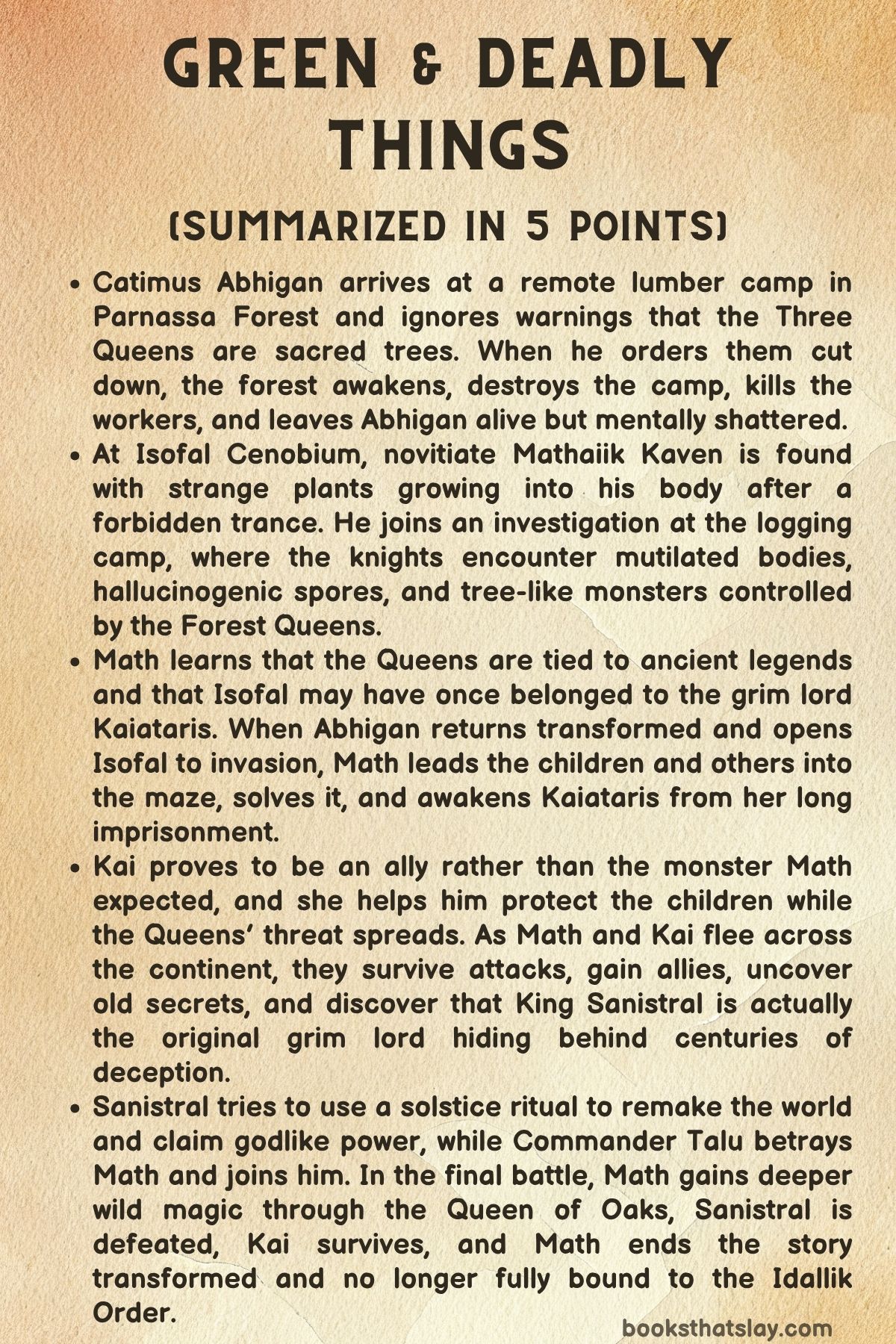
Green & Deadly Things begins in the remote Parnassa Forest, where Catimus Abhigan, a manager for Kegomar Lumber, arrives at a logging camp determined to increase production and enforce company demands. The workers are uneasy because the forest is not an ordinary place to them.
They believe certain trees are sacred and dangerous, especially three ancient trees known as the Three Queens. An older lumberjack named Ganner warns Abhigan not to interfere with them, but Abhigan dismisses the warning as ignorance and superstition.
He orders the workers to cut the trees down.
The order proves disastrous. The attempt to fell the Three Queens wakes something old and powerful in the forest.
The trees and the land itself turn against the camp. The lumberjacks are attacked by forces they cannot understand or fight.
Hail destroys the bombard field meant to protect them, the forest tears through the camp, and the workers are killed in terrifying ways. Abhigan survives, but only physically.
The attack leaves him shattered, changed, and marked by the power he had mocked.
Elsewhere, at Isofal Cenobium, Mathaiik Kaven wakes in a forbidden trance inside the maze antechamber. He is not simply lying among plants; they have grown into him, tangled through his body in a way that should not be possible.
His sister Tanxi finds him and tells him there has been an attack by plant grimmocks. Math is twenty-two and still a novitiate because he has not manifested the weapon expected of a true knight.
This already makes him feel out of place within the Idallik Order, but the strange plants in his body make him even more suspect.
Math is sent with Lieutenant Nuhzar and several captains to investigate the logging camp. What they find there confirms that the forest attack was not a simple grimmock incident.
The camp is full of mutilated bodies, signs of unnatural violence, and living trees made from missing lumberjacks. Abhigan is found alive but broken, muttering about “the Green.” The knights also encounter a corpse rigged with hallucinogenic spores.
When the spores are released, they drive several knights into madness. The trees attack, and the mission becomes a fight for survival.
During the battle, Math begins to understand that the monsters are not acting randomly. They are being directed by three intelligent tree-women, the Forest Queens.
These beings are not mindless beasts but ancient powers with purpose and memory. The knights manage to survive the encounter, but several die, and the Queens escape.
Math returns to Isofal with more questions than answers.
Back at the fortress, Math and Captain Danvi search for information about the Queens. Their research leads them into old stories about the Green Mothers, the Gray Lady, and the deeper history of Isofal itself.
The evidence suggests that the fortress may not have originally belonged to the Illuminated, as Math has been taught. Instead, it may once have been connected to Kaiataris, one of the grim lords.
This discovery threatens the accepted history of the order and raises doubts about what the Idallik Order has hidden or misunderstood.
Math also discovers the secret of the maze. It can be opened not through force or clever noise, but by choosing silence.
When he tries to warn Commander Talu, however, Talu does not trust him. The plants growing inside Math’s body make him look compromised, and Talu suspects him of being a Kaliri spy.
Instead of listening, Talu imprisons him.
While Math is trapped, Abhigan returns in a terrible new form. Transformed by the Queens, he breaks into the storeroom and explodes into vines, opening Isofal’s defenses from within.
The Queens invade the fortress. They use spores to control poisoned knights and try to seize the children.
As the fortress falls into panic, Math takes action. He leads the children, Tanxi, and Master Wadera into the maze.
By solving it, he reaches the sealed presence hidden inside Isofal and awakens Kaiataris Von.
Kaiataris, known as Kai, is not the monster Math expected from the stories. Instead of destroying them, she helps save the children.
She explains that the Queens are ancient Parnathi beings and that the history Math has been taught is incomplete. Her awakening changes the balance of events.
Isofal is thrown into deeper chaos, and Math is soon carried toward Bashan under custody, caught between the order that doubts him and the ancient power that may be one of the few beings able to help.
The journey to Bashan quickly becomes dangerous. Assassins and grimmocks attack, forcing Math and Kai to flee across the continent.
During this time, the relationship between them changes. Math begins to see Kai not as a legendary enemy but as a person with knowledge, grief, and power.
Kai, in turn, sees Math as more than an uncertain novitiate. Together they survive attacks, disasters, and magical threats while trying to understand how to stop the Queens.
Their flight brings them into contact with Souna warriors. They survive a train disaster, fight transformed enemies, and use their combined magic to heal a Souna chief.
These events show Math that his abilities do not fit neatly within the Idallik Order’s rules. The plants inside him and his connection to wild magic are not just signs of corruption.
They may be part of a larger power that the order has feared or denied. Math and Kai search for old waystations that can help them reach Lomar, where they hope King Sanistral will have the knowledge or authority needed to stop the Queens.
In Lomar, Sanistral appears at first to be wise, gracious, and well informed. He seems like a ruler who understands old history and may be able to help them.
Math soon discovers the truth is far worse. Sanistral is not merely a king with access to ancient knowledge.
He is the original grim lord, still alive after all this time, ruling through layers of deception. He has used law, magic, and political control to protect himself and hide his true nature.
Sanistral imprisons Math and reveals the scale of his plans. He has been preparing a ritual connected to the solstice, one that could reshape the world and give him godlike power.
His goal is not simply rule but transformation on a vast scale, with himself at the center of the new order. Math and Kai escape, but the danger has grown beyond the threat of the Queens.
The crisis now includes an immortal ruler, a corrupted political system, and magic powerful enough to alter reality.
Math and Kai return toward Bashan and discover that the Idallik Order’s planned attack on the Queens has ended in disaster. The order that once seemed so strong is shown to be vulnerable, divided, and badly misinformed.
Commander Talu then betrays everyone by joining Sanistral. His betrayal helps Sanistral seize the imperial palace, placing the young empress, Tanxi, the children, Math, and Kai in the middle of a struggle for the future of the empire.
As Sanistral begins his solstice ritual, Math seeks another path. He negotiates with the Queen of Oaks, one of the great forest powers.
She adopts him as her child and gives him deeper access to wild magic. This marks a turning point for Math.
He is no longer simply a failed novitiate or a suspected spy. He becomes someone connected to powers older than the Idallik Order, and his identity expands beyond the rules that once defined him.
The final battle brings Math, Kai, Sanistral, and the Queen of Oaks into direct conflict. Sanistral’s ritual threatens to remake the world, but Math and Kai resist him.
The Queen of Oaks sacrifices herself to help stop Sanistral, and her death gives the battle both victory and cost. Sanistral is defeated, and Kai survives.
Math also survives, but he is changed by everything he has seen, done, and become. He no longer belongs fully to the Idallik Order, and he cannot return to the limited understanding of the world that shaped his early life.
After the main conflict ends, Math finds Talu trying to flee. Rather than kill him, Math strips him of his magic and curses him so that every selfish act he attempts will fail.
Talu is allowed to run, but he leaves powerless and diminished. This final act shows Math’s new authority and his refusal to follow the old order’s way of handling power.
By the end of Green & Deadly Things, Math has moved from uncertainty into a new role shaped by wild magic, painful truth, and his own choices.
Characters
Mathaiik Kaven
Mathaiik Kaven is the emotional and moral center of Green & Deadly Things. He begins the book as a frustrated novitiate who is old enough to feel ashamed of his failure but still young enough to be underestimated by nearly everyone around him.
His lack of a manifested knightly weapon makes him feel incomplete within the Idallik Order, and this failure shapes much of his insecurity. Yet Math’s weakness in the eyes of the Order becomes one of his greatest strengths, because he is not fully trapped by its rigid expectations.
He thinks differently, listens carefully, and notices patterns others dismiss. His forbidden trance in the maze marks him as strange and possibly dangerous, but it also connects him to deeper, older forces that the Order does not understand.
As the story progresses, Math becomes less concerned with proving himself to the knights and more focused on protecting the vulnerable, understanding the truth, and choosing compassion over obedience.
Math’s development is especially important because he changes from a passive figure waiting to be accepted into someone who makes his own moral decisions. He repeatedly acts when authority fails: he leads the children into the maze, questions Commander Talu’s assumptions, negotiates with the Queen of Oaks, and ultimately confronts Sanistral.
His relationship with wild magic also reflects his inner transformation. At first, the plants in his body seem like a curse or contamination, but they later become a sign of connection, growth, and belonging outside the narrow world he was raised in.
By the end of the book, Math no longer fits neatly into the Idallik Order’s definition of a knight. He becomes something more complicated: a protector shaped by grief, courage, magic, and moral independence.
Kaiataris Von
Kaiataris Von, or Kai, is one of the most powerful and misunderstood figures in the story. She is introduced through fear and legend, sealed away as a grim lord and expected to be monstrous, but her actual character challenges those expectations.
When Math awakens her, Kai does not behave like the simple villain others have imagined. Instead, she helps save the children and becomes an ally whose knowledge of the old world is essential to understanding the Queens, Sanistral, and the forgotten history beneath Isofal.
Her presence forces both Math and the reader to question inherited stories, because the people labeled dangerous are not always the true threat, and the institutions claiming righteousness are not always trustworthy.
Kai’s complexity comes from the contrast between her terrifying reputation and her humane actions. She is ancient, powerful, and connected to a violent past, but she is also capable of loyalty, tenderness, and sacrifice.
Her bond with Math grows through danger and exile, and it becomes one of the emotional anchors of the book. Kai helps Math see beyond the Idallik Order’s teachings, while Math helps Kai reconnect with hope and trust after long isolation.
She represents buried truth: the kind of truth that has been sealed away because it threatens the version of history powerful people prefer. By surviving the final conflict, Kai becomes a sign that the past does not have to remain imprisoned, and that redemption is possible even for figures surrounded by fear.
Catimus Abhigan
Catimus Abhigan is a destructive example of arrogance, exploitation, and disbelief. As a Kegomar Lumber manager, he arrives in Parnassa Forest with the confidence of someone who values profit and authority more than wisdom.
He dismisses the workers’ precautions as superstition and ignores Ganner’s warnings about the Three Queens. His decision to cut down the sacred trees is not simply a mistake; it is an act of disrespect toward a living world he refuses to understand.
Because of this, Abhigan becomes the first major human cause of disaster in the book. His arrogance awakens the forest’s wrath and leads directly to the slaughter at the logging camp.
Abhigan’s later condition is a grim punishment and transformation. Left alive but broken, he becomes a living witness to the power he mocked.
When the Queens transform him and use him to breach Isofal, his body becomes a weapon against the very human systems he once served. This makes him both guilty and pitiable.
He is responsible for the initial violation of the forest, but he also becomes a victim of forces far beyond his control. Abhigan’s role shows how greed and contempt for sacred boundaries can unleash consequences that spread far beyond the original offender.
Ganner
Ganner, the old lumberjack, represents experience, memory, and respect for the forest. Unlike Abhigan, he understands that the workers’ precautions are not meaningless superstition but survival practices rooted in long knowledge.
His warnings about the Three Queens carry the weight of tradition, and his presence shows that ordinary laborers may understand danger more clearly than managers and officials. Ganner’s importance lies not in power but in wisdom.
He sees the forest as something alive and deserving of caution, while Abhigan sees it only as a resource.
Ganner’s role also highlights one of the central conflicts of the story: the clash between old knowledge and institutional arrogance. He cannot stop Abhigan, because he lacks official authority, but his warnings prove correct.
Through him, the book shows how disaster often begins when those in power silence or mock those who understand the land, its history, and its dangers. Ganner may not dominate the plot, but his perspective frames the tragedy of the logging camp and gives moral clarity to the early conflict.
Tanxi Kaven
Tanxi Kaven is Math’s sister and one of the characters most closely tied to his humanity. She finds him after his forbidden trance and immediately becomes part of the crisis surrounding the grimmock attacks.
Tanxi’s role is important because she is not merely a family connection; she represents the personal stakes behind Math’s decisions. When danger reaches Isofal, Math is not fighting for abstract duty alone.
He is fighting for Tanxi, the children, and the fragile bonds that make survival meaningful.
Tanxi also helps show Math’s softer and more protective side. Around her, his identity is not limited to failed novitiate or suspected spy.
He is a brother, someone with attachments and responsibilities outside the Order’s hierarchy. Her presence during the fall of Isofal and the wider conflict gives emotional weight to the chaos.
Tanxi stands for innocence, family, and continuity in a world being torn apart by ancient powers and political betrayal. Her survival matters because she is part of the life Math is trying to preserve.
Lieutenant Nuhzar
Lieutenant Nuhzar represents the martial discipline of the Idallik Order during the first investigation into the logging camp. As one of the officers sent with Math, Nuhzar helps embody the Order’s practical response to supernatural crisis: investigate, classify, fight, and contain.
However, the horrors at the camp quickly reveal that discipline and rank are not enough against the Queens. The hallucinogenic spores, the living trees, and the controlled forest expose the limits of conventional training.
Nuhzar’s importance comes from the way the character helps frame Math’s early growth. Math is surrounded by trained soldiers, yet he is the one who begins to understand that the monsters are being directed by intelligent tree-women.
This contrast shows that insight can matter as much as combat skill. Nuhzar and the other knights are not useless, but their methods are incomplete.
Through them, the book shows an institution encountering a kind of enemy it is not prepared to understand.
Captain Danvi
Captain Danvi is one of the more intellectually useful figures within the Order. Unlike characters who respond only with suspicion or force, Danvi joins Math in researching the Queens and the older stories surrounding the Green Mothers, the Gray Lady, and Isofal’s hidden past.
This makes Danvi important because the character supports investigation rather than blind obedience. Danvi’s willingness to search through forgotten histories helps uncover the possibility that Isofal’s identity has been built on concealment.
Danvi’s role also emphasizes the value of scholarship in a story filled with battle and magic. The danger cannot be solved only by weapons; it requires memory, interpretation, and the courage to question official history.
Danvi helps Math move closer to the truth, even though that truth threatens the Order’s assumptions. In this way, Danvi functions as a bridge between institutional loyalty and intellectual honesty.
Commander Talu
Commander Talu is one of the clearest examples of authority corrupted by fear, suspicion, and self-interest. At first, he appears to be a stern leader trying to protect Isofal during a crisis.
However, his treatment of Math reveals his deeper flaws. Rather than listening carefully to Math’s warning, Talu focuses on the plants in Math’s body and suspects him of being a Kaliri spy.
This reaction shows how rigid thinking can become dangerous when leaders are confronted with something they do not understand.
Talu’s later betrayal confirms the weakness already present in his character. By aligning with Sanistral and helping seize the imperial palace, he chooses personal advantage and obedience to power over loyalty, justice, and protection.
His punishment at the end is fitting because Math does not simply kill him; he strips him of magic and curses his selfish actions to fail. This ending exposes Talu’s true emptiness.
Without authority and power, he is left with the consequences of his own moral cowardice. Talu is not only a traitor but also a warning about leaders who mistake control for wisdom.
Master Wadera
Master Wadera plays a protective and stabilizing role during the fall of Isofal. When Math leads the children, Tanxi, and Wadera into the maze, Wadera becomes part of the fragile group trying to survive while the fortress collapses into chaos.
The character’s presence reinforces the danger faced by noncombatants and those dependent on Math’s leadership. Wadera’s role is quieter than that of the major magical figures, but it matters because the story is not only about ancient beings and rulers; it is also about teachers, children, and ordinary lives caught inside catastrophe.
Wadera also helps highlight Math’s transition into leadership. Math is not leading an army in this moment; he is guiding vulnerable people through uncertainty.
That kind of leadership requires calm, trust, and moral responsibility. Wadera’s inclusion in this group helps show that Math’s heroism is rooted less in glory than in care.
He becomes worthy not because he finally fits the Order’s ideal, but because he protects those who need him.
The Forest Queens
The Forest Queens are terrifying antagonists, but they are not simple monsters. They are ancient Parnathi beings tied to the forest, sacred trees, and wild magic.
Their violence begins after Abhigan orders the Three Queens cut down, so their attack can be read both as revenge and as a defense of violated sacred life. They slaughter the lumberjacks, create living trees from bodies, use spores to control minds, and invade Isofal with devastating force.
Their methods are horrifying, but their rage comes from a history of harm, displacement, and disrespect.
The Queens are especially powerful because they blur the line between victim and villain. They have been wronged, but they also endanger innocents, including children.
This complexity makes them more than a natural disaster. They are intelligent, wounded forces whose pain has become destructive.
Their existence challenges human claims of ownership over land and history. The Queens embody the book’s green, living terror: nature remembered, nature enraged, and nature unwilling to remain silent.
The Queen of Oaks
The Queen of Oaks becomes one of the most important of the Queens because her relationship with Math changes the direction of the final conflict. When Math negotiates with her, she adopts him as her child and grants him deeper access to wild magic.
This moment is crucial because it transforms the conflict from a simple battle between humans and forest beings into a possibility of kinship. Math succeeds where others fail because he does not approach her only as an enemy to be destroyed.
He listens, bargains, and accepts a connection that changes him.
Her sacrifice in the final battle gives her character tragic nobility. She is dangerous and ancient, but she is also capable of choosing something beyond revenge.
By helping stop Sanistral, she proves that the wild powers of the forest are not inherently evil. They can be wrathful, protective, loving, and sacrificial.
Her death also deepens Math’s transformation. By becoming her adopted child, he inherits not only power but responsibility toward a world larger than human law.
Sanistral
Sanistral is the central hidden villain of the book and one of its most dangerous figures because he combines charm, knowledge, political power, and ancient magical survival. When Math reaches Lomar, Sanistral initially appears gracious and helpful, which makes the later revelation more disturbing.
He is not merely a king with secrets; he is the original grim lord, still alive and ruling through deception. His power depends on layered lies, manipulated laws, and systems designed to protect him from accountability.
Sanistral’s ambition is cosmic in scale. His solstice ritual is not only a bid for political dominance but an attempt to remake the world and gain godlike power.
This makes him different from the Queens, whose violence grows from wounded nature. Sanistral’s evil is colder, more deliberate, and more self-serving.
He represents the danger of immortality without humility and intelligence without conscience. His defeat matters because it breaks the illusion that old power has the right to rule forever.
In Green & Deadly Things, Sanistral stands as the embodiment of history weaponized for domination.
The Children of Isofal
The children of Isofal are among the most important collective characters because they represent innocence, continuity, and the moral test of every adult around them. When the Queens invade and try to seize them, the crisis becomes more than a battle for territory or secrets.
It becomes a struggle over the future. Math’s decision to lead them into the maze is one of his defining acts because it shows that his deepest instinct is protective.
The children also help reveal the difference between true heroism and institutional authority. Commander Talu has rank, but Math saves lives.
The Order has rules, but Math has courage and compassion. The children’s presence keeps the emotional stakes grounded throughout the supernatural chaos.
They remind the reader that the consequences of ancient grudges, greed, and political betrayal fall most heavily on those least responsible for them.
The Idallik Order
The Idallik Order functions almost like a collective character because it shapes Math’s identity, limits his confidence, and defines much of the world he must eventually outgrow. The Order values discipline, weapons, hierarchy, and suspicion.
These qualities can create strength, but they also create blindness. Math’s failure to manifest a knightly weapon makes him an outsider within the very institution that raised him, and this outsider status allows him to see what others miss.
The Order’s failure during the conflict exposes the limits of rigid systems. Its planned assault on the Queens ends disastrously, and its leaders misread Math when they most need to trust him.
Yet the Order is not portrayed as meaningless; it has trained brave people and preserved certain forms of protection. Its tragedy is that it cannot adapt quickly enough to the truth.
Math’s final separation from the Order is therefore not simple rejection but growth. He carries some of what it taught him, but he no longer belongs fully to its narrow vision of power and duty.
Themes
Human Arrogance Against Nature
Catimus Abhigan’s decision to cut down the sacred trees shows how human pride becomes dangerous when it refuses to respect forces older and stronger than itself. The workers understand that the forest has rules, but Abhigan treats their caution as weakness and superstition.
His attitude represents a wider belief that nature exists only to be used, measured, and controlled for profit. In Green & Deadly Things, the forest’s violent response is not random cruelty; it is a reaction to being violated.
The destruction of the camp turns the lumber operation into a warning about exploitation. Nature here is not passive scenery but a living power with memory, anger, and agency.
The massacre makes clear that human systems such as business, military discipline, and technology can fail when they ignore ecological boundaries. Abhigan survives physically, but his broken mind becomes proof that arrogance can destroy a person even before death does.
Identity, Belonging, and Self-Discovery
Mathaiik Kaven’s struggle centers on the painful gap between what others expect him to be and what he actually becomes. As a novitiate who has not manifested a knightly weapon, he is treated as incomplete within the Idallik Order.
This makes his journey emotional as well as physical, because he must face the shame of not fitting into the role prepared for him. The plants growing inside his body make him even more suspicious to others, turning his difference into something feared.
Yet the same difference later becomes a source of strength. Math’s connection to wild magic shows that identity is not always found by meeting old standards; sometimes it is found by rejecting them.
His growth comes from accepting parts of himself that his society cannot understand. By the end, he no longer belongs fully to the order, but that separation gives him a clearer sense of who he is.
Power, Corruption, and Control
Sanistral’s rule exposes how power becomes most dangerous when it hides behind law, order, and respectable authority. At first, he appears wise and generous, but this image is carefully constructed to conceal manipulation.
His strength does not come only from magic; it also comes from systems that allow him to protect himself while controlling others. He understands how to use rules, fear, loyalty, and false history to keep people trapped.
Talu’s betrayal reflects a smaller version of the same corruption, because he chooses personal advantage over duty and truth. The conflict shows that evil is not always open violence.
Sometimes it appears as leadership, tradition, or discipline. Sanistral’s desire to remake the world reveals the final form of corrupted power: the belief that one person has the right to decide reality for everyone else.
His defeat matters because it breaks not only a villain’s plan but also the false authority supporting it.
Sacrifice, Loyalty, and Moral Courage
The story gives sacrifice real emotional weight by showing that loyalty is not simply obedience. Math protects the children, trusts Kai despite fear and uncertainty, and repeatedly chooses responsibility even when he has little power.
Kai’s actions also challenge the assumptions others have made about her, proving that moral courage is shown through choices rather than reputation. The Queen of Oaks’ sacrifice deepens this theme because her death is not presented as weakness but as a final act of protection.
She gives Math access to a larger power, but that gift comes with loss. The characters who act bravely are not fearless; they continue despite fear, grief, and betrayal.
This makes courage feel human rather than heroic in a simple way. The ending suggests that loyalty must be guided by conscience.
Math’s decision to punish Talu without killing him shows that justice can be firm without becoming revenge.