It Seemed Like a Good Idea Summary, Characters and Themes
It Seemed Like a Good Idea by Lauren Blakely is a contemporary romantic comedy about mistaken identity, second chances, family loyalty, and the mess that follows when private feelings collide with public attention. The story follows Ripley Addison, a hardworking lavender farm owner whose quiet life changes when her famous twin sister’s movie comes to town.
As Ripley tries to save the family farm and support her sister’s career, she crosses paths with Banks Kendrick, a protective security expert with whom she shares instant chemistry and unresolved hurt. The book blends romance, Hollywood chaos, small-town charm, and emotional risk into a lively love story.
Summary
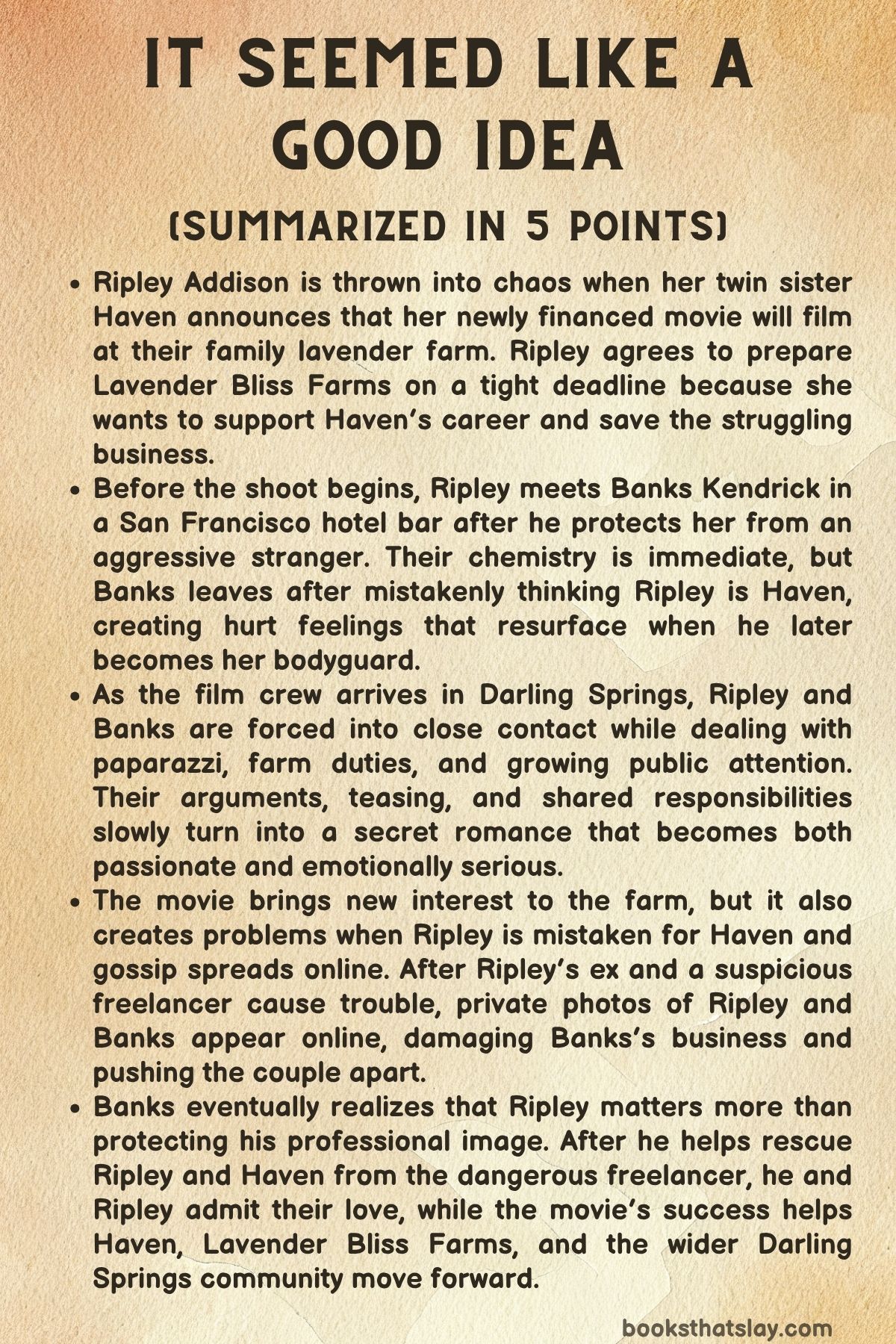
Ripley Addison’s life is already complicated before Hollywood arrives in Darling Springs. She runs Lavender Bliss Farms, her family’s lavender farm, and carries the weight of keeping the business alive.
The farm is beautiful, meaningful, and full of memories, but it is also expensive to maintain. Repairs, bills, product sales, tourism plans, and family responsibilities all sit on her shoulders.
When her twin sister Haven, a rising actress, announces that her newly financed movie will shoot key scenes at the farm, Ripley is shocked.
Haven is excited because the film could be the career breakthrough she has been chasing. The movie, Someone Else’s Ring, has finally secured funding, and the production needs Lavender Bliss Farms as a location.
Haven has to leave almost immediately, which leaves Ripley with less than a month to prepare the farm for cast, crew, equipment, and visitors. Ripley feels overwhelmed, but she agrees because she loves Haven and wants the movie to succeed.
She also hopes the attention might help the farm, bringing in tourists, product orders, and event opportunities.
Before returning home to face the rush of preparations, Ripley spends a night in San Francisco. At a hotel bar, she is bothered by a pushy man who refuses to leave her alone.
Banks Kendrick steps in and pretends to be her boyfriend, smoothly scaring the man away. Banks is a former Marine and now runs a private security company.
He is confident, observant, and calm under pressure, and Ripley is immediately drawn to him.
Their conversation turns playful and intense. They trade sharp comments, read each other well, and discover a quick, powerful attraction.
Banks makes her an origami bird, a small gesture that stays with her because it is unexpected and intimate. Their chemistry builds until they kiss, and they agree to meet in Ripley’s hotel room.
Ripley believes the night is becoming something exciting, maybe even unforgettable.
Before Banks reaches her room, he receives a work call. His firm has been hired to provide security for Haven’s movie.
When he sees Haven’s photo, he assumes that Ripley is actually Haven using a fake name. Because he thinks he nearly became involved with a client, he panics and leaves.
Instead of speaking to Ripley directly, he sends a short apology note through the hotel clerk. Ripley is left confused, embarrassed, and hurt.
She believes Banks changed his mind and rejected her without the courage to face her.
Weeks later, Ripley is back in Darling Springs and has worked hard to get Lavender Bliss Farms ready. The production is close to arriving, and the town is buzzing.
The movie becomes even bigger news when major star Chris Carlisle joins the cast. Rumors begin to spread that Chris and Haven might be romantically involved, which creates more attention for the film.
Because Ripley and Haven are identical twins, Ripley soon becomes part of the confusion. Paparazzi mistake her for Haven and begin following her.
One day in town, a photographer ambushes Ripley. Banks appears, now assigned as her bodyguard.
Ripley is furious to see the man who vanished after their night in San Francisco. Banks quickly realizes his mistake.
Ripley really was Ripley, not Haven. He tries to explain that he thought she was his client, but Ripley is not ready to forgive him.
To her, the explanation does not erase the humiliation of being abandoned with a note. Banks knows he handled it badly, but he also has a job to do.
For her safety, he moves into the guest cottage at the farm.
Their time together begins with tension. Ripley resents being watched, especially by the man who hurt her.
She tests Banks, argues with him, and tries to keep emotional distance. Banks remains patient and protective.
He follows her through town, helps with farm tasks, and proves that he is not only good at security but also thoughtful in practical ways. He gets along with Ripley’s grandmother Lila, who sees more than either of them wants to admit.
Slowly, Ripley’s anger mixes with attraction, and Banks’s professional control becomes harder to maintain.
As the film crew settles into the farm and the town, Ripley’s responsibilities increase. She manages the pressure of hosting production workers while continuing to care for Lavender Bliss.
She also helps on the movie set as Haven’s stand-in, using her identical appearance to support the production. The attention begins to help the farm.
People ask about picnics, lavender products, and visits. Ripley starts to see how the movie could become the turning point Lavender Bliss needs.
At the same time, the public attention creates trouble. Paparazzi continue chasing anything connected to Haven, Chris, and the film.
A photo of Ripley with Chris is mistaken for Haven and adds fuel to the false romance rumor between Haven and Chris. Ripley is not famous, but because she looks like Haven, she becomes trapped in celebrity gossip.
Banks worries about keeping her safe, but his feelings for her complicate everything. He knows their relationship could threaten his professional reputation and damage his security firm.
Ripley and Banks try to control their attraction, but the effort does not last. Their closeness grows through everyday moments: errands, farm work, charged conversations, and quiet time away from the chaos.
When the farmhouse becomes crowded with production people, Ripley moves into the cottage with Banks. They tell themselves they can manage the situation, but their relationship turns physical and then more emotional.
The connection that began in San Francisco returns with more honesty and vulnerability.
Banks sees Ripley’s devotion to her family, her farm, and her community. Ripley sees that Banks is more than the man who hurt her.
He is loyal, protective, and deeply affected by the responsibility he carries. Still, their relationship remains risky.
Banks has clients to satisfy, a company to protect, and a reputation built on trust. Ripley does not want to be the reason his business suffers.
Then Ripley’s ex, Eric Patrick, appears in town. His presence feels opportunistic, especially when he photographs her and seems eager to use her link to the movie for his own benefit.
Banks throws him out of the bar, making it clear that Ripley is not someone to exploit. Soon after, private photos of Banks and Ripley appear online.
The leak damages Banks’s firm and costs him a possible client. The scandal confirms the danger Banks feared: his personal relationship has become public and may harm his work.
Ripley and Banks make the painful decision to stop seeing each other. Ripley takes blame in order to protect him, even though the separation hurts them both.
They have fallen in love, but love seems to have arrived at the worst possible time. Banks tries to put duty first, while Ripley tries to protect him from further damage.
Their breakup is not caused by lack of feeling, but by the fear that being together will cost too much.
Banks eventually understands that losing Ripley is the greater risk. He begins looking more closely at the events around the leaked photos and the paparazzi trouble.
Suspicion turns toward Ian Joseph, a freelancer connected to the chaos. Banks realizes Ian is the same man who bothered Ripley at the hotel bar in San Francisco.
His instincts tell him the situation is not finished.
The danger reaches the lavender maze at the farm. Ian corners Ripley and Haven because he wants a valuable photo.
The twins use their identical appearance to confuse him and stall for time. They rely on quick thinking and self-defense, refusing to become helpless targets.
Banks, guided by Hudson, Ripley’s dog, follows them into the maze. He arrives in time to subdue Ian, who is arrested for trespassing and assault.
After the threat is over, Ripley and Banks are finally honest about what they mean to each other. Banks accepts that his love for Ripley is not a weakness or a professional failure.
Ripley allows herself to trust him again, not because the past disappears, but because he has shown up when it mattered. They choose to be together openly, no longer hiding behind fear, reputation, or timing.
Months later, the film premiere shows how much has changed. Haven is thriving in her career and is engaged to William.
Chris Carlisle is dating Katrina from the bakery, proving the earlier gossip was wrong. Lila has been enjoying a romantic adventure in Paris with Laurent.
Lavender Bliss Farms has gained from the success of the movie, bringing new attention and opportunity to the business Ripley fought so hard to save.
Ripley’s journey ends with both love and stability. She has supported her sister, protected the farm, faced public scrutiny, and found a partner who understands her strength.
Banks has learned that control cannot protect him from every kind of risk, especially the risk of loving someone. Together, they move forward with a relationship built from mistakes, courage, humor, and trust.
It Seemed Like a Good Idea closes Ripley and Banks’s story on a hopeful note while shifting toward another romance. Chloe, whose life is unraveling after losing an event-planning job, attends a dog party and notices an attractive man who seems unavailable.
Her situation hints at a new story filled with fresh complications, romantic possibility, and another chance for life to change in unexpected ways.
Characters
The characters in It Seemed Like a Good Idea are shaped by romance, ambition, family loyalty, public attention, and the pressure of protecting what matters most. The story uses its cast to explore how people respond when private emotions collide with professional duties, financial worries, fame, and unexpected danger.
Ripley Addison
Ripley Addison is the emotional center of the book, and her character is built around responsibility, resilience, vulnerability, and a deep devotion to family. She is not simply a romantic lead; she is a woman carrying the weight of Lavender Bliss Farms, her sister’s career opportunity, and her own uncertain future.
Her decision to let the film crew use the farm shows how much she is willing to sacrifice for Haven, even when the arrangement threatens to overwhelm her already fragile situation. Ripley’s strength lies in the fact that she keeps moving forward despite anxiety, embarrassment, financial pressure, and emotional hurt.
She is practical and hardworking, but she is also deeply sensitive, which is why Banks’s sudden disappearance after their first meeting affects her so strongly.
Ripley’s relationship with Banks reveals many sides of her personality. At first, she protects herself with anger, sarcasm, and resistance because she does not want to be hurt again.
Yet beneath that defensiveness, she remains open to connection, affection, and trust. Her chemistry with Banks is intense, but the more important part of her arc is emotional: she learns to balance caution with honesty and independence with vulnerability.
She is also brave in moments of danger, especially when she and Haven use their twin connection and quick thinking to stall Ian. As the central character of It Seemed Like a Good Idea, Ripley represents a person who is trying to save her home, protect her heart, and still find room for love.
Banks Kendrick
Banks Kendrick is one of the most important characters in the book because he brings together protection, discipline, desire, guilt, and emotional growth. As a former Marine and the head of a private security firm, he is used to control, responsibility, and professional boundaries.
His first meeting with Ripley shows his instinctive protectiveness, as he steps in when she is being harassed, but it also shows his charm and emotional intelligence. He does not merely scare away the aggressive man; he connects with Ripley through wit, attention, and tenderness, symbolized by the origami bird he makes for her.
Banks’s major flaw is not cruelty but fear of crossing professional lines and damaging his company’s reputation. When he mistakenly believes Ripley is Haven, he makes a rushed decision and leaves without giving Ripley the respect of a full explanation.
This mistake creates the central emotional conflict between them. Throughout the story, Banks must learn that professionalism cannot become an excuse for emotional cowardice.
His protective nature is admirable, but it sometimes makes him overthink risk and underestimate the importance of honesty. His eventual choice to stand by Ripley openly shows his growth.
By the end, Banks becomes more than a bodyguard or love interest; he becomes a man who understands that love requires courage, not just control.
Haven Addison
Haven Addison is Ripley’s twin sister, and her character adds glamour, pressure, and emotional complexity to the story. As an actress whose career is rising, Haven’s opportunity to make a major film brings both excitement and disruption to Ripley’s life.
Her decision to shoot important scenes at the family farm is not selfish in a simple way; it comes from ambition, hope, and a belief that the film could also help the farm. However, because she leaves Ripley to handle much of the preparation, Haven’s dream becomes Ripley’s burden.
This creates a meaningful contrast between the sisters: Haven is connected to public life and performance, while Ripley is tied to the land, labor, and family responsibility.
Haven’s twin bond with Ripley is central to her role. Their identical appearance drives mistaken identity, paparazzi confusion, gossip, and danger, but it also becomes a source of strength.
In the confrontation with Ian, Haven and Ripley use their similarity as a tactic, showing that their twinship is not just a plot device but a form of shared intelligence and loyalty. Haven also grows into a more settled and fulfilled version of herself by the end, thriving professionally and finding happiness with William.
She represents the rewards and costs of fame, as well as the complicated way one sister’s success can reshape another sister’s life.
Lila
Lila, Ripley and Haven’s grandmother, brings warmth, humor, wisdom, and emotional grounding to the book. She is closely connected to Lavender Bliss Farms and represents family history, continuity, and the older generation’s perspective on love and life.
Her presence helps soften the tension around the film shoot and the romance between Ripley and Banks. She sees more than people realize, and her bond with Banks suggests that she recognizes his sincerity before Ripley is fully ready to trust him again.
Lila is also important because she is not written only as a quiet background elder. Her life has movement, pleasure, and romance of its own, especially through her time in Paris with Laurent.
This gives her character a sense of independence and charm. She reminds the younger characters that life does not stop being surprising or romantic with age.
In the story, Lila functions as a stabilizing influence, but she also reflects one of the book’s larger ideas: love can arrive unexpectedly, and joy is worth pursuing at every stage of life.
Chris Carlisle
Chris Carlisle is a major star whose arrival increases the pressure surrounding the film shoot. His celebrity status turns the production into a bigger event and brings more attention to Darling Springs, Ripley, Haven, and the farm.
Chris’s presence intensifies the paparazzi problem, especially when photographs and gossip blur the line between truth and public fantasy. Because of his fame, ordinary moments become exaggerated into rumors, and Ripley is pulled into a level of attention she never asked for.
Chris is not presented as a villain. Instead, he represents the machinery of celebrity and how easily public narratives can be created around people.
The fake romance rumor involving Haven affects several characters, and Ripley’s mistaken connection to Chris shows how fame can distort identity. His later relationship with Katrina also gives him a more personal dimension, suggesting that beneath the public image, he is capable of genuine affection and ordinary romantic happiness.
His role helps show the contrast between celebrity spectacle and real emotional intimacy.
Eric Patrick
Eric Patrick, Ripley’s ex, represents intrusion, opportunism, and the discomfort of having one’s past return at the wrong moment. His appearance in town is unsettling because he seems interested not in Ripley as a person but in exploiting her connection to the movie.
By photographing her and inserting himself into the chaos around the production, Eric becomes a reminder of relationships that leave behind distrust and emotional residue. He is not as dangerous as Ian, but he still violates Ripley’s sense of privacy.
Eric’s role also helps reveal Banks’s protective instincts. When Banks throws him out of the bar, the scene shows both his anger on Ripley’s behalf and the tension between personal feeling and professional restraint.
Eric functions as a smaller but meaningful obstacle in Ripley’s life. He shows how fame and attention can attract people who want access, advantage, or control.
Through him, the book emphasizes Ripley’s need to be protected not because she is weak, but because her life has become vulnerable to people who see her as an opportunity.
Ian Joseph
Ian Joseph is the most threatening antagonist in the book because his behavior escalates from harassment to stalking, trespassing, and assault. He first appears as the aggressive man bothering Ripley in the hotel bar, and this early moment establishes him as someone who ignores boundaries and feels entitled to women’s attention.
Later, when he reappears as a freelancer trying to get a valuable photo, his motives become more calculated. He is driven by greed, obsession, and the desire to profit from access to private people.
Ian’s role is important because he turns the dangers of publicity into something physical and immediate. The paparazzi and gossip are already invasive, but Ian embodies the worst version of that world: someone willing to corner and threaten people for a photograph.
His confrontation with Ripley and Haven also allows the sisters to demonstrate courage and cleverness. Ian is not only a plot villain; he represents the predatory side of fame, where personal safety and dignity can be sacrificed for a marketable image.
Hudson
Hudson, Ripley’s dog, adds affection, loyalty, and instinctive protection to the story. His presence gives Ripley’s world warmth and makes the farm feel more personal and lived-in.
He is also part of the emotional texture of Ripley’s life, showing her capacity for care and companionship outside romance and family duty. In scenes involving Banks, Hudson helps create a domestic and trustworthy atmosphere, allowing Banks to become more integrated into Ripley’s world.
Hudson becomes especially important during the final danger involving Ian. His instincts help lead Banks into the lavender maze, which makes him more than a cute side presence.
He becomes part of the rescue and reinforces the story’s theme that loyalty can come in many forms. Hudson’s role may be smaller than the human characters’, but he strengthens the emotional bond between home, safety, and love.
William
William is connected most strongly to Haven’s happy ending. Although he does not dominate the central action, his engagement to Haven shows that her life has moved toward emotional stability as well as professional success.
His presence suggests that Haven’s story is not only about fame or career growth but also about finding a lasting personal relationship. Through William, the book gives Haven a romantic resolution that parallels Ripley’s without taking focus away from the main couple.
William’s importance lies in what he represents for Haven. He signals commitment, steadiness, and a future beyond the pressures of the film.
Since Haven’s career creates much of the disruption in Ripley’s life, William’s role in the ending helps soften that disruption by showing Haven settled and happy. He contributes to the sense of closure in the final scenes.
Katrina
Katrina, who is connected to the bakery, becomes significant through her relationship with Chris. Her role suggests the blending of the celebrity world with the local community of Darling Springs.
Chris’s relationship with her gives a quieter, sweeter outcome to a character surrounded by fame and gossip. Katrina also helps show that the town is not merely a background setting; it is full of people whose lives are touched by the film’s presence.
Through Katrina, the book offers a contrast to the false gossip surrounding Chris and Haven. While the public may invent stories, Chris’s actual romantic interest develops elsewhere.
Katrina therefore represents sincerity in contrast to rumor. Her connection with Chris helps reinforce the idea that real relationships are often more meaningful than the narratives created by outsiders.
Laurent
Laurent is associated with Lila’s life in Paris and represents romance, renewal, and adventure later in life. His role is not central to the main conflict, but he adds charm and emotional breadth to the ending.
Through him, Lila is shown as someone who continues to seek joy and companionship rather than remaining only in the role of grandmother or family elder.
Laurent’s presence also expands the story’s view of love. Romance is not limited to Ripley and Banks or Haven and William.
By giving Lila a romantic connection, the book suggests that affection, excitement, and new beginnings are possible at any age. Laurent helps make the ending feel fuller and more generous, giving multiple characters a sense of happiness and forward movement.
Chloe
Chloe appears near the end as part of a setup for another story, and her character immediately introduces a different kind of emotional tension. Her life is falling apart after losing an event-planning job, which positions her as someone facing instability, disappointment, and the need to rebuild.
Her presence shifts the focus from Ripley’s completed romantic arc to a new character standing at the edge of her own transformation.
Chloe’s reaction at the dog party, especially when she notices an attractive man who appears to be unavailable, creates curiosity and romantic anticipation. She seems to be entering the story from a place of personal frustration and uncertainty, which makes her relatable.
While her role here is brief, it is designed to suggest that she may become the center of a future emotional journey involving career recovery, romantic confusion, and a fresh chance at happiness.
Themes
Trust After Misunderstanding
Ripley and Banks begin with attraction, but their connection is immediately damaged by confusion, fear, and poor communication. In It Seemed Like a Good Idea, Banks’s decision to leave without properly explaining himself makes Ripley feel rejected, even though his action comes from panic rather than cruelty.
This early mistake shapes the way she sees him when he reappears as her bodyguard. Trust does not return easily because Ripley has to decide whether Banks is someone who will stay when things become difficult or disappear again when responsibility feels complicated.
Banks also has to learn that protecting someone is not only about physical safety; it also requires honesty, emotional courage, and respect for the other person’s feelings. Their relationship grows through repeated moments where Banks proves himself through action rather than promises.
The theme shows that trust is not rebuilt through a single apology, but through steady consistency, accountability, and the willingness to face the damage caused by one’s choices.
Duty, Sacrifice, and Family Loyalty
Ripley’s choices are strongly shaped by loyalty to her sister, her grandmother, and the farm that represents her family’s history. Haven’s movie brings pressure, disruption, and risk, yet Ripley agrees to support it because she wants her sister’s career to succeed.
This decision places her in a difficult position: she must manage repairs, finances, public attention, and the emotional burden of being mistaken for someone else. Her sense of duty is admirable, but it also reveals how easily she carries other people’s needs before her own.
The lavender farm becomes more than a setting; it represents responsibility, inheritance, and the quiet sacrifices made to keep something meaningful alive. Ripley’s loyalty is not passive.
She works, adapts, protects, and endures discomfort because she believes in the people she loves. At the same time, the story suggests that sacrifice should not mean losing oneself.
Ripley’s journey shows the need to balance family devotion with personal happiness and emotional self-respect.
Public Image and Private Identity
The arrival of the film crew turns Ripley’s ordinary life into something watched, judged, and misunderstood by outsiders. Because she looks exactly like Haven, strangers and paparazzi project a false identity onto her, treating her less as a person and more as a useful image.
This creates tension between who Ripley really is and what the public assumes her to be. The fake romance rumors, mistaken photographs, and online gossip show how easily appearances can replace truth when people are eager for scandal.
Banks faces a similar conflict because his private relationship with Ripley threatens his professional image and the reputation of his security firm. The theme examines the cost of living under public attention, especially when private moments are taken out of context.
Ripley’s struggle is not only about avoiding photographers; it is about protecting her right to define herself. The story shows that identity must be defended when outside voices try to rewrite it for attention, profit, or entertainment.
Love as Risk and Choice
Ripley and Banks’s romance develops under pressure, making love feel less like an escape and more like a decision that carries consequences. Their attraction is clear from the beginning, but emotional commitment becomes difficult because of professional boundaries, past hurt, public exposure, and fear of loss.
Banks worries that choosing Ripley could damage his company, while Ripley fears being hurt again by someone who once walked away. Their separation after the leaked photos shows how love can be tested by reputation, responsibility, and timing.
Yet the story does not present love as careless impulse. Instead, it becomes meaningful because both characters must decide what they are willing to risk.
Banks’s growth is seen when he understands that protecting his career cannot come at the cost of denying what truly matters to him. Ripley’s growth comes from allowing herself to believe in love without surrendering her strength.
Their final openness shows that love requires courage, not just chemistry.