Lassoed Love Summary, Characters and Themes
Lassoed Love by Ann Einerson is a small-town cowboy romance about Birdie Matterson, a kind but overwhelmed animal rescuer, and Walker Halstead, the rancher and volunteer deputy who has loved her quietly for years. Set in Bluebell, Montana, the book mixes fake dating, friends-to-lovers tension, family strain, animal rescue chaos, and slow-building trust.
Birdie is used to carrying everyone and everything on her own, from her mother’s illness to her crowded sanctuary. Walker becomes the person who sees her clearly, protects her without taking over, and helps her believe she deserves care, desire, and a future that is not built on survival alone. It’s the 2nd book of the Silver Saddle Ranch series.
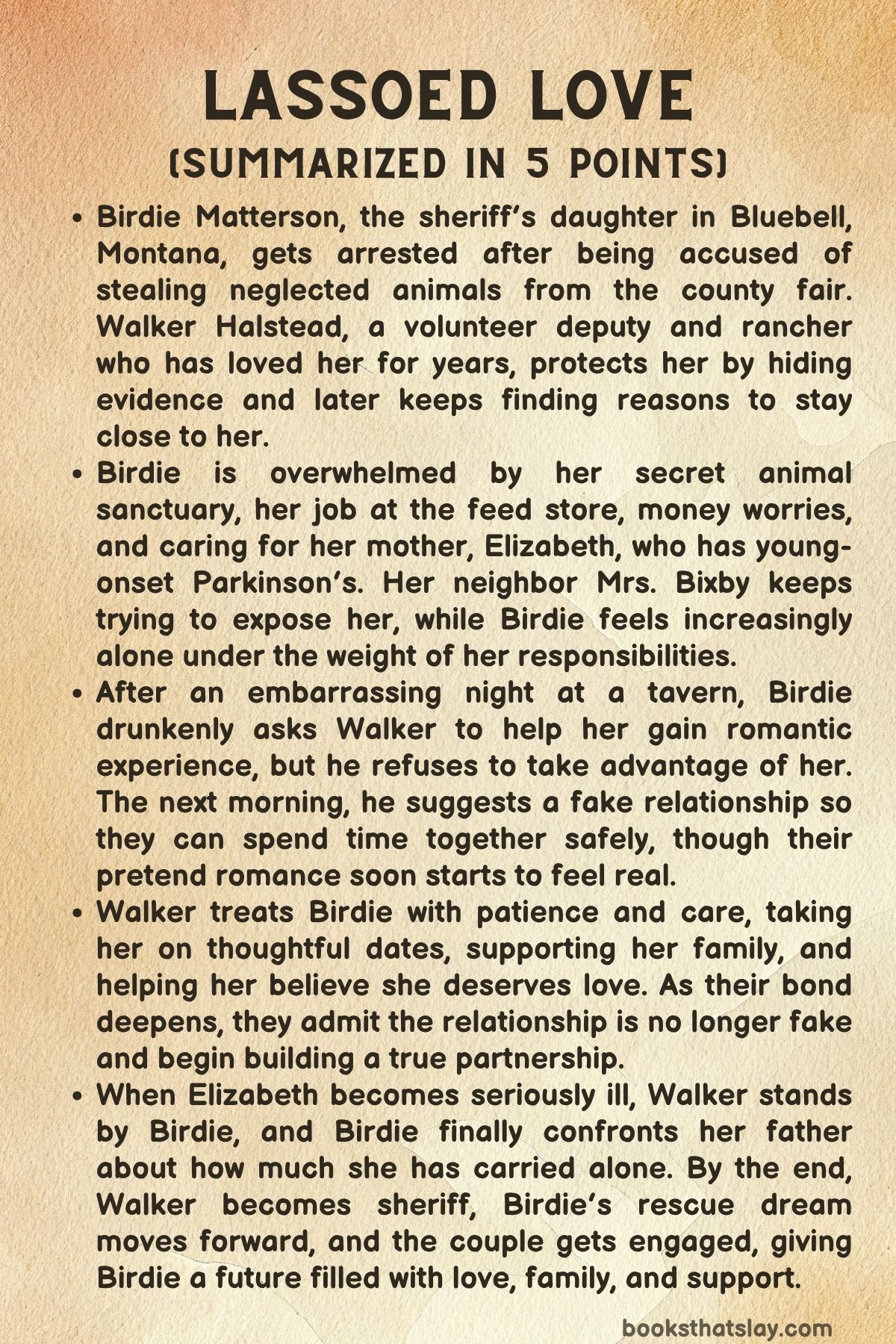
Summary
Lassoed Love begins in Bluebell, Montana, where Birdie Matterson has already earned a reputation for loving animals more than rules. As the sheriff’s daughter, she should know better than to get into trouble, but her compassion keeps leading her into risky situations.
When neglected animals at the county fair are left in poor conditions, Birdie cannot look away. She is accused of trespassing and stealing them, and the situation lands her in a holding cell.
Walker Halstead, a rancher and volunteer deputy, finds her there. He knows Birdie well because she is close to his sister Briar, but his feelings for her go far beyond friendship.
He has loved her for years, though Birdie has never really understood that. To her, Walker is steady, familiar, handsome, and slightly out of reach.
To Walker, she is the woman he cannot stop choosing, even when she has no idea what is in his heart.
At the station, Walker teases Birdie, but he also quietly protects her. He hides the evidence that could connect her to the rescued animals, making sure she has a chance to walk away without the situation becoming worse.
Birdie leaves with her friends Briar and Charlie, but the arrest does not change who she is. She returns home to the crowded, messy, loving world she has created: an unofficial sanctuary full of rescued animals, including Daisy the cow, Peaches the donkey, Nugget the chicken, ducks, geese, pigs, rabbits, and many others who depend on her.
Birdie’s home life is chaotic, but the chaos comes from care. She works at the feed store, looks after the animals, and helps care for her mother, Elizabeth, who has young-onset Parkinson’s and needs constant support.
Birdie’s father, Sheriff Matterson, loves his family, but he has struggled to face the emotional weight of Elizabeth’s illness. Because of this, Birdie often feels as though she is carrying more than a daughter should have to carry.
On top of that, her neighbor Mrs. Bixby watches her closely, determined to catch proof that Birdie is keeping stolen animals.
Walker keeps finding reasons to be near Birdie. He stops by the feed store, brings her lunch, offers supplies, and checks on her even when he pretends it is casual.
Birdie appreciates him, but she is also insecure. She has little dating experience and feels awkward around men, especially when attraction is involved.
She sees herself as inexperienced and clumsy, not as someone a man like Walker could truly want.
One night, overwhelmed by her insecurities and tired of feeling left behind, Birdie decides to go to Blue Moon Tavern alone. She wants to prove to herself that she can flirt, be bold, and maybe find someone to hook up with.
The night goes badly. She drinks, embarrasses herself with another man, and becomes upset.
Walker sees what is happening and steps in, not as someone trying to control her but as someone determined to keep her safe.
Birdie ends up in Walker’s lap and, while drunk, asks him to be her first and teach her about flirting and sex. Walker wants her, but he refuses to take advantage of her vulnerability.
Instead, he takes her home, cares for her while she is sick, and sleeps on the floor so he can make sure she is all right. His actions show the kind of man he is: protective, patient, and deeply aware that Birdie deserves respect even when she is too embarrassed to demand it.
The next morning, Birdie remembers enough to feel mortified. Walker does not shame her.
Instead, he suggests a fake relationship. The arrangement will give them a reason to spend time together, and he can help her learn about dating and intimacy in a safe way.
Birdie agrees, but she sets rules. Their friends and families cannot know the truth, and the arrangement must stay controlled.
Of course, in a town like Bluebell, nothing stays private for long. Their fake relationship quickly becomes gossip.
Walker’s mother is thrilled. Birdie’s friends question her.
Sheriff Matterson warns Walker not to hurt his daughter. What begins as a practical arrangement soon starts looking real to everyone around them, and even more importantly, it begins feeling real to Birdie and Walker.
Walker takes Birdie on a thoughtful first date. He buys her flowers, takes her to a drive-in movie, and shows her how she should expect to be treated.
He does not rush her or make her feel foolish for what she does not know. He teaches her that attraction does not need to come with pressure and that intimacy should be built on trust.
Birdie slowly becomes more comfortable with him, and the lessons stop feeling like lessons. Their kisses become more serious.
Their time together becomes more natural. The line between pretending and truth begins to disappear.
As their relationship grows, Birdie’s responsibilities continue to press in on her. She still works, rescues animals, worries about money, and dreams of making her sanctuary official.
The land behind her property could help her expand, but it feels out of reach. Mrs. Bixby continues trying to expose her, and when Sheriff Matterson comes to Birdie’s property after another report, Birdie fears the worst.
Instead of punishing her, her father chooses to stand up for her. This becomes one of the first signs that he understands more than she thought.
Walker later learns that Sheriff Matterson has quietly been looking for ways to help Birdie, including matters connected to the land she hopes to buy. This discovery shifts how Walker sees him.
The sheriff may have been distant in painful ways, but he has not been completely unaware of Birdie’s burden or dreams.
Birdie and Walker eventually admit that what they have is no longer fake. Walker makes it clear that he has wanted her for a long time, not because of the arrangement, not because she asked him to teach her, but because his feelings have been there for years.
Birdie begins to see that Walker has not been playing a role. He has been showing her the truth in the only way she could accept it.
Their bond deepens when Elizabeth becomes seriously ill with pneumonia and has to be hospitalized. Birdie is terrified.
Her mother’s illness has already shaped so much of her life, and this crisis forces every hidden fear to the surface. Walker stays with her through it, giving her the support she usually gives everyone else.
He does not fix the pain, but he stands beside her in it.
During this difficult time, Birdie and her father finally face the strain in their family. Birdie admits how alone she has felt and how much she has had to manage.
Sheriff Matterson is forced to confront his own avoidance of Elizabeth’s illness and the way his grief has left Birdie carrying too much. Their conversation does not erase the hardship, but it opens a path toward honesty and healing.
Elizabeth improves enough to come home, and Birdie begins to understand that she does not have to keep proving she can survive by herself. Walker has become her safe place, not by taking over her life, but by sharing its weight.
Birdie and Walker confess their love, and their future starts to feel possible. Walker speaks with the sheriff about building a life with Birdie and helping her expand the sanctuary she has dreamed of for so long.
By the end of Lassoed Love, Birdie is no longer standing alone in the middle of her messy, overfilled life. Her family, friends, and community begin showing up for her.
Walker becomes sheriff, stepping into a role that suits his steadiness and sense of duty. Birdie’s animal rescue dream moves closer to becoming real, supported by people who finally recognize the value of what she has been doing.
The romance reaches its happy ending when Walker and Birdie get engaged. Six months later, on the eve of their wedding, Birdie looks back on everything that brought them there: the arrest, the fake dating plan, the awkward lessons, the family crisis, and the love that had been waiting beneath it all.
What began as an arrangement built around insecurity becomes a lasting partnership. Birdie’s life is still full of noise, animals, work, and responsibility, but it is no longer defined by loneliness.
With Walker beside her, she steps into a future built on love, trust, and the knowledge that she is finally being cared for too.
Characters
Birdie Matterson
Birdie Matterson is the emotional center of Lassoed Love, and her character is built around compassion, responsibility, loneliness, and quiet courage. As the sheriff’s daughter in Bluebell, Montana, she carries a public identity that should make her cautious, yet she repeatedly breaks rules when she believes neglected animals need saving.
Her arrest at the beginning of the story shows this contradiction clearly: Birdie is not reckless because she wants attention, but because her sense of justice is stronger than her fear of consequences. Her unofficial sanctuary reveals her deepest nature.
She is nurturing, stubborn, and self-sacrificing, willing to give her time, money, space, and emotional energy to creatures no one else protects.
Birdie’s kindness, however, is not presented as effortless. She is overwhelmed by work, financial stress, animal care, and the round-the-clock needs of her mother.
This makes her a deeply sympathetic character because her warmth often hides exhaustion. She has learned to function as a caretaker before she has fully learned how to be cared for herself.
Her insecurity in romance adds another vulnerable layer to her personality. She is embarrassed by her lack of dating experience and believes she is awkward or undesirable, which makes her attempt to find confidence at the tavern both painful and revealing.
Birdie wants intimacy, but she also wants safety, respect, and reassurance, even before she fully knows how to ask for those things.
Her development comes through learning that love does not have to be another burden. Through Walker’s patience, she begins to understand that she deserves gentleness, honesty, and devotion.
Her relationship with him helps her grow, but it does not erase her strength; instead, it allows her to stop carrying everything alone. Birdie’s journey is not only romantic but personal.
She learns to accept help, confront family pain, and imagine a future in which her rescue work can become something stable and supported. By the end of the book, Birdie remains compassionate and chaotic, but she is no longer isolated.
Her growth lies in realizing that being strong does not mean refusing support.
Walker Halstead
Walker Halstead is one of the most steady and emotionally mature characters in the book. From his first major interaction with Birdie in the holding cell, he shows a mix of teasing affection and protective loyalty.
He hides the evidence that could connect her to the rescued animals, not because he lacks respect for the law, but because he understands her motives and wants to protect someone he deeply cares about. Walker’s love for Birdie has existed quietly for years, and this long-standing devotion shapes much of his behavior.
He is patient rather than forceful, present rather than demanding, and protective without trying to control her.
One of Walker’s strongest qualities is restraint. When Birdie drunkenly asks him to teach her about flirting and sex, he refuses to take advantage of her vulnerability.
This moment defines his character more powerfully than any romantic declaration could. He wants Birdie, but he values her trust and safety more than his own desire.
His care afterward, including taking her home, looking after her while she is sick, and sleeping on the floor, shows that his love is practical and respectful. Walker does not simply say the right things; he proves his character through small, consistent actions.
Walker’s role in the romance is also important because he teaches Birdie what healthy affection can look like. His thoughtful date, flowers, patience, and emotional reassurance show her that intimacy should be rooted in respect.
Yet Walker is not only a romantic ideal; he is also a man imagining a future. His conversations with the sheriff, his support of Birdie’s sanctuary dream, and his eventual role as sheriff show that he is ready for responsibility.
In Lassoed Love, Walker represents the kind of love that steadies rather than overwhelms. His arc is quieter than Birdie’s, but it is meaningful because he moves from loving her silently to openly building a life with her.
Sheriff Matterson
Sheriff Matterson is a complicated father figure whose character is shaped by love, fear, duty, and emotional avoidance. As the sheriff, he represents law and order in Bluebell, yet his own daughter constantly challenges legal boundaries through her animal rescues.
His position creates tension because he must balance his public responsibilities with his private understanding of Birdie’s intentions. When he appears at Birdie’s property after Mrs. Bixby’s suspicions, the scene could easily become punitive, but instead it reveals that he is not blind to his daughter’s goodness.
He may disapprove of her methods, but he understands her heart.
His relationship with Birdie is strained because he has not fully faced the emotional reality of Elizabeth’s illness. Rather than sharing the burden equally, he has allowed Birdie to carry too much.
This does not make him cruel, but it does make him flawed. His avoidance comes from pain and fear, yet the result is that Birdie feels alone in her own family.
His character matters because he shows how love can become inadequate when it is not accompanied by action. He cares deeply, but for much of the story, his care is not expressed in the ways Birdie most needs.
His growth appears when he begins to support Birdie more openly. He secretly works on ways to help her, including matters connected to the land behind her property and the future of her rescue dream.
He also has to confront the fact that his daughter has been acting as a caretaker, rescuer, employee, and emotional anchor all at once. By the end of the story, Sheriff Matterson becomes a more honest and supportive father.
His arc is about moving from avoidance to involvement, and from quiet concern to visible support.
Elizabeth Matterson
Elizabeth Matterson is one of the most emotionally significant characters in the story, even though much of her role is shaped by illness. Her young-onset Parkinson’s affects the entire Matterson family, especially Birdie, who takes on much of her care.
Elizabeth represents both love and loss within the household. She is not simply a source of hardship; she is Birdie’s mother, someone whose presence still matters deeply and whose vulnerability exposes the emotional pressure Birdie has been living under.
Her illness creates a quiet sadness throughout the book because it changes family roles. Birdie becomes more than a daughter; she becomes a caregiver.
Sheriff Matterson becomes a husband struggling to face the reality of decline. Elizabeth’s pneumonia and hospitalization intensify these tensions, forcing the family to confront fears they have tried to manage privately.
Through Elizabeth, the story explores how illness can reshape a home, not only physically but emotionally.
Elizabeth’s improvement and return home bring relief, but they do not erase the difficulty of her condition. Her character helps reveal Birdie’s devotion and also the unfairness of Birdie’s isolation.
She is important because she gives the story emotional weight beyond romance. Elizabeth’s presence reminds readers that love is not only found in courtship, but also in caregiving, endurance, and the painful hope that families hold onto during illness.
Briar Halstead
Briar Halstead is Birdie’s friend and Walker’s sibling, which places her in an interesting position between the central couple. She is part of Birdie’s support circle and one of the people who helps create the lively community around her.
Briar’s presence shows that Birdie is not completely friendless, even though she often feels alone in her responsibilities. As Walker’s sister, Briar also helps define how Birdie originally sees Walker: not as a romantic possibility, but as someone connected to a familiar friendship network.
Briar’s reaction to Birdie and Walker’s fake relationship adds humor and social pressure to the story. Like the other people close to Birdie, she is curious, suspicious, and invested.
Her questioning reflects the closeness of the friend group and the way small-town relationships rarely remain private for long. Briar helps show that Birdie’s choices do not happen in isolation; they ripple through family, friendship, and community.
Although Briar is not the main focus of the book, she is important because she helps frame the warmth surrounding Birdie. Her role emphasizes friendship, loyalty, and the playful scrutiny that comes from people who care.
She also strengthens Walker’s characterization by showing that he comes from a family and social world that Birdie already partially belongs to.
Charlie
Charlie is another important member of Birdie’s circle of friends, and her role helps bring out the social and comedic side of the story. She is present when Birdie leaves the holding cell, which immediately places her among the people who know Birdie’s chaotic tendencies and still stand by her.
Charlie’s friendship contributes to the sense that Birdie is surrounded by people who may question her choices but do not abandon her.
Charlie’s function in the story is partly to create pressure around Birdie’s fake relationship with Walker. When Birdie’s friends interrogate her, it shows how difficult it is for Birdie to keep emotional secrets.
Charlie represents the kind of friend who notices changes, asks questions, and refuses to let major developments pass quietly. This gives the romance a public dimension, making Birdie and Walker’s arrangement feel less controlled than they intended.
Charlie also helps balance the heavier themes of illness, caregiving, and financial stress. Her presence contributes to the community feeling of the book.
Through characters like Charlie, Birdie’s world becomes fuller and more believable. She is not only a woman falling in love; she is a friend, daughter, employee, rescuer, and member of a town where everyone seems to know everyone else’s business.
Mrs. Bixby
Mrs. Bixby functions as an antagonist in the story, though she is more of a nosy neighborhood threat than a deeply villainous figure. Her repeated attempts to catch Birdie keeping stolen animals create tension around the sanctuary.
She represents social judgment, surveillance, and the danger of good intentions being misunderstood or exposed. To Birdie, Mrs. Bixby is not just irritating; she is a real threat to the fragile world Birdie has built for her rescued animals.
Her character is effective because she pressures Birdie from the outside. Birdie already faces emotional and financial stress, but Mrs. Bixby adds the fear of being reported and punished.
She also reflects the small-town environment where privacy is limited and reputation matters. In a larger city, Birdie’s sanctuary might remain hidden longer, but in Bluebell, someone like Mrs. Bixby can turn suspicion into conflict quickly.
Mrs. Bixby’s role also helps reveal the difference between legality and morality in the story. Birdie may technically be crossing lines by taking neglected animals, but Mrs. Bixby’s desire to expose her feels less compassionate than Birdie’s actions.
This contrast encourages the reader to think about justice beyond rules. Mrs. Bixby may believe she is right, but the story positions her as someone more interested in catching Birdie than understanding why Birdie acts.
Walker’s Mother
Walker’s mother is a warm supporting character who helps create the family atmosphere around Walker and Birdie’s romance. Her excitement about their supposed relationship adds humor and tenderness to the story.
She is thrilled not because she wants to interfere cruelly, but because she sees the possibility of happiness between two people who already belong in each other’s lives. Her reaction reflects the affectionate meddling often found in close families and small communities.
Her character also helps show that Walker’s love for Birdie is not sudden or shallow. The people around him seem aware of his feelings, or at least ready to believe in the match.
Walker’s mother helps make the romance feel rooted in a larger social world rather than existing only between the couple. Her approval gives warmth to Birdie’s gradual entrance into Walker’s future.
Though she is a minor character, Walker’s mother contributes to the hopeful tone of the story. She represents family acceptance, emotional enthusiasm, and the joy of seeing love develop.
In contrast to Birdie’s heavier family responsibilities, Walker’s family brings a sense of welcome and celebration.
Daisy
Daisy the cow is one of the rescued animals who helps define Birdie’s sanctuary and, by extension, Birdie herself. Daisy is not just background detail; she represents the kind of vulnerable life Birdie feels compelled to protect.
Through Daisy, the reader sees that Birdie’s compassion is specific and active. She does not love animals in a vague way; she gives them names, homes, care, and emotional importance.
Daisy also helps create the chaotic charm of Birdie’s life. A cow at an unofficial sanctuary is not easy to hide, especially with a suspicious neighbor nearby.
This makes Daisy part of both the humor and the tension of the story. Her presence reminds readers that Birdie’s rescue work is loving but also impractical, expensive, and risky.
As part of Birdie’s animal family, Daisy symbolizes the dream Birdie is trying to build. Birdie wants her sanctuary to become legitimate and secure, and animals like Daisy are the reason that dream matters.
Daisy’s character role is therefore symbolic as well as practical: she represents the lives Birdie saves and the future she hopes to create.
Peaches
Peaches the donkey adds warmth, humor, and personality to Birdie’s rescue world. Like Daisy, Peaches helps show that the sanctuary is not an abstract project but a living, noisy, demanding household full of individual creatures.
Peaches contributes to the sense that Birdie’s home is unconventional but deeply loving. Every animal has a place, and that reflects Birdie’s instinct to make room for those who have been neglected.
Peaches also reinforces Birdie’s identity as someone who sees worth where others may see inconvenience. A rescued donkey requires care, space, and patience, yet Birdie takes that responsibility seriously.
Her bond with animals like Peaches shows that her compassion is not selective or easy. She protects the awkward, the messy, and the unwanted.
Within the story, Peaches helps soften the emotional heaviness surrounding Birdie’s life. The sanctuary animals bring comedy and tenderness into scenes that might otherwise be dominated by stress.
Peaches stands as part of the lovable disorder that makes Birdie’s world distinctive.
Nugget
Nugget the house chicken is one of the clearest examples of the story’s humor and Birdie’s eccentric tenderness. A chicken living inside the house immediately communicates that Birdie’s boundaries between home, sanctuary, and emotional refuge are unusual.
Nugget makes Birdie’s compassion feel vivid and memorable because the animal rescue work is not neat or distant; it is inside her daily life, sometimes literally inside her home.
Nugget also reflects Birdie’s refusal to treat vulnerable creatures as disposable. To others, a chicken might seem ordinary or replaceable, but to Birdie, Nugget matters.
This detail reveals how deeply Birdie personalizes care. She does not rescue animals for praise or appearances; she does it because she cannot ignore suffering.
As a character within the animal group, Nugget adds charm and comic texture to the book. The house chicken helps make Birdie’s life feel chaotic, affectionate, and unmistakably her own.
Nugget symbolizes the way Birdie’s love overflows conventional limits, even when that overflow creates complications.
Themes
Love Built on Respect and Emotional Safety
In Lassoed Love, romance grows because Walker treats Birdie’s vulnerability with patience rather than using it for his own advantage. When Birdie asks him to be her first while she is drunk and emotionally unsettled, his refusal becomes one of the strongest proofs of his care.
He does not shame her, mock her, or make her feel foolish; instead, he protects her dignity and makes sure she is safe. Their fake relationship then becomes a space where Birdie can learn what affection, desire, and trust should feel like without pressure.
Walker’s love is not shown only through grand romantic gestures, but through steady attention: bringing food, offering help, respecting boundaries, and teaching her that she deserves gentleness. This theme matters because Birdie begins the story unsure of herself, especially in romance, yet Walker helps her see that intimacy should never require embarrassment or fear.
Their relationship becomes real because it is based on consent, patience, and emotional security.
The Burden of Caregiving and Silent Responsibility
Birdie’s life is shaped by responsibility long before romance becomes central to her story. Her mother’s illness has forced her into a role that is loving but exhausting, and she carries much of that weight quietly.
She works, rescues animals, manages the sanctuary, worries about money, and also tries to provide the care her mother needs. The emotional strain comes not only from the illness itself but from Birdie’s sense that she has been left to handle too much alone.
Her father’s avoidance adds to that pressure because it makes Birdie feel unseen within her own family. This theme shows how caregiving can become both an act of devotion and a source of loneliness.
Birdie loves her mother deeply, but love does not erase exhaustion. The story presents caregiving as something that requires community, honesty, and shared effort.
When Birdie finally confronts her father, the moment becomes important because she stops hiding the cost of being strong.
Compassion for the Vulnerable
Birdie’s rescue work reflects a deep instinct to protect those who cannot protect themselves. Her animals are not treated as background details; they reveal her character and her refusal to ignore suffering.
Whether she is caring for Daisy, Peaches, Nugget, or other neglected creatures, Birdie acts from a belief that vulnerability deserves action, not pity from a distance. Her choices are sometimes messy and even legally risky, but they come from moral urgency.
This theme connects her animal rescues with her wider emotional life. Birdie understands what it means to be overwhelmed, overlooked, and in need of help, so she responds strongly when she sees helplessness in others.
The sanctuary becomes more than a chaotic home full of animals; it represents her dream of turning compassion into something lasting and organized. The support she eventually receives from Walker, her father, and the community suggests that kindness becomes stronger when it is not carried by one person alone.
From Isolation to Community Support
Birdie begins in a crowded life yet still feels deeply alone. She has friends, family, animals, and work around her, but the emotional labor of her daily life makes her feel isolated.
Much of her struggle comes from believing she must handle every problem herself, whether it involves her mother’s health, the sanctuary, money, or her own insecurities. Walker’s presence slowly challenges that belief.
He does not solve everything for her, but he stands beside her in ways that make support feel dependable rather than intrusive. Her father’s eventual effort to help with the sanctuary and face the family’s problems also widens that circle of care.
By the end, Birdie’s future no longer depends only on her endurance. The engagement, Walker’s new role, and the progress toward an official rescue all show that love and community can turn survival into hope.
The theme is not that Birdie needed rescuing, but that even strong people need others.