My Kind of Guy Summary, Characters and Themes
My Kind of Guy by Sarina Bowen is a contemporary queer sports romance about trust, healing, ambition, and finding home in another person. The story centers on Forest (Seth Forrester), a bar owner and single father who has built a careful life after a frightening betrayal, and Beck, a closeted professional hockey goalie who finds comfort in Forest’s North Denver sports bar.
Their relationship begins with attraction and guarded banter, but grows into something far more serious as both men face fear, pressure, and old pain. The book combines hockey, found family, parenthood, and emotional recovery in a warm, character-driven romance. It’s the 4th book in the Hockey Guys series.
Summary
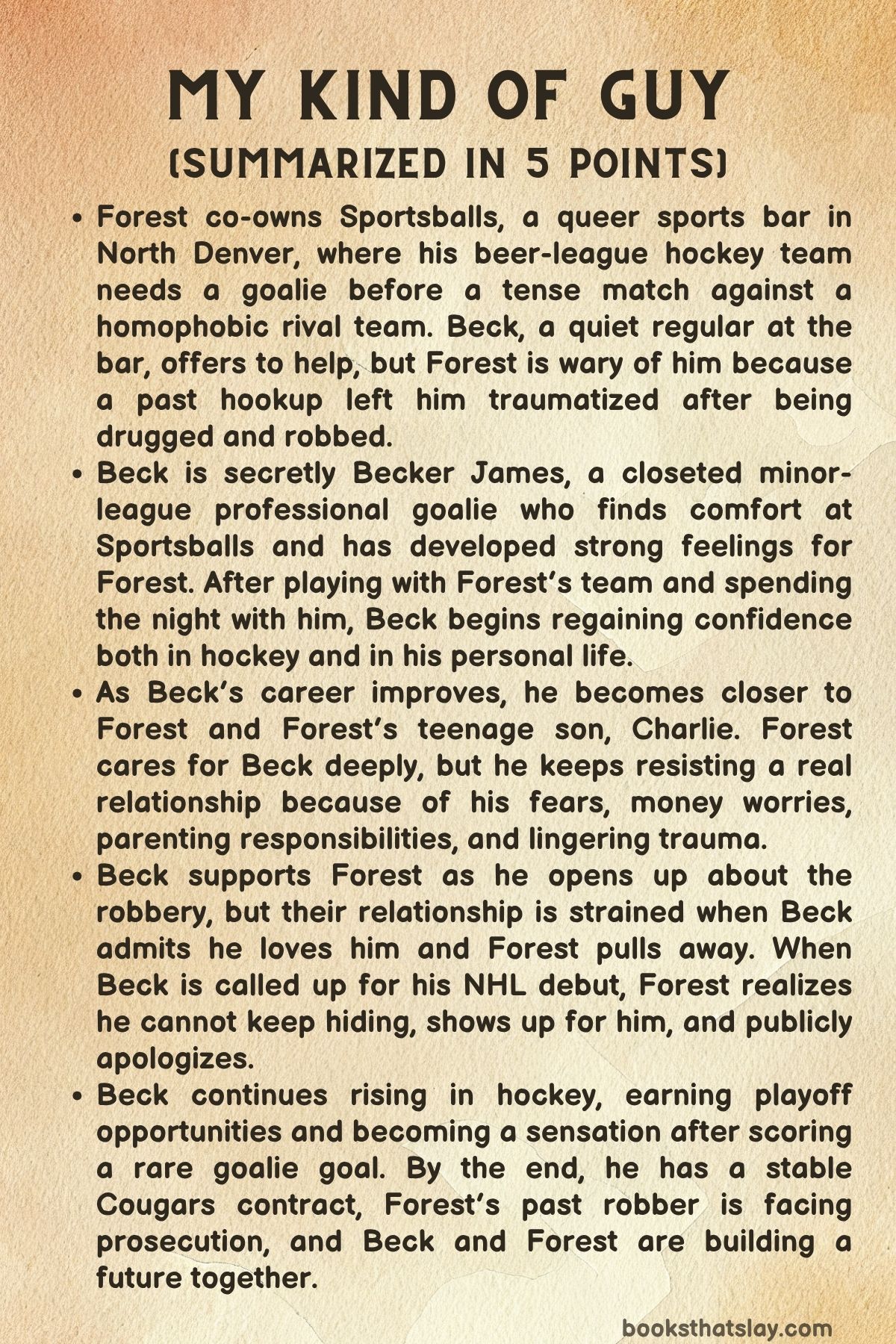
Forest co-owns Sportsballs, a queer sports bar in North Denver, with his friend Scully. The bar is more than a business to him.
It is a place where queer sports fans, athletes, friends, and misfits can watch games without being made to feel unsafe or unwelcome. Forest has worked hard to build this space, but his personal life is much more guarded.
He is a father to his teenage son, Charlie, and he carries the weight of a past trauma that still shapes the way he trusts people.
During a Colorado Cougars game night at the bar, Forest and Scully’s beer-league hockey team, the Stickhandlers, runs into a major problem. Their goalie is unavailable before an important match against the Plague, a team known not only for rough play but also for ugly homophobic taunts.
The Stickhandlers need someone in net, and a quiet regular named Beck unexpectedly offers to play. Beck is attractive, self-contained, and clearly familiar with hockey.
He also makes his interest in Forest obvious by saying that his condition for playing is that Forest take him home afterward.
Forest refuses. He is not interested in being pushed into a hookup, no matter how tempting Beck might be.
His refusal is not only about pride or caution. Forest was once drugged and robbed by a man he took home, and the experience left him shaken, ashamed, and wary of desire that moves too fast.
He has promised himself that he will not make the same mistake again. Scully, however, sees that the team needs help and manages to convince Beck to play anyway.
What Forest does not know at first is that Beck is not just a random bar regular. He is Becker James, a professional goalie for the Ice Cats, the minor-league affiliate of the Colorado Cougars.
Beck is closeted, lonely, and under pressure in his career. His performance has been uneven, and he is afraid he may not have what it takes to move up.
Sportsballs has become a private refuge for him, a place where he can sit quietly, watch hockey, and feel close to a life he wants but has not yet claimed. Forest, with his confidence, humor, and kindness, has become the center of Beck’s longing.
Beck practices with the Stickhandlers under a partial alias and quickly proves that he is far better than an ordinary beer-league goalie. His presence changes the team’s confidence.
When the Stickhandlers face the Plague, Beck helps them hold their ground and win. After the game, Forest accepts a ride from him.
The ride gives Forest a chance to explain some of his reluctance and some of the fear behind it. The tension between them remains strong, and Forest eventually invites Beck inside.
They sleep together, and the connection between them is intense. But the next morning, Forest wakes to find Beck gone.
For a brief, terrible moment, old fear takes over. He thinks he may have been robbed again and that he has repeated the same painful mistake.
Then he realizes Beck has only left early because of team travel. Beck leaves behind a note joking about stealing a sandwich, and the small gesture helps soften Forest’s panic.
It also makes clear that Beck is not the man Forest fears he might be.
After that night, Beck’s hockey begins to improve. He plays with renewed sharpness and starts winning games.
His stronger performance earns attention from Clay Powers, the coach of the Cougars. Powers invites him to lunch and tells him that his recent play shows promise.
He encourages Beck to regain the confidence and joy that once made him stand out. Beck is also stunned to discover that Powers lives with legendary goalie Jethro Hale, whose reputation makes the meeting feel even more meaningful.
The experience strengthens Beck’s desire to reach the Cougars and prove himself at the NHL level.
At the same time, Beck continues to become part of Forest’s life. He does not force his way in, but he keeps showing up with warmth and patience.
On New Year’s Day, he visits Forest with wings and quickly connects with Charlie over video games. Charlie accepts Beck with the easy interest of a teenager who recognizes someone fun and decent.
For Forest, watching Beck bond with his son is both comforting and dangerous. It makes Beck harder to keep at a distance.
Beck gives Forest tickets to an Ice Cats game, and Forest attends with Charlie, Scully, and Divina. Seeing Beck in his professional world changes something for Forest.
He already knew Beck was good, but watching him compete makes Forest understand the full scale of Beck’s talent and ambition. Forest also realizes how much he cares about him.
Still, he keeps trying to control the relationship. He tells himself that he has too many responsibilities, too little money, and too much emotional damage to offer Beck anything real.
Beck wants more than stolen nights and careful limits. Forest insists that he cannot give him a true relationship.
Yet their lives keep moving closer together. Beck stays over.
Charlie grows comfortable with him. Forest lets Beck see more of his home, his work, and his fears.
Their intimacy becomes less like a casual arrangement and more like partnership, even when Forest refuses to name it that way.
On Forest’s birthday, Beck joins his poker night. What should be an easy evening turns painful when Forest is triggered by a whiskey sour, the same drink connected to the night he was drugged and robbed.
Beck sees how deeply the trauma still affects him. Forest finally tells him the full story, including the shame and self-blame he has carried since the attack.
Beck listens without judgment. He relates Forest’s struggle to hockey, explaining that a goalie cannot survive by punishing himself forever after a bad goal.
At some point, he has to learn from it, reset, and keep playing. The comparison reaches Forest because it is practical, compassionate, and true.
Their relationship is tested when Beck gets sick with Covid. In a vulnerable moment, Beck admits that he loves Forest.
Forest does not respond with the reassurance Beck needs. Instead, he retreats.
He convinces himself that pulling away is the responsible choice, that Beck deserves someone less complicated and more available. Beck, hurt and tired of pursuing someone who keeps stepping back, decides he cannot keep chasing Forest forever.
Then Beck is called up for his NHL debut with the Cougars. The moment is huge for him, the chance he has worked toward for years.
Forest realizes that staying away would be another kind of cowardice. Beck has shown up for him again and again, and now Forest has to decide whether he can show up too.
He leaves the bar and goes to the arena to watch Beck play. Beck performs strongly, proving that he belongs on that stage.
After the game, Forest makes his choice clear. Back at Sportsballs, he publicly claims Beck, apologizes for pulling away, and promises to make him feel wanted.
The gesture matters because Forest is not only choosing Beck in private. He is choosing him in front of their community, with honesty rather than fear.
Beck later gets called up again as a playoff Black Ace, a reserve player who may be needed during the Cougars’ postseason run. Forest supports him through the pressure, helping him prepare and continuing to prove that he is no longer halfway in the relationship.
Around the same time, an FBI agent contacts Forest about the man who robbed him. The news that the criminal will be prosecuted gives Forest a measure of closure.
It does not erase what happened, but it helps him understand that the shame was never his to carry.
During the playoffs, Beck gets another chance in net. In a remarkable moment, he even scores a rare goalie goal, turning him into a sensation.
His confidence, career, and personal life all move forward. Six months later, Beck has a one-way contract with the Cougars, giving him a secure place in the NHL.
He and Forest are solidly together, and they begin looking at apartments closer to Forest and the team.
When Beck considers a polished new apartment, he realizes it does not feel right. It is clean and impressive, but it lacks the warmth and life he has found with Forest.
His idea of home has changed. Home is no longer a lonely space where he hides from himself.
It is the future he is building with Forest, Charlie, and the people who have become his community. By the end, My Kind of Guy becomes a romance about choosing love openly, accepting care after fear, and understanding that the right person does not simply enter your life.
He helps you believe that you deserve to live it fully.
Characters
Seth Forrester (Forest)
Forest is the emotional center of My Kind of Guy, a man whose warmth, loyalty, and humor are often guarded by fear. As a co-owner of Sportsballs, he has created a queer-friendly space where others can feel safe, yet he himself struggles to feel truly safe after being drugged and robbed by a past hookup.
This trauma shapes the way he responds to Beck: even when he is attracted to him, he hesitates, pulls back, and tries to protect himself from being vulnerable again. Forest’s conflict is not simply about romance; it is about whether he can trust his own judgment after something terrible happened to him.
Forest is also defined by responsibility. As Charlie’s father, he cannot treat love casually, because every decision he makes has emotional and practical consequences for his family.
His financial worries, his work at the bar, and his role as a parent make him cautious about letting Beck into his life. This makes his resistance understandable rather than cold.
He wants Beck, but he is afraid that wanting him is selfish, risky, or unfair. His character arc comes from learning that love does not have to be another danger.
By the end of the book, Forest’s public claim of Beck shows real growth: he stops hiding behind fear and chooses to make Beck feel wanted.
Beck / Becker James
Beck, whose full identity is Becker James, is one of the most tender and quietly courageous figures in the story. Outwardly, he is a professional goalie trying to regain his confidence and move forward in his hockey career.
Inwardly, he is lonely, closeted, and desperate for a place where he can exist without pressure. Sportsballs becomes that place for him, and Forest becomes someone he admires long before their relationship truly begins.
Beck’s decision to play for the Stickhandlers shows both his skill and his longing to belong somewhere beyond the strict world of professional hockey.
Beck’s romance with Forest reveals his emotional bravery. He is the one who keeps showing up, not in an aggressive way, but with patience, humor, and openness.
He brings food, bonds with Charlie, accepts Forest’s fears, and tries to make himself part of Forest’s everyday life. At the same time, Beck is not weak or passive.
When Forest refuses to meet him halfway after Beck admits his love, Beck recognizes that he cannot keep chasing someone who will not choose him back. His journey in My Kind of Guy is therefore both romantic and personal: he finds his confidence as a goalie, but he also learns that he deserves to be loved openly.
Charlie
Charlie is Forest’s teenage son and an important part of the emotional foundation of the book. He is not just present to show Forest’s responsibilities; he also helps reveal what kind of man Forest is.
Through Charlie, readers see Forest as protective, devoted, and deeply loving. Charlie’s easy bond with Beck, especially through video games, also becomes a meaningful sign that Beck can fit naturally into Forest’s life rather than disrupting it.
Charlie’s role is especially important because he makes the romance feel grounded in family rather than fantasy. Forest cannot make decisions only for himself, and Charlie’s presence raises the emotional stakes of Forest and Beck’s relationship.
Beck’s kindness toward Charlie also proves that his feelings for Forest are not limited to attraction. He is interested in Forest’s real life, including the parts that require patience, maturity, and care.
Scully
Scully is Forest’s friend and co-owner of Sportsballs, and he functions as both comic support and emotional pressure in the story. He understands the culture of the bar, the needs of the Stickhandlers, and Forest’s tendency to protect himself too strongly.
When Beck first offers to help as goalie, Scully helps move the situation forward, showing that he can see possibilities Forest is too guarded to accept.
Scully also represents community. Through him, the bar feels like more than a business; it becomes a chosen-family space where people look out for one another.
His presence helps balance Forest’s fear with warmth and practicality. He does not erase Forest’s trauma, but he nudges him toward life, connection, and trust.
Divina
Divina appears as part of Forest’s close circle and the wider Sportsballs community. Her presence at Beck’s game with Forest, Charlie, and Scully shows that Forest does not exist alone; he is surrounded by people who care about him and participate in his life.
She helps create the sense that Sportsballs is a lively, supportive queer space rather than just a setting for romance.
Divina’s importance lies in the atmosphere she helps build. The story depends on the contrast between hostile spaces, such as the Plague’s homophobic environment, and affirming spaces, such as the bar and Forest’s chosen community.
Divina belongs to that second world. Even with limited direct action, she contributes to the emotional texture of belonging, friendship, and support.
Coach Clay Powers
Coach Clay Powers is an important figure in Beck’s professional development. He notices Beck’s improved performance and gives him encouragement at a moment when Beck badly needs it.
Rather than treating Beck only as an athlete to be judged, Powers reminds him of joy, confidence, and the mindset that once made him a standout goalie. His guidance helps Beck reconnect with the part of himself that loves the game.
Powers also represents possibility. His connection to the Cougars makes Beck’s dream feel closer, and his personal life with Jethro Hale quietly suggests that queerness and professional hockey do not have to be completely separate worlds.
For Beck, who is closeted and uncertain about his future, this matters. Powers becomes a mentor figure whose belief helps Beck imagine a larger life.
Jethro Hale
Jethro Hale is a legendary goalie whose presence carries symbolic weight for Beck. Even though he is not central to the day-to-day romance, his connection to Coach Powers affects how Beck sees the future.
As someone associated with greatness in the same position Beck plays, Jethro represents the level Beck hopes to reach.
Jethro also matters because his life with Powers gives Beck a glimpse of a queer relationship connected to the hockey world. For a closeted player, that example is powerful.
It suggests that success, love, and identity might not have to remain permanently divided. In that sense, Jethro’s role is quieter but still meaningful in shaping Beck’s hope.
Themes
Trust After Trauma
In My Kind of Guy, Forest’s fear of trust is shaped by the robbery that left him feeling unsafe in his own judgment. His hesitation with Beck is not simple emotional distance; it is a defense built from shame, fear, and the belief that wanting someone can make him vulnerable to harm.
This theme is shown through his panic when Beck leaves early, his guarded reactions to kindness, and his struggle to accept that a new relationship does not have to repeat an old wound. Beck’s patience matters because he does not force Forest to heal on command.
Instead, he offers steady care while also refusing to become someone who must beg forever. Forest’s growth comes when he understands that protecting himself has slowly become a way of denying himself love.
Trust is presented as a risk, but also as a choice that must be practiced through honesty, presence, and the courage to believe that the future can differ from the past.
Chosen Family and Safe Spaces
Sportsballs is more than a business or a social setting; it is a place where people who have been pushed aside can gather without having to explain themselves. Forest, Scully, Divina, Charlie, the Stickhandlers, and Beck all find different forms of belonging there.
The bar gives Beck a rare sense of ease before anyone knows his full identity, which makes it emotionally important long before romance begins. It also gives Forest a wider support system beyond his role as a father and business owner.
The beer-league team reflects this same idea of chosen family: imperfect, funny, protective, and loyal when it counts. Their victory over a hostile team becomes meaningful because it is not just about winning a game; it is about refusing to let cruelty define the space.
The theme shows that home is often built through people who make safety active, visible, and shared.
Identity, Secrecy, and the Need to Be Seen
Beck’s life as a closeted professional goalie creates a painful split between public success and private loneliness. On the ice, he is measured by performance, discipline, and results, but away from hockey he longs to be recognized as his whole self.
His partial alias with the Stickhandlers gives him temporary freedom, yet it also shows how much of himself he has learned to hide. Forest becomes important because he sees Beck not only as an athlete, but as a person who wants tenderness, attention, and a place to belong.
At the same time, Beck’s desire to be claimed publicly is not vanity; it is a need to stop feeling like someone’s secret. Forest’s eventual public apology and open acceptance carry emotional weight because they answer Beck’s deepest fear.
The theme argues that love cannot fully thrive when one person is visible only in private.
Ambition, Confidence, and Emotional Renewal
Beck’s hockey career improves when his emotional life begins to change, suggesting that confidence is not only professional but deeply personal. Before meeting Forest more fully, Beck is talented but uncertain, lonely, and disconnected from the joy that once made him strong in goal.
His time with the Stickhandlers, Forest’s attention, and Coach Powers’s encouragement help him remember that pressure does not have to erase pleasure. His rise from minor-league uncertainty to NHL opportunity is not treated as a simple sports triumph.
It is tied to his growing belief that he deserves both success and love. Forest’s journey mirrors this in a quieter way.
He must learn that responsibility, fatherhood, and financial stress do not disqualify him from happiness. Both men renew their confidence by being seen clearly by someone else.
The theme presents ambition not as escape from emotional need, but as something strengthened by connection, support, and self-acceptance.