Served Him Right Summary, Characters and Themes
Served Him Right by Lisa Unger is a dark suspense novel about abuse, revenge, family secrets, and the uneasy line between justice and murder. The story begins with a workplace assault and then moves years later into the life of Ana Blacksmith, whose former boyfriend, Paul Hayes, is found dead.
As suspicion falls on Ana, the book expands into a larger mystery involving poisoned food, hidden alliances, a vanished girlfriend, and a secretive group of women tied to Ana’s family history. The book is about women who have been hurt, the power they claim, and the cost of deciding who deserves punishment.
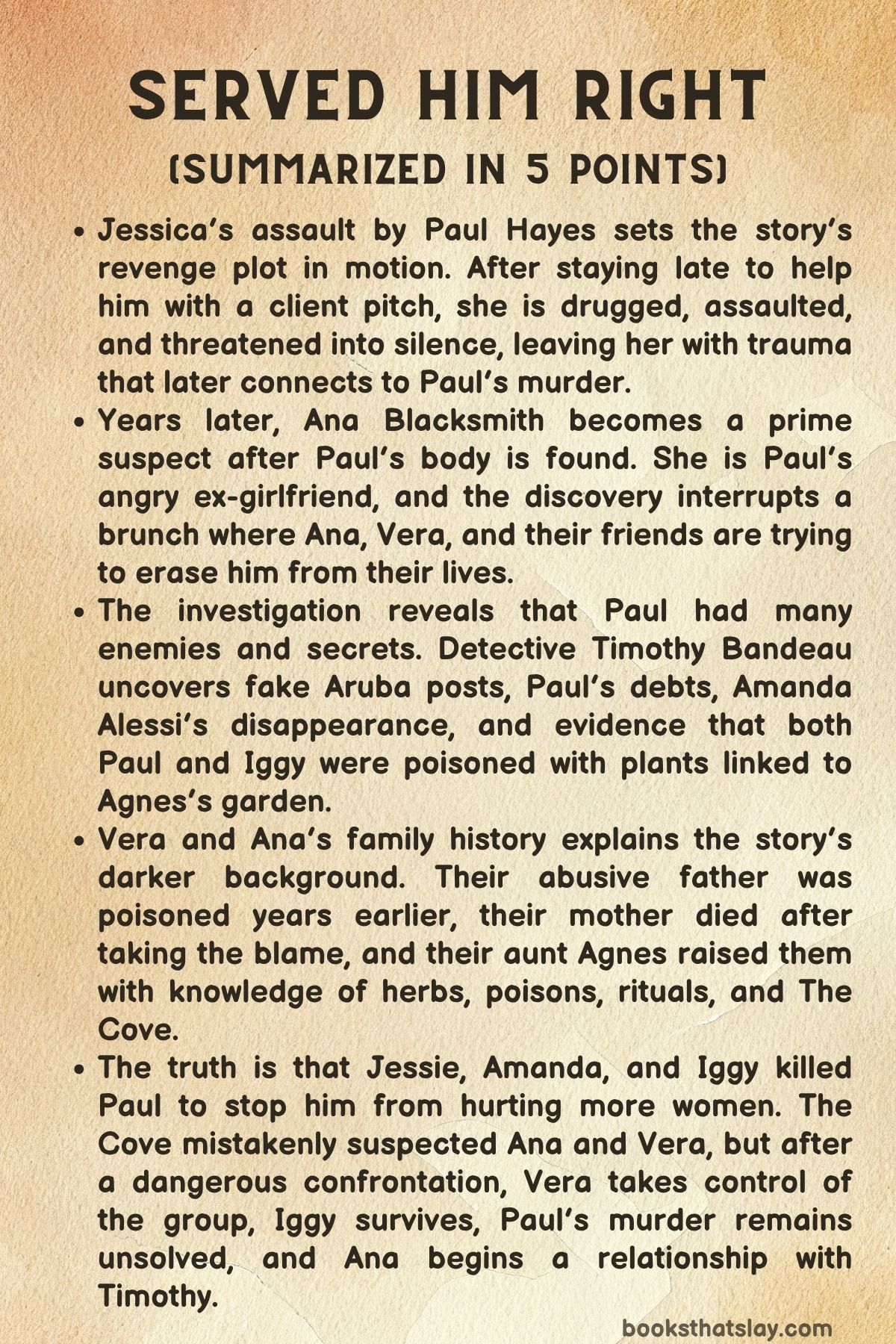
Summary
Served Him Right opens with Jessica, a young assistant who is trying hard to hold on to her job. She works for Paul Hayes, a successful and charming man with a dangerous reputation.
Jessica has heard warnings about him, especially rumors that he has mistreated women, but she believes she is safe because he has always treated her with kindness and respect. One evening, she stays late at the office to help him prepare for an important client pitch.
The office gradually empties, leaving the two of them alone.
Paul brings out vodka and begins praising Jessica’s work. His attention seems flattering at first, but it soon becomes uncomfortable.
He pressures her to drink, and Jessica starts to feel strangely weak and disoriented. She realizes too late that something is wrong.
Her body begins to shut down, and she understands that Paul has drugged her. When she wakes up hours later, she is in her car, injured, half-dressed, and terrified.
She knows Paul assaulted her. As she tries to leave, Paul appears in his Porsche.
He smiles at her and makes it clear that she should stay silent.
Years pass. The story then shifts to Ana Blacksmith, a restless woman recovering from a painful breakup with Paul Hayes.
Ana is impulsive, angry, and still unsettled by the relationship. After the breakup, she meets a stranger through a hookup app at a remote bar.
Their encounter is reckless and brief, and Ana sneaks away afterward. Later, the man is revealed to be Detective Timothy Bandeau, who soon becomes important in the investigation surrounding Paul’s death.
Ana’s older sister, Vera, is rich, controlling, and deeply protective of her family. Vera organizes a Sunday brunch at her home, calling it an “ex-orcism” for Ana.
The idea is to help Ana and her friends erase Paul from their phones, feeds, and lives. The guests include Ana, Vera, Iggy, Esme, and Payton.
The gathering has a strange mix of humor, anger, and ritual, as the women try to clear Paul from Ana’s world.
The brunch is interrupted when Detective Bandeau arrives with shocking news: Paul Hayes has been found dead in a shallow grave at Black River Park. His death is being treated as suspicious.
Because Ana is his angry ex-girlfriend, she immediately becomes an obvious suspect. Her recent behavior, her bitterness toward Paul, and her connection to him all make her look guilty.
Ana denies killing him, but she also knows that many people had reasons to want Paul gone.
At the brunch, Iggy eats cassoulet prepared by Ana. Soon afterward, she becomes violently ill.
At home, she collapses and vomits blood. She is rushed to the hospital, and it becomes clear that she has been poisoned.
This second violent event complicates everything. If Paul was murdered and Iggy was poisoned, the danger is not limited to one dead man.
Someone is still acting, and the circle around Ana may be at risk.
Detective Bandeau begins looking into Paul’s life and death. He quickly learns that Paul had many enemies.
He was not only disliked; he was feared. His past behavior with women had left damage behind, and his charm had hidden a long pattern of cruelty.
Bandeau also discovers that Amanda Alessi, the woman believed to be Paul’s new girlfriend, has disappeared. At first, it looks as if Amanda and Paul had gone to Aruba together, based on their social media posts.
But the images turn out to be fake stock photos, suggesting that someone staged the trip to cover up what really happened.
Paul’s sister Regina enters the investigation with her own anger and suspicions. She blames Ana and insists that Ana had a motive to kill Paul.
Regina also mentions Paul’s debts, which opens another possible reason for his murder. Ana, meanwhile, tries to shift attention away from herself.
She points toward Regina, Amanda, and anyone else who may have had a reason to hate or fear Paul.
As the present-day mystery unfolds, the story reveals the dark history of Ana and Vera’s childhood. They grew up with their mother Sadie and their abusive father, Mac.
Mac was cruel and dangerous, and the family lived under his control. Eventually, Mac was poisoned through beef Wellington.
Sadie accepted blame for his death and went to prison, where she later died. After that, Ana and Vera were raised by their aunt Agnes.
Agnes was not an ordinary guardian. She taught the sisters about herbs, poisons, protective objects, old rituals, and a secret female group called The Cove.
The Cove had its own rules, traditions, and methods of punishment. Vera rejected the idea of leading or belonging to that world, wanting distance from its danger and secrecy.
Ana, however, was drawn to the knowledge Agnes offered. She learned enough to understand how plants could heal, harm, protect, or kill.
In the present, Vera finds a small protective effigy at her house. Its presence alarms her because it connects the current events to the old world of Agnes and The Cove.
Vera realizes that someone tied to that hidden circle may be involved in Paul’s death or Iggy’s poisoning. The family past is no longer safely buried.
It has returned through symbols, poison, and threats.
Ana begins her own secret investigation while Detective Bandeau follows official leads. She steals Iggy’s phone and finds messages from Amanda.
The messages suggest that Amanda was afraid and that Iggy knew more about Paul than she had admitted. Ana starts to see that Paul’s death may have been tied not just to her breakup, but to a group of women connected by fear, anger, and revenge.
Vera’s daughter, Coraline, also becomes part of the larger family pattern. She experiments with old family recipes and considers using what she knows to punish a cheating classmate named Micha.
Her actions show that the dangerous knowledge passed down through Agnes has not ended with Vera and Ana. Coraline is curious, capable, and willing to consider punishment in the same dark terms as the women before her.
Detective Bandeau eventually learns that both Paul and Iggy were poisoned by plants that could have come from Agnes’s old garden. This discovery strengthens the connection between the murder, the poisoning, and the Blacksmith family’s hidden history.
Suspicion begins to circle not only Ana but also Vera, The Cove, and anyone with access to Agnes’s knowledge.
The truth comes out during a Wolf Moon gathering at The Cove. The meeting reveals that Paul’s murder was carried out by Iggy, Amanda, and Jessie, who is the same Jessica from the beginning of the story.
After Paul assaulted her, Jessica was deeply traumatized. She later became the anonymous blogger known as “Jezebel,” using that identity to expose men like Paul and speak for women who had been hurt.
Amanda loved Jessie and helped her. Iggy joined them because she wanted to stop Paul from harming more women, including Ana.
Together, the three women killed Paul, moved his body, staged the fake Aruba trip, and tried to hide what they had done. The fake social media posts were part of the cover.
Iggy’s protective charm accidentally fell near the grave, creating a clue that tied the crime to the old rituals.
The Cove had misunderstood the situation. Its members believed Ana and Vera had killed Paul.
Because of this false belief, April poisoned Ana’s cassoulet to punish her. But Ana did not eat the poisoned serving.
She gave it to Iggy, which is why Iggy nearly died. The poisoning was meant for Ana, not for Iggy.
The final conflict turns dangerous when Lisander and April try to force Vera to take “the cure,” a punishment tied to The Cove’s rules. Coraline and the others intervene, preventing Vera from being destroyed by the same secret world she had tried to avoid.
In this moment, Vera stops running from her inheritance. She claims Agnes’s seat as leader of The Cove, taking control rather than allowing others to use its power against her family.
By the end, Vera stands with Ana and Coraline beside her. The family has not escaped its past, but it has changed its place within it.
Timothy Bandeau sees more than he can officially prove, and he chooses not to expose everything he has learned. His decision leaves Paul’s murder officially unsolved.
Later, at a spring brunch at Agnes’s house, the surviving characters gather again. Iggy has lived through the poisoning.
Vera now controls The Cove. Ana begins a real relationship with Timothy, one that grows out of danger, honesty, and shared secrets.
Paul is dead, the women who killed him remain free, and the official world never fully understands what happened. Served Him Right ends with justice left in morally uncertain hands, suggesting that punishment, protection, and revenge can become difficult to separate.
Characters
In Served Him Right by Lisa Unger, the characters are shaped by trauma, secrecy, loyalty, violence, and revenge. The book presents people who are not simply innocent or guilty, but emotionally complicated figures whose choices come from fear, pain, protection, anger, or survival.
Jessica / Jessie
Jessica, later known as Jessie, is one of the most tragic and important characters in the book. At the beginning, she appears as a hardworking assistant who is simply trying to do her job well and protect her future.
Her trust in Paul comes from the fact that he has treated her kindly before, which makes his betrayal even more disturbing. After he drugs and assaults her, Jessica’s life is permanently changed.
Her later identity as Jessie shows how deeply that trauma has reshaped her. She becomes someone who refuses to stay silent, and her transformation into the anonymous blogger “Jezebel” reveals her need to expose predatory men and protect other women from suffering as she did.
Jessie is not presented as a simple victim. She is wounded, angry, intelligent, and morally complicated.
Her involvement in Paul’s murder comes from trauma and a desire for justice, but it also places her in a dark ethical position. Through Jessie, the book explores how pain can turn into resistance, but also how justice and revenge can become dangerously intertwined.
Paul Hayes
Paul Hayes is the central source of harm in the story, even though much of the book takes place after his death. He is charming, powerful, manipulative, and predatory.
His public image allows him to move through professional and social spaces with confidence, while his private behavior reveals cruelty and entitlement. His assault on Jessica shows that he uses power not only to dominate women physically, but also to silence them emotionally and socially.
The moment when he waits for Jessica in his car and warns her to keep quiet shows his belief that he is untouchable. Paul’s death does not erase his presence from the story; instead, his influence continues through the fear, anger, suspicion, and trauma he leaves behind.
Nearly every major conflict is connected to the damage he has caused. As a character, Paul represents a type of evil that hides behind success, charm, and social status.
He is not complex because he is sympathetic, but because his impact spreads through so many lives.
Ana Blacksmith
Ana Blacksmith is reckless, impulsive, emotionally restless, and deeply wounded in ways she does not always understand. Her breakup with Paul leaves her angry and unstable, which makes her an obvious suspect when his body is found.
Ana often acts before thinking, whether through her risky encounter with Timothy or her secret investigation into Paul’s death. Yet beneath her carelessness is a sharp intelligence and a hunger for freedom.
She does not want to be controlled by Paul, Vera, family history, or The Cove. Ana’s connection to Agnes’s teachings and her attraction to dangerous knowledge make her one of the most unpredictable characters in the story.
She is drawn to power, but she does not always understand its cost. Her flaws make her believable: she can be selfish, defensive, and reckless, but she is also loyal, passionate, and capable of growth.
Ana’s journey is about learning that independence is not the same as chaos, and that power without responsibility can easily become destructive.
Vera Blacksmith
Vera is one of the strongest and most layered characters in the book. She is wealthy, controlled, protective, and used to being in charge.
As Ana’s older sister, she often behaves like a guardian, but her protection can also become controlling. Vera’s life has been shaped by childhood trauma, especially the violence of her father and the loss of her mother.
Unlike Ana, Vera tries to manage pain through order, discipline, and social control. Her Sunday “ex-orcism” brunch shows her desire to turn emotional mess into ritual, structure, and performance.
Vera’s relationship with The Cove is especially important because she has resisted the power and responsibility connected to Agnes’s legacy. However, when danger threatens Ana, Coraline, and the people around her, Vera finally accepts the leadership role she once rejected.
This decision shows her growth from someone who tries to control life from a distance into someone willing to stand directly inside danger. Vera’s strength is not only in her authority, but in her eventual willingness to claim responsibility.
Detective Timothy Bandeau
Detective Timothy Bandeau is both an investigator and a romantic figure in the story. His first encounter with Ana is impulsive and secretive, which complicates his later role as the detective investigating Paul’s death.
Professionally, Timothy is observant and persistent. He follows the evidence and gradually realizes that Paul’s death is connected to a wider network of secrets, trauma, and protection.
However, he is not a purely detached law officer. His connection to Ana affects him, and by the end of the book, he makes a morally significant choice by not exposing everything he has seen.
Timothy represents the tension between official justice and human understanding. He knows the law, but he also recognizes that the truth around Paul’s death is emotionally and morally complicated.
His decision to remain silent suggests that he understands the limits of legal justice in a world where women have been failed, ignored, or harmed.
Iggy
Iggy is a deeply important character because she connects the emotional world of Ana and her friends to the hidden truth of Paul’s murder. At first, she seems like part of the friend group gathered at Vera’s brunch, but her sudden poisoning reveals that she is far more involved in the central mystery than she appears.
Iggy once worked near Paul and knew about the allegations against him, which gives her a personal understanding of the danger he represented. Her participation in Paul’s murder is motivated by a desire to stop him from hurting more women, including Ana.
Iggy is not reckless in the same way Ana is; her actions come from fear, anger, and protective loyalty. Her near death after eating the poisoned cassoulet adds tragic irony, because she is punished for a crime by someone who misunderstands who is truly responsible.
Iggy’s survival is important because it allows the story to preserve a character who acted wrongly but not cruelly. She is morally flawed, but her motives come from compassion and desperation.
Amanda Alessi
Amanda Alessi is initially presented as Paul’s supposed new girlfriend, but her disappearance reveals that her role is much more complicated. The fake Aruba posts make her seem absent by choice, but they are actually part of a larger attempt to hide the truth about Paul’s death.
Amanda’s connection to Jessie gives her emotional depth. She is not merely helping cover up a crime; she is protecting someone she loves and someone who has been badly harmed.
Amanda’s love for Jessie becomes one of the emotional forces behind the murder plot. She represents loyalty taken to a dangerous extreme.
Her actions show how love can become protective, but also secretive and morally compromised. Amanda is important because she helps reveal that Paul’s murder was not a random act of rage.
It was planned by women who saw him as a threat and believed they had to stop him themselves.
Regina Hayes
Regina, Paul’s sister, is a character shaped by loyalty, denial, and anger. Her instinct is to blame Ana for Paul’s death, which shows how strongly she wants to protect her brother’s image or at least direct suspicion away from other possibilities.
Regina’s mention of Paul’s debts adds another layer to his life and reveals that even within his own family, there were signs of disorder and trouble. She functions as a character who complicates the investigation by showing that Paul’s world contained many possible enemies and motives.
Regina does not appear as emotionally central as Ana, Vera, Jessie, or Iggy, but she is still important because she reflects the way families can defend dangerous people, minimize their harm, or refuse to see the full truth. Her suspicion of Ana also increases the pressure on Ana and helps keep the mystery tense.
Mac
Mac, Ana and Vera’s father, is one of the roots of the family’s trauma. He is abusive, violent, and controlling, and his presence in the past explains much about the emotional lives of both sisters.
Mac’s cruelty creates an atmosphere where fear becomes normal and survival becomes the main goal. His poisoning through beef Wellington is a major event because it shows how violence inside the family eventually leads to another act of violence.
Even after his death, Mac’s influence remains. Vera’s need for control and Ana’s attraction to danger can both be understood as different responses to growing up under his abuse.
Mac is not just a villain from the past; he is a source of inherited damage. His character shows how abuse can continue shaping people long after the abuser is gone.
Sadie
Sadie, the mother of Vera and Ana, is a tragic figure whose life is defined by sacrifice and suffering. After Mac is poisoned, she takes the blame and goes to prison, where she later dies.
Her decision suggests a desperate attempt to protect her daughters, though it also leaves them orphaned and emotionally scarred. Sadie’s character carries the pain of a woman trapped by violence and forced into impossible choices.
She is important because her absence shapes Vera and Ana as much as her presence might have. Her sacrifice leaves behind unanswered emotional wounds, especially around guilt, loyalty, and survival.
Sadie represents the cost of protecting loved ones in a world where women are often left with no safe choices.
Agnes
Agnes is one of the most mysterious and powerful figures connected to the Blacksmith family. As the aunt who raises Vera and Ana after Sadie’s death, she becomes a guardian, teacher, and link to an older world of women’s knowledge.
Her lessons about herbs, poisons, rituals, and The Cove shape the sisters in different ways. Agnes represents female power that is ancient, secretive, protective, and dangerous.
She teaches survival, but the knowledge she passes down can be used for both protection and harm. Vera resists Agnes’s legacy, while Ana is drawn to it, which shows how differently the sisters respond to the same inheritance.
Even after Agnes is gone, her influence remains through her garden, her teachings, her house, and the leadership role Vera eventually claims. Agnes is less physically present in the main events, but her shadow stretches across the entire story.
Coraline
Coraline, Vera’s daughter, represents the next generation of Blacksmith women. She is curious, intelligent, and already drawn toward the dangerous family traditions surrounding recipes, punishment, and power.
Her plan to punish Micha shows that she has inherited not only knowledge but also the temptation to use it. However, Coraline is not simply a younger version of Ana or Vera.
She stands at the beginning of her own moral development, and the crisis around Paul’s murder interrupts her before she goes too far. Her role in helping intervene during the confrontation at The Cove shows courage and loyalty.
Coraline is important because she shows that the family’s legacy will continue, but it may be shaped differently under Vera’s leadership. She represents both risk and hope.
Micha
Micha is a smaller character, but his role matters because he reveals Coraline’s attraction to revenge and punishment. As the cheating classmate Coraline wants to target, he becomes a symbol of betrayal on a younger, smaller scale.
His presence shows how the patterns of anger, justice, and retaliation in the adult world are beginning to echo in the next generation. Micha is not developed as deeply as the central characters, but his function in the story is clear.
He helps show that the desire to punish wrongdoing can begin early, and that Coraline’s inherited knowledge could become dangerous if not guided carefully.
Esme
Esme is part of the social circle present at Vera’s brunch, and her role helps establish the network of women surrounding Ana. Though she is not as central to the mystery as Iggy or Amanda, her presence contributes to the atmosphere of female friendship, gossip, emotional support, and suspicion.
Esme helps show that Paul’s death affects not only family members and direct victims, but also the wider group of people connected to Ana. In a story full of secrets, even supporting characters like Esme help create the sense that everyone has a perspective, a history, or a possible motive.
She is part of the social world that makes Ana’s life feel full, messy, and exposed.
Payton
Payton, like Esme, is part of the brunch group and the wider circle around Ana and Vera. Her character helps build the social setting in which Paul’s death is announced and Ana’s suspicion begins to grow.
Payton’s presence matters because the brunch is meant to be a symbolic cleansing of Paul from Ana’s life, but it turns into the moment when Paul becomes impossible to escape. As part of that gathering, Payton helps emphasize the contrast between performative emotional healing and the darker reality underneath.
She is not one of the main drivers of the plot, but she contributes to the group dynamic and the pressure surrounding Ana.
April
April is a dangerous character because she acts on a false belief with deadly consequences. As someone connected to The Cove, she believes Ana and Vera are responsible for Paul’s murder and decides to punish Ana by poisoning the cassoulet.
Her action nearly kills Iggy instead, showing the terrifying cost of certainty without truth. April represents the darker side of secret justice.
She believes she is enforcing punishment, but her judgment is wrong and her violence almost destroys the wrong person. Her character shows that power inside The Cove can become reckless, cruel, and unjust when it is not guided by wisdom.
April’s actions help push Vera toward claiming leadership, because The Cove clearly needs control and accountability.
Lisander
Lisander is another figure connected to the dangerous authority of The Cove. Alongside April, Lisander tries to force Vera to take “the cure,” which shows how coercive and threatening this hidden world can become.
Lisander represents tradition without compassion and power without moral restraint. The attempt to control Vera reveals the internal danger of The Cove itself.
It is not only an organization of protection; it can also become authoritarian and punitive. Lisander’s role is important because it forces Vera to stop avoiding her inheritance.
By standing against figures like Lisander, Vera proves that she is ready to reshape The Cove rather than be ruled by it.
Themes
Trauma and the Long Reach of Violence
The harm Paul causes does not end with the assault itself; it changes how women move through the world afterward. Jessica’s experience shows how violence can leave a person trapped between fear, shame, anger, and the need to survive.
Paul’s power comes not only from the crime he commits but from the confidence that he can silence his victim through threats, status, and intimidation. Years later, the consequences of that violence still shape choices, alliances, and acts of revenge.
The women connected to him are not simply reacting to one isolated event; they are responding to a pattern of cruelty that has been ignored or protected for too long. Served Him Right presents trauma as something deeply personal but also social, because silence allows predators to continue harming others.
The murder is therefore tied to a larger emotional history, where pain becomes rage and rage becomes action. The story asks what happens when justice feels unavailable through ordinary systems and victims begin seeking their own form of closure.
Female Solidarity and Protection
Women in the story protect one another in complicated, morally troubling, and sometimes dangerous ways. The bond between Jessie, Amanda, and Iggy grows from shared knowledge of Paul’s abuse and from the belief that no one else will stop him.
Their actions are not shown as simple heroism, but they come from a fierce desire to prevent further harm. Vera’s protectiveness toward Ana is also intense and controlling, shaped by childhood abuse and the fear of losing the people she loves.
The Cove represents another version of female connection: secretive, powerful, ritualistic, and built around inherited knowledge. Yet this solidarity is not always gentle or wise.
April’s poisoning of the cassoulet shows how protection can become punishment when suspicion replaces truth. The story treats sisterhood as a source of strength but not as automatically pure.
Women support, mislead, test, and rescue one another, often because the outside world has failed them. Their loyalty becomes both a shield and a weapon, depending on who controls it.
Justice, Revenge, and Moral Ambiguity
The story refuses to draw a clean line between justice and revenge. Paul’s death can be understood as punishment for his violence, but it is also a murder planned and concealed by people who believe they are acting for the greater good.
This creates a difficult moral space where the reader is pushed to question whether unlawful action can ever feel emotionally justified. Jessie, Amanda, and Iggy do not kill out of greed or random hatred; they act because Paul has harmed women and seems likely to continue.
At the same time, their decision creates more danger, confusion, and suffering, including Iggy’s near death after April misreads the situation. Detective Timothy’s final choice not to expose everything adds another layer to the theme.
Legal truth and moral truth are not treated as the same thing. The official case remains unresolved, but several characters reach a private sense of balance.
The story suggests that when formal justice fails or arrives too late, people may create their own justice, though that choice carries lasting consequences.
Family Inheritance and Cycles of Power
The past shapes the present through family history, learned behavior, and inherited forms of power. Vera and Ana’s childhood under Mac’s abuse creates emotional patterns that continue into adulthood: fear, defiance, secrecy, and a need for control.
Sadie’s imprisonment and death leave the sisters with unresolved grief and a complicated understanding of sacrifice. Agnes’s influence adds another inheritance, one rooted in herbs, poisons, rituals, and female authority.
This legacy gives the women knowledge, but it also burdens them with danger. Ana is drawn to the darker side of that inheritance, while Vera tries to distance herself from it until crisis forces her to accept responsibility.
Coraline’s behavior shows how easily old patterns can pass to the next generation, especially when punishment is mistaken for justice. By the end, Vera’s decision to claim leadership is not only about power; it is about changing the direction of what has been handed down.
The family cannot erase its past, but it can decide how that past will be used.