Star Shipped Summary, Characters and Themes
Star Shipped by Cat Sebastian is a romantic story about two actors whose public rivalry hides years of attraction, resentment, and misunderstanding. Simon Devereaux and Charlie Blake have built their careers playing beloved sci-fi heroes on the long-running series Out There, but behind the scenes they are known for their sharp words and strained partnership.
As Simon considers leaving the show, the pressure of fame, fandom, mental health, and old wounds forces both men to look more closely at each other. The book follows their slow shift from enemies to lovers, showing how care can grow from honesty, patience, and the courage to be seen.
Summary
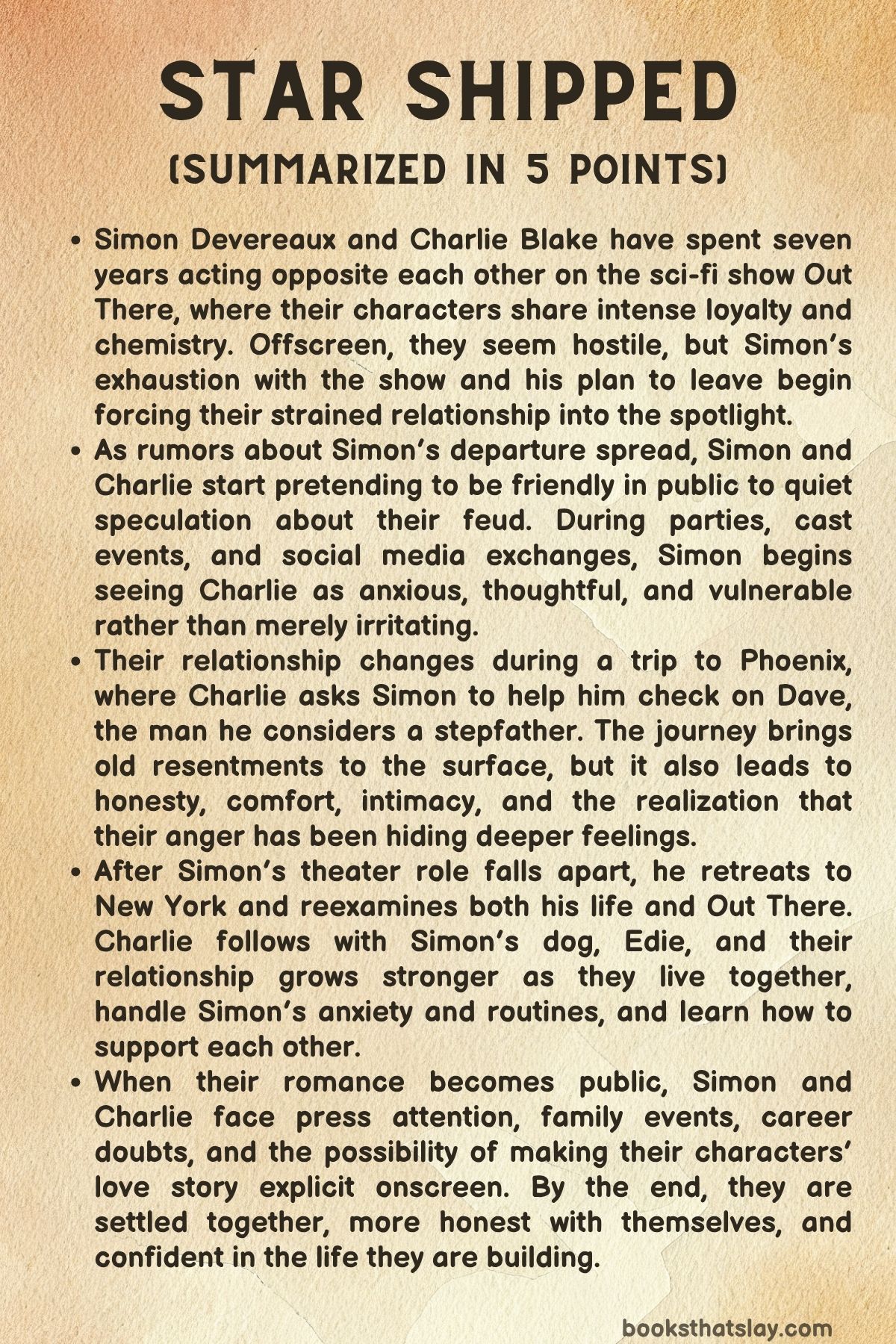
Simon Devereaux and Charlie Blake have worked together for seven years on the popular science fiction series Out There. Onscreen, their characters are partners in danger, always saving each other, standing close, arguing with intensity, and carrying a connection that fans have long read as romantic.
Offscreen, however, Simon and Charlie are famous for not getting along. They trade insults, avoid each other when possible, and treat every interaction like a contest.
Their public image is built around tension, but beneath that hostility lies a complicated history neither of them has been willing to face.
Simon is tired. He has spent years playing the same role, saying similar lines, and acting out storylines that feel repetitive to him.
He is ready for something different and has begun planning his exit from Out There. He hopes to take a role in an off-Broadway production of The Tempest, believing theater might give him the challenge and escape he needs.
At the same time, his personal life becomes more crowded when Jamie, his ex-boyfriend and closest friend, moves into Simon’s spare room after another breakup. Jamie knows Simon well, but his presence also makes it harder for Simon to hide the routines, rules, migraines, anxiety, and compulsive habits that structure his days.
Rumors soon begin to spread that Simon may leave the show. His castmates notice changes in his behavior, and the possibility of his departure creates unease around the production.
Alex confronts him, Charlie begins paying closer attention, and Simon worries about how the public will react if the news becomes real. His concerns are not baseless.
Old articles resurface about difficult behavior on an earlier fantasy series called Tree of the Gods, and Charlie has his own history of career trouble from his younger years. Both men know how quickly the press can shape a story and how hard it can be to escape a reputation once it takes hold.
To control the rumors and soften the idea that they hate each other, Simon and Charlie begin acting friendlier in public. Their interactions start awkwardly, especially online, where even a small exchange can be examined by fans.
At cast parties and industry events, Simon sees sides of Charlie he has either ignored or misunderstood. Charlie is not simply careless, loud, or irritating.
He is anxious, attentive, bisexual, and more thoughtful than Simon expected. Charlie also makes a brief attempt to flirt with Jamie, but Jamie refuses him because he understands that Charlie’s feelings about Simon are not simple.
The forced friendliness begins to change when Charlie asks Simon to go with him to Phoenix. Charlie is worried because he cannot reach Dave, the man he thinks of as a stepfather.
Simon agrees, and the trip takes them away from the controlled environment of the set. In the car, they argue, speak more plainly than usual, and begin unpacking old grievances.
They visit Dave’s neglected house and eventually track him to a remote cabin. Instead of being grateful for Charlie’s concern, Dave dismisses him and makes Charlie feel foolish for caring.
Simon sees Charlie’s hurt clearly and responds with unexpected loyalty. He defends him, stays with him, and offers comfort without making a performance of it.
That trip marks a turning point. Sharing hotel rooms and long conversations, Simon and Charlie begin to understand how much of their hostility has been built from attraction, pride, fear, and old misunderstandings.
Their arguments no longer feel only cruel. They carry a charge both men have tried to deny.
Eventually, they kiss and sleep together. Simon refuses to name what is happening between them, partly because labels make the situation feel dangerous and partly because he does not fully trust happiness when it arrives.
Charlie, too, is afraid of wanting too much. Still, both men understand that something real has changed.
Soon after, Simon’s planned theater role falls through. The loss hits him harder than he expects.
He flees to New York, overwhelmed and unwell, dealing with migraines and emotional exhaustion. During this period of isolation, he begins watching Out There from the beginning.
What he sees surprises him. The show he had dismissed as stale and limiting has more emotional weight than he allowed himself to admit.
He notices the care in the writing, the power of the performances, and especially the long arc between his character and Charlie’s. Their characters have not just been friends or partners.
In many ways, they have been written as a love story all along.
This realization changes Simon’s relationship to the show. Instead of walking away completely, he signs a contract to return for half of the next season.
Meanwhile, he and Charlie keep texting constantly. Their communication becomes a lifeline: teasing, anxious, affectionate, and honest in ways they rarely managed face to face before.
Charlie eventually flies to New York with Simon’s dog, Edie, and their relationship grows stronger in the close quarters of Simon’s temporary life there. They sleep together, spend ordinary time together, and learn how to exist around Simon’s OCD routines and anxiety without either of them pretending those challenges are easy.
Charlie does not try to fix Simon, and Simon does not ask Charlie to become someone simpler. Instead, they learn each other’s needs by paying attention.
Charlie offers steadiness, warmth, and patience. Simon offers loyalty, sharp humor, and a kind of care that often appears through action rather than easy confession.
Their bond becomes less about the old thrill of fighting and more about trust. They still argue, but the arguments no longer exist to keep distance between them.
They become part of how they communicate.
Their relationship becomes public after they appear together at network upfronts. The press reacts quickly, and the fandom explodes with theories, excitement, criticism, and intense attention.
Simon and Charlie are suddenly not just managing their private feelings but also a public narrative neither can fully control. At the same time, Lian, the showrunner, speaks with them about the future of Out There and about what it would mean to make their characters’ romantic relationship explicit onscreen.
This conversation carries weight because Luke and Jonathan’s relationship has mattered deeply to fans, especially those who have seen themselves in the connection even before the show named it.
Simon also brings Charlie and Edie to his niece Nora’s graduation party in Connecticut. The visit forces Simon to face his family and the version of himself he becomes around them.
Charlie’s presence helps him feel steadier. Simon begins to recognize that Charlie is not just a secret comfort or a chaotic new part of his life.
He is someone who can stand beside him in difficult rooms, see his discomfort, and help him remain present without taking over.
Back in Los Angeles, Charlie becomes a regular part of Simon’s home. Jamie is still there, Edie is still a central presence, and the house begins to feel like a strange but workable family arrangement.
Simon and Charlie deal with everyday problems as well as larger fears: migraines, birthdays, publicity, career choices, and the possibility that they might damage something good by mishandling it. Their relationship is not made perfect by love.
They remain anxious, defensive, and uncertain at times, but they become more willing to speak honestly and recover from mistakes.
Charlie worries about his future beyond Out There. He fears that he may not be talented enough to build a career outside the show and that people see him only as one half of a famous pairing.
Simon, who has often been harsh with him in the past, becomes one of the people who reassures him most clearly. He sees Charlie’s talent, his discipline, and his emotional intelligence.
He helps Charlie believe that his career does not have to be defined by fear.
As Simon watches completed episodes, he fully accepts what has been true for a long time: Luke and Jonathan’s story has always been romantic, even when the show avoided saying so directly. This mirrors his own journey with Charlie.
What once looked like rivalry and irritation was also longing, attention, and fear of vulnerability. Simon’s understanding of the show, his work, and his relationship all shift together.
Star Shipped ends with Simon and Charlie together, no longer pretending that their connection is temporary or accidental. After a wedding, they go to a late-night food truck, comfortable in each other’s company and at ease with the life they are building.
The ending does not suggest that every challenge has vanished. Simon still has anxiety and migraines.
Charlie still has insecurities. Fame and work will still bring pressure.
But they know how to care for each other now. They are happy, steady, and certain that what they have is good.
Characters
Simon Devereaux
Simon Devereaux is the emotional center of Star Shipped, and his character is shaped by exhaustion, fear, pride, longing, and a deep need to be understood without having to explain every broken part of himself. At the beginning of the book, Simon appears sharp, guarded, and difficult, especially in his interactions with Charlie Blake.
His irritation with the sci-fi series Out There seems at first like professional boredom, but it gradually becomes clear that his dissatisfaction is tied to something more personal. Simon is tired of repetition, tired of being watched, and tired of managing the expectations of fans, castmates, journalists, and colleagues.
His planned move to an off-Broadway production shows his desire to reclaim seriousness and control, yet it also reveals how desperate he is to escape a role and a public image that have begun to feel suffocating.
Simon’s anxiety, migraines, and compulsive routines make him a deeply vulnerable character beneath his sarcastic exterior. He is not simply private; he is someone who has built rules around himself because rules feel safer than emotional uncertainty.
Jamie’s presence in his spare room makes Simon’s inner life harder to hide, while Charlie’s growing closeness forces him to confront feelings he has buried under years of hostility. His journey is not about becoming easygoing or magically healed.
Instead, Simon slowly learns that being loved does not require him to become uncomplicated. His relationship with Charlie gives him a space where care can exist alongside messiness, fear, and imperfection.
By the end of the story, Simon’s growth lies in his ability to accept tenderness without immediately mistrusting it.
Charlie Blake
Charlie Blake is one of the most emotionally surprising figures in the book because he is first seen through Simon’s frustrated and dismissive perspective. At the start, Charlie seems arrogant, careless, and antagonistic, but the story gradually reveals that much of this impression is incomplete.
Charlie is anxious, thoughtful, bisexual, and far more sensitive than Simon initially understands. His public charm and party-host energy hide a person who worries deeply about being wanted, being talented enough, and being emotionally safe.
His hostility toward Simon is not simple hatred; it is a tangled expression of attraction, insecurity, old resentment, and fear of being misread.
Charlie’s trip to Phoenix becomes one of the most important turning points for his character. His concern for Dave shows how strongly he attaches to the people he considers family, even when they disappoint him.
Dave’s dismissal wounds Charlie because it confirms his fear that his care may not be returned with the same intensity. Simon’s unexpected support during this moment allows Charlie to see him differently, not as an enemy or rival, but as someone capable of loyalty and protection.
Charlie’s romance with Simon develops because both men begin recognizing the loneliness beneath each other’s defenses. By the end, Charlie becomes a steady and loving presence in Simon’s life, but he remains complex, uncertain, and human.
His strength comes not from confidence, but from continuing to reach for connection despite his fear.
Jamie
Jamie functions as Simon’s ex-boyfriend, best friend, roommate, and emotional mirror. His role is important because he knows Simon in a way most people do not.
Unlike the cast, fans, or press, Jamie understands Simon’s patterns, his anxieties, and the ways he hides distress behind sarcasm and control. Jamie’s move into Simon’s spare room makes Simon’s private struggles more visible, and his presence quietly pushes the story toward honesty.
He does not solve Simon’s problems, but he creates a familiar kind of pressure that makes it harder for Simon to pretend he is fine.
Jamie’s brief connection with Charlie also reveals his emotional intelligence. When Charlie flirts with him, Jamie rejects the possibility because he understands that the situation with Simon is complicated.
This choice shows that Jamie is not careless with people’s feelings, even when his own romantic life is unstable. He recognizes tension before Simon and Charlie are ready to name it, and his restraint helps prevent unnecessary harm.
Jamie’s character adds warmth and realism to the story because he represents a form of love that is no longer romantic but still deeply loyal. He is part of Simon’s chosen family, and his presence helps show that intimacy can survive change.
Alex
Alex represents the cast’s awareness of Simon’s possible departure and the emotional consequences of that decision. When Alex confronts Simon, it shows that Simon’s choices affect more than just his own career.
Out There is not merely a job for the people involved; it is a shared professional world, and Simon’s desire to leave creates fear, confusion, and resentment among those who remain invested in it. Alex’s reaction helps place Simon’s personal crisis within a larger community of actors who are also dependent on the show’s stability.
As a character, Alex helps reveal Simon’s discomfort with being interpreted by others. Simon worries not only about leaving, but about how his departure will look, especially when old articles about difficult behavior resurface.
Alex’s confrontation therefore intensifies Simon’s fear that his actions will be reduced to gossip or reputation. Though Alex is not as central as Simon or Charlie, the character serves an important function by showing that the emotional atmosphere around the show is tense, observant, and personal.
Alex helps make the cast feel like a living group rather than a background setting.
Dave
Dave is a painful figure in Charlie’s life because he represents the fragile and disappointing side of chosen family. Charlie considers Dave a stepfather figure, which makes his inability to reach him frightening and emotionally charged.
Charlie’s decision to go to Phoenix is driven by genuine concern, and that concern shows how deeply he values the bonds he has made outside traditional family structures. Dave’s neglected house and eventual retreat to a remote cabin create an atmosphere of abandonment, suggesting that Charlie’s care has been met with distance rather than dependability.
When Dave dismisses Charlie’s concern, he becomes a source of emotional injury rather than comfort. His role in the book is not to provide resolution, but to expose Charlie’s vulnerability.
Charlie wants to matter to Dave, and Dave’s indifference leaves him hurt and unsteady. This moment is also crucial because it allows Simon to step forward with unexpected compassion.
Dave’s failure highlights Simon’s capacity for tenderness and protection, while also revealing Charlie’s deep fear of caring more than he is cared for. Through Dave, the story explores how painful it can be when chosen family does not offer the safety it promised.
Lian
Lian, the showrunner, represents the creative and professional force behind Out There. Her conversations with Simon and Charlie are important because she understands that the relationship between Luke and Jonathan has grown beyond subtext.
She recognizes the responsibility involved in making that relationship explicit onscreen, especially because the fandom and press are already deeply invested in the meaning of Simon and Charlie’s characters. Lian’s role connects the private romance between the actors to the public storytelling of the series.
Lian is not merely a workplace authority figure; she is also someone who understands the weight of representation and narrative choices. Her presence shows that the show’s future is not only a business decision but an artistic and cultural one.
Through Lian, the book examines how fictional relationships can matter intensely to audiences, especially when viewers have long recognized emotional truth before institutions are ready to confirm it. She helps bridge the gap between Simon and Charlie’s real relationship and the evolving relationship of their onscreen characters.
Edie
Edie, Simon’s dog, brings softness, domesticity, and emotional grounding to the story. Although Edie is not a speaking character, her presence matters because she represents the parts of Simon’s life that are tender, private, and real.
When Charlie brings Edie to New York, the gesture shows care in a practical and intimate form. He is not simply chasing Simon; he is bringing Simon something familiar and comforting at a time when Simon is distressed and isolated.
Edie also helps create a sense of home around Simon and Charlie’s relationship. Her presence in Simon’s house, in New York, and later alongside Charlie and Jamie suggests that love is becoming part of daily life rather than remaining confined to dramatic moments.
For Simon, whose routines and anxieties make stability especially important, Edie represents continuity. For Charlie, caring about Edie becomes one more way of caring about Simon.
Edie’s role may be quiet, but she helps the emotional world of the story feel warmer and more lived-in.
Nora
Nora, Simon’s niece, is significant because her graduation party brings Simon into contact with family while Charlie is beside him. Her role is less about direct action and more about what her event reveals in Simon.
By attending the party with Charlie and Edie, Simon enters a family space while carrying his new relationship with him. This matters because Simon often keeps parts of himself separate: work, family, illness, desire, fear, and love.
Nora’s graduation becomes a setting where these separate parts begin to exist together.
Through Nora, the story shows Simon’s growing ability to be seen. Family gatherings can be emotionally difficult because they require a person to face old expectations and familiar judgments.
Charlie’s presence steadies Simon, allowing him to move through that environment with more confidence than he might have had alone. Nora therefore helps mark a stage in Simon’s emotional development.
Her celebration becomes more than a family event; it becomes a quiet test of whether Simon can allow Charlie into parts of his life that were previously guarded.
Luke
Luke is Simon’s character on Out There, and he functions as a reflection of Simon’s hidden emotional life. At first, Simon sees the show as repetitive and limiting, but when he begins watching it from the beginning, he realizes that Luke’s bond with Jonathan has carried more emotional meaning than he had admitted.
Luke is part of the fictional world within Star Shipped, but he also becomes a way for Simon to understand himself. Through Luke, Simon sees that what he dismissed as formulaic storytelling may actually have contained years of longing, loyalty, and romantic tension.
Luke’s importance lies in how he allows Simon to reinterpret his own career and relationship with Charlie. The scenes where Luke and Jonathan constantly save each other become more than genre action; they become evidence of a love story that has been developing in plain sight.
Simon’s changing view of Luke mirrors his changing view of Charlie. Once Simon stops resisting the emotional truth of the show, he also becomes more willing to recognize the emotional truth of his own life.
Jonathan
Jonathan is Charlie’s character on Out There and serves as Luke’s emotional counterpart. Through Jonathan, the story explores how onscreen performance can reveal truths that the actors themselves are avoiding.
Jonathan’s repeated connection with Luke, especially through rescue, loyalty, and charged tension, reflects the unresolved feelings between Charlie and Simon. While Charlie and Simon insist on hostility offscreen, their characters have long been participating in a relationship shaped by devotion and trust.
Jonathan also matters because he is tied to Charlie’s professional insecurity. Charlie worries about whether he is truly talented beyond the show, and Jonathan is both a source of success and a source of fear.
The role has made him visible, but it also leaves him wondering whether people value him as an actor or only as one half of a beloved pairing. As the possibility of making Luke and Jonathan’s relationship explicit becomes real, Jonathan becomes part of a larger conversation about art, identity, fandom, and responsibility.
He helps show that fictional characters can influence real lives, both for the actors who play them and for the audiences who love them.
Themes
Performance, Public Image, and Private Truth
Star Shipped presents performance as something that extends far beyond acting. Simon and Charlie spend years playing emotionally charged roles onscreen while pretending to dislike each other offscreen, and that contrast shows how public image can trap people inside false versions of themselves.
Their feud becomes almost as scripted as their television scenes, shaped by interviews, rumors, fandom expectations, and the pressure of being watched. Simon’s possible departure from the show makes this pressure even stronger, because every private decision is treated as public evidence.
Charlie and Simon’s staged friendliness begins as damage control, but it gradually exposes how much of their hostility has been a protective act. The novel shows that celebrity forces people to manage not only what they say, but also what others are allowed to believe about them.
As Simon and Charlie move from pretending to tolerate each other to honestly choosing each other, the story questions whether any public role can contain the full truth of a person.
Misreading, Resentment, and Emotional Reassessment
Simon and Charlie’s relationship is built on years of assumptions that both men slowly begin to question. Their hostility does not come from simple hatred; it comes from wounded pride, old misunderstandings, professional insecurity, and the habit of seeing each other through the worst possible lens.
Simon sees Charlie as careless and irritating, while Charlie carries his own hurt and defensiveness. Their trip to find Dave becomes important because it removes them from the set, the publicity machine, and the routines that keep their conflict alive.
In that unfamiliar space, Simon begins to notice Charlie’s anxiety, loyalty, and tenderness, while Charlie sees Simon’s fear, pain, and need for control. The shift between them depends less on dramatic confession and more on patient correction.
The story suggests that intimacy often begins when people stop treating their first judgment as the final truth. Their romance grows because they learn to reread each other with more generosity and more honesty.
Mental Health, Control, and Being Cared For
Simon’s migraines, anxiety, and compulsive rules are central to the emotional weight of the story. His need for control is not presented as a quirky trait or a simple obstacle to romance, but as part of how he survives a life that often feels overwhelming.
He hides his routines because he fears being judged, managed, or treated as a problem. Jamie’s presence in his house makes that hidden struggle harder to conceal, and Charlie’s growing closeness makes it impossible for Simon to keep every difficult part of himself separate from love.
What matters is that Charlie does not fix Simon or demand instant openness. Instead, he learns how to be present without turning care into control.
The relationship becomes meaningful because it makes room for discomfort, imperfect communication, and practical kindness. The story shows that being loved does not erase anxiety or pain, but it can make honesty feel less dangerous.
Care becomes an ongoing practice rather than a single grand gesture.
Queer Visibility, Storytelling, and Chosen Belonging
The movement from subtext to openness is one of the most important emotional patterns in the novel. Simon realizes that the fictional relationship between Luke and Jonathan has carried romantic meaning for a long time, even when it was not openly named.
This mirrors his own relationship with Charlie, where desire and attachment have existed beneath denial, performance, and fear. The decision to make that onscreen relationship explicit carries weight because representation is not treated as a minor publicity choice.
It matters to the actors, the showrunner, the fans, and the story itself. At the same time, the novel connects public visibility with private belonging.
Simon’s life expands through Charlie, Jamie, Edie, Nora, and the home they gradually form together. Queer love is shown not only through romance, but through friendship, loyalty, domestic routines, and the courage to stop hiding.
The ending feels secure because Simon and Charlie are no longer merely surviving scrutiny; they are choosing a shared life with confidence.