The Best Little Motel in Texas Summary, Characters and Themes
The Best Little Motel in Texas by Lyla Lane is a cozy mystery about Cordelia West, a Dallas librarian whose carefully controlled life is upended when she inherits a motel in the hometown she has avoided for twenty years. What first looks like an unwanted property problem soon becomes a strange, risky, and darkly comic return to family secrets, old wounds, and unexpected loyalty.
The story mixes small-town scandal, murder, blackmail, and found family as Cordelia learns that the Chickadee Motel is far more complicated than it appears, and that protecting it may require becoming someone she never imagined she could be.
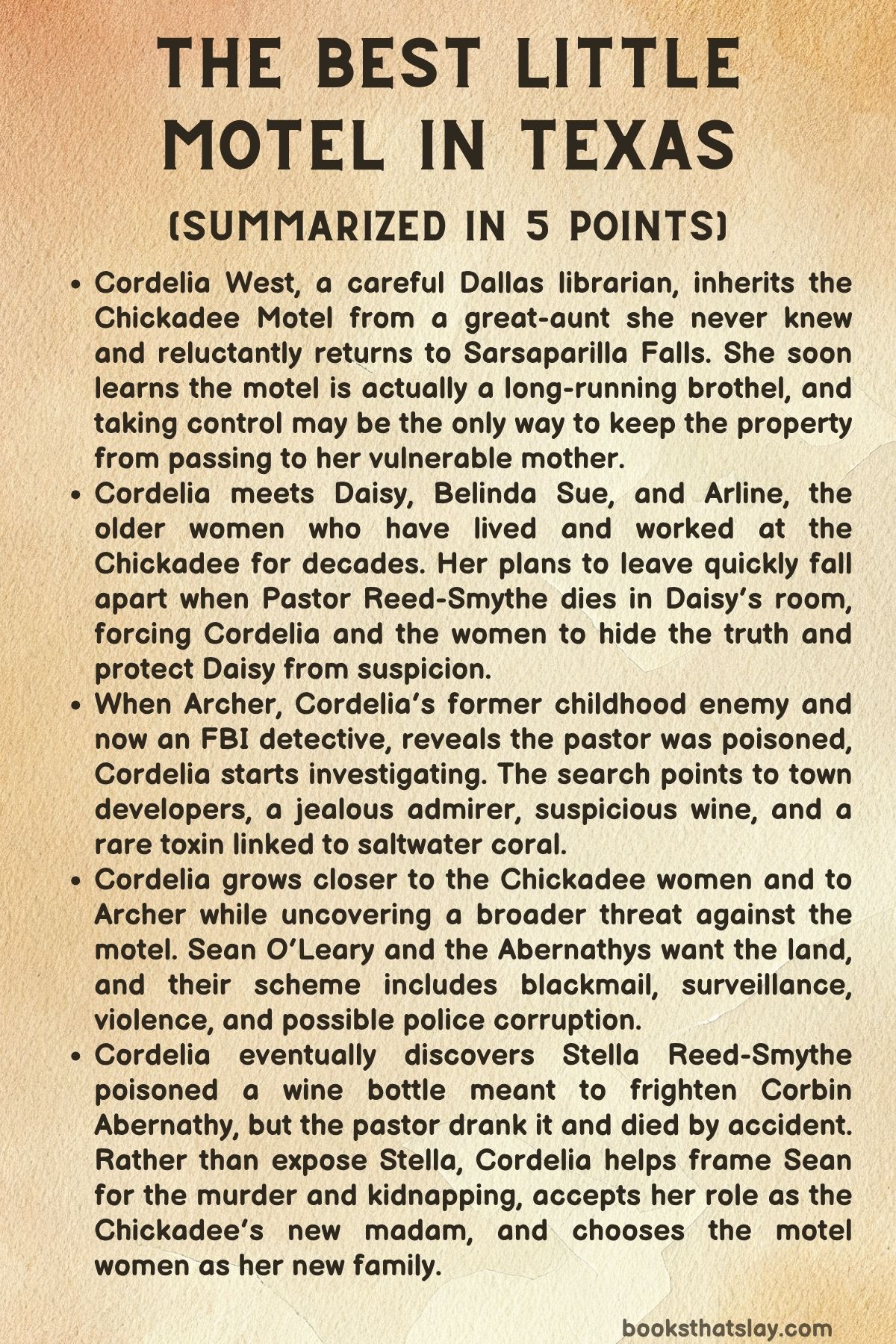
Summary
Cordelia West has built her adult life around order, distance, and routine. As a librarian in Dallas, she keeps herself safely removed from Sarsaparilla Falls, the hometown she left behind two decades earlier.
The town carries memories she does not want to revisit, especially because of the pain it caused her mother, Sherilynn. Cordelia’s careful separation from the past is broken when she receives a call from estate lawyer Arbuckle Jenkins.
He tells her that a great-aunt she never knew, Penelope, has died and left her the Chickadee Motel.
Cordelia has no interest in owning a motel, returning to Sarsaparilla Falls, or taking on family obligations from a woman she never met. At first, she wants to refuse the inheritance or sell the property as quickly as possible.
Jenkins, however, explains that the motel cannot be sold until the current residents leave or die. That strange condition traps Cordelia in a situation she does not understand.
Refusing the inheritance is not simple either, because if she turns it down, ownership will pass to Sherilynn. Cordelia fears that sending her mother back into the town that damaged her could threaten Sherilynn’s sobriety.
With no good option, Cordelia takes three weeks away from her library job and travels to Sarsaparilla Falls. She does not tell Sherilynn the truth.
Instead, she says she is looking into job opportunities, hoping to investigate the inheritance without alarming her mother. When Cordelia arrives at the Chickadee Motel, she finds a pink, dollhouse-like property that seems almost unreal.
There she meets Daisy, Belinda Sue, and Arline, three older women who have lived and worked at the Chickadee for many years. They know the building, the town, and Penelope’s history far better than Cordelia does.
At first, Cordelia assumes the Chickadee is merely a peculiar motel with unusual residents. Gradually, she learns the truth: the Chickadee has long operated as a brothel, and Penelope was its madam.
Cordelia is shocked and angry, especially because Jenkins deliberately avoided explaining the real nature of the business. She calls him and learns that his omission was intentional.
Overwhelmed by the scandal and legal complications, Cordelia thinks about giving Belinda Sue control of daily operations and returning to Dallas as soon as she can.
Before she can escape, the situation turns dangerous. Pastor Reed-Smythe, a longtime client of Daisy and the father of Archer, Cordelia’s childhood enemy, dies in Daisy’s room.
The death is disastrous for everyone involved. Daisy could be blamed, the Chickadee could be exposed, and the pastor’s family could be destroyed by scandal.
Acting out of panic and loyalty, Cordelia joins Daisy, Belinda Sue, and Arline in moving the pastor’s body to the church. They stage the scene to make it look as if he died in his office during a break-in.
Their plan nearly falls apart when an alarm sounds and police sirens approach, but they manage to escape.
The cover-up does not end the problem. Archer, who is now an FBI detective, informs them that the pastor did not die of a heart attack.
He was poisoned. That news changes everything.
Daisy becomes a possible suspect, and Cordelia realizes that the women of the Chickadee may be in real danger. She begins investigating with them, partly to clear Daisy and partly because the truth is now tied to the future of the motel.
Their suspicion first falls on Corbin and Edna Abernathy, who want the Chickadee land for a development deal. The motel’s location makes it valuable, and the Abernathys have clear financial motives for wanting it gone.
Honey Stevens also becomes a suspect because of her obsession with Pastor Reed-Smythe. The deeper Cordelia looks, the more she sees that Sarsaparilla Falls is filled with secrets, grudges, and people willing to lie.
Cordelia’s investigation grows bolder. She distracts Archer by appearing at his office in lingerie, using their complicated history and attraction to throw him off balance.
While he is distracted, she secretly sends a sample of the wine the pastor drank to an FBI lab by slipping it into an official shipment. The test reveals palytoxin, a deadly toxin linked to saltwater coral.
Cordelia deletes the lab record to hide her unauthorized actions, but Archer later discovers what she did and confronts her. Their relationship becomes tense, charged by attraction, mistrust, and the danger surrounding the case.
The search for the poison leads Cordelia and the women toward Dew Valley wine, a wine shop, restaurants connected to that wine, and townspeople who keep saltwater tanks. They try to trace how the toxin entered the pastor’s drink and who had the means to obtain it.
Honey is arrested after arsenic is supposedly found at the Chickadee, but Cordelia does not believe she is guilty. The arrest feels too convenient, and Cordelia senses that someone is trying to redirect attention away from the real killer.
While the murder investigation continues, Cordelia changes. The Chickadee women stop seeming like strangers and begin to feel like family.
Their humor, loyalty, and toughness break through her defenses. She also grows closer to Archer, though their connection is repeatedly strained by the investigation and by Cordelia’s habit of keeping secrets.
At the same time, Dallas begins to feel less like home. Cordelia eventually decides not to return to her old life and gives notice at her library job.
As Cordelia digs further, she uncovers a wider scheme involving Sean O’Leary, a dangerous developer working with the Abernathys and possibly the sheriff. Sean wants the Chickadee property and is willing to use threats, blackmail, surveillance, and violence to get it.
The motel is not only a business or inheritance; it is an obstacle to a larger plan. Cordelia and the women break into an Abernathy warehouse and discover files on Penelope, the Chickadee, and Cordelia herself.
The files prove that Sean and his allies have been watching them and planning against them. However, after police involvement, the evidence disappears, leaving Cordelia with little official proof.
Sean’s threat becomes even clearer when he kidnaps Edna Abernathy. Despite Edna’s earlier role in the development scheme, Cordelia and the Chickadee women help rescue her.
The rescue shows how far Cordelia has come. She is no longer trying to stand apart from the town or the motel.
She is acting as the protector of the women, the property, and the strange new family Penelope left behind.
The truth about the poisoning finally leads to Stella Reed-Smythe, the pastor’s wife. Stella admits that she put palytoxin into a bottle of Dew Valley wine and left it for Corbin.
Her goal was not to kill her husband. She wanted to scare Corbin and Edna away from Sean’s plan against the Chickadee.
The plan went terribly wrong when Corbin gave the bottle to Pastor Reed-Smythe. Because the pastor’s lungs were already weakened, the toxin killed him.
Cordelia faces a moral choice. Exposing Stella would reveal the truth, but it would also hurt people she wants to protect and may not stop Sean.
Instead, Cordelia decides to redirect justice toward the person she sees as the greater threat. She obtains another vial of palytoxin and works with the Chickadee women and Edna to frame Sean for the pastor’s murder and Edna’s kidnapping.
The plan succeeds. Sean is arrested, denied bail, and removed as the immediate danger to the Chickadee.
By the end, Cordelia has accepted a life she once would have rejected completely. She is no longer simply the cautious Dallas librarian who wanted to flee Sarsaparilla Falls.
She becomes the new madam of the Chickadee Motel, not out of scandalous ambition, but out of loyalty and responsibility. She understands that Penelope’s inheritance was not just a building.
It was a community of women who needed protection, a place with a messy history, and a future Cordelia now chooses to defend.
Cordelia takes the women to church, fully aware of the town’s judgment and the risks still ahead. Her choice marks her acceptance of the Chickadee and of herself.
She has returned to the place she feared, faced murder, corruption, family secrets, and old pain, and found a purpose she did not expect. The Best Little Motel in Texas ends with Cordelia ready to protect her new family, hold her ground in Sarsaparilla Falls, and carry forward the complicated legacy Penelope left in her hands.
Characters
Cordelia West
Cordelia West is the central character of The Best Little Motel in Texas, and her journey is shaped by fear, responsibility, loyalty, and gradual self-discovery. At the beginning of the book, she is shown as an orderly, controlled Dallas librarian who has built her adult life around distance from Sarsaparilla Falls.
Her reluctance to return to her hometown reveals how deeply the past has affected her, especially because the place is connected to family pain, social judgment, and her mother Sherilynn’s fragile sobriety. Cordelia initially sees the Chickadee Motel as an unwanted burden, but her reaction changes as she begins to understand the women who live there and the complicated world Penelope left behind.
Her character becomes especially compelling because she is not naturally reckless or rebellious, yet she repeatedly crosses moral and legal boundaries when she believes someone vulnerable needs protection.
Cordelia’s development depends on her growing ability to accept disorder. She begins as someone who wants rules, quiet, and emotional distance, but the story places her in situations where rules fail to protect good people.
Moving the pastor’s body, hiding evidence, manipulating an FBI lab test, and eventually helping frame Sean show that Cordelia becomes willing to act outside conventional morality. However, the book does not present this transformation as simple corruption.
Instead, it shows Cordelia learning that justice, survival, and loyalty are often messier than the life she once tried to maintain. By the end, she no longer sees the Chickadee as something shameful or temporary.
She accepts it as a home, a responsibility, and a chosen family. Her final acceptance of the role Penelope left for her marks a full transformation from reluctant outsider to protective leader.
Sherilynn West
Sherilynn West is important even though she is not physically central to many of the major events. She represents the emotional history Cordelia is trying to manage and protect.
Cordelia’s fear that Sherilynn might inherit the Chickadee if Cordelia refuses it reveals the depth of Cordelia’s protective instincts. Sherilynn’s sobriety makes her vulnerable, and Cordelia believes that returning to Sarsaparilla Falls could reopen old wounds and place her mother in danger.
Through Sherilynn, the story shows that family history does not disappear simply because a person leaves a place behind.
Sherilynn also helps explain why Cordelia is so cautious at the beginning of the book. Cordelia’s secrecy about why she returns to town suggests that their relationship is built on love but also on fear, avoidance, and emotional burden.
Sherilynn’s past connection to Sarsaparilla Falls gives the town a threatening emotional weight before Cordelia even arrives. She is not just Cordelia’s mother; she is a reminder of what the town has already damaged.
Her role deepens Cordelia’s choices because Cordelia is not acting only for herself. She is trying to prevent harm from reaching someone she loves.
Penelope
Penelope is a powerful absent presence in the story. Although she has died before Cordelia arrives, her choices shape nearly everything that follows.
By leaving the Chickadee to Cordelia, Penelope forces her great-niece into a world Cordelia never expected to enter. Penelope’s decision seems shocking at first, especially because Cordelia never knew her, but as the book develops, the inheritance begins to feel less like a random burden and more like a deliberate test of character.
Penelope appears to have understood that the Chickadee needed someone who could protect it, not simply own it.
Penelope’s identity as the former madam of the Chickadee complicates the moral world of The Best Little Motel in Texas. She operated outside polite society, yet the women’s loyalty to her suggests that she gave them stability, shelter, and dignity.
Her legacy is not just a building or a business; it is a community of women who have survived by relying on one another. Penelope’s influence also helps Cordelia discover a different form of inheritance.
Cordelia does not merely receive property. She receives unfinished duties, hidden enemies, and a family structure that exists beyond traditional respectability.
Penelope’s character matters because she challenges Cordelia to redefine what protection, family, and leadership mean.
Daisy
Daisy is one of the most vulnerable and sympathetic characters in the book. Her long connection to the Chickadee and her relationship with Pastor Reed-Smythe place her at the center of the murder crisis.
When the pastor dies in her room, Daisy immediately becomes someone who could be blamed, exposed, or destroyed by scandal. Her situation reveals how easily women like her can be judged by society, even when they are victims of circumstance rather than villains.
Cordelia’s decision to help move the body begins as a desperate attempt to protect Daisy from public shame and legal danger.
Daisy’s character also shows the emotional complexity of the Chickadee women’s lives. She is not presented as a flat comic figure or merely as someone involved in scandal.
Her fear, loyalty, and dependence on the Chickadee make her deeply human. The pastor’s death threatens not only her safety but also the fragile dignity she has maintained.
Through Daisy, the story explores how women who live outside respectable social categories can still possess tenderness, loyalty, and moral worth. Daisy becomes one of the reasons Cordelia begins to understand that the Chickadee is not simply a business to escape from, but a home that protects people who might otherwise be abandoned.
Belinda Sue
Belinda Sue is practical, experienced, and deeply tied to the everyday survival of the Chickadee. When Cordelia first considers handing control of the place to someone else and returning to Dallas, Belinda Sue seems like the obvious person to manage it because she already understands how the motel truly works.
Her presence gives the Chickadee a sense of continuity. She is not shocked by its secrets because she has lived inside them for decades.
This makes her a stabilizing force when Cordelia is still overwhelmed by the truth.
Belinda Sue’s importance grows because she represents the knowledge Cordelia lacks. She understands the women, the town, the business, and the hidden rules of survival in Sarsaparilla Falls.
Her loyalty is not sentimental in a weak way; it is active, practical, and brave. She participates in dangerous plans because protecting the Chickadee and its people matters more to her than preserving a spotless reputation.
Belinda Sue helps Cordelia transition from outsider to leader by showing her that leadership at the Chickadee requires courage, secrecy, and fierce devotion to the women who depend on it.
Arline
Arline is another important member of the Chickadee’s inner circle, and her role strengthens the sense that the motel is a community rather than just a setting. Like Daisy and Belinda Sue, she has lived and worked there for decades, which gives her a strong emotional claim to the place.
Her presence helps Cordelia understand that the inheritance is not just about property ownership. It affects real people whose lives, routines, safety, and identities are connected to the Chickadee.
Arline’s character contributes to the collective strength of the older women. She is part of the group that helps Cordelia cover up the pastor’s death, investigate the murder, break into dangerous spaces, and confront threats from more powerful people.
Her courage is rooted in loyalty rather than ambition. Through Arline, the story emphasizes that older women are not passive background figures.
They are resourceful, protective, and willing to take risks. Arline helps create the emotional foundation that makes Cordelia’s final decision believable.
Cordelia stays because women like Arline make the Chickadee worth protecting.
Arbuckle Jenkins
Arbuckle Jenkins is the estate lawyer who brings Cordelia back into the orbit of Sarsaparilla Falls. His role is important because he controls the first flow of information Cordelia receives about Penelope’s inheritance.
By telling her about the Chickadee while avoiding the full truth, Jenkins creates a situation in which Cordelia walks into the town unprepared. His careful omission about the motel’s real nature makes him appear evasive and morally questionable, even if he may believe he is simply handling difficult legal realities.
Jenkins functions as a gatekeeper between Cordelia’s old life and her new responsibilities. He understands more than he initially says, and this makes him frustrating to Cordelia.
His character reflects the secrecy that surrounds the Chickadee and the town itself. In Sarsaparilla Falls, truth is rarely given directly.
It is hidden, softened, delayed, or manipulated. Jenkins introduces Cordelia to that pattern.
His legal role may seem formal, but his silence has emotional and practical consequences because it forces Cordelia to discover the Chickadee’s reality through shock rather than preparation.
Pastor Reed-Smythe
Pastor Reed-Smythe is central to the murder plot even though he dies early in the story. His death exposes the hypocrisy and secrecy beneath the town’s respectable surface.
As a pastor and Daisy’s longtime client, he represents a public moral identity that conflicts with private behavior. This contradiction is not presented only to condemn him; it also reveals the gap between how Sarsaparilla Falls performs respectability and how its citizens actually live.
His death in Daisy’s room becomes dangerous precisely because his reputation matters so much to the town.
The pastor’s character also connects several major conflicts. He is Daisy’s client, Archer’s father, Stella’s husband, and the accidental victim of a poison meant for someone else.
His weakened lungs make him especially vulnerable to the toxin, turning Stella’s attempt to scare Corbin into a fatal event. In this way, he becomes the tragic center of other people’s schemes and secrets.
His death forces Cordelia into action, brings Archer into the investigation, exposes Stella’s desperation, and gives Sean’s enemies a way to remove him. Even after his death, the pastor continues to shape the choices of the living.
Archer Reed-Smythe
Archer Reed-Smythe is both a romantic interest and a source of pressure for Cordelia. As the son of Pastor Reed-Smythe and Cordelia’s childhood nemesis, he carries emotional history into every interaction with her.
His current role as an FBI detective makes him especially dangerous to Cordelia’s secrets because he has both personal curiosity and professional skill. He is not easily fooled, and his discovery that the pastor was poisoned changes the situation from a hidden scandal into a murder investigation.
Archer’s relationship with Cordelia is defined by attraction, suspicion, and interrupted trust. Cordelia grows closer to him, but her constant concealment keeps creating distance.
Her attempt to distract him with lingerie shows both her boldness and her desperation, while his later confrontation over the unauthorized lab test proves that he is more perceptive than she wants him to be. Archer is important because he represents the lawful path Cordelia repeatedly avoids.
He is not necessarily her enemy, but his commitment to investigation threatens the protective lies Cordelia builds around the Chickadee. His presence makes Cordelia’s moral choices sharper because loving or trusting him would require a kind of honesty she cannot fully afford.
Corbin Abernathy
Corbin Abernathy is one of the early suspects in the pastor’s poisoning and part of the greedy pressure surrounding the Chickadee property. Along with Edna, he wants the land for a development deal, which places him in direct opposition to Cordelia and the women.
His interest in the property shows how outsiders and local power players view the Chickadee not as a home but as valuable land to be exploited. Corbin’s ambition makes him morally suspect even before the full truth is known.
Corbin’s role becomes more complicated when it is revealed that Stella intended the poisoned wine for him, not for the pastor. This places him in the strange position of being both a threat and an intended victim.
His act of giving the bottle to the pastor unintentionally causes the death, making him a key link in the fatal chain of events. Corbin is not innocent in the larger conflict over the Chickadee, but he is also not the murderer Cordelia first needs to find.
His character helps the story show how greed, fear, and careless decisions can create consequences no one fully controls.
Edna Abernathy
Edna Abernathy begins as an antagonist because of her involvement in the effort to obtain the Chickadee land. Her connection to Corbin and the development plan makes her appear aligned with the forces threatening Cordelia’s new family.
At first, she seems like someone who values profit and influence over the lives of the women at the motel. This makes her easy to suspect when the investigation begins.
However, Edna becomes more layered as the story progresses. Sean’s kidnapping of her shifts her position from threatening figure to endangered person.
Cordelia and the women help rescue her, which changes the emotional balance between them. Edna’s later cooperation in framing Sean suggests that she is capable of choosing survival and alliance over greed.
She is not transformed into a purely noble character, but she becomes useful and human in a way that complicates the earlier conflict. Her character shows that enemies can become temporary allies when a greater danger emerges.
Honey Stevens
Honey Stevens is a character shaped by obsession, jealousy, and vulnerability. Her fixation on Pastor Reed-Smythe makes her an obvious suspect once the murder investigation begins.
Because she is emotionally connected to the pastor, the town and the investigators can easily imagine her as someone with a motive. Her arrest after arsenic is supposedly found at the Chickadee shows how quickly suspicion can be directed toward someone whose behavior already seems unstable or socially inconvenient.
Cordelia’s belief that Honey is innocent is important because it shows Cordelia’s growing ability to look beyond appearances. Honey may be obsessive, but that does not make her a killer.
Her character demonstrates how public perception can become dangerous when people confuse emotional messiness with guilt. Honey functions as a false solution to the mystery.
Her arrest could have ended the investigation neatly, but Cordelia refuses to accept a convenient answer. Through Honey, the story criticizes the habit of blaming vulnerable or eccentric women simply because they are easy to frame.
Sean O’Leary
Sean O’Leary is the clearest villain in the book because his actions are driven by greed, control, and intimidation. As a dangerous developer working with the Abernathys and possibly the sheriff, he represents a larger system of corruption rather than a single personal conflict.
Sean wants the Chickadee property, and he is willing to use blackmail, surveillance, violence, and kidnapping to get closer to that goal. Unlike some of the other morally complicated characters, Sean’s behavior is openly predatory.
Sean’s importance lies in the fact that he forces Cordelia to fully become the Chickadee’s protector. He is not simply trying to buy land; he is attacking a fragile community of women who depend on one another.
His files on Penelope, the Chickadee, and Cordelia show that he studies people in order to control them. By framing Sean for the pastor’s murder along with Edna’s kidnapping, Cordelia makes a morally dangerous choice, but the story presents it as a protective act against a man who knows how to manipulate systems for his own benefit.
Sean’s arrest removes the immediate threat, but it also proves how far Cordelia has changed. She defeats him not by remaining innocent, but by becoming strategic, ruthless, and loyal.
Stella Reed-Smythe
Stella Reed-Smythe is one of the most morally complex characters in the story. As the pastor’s wife, she belongs to the respectable surface of Sarsaparilla Falls, but her actions reveal desperation and fear beneath that surface.
Her decision to put palytoxin in a bottle of Dew Valley wine is reckless and dangerous, even though she claims she meant to scare Corbin and Edna rather than kill her husband. Stella’s confession changes the meaning of the murder investigation because the pastor’s death is revealed as accidental rather than intentional.
Stella is not innocent, but she is not portrayed as a simple murderer either. Her motive comes from a desire to stop the threat against the Chickadee, which connects her to the same protective impulse that drives Cordelia and the older women.
The difference is that Stella’s method spirals beyond her control. Her character forces Cordelia into one of her most difficult moral decisions.
By choosing not to expose Stella, Cordelia decides that legal truth and moral justice are not always the same thing. Stella’s role deepens the story because she shows how fear can lead a person to commit a terrible act while still acting from a complicated form of loyalty.
Themes
Chosen Family and Belonging
Cordelia arrives in Sarsaparilla Falls determined to keep emotional distance from the Chickadee and its residents, but The Best Little Motel in Texas slowly reshapes her understanding of home. Daisy, Belinda Sue, and Arline are not simply women tied to an awkward inheritance; they become the first people who accept Cordelia without demanding that she hide her fear, anger, or confusion.
Their bond grows through shared danger, secrecy, and loyalty, but it is also built on small acts of care that Cordelia has long missed. The Chickadee becomes a place where outsiders protect one another because the respectable world has often judged or failed them.
Cordelia’s final choice to remain there shows that family is not limited to blood or social approval. It can be created through trust, sacrifice, and the willingness to stand beside people when doing so is risky.
Morality, Justice, and Protection
The story challenges simple ideas of right and wrong by placing Cordelia in situations where legal action and moral action do not always match. Moving the pastor’s body, deleting evidence, hiding Stella’s role, and framing Sean are all dishonest or unlawful acts, yet Cordelia sees them as ways to protect vulnerable people from greater harm.
Her choices show a world where official systems are weak, biased, or easily manipulated by money and status. Justice becomes personal because the people with power are often the ones creating danger.
Cordelia’s morality is not clean or perfect; it is shaped by urgency, fear, loyalty, and the need to defend those who have few defenses. The theme becomes especially strong because the story does not present protection as innocent.
Instead, it shows that protecting others can demand painful compromises and leave the protector changed.
Escaping the Past
Cordelia’s return to Sarsaparilla Falls forces her to face a past she has spent twenty years avoiding. Her careful life in Dallas has been built around control, distance, and silence, but the inheritance pulls her back into the very place connected to family pain and old humiliation.
Her fear for Sherilynn’s sobriety also shows how deeply the past still controls the present. At first, Cordelia wants only to solve the problem quickly and leave, but each discovery makes escape harder.
The town is not just a place she dislikes; it is a place that still contains unfinished truths about her family, Penelope, and herself. By choosing to stay, Cordelia does not erase the past or forgive everything that happened.
Instead, she stops letting avoidance define her life. Her return becomes a transformation from running away to claiming power over the place that once frightened her.
Reputation and Social Hypocrisy
Sarsaparilla Falls is filled with people who care deeply about public image while hiding private corruption, desire, and cruelty. The Chickadee is judged because of what it represents, yet many supposedly respectable figures are connected to it, threatened by it, or willing to use it for their own purposes.
Pastor Reed-Smythe’s secret relationship with Daisy exposes the gap between public virtue and private behavior, while Sean and the Abernathys show how polished ambition can cover greed and violence. Cordelia learns that reputation often protects the wrong people and condemns those who are already vulnerable.
The older women at the Chickadee may be socially dismissed, but they show more loyalty, courage, and honesty than many people with respected names. Through this contrast, the story criticizes a town that confuses appearance with goodness.
True character is revealed not through status, but through how people act when others are in danger.