The Curse of Hester Gardens Summary, Characters and Themes
The Curse of Hester Gardens by Tamika Thompson is a supernatural crime novel about family, guilt, violence, and the weight a place can carry. Set around the troubled public housing complex of Hester Gardens, the book follows Nona McKinley, a mother trying to protect her sons while hiding a terrible secret from her past.
What begins as one act of murder grows into a legacy of fear that shapes the lives of everyone around her. The novel combines ghostly disturbances with real-world grief, showing how silence, trauma, and unchecked violence can pass from one generation to the next.
Summary
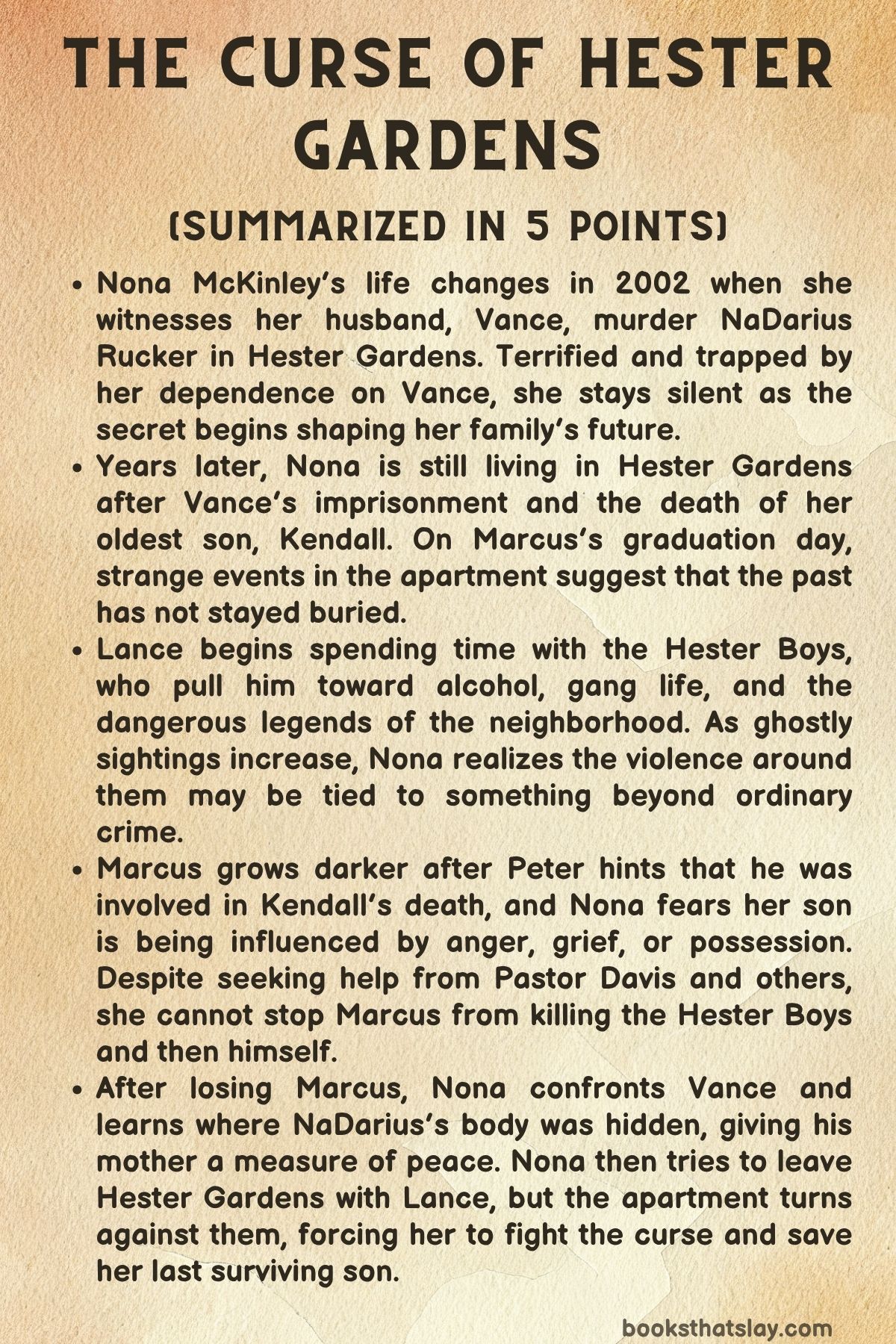
The Curse of Hester Gardens begins with a moment that changes Nona McKinley’s life forever. On May 28, 2002, Nona leaves her three young sons, Kendall, Marcus, and baby Lance, with Mother Lincoln so she can prepare an anniversary dinner for her husband, Vance.
She hopes to create a peaceful evening and hold together the image of a stable family, but that hope is destroyed when she takes a shortcut through an alley in Hester Gardens.
There, Nona sees Vance attacking a young man named NaDarius Rucker with a pistol. NaDarius is badly beaten and terrified.
He sees Nona and begs her not to let Vance kill him. Nona freezes, caught between horror, fear of her husband, and the shock of witnessing what he is capable of doing.
Vance strikes NaDarius one last time, killing him. Instead of calling for help, Vance hides the body and forces Nona into silence.
Nona does not expose him. She stays with him because she is afraid, but also because she has convinced herself that her sons need their father and that the family cannot survive without him.
Her choice becomes the first great wound of the story, a secret that never truly stays buried.
Years pass, and Nona’s life remains tied to Hester Gardens. Vance is eventually imprisoned for drug trafficking, but his absence does not free the family.
Kendall, Nona’s oldest son, has been shot and killed, leaving Nona with another grief she cannot overcome. She is now raising Marcus and Lance in the same housing complex where death, fear, and rumors of ghosts seem to follow everyone.
Hester Gardens is not only a setting; it feels like a force pressing down on the people who live there.
On May 28, 2016, Marcus graduates as valedictorian. It should be one of the proudest days of Nona’s life.
Marcus has worked hard, risen above the violence around him, and become a symbol of possibility. Yet the day begins with signs that something is wrong.
In Nona’s apartment, she hears footsteps and a voice saying, “It’s me.” The stove turns on by itself. These disturbances frighten her because they seem connected to the past she has tried to ignore.
Still, Nona tries to focus on Marcus and the future his success might bring.
At the graduation ceremony, Marcus delivers a powerful speech. He honors Kendall, whose death still shapes the family, and shows the intelligence and promise that make Nona proud.
But Marcus also appears to see someone near the doors whom others cannot see. Nona senses danger beneath the celebration.
Her dread grows stronger, though she has no clear way to explain it.
After the ceremony, Lance slips away and spends time with the Hester Boys, a group that includes Peter, Donnell, Solomon, Cedrick, Rayvon, and Red. Peter gives Lance alcohol and pushes him toward gang life.
Lance is young and vulnerable, caught between wanting acceptance and knowing that the world around him is dangerous. The boys talk about the ghosts of Hester Gardens, including Little Lonnie, a dead child said to appear with a blue ball.
These stories begin to feel less like rumors and more like warnings. Lance starts to understand that the supernatural presence in the neighborhood may be real.
Marcus’s graduation party is hosted by Pastor Davis and is meant to honor his achievement. The celebration turns tense when Peter appears wearing Kendall’s missing watch.
Marcus recognizes it and attacks him. The watch suggests that Peter may know something about Kendall’s death, possibly more than anyone has admitted.
Nona’s suspicion deepens. Kendall’s murder, once treated as another tragedy of the neighborhood, begins to look connected to the same people now circling Marcus and Lance.
In the days that follow, the boundary between the living and the dead grows weaker. Nona, Lance, Gretchen, Kiandra, Donnell, and others experience ghosts or strange events.
Hester Gardens seems full of restless spirits, and Nona becomes convinced that the dead are not only appearing but also influencing the living. The supernatural activity is frightening, but the human danger is just as severe.
The Hester Boys continue to threaten Marcus and Lance, and Marcus’s anger begins to change him.
A fight breaks out between Marcus, Lance, and the Hester Boys. During the confrontation, Peter taunts Marcus by saying he will end up like Kendall.
His words suggest that he may have been responsible for Kendall’s death. Marcus calls 911, trying to seek justice through the police, but there is not enough proof.
The system fails to protect him or give his family answers. This failure increases Marcus’s rage and isolation.
Nona watches Marcus become someone she barely recognizes. Lance tells her that Marcus seems different, angrier, and possibly possessed.
Marcus begins surrounding himself with violent games and dark music. Eventually, he gets a gun.
Nona tries to intervene, but every attempt falls short. She turns to Pastor Davis, Harlan, Mable, and Vega Lawson, looking for help from anyone who might understand what is happening.
Yet the danger keeps moving closer.
Pastor Davis’s role becomes more complicated as secrets around the church surface. A weapons dealer connected to the church may have supplied the gun Marcus uses.
This revelation shows how corruption and violence are not limited to the streets. Institutions that should offer protection are also compromised.
The people of Hester Gardens are trapped between spiritual fear, neighborhood violence, and the failures of those meant to guide them.
Marcus finally breaks. He goes into the homes of the Hester Boys while they sleep and kills them with a semiautomatic rifle.
After carrying out the killings, he goes to Kitledge High and kills himself. Nona loses a second son, and the nightmare she feared becomes real.
The media quickly presents the massacre as gang-related, reducing Marcus’s life and pain to a simple public story. But Harlan understands that what happened is part of something larger.
It reflects the suffering of young people surrounded by violence, grief, neglect, and forces they cannot escape.
After Marcus’s death, Nona can no longer avoid the secret that began everything. She visits Vance in prison and confronts him about NaDarius Rucker.
She forces him to reveal where he hid the body after the murder. Vance admits that NaDarius’s remains are at the lake tied to their early relationship.
The police recover the body, giving NaDarius’s mother, Beth, the chance to finally know what happened to her son. Beth gains some peace after years of uncertainty.
She also gives Nona money to help her save Lance, Nona’s last surviving child.
Nona decides that she must leave Hester Gardens with Lance. She understands that staying means risking the last piece of her family.
As they pack the moving truck, the apartment seems to fight back. The doors lock, the stove bursts into flames, and the haunting reveals itself as something larger than NaDarius alone.
The evil tied to Hester Gardens appears rooted in the place itself, as if years of death, fear, and silence have created a curse that feeds on the people who live there.
Nona refuses to surrender Lance to the same fate as Kendall and Marcus. As the fire spreads, she and Lance struggle against the iron bars trapping them inside.
Nona cries out that she will not lose another son. In a final act of desperate strength, she bends the metal door open and fights to free them.
Her escape is not only physical but moral. After years of silence, fear, and compromise, Nona chooses action.
She cannot undo NaDarius’s murder, Kendall’s death, or Marcus’s destruction, but she can still fight for Lance. The novel ends with that act of resistance, showing a mother’s refusal to let the curse claim everything she loves.
Characters
The characters in The Curse of Hester Gardens are shaped by fear, grief, violence, secrecy, and the heavy influence of the place they live in. Each character carries some connection to the suffering inside Hester Gardens, whether as a victim, survivor, witness, participant, or symbol of the neighborhood’s curse.
The story presents them not only as individuals but also as people trapped inside a cycle where the past refuses to stay buried.
Nona McKinley
Nona McKinley is the emotional center of the book and one of its most tragic figures. She begins as a mother trying to protect the stability of her family, but her life is permanently altered when she witnesses Vance killing NaDarius Rucker.
Her failure to intervene is not presented as simple cruelty; it comes from terror, shock, and the helplessness she feels under Vance’s control. That moment becomes the wound that shapes the rest of her life.
Nona’s silence allows the truth to remain buried, but it also buries part of her own spirit. She continues living in Hester Gardens while carrying guilt, fear, and the knowledge that her family’s safety has been built on a terrible secret.
As a mother, Nona is fiercely loving but often trapped by circumstances. She loses Kendall, then watches Marcus change before losing him too, and her fear of losing Lance becomes the force that finally pushes her toward action.
Her character shows how trauma can make a person passive for years, but also how love can eventually become stronger than fear. By the end of the book, Nona is no longer only a woman haunted by what she saw; she becomes a woman fighting against the curse itself.
Her desperate struggle to save Lance shows her transformation from silence to resistance.
Vance McKinley
Vance McKinley is one of the darkest human forces in The Curse of Hester Gardens. He is violent, controlling, and morally corrupt, and his murder of NaDarius becomes one of the central acts of evil in the story.
Vance does not only kill a young man; he also forces Nona into silence, turning her fear into another weapon he can use. His power over her reveals the kind of domestic terror that can exist behind the appearance of family life.
Even after he is imprisoned for drug trafficking, the damage he caused continues to shape the lives of Nona and her children.
Vance represents violence that spreads beyond a single act. His crime poisons Nona’s conscience, denies Beth the truth about her son, and contributes to the spiritual unrest surrounding Hester Gardens.
He is also connected to the broader world of crime and survival that has trapped many people in the community. When Nona confronts him in prison, he is reduced from a terrifying presence to a man forced to expose the truth he hid for years.
His role in the book shows that secrets do not disappear just because the person who created them is locked away.
Marcus McKinley
Marcus McKinley is one of the most heartbreaking characters in the story because he represents promise destroyed by grief, anger, and supernatural influence. At first, Marcus appears to be a symbol of hope.
He graduates as valedictorian, gives a powerful speech, and honors Kendall, showing intelligence, discipline, and deep love for his dead brother. His achievement suggests that he might be able to rise above Hester Gardens and build a different future.
However, the strange moment when he seems to see someone invisible hints that he is already being touched by forces beyond ordinary understanding.
Marcus’s decline is both psychological and supernatural. His anger over Kendall’s death, especially after Peter appears with Kendall’s missing watch, grows into obsession and rage.
The fact that he begins collecting violent games, dark music, and eventually a gun suggests that something inside him is being fed and changed. Whether his actions come from possession, grief, or the curse working through his pain, Marcus becomes a devastating example of how young people can be consumed by violence when no one can reach them in time.
His massacre of the Hester Boys and his suicide turn him from a hopeful graduate into another victim of the place’s destructive cycle.
Lance McKinley
Lance McKinley is the youngest of Nona’s sons and the character who most clearly represents the possibility of survival. As a baby, he is absent from the original crime but grows up inside the consequences of it.
By 2016, he is vulnerable to the same dangers that destroyed his brothers. His contact with the Hester Boys shows how easily he could be pulled into gang life, especially when Peter gives him alcohol and tries to guide him toward that world.
Lance is young enough to be influenced, but he is also observant enough to understand that something is deeply wrong in Hester Gardens.
Lance becomes important because he sees and hears things that others might dismiss. Through him, the book shows that the hauntings are not only stories adults tell but real experiences shaping the children of the neighborhood.
His fear of Marcus’s transformation also helps Nona understand the seriousness of what is happening. By the end, Lance is the son Nona refuses to lose.
His survival becomes the final test of whether the family can break free from the curse. Lance is not presented as untouched by trauma, but he still carries the possibility of a future outside the destructive world that claimed Kendall and Marcus.
Kendall McKinley
Kendall McKinley is dead before much of the central action unfolds, but his presence is powerful throughout the story. His death has deeply damaged his family, especially Marcus, who honors him at graduation and later becomes consumed by rage over what happened to him.
Kendall functions as both a lost son and an unresolved wound. Because Peter appears wearing his missing watch, Kendall’s death becomes connected to the larger pattern of violence among the Hester Boys and the unanswered questions haunting Nona’s family.
Kendall’s character is important because he represents the first major loss that Nona could not prevent. His absence changes the emotional structure of the family.
Marcus’s grief over him becomes one of the forces that leads to tragedy, and Nona’s fear of losing more children grows from the pain of losing him. Even though Kendall does not act directly in the present storyline, his memory drives the living characters toward confrontation, suspicion, and revenge.
NaDarius Rucker
NaDarius Rucker is one of the most tragic characters in the book because his death begins the chain of guilt and haunting that follows Nona for years. His plea to Nona not to let Vance kill him makes the scene especially painful, because it places Nona in a position where her fear and helplessness become part of the tragedy.
NaDarius is not given the chance to grow, defend himself, or receive justice in life. His body is hidden, and his mother is left without answers, making his death both physical and social erasure.
NaDarius also becomes a symbol of the truth that refuses to stay buried. The disturbances Nona experiences suggest that the dead are still reaching into the lives of the living.
However, the ending reveals that the haunting may be larger than NaDarius alone, which makes his role even more complex. He is both an individual victim and part of a wider spiritual corruption tied to Hester Gardens.
The recovery of his remains gives his mother some peace, but it does not fully end the darkness surrounding the place.
Peter
Peter is one of the most threatening young characters in the story and serves as a major link between street violence, intimidation, and the destruction of the McKinley family. He is part of the Hester Boys and acts with arrogance, cruelty, and confidence.
His decision to wear Kendall’s missing watch is not a small detail; it is a deliberate or careless act that exposes his connection to Kendall’s death and provokes Marcus’s rage. Peter’s taunts make him seem not only guilty but proud of the fear he creates.
Peter’s influence over Lance also shows his danger. He gives Lance alcohol and encourages him toward gang activity, suggesting that he helps recruit younger boys into the same violent cycle.
His power comes from attitude, reputation, and the fear others have of him. In the book, Peter represents the kind of young violence that is both created by the environment and then used to destroy others within it.
His eventual death at Marcus’s hands does not feel like justice as much as another part of the curse consuming the children of Hester Gardens.
Donnell
Donnell is a member of the Hester Boys, but he is also shown as someone who encounters supernatural events, which makes him more than just a background gang member. His presence helps show that the curse does not affect only Nona’s family.
The boys who participate in intimidation and violence are also trapped in the same haunted environment. Donnell belongs to the group that threatens Lance and Marcus, but he is also vulnerable to the forces moving through Hester Gardens.
His character adds to the book’s sense that guilt and fear are spread across the community. Donnell’s connection to the Hester Boys places him on the side of danger, yet the supernatural encounters around him suggest that the boys are not fully in control of the world they think they dominate.
Like the others, he becomes part of the tragic cycle that leads to Marcus’s violent attack.
Solomon
Solomon is another member of the Hester Boys, and his role contributes to the collective menace surrounding Lance and Marcus. As part of the group, he represents the pressure young men face inside Hester Gardens to belong to a violent structure.
His individuality is less developed than Peter’s, but that also reflects how gang identity can reduce young people into members of a larger force. Solomon’s presence strengthens the sense that Lance is being surrounded by a dangerous world that could easily absorb him.
Solomon’s role also matters because the Hester Boys become targets of Marcus’s revenge. This makes him part of the book’s larger tragedy of youth violence.
He is not simply an enemy figure; he is another young person caught inside a place where violence has become normal. His death contributes to the idea that the curse destroys both the guilty and the vulnerable.
Cedrick
Cedrick is part of the Hester Boys and helps form the threatening environment that surrounds the McKinley family. His presence within the group shows how violence in the book is often collective rather than individual.
While Peter stands out as the boldest and most openly cruel member, characters like Cedrick help make the group powerful. They create the atmosphere of intimidation that makes Lance’s involvement so dangerous and Marcus’s anger so explosive.
Cedrick’s character also shows how the story treats the Hester Boys as both agents of harm and products of harm. They frighten others, but they are also young men living inside a damaged place shaped by death, poverty, and spiritual unrest.
Cedrick’s fate under Marcus’s attack reinforces the book’s bleak view of revenge: it does not heal Kendall’s death, protect Lance, or free anyone from the curse. It only adds more bodies to the history of Hester Gardens.
Rayvon
Rayvon is another member of the Hester Boys, and his role adds to the sense of group pressure and danger that threatens Lance. He belongs to the circle of young men who make violence feel ordinary in the neighborhood.
His presence helps show that the Hester Boys are not just a few individuals but a system of influence. They offer belonging, fear, and power, especially to younger boys who may not yet understand the cost.
Rayvon’s character is important because he is part of the group Marcus ultimately destroys. Through him, the book widens the tragedy beyond Marcus and Peter.
The massacre is not only the death of one guilty person but the destruction of multiple young lives. Rayvon represents the way the curse swallows people in groups, turning community life into a chain of suspicion, aggression, and loss.
Red
Red is a member of the Hester Boys whose role contributes to the dangerous social world surrounding Lance and Marcus. Like the other boys, he is part of a group that seems powerful on the surface but is ultimately vulnerable to the violence and haunting that define Hester Gardens.
Red’s presence helps establish the Hester Boys as a real force in the neighborhood, not just a rumor or distant threat.
Red’s character also reflects the book’s interest in how young people inherit violence. He is part of a group that frightens others, but he is also living under the same curse that affects everyone around him.
When Marcus attacks the Hester Boys, Red becomes part of the larger tragedy in which revenge and supernatural darkness blur together. His fate shows that no one inside the cycle is truly safe.
Mother Lincoln
Mother Lincoln plays a smaller but meaningful role in the book because she is connected to the McKinley family’s earlier life. Nona leaves her children with Mother Lincoln before preparing the anniversary dinner for Vance, which places Mother Lincoln near the beginning of the tragedy.
She represents a kind of community caregiving, the older support system that families depend on when trying to survive difficult circumstances.
Her character also helps contrast ordinary family life with the horror that follows. While Nona’s children are being cared for, Nona witnesses a murder that changes everything.
Mother Lincoln’s presence reminds the reader that the characters are not living only inside violence; they also have routines, relationships, and people who help them. This makes the tragedy feel more painful because it interrupts a life that still had tenderness and structure.
Pastor Davis
Pastor Davis is a complicated figure because he appears connected to guidance, celebration, and community care, yet his own secrets weaken his moral authority. He throws Marcus’s lavish graduation party, which makes him seem generous and invested in Marcus’s success.
In that moment, Pastor Davis represents public hope, achievement, and the possibility that the community can honor one of its young men.
However, the later revelation that a weapons dealer connected to the church may have supplied the gun Marcus uses makes Pastor Davis more morally troubling. Even if he is not directly responsible for Marcus’s actions, his world is not as clean as it appears.
His character shows how institutions that should protect young people can become entangled in the same systems that endanger them. Pastor Davis stands at the intersection of faith, reputation, secrecy, and failure.
Harlan
Harlan is one of the characters Nona turns to when she begins to understand that the danger around her family is deeper than ordinary conflict. He functions as a witness to the broader meaning of the violence.
Unlike the media, which treats Marcus’s massacre as gang-related, Harlan recognizes that the tragedy belongs to a larger story of youth suffering and violence. This makes him one of the more thoughtful observers in the book.
Harlan’s importance lies in his ability to see beyond easy explanations. He understands that Marcus’s actions cannot be reduced to one label or headline.
Through Harlan, the book criticizes shallow public interpretations of violence, especially when young people from poor or haunted communities are involved. He helps frame the tragedy as part of a larger human and social crisis.
Gretchen
Gretchen is one of the characters who encounters supernatural events, which connects her to the widening influence of the curse. Her role shows that the haunting is not limited to Nona’s apartment or Nona’s private guilt.
The strange forces in Hester Gardens reach across different lives, making the entire community feel infected by the past.
Gretchen’s character helps build the atmosphere of shared fear. She stands as one of the witnesses to the idea that something unnatural is happening, even if the living characters struggle to understand it.
Her presence supports the book’s larger theme that trauma does not stay isolated. It spreads through homes, relationships, rumors, and memories until many people are forced to confront it.
Kiandra
Kiandra is another character who experiences the supernatural side of Hester Gardens. Like Gretchen, she helps show that the haunting is communal rather than private.
Her role adds to the sense that the neighborhood itself is alive with fear, memory, and danger. The curse is not something that belongs only to Nona or to the dead body of NaDarius; it has become part of the environment.
Kiandra’s presence also helps deepen the social world of the book. She is part of the network of people who witness strange events and sense that the normal explanations are not enough.
Through characters like Kiandra, the story becomes less about one family’s suffering and more about a place where many people are touched by the same darkness.
Mable
Mable is one of the people Nona seeks out as the danger around Marcus grows. Her role suggests wisdom, community knowledge, or at least the possibility of help outside official systems.
Nona’s decision to go to Mable shows her desperation. She is searching for anyone who might understand what is happening and help protect her remaining children.
Mable’s character reflects the way people in frightened communities often turn to informal sources of support when institutions fail them. Police, church, family, and neighbors all seem limited in what they can do.
Mable becomes part of Nona’s search for answers, and her presence shows that the fight against the curse is not only physical but also spiritual and communal.
Vega Lawson
Vega Lawson is another figure Nona turns to when she realizes that ordinary solutions are not stopping the danger. Vega’s role suggests that Nona is reaching beyond the familiar boundaries of her life, looking for someone who may understand forces that others ignore or dismiss.
Even the act of seeking Vega’s help shows how far Nona has moved from denial into alarm.
Vega’s importance comes from the way her character expands the book’s sense of spiritual conflict. Nona is not only trying to stop Marcus from becoming violent; she is trying to understand whether something has taken hold of him.
Vega belongs to the group of characters who show that the living need language, knowledge, and courage to confront what the dead and the cursed place have left behind.
Beth
Beth is NaDarius Rucker’s mother, and her character represents grief denied closure. For years, she does not know where her son’s body is or what truly happened to him.
This makes her pain especially cruel because she has been forced to live without answers. Beth’s suffering is one of the clearest examples of how Vance’s crime continues harming people long after the murder itself.
When NaDarius’s remains are finally recovered, Beth receives a measure of peace. Her decision to give Nona money to help save Lance is deeply significant.
Instead of responding only with bitterness, she helps another mother protect her child. Beth’s character brings moral grace into a story filled with guilt and violence.
She shows that grief can become compassion, even when justice has come painfully late.
Little Lonnie
Little Lonnie is one of the ghostly figures associated with Hester Gardens, remembered as a dead child who appears with a blue ball. His presence gives the haunting a particularly sorrowful quality because he represents childhood lost to the violence and suffering of the place.
Unlike the more direct horror connected to NaDarius or the curse, Little Lonnie carries a quiet sadness that suggests the neighborhood has claimed many innocent lives.
Little Lonnie also helps Lance understand that the stories about ghosts may be real. Through this figure, the supernatural world becomes visible to the younger generation.
His character is important because he shows that the haunting is not only about revenge or fear; it is also about memory. The dead children, the murdered young men, and the grieving families all remain part of Hester Gardens, even when the living try to move on.
Themes
Silence, Guilt, and Moral Responsibility
Nona’s silence after witnessing NaDarius’s murder becomes one of the central burdens of The Curse of Hester Gardens. Her fear of Vance is understandable, yet the story shows that silence does not protect anyone for long.
By refusing to speak, Nona preserves her household on the surface, but beneath that surface guilt grows into dread, shame, and spiritual unrest. NaDarius’s death does not remain buried because the truth has been denied justice.
Nona’s guilt also affects how she mothers her sons, since she lives with the knowledge that danger has always been close to them. Her silence is not shown as simple cowardice; it comes from fear, dependence, trauma, and the pressure to keep her family together.
Still, the consequences are severe. The hidden crime becomes part of the emotional and supernatural weight pressing on Hester Gardens.
When Nona finally confronts Vance and helps recover NaDarius’s body, the act suggests that truth cannot undo death, but it can begin to restore dignity to the dead and peace to the living.
Cycles of Violence and Inherited Trauma
Violence in the story does not appear as a single event, but as a pattern passed from person to person and from one generation to the next. Vance’s killing of NaDarius begins as a private act of brutality, yet its effects spread across families, children, and the entire community.
Kendall’s death, Marcus’s growing rage, Lance’s exposure to the Hester Boys, and the final massacre all suggest that young people are trapped inside a world shaped by earlier harm. The boys in Hester Gardens are not born violent; they are surrounded by grief, poverty, fear, weapons, gangs, and adults who have either failed them or been broken themselves.
Marcus’s transformation is especially tragic because he begins with promise, intelligence, and public success. His fall shows how trauma can hide beneath achievement until it erupts.
The story presents violence as both personal choice and social inheritance. People are responsible for what they do, but they are also shaped by an environment where pain repeats itself because it has never been healed.
Motherhood, Protection, and Powerlessness
Nona’s role as a mother is defined by love, fear, guilt, and desperate protection. She wants to shield Kendall, Marcus, and Lance from the dangers around them, yet Hester Gardens constantly exposes the limits of maternal control.
Her grief over Kendall’s death makes her watch Marcus and Lance with even greater fear, but love alone cannot block gangs, guns, ghosts, secrets, or the influence of violent men. Marcus’s success as valedictorian briefly gives Nona hope that one of her sons might escape the neighborhood’s pull, but that hope collapses as his anger and isolation deepen.
Lance becomes her final chance to save what remains of her family. The ending, where Nona physically fights to free herself and Lance from the burning apartment, turns motherhood into an act of raw resistance.
She cannot save all her children, and the story does not soften that pain. Still, her refusal to surrender Lance shows that motherhood contains strength even when it is surrounded by helplessness.
The Haunting Power of Place
Hester Gardens is more than a setting; it behaves like a living force shaped by death, poverty, fear, and memory. The hauntings suggest that the suffering of the past has soaked into the buildings, alleys, apartments, and daily life of the community.
Ghosts such as NaDarius and Little Lonnie make visible what the living try to ignore: murdered children, abandoned truths, and grief that has never been honored. The supernatural events are frightening, but they also reveal that the real horror is not only paranormal.
It is the way a place can hold people in patterns of danger until leaving feels almost impossible. The final fire shows Hester Gardens as a force that does not want to release Nona and Lance.
The locked apartment and burning stove turn the home itself into a trap. Yet Nona’s escape also challenges the idea that place has complete power over people.
The curse is strong, but her will to save Lance proves that survival can still resist it.