The Dreadfuls Summary, Characters and Themes
The Dreadfuls by A. Rae Dunlap is a historical mystery about girls trapped inside systems that claim to reform them while denying them agency, education, and belief. Set against the terror of the Whitechapel murders, the novel follows Dell Morton, a sharp, book-obsessed orphan sent to a reformatory after stealing sensational literature.
What begins as Dell’s private fantasy of becoming a detective grows into a dangerous investigation involving false identities, blackmail, social prejudice, and real violence. The book balances gothic imagination with the harsher truth of Victorian respectability, showing how stories can distort reality but also give young women the courage to name injustice.
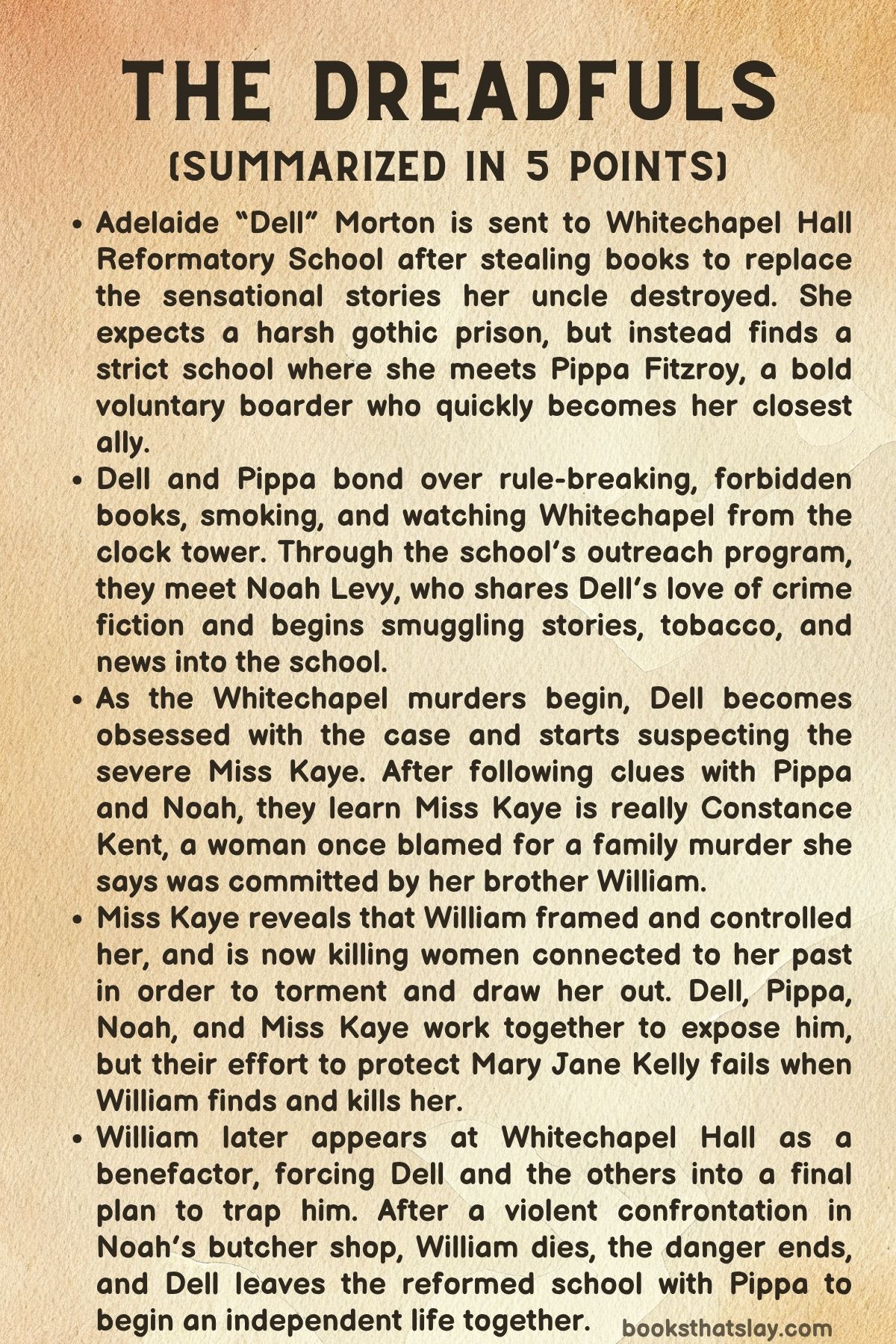
Summary
Adelaide “Dell” Morton arrives at Whitechapel Hall Reformatory School already determined not to be reformed. She has been sent there for stealing books, but to Dell, the crime feels less like theft than resistance.
Her uncle burned the penny dreadfuls and crime broadsides she loved, treating them as corrupting trash, and Dell responded by taking more. Orphaned and unwanted by her relatives, she enters the school expecting something suitably dark and dramatic.
Instead, she finds brightness, order, prayer, domestic labor, and a total lack of real academic teaching. Whitechapel Hall does not aim to educate girls so much as reshape them into obedient servants.
Dell is placed in the belfry annex because the dormitory is full. There she meets Philippa “Pippa” Fitzroy, her new roommate.
At first Dell sees Pippa as too pretty, too passive, and too much like the sort of heroine who might steal attention from her own imagined adventure. Yet Pippa soon proves far stranger and more interesting than Dell expects.
She is mocked by other girls, especially Beatrice, and called “Batty” because of her belfry room, but she is neither weak nor dull. Dell tries to frighten her with fake confessions of murder, only to have Pippa laugh and recognize the performance.
Rather than condemning Dell’s hidden penny dreadfuls, Pippa is fascinated by them. She also reveals a secret route across the belfry beams to an outside ledge where she keeps a hidden cubby and a pipe.
The two girls begin to understand each other as abandoned children: Dell by death and cold relatives, Pippa by a father who chose his new young wife over his daughter.
Their first real taste of freedom comes through market duty. Sent into Whitechapel to buy meat, Dell and Pippa are warned to remain “Ambassadors of Virtue,” but the streets thrill Dell with movement, noise, papers, trains, shops, and possible escape routes.
At the butcher’s shop, they meet Noah Levy, the butcher’s son. Dell sees his father strike him and quickly realizes Noah is also trapped in a difficult life.
Noah shares her love of penny dreadfuls and crime stories, and he begins smuggling papers, serials, and tobacco to the girls inside the meat parcels. Dell enjoys this new connection, though she feels guilty because she still imagines escaping alone, leaving Pippa behind.
Life at Whitechapel Hall soon settles into repetition: chapel, sewing, laundry, kitchen work, moral instruction, and silence. Dell tries to turn ordinary school life into a detective case, suspecting staff members of crimes that turn out to be nothing.
Her fantasy of escape becomes more serious when she discovers a dumbwaiter in the pantry large enough for a person. She lowers herself through it into the alley, but the attempt fails almost immediately.
Frightened by people sleeping outside and spotted by a policeman, she runs straight into Miss Kaye, the stern house mother. To Dell’s shock, Miss Kaye protects her from Headmaster Graves by lying about what happened.
In private, however, she forces Dell to admit the truth and warns her that another escape attempt could send her to prison. Dell is spared, but her betrayal hurts Pippa, who knows Dell nearly abandoned her.
Then Whitechapel is shaken by murder. Mary Ann Nichols is found killed near Buck’s Row, and Dell reacts with a mix of horror and excitement.
The violent crime is nothing like the stories she reads, yet she cannot help wanting to investigate. Noah brings news from the streets, while Reverend Barnett turns the woman’s death into a moral sermon about vice.
Dell and Pippa begin listing suspects, but their early guesses are childish and shaped by sensational fiction. As suspicion falls on “Leather Apron,” a Polish Jew, Noah fears the danger this poses to his whole community.
The case teaches Dell that public fear does not stay neatly attached to evidence. It spreads toward people already treated as outsiders.
Miss Kaye soon becomes Dell’s main suspect. One night Dell and Pippa see her secretly leave the school through the same hidden route near the dumbwaiter and head toward Whitechapel.
When Annie Chapman is murdered, Dell becomes more convinced that Miss Kaye is involved. Searching Miss Kaye’s room, she finds no weapon, but she discovers hair dye, a comb, a sponge, and fake spectacles.
Miss Kaye is clearly disguising herself. A newspaper article about the famous Road Hill House case then gives Dell what seems like a breakthrough.
The article describes Constance Kent, a woman who confessed years earlier to killing her young half-brother, and the portrait resembles Miss Kaye. Dell concludes that Miss Kaye is Constance Kent and possibly a murderer again.
Pippa urges Dell to tell Headmaster Graves, but Miss Kaye is temporarily in charge, and their attempt to report her fails. Miss Kaye burns the newspaper before seeing the article, thinking it is only forbidden reading.
Pippa invents a lie to save them, and Miss Kaye suspends their outreach work, trapping them inside the school. Pippa then tells Dell about Sally, a former girl at Whitechapel Hall who was abused by a schoolmaster and ignored by the authorities until she died by suicide.
Dell realizes that the police and respectable adults may not protect girls like them. The only person they might still reach is Noah.
Noah manages to deliver meat to the school and hears their theory. He is doubtful but agrees to watch Miss Kaye from outside.
When he follows her, he discovers that she has been visiting the Ten Bells pub and asking about the murdered women. This complicates everything.
If Miss Kaye is the killer, why is she investigating the victims? Dell’s view of Miss Kaye shifts further during detention, when they discuss Dell’s essay defending sensational literature.
Their conversation becomes unexpectedly serious. Miss Kaye argues that the real world is not as simple as Dell’s stories, where villains are punished and victims vindicated.
Dell begins to sense pain and purpose beneath Miss Kaye’s severity.
When no new murder occurs for a time, Noah grows exhausted from watching Miss Kaye. His abusive father discovers his absences and beats him.
Pippa persuades Dell that they can take over the watch. The girls follow Miss Kaye through Whitechapel and end up near Berner Street, where a wounded woman staggers toward them with her throat cut.
A man drags the woman back, and Dell, believing him to be Miss Kaye, attacks. The killer is a stranger.
He wounds Pippa when she leaps on him to save Dell, and Miss Kaye appears just in time to drive him away. The victim dies in Dell’s hands.
Dell’s fantasy of investigation collapses into blood, terror, and guilt.
Back at Whitechapel Hall, Miss Kaye treats Pippa’s wound, burns the bloodstained clothing, and forces Dell to face the truth. She admits that she is Constance Kent, but says she never murdered her half-brother.
Her brother William killed the child and later framed her to protect his inheritance. Constance confessed because she was trapped by his evidence and power, then spent twenty years in prison.
After her release, she came to Whitechapel Hall seeking some form of redemption. William has now returned, sending threats that he will kill her “companions” if she refuses to meet him.
Each threat has matched one of the Whitechapel murders. Miss Kaye has been asking about the victims because she is trying to understand how William is choosing them.
Dell, Pippa, Noah, and Miss Kaye form a true investigative alliance. They arrange for Miss Kaye to distract William while the three younger detectives search his house.
Pippa poses as a grand young lady, Dell as her maid, and Noah keeps watch from a nearby roof. In William’s study, Dell finds a hidden safe containing financial records, letters, Annie Chapman’s stolen rings, and a blackmail letter.
The letter reveals that a group connected to the Ten Bells knows William murdered the child and framed Constance. The blackmailers are tied to five women: Nichols, Chapman, Stride, Eddowes, and Mary Jane Kelly.
Mary Jane is the last survivor.
For a while Mary Jane has fled London, and the killings pause. When she returns, Miss Kaye, Dell, Pippa, and Noah go to warn her.
In Mary Jane’s room, they find a hidden box containing an old letter from Constance to Ingrid, a beloved companion from her past. Miss Kaye realizes Mary Jane is Ingrid’s daughter.
She offers Mary Jane a chance to leave for Australia and begin again, but Mary Jane refuses to go immediately. When they return to collect her, she has been murdered.
Miss Kaye’s last hope of escape is destroyed.
William then appears at Whitechapel Hall as its new anonymous benefactor. He openly reveals his control over Miss Kaye, Dell, and Pippa.
He admits, without real remorse, that he killed the women to protect his reputation from blackmail. He also justifies the child murder as a necessary act to secure his inheritance.
His plan is not simply to kill Miss Kaye, but to keep her trapped, watched, and powerless. He warns the girls that if they expose him, he will kill her.
Dell decides to use herself as bait. Disguised as Miss Kaye, she leaves through the dumbwaiter, hoping to lure William into a place where patrols can catch him.
The plan fails when the expected patrols are absent, and Dell and Pippa retreat to Noah’s butcher shop. William follows them inside.
In the slaughter room, the girls fight to survive among knives, beams, hooks, and hanging meat. Pippa saves Dell more than once, but William’s hidden cane-knife causes her to fall and badly injure herself.
Dell, thinking Pippa is dead, confronts William in fury. He nearly strangles her with the veil, but Noah arrives and cuts her free, causing William to fall to his death.
Noah’s father appears, understands enough to know William caused the danger, and burns the shop with William’s body inside.
Afterward, Pippa is taken to the hospital. Noah’s family leaves Whitechapel behind, and Miss Kaye gives Noah the tickets to Sydney she had bought for herself and Mary Jane.
William’s death changes Whitechapel Hall as well. Miss Kaye, as executor of his estate, becomes the school’s financial backer and executive director.
Dell and Pippa are not expelled; instead, they help her build a real academic curriculum.
In spring, Dell completes her sentence and prepares to leave. She has sold the first installments of her own serial, earning enough money to live independently.
Noah sends her a copy of “The Lady Detective,” restoring the kind of story her uncle once tried to destroy. Dell has also written a fictional version of Miss Kaye’s life, turning Constance into the heroine rather than the villain.
She gives Miss Kaye a private account of the truth, leaving her the choice to keep, publish, or destroy it. Pippa joins Dell, and Miss Kaye allows Dell to take her into her care.
The two girls leave Whitechapel Hall together, no longer merely inmates or abandoned daughters, but the first graduates of a changed school and the authors of their own future.
Characters
Adelaide “Dell” Morton
Dell Morton is the central force of the book: clever, theatrical, stubborn, lonely, and desperate to turn pain into adventure. At the beginning, she understands herself through the sensational literature that adults despise.
Penny dreadfuls and crime broadsides give her a language for courage, danger, injustice, and self-invention, especially after her uncle destroys them and her relatives treat her as a problem to be discarded. Dell’s early imagination is both her strength and her weakness.
It allows her to resist shame, but it also makes her selfish and careless. She wants to become a lady detective, yet she initially treats real people as characters in a story she controls.
Her failed escape, her suspicion of Miss Kaye, and her reaction to the Whitechapel murders all show a girl who confuses drama with truth. What makes Dell compelling in The Dreadfuls is that the novel does not punish her imagination; it educates it.
Once she witnesses actual violence and sees Pippa wounded because of her choices, Dell begins to understand that detection is not a game of clever poses. It requires responsibility, humility, and care for the living.
By the end, she has not abandoned stories; she has learned to write them with moral purpose. Her future as an author feels earned because she has moved from consuming sensational tales to reshaping truth into fiction that can restore dignity to the misjudged.
Philippa “Pippa” Fitzroy
Pippa Fitzroy first appears as the kind of girl Dell wants to dismiss: beautiful, delicate, and apparently meek. The book gradually reveals that this impression is misleading.
Pippa has survived abandonment, humiliation, and institutional cruelty, but her response is not Dell’s open defiance. Instead, she becomes observant, socially intelligent, and emotionally precise.
She reads people better than Dell does, noticing Noah’s distress, questioning Dell’s reckless conclusions, and understanding the hidden wounds in others before they are spoken aloud. Pippa’s courage is often quieter than Dell’s, but it is no less real.
She crosses dangerous rooftop spaces, lies under pressure, follows Miss Kaye through Whitechapel, attacks a murderer to save Dell, and later risks herself again in the butcher shop. Her loyalty is active, not decorative.
She is also one of the book’s clearest measures of Dell’s growth. Dell begins by thinking of her as a rival heroine and almost abandons her during an escape attempt; she ends by choosing a life with her.
Pippa’s longing to be chosen matters deeply. Her father’s rejection has left her insecure, especially when she senses Dell and Noah forming their own bond, yet she does not allow that insecurity to sour into cruelty.
Pippa becomes Dell’s partner in every meaningful sense: moral, emotional, and investigative.
Miss Kaye / Constance Kent
Miss Kaye is one of the book’s most layered figures because she first appears as an agent of discipline and later becomes a victim, protector, investigator, and moral guide. Her sternness at Whitechapel Hall is real.
She enforces rules, punishes disobedience, and seems to represent the institution’s cold authority. Yet even early on, she complicates that role by protecting Dell after the escape attempt.
She knows the system well enough to understand how easily a girl can be ruined by one official report. As Constance Kent, she carries the crushing weight of a false confession, imprisonment, public shame, and stolen identity.
Her disguise is not a sign of villainy but a survival strategy in a world that would rather keep a fallen woman fixed forever in her worst-known story. In The Dreadfuls, Miss Kaye also challenges Dell’s simplistic moral imagination.
She does not reject sensational stories merely because they are violent; she pushes Dell to ask what justice means when the innocent are blamed and the guilty are protected by class, gender, and reputation. Her bond with Mary Jane Kelly exposes her capacity for tenderness and regret, while her decision to stay and reform Whitechapel Hall shows that redemption, for her, is not escape alone.
It is the creation of better conditions for girls who might otherwise be silenced as she was.
Noah Levy
Noah Levy brings a different kind of vulnerability and knowledge into the story. As the butcher’s son, he belongs to Whitechapel in a way Dell and Pippa do not.
He knows its languages, gossip, dangers, and community tensions, yet he is also trapped by poverty, family duty, and his father’s violence. His love of penny dreadfuls connects him to Dell immediately, but Noah is not merely a romantic or literary companion.
He expands Dell’s understanding of how public fear operates. When suspicion falls on “Leather Apron” and then spreads toward Jewish residents more broadly, Noah shows how a murder investigation can become an excuse for prejudice.
His family is endangered not because of evidence, but because society is eager to attach guilt to those already marked as outsiders. Noah’s courage is practical and costly.
He smuggles reading material, brings news, watches Miss Kaye, follows her at night, helps search William’s house, and finally saves Dell’s life in the butcher shop. At the same time, he is still a young person who wants escape.
His dream of Australia is not cowardice; it is a desire to live beyond fear, violence, and obligation. His departure is bittersweet because he has earned freedom, but it also marks the end of the trio’s brief, intense partnership.
William Kent
William Kent is the book’s clearest embodiment of respectable evil. He does not behave like a wild monster in public; he is polished, controlled, socially persuasive, and protected by class position.
That makes him more frightening. His crimes are not impulsive acts of chaos but calculated efforts to preserve inheritance, reputation, and power.
He murders his young half-brother, frames Constance, and later kills women connected to the blackmail against him, all while justifying himself through a warped logic of necessity. William’s language reveals how completely he has replaced morality with entitlement.
To him, people who threaten his status become obstacles, and obstacles can be removed. His arrival as Whitechapel Hall’s benefactor is especially sinister because it shows how easily institutions can be captured by the wealthy.
He does not need to drag Miss Kaye into a hidden prison; he can imprison her through money, position, and threat. William also exposes the danger of a society that trusts appearance over truth.
Constance is branded infamous because she confessed under pressure, while William remains credible because he looks and sounds like a gentleman. His death in the butcher shop is violent, but it is also symbolically fitting: the man who treated human beings as disposable bodies meets his end in a place that strips away his polished surface.
Headmaster Graves
Headmaster Graves represents the formal authority of Whitechapel Hall, though his authority is often more concerned with reputation, order, and funding than with the real inner lives of the girls. He treats Dell’s reading habits as moral contamination and accepts the broader Victorian idea that certain stories can corrupt girls into vice.
His educational failure is important: the school under his leadership gives girls religion, domestic discipline, and obedience, but not the intellectual training that might give them independence. Graves is not drawn as a murderer or the novel’s main villain, yet he is part of the world that makes girls vulnerable.
His absence during crucial events allows Miss Kaye to take charge, and that absence also reveals how dependent the institution is on appearances and patrons. When he seeks private funds to protect the school’s future, he creates the opening through which William can enter as benefactor.
Graves’s weakness is institutional rather than melodramatic. He believes in reform, but his version of reform is narrow and paternalistic.
He cannot imagine girls like Dell and Pippa as thinkers, investigators, or future authors of their own lives. That limitation makes him a useful contrast to Miss Kaye, who eventually begins turning the school toward real education.
Reverend Barnett
Reverend Barnett stands for a moral framework that turns suffering into a sermon before it becomes a human tragedy. His repeated comments about the murdered women reduce them to warnings against vice, allowing the school to interpret their deaths as moral examples rather than losses.
This matters because his language reflects a larger social habit: women who are poor, sexually vulnerable, or socially disgraced are denied full sympathy. Barnett’s response to the Whitechapel murders shows how respectability can become cruel when it cares more about categorizing victims than mourning them.
He is not presented as a direct source of physical violence, but his thinking helps create the atmosphere in which violence against certain women seems less urgent to those in power. For Dell, his sermons become part of her moral education in reverse.
She begins by seeing murder through the excitement of crime literature, but Barnett’s cold certainty pushes her to question who gets counted as innocent and who is written off as fallen. His character is important because the book’s danger does not come only from killers.
It also comes from respectable voices that explain away suffering when the victims are poor, inconvenient, or already condemned.
Beatrice
Beatrice first functions as a school bully, mocking Pippa and enforcing the cruel hierarchies that can form among powerless girls. Her taunts about Pippa being “Batty” show how quickly children inside harsh institutions learn to reproduce the contempt directed at them.
Yet Beatrice is not simply a flat antagonist. As the story develops, she becomes a reminder that even unpleasant characters may have their own fears, loyalties, and limits.
Her fainting after seeing a body briefly gives her attention that frustrates Dell, but it also places her near the reality of Whitechapel’s terror. Later, when she overhears enough to understand that Dell and Pippa are in danger, she chooses to help cover for them.
That decision does not erase her earlier cruelty, but it gives her a more human shape. Beatrice’s role suggests that the girls of Whitechapel Hall are all responding differently to confinement, shame, and competition for safety.
Some become secretive, some defiant, some watchful, and some mean. Her late act of assistance matters because it shows that solidarity can appear even from someone who has not been gentle before.
Jacob Levy
Jacob Levy, Noah’s father, is a troubling and tragic figure whose violence affects everyone around him, especially Noah. His abuse makes the butcher shop another kind of prison, one that mirrors Whitechapel Hall’s confinement but is rooted in family obligation and fear.
At the same time, the book places Jacob within a broader context of mental illness, community pressure, and antisemitic suspicion. When public anger seeks a Jewish scapegoat after the murders, Jacob becomes especially vulnerable because his history can be used against him.
This does not excuse the harm he does to Noah, but it prevents him from being treated as a simple villain. He is both dangerous and endangered.
His final action, burning the shop with William’s body inside, is morally complicated. It destroys evidence and closes a chapter of his family’s life in fire, but it also prevents William’s body from becoming the center of a public story that might further harm Noah or the Jewish community.
Jacob’s presence keeps the novel attentive to how violence can move through families, neighborhoods, and public fear, leaving children like Noah to carry burdens they never chose.
Mary Jane Kelly
Mary Jane Kelly is crucial even though she appears late, because she turns the investigation from an abstract case into a personal loss tied directly to Miss Kaye’s past. As the daughter of Ingrid, Constance’s beloved companion, Mary Jane represents a possible bridge between old suffering and future repair.
When Miss Kaye discovers who she is, her desire to save Mary Jane is not only practical but emotional. She wants to rescue someone connected to the life and love stolen from her.
Mary Jane’s refusal to leave immediately is tragically human. She accepts the possibility of escape but remains attached to her own timing, her own room, and perhaps her own disbelief that danger can still reach her so quickly.
Her murder destroys Miss Kaye’s hope of beginning again in Australia and confirms William’s ruthlessness. Yet Mary Jane is more than a victim used to motivate others.
Through her connection to the blackmail plot, she also belongs to a network of women who tried to use the truth against a powerful man. Their method is risky and morally imperfect, but it comes from knowledge that official justice would likely fail them.
Mary Jane’s death marks the cost of that failure.
Mary Ann Nichols, Annie Chapman, Elizabeth Stride, and Catherine Eddowes
The murdered women shape the moral field of the story even when they are not given extended personal scenes. Mary Ann Nichols first brings the reality of Whitechapel’s violence into Dell’s world, forcing a collision between the excitement of crime stories and the horror of an actual woman’s death.
Annie Chapman’s murder deepens the fear and exposes the press’s appetite for lurid detail, while the public reaction around “Leather Apron” reveals how quickly grief can become prejudice. Elizabeth Stride’s death is especially important because Dell witnesses her final moments and can no longer keep murder at a safe imaginative distance.
Catherine Eddowes, killed the same night, expands the scale of the terror and confirms the killer’s speed and brutality. Together, these women are treated by many authority figures as fallen examples, but the novel resists that reduction.
Their deaths are tied to blackmail, secrecy, and William’s self-protection, yet they also stand for the broader vulnerability of women whose lives are not protected by wealth or respectability. Through them, Dell learns that every victim has a life beyond the role assigned by newspapers, sermons, or detectives.
Aunt and Uncle Morton
Dell’s aunt and uncle are important because they create the immediate conditions that send her to Whitechapel Hall. Her uncle’s burning of her beloved literature is more than a household punishment; it is an attempt to destroy the part of Dell that imagines freedom, intelligence, and self-direction.
He sees her reading as corruption, but the severity of his reaction shows his fear of a girl whose mind cannot easily be controlled. Dell’s theft of books afterward becomes an act of rebellion against a home that offers her no warmth.
Her aunt, in turn, describes Dell as macabre, uncontrollable, and morally damaged, helping frame her as a problem to be removed rather than a child in grief. They do not occupy much of the action, but their influence is strong.
They represent the respectable family as a place that can fail an orphan as surely as any institution can. Without their rejection, Dell might not enter Whitechapel Hall; without their contempt, she might not cling so fiercely to fictional detectives and dreadful tales as proof that another kind of life is possible.
Sally
Sally never acts in the present story, but her fate haunts Whitechapel Hall and changes how Dell understands authority. Pippa’s account of Sally’s abuse by a former schoolmaster and the failure of adults to protect her reveals the institution’s darkest history.
Sally’s death by suicide shows what can happen when a girl is trapped between predatory power and official disbelief. Her story also explains Pippa’s distrust of the police and of respectable men who claim to supervise girls for their own good.
For Dell, Sally becomes a warning that truth alone does not guarantee justice. A girl can suffer, speak, or be known to have suffered, and still be abandoned if those in charge choose reputation over accountability.
Sally’s presence in the book is therefore moral rather than physical. She exposes the danger behind Whitechapel Hall’s clean surfaces and religious language.
She also helps justify the later transformation of the school under Miss Kaye, because any real reform must answer not only Dell and Pippa’s needs but the memory of girls like Sally, who were failed before the story began.
Mrs. Dolmer and Cook
Mrs. Dolmer and Cook occupy smaller but meaningful positions within the daily machinery of Whitechapel Hall. Cook, in particular, helps define the routines that govern the girls’ lives: food, errands, market duty, and the practical movement between school and street.
Her instructions to Dell and Pippa during market duty show how even small freedoms are carefully supervised. Yet the kitchen also becomes a place where hidden contact with the outside world is possible.
Noah’s meat deliveries, the smuggling of papers, and the discovery of the dumbwaiter all connect domestic labor to escape and investigation. Mrs. Dolmer’s temporary resignation contributes to Miss Kaye’s increased control of the school, showing how institutional power can shift when ordinary staff structures fall away.
These characters are not central emotional figures, but they help make the school feel like a working institution rather than a mere backdrop. Through them, the book shows how ordinary routines can both confine girls and accidentally create the paths by which they resist confinement.
Maria Harvey
Maria Harvey serves as an important link to Mary Jane Kelly and to the final stage of the investigation. Her message that Mary Jane has returned to Miller’s Court pulls Miss Kaye, Dell, Pippa, and Noah back into urgent action after a period of waiting.
Maria’s role is brief, but it matters because information in the book often travels through informal networks rather than official channels. Women, workers, shopkeepers, and street contacts carry knowledge the police either do not have or do not value in time.
Maria’s connection to Mary Jane also helps ground the danger in a community of women rather than in newspaper spectacle alone. She is part of the social world that William tries to silence through murder.
Although she is not developed at the same level as Dell, Pippa, or Miss Kaye, her presence helps move the story toward its final tragedy and underscores how survival in Whitechapel often depends on who knows where someone is, who is willing to speak, and whether help arrives soon enough.
Themes
Stories as Survival and Moral Education
Dell’s love of penny dreadfuls begins as defiance. Adults call the stories poison, but to Dell they are proof that girls can be clever, brave, strange, and independent.
Her uncle’s destruction of her books is so painful because it attacks more than a hobby; it attacks the private world where she has preserved her sense of self. Yet the novel does not treat sensational fiction as purely liberating.
Dell’s reading gives her courage, but it also distorts her judgment. She suspects Miss Kaye too quickly, treats danger like a performance, and imagines detection as a dramatic triumph rather than a responsibility to real people.
The movement of the book is not from fiction to reality, as if stories must be abandoned. It is from immature reading to mature authorship.
Dell learns that stories can harm when they flatten people into villains, victims, and thrilling clues, but they can also repair when they restore complexity to those who have been falsely named. Her final writing about Constance Kent matters because it answers public lies with a different kind of narrative justice.
The Dreadfuls argues that stories are powerful, but their power depends on whether they exploit suffering or give silenced people back their humanity.
Girls, Confinement, and Chosen Freedom
Whitechapel Hall claims to protect and reform girls, but its version of care depends on obedience, domestic training, and moral control. Dell and Pippa are confined not because they lack intelligence, but because society has little use for difficult, abandoned, or inconvenient girls except as future servants.
Their belfry room becomes a strange symbol of that condition. It is a place of isolation, but it is also high above the school, near hidden routes, secret ledges, and views of the city.
The girls’ friendship turns confinement into the beginning of freedom because they choose each other in a world where adults have chosen against them. Dell’s growth is especially visible in how her idea of escape changes.
At first, freedom means running away alone to Australia and remaking herself without responsibility. Later, freedom means refusing to abandon Pippa, protecting Miss Kaye, helping transform the school, and leaving with enough independence to care for herself and someone else.
Pippa’s own arc is just as important. She begins as a girl discarded by her father and ends as someone chosen by Dell, not as a burden but as a companion.
The book presents freedom not as solitary flight but as the power to build a life with people who see and defend one another.
Respectability, Reputation, and Hidden Violence
The most dangerous people in the story are not the ones who look suspicious according to gothic imagination or street rumor. They are often the ones protected by respectability.
William Kent survives for years because he appears credible, gentlemanly, and socially secure, while Constance is destroyed because her public story marks her as guilty. Whitechapel Hall itself depends on reputation, funding, and appearances, even when its clean moral order hides past abuse and neglect.
Reverend Barnett’s sermons show the same pattern in religious language. The murdered women are treated as warnings about vice rather than as human beings whose deaths demand grief and justice.
This theme gives the mystery its social force. Violence is not only a matter of knives in dark streets; it also lives in inheritance law, family authority, newspaper narratives, religious judgment, and institutional self-protection.
William’s plan to control Miss Kaye through a benefactor’s role is chilling because it reveals how money can become a cage. He does not need to seem monstrous to hold power.
He only needs society to keep trusting the right clothes, the right accent, the right gender, and the right class position. The book asks readers to distrust surfaces that call themselves respectable while making vulnerable people pay the cost.
Justice Beyond Official Power
Again and again, official systems fail the people who most need protection. Constance cannot rely on the law because her brother has already used evidence, gender expectations, and social standing to ruin her.
Sally is not saved by the adults responsible for her care. Noah knows the police and public may turn suspicion against Jewish residents regardless of truth.
The murdered women are reduced by newspapers and moral authorities before their lives are fully recognized. In this world, Dell, Pippa, Noah, and Miss Kaye become investigators not because they are naturally authorized to seek justice, but because authorized power is too compromised, prejudiced, or indifferent.
The book does not pretend that amateur action is simple or safe. Dell’s mistakes place people in danger, and the final plan against William nearly kills her and Pippa.
Still, their work matters because they listen where authorities dismiss, connect details across social boundaries, and care about victims whom respectable society has already judged. Justice here is imperfect and costly.
William’s death prevents a clean public trial, and many truths remain private. Yet the ending offers a different form of repair: Noah escapes, Miss Kaye gains power to reform the school, Dell writes, and Pippa leaves with her.
Justice becomes not only punishment for a villain but the creation of safer futures for those he tried to control.