The Golden Boy Summary, Characters and Themes | Patricia Finn
The Golden Boy by Patricia Finn is a literary novel about wealth, guilt, marriage, memory, and the long consequences of a single betrayal. The story follows Stafford Hopkins, a retired television executive living in Maui with his wife Agnes, as the controlled world he has built begins to crack.
A letter from Canada forces him to confront the death of his childhood friend Bobby Shepherd and the moral debt he has avoided for decades. Through Stafford and Agnes’s damaged marriage, their estranged daughter, and the orphaned Shepherd children, the novel asks whether love, responsibility, and mercy can still grow after a life shaped by shame.
Summary
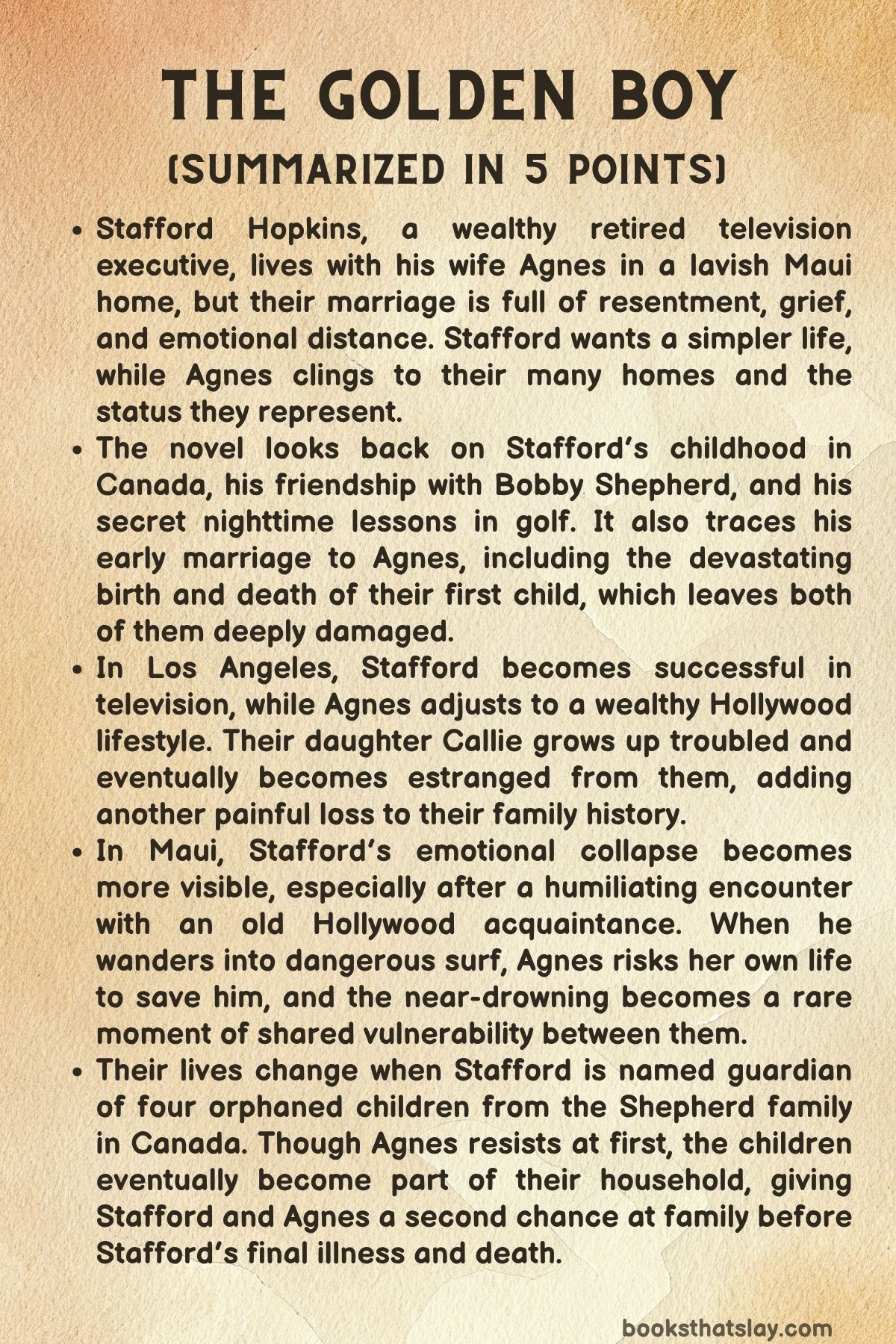
Stafford Hopkins appears to have won every visible prize of adult life. He is wealthy, retired, powerful, and living with his wife Agnes in a beautiful estate in Maui.
Their life is organized around comfort, privacy, and carefully maintained status: houses in glamorous places, elite social circles, managed routines, and staff who keep the household moving. Yet Stafford has begun waking before dawn and crying silently.
His tears do not come from any single crisis at first, but from the weight of a past he has spent decades suppressing. Maui is paradise to others, but to him it often feels like exile.
The ocean both attracts and terrifies him, carrying old warnings and buried memories.
His marriage to Agnes is full of dependence, irritation, cruelty, and habit. They have remained together for decades, but their intimacy is damaged by old wounds.
Stafford judges Agnes for clinging to houses, appearances, and social approval, while he himself hides behind wealth, discipline, and reason. Agnes, meanwhile, is not merely shallow or materialistic.
Her anger, secrecy, and emotional sharpness have roots in grief, abandonment, and trauma. Their marriage has survived, but much of it has survived by avoidance.
The first great wound between them came before their daughter Callie was born. Agnes became pregnant with a son who was diagnosed before birth with anencephaly, a fatal condition.
Stafford, shaped by Catholic doctrine and his own moral rigidity, refused abortion and insisted the baby be carried to term, baptized, and given to medical research. Agnes understood that the suffering would fall on her body.
She secretly researched the condition and chose not to prepare Stafford for the baby’s appearance, wanting him to feel the horror he had forced her to endure. The child was delivered by cesarean section and died in Stafford’s arms, unnamed and unbaptized, after Stafford broke down and struck the priest.
From that moment, their spiritual and marital fracture deepened.
Their daughter Callie becomes another source of sorrow and shame. As a child, she is loved, managed, and placed into the competitive world of elite Los Angeles parenting, but she grows into a troubled adult estranged from both parents.
Stafford admits that he loved the little girl Callie once was but cannot love the woman she has become. Callie’s scandals, anger, and instability expose the failure of Stafford and Agnes as parents.
They outsourced care, confused success with protection, and never learned how to meet a child’s emotional needs. Agnes still hopes for reconciliation, but Stafford sees Callie through disappointment and judgment.
Before Stafford became a television executive, he was a boy in rural Ontario. His childhood was shaped by his Catholic family, his troubled older brother Emmett, his stern but loving parents, and most importantly his friendship with Bobby Shepherd.
Bobby came from a nearby farm and was physically awkward, red-haired, heavy, and often mocked. Yet he was morally clear, generous, loyal, and brave.
Stafford was handsome, admired, and gifted, but Bobby possessed a deeper goodness. Their friendship began in fields, games, shared imagination, and boyhood freedom.
They played golf illegally at night, roamed the land between their farms, and built a private world of trust.
As they grew older, moral differences emerged between them. Bobby saw injustice with instinctive clarity, especially during the Steven Truscott case, when a fourteen-year-old boy was sentenced to death for murder.
Stafford, more trusting of authority and order, initially believed the official version of events. Bobby’s anger at the justice system revealed his compassion and his refusal to accept convenient answers.
Stafford admired him but also felt judged by him. Bobby’s goodness became both a gift and an accusation.
The defining betrayal of Stafford’s life happened when Bobby fell in love with Carrie Ann Schwenke. Stafford could not bear Bobby’s happiness.
Jealous, drunk, and resentful, he had sex with Carrie Ann in an act meant to destroy what Bobby had found. Bobby discovered them and walked away in anguish, crossing the ice toward Kingston.
Stafford tried to follow but fell through. Christy, Stafford’s uncle, saved him, but Bobby froze to death.
Stafford survived, and Bobby did not. For the rest of his life, Stafford concealed the full truth.
He built a career, accumulated wealth, and became known for control, judgment, and success, but his deepest identity remained tied to that night.
In Maui, the past returns through a letter from Ontario. Donny and Marilyn Shepherd have died, leaving four children under Stafford’s guardianship.
These children are Bobby Shepherd’s grandchildren: Donny, Bobby, Andy, and Lucy. Stafford initially treats the matter as a legal and financial problem.
He plans to travel to Canada, set up trusts, refuse custody, and return to his ordered life. He believes money can discharge duty.
But the journey back to Ontario begins undoing him. He is met by Uncle Christy, who knows more about the past than Stafford wants to admit.
The cold landscape, old family names, local history, and memories of Bobby force Stafford to confront the fact that his wealth cannot erase obligation.
Before meeting the children, Stafford breaks down in a church and confesses the truth about Bobby’s death to a caretaker. This confession does not absolve him, but it opens a door he has kept shut for decades.
Soon after, he meets Roger Nuland, the lawyer handling the Shepherd estate, and Tammy Nuland, who was once Tammy Bell, the girl who cruelly mocked Bobby in childhood. Stafford nearly flees when he recognizes her, but then the children enter the office.
They are noisy, grieving, needy, frightened, and alive. Young Bobby, with red hair and pale-green eyes, approaches Stafford and calls him his grandfather’s friend.
In that moment, Stafford can no longer reduce them to documents or costs.
He accepts interim guardianship and begins the difficult work of preparing to bring them to Maui. He meets with doctors, schools, bankers, neighbors, and ministers.
He learns that Donny is angry and behind in school, Bobby is capable but burdened by responsibility, Andy has asthma and developmental challenges, and Lucy is small, demanding, and vulnerable. Stafford buys the Shepherd house into trust rather than selling it and begins making practical arrangements.
The trip to Maui is exhausting and chaotic, full of missed connections, vomiting, crying, diapers, economy seats, and sleeplessness. For the first time, Stafford is forced into direct care of children in a way he largely avoided with Callie.
Agnes, meanwhile, is alone in Maui, angry and afraid. Stafford has not told her the truth.
During his absence, the house has been broken into, and she has become obsessed with security. She changes alarm companies, struggles with the new system, and buys a handgun.
Her fear is not only about the house. It comes from childhood terror she has never fully disclosed: abandonment by her mother, foster care, sexual assault by a man who called her “Poppy,” and the discovery that her mother had been dead for days while Agnes was still trying to reach her.
Agnes’s rage and fear are survival mechanisms formed long before Stafford knew her.
Stafford arrives at the Maui house in the middle of the night with the children, planning to sneak them into the guest suite and explain everything in the morning. The new alarm goes off.
Agnes, drugged by a sleeping pill, terrified, injured by broken glass, and holding the gun, stumbles through the house firing wildly. The scene almost becomes a catastrophe when she encounters Stafford holding Lucy and the three boys standing beside him.
Andy, innocent and confused, greets her. The gun drops, and Donny catches it before Andy can.
It fires, but the bullet only grazes Stafford’s pant leg and hits the wall. Donny calmly unloads the weapon and advises them to store gun and ammunition separately.
The family’s new life begins in horror, absurdity, and miraculous luck.
The next morning, Agnes and Stafford finally speak honestly. They discuss the break-in, the gun, the children, Stafford’s failure to call, and his fear of telling her the truth.
Stafford confesses his betrayal of Bobby and admits that the Shepherd children may biologically descend from him rather than from Bobby. Agnes refuses testing.
She chooses the emotional truth that they are Bobby’s grandchildren and that their place in the family does not depend on blood proof. She begins making practical plans: no gun, no pills, a cell phone for Stafford, better help, swimming lessons, safety measures, and a way to tell Callie.
Life with the children transforms the household. Stafford’s grand office becomes a bunkhouse.
Donny, skilled with tools and full of grief, finds purpose in building it with Stafford. Bobby continues to carry too much responsibility, and Stafford begins to see how dangerous that burden is.
Andy’s openness and vulnerability bring tenderness into the house. Lucy attaches herself to Agnes, who finds herself unexpectedly changed by the child’s need.
Agnes also reaches out to Callie through email, admitting that she and Stafford were terrible parents but may have another chance to do better. Callie reacts with anger, but Agnes responds with humility rather than control.
When Callie reveals that her partner is a woman named Cynthia, Agnes accepts her with awkward but genuine warmth.
The family slowly becomes real. Tutors come, schools are considered, swimming lessons begin, the Shepherd cat arrives in Maui, and Stafford buys a minivan.
Their wealthy friends withdraw, irritated by noise and disruption, but Agnes feels strangely freer without their approval. At the beach, Stafford tells the children stories of the Shepherd family, and Bobby asks for the family tree.
Agnes begins to understand that the island is no longer only a place of loneliness. With the children there, it can become a home.
Years later, Stafford dies after bronchitis becomes pneumonia and then acute respiratory distress syndrome. The old fear of drowning is fulfilled in a strange way as his lungs fill with fluid.
Agnes fights for his dignity in the hospital and has the tubes removed so the family can see his face. Lucy and Andy hold his hands as he dies.
The children have grown into their lives: Andy works proudly on the Plantation grounds crew, Lucy becomes a nationally ranked open-water swimmer, Bobby studies at Berkeley, and Donny returns to Kingston to reopen the old Shepherd house. Stafford wants his ashes buried beside Bobby Shepherd in Napanee.
His life ends not with perfect redemption, but with mercy. The friendship he betrayed remains the deepest truth of him, and the children he accepted become his final answer to guilt.
Characters
Stafford Hopkins
Stafford Hopkins stands at the center of The Golden Boy as a man who has spent most of his adult life hiding from the moral truth of his youth. On the surface, he is disciplined, wealthy, intelligent, and powerful.
He has the habits of a man who believes in structure: houses, schedules, financial plans, social boundaries, professional judgment, and emotional restraint. Yet beneath that controlled exterior is a frightened and grieving boy who never recovered from the death of Bobby Shepherd.
Stafford’s success in television gives him authority over fictional justice, but his private life is built on evasion. His betrayal of Bobby is not a youthful mistake that simply faded with time; it becomes the secret center of his identity.
He wants to believe that money can settle debts and that rational planning can keep pain contained, but the Shepherd children prove otherwise. His transformation begins when he stops treating responsibility as an abstract duty and accepts the daily labor of care.
He is not made innocent by guardianship, but he becomes more truthful. The book allows him moral movement without pretending that his past can be erased.
Agnes Hopkins
Agnes Hopkins is one of the most complex figures in The Golden Boy, because her sharpness and social vanity are gradually revealed as defenses against terror, abandonment, and grief. At first, she may seem obsessed with houses, parties, clothes, status, and appearances, but these habits are part of her need to build a controlled world around a deeply unstable inner life.
Her marriage to Stafford is bitter and dependent; she resents his judgment, yet she also relies on him as the person who has known her longest. Her secret smoking, her anger at servants, her fear after the break-in, and her purchase of a gun all show a woman who feels unsafe even inside luxury.
The revelation of her childhood trauma gives new meaning to her rage and fear. She survived abandonment, sexual violence, and public misunderstanding, and she learned to protect herself through hardness.
Yet Agnes is also capable of surprising growth. With the Shepherd children, especially Lucy and Donny, she becomes practical, tender, and honest.
Her emails to Callie show a woman learning humility late in life. She cannot undo her failures as a mother, but she can stop defending them.
Bobby Shepherd
Bobby Shepherd is the moral presence that shapes the entire novel, even though much of his importance comes through memory. As a child, he is physically awkward, mocked for his appearance, and protected by parents whose love gives him unusual emotional strength.
He is not idealized because he is perfect in a simple way; rather, he represents a form of goodness that is active, brave, and demanding. Bobby understands cruelty when he sees it, whether in a child’s insult or in a public injustice.
His response to the Steven Truscott case shows his instinctive commitment to fairness and his refusal to accept authority merely because it is powerful. For Stafford, Bobby is both beloved friend and unbearable mirror.
Bobby’s goodness makes Stafford feel smaller, especially when Bobby finds happiness with Carrie Ann. His death on the ice becomes the event Stafford cannot escape, not only because Stafford caused the circumstances leading to it, but because Bobby’s trust had been violated.
In the story’s emotional structure, Bobby remains the lost standard of love, loyalty, and justice.
Callie
Callie, Agnes and Stafford’s daughter, is the wounded result of a family that had wealth, intelligence, and access, but lacked the emotional courage required for parenthood. As a child, she is placed into a world of elite expectation, where even early education becomes a performance of ambition and status.
Stafford and Agnes love her, but their love is compromised by exhaustion, resentment, shame, and distance. They rely on nannies and institutions, and they never fully learn how to understand her pain.
As an adult, Callie becomes a figure of scandal and estrangement, especially in Stafford’s eyes. He reduces her to disappointment because he cannot bear to see his own failures reflected in her life.
Yet Callie is not only a failed daughter; she is a person trying to define herself outside her parents’ damage. Her relationship with Cynthia and her angry emails to Agnes show both defensiveness and vulnerability.
Agnes’s willingness to admit parental failure opens a small but important possibility for repair. Callie’s role in the book is to show that neglect can exist inside privilege and that reconciliation requires humility rather than control.
Donny Shepherd
Donny Shepherd is angry, practical, grieving, and more capable than the adults first understand. He arrives in Maui carrying the shock of his parents’ deaths and the defensive habits of a child who has already had to know too much.
His skill with tools and his instinctive competence reveal a boy who has learned through doing, watching, and helping. The gun incident shows his startling steadiness under pressure; he catches the weapon, unloads it, and explains safety with the calm of someone trained by his father.
Yet this competence should not be mistaken for emotional ease. Donny is behind in school, resistant to help, and full of pain he cannot politely express.
The bunkhouse gives him purpose because building allows him to work through grief without having to name it directly. His relationship with Stafford develops through shared labor rather than sentimental conversation.
Donny’s later return to Kingston to reopen the Shepherd house suggests that he becomes the keeper of place, memory, and continuity. He is the child most visibly tied to repair through work.
Young Bobby Shepherd
Young Bobby Shepherd carries his grandfather’s name and, in some ways, his moral inheritance. He is twelve when Stafford meets him, old enough to understand danger and loss, but still young enough to need protection.
He has been holding the family together after his parents’ deaths, and Stafford quickly sees that this burden may crush him if the adults do not step in. His calm approach to Stafford in the lawyer’s office becomes decisive because he does not accuse, plead, or perform; he simply recognizes Stafford as his grandfather’s friend.
That recognition forces Stafford to face the living consequence of the past. Young Bobby’s red hair and pale-green eyes also raise the question of biological descent, but the novel treats emotional kinship as more important than certainty.
He is not a replacement for the dead Bobby. He is a child with his own future, intelligence, and fatigue.
His later life at Berkeley shows promise, but also the difficulty of carrying a family story so heavy with grief, loyalty, and unresolved truth.
Andy Shepherd
Andy Shepherd brings innocence, vulnerability, and unexpected wisdom into the story. He has asthma and developmental challenges, and he often understands the world through sensory experience rather than adult logic.
His first impressions of Maui, including the softness of the air and his attempt to understand “aloha,” give the novel moments of gentleness after long passages of guilt and fear. During the gun incident, his innocent greeting nearly places him in fatal danger, making him the child through whom the household’s secrecy and panic are most clearly judged.
Andy needs protection, patience, and routine, but he is not presented as a burden without agency. His emotions are open; he cries when happiness reminds him of loss, and his reactions expose truths the adults try to manage.
In adulthood, his pride in his grounds crew work, uniform, and golf cart shows a life built around dignity, belonging, and meaningful routine. Andy’s character reminds the reader that care is not abstract.
It is daily, physical, patient, and deeply human.
Lucy Shepherd
Lucy Shepherd is the youngest of the four children and the one whose need most directly changes Agnes. Small, needy, and demanding, Lucy attaches herself to Agnes in a way that disrupts the older woman’s habits of distance and self-protection.
Lucy barely remembers her life before Maui as she grows older, which makes her relationship to grief different from her brothers’. Her loss is real, but it becomes part of her formation rather than a fully remembered before and after.
As a child, her tantrums and dependence force the household to become less elegant and more alive. For Agnes, Lucy represents a second chance at maternal tenderness, though not in a simple or sentimental way.
Agnes must respond to a child’s need without trying to preserve social perfection. Lucy’s later success as an open-water swimmer is especially meaningful because water, which has terrified Stafford throughout his life, becomes for her a place of strength and mastery.
She transforms one of the family’s deepest symbols of fear into freedom.
Emmett Hopkins
Emmett Hopkins is Stafford’s older brother and one of the book’s clearest examples of damaged appetite and family shame. He is associated with drinking, violence, jail, failed hopes, and humiliations that the family cannot fully repair.
Yet he is not written as merely bad. His life contains longing, confusion, and a repeated inability to live within ordinary expectations.
His purchase of the racehorse Brenda Bee Hoover with money meant for cattle is irresponsible, but it also creates a brief period of hope in the Hopkins household. Through the horse, Emmett becomes part of a shared family project, and his father imagines a future in which purpose might save him.
That hope does not last, but it complicates any easy judgment of him. For Stafford, Emmett is both embarrassment and warning.
He represents what happens when desire escapes discipline, but also what happens when a family cannot find a way to love a damaged person effectively. Emmett’s presence helps explain Stafford’s obsession with control.
Michael Hopkins
Michael Hopkins, Stafford’s father, belongs to the rural Ontario world of duty, restraint, Catholic identity, and practical labor. He is not emotionally expressive in a modern sense, but his influence on Stafford is profound.
His heart attack at Collins Bay, his return home after weeks in hospital, and his brief hope around the new bathroom, television, and Brenda Bee Hoover show a man whose life is shaped by work and disappointment, yet still open to moments of joy. Michael’s presence connects Stafford to the land, family history, and inherited expectations he later tries to leave behind.
He also represents a form of fatherhood very different from Stafford’s: imperfect and limited, but rooted in daily responsibility. His relationship with Emmett is especially painful because it contains both anger and hope.
Michael’s decline and death deepen Stafford’s sense that family love often arrives too late or in forms too fragile to last.
Susan and Andrew Shepherd
Susan and Andrew Shepherd provide the novel with one of its clearest images of loving parenthood. Older than most new parents and mocked by their community for having a child late in life, they respond to Bobby’s birth with wonder rather than embarrassment.
Their marriage is unusually tender, musical, humorous, and affectionate compared with the more restrained world around them. Susan, in particular, gives Bobby moral protection.
When Tammy Bell insults him, Susan does not treat it as a small childhood incident; she teaches the boys that cruelty matters and that justice must be taken seriously. Andrew and Susan’s love does not shield Bobby from the world’s ugliness, but it gives him the confidence to meet that ugliness with moral clarity.
They stand in contrast to Stafford and Agnes, whose wealth cannot provide the same emotional security for Callie. Through the Shepherd parents, the book shows that goodness is often formed through ordinary acts of protection, attention, and delight.
Christy Hopkins
Christy Hopkins is the plainspoken survivor of the older family world, and his role is to disturb Stafford’s carefully managed self-image. He knows enough about the past to make Stafford uncomfortable, and his presence in Ontario prevents Stafford from treating the trip as a clean legal errand.
Christy’s speech, memories, and moral pressure reconnect Stafford to the local world he abandoned. He does not allow Stafford to hide behind wealth or distance.
When he tells Stafford that the children need him, he is not making an abstract appeal to charity; he is reminding him of an old debt tied to Bobby, family, and place. Christy also carries the authority of the man who saved Stafford from the ice but could not save Bobby.
That fact gives his judgment weight. He is not polished, wealthy, or socially powerful, but he speaks from memory and consequence.
In a story full of evasion, Christy is a force of uncomfortable truth.
Roger Nuland
Roger Nuland is the careful, persistent lawyer who helps bring the Shepherd children into Stafford’s life. His disability and professional patience make him an important contrast to Stafford’s impatience and privilege.
Roger understands that guardianship cannot be settled by a check, even if Stafford initially wants to believe it can. He and Tammy work to make sure Stafford meets the children before refusing them, because they know that physical presence can break through the defenses that documents cannot.
Roger’s legal competence matters, but his deeper function is moral. He creates the conditions in which Stafford must see the children as children rather than obligations.
His meticulous arrangements later make the transition to Maui possible, but he does not reduce the matter to paperwork. Roger represents a form of quiet justice: steady, practical, and committed to the vulnerable.
Tammy Nuland
Tammy Nuland, formerly Tammy Bell, is a reminder that childhood cruelty does not simply disappear from moral memory. As a girl, she mocked Bobby Shepherd for his appearance, and that act becomes part of Stafford’s remembered understanding of injustice and shame.
When Stafford recognizes her as Roger’s wife, his anger nearly drives him away. Yet Tammy’s adult life complicates the past.
She is now part of the effort to protect Bobby’s grandchildren and make Stafford face them. The book does not erase what she did as a child, but it shows that people may live beyond their worst early acts.
Her presence also forces Stafford to confront his own hypocrisy. He is furious at Tammy’s childhood cruelty, but he has committed a far greater betrayal against Bobby.
Tammy’s character works as a moral mirror: she reminds the reader that judgment is necessary, but it becomes dangerous when it is used to avoid self-knowledge.
Carrie Ann Schwenke
Carrie Ann Schwenke is central to the event that destroys Bobby and Stafford’s friendship, though much of her role is filtered through Stafford’s guilt. She is the young woman Bobby loves, and that love becomes unbearable to Stafford because it threatens his sense of superiority and possession.
Stafford’s sexual betrayal with Carrie Ann is not presented as romance. It is an act of jealousy and destruction.
Carrie Ann becomes the person through whom Stafford tries to prove power over Bobby, and the consequences are fatal. The later uncertainty about whether the Shepherd line may biologically descend from Stafford rather than Bobby keeps Carrie Ann’s role alive in the next generation.
Yet the novel ultimately refuses to make biology the final truth. Carrie Ann’s importance lies in how Stafford uses her, how Bobby is wounded by the betrayal, and how the family must later decide what kind of truth matters most.
Bruce Brown
Bruce Brown represents the human cost of Stafford’s professional ruthlessness. Once an old Hollywood acquaintance, Bruce confronts Stafford in Maui and reminds him that Stafford’s career was not built only on talent and judgment, but also on betrayal, dismissal, and power used without mercy.
Their encounter comes at a moment when Stafford is already emotionally unstable, and Bruce’s resentment strips away the dignity Stafford tries to maintain. Stafford’s fall soon afterward, bloody and humiliated, marks the collapse of the commanding executive persona.
Bruce is not central in terms of plot length, but he is important because he connects Stafford’s private guilt to his public life. The same man who betrayed Bobby also learned to sacrifice people professionally while telling himself it was necessary.
Bruce’s bitterness exposes the hollowness of Stafford’s belief that success equals moral authority.
Themes
Guilt, Responsibility, and the Possibility of Repair
Guilt in The Golden Boy is not a passing emotion but a force that organizes an entire life. Stafford’s betrayal of Bobby Shepherd shapes his marriage, career, emotional habits, and fear of returning home.
He becomes wealthy and respected, yet he cannot free himself from the knowledge that his survival was tied to Bobby’s death. The novel treats guilt as morally useful only when it becomes responsibility.
For decades, Stafford’s guilt remains private and sterile; it produces tears, shame, control, and avoidance, but it helps no one. The Shepherd children change that.
Once they appear before him as living people, he can no longer treat the past as memory alone. Accepting guardianship does not erase what he did, and the novel is careful not to turn care into easy redemption.
Instead, repair is shown as practical and ongoing: buying the Shepherd house into trust, arranging schools and doctors, building a bunkhouse, learning each child’s needs, and telling the truth to Agnes. Responsibility becomes the only honest form of remorse available to him.
The story suggests that the past cannot be undone, but a person can still be required to answer it with action.
Wealth, Privilege, and Emotional Poverty
The Hopkinses’ wealth gives them houses, privacy, staff, travel, social access, and physical beauty, but it cannot give them peace. Their Maui estate is both paradise and fortress, a place designed to protect them from disorder.
Yet disorder enters anyway through memory, illness, fear, burglary, marriage, and children. Stafford and Agnes have built lives around controlled environments, but their emotional lives remain neglected and unsafe.
Their social circle prizes taste, restraint, and status, yet it offers little real care when their household becomes noisy and difficult. The dinner parties, club routines, golf etiquette, and property arguments reveal a world where appearances can replace intimacy.
Even parenting becomes distorted by privilege. Callie is placed into elite systems and surrounded by paid care, but she is not truly understood.
The arrival of the Shepherd children exposes the emptiness of polished living. Their grief, mess, noise, asthma, school struggles, tantrums, and need for attention make the house less elegant but more human.
The novel does not romanticize poverty or reject money entirely; Stafford’s resources help protect the children. But it insists that money becomes morally meaningful only when it serves care rather than insulation.
Marriage, Secrecy, and Late Honesty
Stafford and Agnes’s marriage is built on love, resentment, dependence, and concealment. They know each other intimately, yet each carries truths the other does not fully understand.
Stafford hides Bobby’s death, his guilt, his fear, and later the full reality of the Shepherd children. Agnes hides her smoking, her terror, her childhood trauma, and the depth of her hatred over the doomed pregnancy.
Their marriage survives partly because both are skilled at not saying what would break the surface. This silence allows them to continue, but it also keeps them trapped.
Their fights are often about houses, schedules, Callie, staff, or social matters, yet the real conflicts are older and deeper. The near-shooting forces a crisis that cannot be managed through manners.
Once Stafford returns with the children and Agnes nearly kills someone in panic, secrecy becomes more dangerous than truth. Their conversation afterward is one of the novel’s most important turning points because it is practical as well as emotional.
They discuss guilt, biology, fear, the gun, Callie, safety, and the future. Late honesty does not make them young or innocent again, but it gives their marriage a new form: less elegant, less controlled, and more truthful.
Justice, Mercy, and Chosen Kinship
Justice in the novel is not limited to punishment or legal correctness. The story repeatedly questions official versions of right and wrong, from Stafford’s Catholic certainty about the doomed pregnancy to his trust in the justice system during the Steven Truscott case and his later career producing television stories where good and bad are neatly resolved.
Bobby Shepherd’s moral power comes from his refusal to accept such easy order. He knows that cruelty matters, that false judgment can destroy lives, and that partial justice is not enough.
Yet the novel also moves beyond justice into mercy. Stafford deserves judgment for what he did to Bobby, but the Shepherd children need more than the punishment of an old man.
They need protection, continuity, and love. Agnes’s refusal to test the children’s biological connection is an act of mercy because she chooses the truth that will preserve kinship rather than the fact that might fracture it.
Bobby’s grandchildren become Stafford and Agnes’s family through care, not proof. Mercy does not deny wrong; it creates a future after wrong has been named.
In the end, chosen kinship becomes the novel’s answer to inherited damage, allowing the dead, the guilty, and the living to remain connected without being imprisoned by blood alone.