The Heartless One Summary, Characters and Themes
The Heartless One by Emma Hamm is a dark fantasy romance about power, loyalty, revenge, and the dangerous cost of devotion. The story follows Elric, a resurrected god known as the Deathless One, and Jessamine, who has survived betrayal and death only to return stronger and more ruthless.
After defeating Callum, they are drawn into the Pleasure District by a new witch’s sacrifice and a trail that leads back to Leon, Fortuna Beaumont, and the coup that destroyed Jessamine’s old life. The book mixes magic, political tension, revenge, and found-family coven bonds in a world shaped by fear and worship. It’s the 2nd book of the Gravesinger series.
Summary
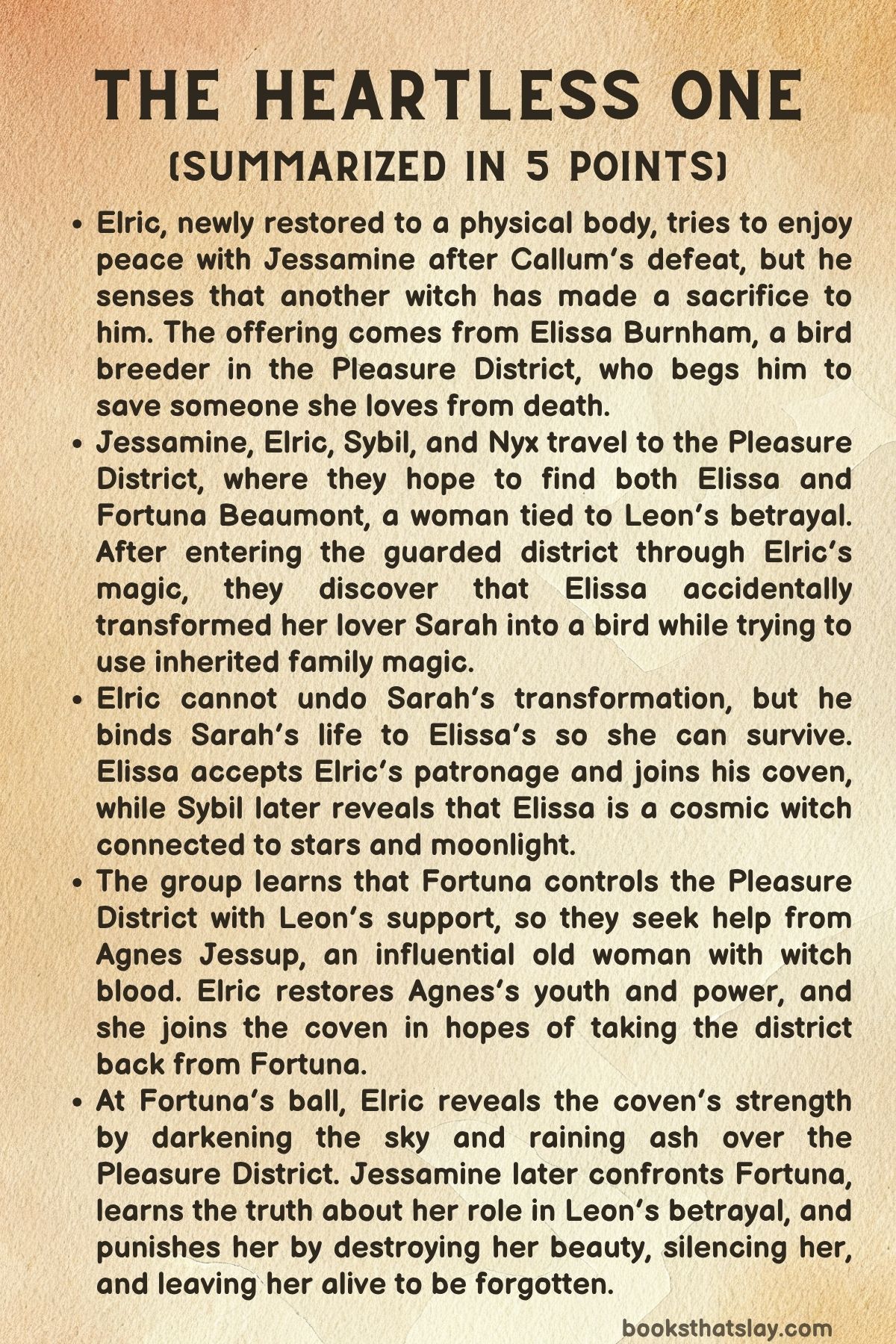
After the defeat of Callum, Elric finally has a body again and is able to enjoy a rare moment of peace with Jessamine. For once, the two are not running, fighting, or surviving.
Elric is newly restored to physical life, and the quiet between them feels precious because both know how much has been taken from them. Yet the peace does not last.
Elric suddenly senses that a witch has made a sacrifice to him. The offering is a prized cow, and the plea attached to it is desperate: the witch wants him to save someone she loves from death.
Elric is unsure how to feel about this new worshipper. More witches would strengthen his coven and help rebuild his power, but it also reminds him of the danger that once destroyed him.
Witches have needed him, worshipped him, used him, and sacrificed to him before. That cycle brought power, but it also brought pain.
He does not want to become a tool again. Sybil senses the sacrifice as well, and both she and Jessamine encourage him to investigate.
They know that ignoring a witch who has reached out to him could cost them a possible ally.
Jessamine uses her scrying bowl, and they discover the witch’s identity. Her name is Elissa Burnham, a bird breeder who lives in the Pleasure District.
This is useful for more than one reason. Jessamine is already searching for Fortuna Beaumont, a woman tied to Leon and to the coup that led to the deaths of Jessamine and her mother.
If Elissa is in the same district where Fortuna may be hiding, then following the sacrifice could bring them closer to another part of Jessamine’s revenge.
Before leaving, Elric visits the place where the cow was offered. He absorbs the dark power left behind by the sacrifice and reveals himself to the terrified farmer.
He tells the man to spread the word that the Deathless One has returned. This is not only a warning, but also a declaration.
Elric is no longer a myth, memory, or trapped spirit. He is present in the world again, and people will know it.
Jessamine, Elric, Sybil, and Nyx travel toward the Pleasure District. They avoid the Factory District and join a caravan for safety.
During the journey, rumors about Elric’s return begin to spread. The idea of the Deathless One walking the world again creates fear and fascination.
When they reach the gates of the Pleasure District, Leon’s guards demand papers. Elric uses his power to influence a guard’s mind and gets the group inside without exposing their true purpose.
The Pleasure District is rich, stylish, and carefully protected. Its streets and people are polished in a way that makes Jessamine feel watched and out of place.
She understands that this district is not safe simply because it is beautiful. Wealth and charm hide control, secrets, and danger.
The group finds Elissa Burnham’s strange home, filled with birds. Elissa comes from an old witch line, though her magic has weakened over time.
She explains that she used bottled family magic in an attempt to help her lover, Sarah, communicate with birds. Instead, the spell went terribly wrong and transformed Sarah into a bird.
Elissa sacrificed to Elric because she wanted him to save Sarah before the mistake became fatal.
Elric cannot undo the transformation, but he can keep Sarah alive. He offers a different solution: Sarah’s life can be bound to Elissa’s, preserving her even if she remains changed.
To complete the spell, Elissa must sacrifice one of her birds. The act is painful, but she agrees because Sarah’s survival matters more to her than anything else.
Afterward, Elric formally offers Elissa his patronage. She accepts and becomes part of his coven.
Sybil later performs a ritual to learn what kind of witch Elissa is. The ritual reveals that Elissa is a cosmic witch, connected to stars and moonlight.
This gives the coven a new kind of power and proves that Elissa is more than a frightened woman who made a mistake. She may become useful, but she is also uncertain, inexperienced, and afraid.
Elissa tells them that Fortuna Beaumont now controls the Pleasure District with Leon’s support. She also suggests that Fortuna may be a witch.
This makes the situation more dangerous because Fortuna is not merely a former lover or political pawn. She may have power of her own.
To move among the district’s elite and get close to Fortuna, the group needs disguises, connections, and influence. Elissa sends them to Agnes Jessup, an old woman with old blood and a strong position in the district’s social world.
Elric and Jessamine meet Agnes and offer her something she cannot easily refuse: power, youth, and the chance to help take the district back from Fortuna. Agnes has lived long enough to understand what is at stake, and she accepts.
Elric transforms her into a young and powerful witch. With Agnes on their side, the coven gains another ally and a way into the circles where Fortuna moves.
The group investigates Fortuna’s home and finds evidence that Leon has kept her in comfort. She has wealth, beautiful things, and signs of royal support.
Letters marked with royal seals burn to ash before they can be fully examined, which proves that someone has protected the secrets inside them. They also find flyers announcing that Fortuna is seeking a new suitor.
This raises questions. Fortuna may be trying to escape Leon, or she may be sending a signal that something is wrong.
Either way, she is not as secure as she appears.
When the group returns to Elissa’s house, they realize Elissa has betrayed them by telling Fortuna they are there. Elric is furious and wants to kill her, but Jessamine stops him.
Instead of allowing him to destroy Elissa, Jessamine teaches her a lesson using a bundle of sticks. One weak branch can be broken easily, but many together cannot be snapped.
The message is clear: Elissa is safer with the coven than alone, and betrayal only weakens everyone.
The coven attends Fortuna’s ball, entering the world of wealth, performance, and hidden threats. Jessamine sees Leon there and is forced to face the man connected to so much of her suffering.
She learns more about Fortuna’s position and the danger surrounding her. During the event, Elric makes a public display of his power.
With the coven behind him, he darkens the sky and causes ash to fall over the Pleasure District. It is a terrifying announcement that the Deathless One has returned, and he is not alone.
In the chaos that follows, Alexander, Leon’s brother, gives them information about Fortuna’s safe house. Jessamine and Sybil go there to confront her.
They break through Fortuna’s wards and find her. Jessamine uses Elric’s shadows to bind Fortuna and force her way into the woman’s mind.
What she finds confirms the depth of the betrayal. Fortuna and Leon were lovers before Leon proposed to Jessamine, and Fortuna’s jealousy helped lead to the events that destroyed Jessamine’s life and family.
Jessamine’s revenge is brutal and deliberate. She does not simply kill Fortuna.
Instead, she ruins the beauty that helped Fortuna gain power, maiming her face and cutting out her tongue. Fortuna is left alive, but stripped of the things she used to influence others.
Jessamine abandons her to be forgotten, choosing a punishment that reflects the pain Fortuna helped cause. By the end, Jessamine has taken another step toward vengeance, while Elric’s coven has grown stronger, darker, and more visible to the world.
Characters
Elric
Elric is the central force of The Heartless One, a resurrected god who is learning what it means to exist again in a physical body while carrying the weight of everything that happened before his return. His quiet moment with Jessamine shows that he is not only a being of death, power, and worship, but also someone who longs for peace, intimacy, and the simple sensations of life.
However, that peace is quickly disturbed when he senses a new sacrifice made in his name. His reaction reveals his inner conflict: he understands that accepting witches will strengthen his coven, but he is deeply aware of the danger of repeating the old cycle in which witches used him, fed from him, and ultimately caused destruction.
Elric’s power is terrifying and instinctive, especially when he absorbs the dark energy of the sacrificed cow and reveals himself to the farmer as the returned Deathless One. Yet he is not careless with that power.
When Elissa asks him to save Sarah, he does not pretend he can undo what cannot be undone. Instead, he offers the only solution available, binding Sarah’s life to Elissa’s.
This makes him both frightening and strangely honest. He is divine, dangerous, and capable of cruelty, but he is also bound by rules, consequences, and an emerging desire to build something more loyal and lasting than the broken coven of the past.
Jessamine
Jessamine is one of the most emotionally intense and morally complicated characters in the book. She is driven by grief, rage, loyalty, and a hunger for justice after the betrayal that destroyed her life and her mother’s.
Her relationship with Elric gives her moments of tenderness, but it also places her closer to darkness and power than ever before. Jessamine often acts as Elric’s emotional anchor, especially when she stops him from killing Elissa after the betrayal.
That moment shows her intelligence as well as her understanding of power: she knows that fear can control people temporarily, but unity and loyalty must be taught if the coven is to survive. Her lesson with the bundle of sticks reveals her ability to think like a leader, not merely a victim seeking revenge.
At the same time, her confrontation with Fortuna shows how far she has changed. By using Elric’s shadows to bind Fortuna and invade her mind, Jessamine crosses into a brutal form of punishment that is personal, symbolic, and merciless.
She does not simply want Fortuna dead; she wants her stripped of the beauty, voice, and social power that helped make her dangerous. Jessamine’s character is shaped by the tension between justice and vengeance, compassion and cruelty, love and corruption.
Sybil
Sybil serves as a steady, perceptive, and spiritually important presence within the group. She is deeply connected to witchcraft and ritual, and her role becomes especially important when she senses the sacrifice made to Elric and encourages him to seek out the witch responsible.
Unlike Elric, who hesitates because of the past, Sybil sees the practical and magical importance of rebuilding the coven. She is not reckless, but she understands that power must be gathered before their enemies can destroy them.
Her ritual to discover Elissa’s power shows her knowledge and authority as a witch, and it also makes her a guide for the newer members of the coven. Sybil is not merely a supporting figure; she helps shape the group’s direction by pushing Elric and Jessamine toward action.
Her presence during the investigation into Fortuna also shows her courage, since she accompanies Jessamine to the safe house and helps break through wards. Sybil represents the older, wiser side of witchcraft: patient, observant, ritualistic, and aware of the deeper patterns moving beneath ordinary events.
Nyx
Nyx has a quieter role in this part of the story, but her presence still matters because she forms part of the traveling group that moves through danger together. She is included in the journey to the Pleasure District, which means she stands within the circle of trust surrounding Elric, Jessamine, and Sybil.
Even when she is not the focus of the major magical confrontations, her presence adds to the feeling that Elric’s returned power is no longer isolated. He is gathering a household, a coven, and a small force of people tied to his fate.
Nyx’s role also strengthens the sense of movement from solitude toward collective strength. In a story where one weak branch can be broken but many together cannot, even the quieter companions matter because they help form the larger structure of loyalty and survival around the central characters.
Elissa Burnham
Elissa Burnham is a fragile, frightened, and deeply important new addition to the coven. She begins as a desperate witch rather than a confident one, sacrificing a prized cow to Elric because she wants to save Sarah from death.
Her home, filled with birds, reflects both her profession and the strange magical disaster that defines her life. Elissa’s tragedy comes from love mixed with inexperience: she uses bottled family magic to help Sarah communicate with birds, but instead transforms her lover into one.
This mistake makes her sympathetic because her actions come from devotion, not malice. However, Elissa is also weak under pressure, and her betrayal of the group by telling Fortuna about them reveals her fear and lack of loyalty.
She is not evil, but she is easily bent by danger. Jessamine’s response to her betrayal becomes one of the most important lessons in the story, because Elissa must learn that survival does not come from surrendering to the strongest threat in the room.
Her revealed identity as a cosmic witch connects her to stars and moonlight, suggesting that she may become far more powerful once she learns courage, discipline, and trust.
Sarah
Sarah is the emotional center of Elissa’s storyline, even though she exists in a transformed state. Her accidental transformation into a bird shows the danger of uncontrolled or poorly understood magic.
She represents the cost of love when love is joined with desperation and magical ignorance. Elissa’s entire sacrifice to Elric is motivated by the desire to save Sarah, which means Sarah’s condition drives the creation of a new bond between Elric and Elissa.
Though Sarah does not act in the same direct way as the other characters, her presence shapes the choices of those around her. Elric’s inability to fully reverse the spell also reinforces the limits of power in the novel.
Even a god cannot always restore what has been broken exactly as it was. By binding Sarah’s life to Elissa’s, the story turns their love into something literal and magical: Sarah’s survival now depends on Elissa’s own life.
This makes Sarah both a victim of magic and a symbol of the intimate, dangerous bonds that witchcraft can create.
Agnes Jessup
Agnes Jessup is an old woman with influence, old blood, and buried ambition. She is important because she represents a different kind of witch from Elissa.
While Elissa is uncertain and afraid, Agnes carries history, social knowledge, and a hunger to reclaim what has been lost. Her willingness to join Elric’s coven comes from more than fear or worship; it comes from the promise of restored power, youth, and political influence in the Pleasure District.
Elric’s transformation of Agnes into a young and powerful witch is significant because it shows what his patronage can offer. He does not merely protect his witches; he can remake them.
Agnes’s character also reveals how the coven grows through bargains. She accepts Elric because he gives her a path back to relevance and strength, while Elric gains someone with local influence and old magical blood.
Agnes stands at the intersection of vanity, survival, revenge, and strategy, making her a valuable but potentially dangerous ally.
Fortuna Beaumont
Fortuna Beaumont is one of the most threatening and personally significant figures in this section of The Heartless One. She is tied to Leon, to the coup, and to the betrayal that led to Jessamine’s death and the death of Jessamine’s mother.
At first, Fortuna appears as a woman of wealth, beauty, and control, someone who now rules the Pleasure District with Leon’s support. The signs inside her home reveal that she has been richly maintained, but the flyers announcing her search for a new suitor suggest that her situation is more complicated than simple triumph.
She may be trying to escape Leon, signal distress, or regain control over her future. However, the truth Jessamine extracts from her mind makes Fortuna’s role much darker.
Her jealousy over Leon’s proposal to Jessamine helped feed the betrayal, making her not just a political player but a personal enemy. Fortuna’s beauty and social power are central to her identity, which is why Jessamine’s punishment is so symbolic.
By ruining her face and cutting out her tongue, Jessamine destroys the very tools Fortuna used to influence others. Fortuna is left alive, but stripped of the power to charm, speak, and command attention.
Leon
Leon is a shadow over the entire story, even when he is not physically present. He represents betrayal, political ambition, and personal cruelty.
His connection to Fortuna reveals that his betrayal of Jessamine was not only political but also intimate. He had been involved with Fortuna before proposing to Jessamine, which makes his actions even more manipulative.
Leon’s control over the Pleasure District through Fortuna shows how he extends power indirectly, using people and systems to maintain influence. His guards at the district gates also show the reach of his authority, since entering the Pleasure District requires papers and surveillance.
Leon’s danger comes from his ability to combine charm, royal power, and emotional deception. He is not simply an enemy with soldiers; he is someone who has already proven that he can get close to people, use their trust, and destroy them from within.
For Jessamine, Leon is not only a political opponent but a living reminder of how love, ambition, and betrayal can become inseparable.
Callum
Callum’s role in this part of the story is mostly defined by his defeat, but that defeat is important because it creates the temporary quiet from which the next conflict begins. The victory over Callum gives Elric and Jessamine a rare moment of peace, showing that he was a major obstacle whose removal mattered.
However, the fact that new danger appears almost immediately after his defeat also shows the structure of the story’s world: no victory is complete, and every enemy defeated reveals another layer of conflict. Callum’s presence lingers as a reminder of the violence and struggle that brought Elric and Jessamine to this point.
He helps establish the emotional state of the characters at the beginning of this section, especially Elric, who has barely begun enjoying his resurrected life before being pulled back into divine responsibility and danger.
Alexander
Alexander is important because he complicates the idea of Leon’s family and power. As Leon’s brother, he is connected to the same dangerous world of politics and betrayal, but his actions suggest that he is not simply another version of Leon.
During the chaos at Fortuna’s ball, Alexander gives the group information about Fortuna’s safe house, which helps Jessamine and Sybil find her. This makes him useful, but also mysterious.
His willingness to provide information raises questions about his motives, loyalties, and possible opposition to Leon. Alexander’s character adds political depth to the story because he suggests that the ruling family or power structure may not be united.
He may become an ally, a manipulator, or someone pursuing his own advantage, but in this section, he functions as a key source of information at a critical moment.
Themes
Power and the Fear of Repeating Old Corruption
Power in The Heartless One is never shown as simple strength; it carries memory, temptation, and danger. Elric’s return gives him the chance to rebuild what was lost, but every new sacrifice reminds him of the past misuse of devotion.
The cow offered by Elissa is not just a gift of faith; it forces him to decide whether accepting worship again will help create protection or repeat the same harmful dependence that once destroyed trust between gods and witches. His hesitation shows that power becomes dangerous when it is separated from responsibility.
At the same time, Jessamine and Sybil understand that refusing power completely can leave them weak before enemies like Leon and Fortuna. The coven’s growth suggests that power must be shared, guided, and watched carefully.
Elric’s public display in the Pleasure District proves that power can inspire fear and belief, but the real question is whether it will be used to dominate others or defend those who have been abandoned.
Trust, Betrayal, and the Need for Unity
Trust is tested repeatedly through the new coven, especially when Elissa betrays the group by warning Fortuna. Her betrayal hurts because she has just been accepted and protected, yet her fear makes her choose self-preservation over loyalty.
Jessamine’s response is important because she stops Elric from killing Elissa and instead teaches her through the bundle of sticks. That moment shows a more mature understanding of leadership: punishment alone cannot build unity, but a clear lesson can turn weakness into commitment.
The image of the single branch breaking while the bundle remains strong becomes a direct symbol of the coven itself. Each witch may be vulnerable alone, but together they become harder to destroy.
This theme also reflects Jessamine’s own journey, because she has survived betrayal from people connected to courtly power and personal jealousy. The coven must therefore become the opposite of Leon’s world: not a place built on secrets and control, but on shared survival.
Identity, Transformation, and Reclaiming the Self
Transformation appears through magic, beauty, age, and even the body itself. Elric’s resurrection gives him physical life again, allowing him to experience touch, desire, and presence after being separated from the ordinary world.
Sarah’s accidental transformation into a bird shows the frightening side of magic, where love mixed with inexperience can permanently alter identity. Agnes’s change is different because she willingly accepts youth and power as a way to reclaim influence stolen by time and by Fortuna’s rule.
These transformations are not only physical; they reveal what each character wants most. Elric wants purpose without becoming a weapon again, Elissa wants to save Sarah, Agnes wants agency, and Jessamine wants justice after being reduced to a victim by betrayal.
Fortuna’s punishment also attacks identity, since her beauty and voice are taken from her, leaving her alive but stripped of the tools she used to survive and manipulate. Through these changes, identity becomes something shaped by choice, magic, pain, and consequence.
Justice, Revenge, and Moral Consequence
Jessamine’s confrontation with Fortuna raises difficult questions about justice and revenge. Fortuna’s role in the betrayal that killed Jessamine and her mother makes her guilty in a deeply personal way, and Jessamine’s anger is understandable because the harm was not political alone; it was intimate, cruel, and rooted in jealousy.
However, Jessamine does not simply seek truth. Once she enters Fortuna’s mind and confirms the past, she chooses a punishment meant to make Fortuna suffer through loss, humiliation, and abandonment.
Leaving Fortuna alive is not mercy in a gentle sense; it is a calculated sentence. This makes the theme morally complex because Jessamine’s actions can be read as justice against a woman who helped destroy lives, but also as a sign that pain can reshape the victim into someone capable of cruelty.
The scene shows that revenge may offer control after helplessness, yet it also leaves behind an uneasy question: whether punishment heals wounds or only creates a new form of darkness.