The Sisters of Book Row Summary, Characters and Themes
The Sisters of Book Row by Shelley Noble is a historical novel about three sisters running a rare bookshop in Manhattan in 1915, at a time when women’s choices, bodies, and voices are tightly controlled. Set against the world of New York’s Book Row and the shadow of Anthony Comstock’s censorship campaigns, the story brings together books, forbidden knowledge, family duty, and social change.
Through Olivia, Daphne, and Celia Applebaum, the novel explores how ordinary women become brave when private convictions collide with public danger, and how the preservation of words can become an act of resistance.
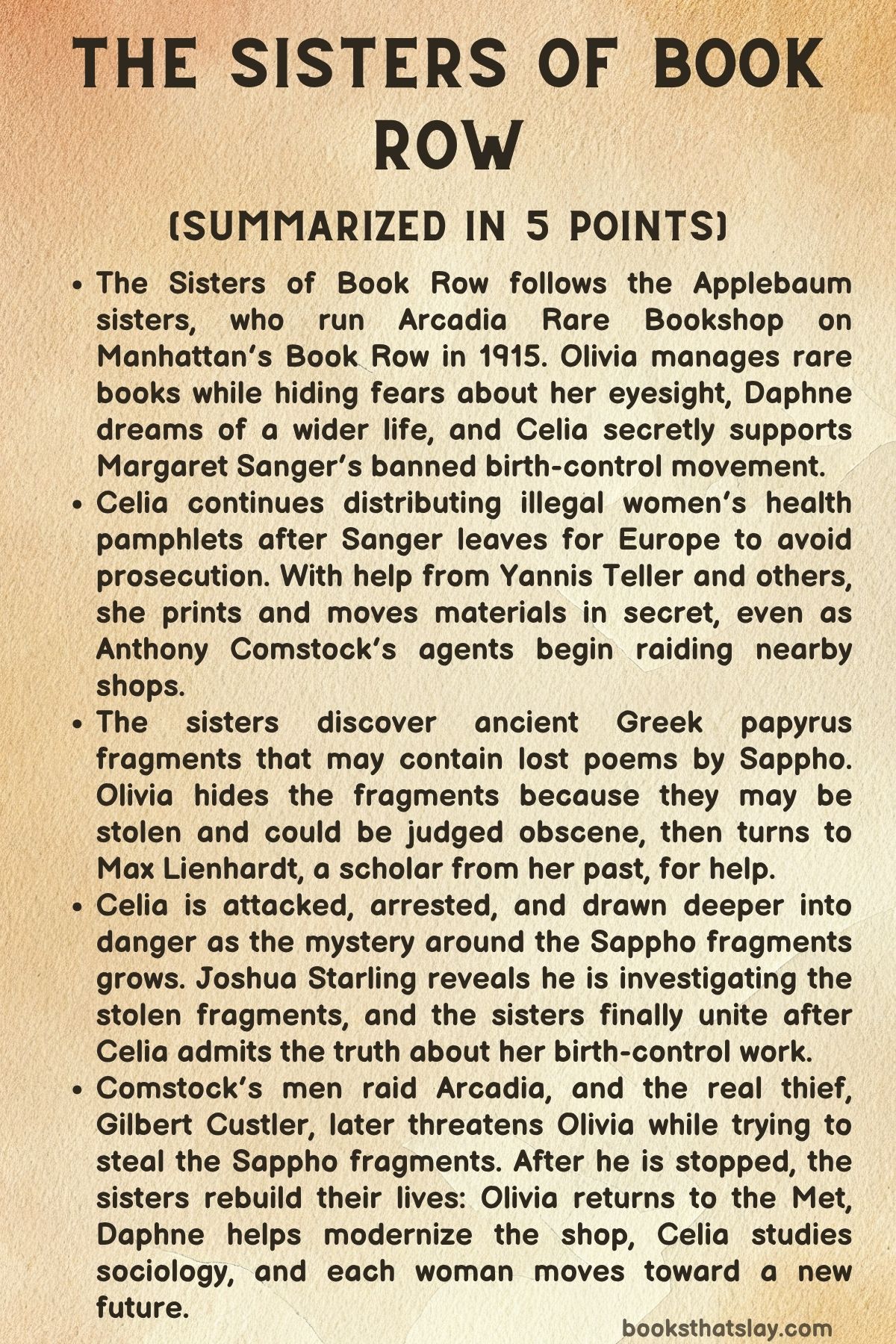
Summary
The Sisters of Book Row begins far from twentieth-century New York, in ancient Lesbos, where Sappho sings among young women in a courtyard. Her voice carries a promise that women’s words and lives will not vanish completely, because someone in another age will remember them.
That opening promise shapes the rest of the novel, which moves to Manhattan in 1915 and follows the Applebaum sisters as they protect books, each other, and women’s right to knowledge.
Olivia, Daphne, and Celia Applebaum run Arcadia Rare Bookshop on Book Row, a crowded stretch of shops where booksellers, collectors, scholars, and printers share both trade and gossip. Olivia, the eldest sister, is practical, disciplined, and devoted to rare books.
She handles restoration and serious collectors, but privately she is frightened because her eyesight is failing. The loss threatens not only her work, but also her sense of identity.
Daphne, the middle sister, helps in the shop but longs for romance, beauty, and a life that feels wider than shelves and ledgers. Celia, the youngest, appears to be simply part of the family business, but she is hiding the most dangerous secret of all: she is connected to Margaret Sanger’s birth-control movement.
The world around the sisters is shaped by Anthony Comstock’s campaign against materials he considers obscene. Under his influence, even medical information about women’s bodies can be treated as criminal.
When Margaret Sanger flees to Europe to avoid prosecution, Celia does not stop helping. She continues carrying illegal pamphlets and health information to women who need them.
She hides the material in her knitting bag and in a secret compartment beneath the Oxford English Dictionary. From there, she moves it through the back courtyard to the printshop next door, run by Yannis Teller and his family.
At night, Celia works with Yannis, Selena, and Jon to print articles and information connected to women’s health. Their work is risky, but they believe the information can save women from ignorance, dangerous pregnancies, and lives controlled by shame.
The danger becomes immediate when Comstock’s agents begin raiding Book Row. A raid on the Teller printshop nearly exposes the secret press.
Selena’s baby, Estelle, distracts the agents long enough to protect the operation, but the shop is damaged. Yannis becomes afraid for his parents and briefly stops the printing, leaving Celia frustrated but not defeated.
While Celia is drawn deeper into activism, a mysterious buyer named Joshua Starling enters the bookshop. He is handsome, polished, and supposedly working for a London collector.
Celia is attracted to him, but she does not fully trust him. His interest in the shop and the sisters seems too careful to be ordinary.
At the same time, the Applebaums discover something astonishing in their throwaway box: ancient Greek papyrus fragments. Olivia realizes that the fragments may contain lost poems by Sappho.
The discovery is thrilling, but also dangerous. The fragments may have been stolen, and because of their subject matter, they could be judged obscene by Comstock’s standards.
Olivia hides the fragments and turns to Max Lienhardt, a scholar at the Metropolitan Museum of Art and a man connected to her past. With Max, Olivia begins examining the papyrus, and their shared work reopens feelings she had tried to leave behind.
The fragments also force Olivia to confront what is happening to her sight. She wants to prove their importance, but she fears she may not have much time left to do the work she loves.
The Sappho pages become more than a scholarly puzzle. They represent women’s voices surviving across centuries, fragile but still powerful.
Meanwhile, Celia refuses to abandon her secret work. She is attacked in the courtyard by a man who tries to steal her bag, and the sisters begin to understand that someone may be watching them.
Soon after, Celia is arrested by Comstock’s agents after leaving the settlement house. She is taken to jail and placed among prostitutes and poor women, many of whom have been treated as disposable by the same society that claims to defend morality.
The experience terrifies Celia, but it also strengthens her understanding of why women need advocates. Mr. Kirsch and Joshua bail her out, and Joshua finally reveals that he is not simply a collector’s agent.
He is investigating the stolen Sappho fragments and believes Celia’s arrest may have been arranged to empty the bookshop so the thief could search it.
Celia can no longer keep her secret from Olivia and Daphne. She tells them about her work with the birth-control movement, the hidden pamphlets, and the printing.
Her sisters are shocked and worried, but they do not abandon her. Their bond becomes stronger because the truth is now shared.
At Celia’s hearing, Comstock’s case begins to fall apart. The judge sees the weakness of the accusations and criticizes the abusive methods used against her.
Book Row’s sellers gather around the sisters, showing that the neighborhood is more than a collection of rival businesses. It is a community.
Rumors also begin to spread that Comstock’s official influence is weakening, giving everyone a brief sense that the worst may be over.
That peace does not last. Comstock and hired thugs raid Arcadia Rare Bookshop itself.
They tear through the shop, damage books, and destroy the displays Daphne has carefully arranged. The agents find nothing, but the violence leaves the sisters shaken.
The attack makes clear that their shop, which once seemed like a protected family space, is no longer safe from the politics of the outside world.
The danger reaches its peak when the real thief enters Olivia’s workroom. He demands the Sappho fragments and threatens her with a knife.
Olivia tries to mislead him and protect the papyri, even though she is physically vulnerable and afraid. The family cat unexpectedly attacks him, giving Olivia a chance to survive until Max arrives and knocks the man down.
The thief is revealed as Gilbert Custler, who will be returned to London for trial. Joshua arranges for the Sappho fragments to be placed safely with the Metropolitan Museum until their rightful future can be settled.
After the threat passes, each sister begins choosing a new path. Olivia decides to close the rare-book and restoration side of Arcadia and return to her former work at the Met while her sight still allows it.
This decision is painful, but it is also freeing. She accepts change instead of pretending nothing is wrong, and she moves toward a possible future with Max.
Daphne steps into a more active role in reshaping the shop. Arcadia becomes brighter and more modern, better suited to the new readers and new century around them.
Celia begins studying sociology so she can help women in a more organized and effective way. Her activism is no longer only secret rebellion; it becomes part of the life she intends to build.
By September, the world around the sisters is changing as well. Comstock dies, Bill Sanger is tried, and Margaret Sanger prepares to return.
The fight for women’s health and freedom is far from finished, but the balance has shifted. Celia receives a new schoolbag from Joshua, along with a teasing note that makes it clear he expects to see her again.
The novel closes with the sisters changed by fear, loss, courage, and love. Their bookshop survives not by staying the same, but by becoming a place where women’s voices, old and new, can continue to be remembered.
Characters
Olivia Applebaum
Olivia Applebaum is one of the central figures in The Sisters of Book Row, and her character represents responsibility, intelligence, restraint, and quiet fear. As the eldest Applebaum sister, she carries the emotional and practical burden of keeping Arcadia Rare Bookshop alive.
Her life is shaped by discipline and duty, especially in the way she manages the rare books and restoration work with care and seriousness. Olivia’s deep knowledge of books makes her more than a shopkeeper; she is a guardian of history, memory, and fragile cultural treasures.
Her discovery of the Sappho fragments shows her scholarly instincts and her ability to recognize the importance of something others might overlook. At the same time, her secret fear of losing her sight makes her character deeply vulnerable.
For someone whose life depends on reading, examining, and restoring books, the threat of blindness is not only physical but also emotional and professional. Olivia’s journey in the book is about learning that strength does not always mean carrying everything alone.
Her connection with Max allows her to revisit a part of herself that she has kept closed off, and by the end of the story, her decision to leave the rare-book side of the shop shows growth rather than defeat. She chooses a future that acknowledges her limitations while still honoring her love for scholarship and books.
Daphne Applebaum
Daphne Applebaum is the sister most strongly associated with beauty, romance, imagination, and the desire for a larger life beyond the familiar walls of the shop. She brings warmth and liveliness to the story, and her longing for romance reveals her wish to be seen as more than just one of the Applebaum sisters.
Daphne’s character is not shallow, even though she is often drawn to elegance, display, and emotional possibility. Her interest in transforming the shop’s appearance shows that she understands people, atmosphere, and presentation in a way Olivia and Celia do not always appreciate.
When Comstock’s raid damages her newly arranged displays, the attack wounds her not only because property is destroyed but because her effort, creativity, and sense of beauty are violated. Daphne grows by becoming more than a dreamer.
She begins to take a stronger role in shaping the renewed shop, suggesting that her imagination has practical value. In the book, she represents the importance of hope, charm, and reinvention.
Her development shows that wanting romance and beauty does not make a woman weak; it can also be a form of ambition and self-expression.
Celia Applebaum
Celia Applebaum is the youngest sister, and her character carries much of the book’s political and moral urgency. She is brave, idealistic, secretive, and deeply committed to helping women who have fewer choices and protections than she does.
Her involvement in Margaret Sanger’s birth-control movement shows that Celia is willing to risk her safety and reputation for a cause she believes is necessary. She is not rebellious merely for the sake of rebellion; her actions come from compassion and anger at the suffering of poor women, prostitutes, and mothers who are denied knowledge about their own bodies.
Celia’s secrecy creates tension with Olivia and Daphne, but it also reflects the dangerous world she is operating in. Her arrest becomes a turning point because it exposes both the cruelty of Comstock’s campaign and the courage required to resist it.
Celia’s time in jail forces her to confront the reality of the women she wants to help, making her activism more mature and grounded. By the end of the story, her decision to study sociology shows that she wants to turn passion into knowledge and long-term action.
Celia is one of the strongest symbols of change in the novel because she refuses to accept silence as safety.
Sappho
Sappho is not a conventional present-day character in the story, but her presence gives the book much of its emotional and symbolic depth. In the opening scene set in ancient Lesbos, she appears as a poet surrounded by young women, singing in a courtyard and promising that they will be remembered in another time.
That promise becomes central to the meaning of the story. Sappho represents women’s voices across history, especially voices that have been broken, hidden, censored, or dismissed.
The fragments of her poetry are physically fragile, but their importance is immense because they connect the Applebaum sisters to a much older tradition of female creativity and desire. Her poems also become dangerous objects in the world of the story because they may be considered obscene by narrow moral standards.
Through Sappho, the book suggests that women’s words have always been powerful enough to frighten authorities. Her role links art, memory, sexuality, and resistance, making her a spiritual ancestor to the women fighting for expression and bodily freedom in 1915.
Margaret Sanger
Margaret Sanger is a major influence on the story even when she is absent for much of the action. Her flight to Europe after facing prosecution shows the danger surrounding the birth-control movement, but her absence also forces others, especially Celia, to decide whether they will continue the work without her.
Margaret represents organized resistance against laws that keep women ignorant and powerless. She is courageous, controversial, and willing to challenge both legal authority and social convention.
In the book, her importance lies not only in what she does directly but in how she inspires other women to act. Celia’s secret work continues because Margaret’s ideas have taken root.
Margaret’s expected return near the end of the story suggests that the movement is larger than one arrest, one raid, or one official attempt to suppress it. She stands for the persistence of reform and the belief that knowledge can be a form of liberation.
Anthony Comstock
Anthony Comstock is the main force of repression in the book, and his character represents moral authoritarianism, censorship, intimidation, and the abuse of power. He sees himself as a defender of public virtue, but his actions reveal cruelty and arrogance.
His campaign against birth-control information and so-called obscene material makes him a threat to both Celia’s activism and Olivia’s protection of the Sappho fragments. Comstock’s danger comes from the fact that he combines personal zeal with institutional power.
He can use raids, arrests, fear, and public shame to control people, especially women. His agents’ treatment of Celia and the raid on Arcadia show how easily morality can become an excuse for violence.
Yet the hearing also exposes his weakness: his case against Celia is flimsy, and his tactics are increasingly criticized. Comstock is important because he gives the sisters something larger to resist.
He is not simply a villain but a symbol of a society that tries to decide what women may read, know, say, and do with their own lives.
Joshua Starling
Joshua Starling is mysterious, intelligent, charming, and morally purposeful. When he first appears as a handsome buyer supposedly working for a London collector, he brings suspense and romantic uncertainty into the story.
Celia is attracted to him, but the secrecy surrounding him makes her cautious, which is important because the sisters are already surrounded by hidden dangers. Joshua later reveals that he is investigating the stolen Sappho fragments, which changes the reader’s understanding of him.
He is not merely a romantic figure or a suspicious outsider; he is someone trying to recover stolen cultural property and protect the truth. His ability to recognize that Celia’s arrest may have been arranged to empty the shop shows his sharpness and understanding of the larger plot.
His bond with Celia is playful but serious, marked by mutual respect and curiosity. The schoolbag he sends her at the end of the book suggests that he values her mind and her future, not just her charm.
Joshua represents adventure, justice, and the possibility of a partnership built on both attraction and shared purpose.
Max Lienhardt
Max Lienhardt is a scholar at the Metropolitan Museum of Art and a significant figure in Olivia’s personal and intellectual life. He represents knowledge, trust, and the possibility of renewed love.
Because he is connected to Olivia’s past, his reappearance forces her to face emotions she has kept buried beneath responsibility and work. Max’s role in examining the Sappho fragments is important because he understands their scholarly and historical value, but he also respects Olivia’s expertise.
Their relationship is not based on rescue alone; it is built on intellectual companionship and emotional familiarity. When he arrives in time to stop Gilbert Custler, he becomes part of the action, but his deeper importance lies in helping Olivia imagine a life beyond fear and isolation.
Through Max, Olivia begins to see that her future does not have to end with the loss of one part of her work. He is a steady, thoughtful character whose presence allows Olivia’s guarded heart to reopen.
Yannis Teller
Yannis Teller is the printer next door, and his character reflects both courage and fear. He helps Celia, Selena, and Jon print illegal articles and women’s health information at night, making him an active participant in resistance.
His printshop becomes a hidden space of rebellion, where words that authorities want to suppress are physically produced and prepared for circulation. However, Yannis is not fearless.
After Comstock’s agents raid Tellers’ and nearly expose the secret press, he becomes frightened for his parents and briefly ends the operation. This hesitation makes him human rather than weak.
He understands that activism has consequences not only for the person taking action but also for loved ones who may suffer because of it. Yannis shows the tension between moral duty and family responsibility.
His character helps the story explore how ordinary people become involved in dangerous causes, not because they are invincible, but because they know the work matters.
Selena
Selena is closely connected to the secret printing operation, and her character represents practical courage, quick thinking, and maternal strength. She helps Celia, Yannis, and Jon print forbidden material, which places her in direct danger.
During the raid on Tellers’, Selena’s baby Estelle helps distract the agents, but Selena’s presence in that moment is also important because it shows how women’s domestic lives and political lives are intertwined. She is not separate from the struggle simply because she is a mother; motherhood makes the stakes even clearer.
Selena understands that women need information, safety, and control over their bodies because she lives in a world where those issues affect families directly. Her courage is quieter than Celia’s, but it is just as meaningful.
She shows that resistance can happen in back rooms, beside cradles, and through small acts of bravery that protect something larger.
Jon
Jon is part of the nighttime printing group, and although he is less central than Celia or Yannis, he helps show that the birth-control movement depends on cooperation. His presence in the printshop suggests loyalty, usefulness, and shared risk.
Jon contributes to the practical side of the operation, helping turn dangerous ideas into printed material that can reach women who need it. His character matters because movements are not built only by famous leaders or bold central figures.
They also depend on people who work in the background, accept danger, and help keep the machinery of reform moving. Jon’s role adds realism to the story’s activist network by showing that change requires many hands, not just one heroic voice.
Estelle
Estelle is Selena’s baby, and although she is too young to act with intention, she has symbolic importance in the story. During the raid on Tellers’, her presence helps distract Comstock’s agents, protecting the hidden press from discovery.
More importantly, Estelle represents the future that the characters are trying to protect. The birth-control movement in the book is not presented as being against children; rather, it is about protecting women, families, and children from suffering caused by ignorance, poverty, and lack of choice.
Estelle’s innocence stands in contrast to the brutality of the raid. Her presence reminds readers that political struggles are not abstract.
They affect homes, mothers, babies, and the shape of future lives.
Mr. Kirsch
Mr. Kirsch is an important supporting figure because he helps bail Celia out after her arrest. His action shows solidarity within the Book Row community and suggests that the Applebaum sisters are not entirely alone, even when powerful men like Comstock threaten them.
Mr. Kirsch represents the protective strength of neighbors, booksellers, and community members who understand that an attack on one shop or one woman can become an attack on all of them. His role may be brief, but it is meaningful because he steps forward at a moment when Celia is vulnerable.
Through him, the book shows that resistance is strengthened by community support, practical help, and the willingness to stand beside someone who has been publicly targeted.
Gilbert Custler
Gilbert Custler is the real thief and one of the most dangerous figures in the later part of the story. His attempt to seize the Sappho fragments reveals greed, violence, and a willingness to threaten Olivia directly.
Unlike Comstock, who uses public morality and official power as weapons, Gilbert operates through theft, secrecy, and physical intimidation. His demand for the fragments shows that he sees cultural treasures as objects to possess rather than voices to preserve.
This makes him a direct opposite of Olivia, who understands the fragments as part of a larger human and historical legacy. The confrontation in Olivia’s workroom exposes his cowardice and desperation.
His defeat and expected return to London for trial restore a sense of justice, but his presence also reminds readers that women’s work, women’s words, and historical artifacts are often endangered by men who believe they have the right to control them.
Themes
Women’s Fight for Control Over Their Own Lives
In The Sisters of Book Row, women are shown struggling against systems that try to control their bodies, choices, knowledge, and futures. Celia’s secret work with the birth-control movement places her in direct conflict with laws that treat women’s health information as criminal.
Her arrest shows how power is used to frighten women into silence, especially poor women and women with fewer social protections. Olivia’s fear of losing her sight also connects to this theme because her future depends on whether she can make choices before circumstances take them away.
Daphne’s desire for romance and independence reflects a quieter version of the same struggle: she wants a life that is not only defined by family duty or shop work. Together, the sisters represent different stages of female self-determination.
Their growth shows that freedom is not only political but also personal, emotional, and professional.
The Power of Forbidden Knowledge
Books, pamphlets, poems, and printed words carry great power because they give people access to truths that authorities want hidden. Celia’s pamphlets are illegal not because they are harmful, but because they educate women about their own bodies.
The Sappho fragments are also dangerous because they preserve female desire, memory, and artistic expression from a world that has often tried to erase them. The secret press, the hidden compartment, and the damaged bookshop all show that knowledge must sometimes survive through secrecy and courage.
Comstock’s raids prove that censorship is not simply about protecting morality; it is about deciding who is allowed to know, speak, and remember. The sisters’ protection of both women’s health information and ancient poetry connects the past to the present.
Words become a form of resistance, and preserving them becomes an act of defiance against fear, ignorance, and control.
Sisterhood, Loyalty, and Shared Courage
The sisters begin with secrets between them, but their bond strengthens when the truth comes out. Celia hides her dangerous work because she fears judgment and wants to protect Olivia and Daphne.
Olivia hides the Sappho fragments because she understands their value and danger. Daphne, at first focused on her own hopes, becomes more deeply connected to the family struggle when the shop itself is attacked.
Their loyalty is tested not by ordinary disagreement, but by real threats: arrest, violence, financial risk, and public scandal. Once Celia confesses, the sisters do not remain divided.
They choose to stand together, and that unity gives them the strength to face Comstock, the thief, and the uncertainty of their future. The theme shows that sisterhood is not perfect agreement.
It is the decision to protect one another after fear, secrecy, and misunderstanding have created distance.
Change, Renewal, and Moving Forward
The story treats change as painful but necessary. Arcadia begins as a rare-book shop tied to tradition, memory, and the sisters’ family history, but by the end it becomes something brighter and more modern.
This transformation reflects the inner changes of the sisters themselves. Olivia accepts that her life cannot remain frozen in the past, especially as her eyesight weakens and her relationship with Max reopens a path she had left behind.
Celia moves from secret activism toward formal study, showing that passion must grow into knowledge and lasting purpose. Daphne gains a stronger role in shaping the shop, proving that her dreams can mature into responsibility rather than disappear.
Even Comstock’s death suggests the ending of one oppressive era, though not the end of the struggle. Renewal does not erase damage, fear, or loss, but it allows the characters to build a future from what they have survived.