We’re a Bad Idea, Right? Summary, Characters and Themes
We’re a Bad Idea, Right? by K. L. Walther is a young adult romance about ambition, friendship, family expectations, and the risky choices people make when they are scared of losing what matters most.
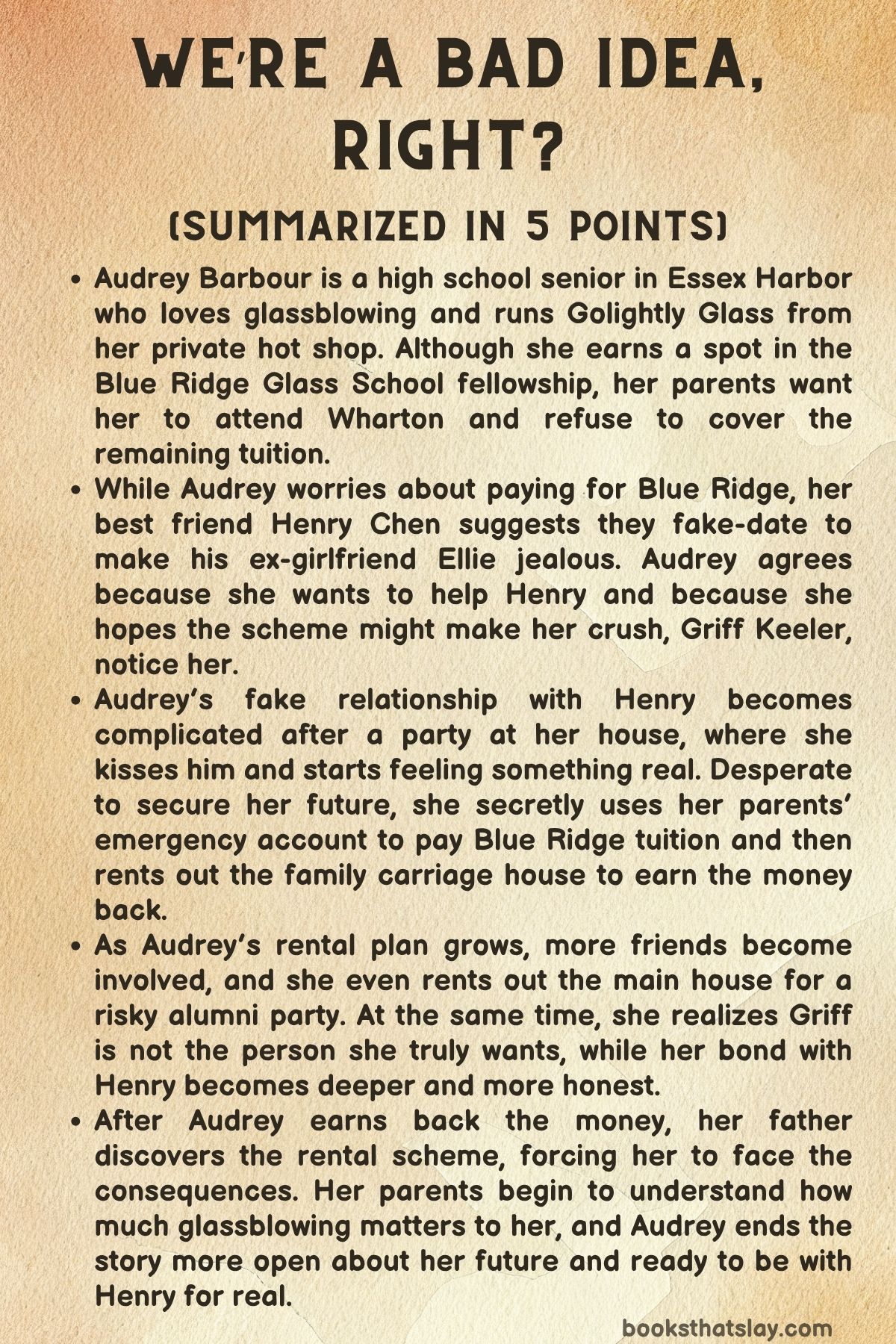
The story follows Audrey Barbour, a talented high school senior whose future is split between her parents’ dream of Wharton and her own passion for glassblowing. As she tries to save her place at an elite glass school, Audrey also gets caught in a fake-dating plan with her best friend, Henry Chen. What begins as a scheme soon forces her to face what she wants in art, love, and life.
Summary
Audrey Barbour is a high school senior living in Essex Harbor, Connecticut, where much of her life revolves around heat, glass, and the private hot shop behind her family home.
She is not just experimenting with a hobby. She runs Golightly Glass, a small business she shares with her best friend, Henry Chen, and she has built a serious identity around her work. Glassblowing gives her focus and purpose, and she has earned a place in the yearlong Blue Ridge Glass School fellowship, a major opportunity that could shape her future as an artist.
The problem is that Audrey’s parents do not see the fellowship the same way she does. They expect her to follow a safer, more traditional path by attending Wharton. To them, business school represents stability and success. To Audrey, Blue Ridge represents the life she actually wants.
The fellowship still requires a remaining payment of $10,000, and her parents refuse to cover it. With the deadline approaching while they are away in France, Audrey feels trapped between obedience and urgency. She cannot bear the thought of losing Blue Ridge, but she also knows that going behind her parents’ backs could create serious consequences.
While Audrey is struggling with her future, her social life becomes complicated. Henry has recently been dumped by Ellie Hopper, who has returned to her college ex, Chase.
Henry is hurt and wants Ellie to notice what she gave up. He suggests that he and Audrey pretend to date so Ellie will feel jealous. Audrey agrees because she wants to help him, but she also has her own reason. She has a crush on Griff Keeler, a charming football player, and thinks that being seen with Henry might make Griff pay more attention to her.
Their pretend relationship starts publicly at a bookstore, where gossip quickly begins to spread. Griff notices Audrey, especially after her dramatic new blond bob, and Audrey enjoys the attention. In a sudden attempt to seem casual and interesting, she tells Griff she is having people over. That careless comment turns into a party at her house, forcing Audrey to manage both the fake relationship and the growing chaos around her.
At the party, Audrey and Henry perform their new roles as a couple. Ellie seems unsettled by seeing them together, which suggests the plan might be working. Audrey’s problem with Blue Ridge also becomes known among her friends, adding more pressure to an already tense night.
After drinking, Audrey kisses Henry, and the moment feels different from what she expected. It is supposed to be part of the act, but the line between pretending and wanting starts to blur. Audrey begins to wonder whether her feelings for Henry are only for show.
That same night, Audrey makes a reckless choice. Afraid of losing her Blue Ridge spot, she uses her parents’ emergency bank account to pay the tuition. Once the payment is made, panic sets in. She has secured the fellowship, but she has also taken money without permission, and now she needs to replace it before her parents return and discover what she has done. Griff gives her an idea: rent out the family’s carriage house through a vacation-rental site. Audrey creates a listing under the name Fair Winds and hopes it will help her earn back the money quickly.
At first, the plan seems possible. With Henry’s help, Audrey prepares the carriage house, welcomes guests, and earns strong reviews. The rental begins bringing in money, but not fast enough to erase the full debt.
Audrey keeps the secret from her parents, and as more friends learn about it, her “circle of trust” grows. Ellie, Griff, Kenzie, Mia, Jared, James, Isa, and others become connected to the plan in different ways. Every new person involved makes the secret harder to control.
As the pressure builds, Audrey takes a bigger risk. She decides to rent out the main house as Fair Winds II to Fairfield alumni who want a place for a reunion after-party.
This is far more dangerous than hosting a few guests in the carriage house. Audrey and her friends have to organize the event as if they are professionals. They prepare food, handle music, manage guests, and try to keep everything from getting out of hand. James and Isa perform, while Henry watches from the hot shop and helps with security. The plan becomes a test of Audrey’s leadership, nerves, and ability to stay calm under pressure.
While Audrey is trying to fix the financial mess, her feelings become clearer. Griff still flirts with her, but Audrey starts to understand that his attention is casual. It does not give her the sense of safety or loyalty she feels with Henry. Henry is the one who shows up, helps her prepare the rentals, supports her choices, and sees the version of herself she is trying to become. Their fake relationship creates situations where they kiss, talk honestly, and depend on each other more deeply than before.
Henry also has doubts. He cares for Audrey, but he worries that a real relationship could hold her back. Audrey has big dreams, and Blue Ridge could take her away from Essex Harbor.
Henry does not want to become another reason for her to limit herself. This fear makes their relationship tender but uncertain. Audrey wants him, but she also wants her future, and neither of them knows how to make those desires fit together neatly.
Ellie’s role also changes. After breaking up with Chase, she admits that seeing Audrey and Henry together has been difficult. Audrey eventually tells Ellie the truth about the fake-dating plan. This honesty hurts, but it also helps them begin to repair their friendship. Ellie recognizes that Audrey’s feelings for Henry have become real, and Audrey starts to understand that keeping secrets has damaged more than just her relationship with her parents.
The alumni party almost collapses when more guests arrive than expected. The situation threatens to become loud, messy, and impossible to hide. Audrey and her friends respond quickly, using air horns, teamwork, and careful coordination to shut the event down before it turns into a disaster. Their quick thinking saves the night, and the party earns enough money for Audrey to restore the emergency account to just over $10,000.
For a moment, it seems as if she might escape the consequences of what she has done.
After the party, Audrey and Henry finally give in to the feelings that have been building between them. Their relationship becomes real in a way neither of them can easily deny. Yet there is little time to sit with what has changed. Audrey, Henry, James, and Isa rush to clean the house before Audrey’s parents return. The work is frantic, and Audrey hopes that if the house looks normal and the money is back, she can avoid discovery.
That hope does not last. Audrey’s father finds out about the rental scheme through photos posted by the first guests, people he happens to know. Audrey can no longer hide behind excuses. Her parents confront her, and the truth comes out.
Although they are upset, the conversation does not become only a punishment. Audrey’s father and Monica finally begin to understand how deeply glassblowing matters to her. They still believe in the value of Wharton, but they can no longer dismiss Blue Ridge as a passing interest.
By the end, Audrey’s future remains open, but it no longer feels as trapped as it once did. She begins to consider several possibilities: a gap year, Blue Ridge, Wharton, and even art classes near Penn.
The point is not that every question has been answered. The point is that Audrey has started speaking honestly about what she wants and taking responsibility for the choices she has made.
The story closes with Audrey back in the hot shop with Henry, the place where she feels most like herself.
She is no longer pretending that her dream is small, and she is no longer pretending that Henry is only her best friend. Audrey tells him she wants them to be together for real, even though the future is uncertain. Their relationship, like her path forward, does not come with guarantees.
But Audrey has learned that uncertainty is not the same as failure. She can love Henry, pursue glassblowing, face her parents, and still keep shaping the life she wants, one honest choice at a time.
Characters
The characters in We’re a Bad Idea, Right are shaped by ambition, friendship, secrecy, romance, and the pressure of deciding what kind of future they want. The book presents them as young people standing at a turning point, where choices about love, loyalty, family expectations, and personal dreams become impossible to avoid.
Audrey Barbour
Audrey Barbour is the central character of the book, and her journey is built around the conflict between the life she wants and the life her parents expect her to choose. She is talented, driven, and deeply passionate about glassblowing, treating her work at Golightly Glass not as a hobby but as a serious artistic calling.
Her acceptance into the Blue Ridge Glass School fellowship represents the future she truly desires, but her parents’ refusal to support the remaining tuition forces her into a desperate situation. Audrey’s decision to use the emergency bank account shows both her impulsiveness and her fear of losing control over her own future. She is not careless in a simple way; rather, she is overwhelmed by the feeling that the adults in her life are not listening to her. This makes her choices risky, but also understandable.
Audrey is also emotionally complicated because she often hides uncertainty beneath confidence and action. She agrees to fake-date Henry partly to help him, but also because she hopes it might make Griff notice her. This shows that Audrey is still learning the difference between wanting attention and wanting real emotional connection.
As the story develops, her feelings for Henry become impossible to dismiss, and this forces her to confront what has been genuine all along. Audrey’s growth comes from becoming more honest: honest about her love for glassblowing, honest about the rental scheme, honest about her friendship with Ellie, and honest about her feelings for Henry. By the end of the book, she is not presented as someone who has solved every problem perfectly, but as someone who has gained clarity and courage.
Henry Chen
Henry Chen is Audrey’s best friend, business partner, and eventual romantic partner, making him one of the most emotionally important characters in the story.
He begins the book heartbroken after Ellie leaves him for Chase, and his suggestion that he and Audrey pretend to date comes from pain, jealousy, and a desire to regain control of a situation that has hurt him. However, Henry is not simply a jealous ex-boyfriend.
He is loyal, thoughtful, and deeply connected to Audrey’s life, especially through Golightly Glass and the practical support he gives her during the carriage house rental scheme. His willingness to help Audrey prepare the rental spaces and manage difficult moments shows how dependable he is.
Henry’s complexity comes from the way he struggles with his feelings for Audrey. He grows closer to her through the fake-dating arrangement, but he also worries that a real relationship could limit her future or make things more complicated when she is on the edge of major life changes.
This fear shows his care for her, even when it causes emotional hesitation. Henry’s love is not loud or showy; it appears through presence, patience, and steady support. His relationship with Audrey becomes meaningful because it grows out of friendship, trust, and shared history.
By the end, Henry represents the kind of love that does not ask Audrey to shrink her dreams, but instead stands beside her as she tries to understand them.
Ellie Hopper
Ellie Hopper is an important character because she creates much of the emotional tension at the beginning of the story, but she also becomes part of Audrey’s emotional growth.
Ellie’s breakup with Henry and return to Chase sets the fake-dating plan in motion, making her central to both Henry’s heartbreak and Audrey’s complicated choices.
At first, Ellie can seem like the person who has caused pain and confusion, especially because her decision deeply hurts Henry. However, the book gives her more dimension by showing that her reactions to Audrey and Henry’s closeness are not simple jealousy.
She is forced to confront the consequences of her own choices and the possibility that Audrey and Henry’s bond is more real than either of them originally admitted.
Ellie’s role also matters because of her friendship with Audrey. When Audrey tells her the truth about the fake-dating scheme, it becomes a moment of honesty that allows their friendship to begin healing.
Ellie’s recognition that Audrey’s feelings for Henry are real shows maturity, even though the situation is uncomfortable for her. She is not only a romantic obstacle; she is a character who reflects the messiness of friendship, past relationships, and changing loyalties.
Ellie helps reveal that Audrey cannot keep living through half-truths and performances. Through Ellie, the story explores how friendships can be damaged by secrecy but also repaired through honesty.
Griff Keeler
Griff Keeler is the charming football player Audrey initially has a crush on, and his main role is to represent the difference between fantasy and real emotional connection. Audrey is drawn to him because he is attractive, confident, and socially appealing.
His attention feels exciting to her, especially when she is trying to be noticed and feel desirable. Griff’s suggestion to rent out the carriage house becomes a major turning point because it gives Audrey a way to repay the money she took from the emergency account. In that sense, Griff is not only a romantic possibility but also a catalyst for the central secret of the story.
However, Griff’s importance fades as Audrey begins to understand what she truly wants. His flirting is casual, and although he notices Audrey, he does not offer the depth of care that Henry does. Griff is not portrayed as cruel; instead, he represents a kind of surface-level appeal that Audrey eventually outgrows.
Her shift away from Griff shows emotional maturity because she learns to distinguish between being admired and being understood. Griff helps Audrey realize that the person who truly matters to her is not the one who simply gives her attention, but the one who knows her deeply and supports the life she wants to build.
Chase
Chase is Ellie’s college ex and the person she returns to after breaking up with Henry. Although he does not appear as deeply as Audrey or Henry, his presence is important because he disrupts the emotional balance between Ellie, Henry, and Audrey.
Chase represents the past that Ellie chooses to revisit, and that decision causes Henry’s heartbreak. Because of him, Henry feels rejected and replaced, which pushes him toward the fake-dating plan with Audrey. Chase therefore functions as a quiet but significant source of conflict.
Chase also helps show the instability of relationships that are based on unresolved feelings. Ellie’s return to him does not bring lasting clarity or happiness, and her eventual breakup with him suggests that going back to an old relationship does not always solve present uncertainty.
Chase is less important as an individual personality and more important as a symbol of emotional confusion. His role helps move the story toward the realization that the relationships worth keeping are the ones built on honesty, not nostalgia or jealousy.
Kenzie
Kenzie is part of Audrey’s wider social circle and becomes included in the secret surrounding the rental scheme. Her presence helps show how Audrey’s private problem gradually expands into a group effort.
What begins as Audrey’s individual crisis becomes something shared by her friends, and Kenzie’s inclusion in the “circle of trust” shows how quickly secrets can spread when someone is trying to manage a situation that has grown too large. Kenzie contributes to the feeling that Audrey is surrounded by people who are willing to help, even when the plan is risky.
Kenzie also represents the social energy of the book. Characters like her help create the atmosphere of parties, gossip, teamwork, and teenage urgency that surrounds Audrey’s decisions.
While she may not carry the emotional weight that Henry or Ellie does, she is still important because she belongs to the network of friends who help Audrey pull off the rental events. Through Kenzie, the story shows that Audrey is not isolated. She is surrounded by peers who become part of both her mistakes and her solutions.
Mia
Mia is another member of Audrey’s friend group who becomes involved as Audrey’s secret grows. Like Kenzie, she helps widen the story beyond Audrey, Henry, Ellie, and Griff. Mia’s role emphasizes the group dynamic that forms around Audrey’s plan to earn back the money.
Her involvement suggests trust, loyalty, and a willingness to participate in something that is both exciting and dangerous. The rental scheme depends not only on Audrey’s determination but also on the cooperation of friends like Mia.
Mia’s presence also helps show the contrast between ordinary teenage life and the increasingly serious consequences Audrey faces. Social gatherings, gossip, and friendship all continue around Audrey, but beneath them is the pressure of money, secrecy, and parental discovery. Mia belongs to that world of friendship and shared risk.
She may not be one of the most individually developed characters, but she supports the book’s larger picture of a friend group pulled into Audrey’s attempt to protect her dream.
Jared
Jared is part of the extended group that becomes aware of Audrey’s secret and participates in the events surrounding Fair Winds. His role, like that of several side characters, helps build the sense that Audrey’s situation has become too large for her to handle alone.
By including Jared in the group, the story shows how Audrey’s private decision creates a chain reaction that involves more and more people. This makes the situation more entertaining, but also more fragile, because every additional person increases the risk of exposure.
Jared’s importance lies in his contribution to the social and logistical world of the story. He helps represent the collective effort behind Audrey’s risky plan. The alumni event especially depends on teamwork, coordination, and quick thinking, and characters like Jared help create the sense that Audrey’s friends are operating almost like a temporary crew.
His role reinforces one of the book’s central ideas: even when Audrey makes impulsive choices, she is not alone in dealing with the consequences.
James
James is one of the more noticeable supporting characters because he contributes directly to the success of the alumni party. Along with Isa, he performs music during the event, helping Audrey and her friends present themselves as organized and capable. His role adds creativity and energy to the group effort, showing that the plan works not simply because Audrey is determined, but because each friend brings something useful.
James becomes part of the improvised team that helps Audrey transform a reckless idea into something that almost succeeds.
James also plays a role near the end, when he and Isa help Audrey and Henry clean everything before Audrey’s parents return. This moment shows his reliability and his place within Audrey’s support system. He is not central to the romantic conflict, but he matters because he helps carry the practical burden of Audrey’s secret.
Through James, the story highlights friendship as action rather than just emotion. He shows up when the situation becomes difficult, and that makes him valuable to Audrey’s journey.
Isa
Isa is connected closely with James in the story’s supporting cast, especially through the music and cleanup surrounding the alumni event.
Her performance with James helps make the party feel convincing and organized, which is crucial because Audrey and her friends are pretending to manage something far more professional than an ordinary teenage gathering. Isa’s contribution helps create the illusion that Audrey needs in order to earn enough money and protect her Blue Ridge opportunity.
Isa also represents the dependable side of Audrey’s friend group. Her willingness to help, especially when the situation becomes chaotic and time-sensitive, shows that Audrey’s world is filled with people who care enough to take risks for her.
Isa may not receive the same emotional focus as Audrey, Henry, or Ellie, but she plays an important role in the collective effort that carries the final part of the story. She helps show that friendship in the book is practical, active, and sometimes messy.
Monica
Monica, Audrey’s mother, represents the parental expectations that Audrey feels trapped by. She values the safer, more traditional path of Wharton and struggles to fully understand Audrey’s commitment to glassblowing. Monica’s position is not simply villainous; from her perspective, she likely sees business school as stable, prestigious, and protective of Audrey’s future.
However, her inability to recognize the seriousness of Audrey’s artistic ambition creates emotional distance between them. This pressure is one of the reasons Audrey feels forced into secrecy.
Monica’s importance becomes clearer when Audrey’s parents discover the rental scheme. Instead of reducing the conflict to punishment alone, the story allows room for conversation.
Monica still values Wharton, but she begins to see that glassblowing is not a passing interest for Audrey.
This shift matters because it gives Audrey a chance to be seen more fully by her family. Monica represents the challenge many parents face when their child’s dream does not match the future they imagined. Her eventual willingness to listen helps open the door to a more honest relationship with Audrey.
Audrey’s Father
Audrey’s father is another major figure in the family conflict, especially because he discovers the rental scheme through photos posted by the first guests. His discovery brings Audrey’s secret into the open and forces the confrontation she has been avoiding.
Like Monica, he initially represents the pressure of parental expectations and the belief that Audrey should choose Wharton over Blue Ridge. His connection to the guests who posted the photos also makes the consequences of Audrey’s actions feel more immediate and unavoidable.
What makes Audrey’s father important is that his reaction is not only anger. Although he discovers that Audrey has lied, misused the emergency account, and rented out family property, he and Monica still talk with her rather than simply destroying her dream.
This response allows the story to move toward understanding instead of pure punishment. Audrey’s father represents authority, disappointment, and concern, but also the possibility of change. By the end of We’re a Bad Idea, Right, his willingness to recognize Audrey’s seriousness about glassblowing helps Audrey imagine a future that may include Blue Ridge, Wharton, a gap year, or another path shaped by her own honesty.
Themes
Choosing Passion Over Expectation
Audrey’s struggle with her future is shaped by the pressure to follow the path her parents believe is safest.
They see Wharton as practical, respected, and secure, while she sees glassblowing as the work that gives her life meaning. Her private hot shop is not just a workspace; it is the place where her talent, independence, and ambition become visible. The conflict becomes sharper when the Blue Ridge opportunity is placed at risk because it forces Audrey to decide whether her dream is worth fighting for without full parental approval.
Her choice to use the emergency account is reckless, but it also shows how deeply she fears losing the one future that feels truly hers. By the end, the issue is no longer simply Wharton versus art school. Audrey begins to understand that growing up means taking her own desires seriously while also accepting the consequences of her choices in the book.
Honesty and the Cost of Secrets
Audrey’s decisions create a chain of secrets that grow harder to control with every step. What begins as a desperate attempt to pay for Blue Ridge becomes a hidden rental business, a fake relationship, and a larger circle of friends who must help protect the truth.
Each secret seems manageable at first, but together they place emotional pressure on Audrey and make her relationships more fragile. Her fear of disappointing her parents pushes her toward deception, yet the deception does not bring real peace. Instead, it creates constant anxiety, forcing her to clean, organize, lie, and improvise before everything collapses. The rental scheme also shows how secrets often require other people to carry part of the burden. Audrey’s friends support her, but their involvement proves that dishonesty rarely stays private.
When the truth finally reaches her parents, the confrontation becomes necessary because Audrey can only move forward once her dream, her mistakes, and her fears are spoken openly.
Friendship, Loyalty, and Emotional Complication
The friendships in the story are warm, messy, and often tested by jealousy, loyalty, and changing feelings.
Audrey agrees to fake-date Henry because she wants to help him after Ellie hurts him, but her choice also serves her own hope of getting Griff’s attention. This makes the arrangement emotionally complicated from the beginning. Henry and Audrey already share trust through their business and daily closeness, so pretending to be romantic slowly exposes feelings that were already present beneath their friendship.
Ellie’s return to the group adds another layer because Audrey must face the pain caused by the fake-dating plan and the truth of her own emotions. The larger friend group also becomes essential during the rental scheme, showing loyalty through action rather than words. They clean, host, perform, manage guests, and protect Audrey when things nearly fall apart. Friendship here is not perfect or simple, but it becomes a place where characters make mistakes, repair damage, and prove care through support.
Love That Grows From Trust
Audrey’s changing feelings for Henry show that love is often built through comfort, honesty, and shared responsibility rather than sudden attraction alone.
At first, she believes Griff is the person she wants because he represents excitement, attention, and social possibility. Yet his interest remains surface-level, while Henry consistently understands her fears, her work, and her hopes. Their closeness grows through ordinary moments: preparing the carriage house, solving problems, protecting secrets, and spending time in the hot shop.
These moments reveal that Henry is not just part of Audrey’s plan; he is the person who sees her most clearly. His hesitation about holding her back adds emotional weight because their future is uncertain, and both of them know Audrey’s ambitions may take her away. The ending does not pretend that love solves every practical problem. Instead, it presents love as a choice made with honesty.
Audrey chooses Henry not because the future is guaranteed, but because the feeling is real enough to face uncertainty together.