What We Did to Survive Summary, Characters and Themes
What We Did to Survive by Megan Lally is a tense young adult survival thriller about friendship, grief, fear, and the choices people make when their lives are at risk. The story follows Hannah, a teenager on spring break in Puerto Vallarta with her best friend Emmy and Emmy’s family.
What begins as a sunny vacation soon turns dangerous after a sailing trip goes wrong during a storm. At its center, the book is about Hannah’s struggle to stay alive, protect Emmy, face the truth about what happened, and understand how trauma can reshape reality.
Summary
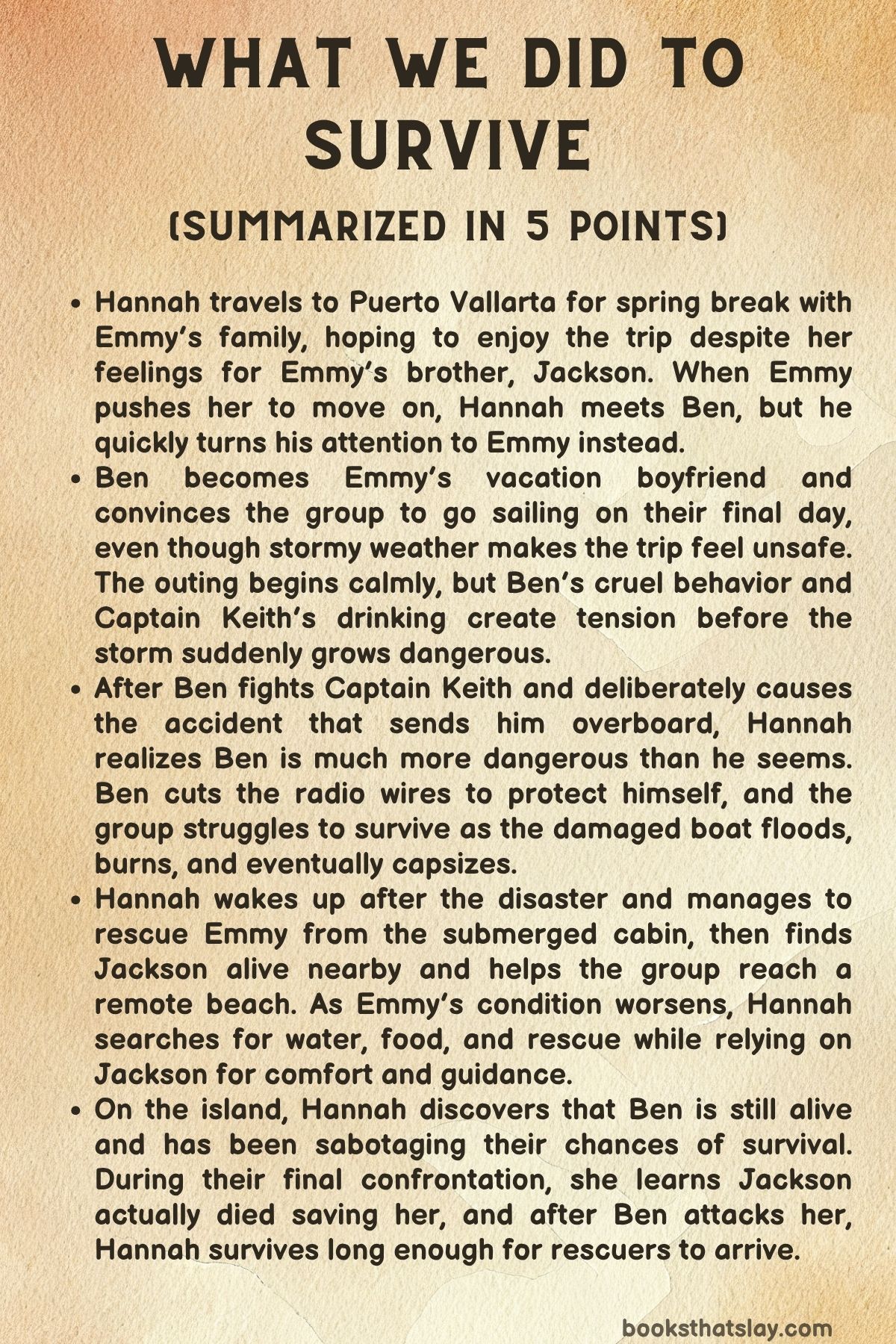
Hannah begins spring break in Puerto Vallarta hoping the trip will give her a chance to relax, enjoy time with her best friend Emmy Cole, and maybe sort through her confusing feelings for Emmy’s older brother, Jackson. Hannah has loved Jackson quietly for years, but their relationship has become strained after an awkward moment over Christmas.
Now, even in a beautiful resort setting, she cannot stop noticing his distance. Every small exchange with him hurts more than she wants to admit.
Emmy, who knows Hannah well, quickly senses that something is wrong. She suggests that Hannah should stop focusing on Jackson and enjoy a harmless vacation fling instead.
Hannah is not sure she wants that, but the idea lingers. Soon after, while swimming, Hannah meets Ben, a good-looking and confident boy who seems interested in her at first.
Their conversation gives her a brief feeling of possibility. But as soon as Emmy appears, Ben’s attention shifts.
He becomes focused on Emmy, and Hannah is pushed to the side.
Ben quickly becomes Emmy’s vacation boyfriend. He is charming, bold, and eager to impress her.
He takes Emmy and Hannah around town, buys Emmy gifts, and acts as though he can offer her a bigger, freer life than the one waiting back home. Emmy is drawn to his confidence and the excitement he represents.
Hannah, however, begins to feel uneasy. Ben’s charm often feels too polished, and his attitude toward others has an edge.
Still, Emmy is caught up in the romance, and Hannah does not want to ruin her friend’s happiness.
As the vacation nears its end, Ben suggests that they spend their last full day sailing. Emmy loves the idea, and Ben presents it as a perfect adventure.
Emmy’s parents are hesitant, but they agree on the condition that Jackson goes along as a chaperone. The next morning, the weather already looks bad.
Storm clouds are gathering, and the conditions seem questionable. Ben insists everything is safe and under control.
When the group reaches the marina, they learn that official charters have been canceled because of the weather. This should be enough to stop the trip, but Ben has arranged another option: a private sailor named Captain Keith, who owns a boat called The Be-Yacht-Ch.
Hannah and Jackson both feel uneasy about the situation. The boat, the captain, and the weather all raise concerns.
But Emmy gets on board, determined to have the day Ben promised her. Hannah and Jackson follow because they do not want to leave her alone.
At first, the sailing trip seems almost normal. Captain Keith takes them along the coast.
They snorkel, eat, watch dolphins, and try to enjoy the ocean. For a while, the tension fades into the background.
But Ben’s behavior continues to reveal troubling sides of his personality. He mocks Hannah’s plans to study nursing and looks down on Jackson’s career interests.
He treats people as though their worth depends on whether they impress him. His arrogance creates more strain among the group.
Hannah and Emmy argue after Ben suggests that Emmy travel with him in Europe. To Hannah, the offer seems impulsive and unsafe.
To Emmy, it feels romantic and full of possibility. Their disagreement exposes the stress already building between them.
Hannah worries that Emmy is ignoring warning signs because she wants the trip to feel magical. Emmy feels judged and controlled.
Their friendship, usually strong, begins to crack under the pressure.
Then the storm arrives faster and harder than expected. The boat is caught in dangerous conditions, and the group looks for Captain Keith, only to find him passed out drunk in the bathroom.
Ben’s tequila bottle is empty nearby, making it clear that something has gone badly wrong. Ben wakes Keith roughly, and the situation turns violent.
The argument becomes a fight, and Ben brutally beats Captain Keith. When Keith threatens to report him for assault, Ben makes a horrifying choice.
During a dangerous tilt of the boat, he lets go of the wheel on purpose. The boom swings across and strikes Keith, knocking him overboard.
Hannah sees what happens. Without thinking, she dives into the water to save Keith, but the current is too strong.
She cannot reach him, and he disappears into the stormy sea. Back on the boat, Ben tries to control the story.
He wants everyone to say that Keith drunkenly fell overboard by accident. Hannah refuses because she knows what she saw.
Ben’s mask slips further. He is not just reckless or arrogant.
He is dangerous.
The storm worsens, and the radio is not working. The group retreats below deck, terrified and trapped.
Later, they discover the radio wires have been cut. Ben has disabled their only clear way to call for help because he does not want to be reported for Keith’s death.
Realizing how much danger they are in, Hannah and Jackson manage to lock him in the bathroom.
The boat continues to suffer in the storm. The mast breaks, water floods in, and the situation becomes desperate.
Ben starts a fire in order to escape, making the boat even more unsafe. Jackson fights him and punches him into the water, but when Ben promises to help, Jackson allows him back aboard.
It is a choice made out of urgency, not trust.
A second storm hits with even more force. Hannah tries to untie Ben, hoping survival matters more than their conflict, but he attacks her and tries to take her life vest.
As chaos breaks out, Jackson and Hannah shove Emmy into the cabin just before a massive wave crashes into the boat.
When Hannah wakes the next day, she is tied to wreckage from the capsized boat. The ocean is calmer, but the horror of what happened settles over her.
At first, she believes everyone else is dead. Then she hears knocking.
Emmy is trapped inside the submerged cabin, alive in a small air pocket. Hannah forces herself to dive again and again into the wreckage.
She rescues Emmy, gathers food and medical supplies, and fights through exhaustion and fear.
Hannah later spots Jackson alive, clinging to emergency flotation. His survival gives her strength.
Together, they inflate a raft and begin moving toward distant land while pushing Emmy, who is injured and feverish, through the water. The journey is punishing.
They face waves, jellyfish, pain, and the constant fear that they will not make it. At last, they reach a remote beach.
On land, Hannah takes charge because she has to. She starts a fire, treats Emmy’s infected arm, searches for water, and tries to keep them alive long enough to be found.
Jackson appears beside her as a steady presence. He helps her think through problems, comforts her, and gives her the courage to keep going.
Hannah leans on him emotionally as the pressure of survival grows heavier.
But strange things begin happening on the beach. Food disappears.
Their raft is damaged. Hannah senses that someone is watching them.
At first, the threat is unclear, but eventually she discovers the truth: Ben is alive. He has been hiding nearby, sabotaging their supplies, and waiting for a chance to control what happens next.
His goal is not just survival. He wants to protect himself and shape the story so he can escape responsibility.
When Ben confronts Hannah, he reveals the truth she has not been able to face. Jackson did not survive the boat disaster.
He died saving her. The Jackson Hannah has been seeing on the island is not real.
He is a hallucination created by trauma, grief, and her need for comfort. The realization devastates her, but it also forces her to see the situation clearly.
She must survive without the person she thought was helping her.
Ben attacks Hannah near a cliff, and she fights back with everything she has left. She is injured, terrified, and grieving, but she refuses to let him win or decide the truth.
Her struggle lasts long enough for rescuers to arrive by helicopter. Hannah and Emmy are saved, and Ben’s crimes are finally exposed.
After the rescue, Hannah and Emmy return home changed forever. Jackson’s death leaves a wound neither of them can easily understand or accept.
Ben’s violence and lies have stolen not only their vacation but also their sense of safety. Months later, Hannah is at college, still carrying her grief and trying to face the anniversary of everything that happened.
Emmy visits her and shares that she wants to reclaim her dream of going to Italy. She does not want Ben to control her future or ruin the life she once imagined for herself.
Hannah understands what that means. Both girls are still broken in different ways, but they are also still alive, still friends, and still capable of choosing what comes next.
Hannah agrees to go with Emmy, but she sets one firm condition: no boats.
Characters
Hannah
Hannah is the central character of What We Did to Survive, and her journey in the book is shaped by fear, grief, loyalty, courage, and emotional awakening. At the beginning, she is presented as someone who feels deeply but often keeps her feelings hidden, especially when it comes to Jackson.
Her secret love for him makes her emotionally vulnerable, and his distance during the vacation leaves her hurt and confused. This romantic tension shows that Hannah is not only dealing with the external dangers of the trip but also with private emotional struggles that affect how she sees herself and the people around her.
As the story progresses, Hannah becomes one of the strongest survival figures in the book. She repeatedly acts when others hesitate, whether she is trying to save Captain Keith, rescuing Emmy from the submerged cabin, retrieving supplies, treating injuries, finding water, starting a fire, or facing Ben.
Her courage is not shown as effortless bravery; instead, it grows out of panic, desperation, and love for her friends. This makes her strength feel realistic because she is terrified throughout much of the story, yet she keeps choosing action over surrender.
Hannah’s character is also deeply connected to trauma. After the wreck, she begins seeing Jackson and speaking with him, believing that he is alive and helping her survive.
This reveals how her mind tries to protect her from the unbearable truth of his death. Jackson’s hallucinated presence becomes a symbol of her grief, guilt, and need for comfort.
Through this, Hannah becomes more than a typical survivor; she becomes a character whose emotional wounds are just as serious as the physical danger around her.
By the end of the story, Hannah has changed from a girl quietly carrying unspoken feelings into someone who has endured loss, betrayal, violence, and survival. Her final confrontation with Ben shows her refusal to let him control the truth or destroy what remains of her life.
Even after rescue, she is not magically healed, which makes her character more believable. She continues to grieve Jackson, but she also begins moving forward with Emmy.
Hannah represents resilience, not because she escapes pain, but because she survives it and still chooses to keep living.
Emmy Cole
Emmy Cole is Hannah’s best friend, and she plays an important role in both the emotional and survival parts of the book. At the start, Emmy appears confident, energetic, impulsive, and eager to enjoy the vacation.
She notices Hannah’s sadness over Jackson and encourages her to have a vacation fling, which shows that Emmy cares about Hannah but sometimes handles serious emotions in a lighthearted or careless way. Her personality brings movement and excitement to the early part of the story, but her impulsiveness also helps create dangerous situations.
Emmy’s relationship with Ben reveals her desire for romance, adventure, and escape. She is quickly drawn to his charm, gifts, attention, and promises of travel.
At first, she sees him as exciting and spontaneous, but this also shows that she can be trusting in ways that put her at risk. Emmy’s willingness to follow Ben onto the boat, even when Hannah and Jackson feel uneasy, becomes one of the turning points of the story.
However, the book does not make Emmy simply foolish; instead, it shows how easily charm and confidence can hide manipulation and danger.
During the survival sections, Emmy becomes physically vulnerable because of her injury and infection. She depends heavily on Hannah and Jackson’s efforts, especially after being trapped in the air pocket inside the submerged cabin.
Her weakened condition raises the stakes because Hannah is not only trying to survive for herself but also fighting to keep Emmy alive. Emmy’s suffering also reveals the depth of her friendship with Hannah.
Their bond is tested by fear, pain, guilt, and exhaustion, but it remains one of the emotional anchors of the story.
By the end, Emmy is also a survivor of trauma. She loses her brother, realizes the horror of Ben’s actions, and has to live with the consequences of choices made during the vacation.
Her decision months later to reclaim her dream of going to Italy is important because it shows that she does not want Ben to control the rest of her life. Emmy’s character represents the painful process of growing beyond innocence.
She begins as a girl chasing excitement and romance, but she ends as someone trying to rebuild herself after tragedy.
Jackson Cole
Jackson Cole is Emmy’s older brother and Hannah’s longtime secret love, but his role in the book goes far beyond being a romantic figure. At the beginning, he is emotionally distant from Hannah, which creates tension because something awkward happened between them earlier.
His distance hurts Hannah, but it also suggests that he is struggling with his own feelings and uncertainty. Jackson is protective, observant, and more cautious than Emmy, especially when Ben begins making risky choices.
Jackson serves as one of the clearest voices of reason during the trip. He is uneasy about the private boat, suspicious of Ben’s behavior, and willing to challenge him when danger increases.
His protectiveness becomes especially important once Captain Keith disappears and Ben becomes openly threatening. Jackson’s courage is physical as well as emotional.
He fights Ben, helps Hannah and Emmy survive the chaos on the boat, and ultimately dies while saving Hannah. His death becomes one of the most devastating events in the story because it turns his quiet protectiveness into a final act of sacrifice.
After his death, Jackson continues to appear through Hannah’s hallucinations. This version of Jackson helps her survive, comforts her, and guides her thinking, but he also represents Hannah’s inability to accept that he is gone.
Through these imagined conversations, the story shows how deeply Jackson mattered to Hannah and how trauma can reshape reality in the mind of someone trying to survive unbearable loss. The hallucinated Jackson is not simply a twist; he is a reflection of Hannah’s grief and her need to hold onto love during extreme fear.
Jackson’s character is tragic because much of his emotional truth remains unfinished. His relationship with Hannah never gets the full honesty or future it might have had.
Yet his actions reveal his character more powerfully than words could. He is brave, loyal, protective, and willing to risk himself for the people he loves.
In the book, Jackson represents both lost possibility and lasting emotional strength. Even after his death, his memory continues to shape Hannah’s survival and healing.
Ben
Ben is the main antagonist of the story, and he is one of the most dangerous characters because he hides cruelty behind charm. When Hannah first meets him, he appears attractive, confident, playful, and exciting.
He knows how to make himself seem appealing, especially to Emmy, and he quickly becomes the center of her attention. His early charm is important because it shows how manipulation often begins with warmth, confidence, and attention rather than obvious violence.
As the trip continues, Ben’s arrogance and selfishness become more visible. He mocks Hannah’s nursing plans and Jackson’s career interests, showing that he looks down on others and enjoys making people feel small.
His charm begins to fall away when he does not get full control of the situation. The storm exposes his true nature because pressure brings out his violence, cowardice, and need to protect himself at any cost.
His attack on Captain Keith marks a major shift from unpleasant arrogance to open brutality.
Ben’s most disturbing trait is his willingness to manipulate the truth. After Keith goes overboard, Ben tries to force everyone into accepting a false version of events.
He cuts the radio wires to prevent anyone from reporting what happened, proving that he values his own escape from blame more than anyone’s safety. Later, when he survives and hides onshore, he sabotages Hannah and Emmy by stealing food, damaging the raft, and watching them suffer.
His survival instinct is completely selfish, unlike Hannah’s, which is rooted in protecting others.
Ben functions as a human threat that is even more frightening than the storm, the ocean, or the remote island. Nature is dangerous, but Ben is deliberately cruel.
He chooses harm, lies, and violence again and again. His final attack on Hannah shows that he is willing to kill to control the story.
In the book, Ben represents manipulation, entitlement, and moral emptiness. He is terrifying because he proves that the greatest danger is not always the disaster itself, but the person who exploits disaster for his own survival.
Captain Keith
Captain Keith is a supporting character, but his role is crucial because his actions and death set much of the disaster into motion. He is introduced as the private sailor Ben hires after official charters are canceled because of the storm risk.
From the start, his presence suggests poor judgment and danger. The fact that he agrees to take the group out despite unsafe conditions shows that he is irresponsible, even before his drinking is revealed.
Keith’s drunkenness makes him partly responsible for the unsafe situation aboard the boat. As captain, he should be the adult authority and the person most capable of protecting everyone, but he fails in that duty.
When Hannah and the others find him passed out, the group loses the one person who should know how to handle the storm. His condition turns the boat from a risky adventure into a true crisis.
This failure also intensifies the conflict between him and Ben.
At the same time, Keith is not portrayed as deserving of what happens to him. Ben’s violence against him is excessive and cruel, and Keith’s threat to report the assault is reasonable.
His death becomes the moment when Ben’s character is fully exposed. When Ben deliberately releases the wheel during the dangerous tilt, Keith is struck and thrown overboard.
Hannah’s attempt to save him shows that, despite his irresponsibility, his life still matters. His disappearance creates guilt, fear, and moral conflict for the survivors.
Captain Keith’s importance lies in how his failure and death reveal the story’s larger themes of responsibility and truth. He makes reckless choices, but Ben turns recklessness into violence and possible murder.
Keith becomes the first major casualty of the trip, and his death forces the other characters to confront not only the danger of the storm but also the danger of lies. His character reminds readers that irresponsibility can create disaster, but deliberate cruelty makes disaster far worse.
Emmy’s Parents
Emmy’s parents are minor characters, but they help establish the emotional and practical circumstances that allow the trip to happen. They bring Hannah along on spring break and seem to trust the vacation setting enough to give the teenagers some freedom.
Their decision to allow the sailing trip only if Jackson goes as a chaperone shows that they are not completely careless. They want some form of supervision and believe Jackson’s presence will make the outing safer.
Their role also shows the limits of adult protection in the story. Even though they set a condition, they cannot see the full danger of Ben, Captain Keith, the storm, or the private boat.
This creates a painful contrast between what adults believe is controlled and what actually happens once the teenagers are beyond their reach. Their trust in Jackson as a chaperone is understandable, but it also places him in a position where he carries responsibility for Emmy and Hannah during a crisis no ordinary older brother could fully manage.
After the disaster, Emmy’s parents become part of the grief surrounding Jackson’s death and Emmy’s trauma, even though they are not deeply explored. Their family loses a son, and their daughter returns changed by violence and survival.
Their presence in the beginning makes the ending more tragic because the vacation starts as a family trip and becomes a source of permanent loss. In the story, Emmy’s parents represent ordinary parental caution that proves powerless against hidden danger, sudden disaster, and human cruelty.
Hannah’s Parents
Hannah’s parents are not central to the action, but their absence from the vacation helps shape Hannah’s position in the story. Hannah is traveling with Emmy’s family, which places her slightly outside the Cole family while still being emotionally tied to them.
This matters because her love for Jackson, her friendship with Emmy, and her dependence on the group all become more intense in the isolated vacation setting.
Because Hannah is away from her own family, she must rely on herself during the crisis. There is no parent nearby to protect her, comfort her, or make decisions for her.
This absence strengthens her role as a survivor because she is forced to become her own source of judgment and courage. Her growth depends on her ability to act without adult rescue until the very end.
Hannah’s family background also becomes important after the rescue, even if it remains mostly outside the main action. Returning home does not erase what she has experienced.
She must carry her grief, trauma, and memories into ordinary life again. Her parents represent the life she comes from, but Hannah herself is no longer the same person who left for spring break.
Their limited role helps keep the focus on Hannah’s inner transformation.
The Rescuers
The rescuers appear near the end of the story, but their arrival is important because it marks the end of Hannah and Emmy’s physical fight for survival. The helicopter represents safety, truth, and the return of the outside world after days of isolation and fear.
Until that moment, Hannah has had to rely on her own strength, her bond with Emmy, and the imagined presence of Jackson.
Although the rescuers do not have developed personal identities, their function in the book is meaningful. They arrive after Hannah has already confronted Ben and survived the worst of the ordeal.
This means the rescue does not take away from her courage. Instead, it confirms that she has endured long enough to be found.
Their arrival allows the truth about Ben’s crimes and Jackson’s death to begin moving beyond the island.
The rescuers also mark the beginning of a different kind of survival. Once Hannah and Emmy are physically saved, they still have to face grief, trauma, and the consequences of everything that happened.
In that sense, the rescue is not a simple happy ending. It is a transition from immediate danger to emotional recovery.
The rescuers bring Hannah and Emmy back to the world, but the girls must still learn how to live in it after what they have lost.
Themes
Survival and Moral Courage
Survival in What We Did to Survive is not shown as a simple fight against nature, but as a test of judgment, courage, and responsibility under extreme pressure. Hannah survives because she keeps making difficult choices when fear could easily freeze her.
She dives after Captain Keith, rescues Emmy from the submerged cabin, retrieves supplies, treats injuries, finds water, starts a fire, and keeps searching for ways to signal rescuers. Her survival depends on practical action, but also on moral strength.
She refuses to accept Ben’s false version of events, even when agreeing with him would seem safer. This makes survival more than staying alive; it becomes a refusal to surrender truth or conscience.
The danger at sea and onshore reveals what each person values when comfort and safety disappear. Hannah’s choices show that courage is often quiet, repeated, and exhausting.
She does not become fearless, but she keeps acting despite fear, grief, pain, and uncertainty.
Grief, Trauma, and the Mind’s Need for Protection
Hannah’s hallucination of Jackson shows how trauma can reshape reality when the mind cannot immediately bear the truth. After the disaster, she is physically stranded, but she is also trapped inside shock and grief.
Seeing Jackson allows her to keep functioning when accepting his death might break her completely. He becomes a source of comfort, guidance, and emotional steadiness, helping her think clearly, protect Emmy, and continue surviving.
This does not make her weak or foolish; instead, it shows the mind trying to protect itself from unbearable loss. The revelation that Jackson died saving her is devastating because it forces Hannah to face both grief and survivor’s guilt.
Her imagined conversations with him suggest that love does not vanish after death, even when the person is gone. The theme treats trauma with seriousness by showing that healing is not instant.
Hannah’s return to college months later proves that rescue ends the physical crisis, but grief continues afterward in quieter, harder ways.
Friendship, Loyalty, and Emotional Reckoning
Hannah and Emmy’s friendship is tested by jealousy, fear, anger, and life-threatening danger. At the start, their bond is strained because Hannah feels pushed aside by Emmy’s excitement over Ben and by her own secret feelings for Jackson.
Emmy’s impulsiveness frustrates Hannah, while Hannah’s resentment creates emotional distance between them. The crisis forces both girls into a deeper understanding of what loyalty really means.
Hannah risks herself again and again for Emmy, especially when she rescues her from the wreck and cares for her infected arm onshore. Emmy, though injured and frightened, remains emotionally important because she gives Hannah someone to protect and a reason to keep going.
Their friendship is not perfect or free from conflict, but that makes it more believable. By the end, Emmy’s decision to reclaim her dream of Italy shows that friendship can help people move forward after harm.
Their bond survives because it changes from carefree closeness into something marked by sacrifice, honesty, and shared grief.
Manipulation, Control, and the Danger of False Charm
Ben’s charm hides a need for control that becomes more dangerous as the story progresses. At first, he appears confident, exciting, and generous, which makes it easier for Emmy to trust him and harder for others to challenge him.
His behavior slowly reveals arrogance and cruelty, especially when he mocks Hannah and Jackson’s ambitions and dismisses concerns about safety. Once the storm exposes his selfishness, he tries to control not only the boat but also the truth.
Cutting the radio wires, pressuring the others to lie, attacking Hannah, and sabotaging the survivors all show that his priority is protecting himself, not saving anyone else. His charm is therefore not romantic or harmless; it is a tool he uses to influence people and avoid consequences.
This theme warns against confusing attention with care. Ben’s danger comes partly from how believable he seems at first.
The story shows that real character appears when power, blame, and fear are involved.