You Did Nothing Wrong Summary, Characters and Themes
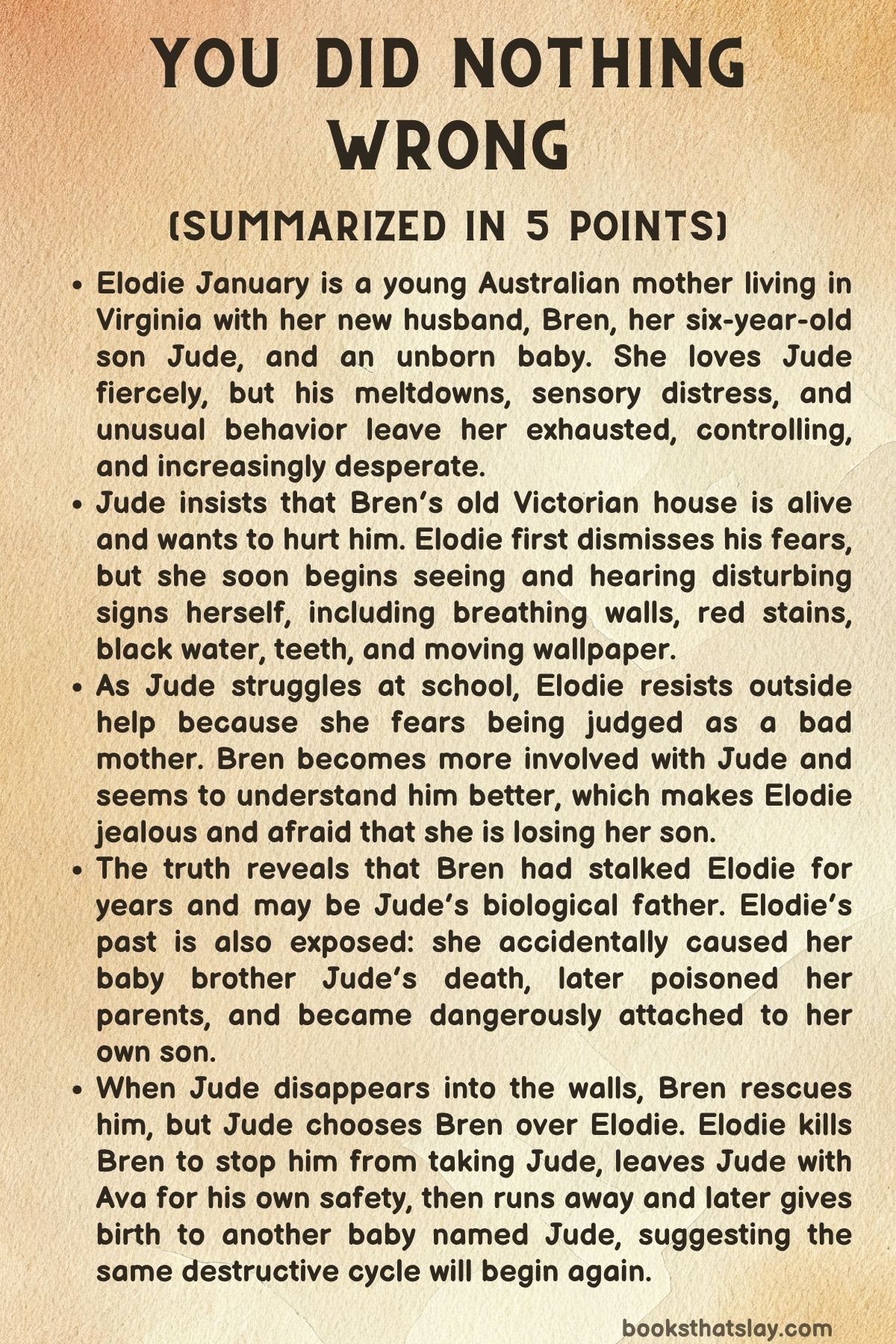
You Did Nothing Wrong by C. G. Drews is a psychological horror novel about motherhood, guilt, obsession, and the terrifying ways trauma can distort love. The story follows Elodie January, a young Australian mother trying to build a new life in Virginia with her husband, Bren, her son Jude, and a baby on the way.
At first, her fears seem tied to a strange old house and a fragile child who says the walls are alive. But as the truth unfolds, the real horror comes from Elodie’s past, her need to control Jude, and the damage hidden beneath her idea of love.
Summary
Elodie January is twenty-two years old, newly married, pregnant, and living far from the life she once knew in Australia. She has moved to Virginia with her husband Bren, her six-year-old son Jude, and the hope that a fresh start might make them into a real family.
Their home is a Victorian house inherited by Bren, a place he is slowly renovating with his own hands. To Elodie, the house is not simply old and difficult.
It feels watchful, damp, and wrong, though at first she tries to treat her unease as stress from the move, the pregnancy, and the demands of caring for Jude.
Jude is not an easy child in the way other people expect children to be easy. He is small for his age, emotionally intense, easily overwhelmed, and often locked inside patterns of play and fear that Elodie alone seems to understand.
He struggles with meltdowns, sensory distress, and obsessive habits. Elodie manages him through rules and games, especially Simon Says, using structure to keep him calm and obedient.
She loves him with a fierce, consuming devotion, but her love is mixed with exhaustion, resentment, and fear. She feels rejected when Jude pulls away from her, and she is desperate to keep him close.
Soon Jude begins saying that the house is alive. He hears breathing inside the walls and believes the house dislikes both Elodie and Bren.
He claims something inside it whispers to him. Elodie wants to dismiss this as imagination, especially because Jude has already been through a major move and has trouble adjusting.
But strange signs begin to appear around her. She finds wet red stains inside the walls.
She hears breathing. She sees the house as if it has flesh, hunger, holes, teeth, black water, and wallpaper that seems to move.
What begins as a child’s fear becomes something Elodie can no longer fully explain away.
The pregnancy adds more strain. When Elodie tells Jude he is going to have a sibling, he reacts violently.
His response frightens and wounds her, and she feels the growing baby as both a promise and a threat. Outside the home, other adults begin noticing Jude’s difficulties.
At school and after-school care, they point out that he behaves younger than six, struggles socially, has bruises, and may need proper assessment or support. Elodie resists these suggestions.
She fears being judged, exposed, or told that she has failed as a mother. She wants to believe that only she knows what Jude needs.
Bren’s sister Ava becomes another uneasy presence in Elodie’s life. Ava warns her that Bren was raised in a strict household and may believe strongly in obedience and discipline.
Elodie listens, but she is also unsettled by how much Bren starts involving himself with Jude. At first, Bren seems to be helping.
He pays attention to the boy, sees his needs, and tries to offer him a different kind of care. Then he makes a major decision: he moves Jude from first grade into preschool and presents him as Jude January, a four-year-old child.
This choice gives Jude an environment that suits him better, but it also disturbs Elodie because it feels like Bren is taking control of the story she has always told about her son.
As Bren and Jude grow closer, Elodie becomes jealous. She has built her whole identity around being Jude’s protector, interpreter, and only safe place.
Watching him trust Bren feels like losing him. The marriage begins to break under suspicion and resentment.
Bren starts noticing the darker side of Elodie’s parenting. He sees how she controls Jude through games, limits his food, treats him as younger than he is, and may have harmed him.
Elodie, in turn, suspects Bren of hurting Jude, especially when she sees marks on the child’s body. Both parents become threats in her mind, and the house seems to feed every fear.
Elodie also discovers that the house itself is physically dangerous. There is black mold and lead paint, and Bren knew the house was unsafe.
This makes the boundary between supernatural horror and real-world danger even harder to separate. Jude’s behavior, Elodie’s visions, and the strange presence in the walls may be tied to the toxic house, but they also reflect the rot inside the family.
The home becomes a symbol of everything hidden, poisoned, and denied.
The buried truth begins to surface when Elodie finds a hidden basement. Inside, she discovers photographs of herself and Jude from years earlier in Australia.
These photos prove that Bren did not meet her by chance. He had been watching her long before their romance began.
Bren admits that he knew her from the past and that Jude is his son. Elodie’s memories return with terrible clarity.
As a teenager, she had used a shy boy at a party in order to become pregnant. That boy was Bren.
Years later, he found her again, pursued her, and brought her and Jude to America.
Bren also knows another secret: Elodie murdered her parents. After they locked Jude in the garage while she was away with Bren, Elodie poisoned their food and killed them.
This revelation shifts the story from a tale of a frightened mother in a haunted house to the portrait of a woman whose life has been shaped by guilt, violence, and a warped need for control. Elodie has not simply been protecting Jude from danger.
She has carried danger with her.
Her past explains part of her obsession. When Elodie was eight, she had a baby brother named Jude.
One day, she left him alone briefly in the bath, and he drowned. Her parents blamed her for his death.
Their grief turned into punishment and neglect, leaving Elodie marked by shame and a desperate need to repair what could never be repaired. Later, when she had her own son, she named him Jude too.
The name became an attempt to replace the brother she lost and to prove she could keep this Jude alive. But her love grew possessive and unstable.
She wanted him small, dependent, and always within reach.
Flashbacks also reveal that Elodie once drugged Jude with sleeping pills so he would seem calm. This confirms that her care for him has crossed into harm before.
Her fear of losing him, her need to control his body and behavior, and her refusal to accept help all come from the same damaged place. She believes she is saving him, but her idea of safety requires Jude to remain trapped inside her needs.
The horror in the house reaches its peak when Jude disappears into the walls. Bren and Elodie tear through the structure in a frantic attempt to find him.
The house seems monstrous, as if it has swallowed the child. Bren manages to pull Jude out alive, but the moment breaks Elodie.
Jude chooses Bren’s arms over hers. For Elodie, this is not simply rejection.
It is the collapse of the life she has built around being Jude’s only protector.
Bren decides to leave with Jude. He tells Elodie she cannot have him.
To Elodie, this means Bren will take away both Jude and the unborn baby. Panic and rage take over.
She attacks Bren with a hammer and kills him. Afterward, she dismembers his body and hides the pieces inside the walls of the house.
The place that seemed hungry and full of hidden flesh becomes the hiding place for the violence Elodie commits. The monster in the walls is no longer only imagined.
Elodie has made it real.
At dawn, something in her changes, at least briefly. She takes Jude to Ava’s house and leaves him there.
In doing so, she recognizes that the best thing she can do for him is to let him go. It is a rare moment of clarity.
She understands that her love has become dangerous and that Jude has a better chance away from her. Then she flees with Bren’s wallet and car, leaving behind the house, the body, and the child she has tried so hard to possess.
The ending shows that Elodie has not truly escaped herself. In the epilogue, she is living under a new name, working in a small shop, and hiding from what she has done.
She gives birth to her baby. The child is also named Jude.
This final choice reveals the terrible cycle beginning again. Elodie has lost one Jude, handed another away, and now creates a new one to fill the same wound.
The ending is chilling because it suggests that the pattern of guilt, replacement, and dangerous love has not been broken. Elodie may understand, for a moment, that she harmed her son, but she has not healed.
She has only moved the obsession into another child.
You Did Nothing Wrong is ultimately a story about how denial can turn love into possession. The haunted house may be frightening, but the deeper terror lies in Elodie’s mind and history.
She wants to be forgiven, to be needed, and to believe she is a good mother. Yet every attempt to protect Jude becomes another way of trapping him.
By the end, the title sounds less like comfort and more like a lie Elodie has told herself for years.
Characters
The characters in You Did Nothing Wrong are shaped by fear, trauma, secrecy, obsession, and the desperate need to control what feels uncontrollable. Each major character contributes to the book’s disturbing atmosphere, not only through what they do, but through what they reveal about family, motherhood, childhood, guilt, and abuse.
Elodie January
Elodie January is the emotional and psychological center of the book, and she is one of its most disturbing, tragic, and morally complicated figures. At twenty-two, she is already a mother, wife, immigrant, and survivor of a deeply damaged childhood.
On the surface, she appears to be an overwhelmed young woman trying to protect her sensitive six-year-old son while adjusting to marriage, pregnancy, and life in an unfamiliar country. Beneath that surface, however, Elodie is unstable, possessive, frightened, and shaped by years of guilt and neglect.
Her love for Jude is real, but it is also suffocating. She does not simply want to care for him; she wants to keep him emotionally dependent on her, controlled by her, and protected from any outside influence that might take him away.
Elodie’s motherhood is presented as both intense devotion and dangerous obsession. She understands Jude’s fears, sensory struggles, and emotional needs better than many adults around him, yet she also uses that closeness to control him.
Her games, especially Simon Says, show how easily care becomes manipulation. She wants Jude calm, obedient, and close, not only because she believes this is safer for him, but because his independence terrifies her.
Her resistance to school intervention, assessment, and outside judgment comes from fear that others will see her as a bad mother. At the same time, it reveals her inability to accept that Jude may need help beyond what she can provide.
Elodie is also haunted by the death of her baby brother Jude, whose drowning becomes the original wound around which much of her life forms. Her parents’ blame and emotional cruelty leave her with a permanent sense that love can vanish through one mistake.
By naming her own son Jude, she tries to repair the past, but instead traps herself and her child inside it. Her son becomes more than a child to her; he becomes proof that she can still be good, still be needed, and still undo what happened.
This makes her love fragile and frightening, because any threat to Jude feels like a threat to her entire identity.
Her violence is not sudden but cumulative. The book gradually reveals that Elodie has already crossed moral boundaries before the events in Virginia.
She has drugged Jude to make him appear calmer, murdered her parents after their abuse and neglect endangered him, and finally kills Bren when she believes he will take Jude and the unborn baby away from her. These acts do not make her simple or purely villainous.
Instead, they show how trauma, guilt, and possessive love can twist into brutality. By the end, Elodie briefly recognizes that leaving Jude with Ava is the only loving choice she can make, but the epilogue shows that she has not truly escaped herself.
Her decision to name the new baby Jude suggests that the cycle of grief, control, and obsession is beginning again.
Jude January
Jude January is the vulnerable child at the center of the book’s horror and emotional conflict. He is six years old, but he is often treated as younger, both by Elodie and later by Bren.
He is small for his age, socially delayed, prone to meltdowns, overwhelmed by sensory distress, and deeply attached to routines and repetitive play. His behavior suggests a child who needs patience, structure, and understanding, yet the adults around him often turn his needs into a battleground.
Jude’s sensitivity makes him especially open to the house’s strange presence, but it also makes him the first person to recognize that something is wrong.
Jude’s insistence that the house is alive is one of the book’s most important signs of danger. At first, his claims may seem like childhood imagination or anxiety after moving to a new place, but as the story develops, his fear becomes increasingly credible.
He hears breathing in the walls, says the house dislikes Elodie and Bren, and believes it wants to eat him. Whether read as supernatural truth, psychological projection, or a reflection of the family’s hidden rot, Jude’s fear exposes what the adults try to deny.
He senses danger before anyone else is willing to face it.
Jude is also caught between Elodie and Bren. Elodie sees him as the center of her world, but her love traps him in dependence.
Bren, meanwhile, offers him attention, protection, and a different kind of parental connection, but Bren’s motives are also complicated by secrecy and control. When Jude eventually chooses Bren’s arms over Elodie’s, it is emotionally devastating because it breaks Elodie’s belief that she is the only person Jude needs.
For Jude, the choice may not be a rejection of his mother so much as a desperate movement toward the adult who feels safest in that moment.
As a character, Jude represents innocence damaged by adult obsession. He does not understand the full history surrounding him, but he suffers because of it.
His bruises, fear, regression, and disappearance into the walls all turn him into a symbol of what happens when a child is forced to carry the weight of adult trauma. His survival is important, but it is not presented as simple rescue.
By the end, he is alive and away from Elodie, yet the damage done to him remains deeply unsettling.
Bren
Bren is one of the book’s most unsettling characters because he shifts between appearing caring, suspicious, controlling, victimized, and predatory. At first, he seems like Elodie’s new husband and the practical owner of the old Victorian house, a man renovating his inherited property while trying to build a family.
He appears patient with Jude at times and increasingly involved in the boy’s care. Compared with Elodie’s emotional instability, Bren can seem more grounded.
Yet this appearance slowly becomes complicated as his secrets emerge.
Bren’s relationship with Jude is central to his character. He sees things about Jude that Elodie tries to deny, including the fact that the child may need different care, more food, and less control.
His decision to move Jude from first grade into preschool appears, on one level, to recognize that Jude is developmentally younger than his official age. But the way Bren does this, by presenting Jude as four-year-old Jude January, also shows his willingness to manipulate systems and rewrite reality.
He may be helping Jude in some ways, but he is also imposing his own version of control.
The revelation that Bren stalked Elodie and Jude before their marriage changes the reader’s understanding of him. He is not merely a husband who discovers disturbing truths; he is a man who has hidden his own history, pursued Elodie deliberately, and brought her into his world under false pretenses.
His claim that Jude is his son makes his actions more emotionally charged but not necessarily more innocent. Bren’s desire to reclaim Jude is understandable in some ways, especially if he believes Elodie is dangerous, but the deception surrounding that desire makes him deeply troubling.
Bren also reflects the book’s interest in inherited violence and strict family structures. Ava’s warning that he was raised with harsh expectations suggests that his ideas about discipline, obedience, and parenthood may have roots in his own upbringing.
He is not as openly chaotic as Elodie, but he is still part of the same world of secrecy and coercion. His death at Elodie’s hands is horrifying, yet it is also the result of a conflict built on lies, control, and fear.
Bren is both a threat to Elodie’s fantasy of motherhood and, possibly, Jude’s best chance of escaping her.
Ava
Ava is an important secondary character because she stands outside the central household and offers a clearer view of Bren, Elodie, and Jude. As Bren’s sister, she understands parts of his past that Elodie does not.
Her warning about Bren’s strict upbringing suggests that she knows how damaging their family environment may have been. Ava’s role is not simply to provide information; she acts as a moral contrast to the secrecy inside the house.
Ava’s concern for Jude is significant because she represents one of the few adults who might be able to offer him safety without the same level of possessive control. Unlike Elodie, Ava is not trying to make Jude an extension of her own trauma.
Unlike Bren, she is not tied to the same hidden pursuit of Elodie. This makes her home, at the end, one of the only places that can plausibly offer Jude a chance at stability.
When Elodie brings Jude to Ava, that action matters because it shows Elodie briefly recognizing that love may require surrender rather than possession.
Ava also helps reveal the difference between family loyalty and moral responsibility. She is connected to Bren, but she is not used only to defend him.
Her presence suggests that families can contain both harm and the possibility of protection. In a book filled with adults who conceal, control, and distort the truth, Ava becomes a quieter but necessary figure of outside care.
Elodie’s Unborn Baby
Elodie’s unborn baby is not an active character in the usual sense, but the baby has enormous symbolic importance. The pregnancy intensifies the conflict between Elodie, Jude, and Bren.
For Elodie, the unborn child represents both hope and terror. She imagines a new baby as part of her family, but Jude’s violent reaction to the news reveals how fragile that family already is.
The baby also threatens Jude’s special place in Elodie’s life, which makes Elodie’s emotional world even more unstable.
The unborn baby also becomes part of Elodie’s fear of being replaced or stripped of motherhood. When Bren decides to leave with Jude and tells Elodie she cannot have him, Elodie believes he may also take the baby.
This fear helps trigger her final violence against him. The baby, therefore, becomes one of the reasons Elodie feels cornered, even before being born.
In the epilogue, the baby’s birth and naming are deeply disturbing. Elodie names the child Jude, repeating the same act she committed with her first son.
This choice shows that she has not escaped the pattern created by her brother’s death. Instead of moving forward, she begins again.
The baby represents the continuation of Elodie’s unresolved trauma and suggests that her love may once more become control.
Jude
Elodie’s baby brother Jude is one of the most important absent characters in the book. Though he died years before the main events, his death shapes Elodie’s entire emotional life.
When eight-year-old Elodie briefly left him in the bath and he drowned, the accident became the defining trauma of her childhood. Her parents’ response turned a tragic mistake into a lifelong sentence of guilt.
Jude’s death explains why Elodie is so desperate to protect, control, and possess her own son. She names her child after her dead brother, which shows that she never truly separated motherhood from grief.
Her son becomes a replacement, a second chance, and a living apology. This is deeply unfair to the child, because he is forced into the emotional space of someone he never knew.
The dead Jude also represents the origin of Elodie’s belief that love can be lost through a single failure. Because she was blamed as a child, she grows into an adult who cannot tolerate the possibility of losing control.
Her brother’s absence is everywhere in the book, not because he acts, but because Elodie’s life has been built around the wound of losing him.
Elodie’s Parents
Elodie’s parents are central to understanding why Elodie becomes the person she is. After the drowning of her baby brother, they blame and neglect her instead of helping her process grief and guilt.
Their cruelty teaches her that love is conditional and that a child can be emotionally abandoned for failing. This damages Elodie’s sense of self and leaves her desperate to prove that she can be loving, needed, and good.
Their later treatment of Elodie’s son Jude deepens their role as harmful figures. They ignore him, neglect him, and eventually lock him in the garage while Elodie is away.
This act becomes the trigger for Elodie’s revenge. Her poisoning of them is horrific, but the book frames it as part of a long history of family abuse rather than as an isolated act.
Elodie’s parents are not physically present for much of the main story, but their influence is constant.
They also represent generational damage. Their refusal to care for Elodie after the first Jude’s death creates the emotional conditions that later endanger her own child.
Their punishment of Elodie does not produce responsibility or healing; it produces secrecy, rage, and obsession. Through them, the book shows how parental cruelty can echo forward into future families.
Themes
Maternal Love and Possessive Control
Elodie’s love for Jude is intense, but it is never simple or fully safe. In You Did Nothing Wrong, motherhood is shown as something shaped by fear, guilt, exhaustion, and the need for control.
Elodie wants to protect Jude from pain, judgment, danger, and abandonment, yet her protection often becomes harmful. She manages his behaviour through games, controls his food, resists outside help, and treats him as younger and more helpless than he is.
Her attachment to him is partly loving, but it is also rooted in her own trauma and need to be needed. Jude becomes the centre of her identity, so any sign of independence feels like rejection.
When Bren begins to understand Jude better, Elodie does not only feel threatened as a wife; she feels displaced as a mother. The tragedy is that Elodie’s love cannot separate Jude’s needs from her own.
She wants to save him, but she also wants to own him, and that makes her care dangerous.
Guilt, Trauma, and the Repetition of Harm
Elodie’s past controls her present because she has never truly faced what happened in her childhood. The death of her baby brother created a wound that shaped her entire understanding of love, blame, and responsibility.
Her parents’ punishment and neglect taught her that guilt was permanent and that she was beyond forgiveness. Naming her son Jude becomes an attempt to repair the past, but it also traps him inside it.
Instead of healing, Elodie repeats patterns of fear, secrecy, and harm. She tries to be the mother she never had, yet her unresolved guilt makes her unstable and controlling.
Her later violence against her parents and Bren shows how buried trauma can turn into revenge and self-justification. The ending makes this repetition especially disturbing, because Elodie gives her new baby the same name and begins again under a new identity.
The past has not been escaped; it has simply been carried forward into another child’s life.
The House as a Symbol of Hidden Decay
The house reflects the rot inside the family and inside the truth they are trying to hide. Its walls breathe, bleed, shift, and seem hungry, turning the home into a physical image of fear and buried violence.
On the surface, it is an inherited Victorian house being repaired, but underneath it contains mold, lead paint, secrets, and eventually Bren’s body. This makes the house more than a setting; it becomes a symbol of domestic life that looks stable from outside but is unsafe within.
Elodie’s visions of flesh, teeth, black water, and moving walls suggest that the home is absorbing everything the characters deny. Jude senses this danger before the adults admit it, which makes his fear seem both supernatural and emotionally truthful.
The house exposes what the family tries to conceal: Bren’s stalking, Elodie’s crimes, Jude’s mistreatment, and the danger behind marriage and motherhood. Its decay shows that hidden harm always finds a way to surface.
Identity, Deception, and the Illusion of Safety
Nearly every relationship in the story is built on false versions of identity. Bren presents himself as a loving husband and stepfather, but he has followed Elodie for years and has shaped their life through lies.
Elodie presents herself as a devoted mother trying to protect her child, yet she hides murder, abuse, manipulation, and deep instability. Jude’s identity is also controlled by adults, especially when Bren moves him into preschool under a false age.
These acts of deception create temporary comfort, but they also destroy trust. The characters keep changing names, ages, histories, and roles to make life feel manageable.
However, each lie only delays the truth and makes the final collapse worse. Safety in the story is often an illusion created by control: a renovated house, a new marriage, a new country, a new baby, or a new name.
By the end, Elodie’s escape under another identity does not suggest freedom. It suggests that deception has become her way of surviving.