You Should Have Been Nicer to My Mom Summary, Characters and Themes
You Should Have Been Nicer to My Mom by Vincent Tirado is a horror mystery about family cruelty, inherited guilt, and the cost of old bargains. Set almost entirely inside a decaying house during a violent storm, the novel follows Xiomara Castillo as she returns to face the relatives who mistreated her late mother.
What begins as a tense will reading becomes a night of accusations, secrets, and supernatural terror. The story uses family drama, Dominican folklore, and a locked-house setup to explore revenge, buried crimes, and the question of whether survival can ever be clean when it depends on someone else’s ruin.
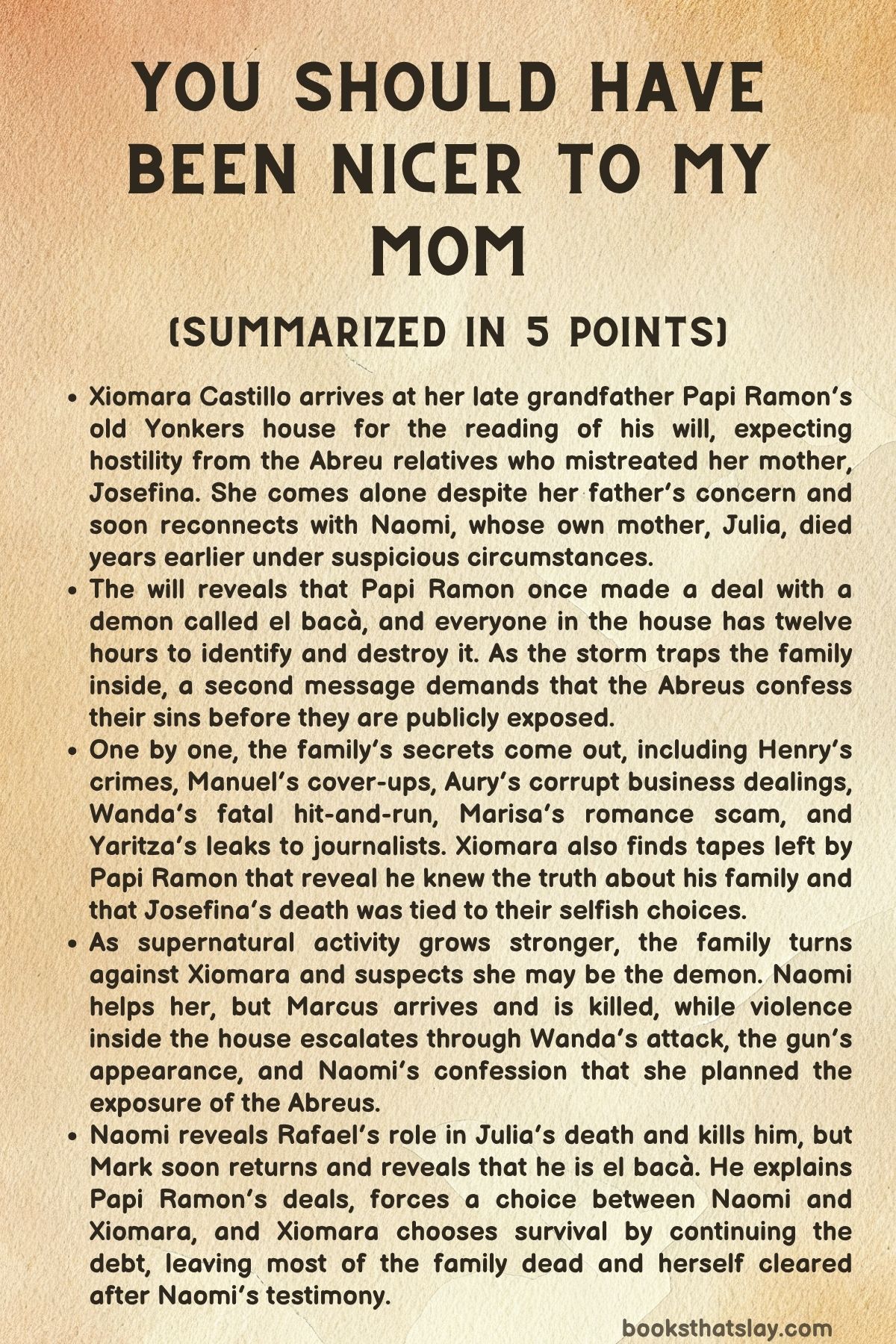
Summary
Xiomara Castillo comes to her late grandfather Papi Ramon’s old house in Yonkers for the reading of his will. The visit is painful before it even begins.
Her mother, Josefina, is dead, and Xiomara knows that Josefina’s side of the family, the Abreus, never treated her with love or respect. They spent years insulting her, blaming her, and spreading ugly stories about her even after her death.
Xiomara’s father wants to come with her for support, but she refuses. She feels that this is something she must face alone, even though she dreads being around the people who caused her mother so much pain.
The house itself feels rotten, both physically and emotionally. It is old, damaged, and full of the kind of silence that suggests too much has happened there.
Xiomara sees relatives she would rather avoid: her aunts Aury and Marisa, her uncles Rafael and Manuel, and her cousins Yaritza, Henry, and Wanda. She also reconnects with Naomi, a childhood friend whose presence brings back memories of a different time.
Naomi is the daughter of Julia, who once worked as Papi Ramon’s housekeeper. Julia died years earlier in what was described as a break-in, but even from the beginning, the past around her death feels unfinished.
The family waits as rain worsens outside. The storm grows severe enough to trap them in the house, turning the gathering into something closer to a confinement.
At last, Mark McClaren arrives. He is the son of Papi Ramon’s lawyer, who has been hospitalized, and he reads the will in his father’s place.
The family expects money, property, and arguments over inheritance. Instead, Papi Ramon’s message is a warning.
The will claims that long ago, Papi Ramon made a deal with a demon known as el bacà. The demon has protected the family’s wealth and property, but now the bargain has reached a dangerous point.
Someone in the house is connected to the demon, and the family has only twelve hours to find and destroy it. The instructions are strange and specific: stab the demon in the chest, say its name, and end the bloodline covenant.
Soon after, a second message arrives, demanding that the Abreus confess their sins before those sins are exposed.
The night becomes a forced reckoning. As the storm cuts them off from help, secrets begin to come out one by one.
Henry is exposed as having been accused of sexual assault and trafficking women. Manuel’s image as a religious and respectable man falls apart when it is revealed that he embezzled church funds to protect his son and cover up Henry’s crimes.
The family tries to argue, deny, and redirect blame, but the house keeps pushing the truth into the open.
Aury’s life is also revealed to be built on corruption. Her company, Alluria, is exposed for selling dangerous products and possibly committing fraud.
Wanda’s secrets follow: she caused a fatal hit-and-run and had an abortion. These revelations bring anger, shame, and violence into the room.
The family members are not simply embarrassed; they are furious at being seen clearly. Marisa, who has been obsessively contacting a boyfriend, learns that he is not real.
The romance she believed in was part of an AI-generated scam. Yaritza is revealed as another source of betrayal in the family’s eyes because she has been communicating with journalists and giving them information.
While the Abreus fight among themselves, Xiomara follows clues left by Papi Ramon. She discovers cassette tapes hidden throughout the house.
Each tape is labeled for a family member, and together they show that Papi Ramon knew far more than anyone realized. Xiomara also finds the yellow Walkman from her childhood hidden inside the broken first stair.
The tapes suggest that the demon’s protection is tied to Abreu property, wealth, and inheritance. The family’s status is not clean or lucky; it has been guarded by something cruel.
Xiomara’s investigation also changes what she understands about her mother’s death. Josefina did not die because of a simple accident disconnected from the family.
The truth is more painful. The selfishness, neglect, and cruelty of her relatives helped create the situation that put Josefina on the road when she died.
Xiomara begins to see that her mother was not just mistreated in life; even the circumstances of her death were shaped by the Abreus’ failures. This knowledge deepens Xiomara’s rage and grief, and it makes the night feel less like a random horror and more like a long-delayed judgment.
As the hours pass, the house becomes increasingly hostile. There are sulfur smells, strange voices, distorted memories, and frightening visions.
The building seems alive with old wrongs. Reality begins to shift in ways that make it difficult to know what is true, what is supernatural, and what is being used to manipulate everyone inside.
The Abreus grow more suspicious of Xiomara. Since she is the outsider among them, and since so much of the night seems to center on her discoveries, they begin to wonder whether she may be the demon.
Naomi helps Xiomara escape from the family’s immediate anger, but the danger follows. Xiomara’s ex-boyfriend Marcus arrives outside the house because he has been worried about her.
His arrival offers a brief possibility of rescue or comfort, but the demon attacks from the house and kills him brutally. Marcus’s death is a turning point.
It proves that the threat is not symbolic and that anyone connected to Xiomara can be pulled into the cost of the Abreu bargain.
The violence inside the house escalates. Wanda attacks Xiomara with a hammer, convinced that Xiomara is evil.
Before Wanda can finish the attack, someone shoots her with Papi Ramon’s gun. Manuel is devastated by Wanda’s death, and Marisa lashes out at Xiomara.
Aury later fires the gun wildly, adding more chaos to an already broken night, before Xiomara manages to knock it away. Naomi then takes the weapon and reveals one of the night’s major truths: she wrote the confession letter.
She wanted the Abreus exposed. She wanted their secrets dragged into the open.
Naomi’s anger is not only about general injustice. She confronts Rafael and reveals that he was involved in Julia’s death.
Julia had discovered a hidden connection between herself, Naomi, and Ramon, something the family wanted buried. Rafael helped cover up what happened to Julia, protecting the Abreus yet again at the expense of someone vulnerable.
Naomi also admits that she was behind Marisa’s fake boyfriend, using the scam to get money and information. Her revenge has been planned, personal, and careful.
When she shoots Rafael and kills him, the night moves fully from exposure into punishment.
The final truth comes when Mark returns and reveals that he is el bacà. He explains the full nature of Papi Ramon’s bargain.
Ramon traded his soul for wealth, fame, and protection. Later, he made a second deal after young Xiomara fell from a window and died.
To save her, Ramon bound her survival to another debt. The demon has been waiting to collect.
Mark gives Naomi and Xiomara a terrible choice. Naomi can accept Ramon’s inheritance and the demon’s protection, but Xiomara will die as payment.
Or Naomi can refuse, and she will die instead. The bargain turns survival into a moral trap.
There is no clean rescue, no justice without cost, and no way to undo the old deal without someone paying for it.
Xiomara chooses to live. She chooses to “pay the debt forward,” accepting the brutal logic that has governed her family for years.
Instead of sacrificing herself, she turns the gun on the older Abreus. Her choice is shocking, but it is also rooted in everything the night has revealed.
The people around her built their lives on denial, exploitation, and cruelty. They helped destroy her mother and protected each other through crime after crime.
Xiomara refuses to be the final victim of their bargain.
After the storm-night tragedy, a later news report explains that nearly the entire family died. Xiomara survived, and Naomi’s testimony helped clear her of wrongdoing.
The public version can only describe a family disaster, but the truth is stranger and darker: the Abreus’ wealth and power were never free, and the cost finally came due. You Should Have Been Nicer to My Mom ends with Xiomara alive, but not untouched.
She has survived the house, the demon, and her family’s hatred, yet her survival comes through a choice that leaves her tied to the same cycle of debt, revenge, and power that ruined the people before her.
Characters
Xiomara Castillo
Xiomara Castillo is the central character of You Should Have Been Nicer to My Mom, and her role in the book is shaped by grief, suspicion, anger, and a painful need for truth. She enters Papi Ramon’s decaying house already burdened by years of family cruelty toward her dead mother, Josefina, and this emotional history makes her both defensive and determined.
Xiomara does not arrive as someone seeking reconciliation; she arrives as someone who knows the Abreus have never treated her or her mother fairly. Her decision to attend the reading of the will alone shows her independence, but it also shows how deeply personal this confrontation is for her.
She wants to face the family without protection because the wounds they caused belong to her as much as they belonged to Josefina.
As the book progresses, Xiomara becomes an investigator of both supernatural danger and family corruption. The tapes, the hidden Walkman, the hostile house, and the distorted memories all pull her deeper into a history that the Abreus have tried to bury.
Her search is not simply about finding el bacà; it is about understanding how greed, selfishness, and silence shaped her mother’s death. Xiomara’s strength lies in her refusal to accept the family’s version of events.
Even when the others begin to suspect her, attack her, or blame her, she continues moving toward the truth. This makes her one of the most emotionally resilient figures in the story, because she is surrounded by people who would rather preserve their lies than acknowledge her pain.
Xiomara is also morally complicated by the ending. For much of the book, she appears to be the victim of the Abreu family’s cruelty and the demon’s manipulations, but her final choice shows how trauma can transform into something darker.
When she chooses to live and “pay the debt forward,” she accepts a logic of survival that mirrors the very family legacy she has been fighting against. This does not erase her suffering, but it changes how the reader understands her.
Xiomara is not a simple heroine who escapes evil untouched. She is a character shaped by injustice, grief, and rage, and by the end of the novel, she becomes part of the same cycle of debt, violence, and inheritance that destroyed the Abreus before her.
Naomi
Naomi is one of the most layered characters in the book because she moves between the roles of friend, survivor, manipulator, and avenger. At first, her reunion with Xiomara seems awkward but familiar, suggesting a childhood bond that still carries emotional weight.
As the daughter of Julia, Papi Ramon’s former housekeeper, Naomi is connected to the Abreu household from the margins. She is close enough to know its secrets, but distant enough to be treated as disposable by the family.
This position gives her a powerful reason to resent the Abreus and to seek justice for what happened to her mother.
Naomi’s actions reveal that she is far more active in the unfolding events than she first appears. She writes the confession letter, exposes the Abreus’ sins, pretends to be Marisa’s fake boyfriend, and uses deception to gather money and information.
These choices make her morally complex. She is not innocent in a simple sense, because she manipulates others and contributes to the chaos inside the house.
However, her actions come from a place of grief and rage rather than shallow selfishness. Naomi understands that the Abreu family has survived by hiding the truth, so she uses secrecy against them.
Her manipulation becomes a weapon aimed at people who have long used power, money, and silence to protect themselves.
Naomi’s confrontation with Rafael is one of her defining moments because it reveals the depth of her pain. By exposing his involvement in Julia’s death and then killing him, Naomi becomes an agent of revenge rather than merely a victim of the past.
Her tragedy is that justice and vengeance have become almost inseparable for her. She wants the truth revealed, but she also wants the people responsible to suffer.
In the final bargain offered by el bacà, Naomi becomes a possible inheritor of Ramon’s wealth and protection, which places her in direct conflict with Xiomara’s survival. Naomi is ultimately a character who shows how the damage caused by the Abreus spreads beyond the bloodline and destroys even those who were forced to live in its shadow.
Papi Ramon
Papi Ramon is one of the most important characters in the story even though he is already dead when the central events begin. His presence controls the house, the will, the tapes, the secrets, and the curse that traps the family.
He is not merely a deceased patriarch whose property is being divided; he is the source of the family’s supernatural and moral corruption. By making a deal with el bacà for wealth, fame, and protection, Ramon turns his family legacy into something poisoned.
His success is built on a debt that others are eventually forced to pay.
Ramon is a deeply contradictory figure. On one hand, he appears to have understood the corruption of his relatives and deliberately left behind clues to expose them.
The tapes show that he knew far more than the family realized, and his planning suggests intelligence, guilt, and perhaps a desire to force a reckoning after his death. On the other hand, he is also responsible for the demon’s continued power.
His second deal to save young Xiomara after she fell from a window makes him more emotionally complicated, because that act can be read as love, guilt, selfishness, or all three at once. He saves Xiomara, but he does so by deepening the covenant and passing the consequences into the future.
Papi Ramon represents the destructive power of inheritance. His money, house, and reputation are not blessings; they are traps.
The Abreus gather expecting material gain, but what Ramon leaves behind is exposure, terror, and punishment. His legacy forces the family to confront the fact that their privilege has always carried a hidden cost.
In this sense, Ramon is both a villain and a judge. He created the evil that haunts the family, but he also arranges the conditions under which their sins can no longer remain hidden.
Josefina Castillo
Josefina Castillo is central to the emotional foundation of the book, even though she is dead before the main events unfold. She exists through Xiomara’s grief, the family’s insults, and the buried truth surrounding her death.
The Abreus’ treatment of Josefina reveals their cruelty long before the supernatural horror fully appears. They spread rumors, insult her memory, and refuse to honor the pain her death caused.
Because of this, Josefina becomes more than a lost mother; she becomes a symbol of the family’s ability to harm someone and then rewrite the story afterward.
Josefina’s death is especially important because it is not treated as a random accident once Xiomara begins uncovering the truth. The relatives’ selfishness and negligence contributed to the circumstances that placed Josefina on the road, meaning that the family’s guilt is not abstract.
They may not all have killed her directly, but their choices helped create the conditions of her death. This makes Josefina’s absence feel active throughout the story.
Her death is one of the buried sins that the house and the tapes force back into the open.
Josefina also shapes Xiomara’s identity. Xiomara’s anger, suspicion, and determination are all connected to her love for her mother and her refusal to let the Abreus’ version of events stand.
Josefina represents the person Xiomara is trying to defend, but she also represents everything the family tried to erase. Through her, the story shows how the dead can remain powerful when the living refuse to forget them.
Aury
Aury is one of the Abreu relatives whose public success hides serious corruption. Her company, Alluria, becomes a major part of the family’s unraveling when it is exposed for dangerous products and possible fraud.
This revelation shows that Aury’s sins are not limited to private cruelty or family drama. Her wrongdoing has a wider social impact because her business choices may have harmed people beyond the walls of the house.
She represents the kind of person who uses wealth, status, and corporate language to disguise irresponsibility.
Aury’s behavior during the storm reveals a character who is invested in control but becomes increasingly unstable as that control collapses. The exposure of Alluria strips away the polished image she likely depends on.
Like the other Abreus, she is forced to confront the difference between reputation and reality. Her later use of Papi Ramon’s gun shows how quickly fear and desperation turn into violence.
When the family’s secrets are no longer protected, Aury does not become honest or reflective; she becomes dangerous.
Aury’s role in the book demonstrates how greed can become institutional rather than merely personal. She is not only protecting herself but also protecting a brand, a company, and a version of success built on harm.
Her downfall fits the larger pattern of the Abreu family, in which every form of power has been corrupted by selfishness. Aury’s tragedy is that she has built her identity around achievement, but the story reveals that her achievement is rotten at the core.
Marisa
Marisa is a character defined by emotional need, denial, and humiliation. Her obsessive attempts to contact her supposed boyfriend suggest loneliness and desperation beneath whatever confidence she presents to the family.
The revelation that the boyfriend is fake and part of an AI-generated romance scam exposes her vulnerability in a particularly painful way. While many of the Abreus are exposed for crimes involving money, violence, or cover-ups, Marisa is exposed through emotional manipulation.
Her secret is not only embarrassing; it reveals how deeply she wanted to be loved or chosen.
Marisa’s situation makes her somewhat pitiable, but the book does not present her as harmless. Her later attack on Xiomara shows how quickly her pain turns outward.
Like many members of the family, she responds to humiliation not with self-awareness but with aggression. This makes her part of the larger Abreu pattern: when confronted with the truth, the family lashes out at whoever is most convenient.
Xiomara becomes a target because she is already positioned as an outsider and scapegoat.
Marisa’s character adds another dimension to the story’s exploration of deception. She is both deceived and deceptive, both victimized and cruel.
Naomi’s role in pretending to be her fake boyfriend also connects Marisa’s humiliation to the wider revenge plot against the Abreus. Through Marisa, the story shows that corruption does not always look powerful.
Sometimes it appears as emotional emptiness, vanity, and the refusal to accept reality.
Rafael
Rafael is one of the darkest figures in the Abreu family because of his connection to Julia’s death. For much of the story, his guilt remains hidden beneath the broader chaos of the family’s exposed sins.
When Naomi confronts him and reveals his involvement, his character becomes a symbol of the family’s willingness to erase people who threaten their secrets. Julia’s discovery of hidden truths made her dangerous to the Abreus, and Rafael helped cover up what happened to her.
This makes him not simply selfish or corrupt, but directly complicit in violence and concealment.
Rafael’s role is especially important because his crime reaches beyond the Abreu bloodline and harms those who served the family from a vulnerable position. Julia was Papi Ramon’s housekeeper, and her death being framed as a supposed break-in suggests how easily the family could manipulate narratives when the victim lacked their power.
Rafael represents the cruelty of people who assume they can decide whose life matters and whose death can be explained away.
His death at Naomi’s hands functions as one of the story’s clearest acts of revenge. Naomi does not kill him randomly; she kills him after naming what he helped do.
Rafael’s end shows that the sins buried by the family are not merely being revealed for emotional closure. They are returning with consequences.
As a character, Rafael embodies the violence hidden beneath respectability, and his exposure confirms that the Abreus’ corruption is much older and deeper than the storm-night revelations alone.
Manuel
Manuel is a character whose corruption is tied closely to family loyalty, hypocrisy, and the abuse of trust. His embezzlement of church funds to cover up Henry’s crimes reveals both moral failure and institutional betrayal.
By stealing from a church, Manuel violates a space that should represent faith, service, and accountability. By using that money to protect his son, he turns parental loyalty into something monstrous.
He does not help Henry become accountable; he helps him avoid consequences.
Manuel’s character shows how families protect abusive men by sacrificing truth and justice. His actions are not passive.
He actively participates in concealing Henry’s wrongdoing, which means he enables further harm. This makes him one of the clearest examples of how the Abreu family preserves itself through silence and money.
Manuel’s sin is not only that he loves his son too much; it is that he values his son’s reputation and freedom more than the lives of the people Henry harmed.
His reaction to Wanda’s death also adds emotional complexity. Manuel mourns her, showing that he is capable of grief and attachment, but that grief does not erase his corruption.
In the book, love within the Abreu family often appears distorted. They love their own, but that love becomes a justification for covering crimes, attacking outsiders, and refusing accountability.
Manuel is a strong example of this poisoned loyalty.
Henry
Henry is one of the most openly predatory characters in the story. The accusations against him involving sexual assault and trafficking women reveal a level of cruelty that is not merely personal weakness but systematic exploitation.
His crimes place him among the most morally repulsive figures in the family. Unlike characters whose secrets involve shame, fraud, or hidden resentment, Henry’s sins involve direct harm to vulnerable people.
Henry’s importance also lies in how others respond to him. Manuel’s embezzlement to cover up his crimes shows that Henry’s abuse is protected by family power.
He is not only an individual villain; he is the beneficiary of a system that shields him. The fact that the family’s wealth and influence can be used to silence or delay consequences makes Henry’s character especially disturbing.
He represents the kind of evil that survives because others find it convenient to protect it.
As a member of the younger generation, Henry also shows that the Abreu family’s corruption has not ended with the older relatives. The legacy of greed, entitlement, and moral rot has continued forward.
His presence proves that the family’s sins are not only inherited property or old secrets. They are behaviors and attitudes passed down, repeated, and defended.
Wanda
Wanda is a volatile and tragic figure whose secrets expose both guilt and desperation. The revelation that she caused a fatal hit-and-run and had an abortion leads to a violent family fight, showing how her private life becomes another battlefield for the Abreus’ judgment and rage.
Her hit-and-run marks her as someone who has caused irreversible harm and failed to take responsibility. At the same time, the exposure of her abortion suggests that the family’s cruelty extends into intimate, personal areas where shame is used as a weapon.
Wanda’s attack on Xiomara with a hammer shows how fear and suspicion push her into violence. She believes Xiomara is evil, but this belief also reflects the family’s tendency to turn against the outsider rather than examine themselves.
Wanda’s violence is not random; it grows from the panic inside the house and from the Abreus’ eagerness to locate evil anywhere except within their own choices. Xiomara becomes the easiest target because the family has already spent years treating her and her mother as problems.
Wanda’s death is one of the moments where the family’s collapse becomes physical and irreversible. Her life is marked by hidden guilt, and her end is marked by chaos.
She is not presented as innocent, but she is also not simply a monster. Wanda is a character whose fear, shame, and violence reveal how the family destroys its own members from within.
Yaritza
Yaritza is an important character because she breaks from the family’s pattern of silence by speaking to journalists and feeding them information. Her actions suggest that she recognizes, at least partly, the corruption around her and chooses exposure over loyalty.
In a family built on secrecy, this makes her dangerous. She understands that public truth can do what private confrontation cannot: strip the Abreus of the protection that wealth and reputation have given them.
Yaritza’s role is morally interesting because informing on the family can be read in more than one way. It may come from conscience, resentment, self-preservation, or a mixture of all three.
The book does not need to make her purely noble for her actions to matter. What matters is that she helps puncture the family’s carefully maintained image.
Her decision to share information contributes to the unraveling of Henry, Manuel, Aury, and the larger Abreu name.
As a younger family member, Yaritza also contrasts with Henry and Wanda. While they represent inherited entitlement, violence, or hidden guilt, Yaritza represents the possibility of refusing the family code.
However, her position remains complicated because she is still part of the same toxic environment. She does not stand completely outside the Abreu legacy, but she helps expose it.
That makes her one of the story’s quieter agents of consequence.
Mark McClaren / El Bacà
Mark McClaren is first introduced as the son of Papi Ramon’s hospitalized lawyer, but his final revelation as el bacà transforms his role completely. For most of the story, he appears to be connected to the will and the legal process, which gives him an air of authority and legitimacy.
This disguise is important because it reflects the demon’s method. El bacà does not enter the story only as a monstrous creature; it also operates through contracts, inheritance, bargains, and formal language.
The supernatural evil is tied to systems of property and power.
As el bacà, Mark represents the hidden cost of the Abreu family’s prosperity. He is not merely a monster attacking from outside the family.
He is the force that has been intertwined with their success for years. Ramon’s deal with him reveals that the family’s wealth and protection were never clean.
The demon’s demand for payment turns inheritance into a curse, making clear that every benefit gained through the covenant must eventually be answered for.
El bacà is especially frightening because he understands human weakness. He offers choices that are morally devastating, forcing Xiomara and Naomi into a situation where survival requires sacrifice.
His power comes not only from supernatural violence but from temptation, fear, and the logic of debt. In the world of You Should Have Been Nicer to My Mom, he is the embodiment of a bargain that turns love, ambition, and survival into forms of corruption.
Julia
Julia is a crucial figure because her death exposes how deeply the Abreu family’s secrets have harmed people outside the family. As Papi Ramon’s former housekeeper and Naomi’s mother, Julia occupied a vulnerable position in the household.
She was close enough to observe what the family wanted hidden, but she did not have the power or protection that the Abreus had. Her supposed death during a break-in is later revealed to be part of a larger cover-up, making her one of the clearest victims of the family’s corruption.
Julia’s importance lies in what she discovered. She learned that she and Naomi were tied to Ramon in a way the family wanted concealed.
This knowledge made her a threat, and the response to that threat was violence and erasure. Through Julia, the story shows how powerful families protect themselves by controlling the stories told about the people they harm.
Her death is not only a personal tragedy for Naomi; it is evidence of the Abreus’ willingness to destroy anyone who might expose them.
Even though Julia is absent from the main action, her memory motivates Naomi and shapes the revenge plot. Naomi’s grief, deception, and confrontation with Rafael all grow from the wound of losing her mother.
Julia therefore remains present through the consequences of what was done to her. Like Josefina, she is a dead mother whose story the living have tried to suppress, and whose truth returns with destructive force.
Marcus
Marcus is Xiomara’s ex-boyfriend, and his role in the story is brief but emotionally significant. His arrival outside the house shows that he still cares about Xiomara and is worried enough to come looking for her.
In a story filled with relatives who distrust, exploit, or attack one another, Marcus represents a more ordinary form of concern. His presence reminds the reader that Xiomara has a life beyond the Abreu family’s poisoned history.
His brutal death at the hands of the demon marks a turning point in the story’s violence. Until then, much of the horror is built through secrets, accusations, supernatural signs, and the growing hostility of the house.
Marcus’s death makes the danger unmistakably physical and immediate. It also deepens Xiomara’s trauma because someone who came for her sake is killed by the evil surrounding her family.
Marcus functions as collateral damage in a conflict he does not fully understand. He is not responsible for the Abreu covenant, Ramon’s bargains, or the family’s buried crimes, yet he becomes one of their victims.
His death shows that the consequences of the family’s corruption do not remain contained within the bloodline. The evil they have nurtured reaches outward and destroys people who simply get too close.
Xiomara’s Father
Xiomara’s father is a minor but meaningful presence because he offers a contrast to the Abreu family. He wants to accompany Xiomara to the will reading, which suggests care, protectiveness, and concern for her emotional safety.
Xiomara’s refusal to let him come shows her independence, but it also implies that she wants to face the Abreus on her own terms. Her father’s offer matters because it reminds the reader that Xiomara is not completely without love or support outside the house.
His character also helps clarify the emotional stakes of Xiomara’s choice. She enters the Abreu home alone not because no one cares about her, but because she feels this confrontation belongs to her.
Her father’s absence from the main events makes the house feel even more isolating. Without him, Xiomara is surrounded by people who either hate her, suspect her, or try to use her.
Although he does not play a major role in the storm-night events, Xiomara’s father represents the life she might have had away from the Abreus’ legacy. He belongs to the world of ordinary grief and family protection, while the house belongs to secrets, curses, and inherited violence.
His presence at the edge of the story makes Xiomara’s final transformation feel even more tragic, because it suggests she once had a path outside the family’s darkness.
Mark McClaren’s Father
Mark McClaren’s father, the hospitalized lawyer, is a small but functional figure in the story. His absence creates the opportunity for Mark to appear in his place and read the will, allowing el bacà to enter the family gathering under a believable identity.
Though the lawyer himself is not deeply developed, his role matters because it gives the demon a legal and social disguise. The family accepts Mark because he appears connected to an official process.
The lawyer’s connection to Papi Ramon also reinforces the importance of documents, inheritance, and contracts in the story. The will is not simply a legal document; it becomes the mechanism through which the family is forced into confession and confrontation.
By placing the lawyer’s son in the position of messenger, the plot blends ordinary legal procedure with supernatural manipulation.
As a character, Mark’s father is more important for what his position allows than for his own actions. He represents the formal world that surrounds wealth: lawyers, wills, estates, and controlled transfers of property.
The demon’s use of that world shows that the horror of the story is not separate from inheritance and ownership. It moves through them.
Themes
Inherited Guilt and Family Accountability
The story treats family history as something that cannot stay buried simply because older generations want silence. The Abreu family’s wealth, reputation, and social standing are all built on concealed harm, and each secret shows how wrongdoing spreads across time when nobody accepts responsibility.
Xiomara enters the house carrying grief for her mother, but she also enters a space where almost everyone has benefited from lies, cover-ups, or selfish choices. The will and the confession letter force the family to face what they have avoided for years, but their first instinct is not honesty.
They deny, blame, threaten, and attack anyone who brings the truth closer. This makes accountability feel less like a moral choice and more like a reckoning that arrives when people have delayed justice for too long.
The theme is powerful because guilt is not shown as one person’s burden alone. It becomes a family inheritance, passed down through money, silence, and protection.
In You Should Have Been Nicer to My Mom, the real horror comes from realizing that the family’s comfort has always depended on someone else’s suffering.
Greed and the Corruption of Love
Greed shapes the Abreu family’s relationships until love becomes almost impossible to separate from ownership, inheritance, and control. Papi Ramon’s deal with el bacà begins as a desire for success and protection, but it poisons the family structure that follows.
The relatives do not gather at the house out of tenderness or respect; they come because they expect property, money, or advantage. Their behavior shows how greed reduces family bonds into transactions.
Even grief is filtered through what each person might gain or lose. This corruption appears in the way the older Abreus protect reputations instead of victims, cover up crimes instead of correcting them, and treat Xiomara as an obstacle rather than as a grieving daughter.
The supernatural bargain only makes visible what already exists inside the family: a willingness to sacrifice others for comfort. Greed also distorts protection, because the family believes wealth can shield them from consequences.
By the end, the inheritance is not a blessing but a trap. The promise of power demands payment, proving that love cannot survive when family loyalty is used to excuse cruelty.
Grief, Memory, and the Search for Truth
Xiomara’s grief is tied to uncertainty, because her mother’s death has been surrounded by rumors, cruelty, and missing pieces. Her return to the house becomes more than a confrontation with relatives; it becomes an effort to recover the truth that was denied to her.
The tapes, the hidden Walkman, and the strange visions all connect memory to investigation. They show that the past is not gone just because people refuse to speak about it.
For Xiomara, learning the truth is painful because it confirms that her mother was failed by the very people who should have cared for her. Yet this knowledge also gives shape to her grief.
Instead of mourning inside a story controlled by the Abreus, she begins to understand the real causes behind her loss. The house itself seems to resist this process, twisting memory and creating fear, which suggests that truth is often hardest to reach in places built on denial.
This theme gives the horror emotional weight. The frightening events matter because they force buried memories into the open, allowing Xiomara to see her mother not as a rumor, but as someone deeply wronged.
Survival and Moral Compromise
Survival in the story is never simple or clean. Xiomara begins as someone trying to endure a hostile family gathering, but by the end, survival demands choices that damage her moral certainty.
The demon’s final bargain places her in a cruel position where living means accepting the logic of debt, sacrifice, and inherited violence. Her decision to live is understandable because she has already lost her mother, Marcus, her safety, and her trust in family.
Still, the choice also shows how trauma can push a person toward the same systems they once feared. Xiomara does not survive by remaining untouched by the house’s evil; she survives by agreeing to carry its consequences forward.
This makes her ending disturbing rather than victorious. The story refuses to present survival as pure triumph, because escaping death may still require emotional and moral cost.
Naomi’s role deepens this theme because she also acts from pain, revenge, and a desire for justice, yet her actions create more violence. Survival becomes a question of what a person is willing to become when every option has been shaped by other people’s sins.