To Cage a Wild Bird Summary, Characters and Themes
To Cage a Wild Bird by Brooke Fast is a dystopian novel about survival, guilt, rebellion, and the cost of freedom. Set in Dividium, a divided society where the poor are punished and the powerful treat cruelty as entertainment, the story follows Raven Thorne, a Lower Sector bounty hunter forced to face the consequences of the work she has done to keep her brother alive.
When her younger brother is sent to Endlock, a prison where inmates are hunted for sport, Raven must enter the very system she once fed. The book blends action, romance, and resistance as Raven learns what freedom demands.
Summary
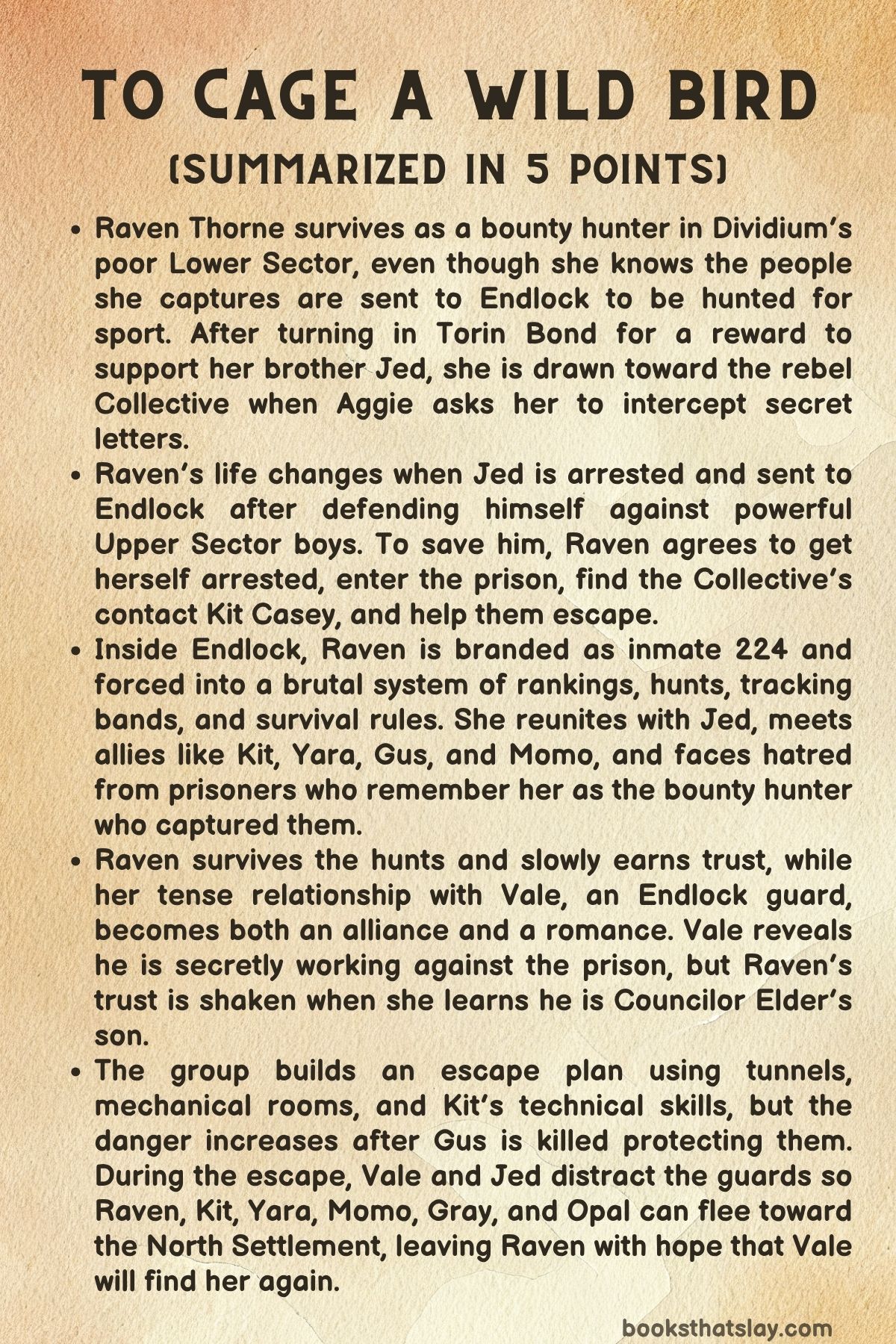
Raven Thorne lives in the Lower Sector of Dividium, a place marked by poverty, danger, and constant fear of the ruling powers. She survives by working as a bounty hunter, a job that brings money but also a heavy moral burden.
Every fugitive she catches is sent to Endlock, a brutal prison where citizens from the higher classes pay to hunt inmates for entertainment. Raven knows what happens to the people she turns in, but she continues because she has a younger brother, Jed, to protect and support.
In her world, survival often leaves little room for clean choices.
At the beginning of the story, Raven captures Torin Bond, a fugitive from the Upper Sector. Torin is not simply a poor criminal trying to escape the system.
He is a privileged man who caused another man’s death after framing his wife’s lover. Raven turns him in and receives a large reward, money she intends to use for Jed’s needs.
Even though Torin’s fate will be terrible, Raven convinces herself that he deserves punishment and that the reward is worth it.
After the capture, Raven goes to Vern’s Tavern, where she meets Aggie, an old family friend with ties to the rebel group known as the Collective. Aggie wants Raven to help intercept letters being sent by Councilor Elder to Endlock.
Raven refuses at first. She does not want to join the rebellion or become involved in something that could put Jed in even more danger.
She agrees to consider helping only if Aggie can keep Jed away from the Collective. Raven’s main concern is not politics.
It is keeping her brother alive.
That night, Raven meets Vale, a mysterious man searching for Eris Cybin, a rebel leader. Raven is drawn to him, and their first interaction carries tension and attraction.
When patrol guards threaten them, Vale helps her, but the moment also reveals that he has some kind of authority connected to Endlock. This makes Raven wary.
Endlock represents everything cruel and corrupt in Dividium, and anyone connected to it cannot be trusted easily.
The next morning, Raven’s life changes completely. Aggie tells her that Jed has been arrested.
Torin Bond’s son, along with Councilor Baskan’s son, attacked Jed at work. When Jed defended himself, the powerful families used the incident as revenge for Raven capturing Torin.
Jed is sent to Endlock. Raven’s worst fear has come true.
Her brother is trapped inside the prison where people are hunted for sport.
Aggie offers Raven a dangerous plan. Raven must get herself arrested and sent to Endlock on purpose.
Once inside, she must find Kit Casey, a Collective contact already imprisoned there, rescue Jed and Kit, and help them escape across the Wastes to the North Settlement. The mission is almost impossible, but Raven has no other way to save Jed.
She agrees. With Aggie’s help, she stages a theft so she will be arrested and placed on the next transport to Endlock.
When Raven arrives at Endlock, she is stripped of her identity and treated like property. She is processed, examined, branded as inmate 224, and assigned to the Lower level.
The experience is humiliating and frightening, but Raven does not allow herself to break. She soon discovers that Vale works as a guard at Endlock.
His presence unsettles her because he seems dangerous, yet he also appears to be watching over her in quiet ways. Raven cannot decide whether he is a threat, an ally, or something in between.
Inside the prison, Raven meets several important people. August, known as Gus, is a highly ranked prisoner with strength and influence.
Kit Casey is the Collective contact Raven was sent to find. Yara is a wealthy inmate with a sharp tongue and a careful mind.
Momo is a young boy protected by Gus. Raven also reunites with Jed and learns that he has already earned respect by standing up to Councilor Baskan’s son.
Seeing Jed alive gives Raven relief, but it also reminds her how dangerous Endlock is.
Raven’s past as a bounty hunter makes her a target. Many prisoners hate her because she captured people and sent them to Endlock.
One of them is Perri, a former criminal Raven once caught. Perri has Raven beaten, making it clear that Raven’s old choices have followed her inside the prison walls.
Yet Raven is not completely alone. Kit, Yara, Gus, and Momo begin to help her, even if trust comes slowly.
Raven is soon forced to take part in her first hunt. The rules of Endlock are designed to entertain the hunters and terrorize the inmates.
Prisoners are tracked through wristbands, controlled by force fields, and ranked according to survival. The Blood Tree serves as the safe point where surviving targets are collected.
Raven survives by working with Jed, Gus, and Momo. Her skills as a hunter now become the skills she needs to avoid being hunted.
As Raven continues to survive, she rises in rank and gains access to better conditions. Higher rank means better food, safer quarters, and more freedom inside the prison, but it does not mean real safety.
Warden Larch controls Endlock with cruelty and enjoys breaking prisoners who challenge him. When Raven defies him, he punishes her by locking her in solitary.
The experience is harsh, but Vale secretly helps her afterward. This becomes a turning point in their relationship.
Vale eventually reveals that he is working against Endlock from the inside. Raven still struggles to trust him, but his actions show that he wants to help.
Their connection deepens into romance, though it is shaped by secrecy, danger, and uncertainty. Vale tells Raven he wants to help her group escape and flee with them to the North Settlement.
Raven wants to believe him, but trust is difficult in a place built on betrayal.
The escape plan begins to take form. Kit’s technical knowledge becomes essential.
The group studies tunnels, mechanical rooms, ventilation routes, and security weaknesses. Raven, Jed, Kit, Yara, Gus, Momo, and Vale gather supplies and plan to disable the tracking system.
They decide to make their move during the full moon, when they have the best chance of crossing dangerous ground and moving through the forest.
During a hunt involving Councilor Elder, Raven discovers that Vale is Elder’s son. The revelation wounds her because Vale had hidden his connection to one of the powerful men tied to Endlock.
Raven feels deceived and wonders whether anything between them has been honest. The hunt itself turns tragic.
Gus is killed while protecting the others. His death devastates the group, especially Momo, and reminds everyone that Endlock takes lives even from those strong enough to survive again and again.
After Gus’s death, Raven must decide whether she can still trust Vale. Though his secret hurts her, his choices continue to prove that he is against Endlock and willing to risk himself for the prisoners.
Raven accepts that his identity does not erase what he has done to help them. The group grieves, but they cannot stop.
Their escape is now not only about survival but also about honoring those who have died trying to resist the prison’s cruelty.
On the night of the escape, Kit installs a device to help disable the system, and the group moves through the tunnels. Vale helps coordinate the plan from inside his position as a guard.
For a brief time, it seems they may succeed without being caught. Then Warden Larch discovers them.
The sedative meant to disable the guards does not fully affect him, and he takes Raven hostage. The escape turns chaotic as alarms begin to sound.
Momo acts with sudden courage and stabs Larch, while Yara helps restrain him. The moment gives the group a chance to keep moving, but the prison is now fully alerted.
Jed and Vale draw the guards away so the others can escape. Raven is forced to leave Vale behind, a painful choice that tests her more than almost anything else.
Their goodbye is brief and full of fear, but Vale promises he will find her.
Raven escapes with Jed, Kit, Yara, Momo, Gray, and Opal. They flee into the forest and reach the edge of the Wastes.
Their supplies are limited, and the journey ahead is dangerous, but for the first time they are outside Endlock’s walls. Raven has saved Jed, but the cost has been high.
Gus is dead, Vale is left behind, and the group must still cross harsh land to reach the North Settlement.
The story ends with Raven moving toward freedom while carrying grief, hope, and uncertainty. She is no longer only a bounty hunter trying to survive.
She has become someone willing to fight the system that once paid her. Her journey shows how survival can turn into resistance when love, guilt, and courage force a person to choose a different path.
To Cage a Wild Bird closes with Raven holding onto Vale’s promise and stepping into an unknown future with the people she has chosen to protect.
Characters
Raven Thorne
Raven Thorne is the central character of To Cage a Wild Bird, and her journey is shaped by survival, guilt, loyalty, and moral awakening. At the beginning of the book, she lives in the Lower Sector of Dividium and works as a bounty hunter, a role that immediately places her in a morally difficult position.
She knows that the fugitives she captures will be sent to Endlock, a brutal prison where inmates are hunted for sport, yet she continues because she is desperate to provide for her younger brother, Jed. This makes Raven neither simply heroic nor cruel; she is a character forced into harsh choices by an unjust world.
Her capture of Torin Bond shows her practical, hardened side, but the consequences of that act also expose the emotional cost of her work. Once Jed is arrested and sent to Endlock, Raven’s priorities become clearer.
Her love for her brother overrides fear, self-preservation, and even resentment toward the Collective, pushing her to enter the prison voluntarily.
Inside Endlock, Raven becomes a much more complex and sympathetic figure. She is forced to confront the hatred of prisoners who see her as part of the system that destroyed their lives, especially people like Perri.
This conflict is important because Raven cannot easily escape the harm she has caused. She must survive not only the hunts and the cruelty of the prison but also the consequences of her past.
Her growth comes from gradually shifting from someone who survives alone to someone who trusts, protects, and fights alongside others. Her relationships with Jed, Kit, Yara, Gus, Momo, and Vale reveal different parts of her character: her fierce protectiveness, her reluctance to be vulnerable, her capacity for loyalty, and her growing willingness to believe in rebellion.
Raven’s romance with Vale also challenges her guarded nature, especially when she learns he is Councilor Elder’s son. By the end of the story, Raven is no longer only a survivor.
She becomes a leader shaped by grief, courage, and hope, carrying both the memory of those lost and the promise of freedom ahead.
Jed Thorne
Jed Thorne is Raven’s younger brother and one of the main emotional forces behind the book. His arrest is the event that pushes Raven into Endlock, making him central to the plot even before he becomes fully active inside the prison.
Jed represents the family bond that Raven has been trying to protect through all of her difficult choices. Although Raven sees him as someone she must save, Jed proves that he is not helpless.
His conflict with Torin’s son and Councilor Baskan’s son shows that he has pride, courage, and a strong sense of self-respect. When he defends himself and is punished unfairly, the injustice of Dividium’s class system becomes even more personal.
Inside Endlock, Jed shows resilience and unexpected strength. He quickly earns respect after striking Councilor Baskan’s son, proving that he refuses to be intimidated even in a place designed to break people.
His relationship with Raven is deeply important because it reveals both affection and tension. Raven wants to protect him, but Jed also wants to prove that he can stand on his own.
This creates a believable sibling dynamic, where love is mixed with frustration, fear, and pride. Jed’s role in the escape further develops him from a vulnerable younger brother into a brave participant in the group’s survival.
When he and Vale lead the guards away so the others can flee, Jed shows real sacrifice and maturity. He becomes a symbol of the younger generation that the corrupt system tries to crush but cannot fully control.
Vale
Vale is one of the most mysterious and emotionally layered characters in the novel. When Raven first meets him, he appears charming, dangerous, and difficult to read.
His connection to Endlock immediately creates suspicion, especially because Raven has every reason to distrust anyone with power in such a cruel system. Vale’s early interactions with Raven are filled with tension because he seems to move between threat and protection.
This uncertainty makes him important not just as a romantic figure but also as a character who embodies hidden motives and divided loyalties.
As the story progresses, Vale becomes more clearly aligned against Endlock, though his secrecy continues to complicate Raven’s trust in him. His role as a guard gives him access and authority, but it also means he is surrounded by corruption and violence.
The revelation that he is Councilor Elder’s son makes his character even more complicated. He comes from the ruling world that Raven hates, yet he chooses to act against it.
This creates a conflict between birth and belief, privilege and conscience. Vale’s love for Raven is meaningful because it is tied to action rather than words alone.
He risks himself to help her and the others escape, and his final goodbye with Raven adds emotional weight to the ending. Vale remains a figure of hope and uncertainty, someone who has broken from his father’s world but must still prove that freedom is possible for himself as well.
Aggie
Aggie is an old family friend and a leader in the rebel Collective, making her a character connected to both Raven’s personal life and the larger resistance against Dividium’s ruling powers. She is practical, determined, and politically aware.
When she asks Raven to intercept Councilor Elder’s letters, she shows how deeply involved she is in the fight against Endlock and the Council. However, Raven’s refusal unless Aggie keeps Jed away from the Collective reveals the tension between personal protection and revolutionary commitment.
Aggie believes in resistance, while Raven initially wants only to keep her family safe.
Aggie’s importance grows when Jed is arrested. She becomes the person who offers Raven a desperate plan, showing both her resourcefulness and her willingness to take risks.
Her plan for Raven to enter Endlock is dangerous, but it is also the only real chance to save Jed and reach Kit Casey. Aggie’s character reflects the difficult moral choices of rebellion.
She is not portrayed as soft or sentimental; instead, she is strategic and focused on results. At the same time, her connection to Raven’s family gives her actions emotional depth.
She functions as a bridge between Raven’s private loyalty to Jed and the wider struggle against the system.
Torin Bond
Torin Bond is important because his capture sets off many of the consequences that follow. He is an Upper Sector fugitive who framed his wife’s lover and caused him to be killed, which presents him as selfish, manipulative, and morally corrupt.
Raven’s decision to turn him in for a reward seems practical at first, especially because she needs money to support Jed, but Torin’s status and family connections make the act far more dangerous than she realizes. Through Torin, the book shows how the crimes of the powerful are treated differently from the actions of the poor.
Torin also represents the entitlement of the Upper Sector. Even though he is guilty of terrible actions, his family still has influence, and that influence contributes to Jed being targeted.
His son’s attack on Jed, along with Councilor Baskan’s son, shows how revenge and privilege work together in Dividium. Torin himself may not remain the emotional center of the story, but his role is structurally important because he exposes how one act of bounty hunting can spiral into deeper injustice.
He is a reminder that Raven’s world punishes the powerless more severely than the guilty powerful.
Kit Casey
Kit Casey is one of the most valuable members of the prison group because of his knowledge, technical skill, and connection to the Collective. He is the person Raven is sent to find inside Endlock, which makes him essential to the escape plan from the beginning.
Kit is not simply a prisoner waiting to be rescued; he is an active thinker whose understanding of the prison’s systems gives the group a real chance of survival. His knowledge of devices, tunnels, mechanical rooms, ventilation routes, and tracking systems makes him one of the most practical and intelligent characters in the story.
Kit’s character also represents the importance of quiet resistance. Unlike characters who fight through physical strength or bold confrontation, Kit fights through planning, patience, and technical ability.
He understands that escaping Endlock requires more than courage. It requires precision, timing, and trust.
His role in installing the device during the escape shows how essential he is to the group’s success. Kit’s presence also deepens the Collective’s role in the book, showing that rebellion depends on people with different kinds of strength.
He is a reminder that intelligence and preparation can be just as powerful as weapons.
Yara
Yara is a wealthy, sharp-tongued inmate whose presence adds wit, confidence, and emotional complexity to the prison group. At first, her background may seem to separate her from prisoners like Raven, Jed, and Momo, but Endlock reduces all inmates to targets regardless of where they came from.
Yara’s wealth and social confidence do not protect her from danger, yet they shape how she speaks and carries herself. She is bold, observant, and often cutting in her remarks, but beneath her sharpness is loyalty.
Yara’s development is significant because she becomes part of Raven’s trusted circle. She helps Raven when many others hate her for being a bounty hunter, showing that Yara is capable of judging people by their present choices rather than only their past.
Her courage becomes especially clear during the escape when she restrains Larch after Momo stabs him. This moment shows that Yara is not merely sarcastic or privileged; she is decisive under pressure.
Her character brings balance to the group by combining intelligence, attitude, and bravery. She represents someone who may come from comfort but is still capable of sacrifice and solidarity.
August “Gus”
August, known as Gus, is one of the strongest and most respected prisoners in Endlock. As a top-ranked inmate, he understands the prison’s rules, dangers, and survival strategies better than most.
His rank gives him status, but what makes him memorable is how he uses that status. He protects Momo and later helps Raven, showing that his strength is not selfish.
In a prison designed to turn inmates against one another, Gus chooses loyalty and care, which makes him morally powerful.
Gus is also important because he teaches Raven and the others how to survive the hunts. He understands Endlock’s ranking system, hunting grounds, and brutal logic, and his experience gives the group a better chance.
His bond with Momo reveals his gentler side and makes his death especially painful. When Gus is killed during the hunt involving Councilor Elder, his loss becomes one of the most tragic moments in the book.
His death is not meaningless because it strengthens the group’s determination to escape, but it also shows the terrible cost of resisting Endlock. Gus represents courage, protection, and sacrifice in a world that tries to make compassion impossible.
Momo
Momo is a young boy in Endlock, and his presence highlights the cruelty of the prison more sharply than almost any other character. The fact that a child is trapped in a place where people are hunted for sport shows how completely corrupt the system has become.
Momo is protected by Gus, and their bond gives the story emotional tenderness amid violence. He represents innocence, vulnerability, and the need for protection, but he is not only a helpless figure.
Momo’s courage becomes clear during the escape when he stabs Larch to protect Raven and the group. This action is shocking because of his youth, but it also shows how Endlock forces even children into violent choices.
Momo’s character therefore carries both innocence and trauma. He should never have had to become brave in that way, yet his bravery helps save the others.
His journey toward the North Settlement with Raven’s group suggests the possibility of a future beyond violence, even though he has already been deeply marked by it. Momo is one of the clearest examples of what the group is fighting to protect.
Perri
Perri is a former criminal whom Raven once captured, and she becomes one of Raven’s most direct enemies inside Endlock. Her hatred of Raven is personal and understandable within the world of the book.
To Perri, Raven is not simply another inmate; she is the person who helped deliver her into a prison where survival depends on being hunted and ranked. This makes Perri’s anger more than simple cruelty.
It is rooted in betrayal, suffering, and revenge.
At the same time, Perri’s actions reveal how Endlock turns pain into violence. By having Raven beaten, she repeats the brutality of the system rather than escaping it.
Perri functions as a dark reflection of what Raven might become if guilt, anger, and survival instinct fully replaced compassion. Her presence forces Raven to face the consequences of her former work as a bounty hunter.
Perri is not the main villain, but she is important because she makes Raven’s past impossible to ignore. Through her, the story shows that survival choices can leave lasting wounds on others.
Warden Larch
Warden Larch is one of the clearest human faces of Endlock’s cruelty. He represents institutional violence, control, and sadism.
His power over the inmates is not only physical but psychological. By branding prisoners, enforcing punishment, controlling their conditions, and overseeing the prison’s brutal structure, he helps maintain a system that treats people as entertainment for the powerful.
His punishment of Raven, especially when he locks her in solitary, shows his need to dominate anyone who resists him.
Larch’s role during the escape confirms his danger. Even after the guards are supposed to be disabled, he resists the sedative and takes Raven hostage, proving that he is both physically threatening and obsessively committed to control.
His confrontation with the group becomes a final expression of the prison’s cruelty trying to stop their freedom. Momo stabbing him and Yara restraining him are significant because they show the prisoners fighting back against the authority that has terrorized them.
Larch is not morally conflicted like some other characters. He is a symbol of the system at its most brutal and corrupt.
Councilor Elder
Councilor Elder is an important figure because he connects the political power of Dividium to the cruelty of Endlock. His letters, his involvement with the prison, and his participation in the hunt show that the violence of Endlock is not hidden from the ruling class.
It is supported and enjoyed by them. Elder represents the kind of authority that turns suffering into sport while maintaining the appearance of respectable power.
The revelation that Vale is Elder’s son adds emotional and moral complexity to the story. Elder becomes more than a distant political figure; he becomes part of Vale’s personal conflict and Raven’s struggle to trust him.
Through Elder, the book explores inherited privilege and the possibility of rejecting one’s family’s corruption. Elder’s role in the disastrous hunt that leads to Gus’s death makes him directly tied to the group’s grief.
He stands for the ruling class’s arrogance and cruelty, and his presence makes the escape feel not only like a personal rescue mission but also an act of rebellion against the powerful.
Councilor Baskan
Councilor Baskan is significant because his family’s influence contributes to Jed’s unjust imprisonment. His son’s attack on Jed, followed by Jed being punished for defending himself, shows how power protects the privileged and condemns the poor.
Baskan’s importance lies in what he represents: a ruling class that can twist justice into revenge. Even when the wealthy or well-connected are responsible for violence, the system bends in their favor.
Through Baskan, the story emphasizes the corruption of Dividium’s legal and social order. Jed’s arrest is not fair punishment; it is retaliation connected to Raven’s capture of Torin and the anger of powerful families.
Baskan’s role may be less direct than Larch’s or Elder’s, but his influence is part of the same structure. He represents the political corruption that feeds Endlock by sending vulnerable people into its control.
Eris Cybin
Eris Cybin is the rebel leader Vale is searching for, and even though this character is not as directly present as others, the name carries weight within the world of the book. Eris represents organized resistance and the threat that rebellion poses to the ruling powers.
The fact that Vale is looking for Eris connects him to the political conflict beneath the surface of his first meeting with Raven. This makes Eris important as part of the larger struggle against Dividium and Endlock.
Eris also helps expand the story beyond Raven’s immediate mission to save Jed. The mention of a rebel leader reminds readers that Raven’s personal crisis is part of a wider movement.
The Collective is not merely a background group; it is connected to real efforts to challenge the system. Eris therefore functions as a symbol of resistance, secrecy, and hope.
Even without being one of the most developed figures, Eris helps show that the fight against Endlock existed before Raven entered it and will likely continue beyond the ending.
Gray
Gray is one of the people who escapes with Raven’s group, and his presence near the end of the story helps show that the escape is not only about Raven and Jed. Other prisoners also need freedom, and Gray’s inclusion widens the emotional and moral scope of the journey.
He represents the many lives trapped inside Endlock, each with their own fear, suffering, and hope for survival.
Although Gray is not developed as deeply as the central group members, his survival matters because the escape becomes a collective act rather than an individual rescue. His presence in the forest and at the edge of the Wastes reinforces the idea that freedom requires cooperation.
Gray’s character helps show that Endlock’s victims are not nameless background figures. Even those with smaller roles are part of the human cost of the prison’s cruelty.
Opal
Opal, like Gray, is part of the group that escapes into the forest and begins the journey toward the North Settlement. Her role is smaller, but she adds to the sense that the escape has consequences beyond Raven’s immediate circle.
Opal’s presence shows that the desire for freedom spreads across different prisoners and that the group’s success matters to more than just the main characters.
Opal also helps strengthen the ending’s feeling of fragile hope. The journey across the Wastes is dangerous, and survival is not guaranteed, but her escape from Endlock means the prison has failed to completely contain its victims.
She represents the possibility of a new beginning after captivity. In To Cage a Wild Bird, even smaller characters like Opal contribute to the broader message that freedom is worth pursuing, even when the path forward is uncertain.
Themes
Survival and Moral Compromise
Raven’s life in the Lower Sector is shaped by poverty, danger, and impossible choices. Her work as a bounty hunter gives her money to protect Jed, but it also makes her part of a cruel system that sends people to Endlock.
This creates a strong moral conflict because Raven is not simply good or bad; she is someone forced to survive inside a society that punishes weakness. Her decision to capture fugitives is practical, but it carries emotional weight once Jed becomes a victim of the same system.
Endlock makes this theme even stronger because survival there requires quick thinking, alliances, violence, and emotional control. Raven must learn that staying alive is not only about physical strength but also about deciding what kind of person she wants to be while facing fear, guilt, and loss.
Her journey shows that survival can damage a person, but it can also push them toward courage and change.
Injustice and Abuse of Power
Dividium is built on unfairness, with the Upper Sector holding wealth, comfort, and political control while the Lower Sector lives under pressure and fear. Endlock is the clearest symbol of this injustice because it turns prisoners into entertainment for the powerful.
The prison is not designed for justice or reform; it exists to satisfy the cruelty of citizens who can pay to hunt human beings. Jed’s arrest proves how easily power can be misused, since he is punished not because he deserves it but because influential people want revenge.
Warden Larch also represents institutional cruelty, using punishment, humiliation, and control to break prisoners down. Through these events, the story shows how corrupt systems protect the powerful and silence the weak.
The unfairness is not accidental; it is organized, legal, and accepted by society, which makes Raven’s resistance feel necessary rather than rebellious for its own sake.
Loyalty, Found Family, and Sacrifice
Raven’s strongest motivation is her loyalty to Jed, and that bond drives nearly every major choice she makes. She is willing to enter Endlock because saving her brother matters more to her than her own safety.
However, the story gradually expands loyalty beyond blood. Inside Endlock, Raven forms bonds with Kit, Yara, Gus, Momo, and Vale, and these relationships become essential to her survival.
At first, many prisoners distrust her because of her past as a bounty hunter, but shared danger slowly creates trust. Gus’s protection of Momo and his death during the hunt show how love and responsibility can exist even in a place designed to destroy compassion.
Vale’s choices also reflect sacrifice, since he risks his position and safety to help the group escape. The theme shows that family is not only inherited; it can be built through trust, shared suffering, and the willingness to protect one another at great cost.
Freedom and Resistance
Freedom is presented as more than escape from a physical prison. Raven and the others want to leave Endlock, but they are also fighting against a world that has decided they are disposable.
The tracking wristbands, rankings, force fields, guards, and hunts all represent systems meant to control bodies and crush hope. The escape plan becomes an act of resistance because it challenges the belief that prisoners have no future beyond being hunted.
Raven’s growth is closely tied to this theme. She begins as someone trying to protect only Jed, but her time in Endlock forces her to see the wider cruelty around her.
By joining with others and trusting the Collective’s mission, she moves from personal survival toward collective resistance. The journey toward the North Settlement is uncertain, but it represents the possibility of a life not ruled by fear.
Freedom, in this sense, is both a destination and a choice to keep resisting.