Under Water Summary, Characters and Themes
Under Water by Tara Menon is a novel about survival, memory, guilt, and the long reach of loss. Set between New York in 2012 and Thailand before and after the 2004 tsunami, the book follows Marissa, a young woman who has built a life around avoidance while still carrying the disaster inside her.
Her work at a luxury travel magazine forces her to sell perfect images of beaches, though she knows how violent and unforgiving the sea can be. Through Marissa’s memories of her childhood, her friendship with Arielle, and her return to the place that shaped her, Under Water examines how grief can remain unfinished until it is faced.
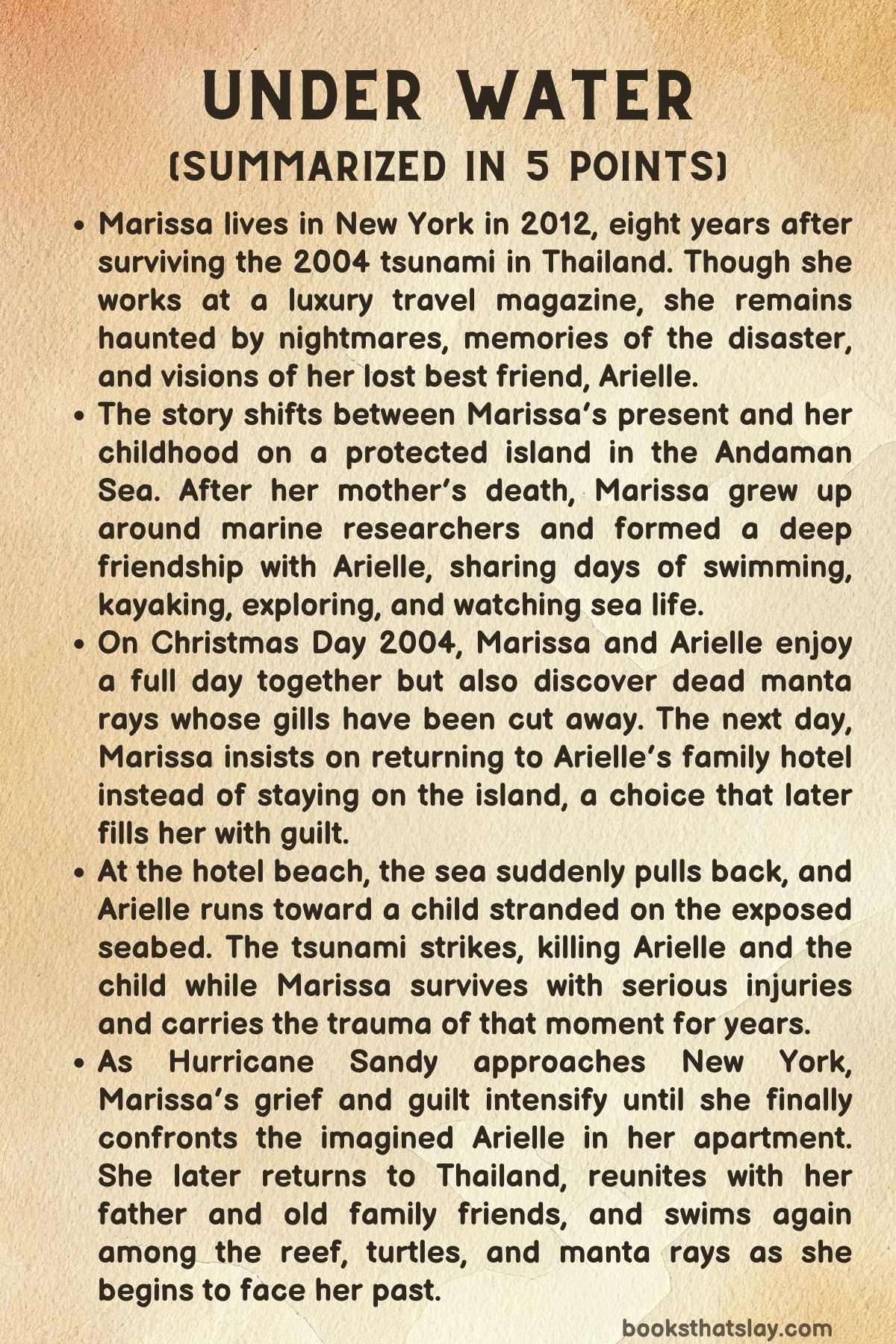
Summary
Under Water follows Marissa, a young woman living in New York in 2012, eight years after surviving the 2004 tsunami in Thailand. On the surface, her life appears orderly and adult.
She works as an editorial assistant at a luxury travel magazine, producing elegant copy about beaches, resorts, and dream vacations for rich readers. Yet her private response to these places is very different.
While her job requires her to make coastlines sound inviting and safe, she collects darker, truer images of them, as if trying to correct the false beauty she is paid to create. The sea, for her, is not a symbol of escape.
It is the place where her childhood ended.
As Hurricane Sandy approaches New York, Marissa moves through the city in a restless state. The storm outside seems to answer the storm inside her.
She walks through Central Park, rides the subway, visits the Hudson River waterfront, enters a bookstore, and goes to a restaurant. Everywhere she goes, she notices signs of danger, decay, and death: animals behaving strangely, strangers preparing for bad weather, warnings about the coming hurricane, and small reminders that the natural world cannot be controlled.
Her mind keeps returning to Arielle, her childhood best friend, who died in the tsunami. Arielle appears to Marissa as a haunting presence, not only as a memory but almost as a companion, a voice, and an accusation.
The novel moves between Marissa’s present in New York and her past in Thailand. Marissa’s childhood was marked early by loss.
Her mother died in a car accident when Marissa was six, leaving her father, Isaiah, to raise her. After the death, Isaiah took Marissa to a small protected island in the Andaman Sea, where Annie Watkins, a marine biologist, ran a research station.
The island became Marissa’s home. She grew up surrounded by adults who studied and documented the natural world: Isaiah, Annie, the photographer Matthew, the journalist David, and visiting researchers who came and went.
This childhood was unusual, rich in freedom, and deeply connected to the sea.
At school, Marissa met Arielle. Arielle’s parents owned a hotel, and Marissa often stayed there during the school week.
On weekends and holidays, she and Arielle returned to the island. Their friendship became the center of Marissa’s young life.
The girls swam, kayaked, explored the forest, watched birds and turtles, and spent time around the research station. They learned the moods of the water and the island.
They shared books, secrets, adventures, and the easy closeness of children who feel almost like one person. Arielle was brave, curious, and alive to the world around her.
To Marissa, she was more than a friend; she was family.
The days before the tsunami are remembered with painful clarity. On Christmas Day 2004, Marissa and Arielle spend the day in the way they often do: swimming, reading, exploring mangroves, visiting the treehouse at the research station, going to the hotel, stealing drinks from tourists, swimming out to a buoy, and later spending time with friends.
The day carries the brightness of childhood adventure, but it also contains signs of violence. The girls find three dead manta rays on the beach.
Their gills have been cut away, evidence of poaching. The bodies of the rays disturb them, showing that even their protected world is not safe from greed and destruction.
The next day, Arielle wants to stay on the island and dive with the adults. Marissa wants to go back to the hotel instead.
She sulks until Arielle gives in. This choice becomes the wound Marissa cannot stop touching in memory.
Because Marissa insisted, Arielle returned to the hotel. Because Arielle returned to the hotel, she was on the beach when the sea began to withdraw.
At first, the strange retreat of the water is confusing. The seabed is exposed, and people are drawn toward it.
Arielle recognizes that something is wrong. She sees a small child in a pink hat out on the emptied seabed and runs toward the child.
Marissa calls after her, but Arielle keeps running. Then the tsunami arrives.
Marissa watches the water take Arielle and the child. The wave catches Marissa too, hurling her into darkness filled with debris, bodies, and broken pieces of the world she knew.
She is badly injured but survives. Strangers carry her, and she eventually reaches a hospital.
She searches for Arielle, desperate for news, but Arielle is never found.
The disaster changes everything. Arielle is gone.
David is killed. Isaiah, Annie, Matthew, and Anurak survive, but survival does not restore what has been lost.
For Marissa, the central fact of her life becomes not only that Arielle died, but that Arielle died after following Marissa back to the hotel. Marissa cannot forgive herself.
She cannot accept that the tsunami was beyond her control. Instead, she shapes the event into a private punishment: Arielle would be alive if Marissa had not insisted on leaving the island.
Years later in New York, Hurricane Sandy forces these buried feelings closer to the surface. Marissa walks through the city as the weather worsens, drawn toward danger rather than away from it.
She buys paint, checks into the Soho Grand Hotel, notices a man reading Moby-Dick, and has sex with him. The encounter does not free her from herself.
Instead, her actions show how disconnected she has become from her own body and from ordinary ideas of safety. She is almost daring the storm to reach her.
Later, Marissa goes out into the dangerous weather and is picked up by the police, who take her home. Alone in her apartment, she begins painting her walls.
The act is frantic and physical, as if she is trying to cover over the space she lives in or force some change onto her life. Arielle appears again in Marissa’s mind, and their imagined argument becomes the emotional center of the novel.
Marissa lashes out at Arielle, accusing her of not swimming out of the wave, of not surviving. But beneath that anger is the truth Marissa has avoided for eight years.
She does not really blame Arielle. She blames herself.
Marissa finally breaks down and admits the guilt she has carried since the tsunami. Arielle returned to the hotel because Marissa wanted to go back.
Arielle died after making that choice for Marissa. This confession does not erase the past, but it allows Marissa to name the pain that has trapped her.
For years, she has lived as if she were still inside the wave, dragged through memory, unable to surface. Speaking the truth marks the beginning of a return.
When Marissa wakes, she imagines Arielle telling her to come home. The message sends her back to Thailand for the first time in eight years.
Anurak brings her by boat to the rebuilt island. Isaiah, Annie, and Matthew are there to welcome her.
Her father has prepared her old room, preserving books and a photograph of Marissa and Arielle. The room is not only a reminder of the past; it is also an invitation to belong again.
Marissa takes Arielle’s red kayak to their old beach. She dives into the reef and swims among fish, turtles, and three familiar manta rays.
Underwater, she returns to the world that once held both joy and catastrophe. The sea remains dangerous, but it is also alive, beautiful, and part of her.
As Marissa stays beneath the surface with the manta rays for as long as she can, the novel closes on a moment of release. She has not forgotten Arielle, and she has not escaped grief.
But she has come back to the place she feared, faced the memory she avoided, and begun to understand that surviving does not have to mean remaining frozen in the moment of loss.
Characters
Marissa
Marissa is the central character of Under Water, and her life is shaped by survival, grief, guilt, and the long afterlife of trauma. In 2012, she appears outwardly functional: she lives in New York, works as an editorial assistant at a luxury travel magazine, and produces polished descriptions of beaches and resorts for wealthy readers.
Yet this professional role sharply contrasts with her inner reality, because beaches and tropical landscapes are not places of pleasure for her but reminders of catastrophe. Her private habit of collecting darker, more truthful images of the places she is expected to romanticize reveals her divided mind.
She understands beauty, but she cannot separate it from danger, loss, and death. This makes her a deeply conflicted character, caught between the commercial language of escape and the private memory of destruction.
Marissa’s emotional life is dominated by the 2004 tsunami and especially by the death of Arielle, her childhood best friend. Her visions and arguments with Arielle show that Arielle remains psychologically present, almost as if Marissa has never fully accepted her death.
Marissa’s guilt is not simple grief; it is tied to the belief that her own sulking caused Arielle to return to the hotel, placing her in the path of the wave. This guilt explains why Marissa is restless, self-punishing, and drawn toward danger as Hurricane Sandy approaches.
Her movement through New York during the storm mirrors her emotional state: she is surrounded by warnings, rising water, animals, strangers, and signs of death, but she keeps moving toward risk instead of safety. Her encounter with the man at the hotel and her later wandering into dangerous weather suggest a character trying to numb herself, test her own survival, or recreate the conditions of disaster in a way she can finally confront.
Marissa’s return to Thailand at the end of the story marks a quiet but significant emotional shift. She does not erase her guilt or recover in a simple way, but she begins to face the place she has avoided for eight years.
Her old room, the photograph of herself and Arielle, the red kayak, the reef, the turtles, and the manta rays all reconnect her with a life that existed before trauma hardened into isolation. By diving underwater and staying among the sea creatures as long as she can, Marissa briefly enters the world that once gave her wonder rather than terror.
She remains a wounded character, but her return suggests that healing begins when she stops fleeing both the island and her own memories.
Arielle
Arielle is one of the most important emotional forces in the book, even though she dies in the tsunami. She is Marissa’s childhood best friend, and their relationship is built on closeness, adventure, and shared freedom.
Arielle’s family hotel gives Marissa a second home during school weeks, while the island gives both girls a place of exploration and wonder. Together they swim, kayak, read, wander through forests, watch birds and turtles, and study marine life.
Arielle represents the part of Marissa’s childhood that was vivid, fearless, and deeply connected to the natural world. Because of this, her death is not only the loss of a friend but also the loss of an entire version of Marissa’s life.
Arielle is portrayed as perceptive, brave, and instinctively compassionate. When the sea withdraws before the tsunami, she understands that something is wrong before many others do.
Her decision to run toward the small child in the pink hat shows her moral courage. She does not think first of self-preservation; she moves toward someone more vulnerable.
This moment makes her death especially painful because it is connected to an act of protection. Arielle’s final action defines her as someone whose courage is immediate and physical, not abstract.
She sees danger and responds with urgency.
In Marissa’s adult life, Arielle becomes both memory and imagined presence. The Arielle Marissa sees and argues with is not simply the real Arielle but also a projection of Marissa’s guilt, anger, longing, and unresolved grief.
Marissa’s accusation that Arielle should have swum out of the wave reveals how grief can become irrational and cruel when it has nowhere else to go. Yet Arielle’s imagined invitation for Marissa to come home also becomes part of Marissa’s movement toward healing.
Arielle remains the emotional center of Marissa’s past, and her absence shapes nearly every important choice Marissa makes.
Isaiah
Isaiah, Marissa’s father, is a figure of love, survival, and quiet endurance. After the death of Marissa’s mother in a car accident, he takes Marissa to the protected island in the Andaman Sea, where a new life slowly forms around the research station.
This decision shows him as a father trying to rebuild after loss, not by forgetting grief but by creating a world where his daughter can grow within nature, community, and purpose. His move to the island suggests both escape and renewal.
He cannot restore Marissa’s mother, but he can offer Marissa a childhood filled with the sea, animals, learning, and chosen family.
Isaiah’s importance lies partly in his steadiness. In a story filled with overwhelming water, sudden death, and emotional instability, he represents a form of grounded love.
He survives the tsunami, but survival does not free him from loss; he has to live with the death of David, the disappearance of Arielle, and the emotional distance of his own daughter. Marissa’s long absence from Thailand implies that Isaiah has also endured years of separation from her.
His preparation of her old room when she returns shows patience rather than pressure. He has preserved a place for her, including her books and the photograph of Marissa and Arielle, as if waiting for the moment when she might be ready to come back.
Isaiah’s role is not dramatic in the same way as Marissa’s or Arielle’s, but he is essential to the emotional structure of the story. He embodies the possibility that love can remain available even after silence, distance, and trauma.
His welcome does not demand that Marissa explain everything. Instead, it gives her the safety she needs to re-enter the past.
Through Isaiah, the book shows that healing often depends on the quiet presence of people who keep a place open for the wounded.
Annie Watkins
Annie Watkins is the marine biologist who runs the research station on the island, and she represents scientific care, ecological awareness, and maternal steadiness. As the person responsible for the station, Annie helps create the environment in which Marissa grows up after her mother’s death.
She is connected to the sea not as a tourist fantasy but as a living system that requires study, respect, and protection. Her presence gives the island a sense of purpose.
The children’s experiences with turtles, manta rays, forests, reefs, and birds are not just adventures; they are part of a larger world of observation and responsibility shaped by Annie’s work.
Annie also functions as part of Marissa’s extended family. Although she is not Marissa’s mother, she belongs to the circle of adults who help raise and guide her.
The island community becomes a substitute family after Marissa’s early loss, and Annie’s role within that community is nurturing without being sentimental. Her work with marine life also deepens one of the book’s central contrasts: the sea is both beautiful and dangerous, both a source of wonder and a force of death.
Annie understands the sea through knowledge and care, while Marissa later experiences it through trauma. This difference makes Annie’s world especially important when Marissa returns, because it reminds her that the ocean was not always only the place that took Arielle away.
Annie’s survival after the tsunami gives her a continuing role in the rebuilt island. When Marissa returns years later, Annie is part of the welcome that helps restore Marissa’s connection to home.
She represents continuity after devastation. The research station, the reef, and the remembered marine life all carry Annie’s influence, and through her the story suggests that care for the natural world can also become a way of caring for damaged human lives.
Matthew
Matthew is the photographer connected to the island community, and his role is closely tied to memory, image, and witness. As a photographer, he belongs to the world of looking carefully, preserving moments, and giving shape to what might otherwise disappear.
This makes him an important counterpart to Marissa, who as an adult also works with images, though in a more conflicted way. Marissa’s job turns beaches and resorts into polished fantasies, while Matthew’s photography suggests a more attentive and possibly more honest relationship with place.
His presence in Marissa’s childhood helps establish the island as a world observed with care.
Matthew is also one of the adults who forms Marissa’s chosen family after her mother’s death. Alongside Isaiah, Annie, David, and visiting researchers, he contributes to the communal atmosphere that shapes Marissa’s early years.
His survival after the tsunami makes him one of the living links between Marissa’s past and her return. Like Isaiah and Annie, he belongs to the home Marissa has avoided.
His continued presence on the rebuilt island suggests that the past has not vanished completely, even though it has been violently altered.
Matthew’s character also carries quiet symbolic weight because the book is filled with images: Marissa’s memories, her visions of Arielle, the travel magazine’s artificial descriptions, the photograph of Marissa and Arielle, and the scenes of animals, beaches, bodies, and storms. Matthew’s role as a photographer connects him to this visual pattern.
He stands for the effort to preserve what time and disaster threaten to erase. When Marissa returns and finds a photograph of herself and Arielle, the emotional power of images becomes especially clear, and Matthew’s presence in the story helps support that theme.
David
David is the journalist in the island community, and his death in the tsunami gives him a tragic but meaningful role. As a journalist, he is associated with truth, observation, and the act of recording what happens.
This matters in a book where Marissa’s adult work involves producing attractive descriptions for wealthy travelers, often smoothing over the darker realities of the places being sold. David’s profession suggests a different relationship to reality: one based on witnessing rather than beautifying.
His presence in Marissa’s childhood community contributes to the atmosphere of curiosity, awareness, and engagement with the wider world.
David’s death also expands the tragedy of the tsunami beyond Arielle. For Marissa, Arielle’s loss is the emotional center of the disaster, but David’s death reminds the reader that the wave shattered an entire community.
The island was not only a setting for childhood adventure; it was a network of relationships among adults and children, researchers and visitors, family and friends. David’s absence after the disaster marks the permanent damage done to that network.
He is part of what cannot be rebuilt exactly as it was.
Although David does not receive the same psychological focus as Marissa or Arielle, his role strengthens the book’s concern with truth and memory. A journalist’s work is to tell what happened, yet the trauma of the tsunami leaves Marissa unable to fully tell the truth even to herself for many years.
David’s death therefore becomes part of the silence surrounding the disaster. He represents both the human cost of the wave and the difficulty of giving language to catastrophe.
Anurak
Anurak is a survivor and a bridge between Marissa’s past and her return. He survives the tsunami along with Isaiah, Annie, and Matthew, and years later he is the one who brings Marissa by boat back to the rebuilt island.
This role is quietly significant because Marissa’s journey home is not only physical but emotional. Anurak helps carry her back across the water, the very element associated with her terror and guilt.
His presence makes the return feel guided rather than solitary.
Anurak also represents continuity within a world that has been damaged and rebuilt. The island Marissa returns to is not exactly the same as the island of her childhood, yet people like Anurak connect the present to what came before.
He is part of the living memory of the place. Because he does not need to explain the past to Marissa, his role carries a sense of shared history.
He belongs to the group of survivors who know what was lost without needing to state it constantly.
His character is important because healing in the story does not happen through dramatic speeches alone. It happens through practical gestures: someone brings Marissa home, someone prepares her room, someone welcomes her back, and the natural world receives her again.
Anurak’s boat journey is one of those gestures. Through him, the story shows that return often depends on the quiet help of people who remain connected to both place and memory.
Marissa’s Mother
Marissa’s mother is absent from most of the direct action, but her death shapes the emotional foundation of Marissa’s life. She dies in a car accident when Marissa is six, and this early loss leads Isaiah to take Marissa to the island.
In that sense, Marissa’s entire childhood in Thailand begins after bereavement. The island is not simply an exotic or adventurous setting; it is a place created in response to grief.
Marissa’s mother’s absence therefore stands behind the story’s later losses, preparing a pattern in which Marissa’s life is repeatedly divided into before and after.
The death of Marissa’s mother also helps explain why Arielle becomes so important. After losing her mother, Marissa grows up in a community of substitute attachments, and Arielle becomes the closest companion of her childhood.
Their friendship carries the intensity of someone who has already known loss and clings deeply to love when it appears. This makes Arielle’s death even more devastating.
Marissa loses not only a friend but one of the central emotional anchors of the life built after her mother’s death.
Although Marissa’s mother does not appear as an active character in the present, she remains a silent force in the book. Her absence helps explain Isaiah’s choices, Marissa’s vulnerability, and the story’s deep concern with how people continue after sudden loss.
She is part of the emotional history that makes Marissa’s later trauma so overwhelming.
Arielle’s Parents
Arielle’s parents are important because they provide the hotel where Marissa stays during school weeks, giving her another kind of home outside the island. Their hotel connects the girls’ everyday life to the world of tourism, beaches, guests, and commercial pleasure.
This setting later becomes tragic because the hotel beach is where the girls return on Boxing Day and where Arielle dies. The place associated with school weeks, friendship, and family hospitality becomes the site of Marissa’s most painful memory.
Their presence also helps define Arielle’s world. Arielle is not only Marissa’s island companion; she belongs to a family rooted in the hotel and in the social landscape of Thailand’s tourist coast.
Through Arielle’s parents, the story links private childhood friendship to a larger setting shaped by travel, money, leisure, and vulnerability to natural disaster. The hotel is not portrayed only as a business but as part of the girls’ shared geography.
Arielle’s parents also deepen the emotional consequences of Arielle’s death, even though the events focus mainly on Marissa’s grief. Arielle’s loss is not Marissa’s alone.
It belongs to her family as well, and the knowledge that Arielle had parents who owned the hotel makes her death feel even more rooted in a wider circle of suffering. Their role reminds the reader that every person lost in a disaster leaves behind an entire network of grief.
Themes
Trauma and the Return of Memory
In Under Water, trauma is shown as something that does not remain buried in the past; it follows Marissa into ordinary moments and reshapes how she sees the world. Her life in New York appears functional on the surface, but her mind keeps returning to the disaster through nightmares, visions, and sudden associations with death, water, and danger.
The approaching hurricane does not simply create external tension; it forces her inner fear into the open. Streets, rivers, subway tunnels, and storm warnings become reminders of the earlier wave, making the present feel unsafe and unstable.
Marissa’s memories are not arranged neatly, because trauma often returns in fragments rather than in a clear sequence. Her visions of Arielle show how grief has become part of her daily reality, almost like a second voice inside her.
The storm in New York becomes a mirror of the storm inside her, pushing her toward the emotional confrontation she has avoided for eight years.
Guilt and the Burden of Survival
Marissa’s guilt comes from the belief that her own wish to return to the hotel placed Arielle in the path of death. This guilt is especially painful because it is tied to an ordinary childhood conflict: sulking, wanting her own way, and expecting her best friend to give in.
After the tsunami, that small act becomes impossible for her to forgive. She does not only mourn Arielle; she judges herself as the reason Arielle was there.
Her anger at the imagined Arielle for not surviving is really a sign of her own helplessness and self-blame. She needs someone to accuse, but the accusation always returns to herself.
The fact that Arielle ran to save a child deepens Marissa’s pain because Arielle’s final action was brave, while Marissa remembers herself as selfish. The emotional climax comes when Marissa finally admits the truth she has been carrying: she has confused survival with guilt and treated her own life as something undeserved.
Nature as Beauty and Threat
Nature is presented with both wonder and terror. The island, reef, birds, turtles, forests, and manta rays are connected to Marissa’s happiest childhood memories, giving the natural world a sense of freedom, discovery, and belonging.
At the same time, the sea becomes the force that destroys that childhood in a single moment. This contrast prevents nature from being reduced to either comfort or cruelty.
The same water that once gave Marissa joy also becomes the source of her deepest fear. The dead manta rays add another layer to this theme, showing that human violence against nature exists beside natural disaster.
The sea is not only dangerous because of the tsunami; it is also vulnerable to greed and exploitation. When Marissa returns to the reef at the end, swimming among familiar marine life does not erase what happened, but it allows her to face water again without seeing only death.
Nature becomes a place of memory, loss, and possible renewal.
Home, Healing, and Reconnection
Home is not treated as a simple place of comfort; for Marissa, it is also the place where grief began. Her return to Thailand matters because healing requires her to face the world she has avoided, not escape it forever.
New York has allowed her to survive at a distance, but it has also kept her emotionally suspended between past and present. Her work at a luxury travel magazine shows this distance clearly: she writes polished versions of places while privately knowing that real landscapes contain suffering, history, and damage.
Returning to the island reconnects her with people who remember both who she was and what she lost. Her father’s preparation of her old room shows patient love, suggesting that home has waited for her without demanding that she heal quickly.
Taking Arielle’s kayak and entering the reef is a quiet act of acceptance. She does not recover by forgetting Arielle, but by carrying her memory into life rather than remaining trapped by it.