Wait for Me Summary, Characters and Themes
Wait for Me by Amy Jo Burns is a novel about lost women, unfinished songs, stolen histories, and the strange ways the past returns when people think it has finally gone quiet. Set between the mountains of West Virginia, the music industry of Nashville, and the wooded town of Lenora, Pennsylvania, the story follows Marijohn Shaw, a young musician abandoned as a baby, and Elle Harlow, a legendary singer who vanished eighteen years earlier.
Their lives are connected by a broken mandolin, a meteor, a missing car, and a truth buried under fame, shame, and longing.
Summary
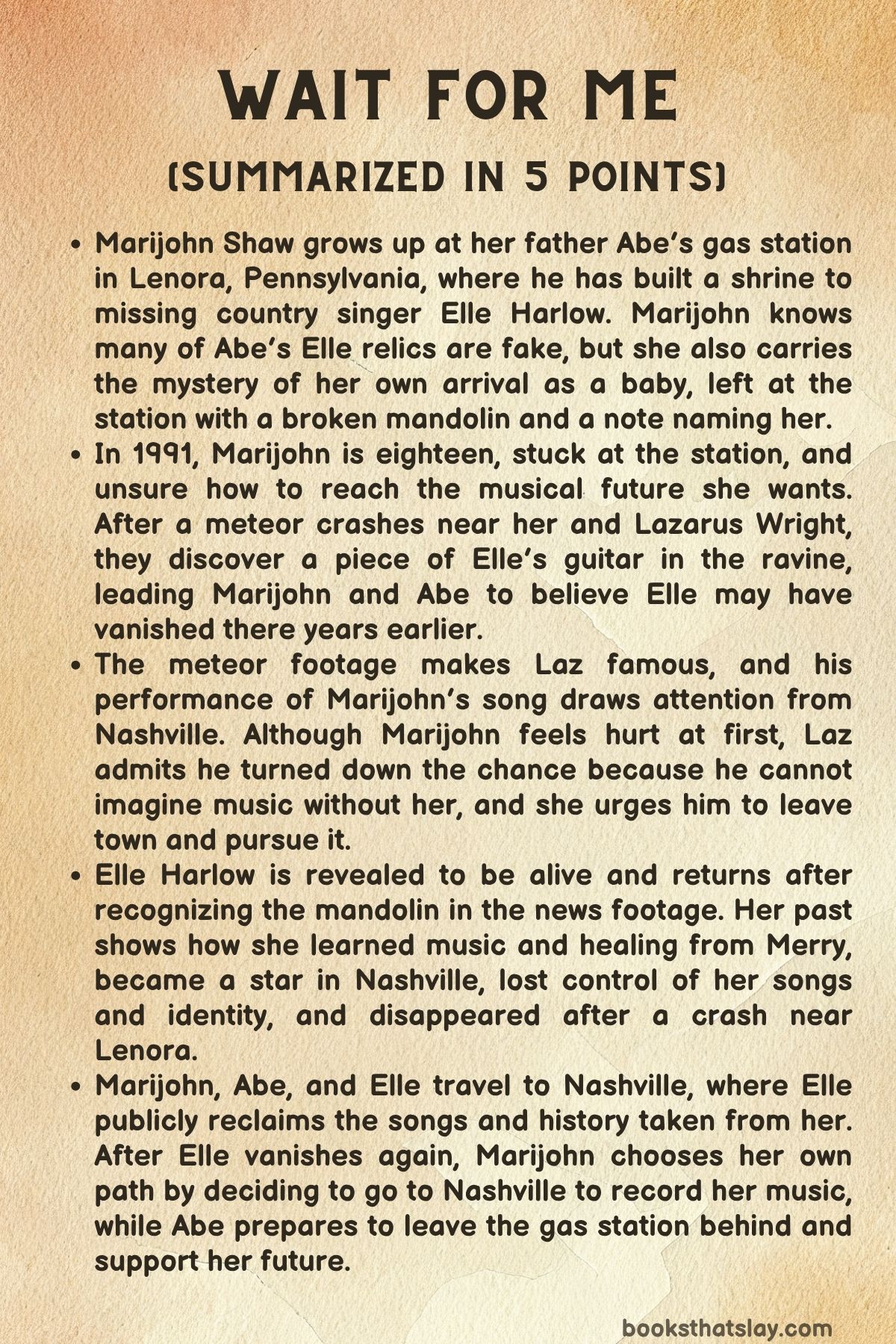
The novel opens in Lenora, Pennsylvania, where a meteor tears across the night sky and crashes near a ravine. The event is witnessed by many people, but no one describes it in exactly the same way.
Some call it fire, some thunder, some an earthquake, and some say it looked as if the sky itself had opened. This moment sets the tone for a story about memory, testimony, and the difference between what people see and what really matters.
The meteor also brings back the old mystery of Elle Harlow, a famous singer who disappeared eighteen years earlier and was last believed to have passed through Lenora.
Marijohn Shaw has spent her life inside that mystery. She is eighteen, musically gifted, and raised by Abe Shaw, the owner of a remote gas station that he claims was the last place Elle Harlow was seen alive.
Abe has filled the station with objects connected to Elle, though Marijohn knows many of them are not real. He believes Elle may have been Marijohn’s mother because a woman once left baby Marijohn in a wicker trunk beside the pump with a broken mandolin and a note naming her.
Marijohn loves Abe, but she is tired of living inside a story built from guesses.
Her closest friend and secret love is Lazarus, who is preparing to leave for college. On their last night together, they go into the woods to play music.
Marijohn carries the emotional weight of abandonment, and she has written a song about her name and her mother. She finally kisses Lazarus, hoping he will admit what has long existed between them.
He pulls away because he fears leaving will make him another person who hurts her. Then the meteor falls, and Lazarus shields Marijohn with his body.
His camcorder captures the event, their music, and the charged intimacy between them.
After the crash, Marijohn climbs into the ravine to search for the meteor. Instead of the stone, she finds a piece of pink-and-white plastic marked with Elle Harlow’s famous guitar design.
The discovery suggests that Elle’s missing Studebaker may have gone off the road and into the river years earlier. Abe recognizes the importance of the object immediately, and he and Marijohn begin to believe that his long-held story may not be fantasy after all.
Lazarus’s video becomes national news. The media turns the private night into a romance, showing Lazarus as the brave boy saving an unknown girl.
Worse for Marijohn, her song is exposed without her consent. Lazarus later performs it on television and receives attention from the music industry.
Marijohn feels that he has taken something intimate and made it public before she was ready. Their relationship fractures as Lazarus leaves for Nashville opportunities and Marijohn stays behind with Abe, angered by the way her voice has once again been overshadowed.
While searching the ravine, Marijohn and Abe recover the chrome bumper of Elle’s car. Abe realizes that in trying to give Marijohn a past, he may have failed to help her imagine a future.
Soon after, Elle Harlow appears at their door, alive. She recognizes the mandolin Marijohn owns and demands to know where it came from.
The novel then moves into Elle’s past. As a girl in 1960s West Virginia, Elle grows up poor, hungry, and forced into responsibility while her father Hosea is away at war.
Her younger brother Reuben is sick with pneumonia. A silent mountain healer named Merry arrives with a mandolin and treats Reuben.
Elle is suspicious of Merry but drawn to her power. Reuben improves briefly, then dies when the medicine runs out.
His death marks Elle deeply, teaching her that love cannot always save someone and that grief leaves a silence that demands an answer.
Elle begins following Merry and learning from her. She discovers that healing is not only medicine but presence, listening, and shared sorrow.
During a crisis with a grieving boy, Merry asks Elle to sing, and Elle realizes her voice can reach suffering in a way words cannot. She begins to understand music as a kind of healing.
Over the years, she becomes Merry’s apprentice, learning remedies, guitar, and the discipline of attention. Merry becomes the person Elle most needs.
That bond is shattered when Elle follows Merry to a hidden cabin and discovers that Merry has been caring for a secret sister. Elle feels excluded and betrayed.
During a storm, Merry catches Elle spying and drives her away. At the truck, Merry slips, strikes her head, and dies.
Elle believes her own neediness caused the accident. She later returns, rescues Merry’s mandolin, and sends Merry’s truck into the river as a private burial.
From that moment on, Elle carries both the instrument and the guilt.
Elle tries to continue Merry’s healing work, but after a mountain fire leaves people with wounds she cannot treat, she understands that she cannot simply become Merry. She turns to songwriting instead, writing songs that preserve Merry’s life, Reuben’s death, and the mountain’s grief.
Her mother Susannah recognizes the songs as extraordinary and urges Elle to go to Nashville.
In Nashville, Elle meets Josie Starling, a wealthy and ambitious studio secretary who wants a country music career. Josie has polish, training, and access; Elle has raw songs and emotional force.
The two women begin playing together at night in Weston Studios. Josie helps shape Elle’s songs, and their creative partnership becomes powerful, intimate, and dangerous.
Elle trusts Josie with songs about Merry, songs she considers sacred.
The friendship breaks after Josie takes Elle home for Thanksgiving. Elle discovers Josie’s wealth and feels deceived.
A family crisis erupts when Josie’s twin sister Jaclyn attempts suicide. Elle uses song and mountain remedies to keep Jaclyn alive, but Josie’s family treats her like something frightening.
Josie recoils from Elle’s darkness, and Elle leaves humiliated. Later, Elle hears Josie’s new hit on the radio and realizes it is one of her songs about Merry, rewritten and sold as a song for a soldier lover.
Elle understands that Josie has not only taken music but stolen the life inside it.
Elle confronts producer Arlo Weston, who knows she is telling the truth but explains that without copyright or power, she cannot beat Josie publicly. He offers Elle a record deal in exchange for silence.
Elle accepts, not because it is justice, but because it gives her a way into the industry. Her first album makes her famous, but the studio turns her into a cute, marketable figure that does not reflect who she is.
Eventually, Elle rebels onstage by performing one of her true songs in her own style, and the crowd responds.
Unable to write her next album in Nashville, Elle is sent to a remote cabin in Lenora, Pennsylvania. There she meets Weston, Arlo’s cousin, a luthier who does not care about her fame.
Weston’s mandolin playing reminds Elle of Merry, and his attention helps her write again. Their connection grows through music, silence, and shared loneliness.
Elle tells him about Merry’s death and Josie’s theft. Weston offers to restore Merry’s mandolin and later disappears with it.
Elle believes he has abandoned her and stolen the last sacred object she had left.
Back in Nashville, Elle records the album that becomes her real legacy, born from hunger, betrayal, shame, and love. At a public event honoring Josie’s stolen album, Elle sees Weston with Josie and realizes he is part of the false “soldier lover” story Josie sold to the world.
Elle performs the stolen song in a mournful, reclaimed way, then punches Josie and flees.
On the road, Elle stops at Abe Shaw’s gas station. While Abe goes to fetch a marker for her autograph, Elle discovers a baby in a wicker trunk in her back seat.
Terrified by her own damage and convinced she will harm the child, she leaves the baby beside the pump. She then drives away and crashes through the guardrail into the ravine.
Her Studebaker sinks into the water, along with her public identity. Elle escapes, calls her mother, and returns home to the mountain.
The world believes she has vanished, but she has chosen to live outside the myth built around her.
Eighteen years later, the meteor footage shows Marijohn holding Merry’s mandolin, and Elle comes to Lenora to reclaim it. Instead, she finds a young musician whose playing carries echoes of Merry.
Elle begins mentoring Marijohn and urges her to stop hiding. She also starts facing the past she escaped.
She confronts Arlo, who tells her that her value lies in being a young, missing legend, not a living woman who has aged. She confronts Josie, who is frail and broken.
Josie denies leaving the baby with Elle and realizes Arlo must have placed the child in Elle’s car. Marijohn’s birth name is revealed as Marijohn Jaclyn Starling, making her Josie’s daughter.
Marijohn tries to meet Josie, but Josie cannot give her the love or explanation she needs. Heartbroken, Marijohn writes a song of her own.
Elle teaches her how to turn pain into music without making it pretty or easy. Together, they perform the stolen Merry songs publicly on Arlo’s lawn, taking the music back by singing it in Elle’s voice.
Marijohn performs her own song, beginning to claim her future as an artist.
After the concert, Elle reunites with Weston. He explains that he took the mandolin to restore it and had placed it in Elle’s car the night she disappeared, never knowing Arlo had also put the baby there.
Their love was real, but it was damaged by secrets and timing. Soon after, Elle vanishes again, leaving uncertainty behind.
Months later, the live album succeeds, and Marijohn begins receiving calls from producers. Lazarus shows her the hidden third piece of the meteor, but Marijohn decides not to claim it.
She understands that not everything lost must be owned. She prepares to make music on her own terms, carrying her wounds not as proof of ruin, but as part of the life that made her songs possible.
Characters
Marijohn Shaw
Marijohn Shaw stands at the center of the book as a young woman shaped by abandonment, secrecy, and artistic hunger. Raised by Abe Shaw after being left at his gas station as an infant, she grows up with a life story built from rumor and devotion rather than certainty.
Her identity is tied to a note, a broken mandolin, and the legend of Elle Harlow, yet she is never allowed the comfort of knowing whether that legend is truly hers. This makes Marijohn guarded, sharp, and deeply afraid of wanting too much.
She loves music, but she hides from being heard because exposure feels dangerous. Her song “Namesake” reveals the wound she cannot fully speak: the belief that her mother left because she was unwanted.
Marijohn’s journey in Wait for Me is not simply about finding her mother; it is about learning that a person can come from pain without being owned by it. Her anger toward Lazarus after he shares her music is important because it shows how fiercely she values control over her own voice.
She does not want to become another girl used as material for someone else’s story. Through Elle, she learns that music can be a claim, not just a confession.
Her discovery that Josie Starling is her mother hurts her, but it also frees her from the fantasy that has ruled her childhood. By the end, Marijohn is still uncertain, but she is no longer waiting for someone else to name her life.
She chooses music, love, and self-definition on terms she is beginning to understand.
Elle Harlow
Elle Harlow is the novel’s great missing figure, but when she enters the story fully, she becomes far more than a legend. She is a woman formed by poverty, grief, guilt, ambition, and a lifetime of being misread.
As a girl in West Virginia, Elle is forced to become hard because survival demands it. Reuben’s death, Merry’s influence, and Merry’s accidental death leave her with a terrible belief that love from her can destroy what it touches.
Her music grows from this belief, which is why her songs carry so much force. They are not performances of sadness; they are attempts to preserve the dead, confess the unsaid, and survive what she cannot repair.
Elle’s public career exposes the cost of female artistry in a world eager to sell women while controlling them. Josie steals her sacred songs, Arlo packages her into a false image, and audiences turn her disappearance into romance and myth.
Yet Elle is never only a victim. She makes bargains, runs when she cannot bear the consequences, and leaves others with unanswered pain.
Her decision to abandon baby Marijohn is rooted in terror, but it also becomes another wound passed forward. In the later sections of Wait for Me, Elle becomes a mentor who tries to prevent Marijohn from losing her voice as she once lost hers.
She is fierce, flawed, loving, evasive, and unfinished. Her final promise that she is coming back matters because it suggests that disappearance is no longer her only language.
Abe Shaw
Abe Shaw is one of the gentlest and most quietly tragic figures in the story. He raises Marijohn after finding her abandoned at his gas station, and his love for her is genuine, patient, and protective.
Yet Abe also builds her childhood around the mystery of Elle Harlow, filling the station with relics and stories that blur the line between devotion and delusion. His shrine to Elle is not merely fan obsession; it is his attempt to give Marijohn a past when the truth has denied her one.
He wants her to feel chosen by a story larger than abandonment, but his effort also traps her inside uncertainty.
Abe’s emotional growth comes when he recognizes that a past, even a beautiful one, is not enough. By clinging to the idea of Elle as Marijohn’s mother, he has sometimes made it harder for Marijohn to imagine a future separate from the mystery.
His admission of this failure shows humility and real parental love. Abe is not Marijohn’s biological father, but the book treats fatherhood as an act of care rather than blood.
He is the person who stays, feeds, protects, listens, and eventually helps Marijohn step beyond him. His role in the final performance, handling the sound as Elle and Marijohn reclaim the stolen music, shows that his love finds its best form when it supports Marijohn’s voice instead of trying to define her story.
Lazarus
Lazarus is Marijohn’s best friend, musical partner, and romantic counterpart, but his character is built around conflict between love and ambition. He cares deeply for Marijohn, yet he repeatedly misunderstands what she needs.
When the meteor video becomes public and her song reaches the world without her permission, Lazarus believes he has helped her. From his point of view, he has given her talent an audience.
From Marijohn’s point of view, he has exposed something private and taken away her choice. This conflict makes Lazarus more than a simple love interest.
He is a young artist learning that intention does not erase harm.
His brief movement toward Nashville fame reveals another part of him: he is not truly made for the kind of performance the industry wants. Unlike Marijohn and Elle, who must fight to claim public space, Lazarus discovers that he values private music, shared music, and emotional truth more than applause.
His shallow single and discomfort with the record company show that success can be its own form of misrecognition. His return to Marijohn is meaningful because he does not come back as a triumphant star, but as someone willing to admit confusion and love.
By the end, Lazarus becomes a partner who encourages Marijohn to record her songs while understanding that he cannot own them, speak for them, or rush the life they contain.
Merry
Merry is the spiritual and artistic root of much of the novel, even though she dies early in Elle’s life. She is a silent mountain healer whose power comes from attention, skill, and presence rather than speech.
To young Elle, Merry first appears mysterious and almost frightening, but she becomes the person who teaches Elle that care can exist without domination. Merry refuses payment when it would harm a hungry family, comforts Susannah through shared grief, and shows Elle that healing is not always about curing the body.
Sometimes it is about staying beside pain without turning away.
Merry’s mandolin becomes one of the story’s most important objects because it holds the memory of her life and the sound of what Elle lost. Her death is the trauma that shapes Elle’s self-understanding.
Elle believes that her need to be included and loved led to the accident, and this belief poisons much of her later life. Yet Merry’s influence also saves Elle.
The songs Elle writes, the remedies she uses, and the way she later teaches Marijohn all carry Merry’s lessons forward. Merry is not idealized as someone who could fix everything; Reuben dies, the mountain fire overwhelms Elle, and healing has limits.
Her importance lies in showing that tenderness, music, and witness can still matter even when they cannot undo loss.
Josie Starling
Josie Starling is one of the story’s most morally complicated characters. She is privileged, talented, ambitious, and trapped within the expectations of her wealthy family.
When Elle meets her, Josie represents access to Nashville, studio knowledge, polish, and possibility. Their creative partnership is real, and that makes Josie’s betrayal more painful.
She does not steal from a stranger; she steals from someone who trusted her with songs rooted in death, grief, and sacred memory. By turning Elle’s songs about Merry into a false romance about a soldier lover, Josie commits an artistic and personal violation.
Yet Josie is not written as a simple villain. Her life is marked by Jaclyn’s suicide attempt, family control, failed motherhood, and the pressure to turn herself into a marketable figure.
She takes Elle’s songs partly because she believes she improved them and partly because the industry rewards the version of womanhood she can perform. Her later inability to meet Marijohn with honesty or care shows the damage she has never faced.
Josie wants the benefits of confession without the full cost of responsibility. Her frailty near the end does not excuse her theft or abandonment, but it reveals that the victory Elle imagined Josie enjoying was hollow.
Josie has fame, but not peace; a daughter, but no maternal courage; songs, but not true ownership of the life inside them.
Arlo Weston
Arlo Weston represents the music industry’s cold intelligence. He recognizes talent quickly, which makes him powerful, but his recognition is always tied to control.
When Elle confronts him about Josie’s theft, he knows she is telling the truth, yet he offers her a bargain instead of justice. His record deal gives Elle opportunity while forcing her into a false image.
This makes Arlo dangerous not because he lacks taste, but because he has taste without moral responsibility. He can hear greatness and still choose profit over fairness.
Arlo’s treatment of Elle after her return exposes his deepest cruelty. He prefers her as a young, missing legend because that version is easier to sell.
A living woman in middle age, carrying anger and history, threatens the myth that has made him money. His role in placing baby Marijohn in Elle’s car is especially revealing.
He makes a life-altering decision for multiple women, assuming Elle will absorb the burden because women in his world are always expected to carry what men arrange. Arlo is not loud or chaotic; his harm is managerial, polished, and practical.
He embodies a system that turns women’s pain into catalog value and then calls that success.
Weston
Weston, the luthier, is a character of silence, skill, and missed timing. He meets Elle in the Lenora cabin at a moment when she is creatively blocked and emotionally raw.
Unlike the men in Nashville, he does not treat her fame as the most important thing about her. He sees the musician beneath the costume and responds to the truth in her songs.
His mandolin playing reconnects Elle to Merry, and his workshop offers a world where instruments are made, repaired, and honored rather than marketed. This makes him a healing presence, though not an uncomplicated one.
The misunderstanding over Merry’s mandolin shapes nearly twenty years of pain. Elle believes Weston has stolen it and abandoned her, while Weston believes he has restored it and returned it.
Their tragedy lies in the way secrets, Arlo’s manipulation, and fear distort what each of them did. Weston’s connection to Josie’s false soldier story makes him part of the lie that wounds Elle, even though his love for Elle in the woods was genuine.
His later reunion with her does not erase the lost years, but it allows truth to replace assumption. Weston is important because he shows that love can be real and still fail when people do not know enough, speak enough, or arrive in time.
Susannah Harlow
Susannah Harlow is Elle’s mother and one of the story’s strongest examples of endurance. Her life is marked by poverty, loss, and the absence or hardness of the men around her, yet she survives without becoming cruel.
Reuben’s death leaves her devastated, and the scene of burying him with Elle shows the brutal physical and emotional labor women carry when no one else comes to help. Susannah’s grief is quiet but immense, and her bond with Merry shows her capacity to receive comfort even when nothing can be fixed.
As Elle grows, Susannah becomes the person who can tell her hard truths without taking away her dignity. She recognizes the power of Elle’s songs and urges her to go to Nashville, not because leaving is easy, but because staying out of fear would be another kind of death.
Later, when Elle returns after her disappearance, Susannah refuses to let her hide behind guilt forever. She tells Elle that Merry’s death was an accident and challenges her to decide what she will do with regret.
Susannah’s love is not sentimental. It is practical, steady, and rooted in survival.
She gives Elle a place to return to when the world has turned her into a myth.
Hosea Harlow
Hosea Harlow is Elle’s father, and his influence is harsh, damaging, and important. Before and after the war, he teaches Elle that survival requires toughness and emotional denial.
When he leaves her to act as the “man of the house,” he places an adult burden on a child. This shapes Elle’s belief that she must become hard, ugly, and useful in order for others to live.
His worldview turns care into duty and duty into a form of violence against the self.
When Hosea returns from war injured and unable to play banjo, his own brokenness becomes bitterness. The loss of his finger is not only physical; it represents the destruction of his music, identity, and tenderness.
Rather than allowing grief to soften him, he passes pain downward. Elle eventually understands that he tried to make her into a version of himself instead of loving her as she was.
Hosea matters because he helps explain why Elle fears her own hunger and softness. He is not the source of all her wounds, but he teaches her some of the wrong lessons she spends the rest of her life trying to unlearn.
Reuben Harlow
Reuben Harlow, Elle’s younger brother, has a brief life in the story, but his death echoes through nearly every major emotional movement that follows. He represents innocence, music, and the fragile beauty Elle cannot protect.
His dulcimer playing fills the Harlow home with sound before illness and poverty take him. Elle’s desperate need to save him is one of her earliest experiences of helpless love.
When Merry’s medicine can no longer help and Reuben dies, Elle learns the terrible limit of care.
Reuben’s burial in the frozen ground is one of the events that forms Elle’s understanding of grief as labor. His death empties the family’s music and leaves Elle with a silence that later becomes song.
Many of Elle’s creative impulses can be traced back to him: the need to remember the dead accurately, the fear of failing those she loves, and the desire to make beauty from what cannot be repaired. Reuben is not developed through long action, but through consequence.
He is the lost child whose absence teaches Elle that music can become a vessel for those who cannot return.
Leo
Leo is a Black banjo player in Nashville who helps Elle when she is young, poor, and nearly invisible to the industry. His role is brief compared with the central figures, but he brings an important understanding of exploitation and erasure.
Leo knows that the music business uses people, especially those without social power, and often profits from their sound while denying them full recognition. His insight helps Elle see that her struggle is part of a larger system, not only a private failure.
Leo’s advice to take Arlo’s deal is practical rather than pure. He understands that unjust opportunities can still be opportunities, especially for artists with no leverage.
This does not make the system fair, but it reveals the compromises survival can demand. Leo also offers kindness without trying to possess Elle’s talent.
In a world where many people want to shape, sell, or steal her music, his presence stands out because he sees the danger clearly. He is a witness to the industry’s unfairness and a reminder that artistic history is filled with people whose contributions are known by those around them even when institutions refuse to honor them fully.
Jaclyn Starling
Jaclyn Starling, Josie’s twin sister, is mostly seen through crisis, but her presence reveals the damage inside the Starling family. Her suicide attempt during Thanksgiving exposes the misery beneath wealth, polish, and social control.
For Elle, the event is terrifying because it places her mountain knowledge inside a wealthy household that both needs and rejects it. Elle helps keep Jaclyn alive, but the family’s response makes her feel monstrous rather than useful.
Jaclyn also becomes part of Marijohn’s identity because Marijohn’s birth name includes her name. This naming carries heavy emotional weight.
It suggests grief, replacement, guilt, and the unresolved pain Josie could not bear. Jaclyn’s suffering helps explain some of Josie’s brokenness, though it does not excuse Josie’s later choices.
In the larger story, Jaclyn represents the hidden despair that can exist behind privilege. Her life shows that money can protect reputation, but it cannot guarantee tenderness, honesty, or the will to live.
Themes
Absence, Disappearance, and the Stories People Build Around Silence
Silence in the novel is never empty. It becomes a space where people invent explanations, preserve hope, and sometimes harm themselves with stories that cannot be proven.
Elle’s disappearance turns her into a legend, but the legend is more useful to others than it is true to her life. Abe builds a shrine from fragments because Marijohn needs a history, yet those fragments also keep both of them tied to uncertainty.
Marijohn grows up surrounded by signs that may or may not mean anything, and this makes her identity feel conditional, as though she cannot fully begin until the missing woman is explained. The meteor’s arrival sharpens this idea because it is witnessed by many people, yet everyone interprets it differently.
Public testimony creates noise, not certainty. Wait for Me treats disappearance as both an event and a long aftermath.
The person who vanishes does not simply leave; she continues shaping the lives, beliefs, and desires of those who remain. The story suggests that mystery can become a cage when people mistake it for meaning.
Healing begins when characters stop needing every lost thing to be found, owned, or turned into proof.
Women’s Art, Ownership, and the Cost of Being Heard
Music in the story is never just entertainment. It carries memory, grief, identity, and power, which is why theft of music becomes such a serious violation.
When Josie takes Elle’s songs, she does not merely borrow melodies. She takes songs rooted in Merry’s life, Reuben’s death, mountain poverty, and Elle’s guilt, then reshapes them into a marketable lie.
This theft reflects a wider system where women’s voices are welcomed only when they can be packaged safely. Arlo understands Elle’s talent, but he wants to control its image, softening and selling her as something less threatening than her real self.
Marijohn faces a similar danger when Lazarus shares her song without permission, even though he believes he is helping her. The novel pays close attention to consent in art: who gets to sing, who gets credit, who profits, and who decides when private pain becomes public work.
The act of Elle and Marijohn performing the stolen songs publicly is powerful because it refuses the industry’s version of ownership. They cannot undo the original theft, but they can restore truth to the music by singing it from the life that created it.
Inherited Wounds and the Burden of Mothers and Daughters
The relationships between mothers and daughters in the novel are filled with longing, failure, protection, and silence. Marijohn grows up believing her mother did not want her, and that belief shapes how she loves, writes, and protects herself.
When she learns that Josie is her mother, the truth gives her a name but not the comfort she hoped for. Josie cannot meet Marijohn’s need because she has never faced her own shame, grief, and fear of motherhood.
Elle is not Marijohn’s mother, yet she becomes the woman who helps Marijohn understand how to use pain without being destroyed by it. This creates a different kind of maternal bond, chosen through music and recognition rather than blood.
Susannah’s relationship with Elle adds another layer. She cannot save Elle from guilt or the industry, but she gives her a place to return and a way to think about regret without surrendering to it.
The book presents motherhood not as a simple source of comfort, but as a field of human limitation. Mothers fail, daughters misread those failures, and love sometimes arrives through substitutes.
What matters is whether a wound is passed on untouched or finally named.
Love, Freedom, and the Refusal to Possess What Is Lost
Love in the story is tested by the desire to keep, claim, or define another person. Elle wants Merry’s whole trust and is devastated by the discovery that Merry has a private life.
Marijohn wants Lazarus to love her without becoming another person who leaves, yet she must also learn that love cannot be proved by staying small. Lazarus must learn that loving Marijohn means respecting her voice, not exposing it for her own good.
Elle and Weston’s relationship is shaped by desire, misunderstanding, and the pain of objects that seem stolen but were meant to be restored. Again and again, the story asks whether love can survive without possession.
The hidden meteor piece near the end gives this idea physical form. Marijohn could claim it and turn it into proof, money, or myth, but she leaves it where it is.
That choice shows how much she has changed. Not every mystery has to become property.
Not every wound has to become a performance. Not every lost person has to be forced back into the shape others need.
Love becomes more honest when it allows return without demand, memory without ownership, and future without certainty.