A Violent Masterpiece Summary, Characters and Themes
A Violent Masterpiece by Jordan Harper is a dark crime novel set in a Los Angeles where fame, money, violence, and exploitation feed each other. The story follows Jake Deal, a crime-scene livestreamer who turns death into entertainment; Kara Delgado, a concierge worker trapped near the secrets of the rich; and Doug Gibson, a defense lawyer drawn into a case that exposes something far larger than one client’s downfall.
As murders, blackmail, celebrity cover-ups, and missing women connect, the book paints a brutal picture of power without shame and people trying to survive inside its shadow.
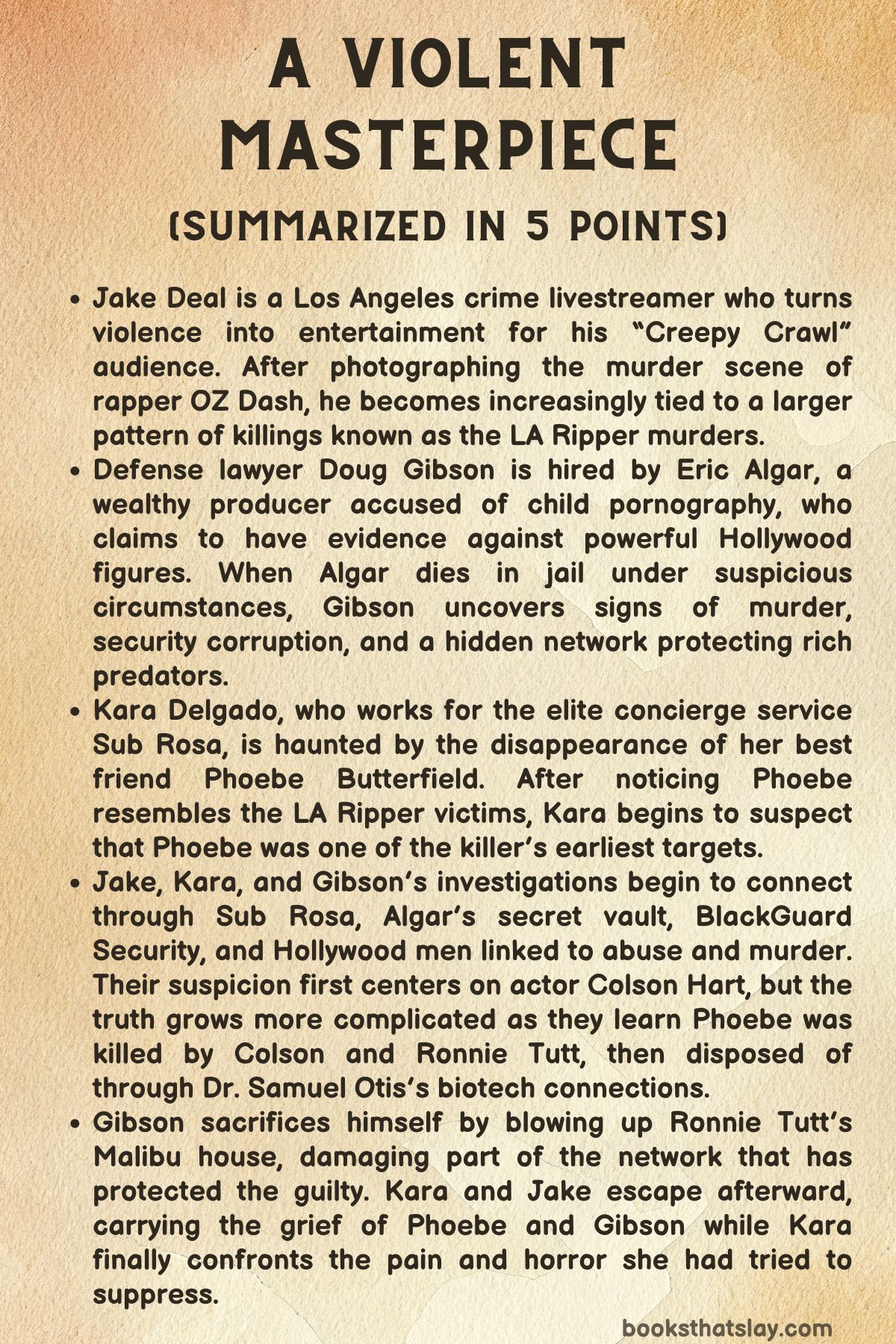
Summary
Jake Deal makes his living by chasing horror across Los Angeles. He listens to police calls, races to crime scenes, and broadcasts what he finds to viewers who follow his “Creepy Crawl” stream.
Murder, wreckage, blood, celebrity scandal, and fear are all material for him. He also sells graphic photos to Michelle Weiss, a gossip editor who knows exactly how much the public will pay to look at someone else’s ruin.
Jake understands that he is part of something ugly, but he keeps going because the city rewards him for it.
When rapper OZ Dash is killed during a robbery in Inglewood, Jake gets to the scene fast enough to photograph the body and Dash’s girlfriend, who is covered in blood. He sells the images and keeps building his brand on other people’s worst moments.
Later, he runs a tour built around the LA Ripper murders, guiding viewers through the stories of women with dark hair and green eyes who were killed across the city. Their names include Natalie Rey, Jen Conley, Madison Zulawski, and others.
To Jake’s audience, the murders are entertainment. To Jake, at first, they are another way to stay visible.
At the same time, defense lawyer Doug Gibson is pulled into a case that seems strange from the beginning. Eric Algar, a wealthy Hollywood producer, has been arrested for child pornography.
He rejects the elite lawyer who would usually handle a case like his and hires Gibson instead. Algar says he wants someone outside the protected Hollywood system.
He hints that he has information about powerful men, a group he calls “the Kids in the Candy Store.” He also claims he has hidden evidence in an anonymous Beverly Hills vault.
Gibson is uneasy, and the situation grows more dangerous when an online figure named BOB warns him that Algar will be killed unless Gibson can make him talk. Soon after, Algar is found dead in jail.
The official story calls it suicide, but Gibson does not believe it. He starts looking closer and finds signs that Algar was murdered.
The deeper he goes, the more the case points toward private security, corrupt law enforcement, Hollywood influence, and a cover-up designed to protect men with money and access.
Kara Delgado works for Sub Rosa, a private concierge company that caters to the desires of the ultra-rich. Sub Rosa can provide drugs, sex, rare luxuries, and illegal experiences for clients who believe rules are for other people.
Kara knows the world she works in is dangerous, but she has learned to keep her head down. Her greatest wound is the disappearance of her best friend, Phoebe Butterfield.
Months earlier, Kara went to Phoebe’s apartment and found signs that something was wrong: rotting bananas, absence, silence, and the feeling that someone had been there before her. Then men in black gloves entered the apartment and searched it, removing electronics and papers.
Kara hid, escaped through a bathroom window, and stayed quiet because fear told her silence was the only way to survive.
As reports about the LA Ripper continue, Kara notices that Phoebe matches the appearance of the victims. The thought terrifies her, but it also gives shape to the grief she has been avoiding.
She begins to suspect that Phoebe may have been the killer’s first victim, erased before the pattern became public.
Jake’s path moves closer to Kara’s when he accepts a secret blackmail job through Michelle. He is paid to collect damaging information on men connected to Algar, including Colson Hart, Ronnie Tutt, Samuel Otis, Zach Maddox, and others.
These men move through celebrity circles, private parties, protected clubs, and hidden systems where wealth shields cruelty. Jake enters that world looking for dirt, but what he finds is worse than ordinary scandal.
At a dangerous sex party called Hellfyre, Kara tries to save a woman named Mona who has overdosed. Jake helps her get Mona to a hospital.
The moment changes the way they see each other. Kara realizes Jake is not only the parasite he appears to be, and Jake sees that Kara is carrying fear, guilt, and loyalty all at once.
Their connection grows, and Kara eventually tells him what happened at Phoebe’s apartment. Together, they begin to follow the possibility that Phoebe’s disappearance is tied to the LA Ripper murders.
Their suspicion falls on actor Colson Hart, a famous man with violent habits, disturbing fantasies, and links to women who have disappeared or died. Colson seems to fit too many pieces of the pattern to ignore.
He is also connected to the larger circle of men around Algar, Sub Rosa, and the hidden entertainment industry. Jake and Kara believe they may have found the person behind the murders, but the truth is more complicated.
Gibson, meanwhile, pays a heavy price for refusing to walk away. Men connected to BlackGuard Security abduct and torture him.
They drill near his ear and leave him badly shaken, hoping pain will make him stop. It does not.
Gibson keeps investigating because he understands that Algar’s death was not an isolated crime. BOB eventually reveals more of the machinery behind the cover-up.
Once a black-bag publicist who helped bury scandals, BOB now gives Gibson information linking BlackGuard, dirty deputies, Algar, and a network of Hollywood predators.
Kara and Jake bring their theory about Phoebe to Gibson, and the separate parts of the story begin to lock together. Algar’s vault, Sub Rosa, the Ripper victims, Colson Hart, and a planned reality dating show all appear connected.
Phoebe and several of the victims had ties to casting for Colson’s dating project. The show becomes a possible hunting ground, a place where vulnerable women were selected, studied, and discarded.
Still, new evidence challenges the idea that Colson is the LA Ripper. Angela Augustine, Colson’s famous ex, tells Kara and Jake that Colson is abusive and monstrous, but she does not believe he is the Ripper.
Her account does not excuse him, but it shifts the investigation. Colson may be guilty of terrible things without being the exact killer they are looking for.
Kara and Jake confront Dr. Samuel Otis, whose biotech connections give him a special role in the network’s crimes. From him, they learn the truth about Phoebe.
She was not simply taken by an unknown serial killer. Colson and Ronnie killed her, and Otis helped dispose of her remains through his professional connections.
This truth breaks through Kara’s fear and restraint. She attacks Otis, forcing him to face a fraction of the pain he helped create.
His mistress Nicole, seeing what he is and what he has done, leaves with the intention of exposing him.
Gibson realizes that Algar’s hidden evidence is the key to bringing down the network. He tries to retrieve or protect the files from the Beverly Hills vault, but BlackGuard gets there first and empties it.
The men behind the cover-up are still moving faster, using money, violence, and access to erase proof before it can hurt them. Gibson understands that normal legal methods may not be enough.
The system he serves has already been bent around the people he is trying to stop.
Knowing the conspirators will keep killing and covering for one another, Gibson chooses a final act that is both desperate and deliberate. He drives to Ronnie Tutt’s Malibu house and creates a diversion that ends in an explosion.
Gibson dies, but the blast damages part of the network’s protection and strikes at people who believed they were untouchable.
Kara and Jake arrive too late to save him. In the aftermath, they leave together and head toward the coast.
Kara is left with the truth about Phoebe, the cost of silence, and the knowledge that Gibson gave his life trying to break open a world built on abuse. Looking at the Pacific, she finally allows herself to face the grief and horror she had buried.
A Violent Masterpiece ends not with clean justice, but with survival, mourning, and the hard recognition that truth can be uncovered even when power tries to erase it.
Characters
The characters in A Violent Masterpiece are shaped by corruption, fear, grief, ambition, guilt, and the violent machinery of fame. Each character is connected to a larger world where wealth protects cruelty, trauma is turned into spectacle, and truth survives only through people willing to risk themselves for it.
Jake Deal
Jake Deal is one of the most important characters in the book because he represents the ugly relationship between violence, entertainment, and public attention. As a livestreaming nightcrawler in Los Angeles, he makes a living by chasing police calls, photographing crime scenes, and turning real suffering into content for his “Creepy Crawl” audience.
At first, Jake appears morally compromised because he treats death as a product and seems more interested in shock value than human pain. His behavior after OZ Dash’s murder shows how deeply he has accepted the logic of the city around him: if horror can be recorded, sold, and watched, then horror becomes part of the marketplace.
However, Jake is not presented as a simple villain. His character becomes more complex as he is pulled deeper into the hidden crimes of Hollywood’s powerful men.
His work begins as exploitation, but it gradually becomes investigation. Through his connection with Kara, he starts to confront the human cost behind the images he captures.
Kara’s grief over Phoebe forces him to see victims not as content, but as people with lives, friendships, and histories. His development is important because he moves from observer to participant, from someone who profits from other people’s tragedies to someone who helps expose the system that creates them.
Jake’s relationship with Kara also gives him emotional depth. He is drawn to her not only because she is connected to the mystery, but because she forces him to face the emptiness of his own life.
Their bond is built in dangerous circumstances, especially when they work together to save Mona and later investigate Phoebe’s disappearance. By the end of the story, Jake becomes a more sympathetic figure because he chooses loyalty, truth, and escape over the hollow fame of his livestreaming world.
He remains flawed, but his flaws make his transformation more meaningful.
Kara Delgado
Kara Delgado is the emotional center of the book. She works for Sub Rosa, a company that serves the secret desires of the wealthy, and this places her directly inside the world of privilege, exploitation, and moral decay.
Kara understands the hidden economy of Los Angeles better than most people because she has seen what rich and powerful clients demand when they believe consequences cannot reach them. Her job requires silence, obedience, and emotional distance, but her personal history with Phoebe Butterfield makes such distance impossible.
Kara is haunted by guilt because she knows something terrible happened to Phoebe and also knows that fear kept her silent. The scene in Phoebe’s apartment reveals Kara’s survival instinct, but it also creates a wound that follows her throughout the story.
She escapes danger, but she cannot escape the knowledge that Phoebe may have needed her. This guilt becomes one of Kara’s strongest motivations.
When she begins connecting Phoebe to the LA Ripper victims, her grief transforms into determination. She is not investigating out of curiosity; she is searching because she loved Phoebe and needs to give meaning to a death that others tried to erase.
Kara’s strength comes from her refusal to keep looking away. She has been trained by her environment to hide, manage, and survive, yet she gradually chooses confrontation instead.
Her violence toward Samuel Otis shows the depth of her rage, but it also reveals how badly the system has failed her. Legal justice seems distant or impossible, so Kara’s anger becomes personal and physical.
By the end, Kara is still grieving, but she is no longer trapped by silence. Her final movement toward the coast with Jake suggests not a perfect recovery, but the beginning of an escape from the world that consumed Phoebe.
Doug Gibson
Doug Gibson is one of the most tragic and morally determined figures in the book. As a defense lawyer, he enters the story through Eric Algar’s case, but his role quickly becomes much larger than legal representation.
Gibson is not part of Hollywood’s elite legal machinery, which is exactly why Algar chooses him. This outsider status makes Gibson important because he is close enough to the legal system to understand procedure, but distant enough from the entertainment industry’s power structure to question what others might ignore.
Gibson’s investigation reveals his courage and stubbornness. After Algar’s death, he could accept the official explanation and step away, but he notices inconsistencies and continues digging.
His persistence makes him dangerous to the people behind the cover-up. The torture he suffers at the hands of men connected to BlackGuard Security is a turning point for his character.
It shows the physical cost of truth in a world protected by money and violence. Even after being traumatized, Gibson continues, which makes him one of the clearest moral forces in the story.
His final act at Ronnie Tutt’s Malibu house defines him as a sacrificial character. Gibson understands that the conspiracy is too powerful to defeat through ordinary channels, so he creates a diversion that destroys part of its protection, even at the cost of his own life.
His death is not meaningless because it gives Kara and Jake a chance to continue and weakens the network that has shielded predators. Gibson’s tragedy lies in the fact that he is a decent man forced into extreme action because the official systems of justice have been corrupted.
Eric Algar
Eric Algar is a disturbing and pivotal character because he connects the legal plot to the larger world of Hollywood corruption. As a wealthy producer arrested for child pornography, he is already morally compromised, but his importance lies in what he knows about other powerful men.
Algar is not innocent, yet he becomes dangerous to people even worse than himself because he possesses evidence that could expose a hidden network. This makes him both a criminal and a potential witness.
Algar’s decision to hire Doug Gibson instead of Frederick Kim reveals his distrust of the usual Hollywood power structure. He knows that elite lawyers, publicists, fixers, and security firms may all be connected to the same machinery that protects influential men.
His mention of the “Kids in the Candy Store” suggests that his crimes are part of something organized and deeply embedded. The anonymous Beverly Hills vault becomes a symbol of the truth he is trying to preserve, even if his motives are partly selfish.
His death in jail shows how efficiently the conspiracy eliminates threats. Officially, it appears to be suicide, but Gibson’s investigation reveals signs of murder and cover-up.
Algar’s character is important because he proves that even wealthy insiders can be destroyed once they become inconvenient. He is not redeemed by his attempt to expose others, but his fear and murder reveal the scale of the evil operating behind the public face of Hollywood.
Phoebe Butterfield
Phoebe Butterfield is absent for much of the book, but her presence shapes Kara’s entire emotional journey. She represents the victim whose disappearance was hidden before it could become a public story.
Unlike the later LA Ripper victims, Phoebe’s fate is initially uncertain, which makes her haunting even more powerful. She exists in Kara’s memory as a friend, a warning, and an unresolved wound.
Phoebe’s apartment becomes one of the most important spaces connected to her character. The rotting bananas, the searched rooms, and the men removing electronics and papers all suggest that her disappearance was not random.
These details make Phoebe’s absence feel active, as if the people who harmed her are still trying to erase every trace of her life. Kara’s silence after escaping the apartment adds another layer of tragedy because Phoebe becomes not only a victim of violence, but also a victim of fear.
When Kara and Jake learn that Phoebe was connected to Colson Hart, Ronnie Tutt, and Samuel Otis, her role becomes central to exposing the conspiracy. Phoebe is not simply a background victim; she is the key that links Sub Rosa, Hollywood abuse, medical disposal, and the false trail of the LA Ripper.
Her death forces Kara to confront the world she has been serving and finally reject it. Through Phoebe, the book shows how easily vulnerable women can be erased when powerful men control the story.
Colson Hart
Colson Hart is a celebrity figure who embodies charm, fame, abuse, and moral rot. He is initially suspected of being the LA Ripper because of his disturbing fantasies, his connection to missing or dead women, and his proximity to the entertainment world’s predatory culture.
Colson’s public image hides a private brutality, making him a symbol of how celebrity can protect monstrous behavior. He is dangerous not only because of what he does, but because people around him are willing to manage, excuse, or conceal it.
Angela Augustine’s description of Colson complicates his role. She confirms that he is abusive and monstrous, but she does not believe he is the Ripper.
This distinction is important because it prevents the story from simplifying evil into one figure. Colson may not be the serial killer, but he is still part of a system that destroys women.
His connection to Phoebe’s death proves that he does not need to be the Ripper to be guilty of terrible violence.
Colson’s planned dating show adds another disturbing dimension to his character. It suggests that the machinery of entertainment can turn women into contestants, images, and disposable objects while hiding real danger behind glamour.
Colson represents the kind of man whose fame makes him desirable in public and untouchable in private. His character is frightening because he reflects a world where charisma can become camouflage for cruelty.
Ronnie Tutt
Ronnie Tutt is one of the most dangerous figures in the book because he operates as a protector, enforcer, and participant in the hidden crimes of the powerful. His involvement in Phoebe’s death places him close to the center of the conspiracy.
Unlike characters who hide behind charm or professional respectability, Ronnie is associated with direct violence and practical cover-up. He is the kind of man who makes sure the consequences of powerful people’s actions disappear.
Ronnie’s Malibu house becomes important because it represents the physical shelter of the network. It is not only a home, but a place connected to protection, secrecy, and power.
Gibson’s final decision to target Ronnie’s house shows how central Ronnie is to the conspiracy’s survival. Destroying that space is a way of striking at the network’s confidence and security.
Ronnie is frightening because he shows how evil depends on logistics. Wealthy predators need people who can clean scenes, intimidate witnesses, move bodies, and silence threats.
Ronnie fills that role. His character demonstrates that corruption is not only made of famous abusers and rich clients; it also depends on violent men who know how to make crimes vanish.
Dr. Samuel Otis
Dr. Samuel Otis is one of the most disturbing characters because he brings scientific respectability into the world of concealment and exploitation. His biotech connections allow him to help process Phoebe’s body after her death, turning medical knowledge into a tool of erasure.
This makes him especially horrifying because he uses intelligence, status, and professional access not to heal or protect, but to hide violence.
Otis’s confession reveals the coldness beneath his respectable surface. He does not act like a man driven by passion or chaos; he appears calculating, practical, and self-preserving.
His role shows that the conspiracy extends beyond entertainment and security into medical and scientific spaces. The involvement of someone like Otis makes the cover-up feel broader and more institutional.
Kara’s attack on Otis is emotionally significant because he becomes a target for all the grief and rage she has carried since Phoebe disappeared. Otis is not only guilty of helping dispose of Phoebe’s remains; he represents the system that treated her body as evidence to be managed rather than a human life to be mourned.
His mistress Nicole’s decision to expose him further weakens the illusion of control around him.
Michelle Weiss
Michelle Weiss is a gossip editor who profits from scandal, death, and public appetite for sensational material. Her relationship with Jake is transactional, built around the exchange of graphic photographs and damaging information.
She represents the media side of exploitation, where private tragedy becomes public currency. Michelle does not need to commit violence herself to participate in a violent culture; she amplifies and sells its aftermath.
Her role in connecting Jake to the blackmail job makes her more than a passive editor. She functions as a gatekeeper between street-level spectacle and elite-level manipulation.
Through Michelle, Jake is pulled deeper into the world of powerful men, secret parties, and hidden crimes. She understands that information has value, especially when it concerns people who depend on reputation.
Michelle’s character shows that the hunger for scandal can overlap with the search for truth, but the motives are very different. She may help move the plot forward, yet her main concern is not justice.
Her presence reminds the reader that exposure can be morally complicated when it is driven by profit as much as principle.
BOB
BOB is a mysterious and important figure because he understands the hidden systems that protect powerful men. As a former black-bag publicist, he knows how reputations are cleaned, scandals are buried, and threats are managed.
His anonymous warnings to Gibson show that he has insider knowledge, but also that he is afraid to act openly. This makes him both helpful and morally ambiguous.
BOB’s role is largely informational, but that information is crucial. He connects Gibson to the larger network involving BlackGuard, dirty deputies, Algar, and Hollywood fixers.
He helps Gibson see that Algar’s case is not isolated, but part of a broader structure of abuse and concealment. BOB understands the machinery because he once worked close to it.
His anonymity suggests guilt, caution, and survival. He may want the truth exposed, but he also knows how dangerous that truth is.
BOB represents people who have helped corrupt systems function and later try to undo some of the damage from the shadows. His character raises an important moral question: how much redemption is possible for someone who once helped powerful people hide their crimes?
OZ Dash
OZ Dash is a rapper whose murder reveals the brutal public economy of death in Los Angeles. His killing during a robbery becomes material for Jake’s livestreaming world and for Michelle’s gossip market.
Although OZ Dash does not drive the later investigation in the same way as Phoebe or Algar, his death introduces the reader to a city where violence is instantly consumed as entertainment.
The treatment of his body after death is central to his character’s significance. Jake photographs him and sells the images, which shows how fame does not protect a person from being reduced to content.
In fact, fame makes his death more valuable to people who profit from spectacle. OZ Dash becomes a symbol of how celebrity and violence feed the same public appetite.
His girlfriend, photographed blood-spattered and traumatized, extends the emotional damage of his death. Through OZ Dash, the book establishes a world where suffering is not given privacy.
It is recorded, packaged, and distributed before grief can even begin.
OZ Dash’s Girlfriend
OZ Dash’s girlfriend is a minor but meaningful character because she represents the people left alive inside public tragedy. Her blood-spattered image becomes part of the material Jake sells, which shows how victims and witnesses can be exploited even when they are not the main target of violence.
She is not treated by the media economy as a grieving person, but as a shocking image.
Her character matters because she exposes Jake’s early moral numbness. He sees her pain as something valuable to capture, not something sacred to protect.
This moment helps establish the emotional distance Jake must later overcome. Although she does not have a large role, her presence sharpens the book’s criticism of spectacle.
She also reflects the broader pattern of women being visually consumed in the story. Whether through crime photos, casting projects, parties, or murder investigations, women’s bodies and pain are repeatedly turned into material for others.
OZ Dash’s girlfriend becomes one of the earliest examples of that pattern.
Frederick Kim
Frederick Kim represents the elite legal world that serves Hollywood’s powerful class. Algar rejects him in favor of Gibson because Kim belongs too closely to the system Algar no longer trusts.
Even though Kim is not explored as deeply as Gibson, his presence is important because he helps define Gibson as an outsider.
Kim’s character suggests that prestige can become part of the machinery of control. In a world where lawyers, fixers, publicists, and security firms overlap, an elite attorney may not simply defend a client; he may also help manage what the client is allowed to reveal.
Algar’s refusal to hire him implies that the usual channels of protection are compromised.
Frederick Kim therefore functions as a symbol of respectable power. He does not need to be shown committing crimes to represent a system that protects reputation over truth.
His role helps make Hollywood’s corruption feel organized, professional, and deeply entrenched.
Angela Augustine
Angela Augustine is Colson Hart’s famous ex and one of the characters who complicates the investigation. Her testimony is important because she confirms Colson’s abusive nature while challenging the assumption that he is the LA Ripper.
This makes her a valuable truth-teller. She does not excuse Colson, but she also refuses to let Kara and Jake settle for an answer that may be emotionally satisfying but incomplete.
Angela’s character shows the difficulty of separating different forms of male violence. Colson can be cruel, dangerous, and guilty without being guilty of every crime attributed to him.
Angela understands his monstrosity from personal experience, which gives her perspective weight. Her role helps redirect the investigation toward a more complicated truth.
She also represents survival after abuse. As Colson’s ex, she has escaped him, but she still carries knowledge of what he is capable of.
Her willingness to speak matters because silence is one of the conspiracy’s strongest weapons. Angela helps break that silence, even while forcing the protagonists to think more carefully.
Mona
Mona is a vulnerable character whose overdose at the Hellfyre party reveals the extreme danger hidden inside elite pleasure. She is surrounded by people who treat excess as entertainment, but when her life is at risk, Kara and Jake are the ones who act.
Mona’s situation shows how quickly the rich can turn human beings into disposable participants in their private fantasies.
Her character is important because she brings Kara and Jake closer together. Their effort to save her becomes a moment of shared moral action.
In a setting built on exploitation, their decision to get Mona to a hospital stands out as a refusal to let another woman be erased. Mona’s body is not treated by them as a problem to be hidden, but as a life worth saving.
Mona also reflects the dangers of Sub Rosa’s world. The company promises rare experiences and forbidden access, but those experiences often place vulnerable people in situations where their safety depends on the mercy of the powerful.
Mona’s near-death becomes another warning sign that the world Kara serves is rotten at its core.
Nicole
Nicole, Samuel Otis’s mistress, becomes important because she chooses to expose him after Kara confronts him. At first, she appears connected to Otis’s private life rather than the central conspiracy, but her decision gives her moral importance.
She is close enough to a corrupt man to know something about his world, and she ultimately decides not to remain silent.
Her role shows how systems of secrecy can begin to collapse when people on the edges stop cooperating. Nicole may not be as central as Kara, Jake, or Gibson, but her choice matters because exposure depends on more than one heroic act.
It requires multiple people to refuse complicity.
Nicole also functions as a contrast to the women who are silenced permanently. Phoebe cannot speak, and the Ripper victims cannot tell their stories, but Nicole can still act.
Her decision to expose Otis becomes a small but meaningful act of resistance against the network’s culture of concealment.
Natalie Rey
Natalie Rey is one of the LA Ripper victims and represents the pattern of targeted violence against women with dark hair and green eyes. Her death helps form the public mythology of the killer, but she is also part of the book’s larger concern with how victims can be reduced to details in a frightening pattern.
The repeated focus on appearance shows how the killer’s violence turns women into types rather than individuals.
Natalie’s importance lies in how her murder contributes to Kara’s growing suspicion about Phoebe. The similarities among the victims make Kara wonder whether Phoebe may have been the first or hidden victim.
In this way, Natalie’s death is not isolated; it becomes part of the chain that helps uncover deeper crimes.
As a victim, Natalie also reflects the failure of the city to protect women from predatory men. Her name matters because naming victims resists the tendency to let them disappear into statistics or sensational headlines.
She is part of the moral weight of the story.
Jen Conley
Jen Conley is another LA Ripper victim whose death adds to the atmosphere of fear and pattern surrounding the murders. Like Natalie, she becomes part of a sequence that Jake uses for his LA Ripper tour, which turns her murder into entertainment for an audience.
This treatment is important because it shows how easily real victims can be absorbed into urban legend.
Jen’s character matters because her death exposes the gap between public fascination and private loss. To Jake’s viewers, she may be another name in a frightening story.
To the moral structure of the book, she is another person whose life was taken and then repackaged by media, gossip, and crime tourism.
Her inclusion among the Ripper victims also helps connect the serial killings to Kara’s fear for Phoebe. Jen’s death becomes part of the pattern that makes Kara realize that her friend’s disappearance may belong to something larger and more horrifying than she first understood.
Madison Zulawski
Madison Zulawski is one of the named LA Ripper victims and contributes to the sense of escalating violence in the city. Her murder strengthens the pattern that Jake publicly narrates and that Kara privately studies.
Like the other victims, Madison is linked through appearance, which reinforces the killer’s obsession and the vulnerability of women who fit his chosen image.
Madison’s role is significant because her death deepens the contrast between spectacle and grief. Jake can turn the Ripper murders into a tour, but each name represents a destroyed life.
The book uses characters like Madison to show how public storytelling can flatten victims unless someone insists on seeing their humanity.
Her presence also helps build the investigative bridge between the Ripper case and Phoebe’s disappearance. Madison is part of the pattern that pushes Kara toward action.
Even though Madison is not developed through direct scenes, her death carries weight because it helps expose the hidden violence running beneath the city’s surface.
Zach Maddox
Zach Maddox is one of the powerful men connected to Algar and the blackmail investigation. His role is important because he helps widen the conspiracy beyond a few central figures.
Jake’s assignment to gather dirt on men like Zach shows that the corruption is not limited to one celebrity, one producer, or one killer. It is a network.
Zach represents the kind of wealthy or influential man whose secrets have value because his reputation depends on concealment. The fact that he appears among names connected to Algar suggests a shared world of privilege, appetite, and potential criminality.
He is part of the social circle that makes the conspiracy feel broad and deeply protected.
Even without being as fully developed as Colson, Ronnie, or Otis, Zach matters because he adds scale. His presence shows that the story is not only about solving individual crimes, but about exposing a class of men who believe their desires can be protected by money and silence.
BlackGuard Security
BlackGuard Security functions almost like a collective character because it represents organized violence in service of wealth. The men connected to BlackGuard abduct and torture Gibson, showing that the conspiracy has access to trained professionals who can intimidate, injure, and silence threats.
They are not random criminals; they are part of a system.
Their role is important because they turn private corruption into physical force. Powerful men need protection, and BlackGuard provides it through fear.
The torture of Gibson demonstrates how far the network will go to stop exposure. It also proves that Gibson is not imagining the conspiracy; the danger is real and immediate.
BlackGuard represents the militarized edge of elite secrecy. Publicly, such security may appear professional or protective, but in the book, it becomes a shield for predators.
The group’s existence shows that corruption survives not only through money and influence, but through men willing to inflict pain on command.
The Kids in the Candy Store
The “Kids in the Candy Store” are less a single character than a hidden circle of powerful men whose appetites drive much of the story’s horror. Algar’s reference to them suggests a group protected by wealth, secrecy, and mutual compromise.
The phrase itself is chilling because it makes predation sound playful, entitled, and consequence-free.
This group represents the deepest moral sickness in A Violent Masterpiece. They are men who treat people, especially vulnerable women and children, as objects available for consumption.
Their power comes not only from what they do, but from how carefully the world around them protects them. Lawyers, fixers, security forces, medical contacts, media channels, and private services all help maintain their freedom.
As a collective presence, they are the true enemy behind many individual crimes. Colson, Ronnie, Otis, Algar, and others may have different roles, but the “Kids in the Candy Store” represent the culture that allows them to exist.
They make the story larger than a murder investigation by revealing a whole ecosystem of protected abuse.
Themes
Voyeurism and the Business of Suffering
Public pain becomes a product in A Violent Masterpiece, where murder, addiction, celebrity collapse, and private grief are packaged for attention. Jake’s work as a livestreaming nightcrawler shows a city where tragedy is no longer simply witnessed; it is filmed, sold, branded, and consumed.
His audience does not come to understand the victims or the systems that failed them. They come for shock, closeness, and the thrill of looking at what should remain sacred or private.
This theme becomes especially disturbing because Jake is not a simple villain. He is part of a larger culture that rewards speed, access, and emotional distance.
Crime scenes turn into entertainment, dead bodies become marketable images, and women’s deaths become material for tours and online spectacle. The novel questions what happens when people become trained to watch suffering without responsibility.
Jake’s gradual movement toward care and action matters because it shows the difference between seeing and truly recognizing. The theme suggests that looking at violence is easy; accepting moral responsibility for what is seen is much harder.
Power, Wealth, and Hidden Abuse
The world of the rich and famous is shown as a protected zone where abuse survives because money can buy silence, loyalty, and removal of evidence. Producers, actors, lawyers, security firms, doctors, publicists, and private fixers form a system that protects powerful men from consequence.
The danger does not come from one criminal alone, but from the network around him. Each person who hides evidence, threatens witnesses, moves bodies, or manages public image helps violence continue.
This makes the abuse feel institutional rather than accidental. Hollywood glamour becomes a mask for exploitation, where access to beauty, sex, drugs, and luxury depends on obedience and secrecy.
The wealthy characters are not only protected by their money; they are protected by the fear they create in others. Kara’s silence after Phoebe’s disappearance shows how power works even when no one is present.
She has already learned that speaking can destroy her. The theme exposes a world where justice is not absent by chance.
It is actively blocked, managed, and buried by people whose privilege depends on keeping the truth hidden.
Guilt, Silence, and the Cost of Survival
Kara’s grief over Phoebe is shaped by more than loss; it is shaped by the shame of surviving and staying silent. Her decision to flee and say nothing is understandable because she is terrified, but that fear does not free her from guilt.
This makes her emotional journey painful and human. She is not simply searching for the truth about Phoebe; she is trying to face the version of herself that ran away.
Silence becomes one of the novel’s most damaging forces. It protects the guilty, isolates the frightened, and turns trauma inward.
Gibson also carries the burden of knowing that truth may arrive too late, while Jake must confront the harm caused by treating victims as content rather than people. Each of them is forced to choose between self-preservation and moral action.
The theme shows that survival can come with emotional debts that cannot be ignored forever. Kara’s final grief near the ocean is powerful because it is not a neat recovery.
It is the beginning of honest mourning after fear, denial, and silence have finally broken.
Justice, Sacrifice, and Moral Courage
Justice in the novel is not clean, official, or fully satisfying. The legal system is compromised, evidence disappears, witnesses are threatened, and powerful men remain difficult to reach.
Because formal justice keeps failing, moral courage becomes personal and dangerous. Gibson’s role is central to this theme.
He begins as a defense lawyer drawn into a case filled with lies, but he continues even after torture and terror make retreat seem reasonable. His final act is not a perfect victory, yet it disrupts the machinery protecting the guilty.
That sacrifice shows how justice sometimes depends on people willing to act when institutions refuse to. Kara and Jake also move toward courage, though in different ways.
Kara risks facing the people connected to Phoebe’s death, while Jake begins using his skills for something beyond profit and spectacle. The theme does not pretend that courage fixes everything.
Instead, it shows courage as resistance against a world designed to make people look away. Justice may remain incomplete, but refusing silence becomes a meaningful act of defiance.