American Spirits Summary, Characters and Themes
American Spirits by Anna Dorn is a sharp, satirical novel about fame, fandom, obsession, and the strange intimacy between artists and the people who worship them. At its center are Blue Velour, a chaotic pop star; Sasha Harlow, her creative partner; and Rose Lutz, a fan whose devotion turns into ambition.
The book looks at celebrity culture from the inside and the outside, showing how admiration can become possession and how art can be shaped by rivalry, longing, and performance. With humor and bite, American Spirits explores what happens when the boundary between fan and star collapses.
Summary
Blue Velour begins the story on the edge of another major career moment. She is preparing for a high-profile New York Times interview about her new album, Blue’s Beard, and her public image is as carefully unstable as ever.
Blue is talented, volatile, guarded, and fully aware that people want access to her private life as much as they want her music. During the interview with Zoe Alexander, she speaks about the album but resists giving clear answers about Sasha Harlow, her longtime producer and creative partner.
Blue admits that Sasha is her soulmate, yet she refuses to explain whether that bond is romantic, artistic, or something that cannot be neatly named.
The focus then shifts to Rose Lutz, a young woman in Los Angeles whose life revolves around Blue. Rose works at a coffee shop, lives with Ella, another fan, and spends much of her time online as the founder of BlueBeards, a subreddit dedicated to proving that Blue and Sasha are secretly together.
Rose is not a casual admirer. She studies Blue’s lyrics, tracks her movements, analyzes her relationships, and treats every public gesture as evidence.
Her identity is built around being close to Blue from a distance.
Rose’s chance to cross that distance comes through Grace, another member of the fan community who has a loose connection to Blue’s sister, Max. Through this link, Rose gets an interview to become Blue’s assistant.
When she finally meets Blue, Rose performs the role of the perfect fan. She proves that she knows Blue’s work, sings “Rose Ghost,” and mentions that she is also a Gemini.
Blue, impulsive and drawn to attention, hires her.
Rose quickly enters Blue’s private world. She drives her around, handles errands, attends rehearsals, manages small crises, and tries to make herself indispensable.
For Rose, even ordinary tasks feel charged with meaning because they bring her closer to the person she has worshipped for years. Her sense of being chosen grows stronger when she accompanies Blue to the Grammys, where Blue’s Beard wins Album of the Year.
Blue hugs her and kisses her cheek, and Rose interprets the moment as proof that she matters.
Soon after, Blue prepares for a tour through smaller American towns, a project meant to reshape her image and reconnect her with a different kind of audience. The tour begins in Wheatland, but almost immediately the Covid-19 pandemic shuts everything down.
Blue reacts with anger and violence, unable to accept the sudden loss of control. Then she redirects her energy by renting a secluded house in the redwoods called Velour Chalet.
Blue, Max, Rose, Sasha, and the dogs settle there to quarantine.
At the chalet, Blue and Sasha begin making new music. Their creative connection is intense and private, and Rose becomes increasingly jealous.
She has long imagined Blue and Sasha as a couple, but being near them makes the fantasy painful and unstable. At the same time, Rose grows close to Sasha.
They drink together late at night, talk about music, and form a bond that mixes admiration, desire, and ambition. Rose begins to imagine herself not only as Blue’s assistant but as an artist in her own right.
Blue becomes more erratic during quarantine. She records Mood Onyx, an impulsive album shaped by her mood swings and isolation, and releases it without Sasha’s approval.
The response is brutal. Critics attack the album, and Blue’s confidence gives way to rage.
She turns on the people closest to her, verbally attacks Rose, fires both Rose and Sasha, and leaves.
Blue then relapses into drinking and partying. She moves through Nevada in a self-destructive haze before driving to New York to work with producer Liam Sterling.
While Blue spirals, Rose remains with Sasha at the rental house. Rose persuades Sasha to record her songs and begins reinventing herself as Rose Lush.
When Sasha posts a photo of Rose online, Rose gains attention almost instantly. Her proximity to Blue and Sasha becomes part of her new identity as a rising artist.
Rose’s past catches up with her when Grace exposes her as the founder of BlueBeards. The fan community that once gave Rose power turns against her.
The revelation makes her look manipulative and obsessive, but it also keeps her in the public conversation. Meanwhile, Blue eventually checks into rehab, trying to step away from the chaos she has created.
Rose and Sasha release Pop My Cherry, an album that attracts attention largely because of its connection to Blue’s world.
By 2021, Blue returns with Violet, an album inspired by Max’s baby. Compared with her earlier work, it is received without much excitement.
Blue is still famous, but her cultural force has weakened. Rose, meanwhile, begins to experience her own version of fame.
She drinks, parties with Ella, and becomes less steady in her relationship with Sasha. The attention she once craved starts to warp her behavior, just as it has warped Blue’s.
Blue remains furious about Pop My Cherry and the way Rose has profited from her orbit. Yet industry pressure and career calculation push her toward a strange solution: a collaboration with Rose and Sasha.
The three women form Blue Rose and create an album called American Spirits. The project becomes a critical success, but the success does not heal anything.
The group is built on rivalry, resentment, attraction, and unresolved history. Blue wants control.
Rose wants recognition. Sasha is caught between them, emotionally and artistically.
The tension reaches its breaking point during the American Spirits tour at the Hollywood Bowl. Blue plans to humiliate Rose in front of the audience by projecting Rose’s old obsessive Reddit posts and a legal complaint claiming ownership of Pop My Cherry.
Rose, under pressure and exposed, performs badly. Sasha, drunk and panicked, rushes onto the stage and proposes to Rose with a ruby ring.
The moment turns the concert into a public spectacle. Then the chaos becomes dangerous when someone in the audience points and fires a real gun.
The bullet grazes Rose’s ear.
After the shooting, the women separate. Blue begins therapy and steps back from performing.
Rose ends up with Ella, and the two plan a wedding in Dahlonega, Georgia. Sasha attends the wedding hoping to see Blue, but she also unexpectedly takes on a tender role by walking Rose down the aisle.
Blue attends too, watching Rose marry Ella and quietly reconnecting with Sasha. The old triangle does not disappear, but it changes shape.
The women are no longer trapped in the same pattern of competition and dependence.
By 2025, Blue releases Queen of My Heart, an album understood as a mature tribute to Sasha and to music itself. It suggests that Blue has found a calmer way to honor the relationship that shaped her life and career.
The ending then shifts perspective with a final reveal: the entire story has been presented as fanfiction written by a former online fan. This narrator admits that the characters and events have been fictionalized.
That twist reframes American Spirits as a story not only about celebrity and art, but about the fantasies fans build around famous people, and the power those fantasies have to create their own version of truth.
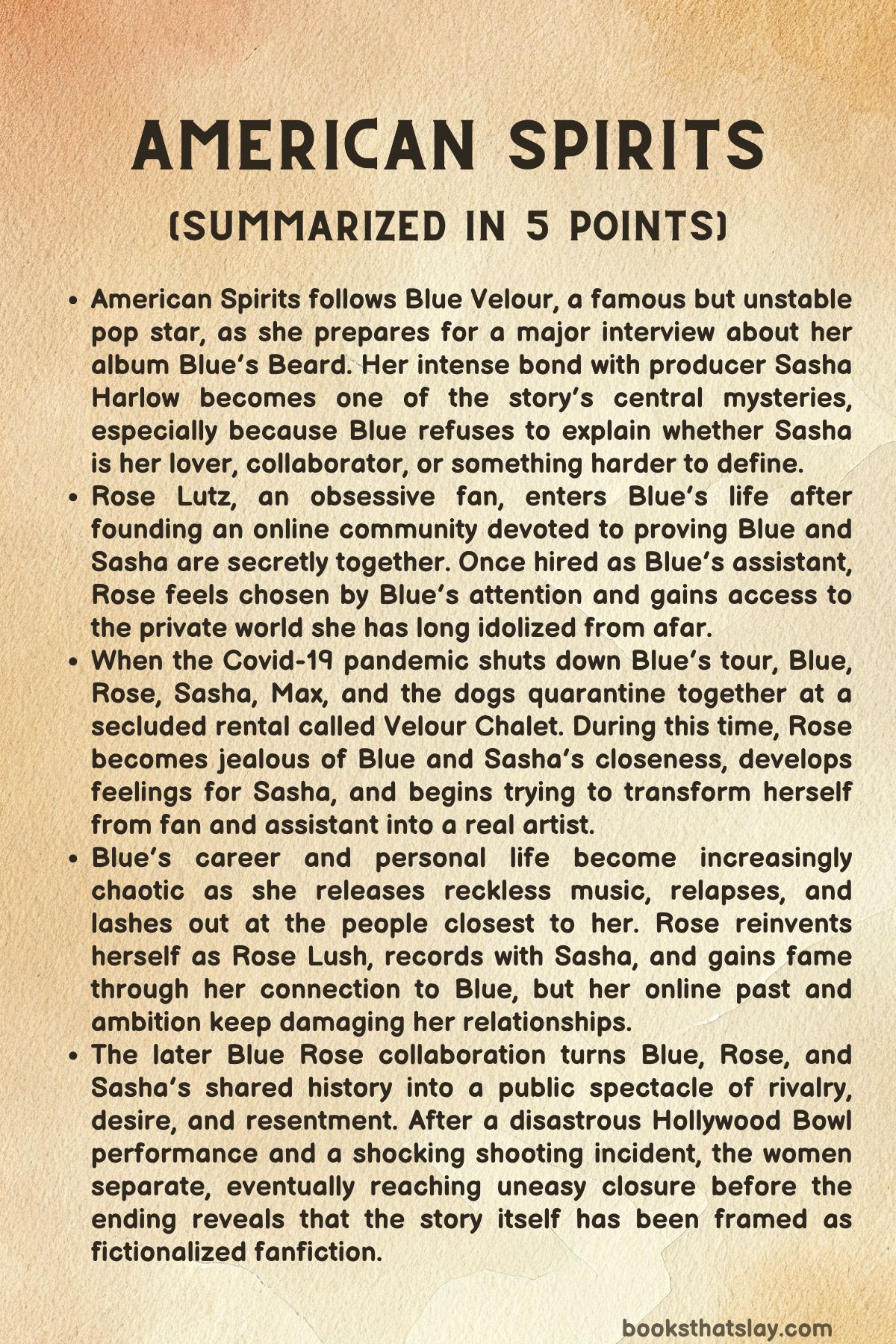
Characters
Blue Velour
Blue Velour is the central force of American Spirits, a brilliant, unstable, magnetic pop star whose artistic power is inseparable from her emotional volatility. She begins the book as a guarded celebrity preparing for a major interview, already aware that the public wants access not only to her music but also to the mystery of her bond with Sasha Harlow.
Blue’s refusal to define Sasha as either a romantic partner or creative partner shows how much she depends on ambiguity. She understands that mystery protects her, but it also traps her, because the relationships she refuses to name become sources of obsession for others and confusion for herself.
Blue is deeply talented, but her talent often appears alongside destructiveness. She can turn pain, jealousy, glamour, and chaos into art, yet she struggles to treat the people around her as fully separate human beings.
Rose, Sasha, Max, and even her fans are often pulled into the emotional weather of Blue’s moods. Her hiring of Rose is impulsive, almost theatrical, because she is drawn to devotion and spectacle.
At the same time, Blue’s treatment of Rose later reveals her cruelty when she feels threatened. She wants admiration, but she cannot always tolerate the needs and ambitions of those who admire her.
Her relationship with Sasha is the emotional center of her character. Sasha is her soulmate in a way that exceeds simple labels, but Blue’s inability to handle intimacy makes the connection painful.
She needs Sasha’s steadiness, musical judgment, and emotional presence, yet she resents being dependent on her. When Blue releases Mood Onyx recklessly and collapses under its failure, her anger toward Sasha and Rose exposes how fragile her self-image is.
Criticism does not merely wound her professionally; it makes her feel abandoned, misunderstood, and exposed.
Blue’s later withdrawal, therapy, and mature return through Queen of My Heart suggest that she is not simply a destructive celebrity figure. She is also someone capable of growth, even if that growth comes after serious harm.
By the end of the book, Blue becomes quieter and more reflective. Her final reconnection with Sasha and her mature tribute to music show that her deepest love may not be fame itself, but the act of creating with someone who truly understands her.
Blue’s arc is therefore one of brilliance moving through ego, addiction, rivalry, collapse, and finally a more honest form of devotion.
Rose Lutz / Rose Lush
Rose Lutz is one of the most psychologically revealing characters in the book because she begins as a fan and gradually becomes part of the celebrity world she once observed from a distance. At first, Rose’s identity is built around obsession.
As the founder of the BlueBeards subreddit, she is not merely a casual admirer of Blue Velour; she is a person who has organized her imagination, friendships, routines, and ambitions around Blue’s life. Her belief that Blue and Sasha are secretly together gives her a sense of purpose and community, but it also shows how fandom can blur the line between interpretation and possession.
When Rose becomes Blue’s assistant, she experiences the opportunity as a kind of personal destiny. She feels chosen by Blue, especially after intimate gestures like the cheek kiss at the Grammys.
Yet her closeness to Blue does not cure her obsession; it intensifies it. Rose moves from watching Blue to wanting to be recognized by her, then from wanting recognition to wanting Blue’s creative life for herself.
Her jealousy of Sasha is complicated because Rose is not only envious of Sasha’s access to Blue, but also drawn to Sasha personally and artistically.
Rose’s transformation into Rose Lush marks a major shift in her character. The new name suggests reinvention, glamour, appetite, and performance.
She attempts to move from assistant to artist, but her rise is inseparable from the people she once idolized. Pop My Cherry gains attention partly because of its connection to Blue and Sasha, which makes Rose’s success unstable.
She wants to be seen as original, but the public reads her through Blue’s shadow. This creates a painful contradiction: Rose wants independence, yet the source of her fame is the very obsession she would prefer to outgrow.
Rose is also morally complex. She is vulnerable, ambitious, manipulative, insecure, and often self-deceiving.
Her relationship with Sasha contains real feeling, but it is also shaped by opportunity and rivalry. Her later life with Ella suggests that she may eventually seek something more stable than celebrity chaos, but even her wedding carries the residue of the old triangle when Sasha walks her down the aisle and Blue appears as a witness.
Rose’s arc shows how dangerous it can be when fandom becomes identity. She does not simply admire art; she tries to enter it, control it, and finally become part of it.
Sasha Harlow
Sasha Harlow is the emotional and creative anchor of the story, though she is often caught between other people’s desires. As Blue’s longtime producer and creative partner, Sasha represents discipline, intimacy, and musical seriousness.
She understands Blue’s artistic instincts better than almost anyone, but this closeness places her in a painful position. She is needed by Blue, admired by Rose, and relied upon by the music itself, yet she rarely seems fully in control of her own emotional life.
Sasha’s bond with Blue is intense and undefined. The book presents their connection as something larger than a standard professional partnership, but also too unstable to become a simple romance.
Sasha appears to be the person who can translate Blue’s chaos into art, but she also suffers from the emotional demands of that role. When Blue releases Mood Onyx without Sasha’s approval, Sasha’s authority as a collaborator is violated.
This moment reveals how easily Blue can turn their partnership into a dictatorship when fear and ego take over.
Sasha’s relationship with Rose is both tender and troubling. She gives Rose creative attention, records her songs, and helps launch her reinvention as Rose Lush.
However, Sasha’s involvement with Rose also feels like a reaction to Blue’s rejection. Rose becomes someone Sasha can nurture, shape, and perhaps be loved by in a way that Blue has made impossible.
This makes Sasha sympathetic but not innocent. Her choices contribute to the rivalry between Blue and Rose, even when she seems less openly aggressive than either of them.
The onstage proposal during the joint tour exposes Sasha’s own instability. Drunk, panicked, and desperate, she turns a public disaster into an emotional spectacle.
The proposal is not simply romantic; it is an act of confusion, fear, and theatrical collapse. Yet Sasha’s later appearance at Rose and Ella’s wedding, where she unexpectedly walks Rose down the aisle, gives her character a strange dignity.
She becomes a bridge between past chaos and possible forgiveness. By the end, her quiet reconnection with Blue suggests that Sasha’s deepest role in the story is not as a prize to be won, but as the person through whom the others confront what love, art, and loyalty have cost them.
Max
Max, Blue’s sister, functions as one of the few characters connected to Blue outside the machinery of fame, fandom, and music-industry ambition. Her presence gives Blue a family context and reminds the reader that Blue is not only a star but also a sister, a person with private histories and ordinary attachments.
Max does not dominate the plot in the way Blue, Rose, and Sasha do, but she is important because she offers a different emotional register. Around Max, Blue’s celebrity persona becomes less complete, and glimpses of a more personal Blue become possible.
Max’s connection to the fan world also helps move the plot forward, since Grace’s loose connection to her helps Rose get closer to Blue. This makes Max indirectly important to Rose’s entry into Blue’s life.
Although Max is not responsible for Rose’s obsession, her place near Blue becomes part of the pathway through which fandom crosses into private life. In that sense, Max represents how even peripheral family connections can become vulnerable when someone famous is surrounded by intense public fascination.
The birth of Max’s baby also has symbolic importance. Blue’s album Violet is inspired by the child, suggesting that Max’s life offers Blue a source of renewal, tenderness, and family feeling.
Even though Violet is received lukewarmly, its inspiration points to Blue’s desire to create from something gentler than rivalry, addiction, or spectacle. Max therefore represents ordinary continuity in a world defined by performance and instability.
She is not the loudest character, but her presence helps reveal what Blue lacks and what she sometimes longs for: family, grounding, and love that is not dependent on applause.
Ella
Ella begins as another Blue fan living with Rose in Los Angeles, but her role becomes more meaningful as the book develops. At first, she appears connected to Rose through shared fandom, giving Rose a domestic companion within the obsessive world of BlueBeards culture.
Ella’s presence shows that Rose’s fixation is not isolated; it is social, communal, and reinforced by people who speak the same fan language. However, Ella is not merely a background fan.
She later becomes part of Rose’s life after the collapse of the Blue-Rose-Sasha triangle.
Ella’s relationship with Rose offers a contrast to the destructive intensity of Rose’s connections with Blue and Sasha. While Rose’s bond with Blue is based on worship and envy, and her bond with Sasha is tangled in ambition and emotional confusion, Ella represents a more grounded possibility.
Their eventual wedding suggests that Rose may be trying to choose stability over obsession. Yet the fact that Blue and Sasha are still present at the wedding shows that Rose cannot completely escape the world that formed her.
Ella also reflects the persistence of fandom as an emotional foundation. She knew Rose before Rose became Rose Lush, before fame and scandal transformed her life.
This gives Ella a kind of continuity that the other relationships lack. She is connected to Rose’s earlier self, which may be why their marriage feels like both a retreat and a resolution.
Ella does not erase Rose’s past, but she offers a future in which Rose is not defined only by Blue, Sasha, or public attention.
Grace
Grace is a secondary but important figure because she helps connect online fandom to the real world of celebrity access. As a member of the BlueBeards subreddit with a loose connection to Max, Grace becomes one of the reasons Rose is able to enter Blue’s private orbit.
Her role shows how fandom communities often operate through rumors, weak ties, speculation, and opportunity. A small connection becomes a major turning point because Rose is ready to use it.
Grace later exposes Rose as the founder of BlueBeards, turning the fanbase against her. This act is crucial because it destroys Rose’s attempt to control her own reinvention.
Rose wants to become an artist rather than remain an obsessive fan, but Grace’s exposure reminds everyone where Rose came from. In this way, Grace becomes a force of revelation.
She pulls Rose’s hidden past into public view and forces the celebrity world to confront the fan culture that helped create Rose.
Grace is not developed as deeply as the central trio, but she represents the volatility of online communities. Fans can adore, investigate, elevate, and punish with equal intensity.
Grace’s betrayal or exposure of Rose may be read as moral correction, jealousy, or community policing. Whatever her motive, her actions reveal that Rose cannot simply use fandom as a ladder and then abandon it.
Grace makes clear that the internet remembers, and that online identities can become impossible to outrun.
Zoe Alexander
Zoe Alexander appears as the New York Times interviewer who questions Blue about her album Blue’s Beard and her relationship with Sasha. Though her role is brief, she is important because she represents the public’s desire to interpret Blue.
Zoe’s interview places Blue in the position of having to explain herself, her art, and her attachments. Blue may be famous, but Zoe’s questions show that fame also means being constantly translated by others.
Zoe’s interest in Sasha reveals how Blue’s personal relationships have become part of her public mythology. The interview is not only about music; it is also about the story behind the music, especially the mystery of Blue and Sasha’s bond.
Blue’s guarded answers show her need for control. She wants to benefit from intrigue while refusing full disclosure.
Zoe therefore helps establish one of the book’s central tensions: the conflict between artistic privacy and public consumption.
As a journalist, Zoe also reflects the more respectable side of the same interpretive hunger that drives the fan subreddit. She is not an obsessive fan like Rose, but she is still part of a culture that turns artists into narratives.
Through Zoe, the story shows that celebrity mythology is produced not only by fans but also by media institutions. Her presence at the beginning helps frame Blue as both artist and object of analysis.
Liam Sterling
Liam Sterling is the producer Blue turns to after her relapse and flight from the wreckage of her relationships with Rose and Sasha. His role is significant because he represents Blue’s attempt to keep creating while escaping the emotional consequences of her broken partnership with Sasha.
By going to New York to work with Liam, Blue tries to replace or bypass the creative bond that has defined her career. This choice shows both her resilience and her avoidance.
Liam functions as a contrast to Sasha. While Sasha is emotionally entangled with Blue and deeply connected to her artistic identity, Liam appears more like an industry figure who can offer professional distance.
For Blue, that distance may seem useful after the pain of Mood Onyx and the rupture with Sasha. However, the very need to seek out another producer reveals how irreplaceable Sasha has been.
Liam’s presence makes Sasha’s importance clearer by showing that Blue can continue working, but not necessarily with the same emotional or creative truth.
Although Liam is not one of the major emotional players, he helps demonstrate the machinery of the music business. Producers, collaborators, and industry advisers surround the central artists, shaping their choices and helping them survive scandal or failure.
Liam’s role is practical, but thematically he represents substitution. Blue can find another producer, but she cannot easily replace the person who understands the deepest source of her music.
Themes
Obsession and the Hunger to Be Chosen
In American Spirits, fandom becomes less about admiration and more about possession. Rose’s devotion to Blue begins as emotional escape, but it gradually turns into a way of building an identity around someone else’s life.
Her subreddit, theories, and desire to prove a hidden relationship show how obsession can make fantasy feel more real than reality. When Rose becomes Blue’s assistant, she does not simply enter the celebrity world; she believes she has been selected, almost rewarded, for her loyalty.
This creates a dangerous imbalance because Rose cannot separate professional access from emotional intimacy. Every small gesture from Blue feels loaded with meaning, while every sign of closeness between Blue and Sasha feels like betrayal.
The theme shows how wanting to be chosen can make a person surrender judgment, privacy, and self-respect. Rose’s rise also proves that obsession can imitate ambition, but it is built on unstable ground because it depends on attention from someone else.
Fame as Performance and Punishment
Fame appears glamorous from a distance, but inside the story it functions like a trap that rewards instability while punishing vulnerability. Blue is celebrated for her intensity, emotional excess, and public image, yet those same qualities destroy her relationships and sense of control.
Her success depends on being watched, discussed, and mythologized, but constant attention leaves her unable to exist privately without turning life into performance. Rose experiences fame from the opposite direction.
At first, she wants recognition because she feels invisible, but once she receives attention, it feeds her worst impulses. Parties, public image, and online judgment begin shaping her choices.
The story presents fame as something that does not create a self; it enlarges whatever fractures already exist. Public success does not heal loneliness, jealousy, addiction, or insecurity.
Instead, it gives those feelings a stage. The characters are rewarded when they become spectacle, but the cost is emotional honesty and personal peace.
Creative Partnership, Desire, and Control
The bond between Blue and Sasha is built on music, history, dependence, and desire that remains difficult to define. Their connection is powerful because it produces art, but it is also painful because neither person fully controls what the relationship means.
Blue relies on Sasha as a creative anchor and emotional mirror, while Sasha often becomes the person who steadies Blue’s chaos. Rose’s arrival disrupts this balance because she wants both artistic validation and personal access to Sasha.
The creative world becomes a battlefield where affection, authorship, and power are constantly contested. Albums are not just music here; they become proof of loyalty, betrayal, ownership, and revenge.
When Rose records with Sasha, the act feels both like self-invention and an intrusion into Blue’s most intimate territory. This theme shows that art can bring people together, but it can also become a weapon when love, ambition, and insecurity are left unresolved.
Identity, Reinvention, and the Unreliable Story
Characters repeatedly rename, rebrand, and revise themselves in search of power. Rose becomes Rose Lush, transforming from fan to performer, but the change does not erase the insecurity that shaped her earlier life.
Blue also shifts through public eras, albums, moods, and images, using reinvention as both artistic language and emotional defense. These transformations raise the question of whether identity is authentic or simply performed for whoever is watching.
The final revelation that the entire story has been presented as fanfiction deepens this theme by making the reader reconsider what was real, exaggerated, or invented. The characters are not only shaped by their own choices; they are shaped by the person telling the story.
This ending reflects the same fan culture that drives much of the plot, where strangers turn celebrities into characters and private lives into narratives. Identity becomes unstable because everyone is performing, interpreting, or rewriting someone else.