Don’t Tell Me How It Ends Summary, Characters and Themes
Don’t Tell Me How It Ends by Adrienne Thurman is a contemporary romance about family, fear, timing, and the messy work of choosing a future before every answer is clear. The story follows Kaia Harper, a recent graduate who returns home to Connecticut after her life in Kansas falls apart.
There, she is pulled into the chaos of her pregnant sister Zola’s new matchmaking business, their mother Angela’s emotional reset, and her own unexpected connection with artist and tow truck driver Ro Jackson. Warm, funny, and emotionally honest, the book explores love as something less like a perfect plan and more like a brave decision.
Summary
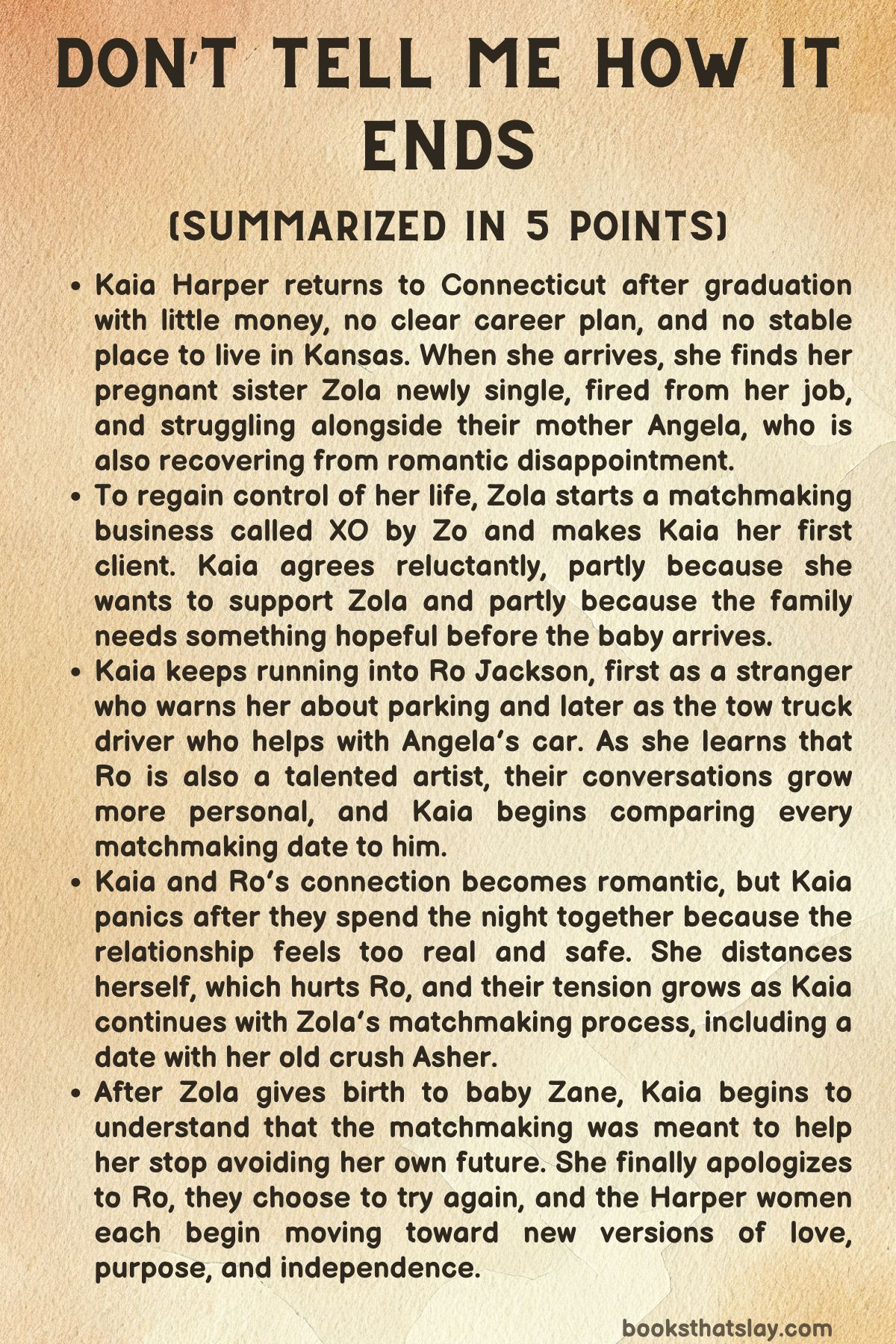
Kaia Harper begins the story at a point of uncertainty. She has recently graduated, but the life she expected to step into has not come together.
She is broke, unable to renew her lease in Kansas, and unsure whether becoming a teacher is truly what she wants. Her personal life is not offering much comfort either.
After an awkward late-night hookup that leaves her feeling worse rather than better, and with her landlord pressing her about the lease, Kaia finally accepts that she cannot stay where she is. With no clear plan and no real sense of direction, she decides to return to Connecticut.
Her return is not a calm homecoming. Kaia’s older sister, Zola, is pregnant and struggling.
Jason, the baby’s father, has recently left, and Zola is trying to manage heartbreak, fear, and the reality of becoming a single mother. Their mother, Angela, is also emotionally unsteady after another failed relationship.
When Zola picks Kaia up from the airport, the pressure catches up with her. She breaks down in the pickup lane and admits that she has just been fired from her job at a matchmaking company.
In one moment, Kaia learns that Zola is pregnant, single, unemployed, and back living with their mother, trying to hold herself together.
At Angela’s house, the three women settle into an uneasy rhythm. None of them is where she imagined she would be.
Kaia is avoiding decisions about her career and future. Zola is facing motherhood without financial security or a partner she can fully trust.
Angela is trying to recover from another romantic disappointment while also supporting her daughters. The house becomes a place of tension, humor, worry, and unexpected comfort as the women try to find a way forward.
Zola, refusing to let the loss of her job define her, decides to start her own matchmaking company. She calls it XO by Zo and treats the idea as both a business plan and a personal mission.
Kaia becomes her first client, though she is far from enthusiastic. Zola uses a thirty-six-question intimacy questionnaire to study Kaia’s personality and match her with three potential partners.
Kaia resists the entire setup. She does not believe a questionnaire can solve her life, and she is not sure she wants romance at all.
Still, she sees how much Zola needs the project. It gives her sister a sense of purpose before the baby arrives, gives Angela something to focus on, and gives the family a small source of hope.
Because of that, Kaia agrees.
Around the same time, Kaia begins running into Ro Jackson. Their first meeting is not romantic.
He warns her about parking illegally outside a grocery store, and the exchange is tense enough to leave an impression. Later, when Angela’s car dies, Kaia calls a tow company and is surprised when Ro turns out to be the driver.
He takes her to meet her friend Liv at a bar, and Kaia later realizes that she never even asked his name. When she goes to Pops’ Auto Shop to retrieve the car, she discovers another side of him.
The lobby is filled with murals he has painted, and Kaia realizes that Ro is not only a tow truck driver but also an artist with real talent and ambition.
Zola quickly notices the chemistry between Kaia and Ro. Always thinking like a matchmaker, she tries to draw him into her plans.
Kaia, embarrassed and defensive, refers to him as “just the tow truck guy,” a remark that hurts Ro and immediately makes her regret her carelessness. She later apologizes, and the apology opens the door for more honest conversation between them.
They begin talking more often, and Ro becomes harder for Kaia to dismiss. He is observant, grounded, creative, and willing to challenge her without pushing too hard.
As Kaia continues through Zola’s matchmaking experiment, the dates do not go as expected. Her first date is uncomfortable and leaves her more skeptical than before.
She tries to cooperate for Zola’s sake, but the process often feels forced. Another match, James, seems promising at first, but Kaia soon realizes that he is still emotionally attached to his ex.
Instead of romance, their connection points toward friendship. Each date teaches Kaia something, but not always what Zola intended.
The more men she meets, the more she finds herself comparing them to Ro.
Ro also fills out the questionnaire, partly for fun and partly because he is curious about Zola’s process. His answers give Kaia glimpses of who he is beneath his calm surface.
Their conversations become more personal, and their connection grows through small moments of honesty. Ro invites Kaia to Manhattan for an art exhibition, where she sees him in an environment that matters deeply to him.
Surrounded by art and ambition, Ro appears more fully himself. Kaia sees how seriously he takes his work and how much he wants a life shaped by creativity.
The trip brings them closer, and friendship begins shifting into attraction.
Eventually, Kaia and Ro spend the night together. The connection between them is strong, but that strength frightens Kaia.
Instead of feeling free, she feels exposed by how safe she feels with him. She is not used to wanting something that could truly hurt her if it went wrong.
Rather than stay and face the emotion honestly, she leaves while Ro is asleep and sends him a casual excuse afterward. Ro understands enough to know she has pulled away.
He becomes more guarded, and the comfortable rhythm between them changes.
Zola, meanwhile, is pressing forward with the launch of XO by Zo. She plans a beach event to introduce the business and celebrate the idea of new beginnings.
Ro agrees to attend, which forces Kaia to face the awkwardness between them. At the launch party, Kaia also sees Asher Hall, her old high school crush.
Zola has saved him as Kaia’s final match, believing he might be the ideal romantic option. Before Kaia can fully react to Asher’s arrival, Zola experiences a medical scare.
The focus shifts immediately from romance to family. Ro helps get Zola safely to the car, showing up in a moment when Kaia and her family need support.
After the scare, Zola is placed on bed rest. The family has to slow down and take her condition seriously.
Even so, Zola’s matchmaking plan continues, and Kaia goes on the date with Asher. The date is pleasant.
Asher is kind, familiar, and easy to talk to, but the experience makes something clear to Kaia. He represents an old fantasy, not her present desire.
She does not want the high school crush she once imagined. She wants Ro, though admitting that means facing the pain she caused and the fear she has been running from.
Ro sees Kaia with Asher afterward, and the tension between them finally breaks into an argument. Ro feels used, hurt, and shut out.
From his point of view, Kaia let him close and then acted as if he did not matter. Kaia feels exposed and frightened by how much he sees.
Their argument reveals the truth beneath their distance: both of them care, and both of them are protecting themselves. Later, Kaia reads Ro’s questionnaire and realizes that his answers point to her.
What she treated as uncertain has been clear in his heart for longer than she allowed herself to see.
Zola eventually goes into labor and gives birth to baby Zane. Jason is present for the birth and begins showing signs that he wants to step up.
His presence does not erase what happened before, but it suggests the possibility of growth and responsibility. Zola’s transition into motherhood also changes the way she speaks to Kaia.
She admits that the matchmaking was never only about finding Kaia a boyfriend. It was also about helping Kaia stop hiding from her own life.
Zola saw that Kaia was drifting, avoiding risk, and waiting for certainty before making any real choices. Through the matches, Zola hoped to push her sister toward honesty.
Kaia takes that lesson seriously. She goes to Ro’s shop and speaks with his father, trying to understand Ro better and find the courage to make things right.
Later, she reaches Ro at a gallery event. There, Ro reveals deeply personal artwork, and Kaia sees how much of himself he has been willing to put into the world.
This moment helps her understand what bravery can look like. Ro has fears too, but he still creates, still shows up, and still lets himself be seen.
Kaia finally apologizes without hiding behind jokes or excuses. She admits that she was scared by how much he mattered to her and that leaving after their night together was unfair.
Ro listens, and though the hurt does not disappear instantly, he is willing to meet her honesty with honesty of his own. They reconcile, not because everything is simple, but because both of them choose to try.
Their relationship begins again with more truth and less pretending.
By the end, each of the Harper women has moved toward a new version of herself. Zola’s business begins gaining momentum, giving her confidence as both an entrepreneur and a new mother.
Angela starts to find herself again outside the wreckage of her failed relationships. Kaia accepts that she does not need a flawless plan before she can live.
She can choose love, work, family, and change one step at a time. Don’t Tell Me How It Ends closes with Kaia understanding that uncertainty is not a reason to stop moving.
It is simply part of beginning.
Characters
Kaia Harper
Kaia Harper is the emotional center of Don’t Tell Me How It Ends, and her journey is shaped by uncertainty, avoidance, and the slow courage to choose a life before she fully understands it. At the beginning of the book, she is newly graduated, financially unstable, and unsure whether she truly wants to become a teacher.
Her inability to renew her lease in Kansas becomes more than a practical problem; it reflects how unsettled she feels internally. Kaia is not simply running out of money or options, but running away from the pressure of deciding who she wants to become.
Her return to Connecticut places her back inside the emotional messiness of her family, where she is forced to confront the patterns she has used to protect herself.
Kaia’s greatest conflict is her habit of emotional retreat. She wants connection, but she fears what connection requires from her.
This is clearest in her relationship with Ro. She is drawn to his warmth, creativity, patience, and quiet confidence, yet when their bond becomes real, she panics.
Leaving him after their night together shows how deeply afraid she is of needing someone. Her fear is not cruelty; it comes from vulnerability.
Kaia has learned to survive by keeping parts of herself hidden, and Ro unsettles her because he sees more of her than she is ready to show. Her matchmaking dates also reveal this truth, because each man she meets only makes her more aware that what she wants is not an ideal match on paper, but someone who makes her feel known.
By the end of the story, Kaia’s growth lies in her willingness to stop hiding behind uncertainty. She does not suddenly become fearless or completely certain about her future, but she becomes more honest.
Her apology to Ro matters because it shows that she can finally name her fear instead of disguising it as casualness or confusion. Kaia’s arc is ultimately about accepting that life does not need to be perfectly planned before it can be lived.
She begins the book as someone waiting for certainty before making choices, and she ends as someone learning that love, work, family, and identity all require movement even when the ending is unknown.
Zola Harper
Zola Harper is one of the most dynamic characters in the book because she is both deeply vulnerable and fiercely determined. When Kaia returns to Connecticut, Zola is pregnant, abandoned by Jason, newly fired, and emotionally overwhelmed.
Her breakdown at the airport reveals how much she has been trying to carry alone. She is not just upset about losing a job or being left by the father of her child; she is facing the collapse of the future she imagined for herself.
Her pregnancy makes that collapse even more urgent because every personal fear is tied to the responsibility of becoming a mother.
Zola’s decision to create XO by Zo shows her refusal to let failure define her. The matchmaking business becomes more than a career idea; it is her attempt to reclaim control over her life.
Even when her own romantic life has fallen apart, she chooses to build something centered on love and connection. This could seem ironic, but it actually reveals her strength.
Zola still believes in people, possibility, and emotional risk, even when she has been hurt. Her desire to make Kaia her first client also shows that her business is not only about romance.
She understands that Kaia is hiding from herself, and she uses matchmaking as a way to gently push her sister toward honesty.
Zola’s relationship with Kaia is central to her character. She can be pushy, dramatic, and overly involved, but her actions come from love.
She sees through Kaia’s defenses because she knows her sister intimately. Zola’s pregnancy and later medical scare also shift the emotional balance of the family, forcing Kaia and Angela to show up for her.
By the time Zane is born, Zola has moved from crisis into a more grounded form of strength. She is still figuring out motherhood, work, and her relationship with Jason, but she has proven that she can create new beginnings even when life feels broken.
Ro Jackson
Ro Jackson is a grounded, emotionally perceptive, and quietly passionate character whose presence challenges Kaia to be more honest with herself. His first meeting with Kaia is tense, but that tension becomes part of the slow-building connection between them.
At first, he appears to her as someone ordinary, even dismissible, especially when she refers to him as “just the tow truck guy.” However, the book gradually reveals that Ro is far more complex. He is not only connected to Pops’ Auto Shop, but also an artist whose murals express his inner life, ambition, and sensitivity.
Ro’s artistry is essential to understanding him. His paintings and murals show that he feels deeply and observes closely.
He may work around cars and towing, but his creative identity is just as important as his practical one. This contrast makes him compelling because he does not fit neatly into Kaia’s first impression of him.
He is patient and open, yet he also has self-respect. When Kaia leaves after their night together and then acts casual about it, Ro is hurt because he allowed himself to be emotionally available.
His withdrawal is not punishment; it is protection. He recognizes that Kaia has treated their intimacy as something she can step away from without consequence, even though it mattered to both of them.
Ro’s questionnaire answers reveal the depth of his feelings. While Kaia is still trying to deny what is obvious, Ro has already admitted the truth to himself.
He represents the kind of love that requires presence rather than fantasy. Unlike Asher, who belongs partly to Kaia’s past, Ro belongs to her real present.
He sees her fear, but he does not want to be used as a temporary comfort while she avoids making choices. By the end, his reconciliation with Kaia feels earned because he does not simply accept an easy apology.
He needs honesty, and Kaia finally gives it to him. Ro’s role in the story is to show that love is not only chemistry, but also recognition, accountability, and the bravery to be seen.
Angela Harper
Angela Harper is a mother whose emotional instability reflects years of disappointment, romantic frustration, and unresolved longing. At the start of the book, she is spiraling after another failed relationship, which places her in a fragile emotional state just as both of her daughters also need support.
Angela is not presented as a perfectly steady parent. Instead, she is a woman whose own wounds remain active.
Her struggles make the family home feel chaotic, but they also make her human. She is not only a mother figure; she is someone still searching for love, identity, and steadiness in her own life.
Angela’s relationship with Kaia and Zola is complicated by the fact that all three women are in crisis at the same time. Rather than serving as the calm center of the family, Angela is part of the emotional storm.
This creates tension, but it also allows the book to show the Harper women as individuals rather than simple family roles. Angela wants to be there for her daughters, but she is also trying to recover from her own disappointments.
Her emotional messiness mirrors some of Kaia’s fear and Zola’s overwhelm, suggesting that the women in this family have all learned different ways of surviving instability.
Angela’s gradual movement toward finding herself again is important because it prevents her from being defined only by failed romance. By the end of the story, she begins to shift away from desperation and toward self-recognition.
Her growth is quieter than Kaia’s or Zola’s, but it matters. Angela shows that reinvention is not limited to youth, career beginnings, or first love.
Even as a mother with adult daughters, she still has the right to change, heal, and rediscover who she is outside of the relationships that have hurt her.
Jason
Jason is an important character because his absence shapes much of Zola’s emotional crisis. At the beginning of the book, he has abandoned Zola during her pregnancy, leaving her to face fear, unemployment, and motherhood without the support she expected from him.
This makes him a source of pain and disappointment. His failure is not just romantic; it is practical and moral.
He has left Zola at the exact moment when she needs reliability, and his absence forces her to rebuild her sense of security without him.
However, Jason’s later presence during Zane’s birth suggests that he is not completely beyond growth. His decision to show up and begin stepping up does not erase the hurt he caused, but it does complicate him.
He is not portrayed only as a villain. Instead, he represents someone who has failed badly but may still have the capacity to take responsibility.
His character matters because Zola’s future does not depend on pretending he never hurt her, nor does it require the book to resolve everything between them perfectly. What matters is that Jason begins to understand that fatherhood requires presence.
Jason’s role also highlights Zola’s strength. Whether or not he becomes dependable, Zola has already proven that she can survive his absence.
His return does not rescue her; it only offers the possibility of shared responsibility. This distinction is important because it keeps Zola’s growth centered on herself.
Jason’s character functions as a reminder that love and family are not proven by promises, but by whether a person shows up when it matters.
Liv
Liv serves as a friend figure for Kaia and helps connect her to a world outside the intense emotional atmosphere of her family. When Kaia returns to Connecticut, she is quickly pulled into Zola’s pregnancy, Angela’s heartbreak, and the uncertainty of her own future.
Liv provides a different kind of presence. Meeting her at the bar gives Kaia a space where she can briefly step outside the family home and exist as herself rather than only as a daughter or sister.
Although Liv does not drive the main romantic plot, her role is still meaningful because she helps reveal Kaia’s social and emotional state. Kaia’s interactions around Liv show that she is trying to re-enter a life she once knew while also feeling changed by failure, confusion, and distance.
Liv represents familiarity, but not necessarily resolution. Through her, the book shows that returning home does not automatically mean returning to the person one used to be.
Liv’s importance lies in the balance she brings. She is not part of the Harper family’s central crisis, and because of that, she gives Kaia access to a more ordinary kind of friendship.
In a story filled with romantic possibility and family pressure, Liv reminds the reader that friendship also forms part of a character’s emotional support system. Her presence helps make Kaia’s world feel fuller and more lived in.
James
James is one of Kaia’s matchmaking dates, and his role is important because he helps Kaia understand what she does not want. On paper, he may seem like a possible match, but their connection reveals itself as something closer to friendship.
Kaia realizes that James is still emotionally tied to his ex, which prevents him from being truly available for a new relationship. This makes their date useful not because it succeeds romantically, but because it teaches Kaia to recognize emotional unavailability in another person.
James also acts as a mirror for Kaia. His attachment to his past relationship reflects Kaia’s own difficulty moving forward.
Although their situations are different, both characters are caught between what is familiar and what might come next. James cannot fully step into a new romance because part of him remains elsewhere.
Kaia, too, struggles to step into her present because she is afraid of what real attachment might demand. Through James, the book shows that a person can be kind and compatible in some ways while still not being ready for love.
His character also supports the larger purpose of Zola’s matchmaking experiment. Not every match is meant to become a romance.
Some matches clarify emotional truths. James helps Kaia see that romance cannot be built only on shared answers or surface compatibility.
A person must also be emotionally present. His role is brief, but he contributes to Kaia’s gradual understanding that the right relationship is not simply the one that looks reasonable, but the one that feels honest and alive.
Asher Hall
Asher Hall represents Kaia’s past, especially the romantic fantasy she once carried from high school. As her old crush and Zola’s final match for her, Asher arrives in the story as a symbol of possibility.
He is kind, pleasant, and familiar in the way an old dream can feel familiar. At first, his presence seems as though it might offer Kaia a clean and easy answer.
If she once wanted him, then perhaps choosing him would mean fulfilling an unfinished part of her younger self.
However, Asher’s function is to show Kaia how much she has changed. The date with him is not bad, which is exactly why it matters.
He does not need to be cruel, boring, or obviously wrong for Kaia to realize that she does not want him. Her lack of deeper desire shows that the fantasy of Asher is stronger than the reality of Asher.
He belongs to a version of Kaia who no longer exists. This makes him an important contrast to Ro, who represents the present and requires Kaia to confront real vulnerability.
Asher also helps Kaia separate nostalgia from love. Sometimes people hold on to old crushes because they represent a simpler time or an imagined version of happiness.
Kaia’s date with Asher allows her to see that wanting an old dream is not the same as wanting a real future. His character is not a rival in a dramatic sense as much as he is a test of Kaia’s honesty.
By recognizing that she does not want him, Kaia moves closer to admitting that her feelings for Ro are real.
Zane
Zane, Zola’s baby, is a small but symbolically powerful presence in the story. Before he is born, he represents urgency, change, and the future.
Zola’s pregnancy forces the Harper family to confront realities they might otherwise avoid. Kaia cannot remain detached from her family’s needs, Angela cannot stay entirely absorbed in her own heartbreak, and Zola cannot postpone the question of what kind of life she wants to build.
Zane’s coming arrival places pressure on everyone, but it also gives them something hopeful to move toward.
After his birth, Zane becomes a symbol of new beginnings. His arrival does not magically fix every problem, but it changes the emotional atmosphere.
Jason begins to step up, Zola enters motherhood with more strength than she may have believed she had, and the family’s focus shifts from fear to possibility. Zane’s role is not defined by dialogue or action, but by what his presence brings out in others.
Zane also deepens the book’s interest in uncertain futures. No one knows exactly what life will look like after his birth.
Zola’s business is still new, Jason’s reliability is still developing, Angela is still healing, and Kaia is still figuring out her path. Yet Zane’s birth shows that uncertainty does not stop life from moving forward.
He embodies the idea that beginnings often arrive before anyone feels fully ready.
Themes
Self-Discovery and Choosing an Uncertain Future
Kaia’s journey in Don’t Tell Me How It Ends is shaped by the fear of making the wrong choice. She begins as someone who has completed one stage of life but has no clear confidence about the next.
Teaching, relationships, home, and adulthood all feel like decisions she is expected to understand before she is ready. Her return to Connecticut does not immediately solve this confusion; instead, it places her in the middle of family pressure, romantic possibility, and personal doubt.
What makes her growth meaningful is that she does not suddenly discover a perfect plan. She slowly learns that waiting for certainty can become another way of avoiding life.
Her relationship with Ro challenges this pattern because it asks her to be present rather than guarded. By the end, Kaia’s development comes from accepting that the future can be chosen step by step, even when it is still unclear.
Love as Vulnerability Rather Than Control
Romance in the story is not presented as a simple reward for meeting the right person. Kaia’s connection with Ro becomes powerful because it exposes the emotional habits she has used to protect herself.
She is drawn to his honesty, creativity, and steadiness, but the same qualities make her feel unsafe because they require openness. After spending the night with him, her decision to leave while he is asleep shows how deeply she fears emotional dependence.
Ro is hurt not because he expects perfection from her, but because he senses that she is refusing to be honest about what they share. The matchmaking dates make this clearer by showing the difference between pleasant compatibility and real emotional risk.
Asher may represent an old fantasy, but Ro represents the harder truth of being known. Love becomes less about finding someone ideal and more about learning not to run from intimacy.
Sisterhood, Family, and Emotional Repair
The relationship between Kaia, Zola, and Angela gives the story much of its emotional weight. Each woman is facing a different kind of disappointment: Kaia feels directionless, Zola is abandoned and unemployed while pregnant, and Angela is recovering from another failed relationship.
Their home becomes a place of stress, but also a space where they can begin repairing themselves through one another. Zola’s matchmaking business is not only a professional attempt to rebuild her future; it also becomes a way for her to help Kaia stop hiding.
Angela’s presence shows how patterns of romantic disappointment can affect the whole family, especially when women are left to hold themselves together after being let down. The family does not heal through dramatic speeches or perfect solutions.
They heal through practical care, shared responsibility, humor, arguments, and showing up during moments of fear, especially around Zola’s pregnancy and Zane’s birth.
Reinvention After Failure
Failure appears throughout the story not as an ending, but as the condition that forces change. Kaia’s unstable life in Kansas, Zola’s firing, Angela’s romantic disappointment, and Ro’s uncertain artistic path all show characters confronting versions of collapse.
What matters is how each person responds after losing the future they expected. Zola’s decision to create XO by Zo is especially important because it transforms humiliation into purpose.
She refuses to let abandonment and unemployment define her, even while she is scared and vulnerable. Kaia’s reinvention is quieter but equally significant.
She must stop treating uncertainty as proof that she has failed. Ro’s art also reflects this theme because his work reveals the courage involved in making something personal visible to others.
Reinvention is shown as messy, imperfect, and often uncomfortable, but it allows the characters to move forward without needing their lives to look flawless first.