Good for Her Summary, Characters and Themes
Good for Her by Tylor Paige is a dark romantic horror story about fame, revenge, trauma, and the terrible price of survival in Hollywood. The novel follows Evie Reyes, the daughter of a beloved horror icon, as she returns to the franchise that shaped her childhood and destroyed her life.
Years after her mother’s death, Evie comes back not as a grieving daughter looking for closure, but as a woman with a plan. Alongside Sebastian Shaw, her first love and former best friend, she faces the people who used her mother, buried the truth, and thought they would never answer for it.
Summary
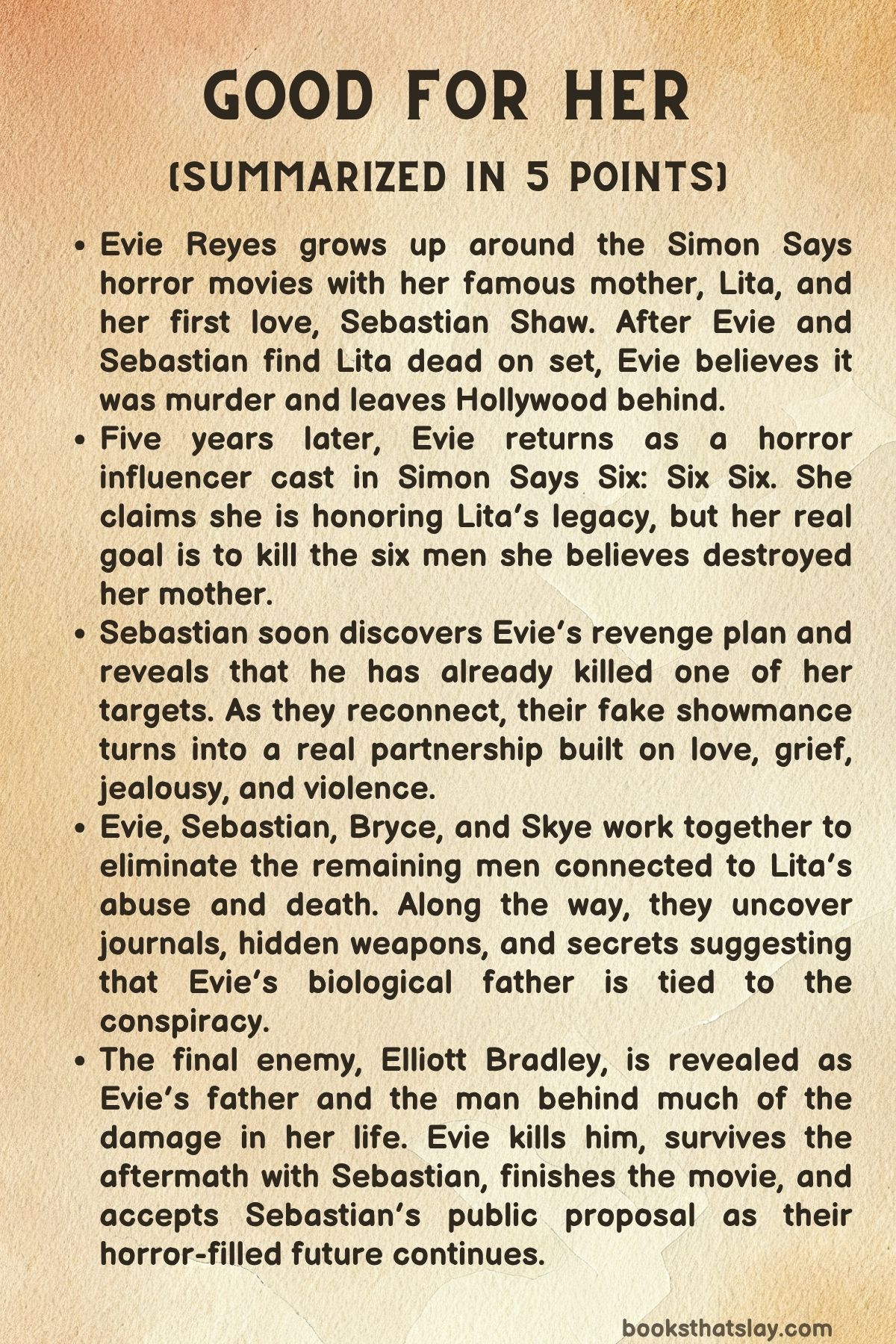
Evie Reyes grows up inside the world of horror films, surrounded by fake blood, costumes, cameras, and the larger-than-life fame of her mother, Lita Reyes. Lita is the star of the Simon Says franchise, a horror series that gives her public admiration but also traps her inside a system controlled by powerful men.
For Evie, the sets are both home and playground. She spends her childhood and teenage years near the films, watching how Hollywood works from the inside, learning early that glamour often hides ugliness.
Her closest companion is Sebastian Shaw. He is her best friend, her partner in mischief, and the one person who understands her strange, movie-soaked life.
Together, they share a private language built from horror references and lines from the films they love. Their friendship turns into romance as they grow older, and the bond between them becomes intense, intimate, and full of trust.
They fall in love as teenagers and sleep together for the first time, believing they have crossed into a new stage of their lives together.
That hope is destroyed the next morning. Evie and Sebastian arrive on set early and find Lita’s body hanging from the scaffolding.
The official story says Lita died by suicide, but Evie knows that is not true. She is certain her mother was murdered.
The shock of Lita’s death breaks Evie’s world apart. Instead of staying in Hollywood, she leaves for Michigan and cuts off Sebastian completely.
Her grief hardens into anger, and over the next five years she carries the belief that six men were responsible for what happened to her mother.
When Evie returns to Hollywood, she does so with a carefully built public image. She is now a horror influencer, and she joins the new film, Simon Says Six: Six Six, under the claim that she wants to honor Lita’s legacy.
To everyone watching, her return looks like a daughter stepping back into her mother’s world. In truth, Evie has come back to punish the men she believes ruined Lita and caused her death.
Her list includes Thornton, Dourif, Castle, Hodder, Englund, and Bradley.
Sebastian is now the adult star of the franchise, and Evie’s return shakes him. He is hurt by the way she disappeared, still drawn to her, and suspicious of what she is really doing there.
Their reunion is tense from the start. Old love, resentment, jealousy, and unfinished grief sit between them.
Things grow more complicated when Evie is cast as Sebastian’s love interest, taking the role another actress, Skye, had expected. Their staged romance for the movie brings Evie and Sebastian back into close contact, forcing them to face the past they never truly escaped.
Evie’s first major target is connected to the Thornton family. She gets close to Glenn Thornton, the son of Michael Thornton, one of the men she blames for Lita’s death.
Glenn insults Lita and claims she had an affair with his father. The conversation pushes Evie past restraint, and she attacks him.
Sebastian arrives and finds Glenn tied up, realizing Evie has come back with violent intentions. Instead of stopping her, he reveals a secret of his own: he has already killed Michael Thornton.
Months earlier, Sebastian manipulated Michael’s medication during a meeting connected to the movie’s funding.
Glenn becomes a problem they cannot leave behind. When he threatens them, Sebastian poisons him by putting bleach into an energy drink.
Evie and Sebastian dispose of the body together, crossing a line that makes them partners in revenge. Evie understands then that Sebastian not only knows what she is doing, but is willing to join her.
Their shared guilt and shared purpose pull them closer, even as both of them become more dangerous.
To remain close to the franchise and the people they are hunting, Evie agrees to a showmance contract with Sebastian. Publicly, they play the role of a glamorous couple for publicity.
Privately, the fake relationship becomes difficult to separate from their real feelings. As they film romantic scenes, face media attention, and deal with scandals, their old connection returns.
They are no longer the teenagers who lost everything, but the bond between them has not vanished. It has only become darker, more complicated, and tied to blood.
Their revenge expands as they target Jason Dourif. Through him, Evie learns more about how Lita was exploited.
The more Evie discovers, the clearer it becomes that her mother was trapped by men who used her beauty, talent, and vulnerability for their own gain. Lita’s image had been sold to the public, but her pain had been hidden and dismissed.
Killing Jason brings Evie closer to the truth, but it also confirms that the conspiracy around Lita was larger and more personal than she first understood.
Bryce, the actor who plays Simon Says, becomes an important ally. He reveals that Lita left Evie engraved daggers, giving Evie a physical link to her mother and a symbol of the justice she seeks.
Bryce is not simply a performer hiding behind a mask; he proves loyal, resourceful, and willing to protect Evie. Skye also becomes part of the group, and together they help cover up Glenn’s death while shielding Evie and Sebastian from discovery.
What begins as Evie’s private mission grows into a small circle of people bound by secrets, loyalty, and violence.
Fred Castle is another powerful figure tied to the past. A lawyer and Sebastian’s neighbor, Fred uses his status to humiliate and threaten them during a party.
He represents the kind of man who has survived for years because he knows how to control people, shape stories, and frighten anyone who might expose him. Bryce kills Fred in a hot tub using electricity, and the group stages the scene to hide what really happened.
Each death brings them closer to the center of the truth, but also makes escape from their crimes less possible.
Evie and Sebastian then turn their attention to Charles Hodder. Charles had once loved Lita and kept journals about her.
At first, his connection to Lita seems different from the others, but he is still part of the web surrounding her life and death. When Charles captures Evie and Sebastian, the danger becomes immediate and personal.
Skye rescues them and kills him, proving that she is more than a rival or bystander. Charles’s journals reveal painful details about Lita’s past.
They show how the men around her used and abused her, and they also suggest that Evie’s biological father may be one of the remaining men on her list.
The final targets are Arthur Englund and Elliott Bradley. Arthur is manipulative and cruel.
He tries to turn Evie and Sebastian against each other, using strange “Ich lüge” bullets and suggesting that Sebastian is the true monster. His mind games strike at the weakest parts of their relationship.
Evie, injured and overwhelmed by revenge, begins to pull away from Sebastian. For a time, the two fracture under the pressure of everything they have done and everything they still need to face.
Yet their connection survives the break. They reconcile, choosing each other again despite the damage between them.
Sebastian’s past also comes into focus through Heather, his former agent. After Evie left, Heather groomed and exploited him, taking advantage of his loneliness, youth, and need for guidance.
Her abuse reveals that Sebastian, like Lita and Evie, has been harmed by the same industry that made him famous. Evie and Sebastian confront Heather together, then kill and dispose of her.
This act is not part of Evie’s original list, but it becomes part of their broader fight against the people who shaped and profited from their pain.
Arthur eventually dies during filming after Evie gives him a poisoned energy drink. With him gone, Elliott Bradley remains.
Elliott is revealed as Evie’s biological father and the true force behind much of what happened. He is not only connected to Lita’s death, but also to the wider machinery of control that kept the truth buried.
His confession gives Evie enough to understand the scale of his power. He also claims responsibility for killing Antoinette, Evie’s agent, adding another loss to the long list of harm he has caused.
The final confrontation happens at Sebastian’s house, where Elliott attacks Evie. This fight brings Evie face to face with the man who helped create her life and tried to control the story of her mother’s death.
Evie refuses to be another victim in his version of events. She traps Elliott beneath the pool cover and drowns him, nearly dying in the process.
Sebastian arrives in time to save her, and the moment closes the revenge mission that brought Evie back to Hollywood.
After Elliott’s death, Bryce helps patch Evie up, and the group keeps moving forward. The film is completed despite everything that happened behind the scenes.
Simon Says Six: Six Six becomes a major success, turning the franchise’s bloody legacy into another public triumph while the truth remains known only to those who survived it. Evie and Sebastian stay together, no longer pretending that their relationship is only for publicity.
They have hurt people, protected each other, and faced the ghosts that ruled their lives.
At an awards event, Sebastian publicly proposes to Evie, turning their story into a spectacle in front of the same industry that once broke them. Evie accepts.
Bryce announces that Simon Says Seven is already on the way, and Evie agrees to make another movie with Sebastian. By the end of Good for Her, Evie has claimed revenge for her mother, chosen the man who stood beside her, and stepped fully into the horror legacy that once haunted her.
Characters
Evie Reyes
Evie Reyes is the emotional and moral center of Good for Her, a character shaped by grief, betrayal, love, and a hunger for justice that slowly becomes inseparable from revenge. As a child of Hollywood, she grows up around performance, violence, and illusion, but the murder of her mother destroys any innocence she has left.
Her decision to leave Hollywood for Michigan shows how deeply traumatized she is, because she does not simply leave a place; she cuts herself away from Sebastian, her childhood, and the world that reminds her of Lita. When she returns five years later, Evie is no longer only a grieving daughter.
She has become someone precise, secretive, and dangerous, using her public image as a horror influencer to hide a private mission of murder.
Evie’s complexity comes from the fact that her violence is rooted in love. She does terrible things, but the book presents her rage as the result of years of silence, exploitation, and unanswered truth.
Her revenge is not random cruelty; it is a response to a system of men who harmed her mother and then protected themselves. At the same time, Evie is not emotionally untouched by what she does.
Her obsession with revenge strains her relationship with Sebastian, isolates her, and nearly destroys her sense of self. She wants justice for Lita, but she also wants control over a life that has been controlled by others since childhood.
Evie’s relationship with Sebastian reveals her softer and more vulnerable side. Their shared history gives her a connection to the person she was before everything fell apart.
Even when she pushes him away, lies to him, or acts recklessly, her bond with him remains one of the few things that keeps her human. By the end of the story, Evie survives not because revenge fully heals her, but because she is able to accept love, loyalty, and a future beyond the deaths that shaped her.
She is fierce, wounded, intelligent, and morally complicated, making her one of the most powerful characters in the book.
Sebastian Shaw
Sebastian Shaw is Evie’s childhood best friend, first love, partner in revenge, and emotional mirror. He begins as someone tied deeply to Evie’s past, especially to the years they spent together on the Simon Says horror franchise.
Their bond is built on shared language, shared desire, and shared trauma, but when Evie leaves him after Lita’s death, Sebastian is left behind in Hollywood to become part of the very industry that damaged them both. As an adult star of the franchise, he appears successful, but underneath that success is loneliness, pain, and his own history of exploitation.
Sebastian’s most important quality is his devotion to Evie. When she returns, he quickly senses that she is hiding something, but instead of rejecting her darkness, he steps into it.
His confession that he killed Michael Thornton before Evie even returned changes the reader’s understanding of him. Sebastian is not merely reacting to Evie’s revenge plan; he has already been carrying his own violent loyalty.
This makes him both romantic and frightening. He loves Evie so completely that he is willing to kill for her, lie for her, and build a future with her on top of buried bodies.
Sebastian is also a victim in his own right. His past with Heather reveals that he was groomed and exploited after Evie left, showing that his fame did not protect him from harm.
This gives his character a tragic dimension, because he is not simply a charming actor or a dangerous lover. He is someone who has been used by Hollywood and has learned to survive by becoming controlled, guarded, and ruthless.
His love for Evie helps him reclaim agency, but it also draws out his most violent instincts. By the end, Sebastian’s proposal is not just a romantic gesture; it is proof that he and Evie have chosen each other despite everything they have done and endured.
Lita Reyes
Lita Reyes is dead before much of the main action unfolds, but she remains one of the most influential characters in the story. As Evie’s mother and a major figure in the Simon Says franchise, Lita represents both glamour and suffering.
To the public, she is a movie star whose legacy can be packaged, marketed, and honored. To Evie, she is a beloved mother whose death was falsely dismissed as suicide.
The difference between these two versions of Lita drives much of the book’s conflict, because Evie’s revenge is an attempt to uncover the truth beneath the image Hollywood created.
Lita’s character is tragic because she appears to have been surrounded by men who desired, used, controlled, and ultimately destroyed her. The information revealed through confessions and journals shows that her life was not simply marked by fame, but by exploitation.
She becomes a symbol of how powerful people can rewrite a woman’s pain, turning abuse into rumor and murder into scandal. Even after death, men continue to speak about her as if she belonged to them, which makes Evie’s rage feel deeply personal and justified.
Lita’s presence also shapes the emotional inheritance Evie carries. Evie does not only mourn her mother; she inherits her mother’s unfinished fight.
The engraved daggers Lita leaves for Evie suggest preparation, warning, and love. They make Lita feel like a woman who understood danger and tried, in the limited ways available to her, to protect her daughter.
Although Lita is absent physically, she dominates the moral atmosphere of the story. Every act of revenge, every revelation, and every confrontation leads back to what was done to her.
Bryce
Bryce is one of the most surprising allies in the story, especially because he plays Simon Says, the masked horror figure at the center of the franchise. At first, his role could make him seem like a symbol of the industry that consumed Lita and Evie, but he gradually becomes part of Evie and Sebastian’s chosen circle.
His decision to join their side after revealing Lita’s engraved daggers shows that he understands more than he initially lets on. He becomes a keeper of hidden truth and a protector rather than just another performer in the franchise.
Bryce’s character is important because he brings loyalty, practicality, and dark competence to the group. His killing of Fred Castle in the hot tub proves that he is willing to cross the same moral lines as Evie and Sebastian.
However, his violence feels less impulsive and more strategic. Bryce does not simply sympathize from a distance; he acts when action is needed.
His ability to help stage scenes, cover up crimes, and patch Evie up after the final fight makes him one of the group’s most reliable figures.
Bryce also gives the story a sense of found family. He is not connected to Evie through childhood love like Sebastian, or blood like Lita and Elliott, but he chooses to stand with her.
That choice matters because Evie has spent much of her life surrounded by people who either abandoned the truth or benefited from lies. Bryce’s loyalty helps create a new circle around her, one based on protection rather than exploitation.
His announcement that another Simon Says film is coming also positions him as part of Evie and Sebastian’s future, not just their revenge.
Skye
Skye begins as a potential rival to Evie, especially when Evie is cast as Sebastian’s love interest instead of her. Because of this, she could easily have remained a jealous actress or obstacle in the romance, but the story develops her into something far more meaningful.
Skye becomes an ally, a rescuer, and a key member of the group that protects Evie. Her shift from romantic or professional competition to genuine loyalty adds depth to her role and prevents her from being reduced to a simple rival.
Skye’s defining moment comes when she rescues Evie and Sebastian from Charles Hodder and kills him. This act proves her courage and decisiveness.
She does not merely support the main characters emotionally; she risks herself and becomes directly involved in their violent world. Her actions show that she is capable of seeing the truth of a situation and choosing a side, even when that choice is dangerous.
Skye’s loyalty is especially valuable because it is not based on lifelong attachment. She earns her place through action.
Skye also helps balance the emotional world of the story. In a narrative filled with secrets, revenge, and old trauma, she represents the possibility of new trust.
She protects Evie not because she has to, but because she chooses to. Her presence also expands the story beyond Evie and Sebastian’s intense relationship, showing that survival depends on more than romance.
It depends on allies who are brave enough to stand against powerful people.
Glenn Thornton
Glenn Thornton is one of the first major targets Evie confronts after returning to Hollywood, and his role establishes the danger and ugliness of the world she has re-entered. As the son of Michael Thornton, he is connected to the older generation of men Evie believes destroyed Lita.
Glenn’s insults about Lita and his claim that she had an affair with his father reveal his cruelty and entitlement. He speaks about Lita not with respect, but with the arrogance of someone who believes powerful men have the right to possess and define women.
Glenn’s death is important because it brings Evie and Sebastian fully together in violence. When Sebastian poisons him after finding him tied up, the story shifts from Evie’s private revenge fantasy into a shared mission.
Glenn is not one of the original six men Evie came to kill, but his behavior and threats make him part of the same corrupt inheritance. He represents the next generation of Hollywood privilege, carrying forward the same contempt and protection that allowed men like his father to escape consequences.
As a character, Glenn is not meant to be sympathetic. His purpose is to expose how casually the truth about Lita has been distorted and how easily powerful families protect their own reputations.
His confrontation with Evie forces her to act, but it also reveals that she is not alone. Glenn’s death becomes the first proof that Sebastian is not merely Evie’s lost love.
He is her accomplice.
Michael Thornton
Michael Thornton is one of the men Evie believes responsible for Lita’s death, though he is already dead before Evie can personally confront him. His importance comes through Sebastian’s confession that he killed Michael months earlier by manipulating his medication during a meeting about film funding.
This revelation makes Michael a key figure in both the revenge plot and Sebastian’s characterization. He is one of the hidden villains whose influence continues even after death.
Michael represents the older Hollywood power structure that the story condemns. His connection to Lita, Glenn’s claim about an affair, and his place on Evie’s list all suggest that he was part of the group that used and harmed her.
Even without appearing directly for a long time in the present action, he casts a shadow over the story. His death shows that the revenge plot began before Evie’s official return, meaning the need for justice had already infected Sebastian’s life.
Michael’s character also matters because of what he passes down. Glenn’s behavior reflects the same entitlement and disrespect associated with his father’s generation.
Through Michael and Glenn, the story shows corruption as something inherited, protected, and repeated. Michael may be gone, but the damage he helped create remains alive until Evie and Sebastian begin dismantling it.
Jason Dourif
Jason Dourif is one of Evie’s targets and one of the men connected to Lita’s exploitation. His role is significant because he reveals information that helps Evie better understand what happened to her mother.
In revenge stories, targets often function only as obstacles, but Jason also serves as a source of truth. His presence helps confirm that Evie’s suspicions are not baseless and that Lita’s death was part of a much larger pattern of abuse and control.
Jason’s character represents cowardice and complicity. He knows pieces of the truth, but like the other men involved, he has benefited from silence.
His eventual death is not just punishment for what he did, but for what he helped conceal. In this sense, Jason is part of the machinery that allowed Lita’s suffering to be erased.
He may not be presented as the final mastermind, but he belongs to the circle of men whose choices made the murder possible.
His importance also lies in how his death deepens Evie and Sebastian’s commitment. Each target they kill gives them more information, but it also pulls them further from ordinary morality.
Jason’s role pushes the story forward by turning revenge into investigation. Evie is not only killing the men on her list; she is uncovering the hidden history they tried to bury.
Fred Castle
Fred Castle is a powerful lawyer, Sebastian’s neighbor, and one of the men tied to the conspiracy around Lita. He represents legal and social power, the kind of man who can humiliate, threaten, and intimidate others because he believes consequences are for weaker people.
His behavior at the party shows his arrogance and his confidence that he can still control the people around him. He is dangerous not only because of what he may have done in the past, but because he still has the influence to harm Evie and Sebastian in the present.
Fred’s death at Bryce’s hands is one of the moments where the revenge circle expands beyond Evie and Sebastian. Bryce killing him with electricity in the hot tub shows that the group’s loyalty has become active and deadly.
Fred’s staged death also reflects the story’s horror-movie logic, where punishment becomes theatrical and symbolic. A man who used power and intimidation is destroyed in a scene that turns his own comfort and luxury against him.
As a character, Fred embodies the protection system around abusers. His profession as a lawyer matters because it suggests knowledge of how to hide wrongdoing, manipulate narratives, and threaten victims into silence.
His death removes one more shield from the larger conspiracy. He is not just a villain because he is cruel; he is a villain because he represents the institutions that help cruelty survive.
Charles Hodder
Charles Hodder is one of the more emotionally complicated targets because he once loved Lita and kept journals about her. Unlike some of the other men, his connection to Lita is not presented only through contempt or control.
However, that does not make him innocent. His love appears possessive, obsessive, and unable to save her from the exploitation surrounding her.
He becomes another example of a man who may have claimed to care for Lita while still participating in, enabling, or failing to stop the harm done to her.
Charles’s journals are crucial because they reveal more of Lita’s past and help Evie understand the depth of the conspiracy. Through him, the story shows how memory can be both evidence and violation.
His writings preserve pieces of Lita, but they also suggest that she was watched, interpreted, and possessed by men even in private. Charles’s version of love does not free Lita; it traps her inside his perspective.
His capture of Evie and Sebastian reveals the danger beneath his sentimentality. Whatever love he once felt for Lita, he is still capable of violence and control.
Skye’s rescue and killing of Charles mark a turning point because his death gives the group access to truths that reshape Evie’s understanding of herself, especially the possibility that one of the remaining men is her biological father. Charles is tragic, but he is not absolved.
His character shows that obsession can disguise itself as devotion.
Arthur Englund
Arthur Englund is one of the final targets and one of the most manipulative figures in the book. He understands how to attack Evie and Sebastian psychologically, not just physically.
His use of “Ich lüge” bullets and his claim that Sebastian is the real monster are designed to create doubt, division, and emotional collapse. Arthur’s power lies in his ability to twist truth and fear into weapons.
He does not merely threaten the couple’s lives; he threatens their trust in each other.
Arthur’s role is important because he exposes the instability inside Evie’s revenge mission. By the time she reaches him, Evie is injured, consumed by rage, and increasingly close to losing herself.
Arthur takes advantage of that vulnerability. His manipulation briefly separates Evie and Sebastian, showing that their relationship, though intense, is not invincible.
He understands that the best way to hurt them is to make them question whether their love has become monstrous.
His death by poisoned energy drink during filming is fitting because it combines performance, deception, and revenge. Arthur tries to control the script of Evie and Sebastian’s lives, but Evie turns that control back on him.
As a character, Arthur represents psychological abuse and narrative manipulation. He is dangerous because he knows how to make victims doubt themselves, and his defeat allows Evie and Sebastian to reclaim their bond before facing the final enemy.
Elliott Bradley
Elliott Bradley is the final and most personal villain, revealed as Evie’s biological father and the true power behind the murders. His role transforms the revenge plot into something even more intimate and horrifying.
Evie has spent the story hunting the men who destroyed her mother, only to discover that the ultimate source of control is also tied to her by blood. This revelation makes Elliott not only a villain but a corruption of family itself.
Elliott’s power comes from control. He admits enough for Evie to understand the scale of his influence, and he also claims responsibility for killing Antoinette.
He is not merely one participant among many; he is the figure who stands behind the network of abuse, silence, and murder. His connection to Evie makes his villainy especially cruel because he represents the biological truth she never asked for.
Instead of offering identity or belonging, he offers domination and threat.
The final fight, where Evie traps Elliott under the pool cover and drowns him, is symbolically powerful. Elliott tries to invade Sebastian’s house and destroy Evie, but she turns the environment against him and survives.
Her near-death in the process shows that defeating him costs almost everything. Elliott’s death is the climax of Evie’s revenge and the final severing of the bloodline of control.
By killing him, she rejects the idea that biology defines her and chooses the family she has built instead.
Heather
Heather is Sebastian’s former agent and one of the clearest examples of exploitation in the story. Her grooming and abuse of Sebastian after Evie left reveal that Sebastian’s years in Hollywood were marked by more suffering than Evie initially understands.
Heather’s role is important because she broadens the story’s focus beyond Lita and Evie, showing that the industry’s abuse is not limited to one woman or one generation. Sebastian, too, has been used by someone with power over his career and emotional vulnerability.
Heather’s character is disturbing because she hides exploitation behind professional authority. As an agent, she should have protected Sebastian’s interests, but instead she took advantage of him.
This makes her betrayal both personal and structural. She represents the people who use access, contracts, fame, and ambition to control young performers.
Her presence helps explain Sebastian’s darkness and his willingness to kill. He has not simply become violent because he loves Evie; he has also been shaped by his own victimization.
Evie and Sebastian killing Heather together is significant because it allows them to confront Sebastian’s trauma as a shared truth. Until then, much of the revenge mission centers on Lita, but Heather’s death acknowledges Sebastian’s pain as equally real.
Her removal is not just another act of violence; it is a moment where Sebastian stops being only Evie’s protector and becomes someone whose wounds are also seen and avenged.
Antoinette
Antoinette is Evie’s agent, and although she does not dominate the action, her death matters because it reveals the reach of Elliott Bradley’s power. When Elliott claims responsibility for killing her, Antoinette becomes another casualty in the web surrounding Evie.
Her fate shows that anyone connected to Evie can become a target if they interfere with the hidden forces controlling the truth.
Antoinette’s importance lies in what her death represents. She is not one of the original conspirators or revenge targets, but she becomes proof that the danger is still active.
The villains are not only guilty of past crimes against Lita; they are willing to keep killing in the present to maintain control. Antoinette’s death raises the stakes by showing that Evie’s return to Hollywood has consequences for people around her.
As a character, Antoinette also reflects the difficulty of trust in Evie’s world. Agents, lawyers, producers, and performers all exist inside a system where professional relationships can become dangerous.
Unlike Heather, Antoinette is not framed as an exploiter of Sebastian or Evie. Instead, she becomes a victim of Elliott’s larger scheme.
Her death strengthens the sense that Evie is fighting not only for her mother, but against a system that continues to destroy anyone who gets too close to the truth.
Themes
Revenge as a Response to Power
In Good for Her, revenge grows out of years of silence, grief, and institutional protection. Evie’s violence is not presented as random anger but as a direct response to men who used fame, money, and influence to avoid consequences.
Her targets are not only individual criminals; they represent an entire system that allowed Lita to be exploited, dismissed, and finally erased. Evie’s return to Hollywood becomes an attempt to take control of a story that powerful men had already written for her mother.
Her revenge is personal, but it is also symbolic because each killing challenges the idea that wealth and reputation can protect abusers forever. At the same time, the novel does not make revenge feel clean or simple.
Evie becomes more isolated, more reckless, and more emotionally unstable as her mission continues. Her pain gives her purpose, but it also threatens to consume her identity.
The theme shows revenge as both empowerment and danger: it restores agency, but it also demands a heavy emotional cost.
Love Built Through Shared Damage
Evie and Sebastian’s relationship is shaped by longing, betrayal, guilt, and survival. Their love begins in youth, when horror movies, private jokes, and emotional dependence create a bond that feels separate from the world around them.
Lita’s death breaks that bond, leaving both of them trapped in different versions of the same trauma. When they reunite years later, their attraction is still present, but it is tangled with resentment and mistrust.
Sebastian’s willingness to help Evie kill shows devotion, but it also reveals how damaged he has become in her absence. Their romance is not gentle or innocent; it is built through secrecy, shared crimes, and the recognition that both have been harmed by Hollywood’s cruelty.
What makes their love significant is that they understand the worst parts of each other without turning away. The relationship becomes a place where they can be fully seen, even when they are violent, broken, or afraid.
Love here is not a cure, but it becomes a form of loyalty and survival.
Hollywood, Exploitation, and Image
Hollywood appears as a world where image matters more than truth. Public relations, contracts, casting decisions, and celebrity narratives are used to hide pain behind glamour.
Evie’s return is publicly framed as a tribute to her mother, but privately it is an act of investigation and punishment. This contrast exposes how the entertainment industry can turn real suffering into marketable content.
Lita’s life and death are shaped by men who treat her as useful only when she can serve their desires, careers, or reputations. Even after her death, others continue to control the story told about her.
Sebastian’s past with Heather also shows how young performers can be manipulated by adults who claim to be helping them. The horror franchise becomes more than a film setting; it reflects the real horrors behind celebrity culture.
The theme criticizes a system that protects powerful people, rewrites abuse as scandal, and rewards silence. Beneath the fame and success, the industry is shown as a place where exploitation can be carefully packaged as entertainment.
Inherited Trauma and Reclaiming Identity
Evie’s life is shaped by a trauma she did not fully understand when it happened. Lita’s death does not remain in the past; it controls Evie’s relationships, career choices, and sense of self.
Her belief that her mother was murdered gives her a mission, but it also keeps her trapped inside the moment of loss. As she uncovers more about Lita’s exploitation and her own parentage, Evie realizes that her identity has been shaped by secrets others kept from her.
The revelation about Elliott Bradley is especially painful because it connects her existence to the same abuse and control she has been fighting. Yet Evie’s journey is not only about discovering what happened to her mother.
It is also about deciding who she will become after learning the truth. By surviving Elliott and choosing a future with Sebastian and her chosen allies, Evie begins to reclaim her identity from the people who tried to define it.
The theme shows that inherited trauma can shape a person, but it does not have to own them forever.