How to Cheat Your Own Death Summary, Characters and Themes
How to Cheat Your Own Death by Kristen Perrin is a mystery about inheritance, old crimes, family secrets, and the dangerous cost of stolen lives. The story follows Annie Adams after she inherits Gravesdown Hall and the unsettling archive of secrets left behind by her great-aunt Frances.
When a new warning from Peony Lane points toward Annie’s family, a fresh murder draws her into a case that reaches back to 1968. The novel moves between Annie’s present-day investigation and Frances’s past in London, connecting art, identity, revenge, and murder through two women whose choices still shape the truth decades later. It’s the 3rd book of the Castle Knoll Files.
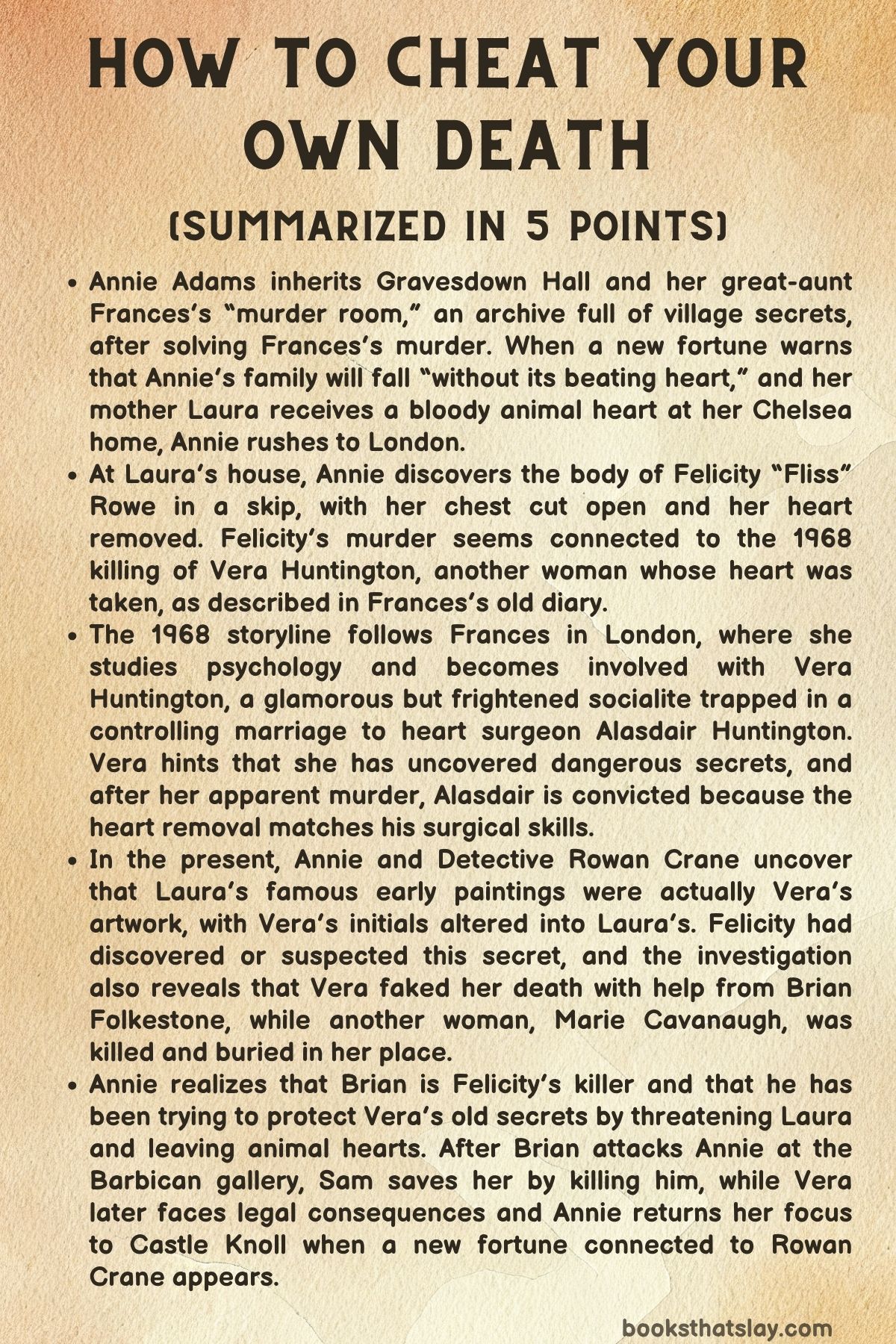
Summary
After solving the murder of her great-aunt Frances, Annie Adams inherits Gravesdown Hall, a place crowded with memories, mysteries, and the strange legacy Frances left behind. Among the most unsettling parts of that legacy is Frances’s “murder room,” an archive packed with files, notes, theories, and secrets about the people of Castle Knoll and beyond.
Annie is still adjusting to this inheritance when another warning arrives from Peony Lane, the fortune-teller whose predictions have already shaped her family’s history. This new message says that without its beating heart, Annie’s family will fall.
At first, the warning feels strange but unclear. Then Annie’s mother, Laura, mentions that she has been painting hearts.
Soon after, a bloody animal heart is left on Laura’s doorstep in Chelsea. Annie fears the warning may be coming true, so she hurries to London to check on her mother.
Laura’s house is chaotic, full of art, mess, unfinished business, and emotional tension. Annie also discovers that Laura has taken in Felicity Rowe, known as Fliss, a former lawyer from Castle Knoll who now wants to become a sculptor.
Felicity has a complicated past of her own: she was once engaged to Detective Rowan Crane and was accused of stealing money from his family.
Annie is already uneasy about Laura’s renewed connection with Sam Arlington, Annie’s father, who has been absent for much of her life. Sam’s sudden return raises old questions about trust, loyalty, and why he stayed away for so long.
Laura avoids giving Annie clear answers about Felicity, which only makes Annie more suspicious. Then, while taking rubbish outside to the skip, Annie makes a horrifying discovery.
Felicity’s body is hidden there. Her chest has been cut open, and her heart is missing.
The murder is made even more disturbing by the items around the body. Felicity lies among bin bags containing paintings that appear to be in Laura’s style.
The scene seems designed to point suspicion toward Laura or toward something connected to her art. Detective Rowan Crane arrives in London, shaken by Felicity’s death.
Felicity had recently contacted him and said she had made a terrible mistake, but she died before she could fully explain herself. Annie and Crane begin to suspect that Felicity’s murder is tied to something older and darker.
Annie turns to Frances’s records and finds a link to a murder from 1968. Frances had written about Vera Huntington, a wealthy and glamorous socialite whose heart was also removed after death.
Vera’s husband, Alasdair Huntington, was a heart surgeon, and he was convicted of the crime because the removal of the heart seemed to match his surgical skill. Yet Frances’s diary suggests that the truth may not have been as simple as the official story claimed.
The past begins with Frances moving to London in 1968 to study psychology. She joins a course led by Professor Dane, who teaches about murderers and criminal behavior.
Frances is intelligent, observant, and determined to understand the darker side of human nature. In London, she meets Max Torrence, a privileged and arrogant man who often clashes with her.
She also becomes friends with Elaine, another young woman drawn into the same social world. Through Max and Elaine, Frances enters the circle of Vera Huntington, Max’s beautiful and unpredictable sister.
Vera is married to Alasdair Huntington, a respected heart surgeon whose public image hides a cold and controlling nature. He treats Vera as unstable and dismisses her fears, but Frances begins to sense that Vera may be trapped rather than merely troubled.
Vera’s world is filled with wealth, parties, secrets, and cruelty disguised as sophistication. At a private art auction, Vera humiliates Elaine by revealing a nude painting of her.
Frances and Ford Gravesdown try to protect Elaine by buying the painting, but the damage is done. The incident exposes Vera’s power to wound others, yet it also hints that Vera herself is frightened and cornered.
As Frances spends more time around Vera, she notices changes in her. Vera becomes increasingly anxious and secretive.
She gives Frances a red handbag and hints that she has learned dangerous information about Max, Alasdair, and others in their circle. Soon afterward, Vera is believed to have been murdered.
Her heart is missing, and Alasdair is convicted. Frances never fully accepts the neatness of the solution.
Too many details feel arranged, and too many people had motives to silence Vera.
In the present, Annie and Crane investigate both Felicity’s murder and Vera’s supposed death. The connection between the two women grows stronger, especially as Felicity seems to have been looking into Laura’s art.
Annie learns from Sam that Laura’s early paintings did not bring in the fortune everyone believed they had. Instead, Sam once found valuable artworks in Frances’s house and sold them.
This confession leads Annie to a painful truth about Laura’s career.
Laura’s celebrated first series, the paintings that made her famous, were not truly hers. They were Vera Huntington’s work.
Vera’s initials had been altered so the paintings appeared to belong to Laura. Laura eventually admits that she found the paintings after Vera was believed to be dead.
She thought Vera was gone forever and used the artworks to begin her own career. What started as an act of desperation became the foundation of Laura’s fame.
Felicity had either discovered or strongly suspected this secret and was trying to remove, expose, or reclaim the paintings before she was killed.
The red handbag Vera gave Frances becomes a key piece of evidence. Inside are medical records that reveal Alasdair Huntington’s own crimes.
His dead patients were not simply unfortunate cases. They were homeless people who had died during his experimental heart surgeries.
These forgotten victims had been used and discarded by a powerful doctor who believed he could act without consequence. This discovery changes the meaning of Vera’s old case.
Alasdair was guilty of terrible crimes, but he may not have killed Vera in the way everyone believed.
Annie and Crane uncover the role of Brian Folkestone, a former constable who loved Vera. Brian had helped Vera escape her life and frame Alasdair.
The woman in Vera’s coffin was not Vera at all. It was Marie Cavanaugh, a woman connected to Alasdair and Vera, who had been killed and substituted for Vera’s body.
Vera survived and lived under another identity while the world believed she was dead. Brian’s devotion to Vera led him deeper into violence.
Later, he poisoned Alasdair in prison, acting on revenge tied to Vera and the suffering Alasdair had caused.
As Annie puts the clues together, she realizes that Brian is not only part of the old crime. He is also Felicity’s killer.
He has been stalking Laura’s house, leaving animal hearts, and trying to protect secrets that should have been buried with Vera’s old identity. Felicity came too close to the truth about the paintings, Vera, and the past, so Brian murdered her and removed her heart to echo the earlier crime.
Brian lures Annie to the Barbican gallery, where the danger finally becomes direct. He attacks her with a knife and reveals enough for Annie to understand the full horror of what he has done.
He killed Marie years ago to help Vera vanish, and he killed Felicity to keep the truth hidden. Annie is nearly killed, but Sam has been secretly following her, trying in his own flawed way to protect his daughter.
He intervenes and stabs Brian in the back, saving Annie’s life.
Sam flees afterward because his own criminal past makes staying dangerous for him. Annie protects him by claiming she killed Brian herself in self-defense.
The official ending of the case is therefore only partly true, another example of how families shape the stories they choose to tell.
After Brian’s death, Vera returns to public knowledge and faces consequences for fraud, identity theft, and her role in hiding Marie’s murder. Laura and Vera settle the dispute over the artwork, forcing Laura to face the fact that her success was built on another woman’s creations.
Annie turns her attention to Alasdair’s victims, the homeless people whose lives had been erased from the record. She begins a project to tell their stories and restore some dignity to the people who were treated as disposable.
Crane, meanwhile, pulls away from Annie. He reveals that an old killer has been taunting him for years, and he fears that anyone close to him could become a target.
His distance hurts Annie, but it also shows that his past still has power over him. At Annie’s exhibition, one of Peony Lane’s old fortune envelopes appears with Rowan Crane’s name on it.
The message suggests that the danger surrounding Crane is not finished. Annie understands that her work is not over, and she decides she must return to Castle Knoll.
Characters
The characters in How to Cheat Your Own Death are shaped by secrecy, inherited guilt, artistic ambition, family damage, and the long reach of old crimes. The book connects its present-day murder mystery with an older scandal from 1968, so many characters are important not only for what they do directly, but also for what they hide, protect, steal, misunderstand, or pass down to others.
Annie Adams
Annie Adams is the central investigative force of the book, but she is not presented as a detached detective figure. She is personally tied to almost every major secret, which makes her search for the truth emotionally dangerous as well as physically risky.
After inheriting Gravesdown Hall and Frances’s murder room, Annie becomes the keeper of a family archive filled with village secrets, and this role places her between the past and the present. She is intelligent, observant, and persistent, but her strength comes from her willingness to follow uncomfortable connections even when they involve people she loves.
Annie’s character is also defined by her complicated family loyalties. Her mother Laura’s possible connection to Felicity’s murder deeply unsettles her, and her father Sam’s sudden return creates both suspicion and longing.
Annie wants the truth, but she also wants her family to be more stable than it really is. This tension makes her a layered protagonist because she is never simply solving an outside crime; she is slowly discovering how deception has shaped her own life.
Her decision to protect Sam after he kills Brian shows how far she is willing to go when love, gratitude, fear, and justice collide.
By the end of the story, Annie has grown from someone investigating a murder into someone determined to give voice to the forgotten dead. Her project about Alasdair’s victims shows her moral development.
She does not only want to expose the glamorous or shocking parts of the mystery; she wants to restore dignity to people who were erased because they were poor, homeless, or socially invisible. This gives Annie a strong ethical center and makes her one of the most emotionally grounded characters in the book.
Frances Adams
Frances Adams is one of the most important figures in the novel because her experiences in 1968 form the foundation of the present mystery. As a young woman studying psychology in London, Frances is curious, sharp, and drawn toward the hidden motives behind human behavior.
Her interest in murderers and criminal minds is not merely academic; it becomes part of the way she learns to read the dangerous world around her. She is surrounded by wealth, manipulation, social performance, and violence, and her diary becomes a record of truths that others try to bury.
Frances is also significant because she represents a kind of moral witness. She sees the cruelty directed at Elaine, recognizes Vera’s fear, and senses that the official story of Vera’s death does not fully make sense.
Unlike many characters who use secrets for profit, power, or self-preservation, Frances collects secrets in order to understand them. Her murder room later becomes a symbolic extension of her mind: organized, watchful, suspicious, and committed to patterns others overlook.
Even after her death, Frances continues to shape the action of the story. Her files, diary, and past observations guide Annie toward the truth.
She is not simply a background relative; she is a bridge between generations. Through Frances, the book shows how unresolved injustice does not disappear with time.
It waits in papers, memories, objects, and old relationships until someone is brave enough to examine it.
Laura Arlington
Laura Arlington is a deeply flawed and emotionally vulnerable character whose artistic identity is built on a secret. At first, she appears chaotic, evasive, and fragile, especially when Annie arrives at her Chelsea house and finds her behaving strangely.
Her renewed closeness with Sam also makes her seem unreliable, as though she is repeating old emotional patterns that have already hurt her and Annie. However, Laura is not simply careless or selfish; she is someone who has spent years living inside a lie that gradually becomes inseparable from her career.
The revelation that Laura’s famous early paintings were actually Vera’s artwork changes the way her character must be understood. Laura’s success is not only artistic achievement; it is also appropriation.
Yet the book presents this act with some emotional complexity. Laura found the paintings after Vera’s supposed death and believed Vera was gone, but she still chose to alter the initials and build her reputation on another woman’s work.
This makes her both guilty and pitiable. She is not a murderer, but she benefits from the disappearance of another woman and then becomes trapped by the consequences of that benefit.
Laura’s relationship with Annie is marked by love, secrecy, and avoidance. She clearly matters deeply to Annie, but she repeatedly withholds information, which puts Annie in danger.
Her character shows how deception inside a family can be just as damaging as public crime. By the end, Laura must face the collapse of the artistic myth that sustained her.
Her settlement with Vera suggests accountability, but it does not erase the moral weight of what she has done.
Felicity “Fliss” Rowe
Felicity Rowe is one of the most tragic and morally complex figures in the book. She enters the present story already surrounded by suspicion because of her past connection to Rowan Crane and the accusation that she stole money from his family.
Her reputation makes it easy for others to see her as untrustworthy, but her murder reveals that she was much more than a scandalous figure from Crane’s past. She had discovered, or was close to discovering, a secret powerful enough to get her killed.
Felicity’s role is especially important because she connects the present-day murder to the buried crimes surrounding Vera. Her death mirrors the older heart-removal crime, making her body a message as well as a murder victim.
The removal of her heart turns her into part of a symbolic pattern: women punished, silenced, and physically violated because they came too close to dangerous truths. Her final call to Crane, in which she says she has made a terrible mistake, suggests fear, regret, and a desire to repair something before it is too late.
Although Felicity is dead for much of the story, her presence continues to pressure the living characters. She exposes Laura’s hidden vulnerability, reopens Crane’s emotional wounds, and forces Annie to investigate the link between art theft, old murder, and revenge.
Felicity is not only a victim; she is a catalyst. Her death pulls the secret history of Vera, Brian, Laura, and Alasdair back into the present.
Rowan Crane
Rowan Crane is a detective figure, but his character is shaped as much by personal pain as by professional duty. His past engagement to Felicity gives her murder an emotional weight that complicates his investigation.
He is shaken by her final call, and this shows that despite whatever happened between them, he still carries unresolved feelings and guilt. Crane is controlled, capable, and serious, but the story gradually reveals that his calmness hides fear and trauma.
Crane’s relationship with Annie is built on trust, attraction, and shared danger, but it is also limited by his instinct to protect her from the darker parts of his life. When he pulls away from her near the end, his distance is not simple rejection.
It comes from the revelation that an old killer has been taunting him and that anyone close to him may become a target. This makes Crane a character haunted by threats that extend beyond the central mystery.
His importance lies in the way he balances Annie’s more personal investigation. He brings official experience, but he is not emotionally untouched by the case.
His connection to Felicity and his concern for Annie make him vulnerable. The fortune envelope bearing his name at Annie’s exhibition suggests that his story is not finished and that he may become the center of the next danger.
Vera Huntington
Vera Huntington is one of the most fascinating characters in the novel because she is at once victim, artist, manipulator, survivor, and criminal. In the 1968 storyline, she appears glamorous, wealthy, and socially powerful, but beneath that surface she is trapped in a controlling marriage to Alasdair.
Her fear and instability are not simple weakness; they are signs of a woman living under pressure and surrounded by dangerous men. She understands more than she first reveals, and her red handbag becomes a crucial container of hidden truth.
Vera’s treatment of Elaine at the private art auction shows her cruelty and recklessness. She humiliates Elaine by revealing the nude painting, which makes Vera difficult to view only as a victim.
Yet Vera is also an artist whose work is later stolen and turned into the foundation of Laura’s career. Her identity is repeatedly taken, reshaped, or hidden by others, but she also participates in deception herself by faking her death and allowing another woman’s body to stand in for hers.
Vera’s survival under another identity gives her character a sharp moral ambiguity. She escapes Alasdair and helps expose his crimes indirectly, but her freedom depends on Marie Cavanaugh’s death being concealed.
She is damaged by patriarchy, control, and fear, but she also protects herself through fraud and silence. Her eventual reemergence forces the story to confront the uncomfortable fact that survival does not always make a person innocent.
Alasdair Huntington
Alasdair Huntington is one of the clearest representations of power abused under the appearance of respectability. As a heart surgeon, he holds a position associated with skill, authority, and saving lives, but the medical records reveal a horrific truth about his experimental surgeries on homeless people.
His crimes are especially disturbing because his victims are people society already overlooks. He exploits their vulnerability and treats them as disposable bodies for his ambition.
His marriage to Vera also reveals his controlling nature. He dismisses her as unstable, which allows him to undermine her credibility and control the narrative around her.
This makes him dangerous not only because of what he does medically, but because of the social power he has to define truth for others. His authority protects him until the evidence becomes impossible to ignore.
Although Alasdair is convicted for Vera’s supposed murder, the full truth is more complicated. He is guilty of terrible crimes, but the body believed to be Vera’s is not Vera.
This makes him a morally guilty man punished through a legally distorted version of events. His later poisoning in prison extends the cycle of revenge and secrecy that surrounds Vera and Brian.
Alasdair’s character shows how institutional power can hide brutality, especially when the victims lack status.
Brian Folkestone
Brian Folkestone is one of the darkest characters in the story because he commits violence in the name of loyalty and protection. As a former constable, he once belonged to the world of law and order, but his love for Vera draws him into murder, concealment, stalking, and revenge.
His devotion is not noble in any simple sense. It becomes obsessive, corrupting his judgment until he believes that killing people is justified if it protects Vera’s secrets.
Brian’s role in Marie’s death and Felicity’s murder makes him the living link between the old crime and the present one. He is not merely repeating the past; he is actively preserving it.
His use of animal hearts and his stalking of Laura’s house show a theatrical cruelty meant to frighten and control. He understands the symbolic power of the heart and uses it to warn, punish, and intimidate.
His final confrontation with Annie at the Barbican gallery reveals the extent of his violence. He is dangerous because he sees himself as purposeful rather than senseless.
In his own mind, he is protecting someone he loves and maintaining a necessary secret. This self-justification makes him more chilling.
Brian’s character shows how love, when mixed with obsession and secrecy, can become monstrous.
Sam Arlington
Sam Arlington is Annie’s absent father, and his character is defined by unreliability, charm, guilt, and unexpected protectiveness. His reappearance unsettles Annie because he represents a part of her family history marked by abandonment and mistrust.
His renewed relationship with Laura makes Annie worry that old mistakes are being repeated. At first, Sam seems like someone who may be using emotional closeness to avoid accountability.
The revelation that Sam sold valuable works found in Frances’s house adds another layer to his moral ambiguity. He is connected to the financial lies surrounding Laura’s career, and his actions suggest opportunism.
Yet Sam is not presented as purely selfish. He secretly follows Annie to protect her and ultimately saves her life by stabbing Brian.
This act does not erase his past, but it complicates him.
Sam’s decision to flee after Brian’s death reflects his inability to fully step into responsibility. Annie’s choice to claim self-defense on his behalf shows the painful bond between them.
Sam is both a failed father and a lifesaver, both a criminally compromised man and someone capable of real love. His character adds emotional messiness to the story’s moral landscape.
Max Torrence
Max Torrence represents privilege, arrogance, and the entitlement of a social world that protects its own. In the 1968 storyline, he clashes with Frances and is connected to Vera’s glamorous but dangerous circle.
As Vera’s brother, he belongs to the same upper-class environment that Frances enters as an outsider. His presence helps show the difference between people who inherit power and those who must fight to be heard.
Max’s importance comes from the suspicion and danger that gather around him. Vera hints that she has discovered secrets involving Max, Alasdair, and others, which places him within the network of hidden corruption.
Even when he is not the central criminal, he helps create the atmosphere of threat surrounding Vera. He is part of a world where reputation matters more than truth and where cruelty can be disguised as sophistication.
As a character, Max is less emotionally open than many others, but that is part of his function. He embodies the coldness of elite social circles, where people can humiliate, manipulate, and endanger others while maintaining appearances.
His clashes with Frances also sharpen her role as a watchful outsider who sees the ugliness behind status.
Elaine
Elaine is a vulnerable and sympathetic figure whose humiliation at the private art auction reveals the cruelty of Vera’s social world. As Frances’s friend, she brings warmth and emotional stakes to the 1968 storyline.
Her experience with the nude painting shows how women’s bodies and reputations can be used against them for entertainment, control, or social punishment. The scene involving her painting is not only embarrassing for Elaine; it exposes the casual brutality of the people around her.
Elaine’s character also helps reveal Frances’s loyalty. Frances and Ford try to protect her by buying the painting, which shows that Elaine inspires genuine care in those who understand the harm being done to her.
Through Elaine, the book contrasts kindness and exploitation. She is not a powerful character in terms of social status, but her mistreatment is central to understanding the moral atmosphere of the past.
Elaine represents the people who are harmed by the games of the wealthy and powerful without necessarily being part of the central crime. Her role reminds the reader that violence in the story is not limited to murder.
Public humiliation, objectification, and social cruelty are also forms of damage, and Elaine’s experience makes that damage visible.
Ford Gravesdown
Ford Gravesdown is important as a protective and decent presence in Frances’s 1968 world. His attempt to help Frances protect Elaine by buying the painting shows that he has a moral instinct that sets him apart from the more callous figures around Vera.
He is connected to the Gravesdown legacy, which later becomes important through Frances’s house and archive, but his immediate role is emotional and ethical.
Ford’s character gives Frances someone who can act with her rather than against her. In a world filled with people hiding motives, Ford appears more straightforwardly compassionate.
His concern for Elaine suggests that he recognizes harm even when others dismiss it as entertainment or scandal. This makes him a stabilizing figure in the older storyline.
Although he may not dominate the plot in the same way as Vera, Frances, or Alasdair, Ford helps establish the contrast between those who protect the vulnerable and those who exploit them. His presence supports the book’s broader concern with moral choice.
When people witness cruelty, they can ignore it, benefit from it, or try to stop it. Ford belongs to the group that tries to stop it.
Professor Dane
Professor Dane shapes the intellectual environment of Frances’s 1968 storyline. As the professor leading the course on murderers, he introduces Frances to formal ways of thinking about crime, motive, psychology, and deviance.
His presence matters because Frances’s later habit of collecting evidence and interpreting patterns is connected to this early academic world. He gives structure to her curiosity, even though the real crimes around her soon become more urgent than anything discussed in class.
He also represents the distance between studying murder and being close to it. In the classroom, violence can be analyzed as theory, but Frances’s experiences with Vera, Elaine, Alasdair, and Max show that crime is not abstract.
It is social, intimate, and often hidden behind respectable surfaces. Professor Dane’s role therefore helps create contrast between academic understanding and lived danger.
As a supporting character, Professor Dane does not carry the emotional weight of the central figures, but he helps frame Frances’s development. Through him, the book shows how fascination with murder can begin as intellectual curiosity and become a practical tool for survival, investigation, and justice.
Marie Cavanaugh
Marie Cavanaugh is one of the most tragic hidden victims in the story. Her death is essential to the deception that allows Vera to survive, yet for much of the book, her identity is erased.
She is reduced to a substitute body, someone whose death enables another woman’s disappearance. This makes her character important even though she is not present in the same active way as Annie, Vera, or Laura.
Marie’s connection to Alasdair and Vera places her inside the dangerous web of secrets surrounding the Huntington household. Her murder exposes the moral cost of Vera’s escape and Brian’s devotion.
Vera survives, but Marie is denied recognition, justice, and even her own name in death. This makes her one of the clearest examples of how the powerless are used by those desperate to protect themselves.
Her character also deepens the book’s concern with forgotten victims. Like Alasdair’s homeless patients, Marie becomes someone whose life is hidden beneath a more dramatic story involving wealth, art, and scandal.
Recovering the truth about her is part of the larger moral correction the novel attempts. Marie matters because the mystery is not complete until the person buried under Vera’s false death is seen as a real victim.
Peony Lane
Peony Lane functions less like an ordinary character and more like a mysterious force of warning, prophecy, and narrative pressure. The fortune connected to Peony Lane sets the events of the present story in motion by warning that Annie’s family will fall “without its beating heart.” This message is eerie because it connects emotional family collapse with the literal heart imagery of the murders.
Peony Lane’s presence suggests that the past has not finished speaking.
The fortune envelopes create a sense of fate around the characters. They are not simply clues; they feel like signals from a hidden pattern that Annie must learn to read.
The appearance of Rowan Crane’s name at Annie’s exhibition extends this role into the future, suggesting that the danger surrounding Annie and Crane is not over. Peony Lane therefore works as a bridge between mystery, superstition, and suspense.
As a character-like presence, Peony Lane adds atmosphere and continuity. The fortunes make the story feel larger than one investigation because they imply that secrets, danger, and destiny may still be unfolding.
This gives the ending its forward pull and connects Annie’s personal choices to a wider pattern of threats.
The Forgotten Victims
Alasdair’s forgotten victims are not developed as individual characters in the same way as Annie or Vera, but they are morally central to the book. They were homeless people who died during his experimental heart surgeries, and their social invisibility allowed his crimes to remain hidden.
Their deaths reveal the most horrifying aspect of Alasdair’s character: he did not merely harm people close to him; he exploited people whom society had already failed.
These victims matter because they shift the story away from glamorous secrets and toward structural injustice. The world of Vera, Laura, art, inheritance, and scandal is dramatic, but the medical records show that the deepest horror lies in the lives that were considered unimportant.
Annie’s decision to tell their stories at the end gives them a form of restoration. She refuses to let them remain only evidence in someone else’s crime.
Their presence also clarifies the book’s moral purpose. The mystery is not only about identifying killers or exposing fraud.
It is about asking whose lives are remembered, whose deaths are investigated, and whose suffering is ignored. Through these forgotten victims, How to Cheat Your Own Death becomes a story about memory, justice, and the responsibility to name the people history tries to erase.
Themes
Secrets, Inheritance, and the Burden of the Past
In How to Cheat Your Own Death, inheritance is not only about property or money; it is about receiving the unfinished damage of earlier generations. Annie inherits Gravesdown Hall, but the more important inheritance is Frances’s archive of secrets, old suspicions, and unresolved crimes.
The past keeps shaping the present because people have protected lies for decades instead of facing them. Laura’s career, Sam’s choices, Vera’s false death, Brian’s loyalty, and Alasdair’s crimes all show how hidden truths do not disappear with time.
They become heavier, more dangerous, and harder to contain. Annie’s role is not simply to solve a murder but to confront what others buried.
The story suggests that families and communities can survive only when they stop treating silence as protection. Secrets may preserve reputations for a while, but they also distort love, justice, memory, and identity.
Art, Ownership, and Stolen Identity
Art becomes a way of asking who has the right to tell a story, claim a life, or profit from another person’s work. Laura’s fame rests on paintings that were not truly hers, which turns artistic success into an act of erasure.
Vera’s identity is stolen not only through her false death but also through the alteration of her initials and the public misattribution of her work. This makes the crime emotional as well as legal.
The paintings are not just valuable objects; they carry Vera’s voice, talent, fear, and survival. Felicity’s discovery threatens Laura because it exposes the fragile foundation beneath her reputation.
Through this conflict, the narrative shows that stolen art is also stolen history. Recognition matters because it restores personhood.
When the truth comes out, the issue is not only who owns the paintings, but who gets to be remembered honestly.
Control, Violence, and the Treatment of Women
The women in the story face different forms of control, from social humiliation to physical violence and reputational destruction. Vera is dismissed as unstable by Alasdair, which allows his authority as a husband and surgeon to weaken her credibility.
Elaine is exposed through art in a way meant to shame her, showing how women’s bodies can be used against them in public and private spaces. Laura’s artistic identity is built on concealment, but she is also trapped by fear of exposure and by her dependence on a false story.
Felicity, who tries to uncover or correct the truth, is murdered before she can fully speak. Annie stands apart because she keeps asking questions even when others evade them.
The repeated image of the missing heart turns violence into a symbol of how women are stripped of agency, truth, and safety. The narrative criticizes the systems that allow powerful people to decide which women are believed.
Justice, Memory, and the Forgotten Victims
Justice in the story is not limited to identifying a killer. It also means restoring attention to people who were ignored, misnamed, or treated as disposable.
Alasdair’s victims were homeless people used in experimental surgeries, and their deaths were easier to hide because society had already failed to value them. Marie Cavanaugh’s body is used to support Vera’s false death, reducing her to evidence in someone else’s escape.
Felicity’s murder is also tied to a larger effort to protect an old lie rather than honor a human life. Annie’s later project about Alasdair’s victims is important because it changes the purpose of investigation.
Solving the case is not enough if the dead remain faceless. By turning toward remembrance, Annie challenges the idea that justice belongs only to the famous, wealthy, or socially important.
The story argues that truth must include the vulnerable, not just the dramatic secrets of the powerful.