Mrs. Shim Is a Killer Summary, Characters and Themes
Mrs. Shim Is a Killer by Kang Jiyoung is a darkly comic crime novel about an ordinary widow who is pushed into an extraordinary and violent life. Shim Eunok is a former butcher, a mother, and a woman used to surviving quietly, but unemployment and family pressure lead her to a job that changes everything.
What begins as a desperate attempt to earn money becomes a strange second career in contract killing. The novel mixes crime, family drama, satire, and absurd humor as Eunok enters a hidden world of detective agencies, hired killers, scams, rivalries, and old grudges.
Summary
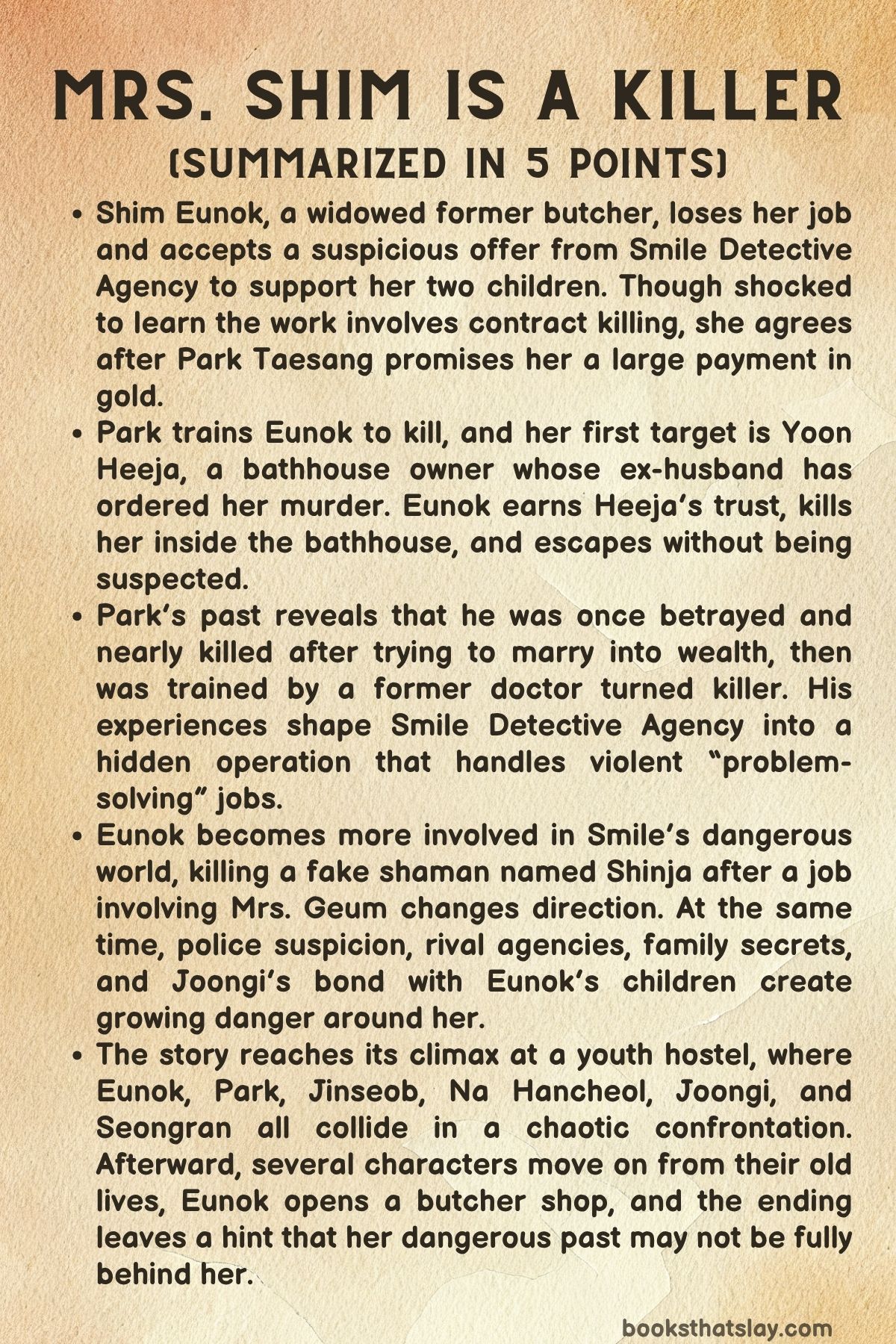
Shim Eunok is a widowed former butcher who has spent years working hard to support her two children. Her life is not glamorous, but it is practical and steady.
That stability disappears when the owner of the butcher counter at the mart where she works is arrested for gambling. With the business disrupted and her job gone, Eunok is left facing an uncertain future.
She has two children depending on her: her son Jinseob, who has completed his military service and wants to return to university, and her daughter Jina, a hardworking student with a sincere nature. Eunok knows she needs income quickly, and that pressure makes her consider opportunities she might otherwise ignore.
While searching for work, she comes across a strange job advertisement from an organization called Smile. The listing seems suspicious, but Eunok is desperate enough to answer it.
When she arrives, she discovers that Smile is not an ordinary business but the Smile Detective Agency, run by a man named Park Taesang. Park notices Eunok’s background as a butcher and becomes interested in her knife skills.
Rather than offering her normal investigative work, he proposes something shocking: she can become a “problem-solver,” which is Smile’s coded term for a contract killer.
Eunok is horrified by the idea. She is not a criminal by habit or temperament, and she has no desire to murder anyone.
Yet Park understands how to tempt her. He offers a large payment in gold, enough to help her family and secure her children’s futures.
The promise of money, combined with Eunok’s fear of failing as a mother, slowly weakens her resistance. She accepts, not because she has stopped seeing murder as wrong, but because she convinces herself that sacrifice and survival sometimes demand terrible choices.
Park takes Eunok to a vacation house and begins training her. He teaches her where to stab, how to move, and how to kill quickly.
Eunok’s years as a butcher give her an unsettling natural advantage. She knows flesh, knives, and precision.
Her first target is Yoon Heeja, a woman who owns a bathhouse. Heeja’s ex-husband has hired Smile to have her killed.
Eunok does not simply attack her at once. Instead, she spends time getting close to Heeja, learning her habits and earning her trust.
She visits the bathhouse, becomes familiar to the people there, and even attends Heeja’s birthday party.
After the party, Eunok hides inside the jjimjilbang and waits until everyone has gone. Near the bathroom, she kills Heeja.
The murder is later reported in the news, but the police do not connect it to Eunok. She receives her payment in gold, proving that Park’s promise was real.
With that, she crosses a line. She is still a mother and neighbor, still a woman worrying over meals, bills, and her children, but she is also now a paid killer.
The story then gives more insight into Park Taesang and how he became the head of Smile. Park once worked in a sashimi restaurant, where he tried to marry Soondeok, the owner’s daughter.
His motives were not pure; money and ambition played a role in his plans. When Soondeok discovered his true intentions, she responded with violence.
She stabbed him and forced him into killing a coworker named Daeho. Afterward, Park was declared legally dead.
Cut off from his old life, he was taken in by Oh Gilsoo, a former doctor who had become a killer. Gilsoo trained Park, shaping him into someone capable of surviving in the hidden world of contract murder.
After Gilsoo’s death, Park returned to society under a new kind of identity and eventually founded the Smile Detective Agency.
As Eunok continues working with Smile, the cases around her become more tangled and absurd. A fake shaman named Shinja enters her life.
Shinja believes Eunok is an old school friend and accidentally learns that she is connected to contract killing. Instead of reacting with fear alone, Shinja tries to use this knowledge for her own advantage.
She manipulates Eunok into becoming involved in a situation connected to a woman called Mrs. Geum. Shinja thinks she can steer events for her benefit, but the truth is different from what she imagines.
Mrs. Geum has already hired Smile, not to kill an innocent victim, but to expose and punish Shinja, who had scammed her and had an affair with her husband. In the end, Eunok kills Shinja instead, and the fake shaman becomes the victim of the scheme she tried to control.
Meanwhile, Smile attracts attention from the police. A police officer begins to suspect that Park has trained a new killer.
His wife, Lee Seongran, becomes involved in her own strange way. Seongran is vain, curious, and eager to feel important.
She infiltrates Smile while pretending to be a secret agent. Her imagination leads her to misunderstand much of what she sees.
At one point, she believes Eunok, Park, Choi Joongi, and the security guard are involved in a murder plan, only for one supposed conspiracy to turn out to be connected to making toy dolls. Even so, Seongran does witness enough odd behavior to remain suspicious.
Her role adds comic confusion, but she also becomes part of the larger conflict surrounding Smile.
Eunok’s personal life continues alongside her secret work. She regularly visits Granny Oksoon, an elderly neighbor who suffers from delusions.
Eunok’s visits show that she has not become a cold person, even though she now kills for money. She still looks after people, still notices loneliness, and still responds when someone nearby needs help.
When a serial killer named Lee Soonyoung attacks Granny Oksoon, Eunok saves her. This moment complicates Eunok’s identity further.
She is both a murderer and a protector, someone capable of cruelty in one setting and care in another.
Choi Joongi, Park’s young assistant, also becomes more important. He is searching for his mother and becomes connected to Eunok’s family while pretending to tutor Jina.
Through this arrangement, he grows closer to Eunok’s household. Jina develops feelings for him, unaware of the full danger surrounding him and her mother.
Joongi’s presence links Smile’s criminal world to Eunok’s domestic world, making it harder for Eunok to keep her two lives separate.
Another major threat emerges through Na Hancheol, the ruthless head of the rival Happy Detective Agency. Na is not merely a professional rival to Park.
He has a personal connection to Eunok’s past. He discovers that Eunok is the widow of his old friend Kim Dalho and that Jinseob is her son.
Na once had feelings for Eunok, and bitterness over that old attachment shapes his choices. Rather than leaving her family alone, he hires Jinseob and pulls him into his criminal world.
This is especially dangerous because Eunok has been doing everything, even committing murder, to support and protect her children. Na’s involvement means that her son is being drawn toward the same darkness she tried to keep hidden from him.
Happy Detective Agency is connected to even stranger criminal enterprises, including Kim Sangho’s matchmaking business for dead people. Around these businesses are layers of scams, hired killings, and personal betrayals.
Na’s own household is unstable. His pregnant wife, trapped in a life with a violent killer, wants freedom from him.
She attempts to hire Smile to murder her husband, turning the rivalry between Smile and Happy into something even more personal. At the same time, a rival killer named Park Hyunsuk is sent after Park Taesang.
Before dying, Hyunsuk reveals that Jinseob is involved, forcing Eunok and Park to confront the fact that the conflict has reached Eunok’s family.
The major confrontation takes place at a youth hostel, where several storylines collide. Park, Eunok, Jinseob, Na, Joongi, and Seongran all arrive there for different reasons, each carrying suspicion, fear, anger, or a hidden plan.
Jinseob points a fake knife at Park, showing how deeply he has been pulled into a dangerous game he does not fully understand. Eunok prepares to attack Na, driven by rage and fear over what he has done to her son.
Seongran, still acting from her confused mixture of suspicion and self-importance, fires a stolen police gun. The first shots turn out to be blanks, adding a strange comic note to a scene filled with real danger.
During the chaos, a powerful client who has been trying to use both Smile and Happy for his own purposes is exposed and arrested. The hostel confrontation does not simply resolve a murder plot; it breaks open the network of manipulation behind both agencies.
It also reveals how greed, resentment, and desperation have pushed many of the characters into violence.
Afterward, the characters move into changed lives. Joongi is sent away with money so he can go to school, suggesting the possibility of escape from the criminal world.
Seongran’s husband quits the police, ending one thread of official suspicion. Na’s wife divorces him, freeing herself from a dangerous marriage.
Eunok, after all she has done, eventually opens a butcher shop. This return to butchery is both ordinary and unsettling.
It connects her back to her old skills, but those skills now carry the memory of her secret life as a killer.
The ending leaves a sense of unease rather than simple closure. Jina sees Eunok and another knife master smiling for a photo, a scene that presents Eunok as a respectable businesswoman and skilled butcher.
Yet nearby, a man in a Hawaiian shirt watches Eunok from across the street before walking away. His presence suggests that Eunok’s past may not be fully behind her.
She has survived, protected her family, and built a new livelihood, but the hidden world she entered may still be watching. Mrs. Shim Is a Killer ends with Eunok standing between two identities: mother and murderer, butcher and assassin, ordinary woman and dangerous survivor.
Characters
In Mrs. Shim Is a Killer, Kang Jiyoung builds a darkly comic and unsettling world through characters who are ordinary on the surface but are connected to violence, secrecy, desperation, and survival. The characters are not simply divided into good and evil; most of them are shaped by pressure, loneliness, greed, fear, or the need to protect themselves and their families.
Shim Eunok
Shim Eunok is the central character of the book and one of its most morally complicated figures. She begins as a widowed former butcher who is struggling to support her two children after losing her job, and this financial desperation becomes the force that pushes her into Park Taesang’s criminal world.
Eunok’s background as a butcher is important because it gives her the physical skill that makes her valuable to Smile, but the book does not present her as someone who naturally wants to kill. Her first reaction to Park’s offer is horror, which shows that she still has a moral boundary.
However, when she thinks of her children, her poverty, and the promised gold, she crosses that boundary and begins to live a double life.
Eunok is frightening because she is both motherly and murderous. She can care deeply for her children, visit Granny Oksoon, act kindly toward others, and still carry out brutal killings when she convinces herself that doing so is necessary.
Her relationship with Yoon Heeja shows this contradiction most clearly, because Eunok does not kill a stranger from a distance; she befriends Heeja, enters her life, shares warmth with her, and then murders her. This makes Eunok deeply disturbing, but also tragic, because the book shows how a seemingly ordinary woman can be transformed by need, opportunity, and repeated exposure to violence.
Eunok’s greatest emotional conflict comes from the tension between her role as a mother and her role as a killer. She wants Jinseob and Jina to have better lives, yet the money that may help them comes from death.
Her later attempt to attack Na Hancheol also shows that her violence is not only professional but personal, especially when her family becomes entangled in the criminal world. By the end, when she opens a butcher shop, Eunok appears to return to a more ordinary life, but the ending suggests that her past cannot be fully erased.
She remains a character marked by survival, guilt, skill, and danger.
Park Taesang
Park Taesang is the head of the Smile Detective Agency and the person who brings Eunok into contract killing. He is calm, observant, manipulative, and practical, but he is not a simple villain.
His ability to recognize Eunok’s knife skills shows his intelligence, while his training of her shows his cold professionalism. Park understands violence as a craft, and he treats murder not as an emotional act but as a service that can be planned, taught, and sold.
This makes him one of the most unsettling characters in the story because he gives evil a businesslike structure.
Park’s past adds depth to his character and explains why he is emotionally detached. Before becoming the head of Smile, he was connected to a sashimi restaurant and tried to marry Soondeok partly for money.
When his motives were exposed, his life collapsed into violence, humiliation, and death. Soondeok’s stabbing of him and her forcing him to kill Daeho become turning points that destroy his former identity.
After being declared legally dead and trained by Oh Gilsoo, Park is reborn into a world where ordinary social rules no longer apply.
Despite his criminal role, Park is not entirely without loyalty or feeling. His relationship with Eunok develops beyond simple employment, and his connection to Joongi also reveals a more protective side.
He can be ruthless, but he is also a survivor who understands what it means to be remade by violence. Park represents the professionalized face of murder in the book: controlled, hidden, efficient, and strangely disciplined.
Shim Jinseob
Shim Jinseob is Eunok’s son, and his role is important because he represents the future Eunok wants to protect. At first, he appears to be a young man trying to move forward after military service, hoping to return to university and build a stable life.
For Eunok, Jinseob’s education and future become part of the emotional justification for her crimes. She wants him to have chances that poverty might otherwise deny him, and this makes him central to her motivation even before he becomes directly involved in the criminal plot.
Jinseob becomes more complicated when Na Hancheol draws him into his own dangerous world. His involvement with Na shows how easily the younger generation can be pulled into the same cycles of manipulation and violence that have already consumed the adults.
Jinseob is not presented as purely innocent once he enters this world, but he is still partly a victim of forces he does not fully understand. His fake knife at the youth hostel captures his uncertain position: he appears threatening, but the threat itself is hollow, suggesting confusion, immaturity, and danger without full control.
Through Jinseob, the book explores how parents’ secrets and older grudges can damage children. Eunok kills partly for him, but that very world eventually reaches him.
His character shows that crime cannot remain neatly separated from family life, no matter how hard Eunok tries to protect her children from the truth.
Shim Jina
Shim Jina is Eunok’s diligent daughter and one of the more innocent figures in the book. She represents ordinary ambition, youth, and emotional openness within a story full of deception and murder.
Unlike many of the adults, Jina does not understand the hidden criminal structures surrounding her family. Her innocence makes the reader more aware of how dangerous Eunok’s secret life is, because Jina lives close to violence without fully recognizing it.
Jina’s feelings for Choi Joongi add tenderness to the story. Joongi enters her life while pretending to tutor her, and the relationship creates a contrast with the darker plots surrounding Smile, Happy Detective Agency, and the contract killings.
Jina’s affection is sincere, which makes Joongi’s deception more painful, even if he himself is not entirely malicious. Her emotional world is simpler and more hopeful than the world of the adults, and this makes her vulnerable.
The ending, where Jina sees Eunok and another knife master smiling for a photo, is significant because it places her near the mystery of her mother’s identity. She may not fully understand everything, but she is close enough to sense that there are hidden layers to Eunok’s life.
Jina represents the family life Eunok wants to preserve, but she also reminds the reader that secrets do not remain invisible forever.
Yoon Heeja
Yoon Heeja is Eunok’s first victim, and her role is crucial because she turns the idea of contract killing from an abstract job into a deeply personal moral crime. Heeja is a bathhouse owner whose ex-husband wants her dead, but the book does not treat her only as a target.
Eunok spends time with her, befriends her, attends her birthday party, and becomes close enough to see her humanity. This makes Heeja’s death especially tragic.
Heeja’s character exposes the emotional cost of Eunok’s new work. If Eunok had killed a faceless stranger, her first murder might have seemed like a simple criminal act.
Instead, Heeja becomes a person with a social life, warmth, and trust. Her birthday party makes her death feel even more cruel because it places celebration and murder side by side.
She is important not because she dominates the plot for a long time, but because she marks the moment when Eunok truly becomes a killer.
Heeja also shows how murder-for-hire turns private resentment into irreversible violence. Her ex-husband’s desire to have her killed reflects the ugliness of personal revenge, but Eunok is the one who carries it out.
Through Heeja, the book forces the reader to see that every “assignment” is also the destruction of a human life.
Park Taesang’s Former Lover Soondeok
Soondeok is a disturbing and powerful figure in Park Taesang’s backstory. She is the daughter of the sashimi restaurant owner, and Park tries to marry her partly because of money.
When she discovers his motives, she responds with violence and domination rather than simple heartbreak. By stabbing him and forcing him to kill Daeho, Soondeok becomes the person who shatters Park’s old life and pushes him into a new identity.
Soondeok is important because she reverses expectations. Park may think he is the manipulator, but Soondeok proves that she can be far more dangerous than he expects.
Her actions expose Park’s greed and punish him with a cruelty that changes his future permanently. She is not merely a betrayed woman; she becomes a violent judge, forcing Park into guilt and bloodshed.
Her role also helps explain why Park later treats violence with such emotional distance. His transformation does not begin as ambition alone; it begins with trauma, coercion, and survival.
Soondeok’s presence in the book is brief but powerful because she is one of the forces that creates the Park Taesang who later runs Smile.
Daeho
Daeho is the coworker Park Taesang is forced to kill in his past. Although he does not appear as a major active character, his death is essential to Park’s transformation.
Daeho represents the innocent or secondary person who becomes trapped in someone else’s conflict. He is not killed because of a direct feud with Park, but because Park has been pushed into a violent situation by Soondeok.
Daeho’s role shows how violence spreads beyond the people who begin it. Park’s greed, Soondeok’s rage, and the chaos of betrayal all converge on Daeho, making him a casualty of a conflict that is larger than him.
His death becomes one of the foundations of Park’s new life, proving that Park’s criminal identity is built not only on training but also on guilt and irreversible action.
Oh Gilsoo
Oh Gilsoo is a former doctor turned killer who takes Park in after Park is declared legally dead. He is a mentor figure, but a dark and twisted one.
As a former doctor, he carries the irony of someone trained to preserve life who has become skilled in taking it. This contradiction makes him an important figure in the moral landscape of the book.
Gilsoo trains Park and gives him a new way to survive after his old identity disappears. In this sense, he functions almost like a creator of Park’s second life.
He does not guide Park back into society through healing or redemption; instead, he teaches him how to exist in the hidden world of killers. His influence explains Park’s later professionalism and discipline.
Gilsoo also represents the passing down of violent knowledge. Just as he trains Park, Park later trains Eunok.
This chain of instruction suggests that murder in the book is not only an act but also a craft, a business, and an inheritance. Gilsoo’s presence helps show how people become absorbed into systems of violence that continue after their original teachers are gone.
Shinja
Shinja is a fake shaman and one of the book’s most manipulative characters. She recognizes Eunok as an old school friend, or at least believes she does, and uses that connection to draw information from her.
Shinja’s power does not come from physical violence but from deception, performance, and emotional pressure. She survives by pretending to possess spiritual authority, using people’s fears and desires for her own benefit.
Her attempt to manipulate Eunok into taking a job involving Mrs. Geum reveals her greed and overconfidence. Shinja thinks she can control the situation, but she misunderstands the scale of danger around Smile.
She believes she is using Eunok, yet she is actually caught in a trap set by Mrs. Geum. This reversal makes her downfall feel both ironic and fitting.
Shinja’s death shows that deception has limits in a world where other people are even more dangerous. She is not innocent, because she has scammed Mrs. Geum and had an affair with her husband, but her murder still adds to the book’s atmosphere of moral disorder.
She is a fraud who becomes a target, proving that manipulation can easily turn back on the manipulator.
Mrs. Geum
Mrs. Geum is a sharp and vengeful character who hires Smile to expose and punish Shinja. She has been wronged by Shinja, who scammed her and had an affair with her husband, and she responds not with open confrontation but with calculated revenge.
Mrs. Geum’s role shows that the clients in the book can be just as morally troubling as the killers themselves.
Mrs. Geum is significant because she understands how to use Smile’s services for her own purpose. She is not fooled by Shinja’s performance and instead turns the situation into a trap.
Her intelligence makes her dangerous, even though she is not a professional killer. She knows how to weaponize the criminal system without doing the killing herself.
Her character also reflects the book’s interest in hidden anger, especially within domestic and social relationships. Mrs. Geum’s revenge grows out of betrayal, humiliation, and resentment.
Through her, the story shows how ordinary grievances can become deadly when people have access to a service like Smile.
Lee Seongran
Lee Seongran is one of the book’s most comic yet important characters. She is the vain wife of a police officer, and she infiltrates Smile after her husband suspects Park has trained a new killer.
Her misunderstanding of the agency’s activities creates humor, especially when she mistakes certain situations for murder plots even when they involve something as harmless as making toy dolls. However, beneath the comedy, Seongran is more perceptive than she first appears.
Seongran’s vanity and imagination make her easy to underestimate. She wants to see herself as a secret agent, and this fantasy shapes how she interprets the people around her.
Yet her suspicions are not entirely wrong. Even when she misreads details, she senses that something dangerous is hidden beneath Smile’s ordinary appearance.
This makes her a character who moves between farce and truth.
At the youth hostel, Seongran becomes directly involved in the chaos when she fires a stolen police gun, though the first shots are blanks. This moment shows how her fantasy of action becomes real, even if in a confused and accidental way.
Seongran adds energy and absurdity to the book, but she also helps expose the instability of the criminal world around Smile.
Lee Seongran’s Husband
Lee Seongran’s husband is a police officer whose suspicions about Park Taesang help bring Seongran into the plot. He represents official law and order, but his role is limited and somewhat weakened by the strange events around him.
His suspicion that Park has trained a new killer is important because it is correct in substance, even if the investigation does not unfold in a straightforward way.
His connection to Seongran also creates a contrast between professional suspicion and amateur fantasy. He belongs to the police, but it is Seongran who enters Smile and becomes personally entangled in its world.
This makes him a less active but still important figure, because his concerns set part of the comic investigation in motion.
By the aftermath, his decision to quit the police suggests exhaustion, disillusionment, or a desire to escape the danger and absurdity that has overtaken his life. His character shows that even those connected to the law can be overwhelmed by the hidden systems of violence operating around them.
Granny Oksoon
Granny Oksoon is Eunok’s elderly neighbor, and she brings tenderness, vulnerability, and sadness into the story. She has delusions, which makes her dependent on the kindness and attention of others.
Eunok’s regular visits to her reveal a caring side of Eunok that contrasts strongly with her role as a killer. Through Oksoon, the reader sees that Eunok is still capable of compassion.
Oksoon’s vulnerability becomes especially important when Lee Soonyoung attacks her. Eunok’s act of saving her shows that Eunok’s violence is not always selfish or criminal; sometimes it is protective.
This complicates the reader’s judgment of Eunok. She can murder for money, but she can also risk herself to protect a helpless neighbor.
Granny Oksoon represents the fragile people who exist on the edges of the main criminal plot. She is not powerful, wealthy, or manipulative, but her presence matters because she brings out genuine humanity in Eunok.
In a book filled with killers and schemes, Oksoon reminds the reader of the ordinary lives that violence threatens.
Lee Soonyoung
Lee Soonyoung is a serial killer who attacks Granny Oksoon. His role introduces a different kind of violence from the contract killings associated with Smile and Happy Detective Agency.
While Park and Eunok operate through assignments and payment, Soonyoung represents predatory violence that is more chaotic and openly monstrous.
Soonyoung’s attack on Oksoon is important because it forces Eunok into a protective form of violence. He becomes a threat not because of business, revenge, or manipulation, but because he attacks someone vulnerable.
This gives Eunok a moment in which her deadly abilities are used to save rather than to murder for money.
As a character, Soonyoung helps sharpen the book’s moral complexity. The presence of a serial killer does not make Eunok innocent, but it does show that violence exists in many forms.
Compared with Soonyoung’s predation, Eunok’s actions can appear more controlled and purposeful, even though they remain morally troubling.
Choi Joongi
Choi Joongi is Park Taesang’s young assistant and one of the more emotionally sympathetic characters in the book. He works within Smile’s criminal world, but he is also searching for his mother, which gives him a personal sadness and longing.
This search makes him feel less like a hardened criminal and more like a young person trying to find belonging.
Joongi’s closeness to Eunok’s family adds warmth and complication to the story. While pretending to tutor Jina, he becomes connected to her and to the domestic world Eunok is trying to protect.
Jina’s feelings for him make his deception emotionally risky, because he is not simply performing a role; he is entering the life of someone who trusts him.
His eventual departure with money for school suggests that he is given a chance to escape or begin again. Joongi represents the possibility of a different future, even for someone who has been near crime.
He is tied to Smile, but he is not fully consumed by it, and that makes him one of the book’s more hopeful figures.
Na Hancheol
Na Hancheol is the ruthless head of the rival Happy Detective Agency and one of the most dangerous characters in the book. He is tied to contract killings, criminal schemes, and old emotional wounds.
His discovery that Eunok is the widow of his old friend Kim Dalho and that Jinseob is her son gives his actions a bitter personal edge. He is not only a rival in business; he is a man driven by resentment, memory, and possessive anger.
Na’s old love for Eunok makes him especially troubling because it turns affection into control and revenge. Instead of respecting Eunok’s life, he tries to draw her son into his criminal world.
This is one of his cruelest actions because it attacks Eunok through the person she most wants to protect. Na understands family bonds, but he uses that understanding as a weapon.
As the head of Happy Detective Agency, Na represents a darker and more openly ruthless version of the world Park occupies. He is ambitious, dangerous, and emotionally corrupted.
His wife’s desire to have him killed also shows that his violence poisons even his closest relationships. Na is a villain shaped not only by criminal power but by bitterness and failed love.
Kim Dalho
Kim Dalho is Eunok’s deceased husband and Na Hancheol’s old friend. Though he is not alive during the main events, his memory has a strong influence on the story.
His connection to both Eunok and Na creates part of the emotional background behind Na’s bitterness. The fact that Jinseob is Dalho’s son also becomes important when Na learns the truth and begins to involve Jinseob in his world.
Dalho represents the past that Eunok has lost and Na has not fully escaped. For Eunok, he is part of the family life that existed before poverty and killing overtook her.
For Na, he is connected to old friendship, rivalry, and unresolved feelings for Eunok. Because Dalho is absent, other characters project their grief, resentment, and memory onto him.
His role shows how the dead continue to shape the living. Even though Dalho does not act directly, his relationships influence Na’s choices and deepen the danger around Eunok’s family.
He is a quiet but important presence in the emotional structure of the book.
Na Hancheol’s Wife
Na Hancheol’s wife is a pregnant woman who wants freedom from her killer husband. Her attempt to hire Smile to murder Na reveals the misery and fear inside their marriage.
She is not presented as simply helpless, because she takes action, but the action she chooses belongs to the same violent system that has trapped her.
Her pregnancy makes her situation more emotionally urgent. She is not only trying to escape for herself but also for the life she is carrying.
This gives her desire for freedom a sympathetic dimension, even though hiring killers is morally extreme. Her character shows how living with a violent person can push someone toward desperate and dangerous choices.
Her eventual divorce from Na suggests a form of release. In a story where many problems are answered with murder, her separation from him offers a different kind of ending.
She represents the possibility of escaping a violent man without becoming fully defined by his world.
Kim Sangho
Kim Sangho is connected to Na’s agency and runs a bizarre matchmaking business for dead people. His character adds one of the strangest and darkestly comic elements to the book.
The idea of matchmaking the dead reflects the story’s unusual blend of crime, absurdity, and social satire. Sangho’s business suggests a world where even death can be turned into a service, a transaction, or a performance.
Sangho’s connection to Happy Detective Agency places him within the broader criminal and morally distorted network surrounding Na. He may not be as physically threatening as the killers, but his work contributes to the book’s atmosphere of grotesque business practices.
Like Smile and Happy, his operation turns human pain and death into something organized and profitable.
His character helps expand the world beyond Eunok’s personal story. Through Sangho, the book suggests that the society around these characters is full of strange markets, hidden desires, and people willing to exploit even the most intimate parts of life and death.
Park Hyunsuk
Park Hyunsuk is a rival killer sent after Park Taesang. His role is brief but important because he raises the stakes of the conflict between criminal agencies.
He is a professional threat, someone who belongs to the same violent world as Park and Eunok but stands on the opposing side. His presence shows that the world of contract killing is competitive, dangerous, and unstable.
Before his death, Hyunsuk reveals that Jinseob is involved, making him important not only as an attacker but also as a messenger of dangerous truth. This revelation deepens Eunok’s fear and pushes the conflict closer to her family.
Hyunsuk’s death also reinforces Park Taesang’s survival skills and the danger of moving against him.
Hyunsuk represents the disposable nature of killers in the book’s criminal ecosystem. Even skilled professionals can be sent, used, and killed.
His character shows that in this world, violence is not only a job but also a constant risk for those who practice it.
Themes
Survival and Moral Compromise
Shim Eunok’s choices are shaped by pressure rather than simple greed or cruelty. As a widowed mother who loses her stable job, she faces a world where honest work does not protect her family from financial insecurity.
Her son’s education, her daughter’s future, and the daily burden of survival push her into accepting work that violates her own moral instincts. In Mrs. Shim Is a Killer, killing becomes a brutal extension of labor, and Eunok’s knife skills, once tied to butchery and ordinary work, are redirected into crime.
This shift shows how poverty can narrow a person’s choices until the unthinkable begins to appear practical. Yet the story does not remove her responsibility.
Eunok is horrified, hesitant, and aware of the wrongness of what she does, but she still continues. The theme becomes powerful because it does not present morality as abstract.
It shows morality being tested by hunger, parenting, debt, fear, and the desire to give one’s children a better life.
Motherhood and Protection
Eunok’s identity as a mother drives much of her behavior, even when her actions become violent or morally disturbing. Her entrance into Smile is not motivated by a desire for power but by the need to support Jinseob and Jina.
This makes her character complicated because the same love that makes her caring also leads her into dangerous choices. Her work as a killer becomes connected to sacrifice, secrecy, and protection.
She hides the truth from her children because she wants them to remain untouched by the world she has entered. At the same time, the story shows that parents cannot fully control the lives of their children.
Jinseob is pulled into Na Hancheol’s criminal circle, while Jina develops feelings for Joongi, who is also linked to Smile. Eunok’s efforts to protect her family therefore become painfully limited.
The theme suggests that love can motivate courage, but it can also blind a parent to the risks growing around the very people she wants to save.
Hidden Lives and False Appearances
Many characters live behind masks, and the difference between public identity and private truth shapes the story’s tension. Smile presents itself as a detective agency, but its real work involves murder.
Park Taesang appears controlled and professional, yet his past reveals humiliation, violence, and reinvention. Shinja performs spiritual authority as a shaman, but her life is built on fraud and manipulation.
Lee Seongran imagines herself entering a secret world of spies and killers, and although she often misunderstands what she sees, her suspicions are not entirely foolish. These mistaken identities and hidden motives create a world where people rarely appear as they truly are.
The theme is especially important because Eunok herself also becomes divided. To her family and neighbors, she remains a hardworking widow and mother.
To Smile, she becomes a trained killer. This contrast shows how ordinary life can hide disturbing secrets, and how easily society accepts surfaces without asking what lies beneath them.
Power, Exploitation, and Criminal Systems
The violence in the story is not only personal; it is organized through systems that turn suffering, resentment, and greed into business. Smile and Happy operate like distorted service companies, taking private grudges and converting them into paid murder.
Clients use these agencies to avoid direct responsibility, while killers carry out desires that others are too afraid or too privileged to act on themselves. Na Hancheol’s world is especially ruthless because he uses personal history, emotional weakness, and family connections as tools of control.
His attempt to draw Jinseob into crime shows how power often spreads through manipulation rather than open force. Park Taesang’s own background also suggests that violence reproduces itself through training, debt, and dependence.
People who are damaged by one criminal structure often become part of another. The theme exposes a society where money can purchase harm, where agencies disguise brutality as service, and where vulnerable people are recruited because they are easier to pressure, use, and discard.