Murder Mindfully Summary, Characters and Themes
Murder Mindfully by Karsten Dusse, originally published as Achtsam morden am Rande der Welt, is a darkly comic crime novel about Björn Diemel, a successful lawyer whose attempt to become calmer and more present leads him into murder, deception, and accidental underworld management. The book mixes mindfulness advice with criminal absurdity, showing how self-help language can be twisted into a strange moral logic.
Björn begins as a stressed husband, distant father, and overworked legal fixer for a dangerous gangster. As he tries to protect his time with his daughter, he discovers that the tools meant to improve his life can also help him rationalize ruthless choices.
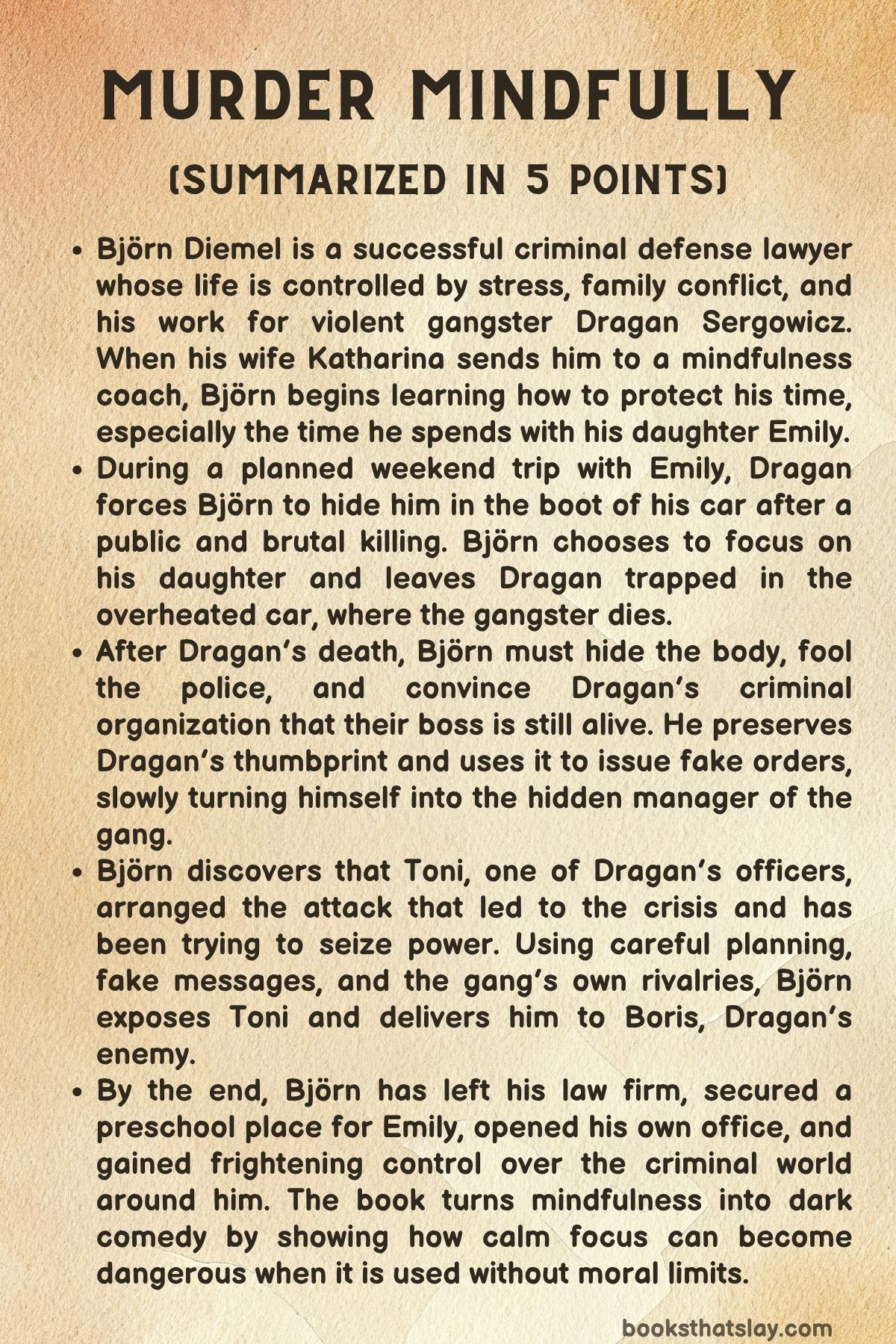
Summary
Björn Diemel is a criminal defense lawyer who insists he was never a violent person. Yet by the time he tells his story, he has killed a man and soon caused the deaths of several others.
His explanation is unusual: everything began because he tried to become more mindful. His marriage to Katharina is falling apart because he is constantly stressed, absent, and tied to his demanding work.
Katharina sends him to mindfulness coach Joschka Breitner as a last attempt to repair their family life.
Björn’s first meeting with Breitner exposes how scattered and tense he has become. While waiting outside the coach’s office, he is not really waiting; he is replaying arguments, work pressures, and excuses in his head.
Breitner explains that mindfulness means doing only what one is actually doing. Waiting means waiting.
Breathing means breathing. Being with one’s child means being with one’s child.
Björn is skeptical, but the lessons start to affect him because they answer a problem he cannot solve by legal skill or sarcasm: he has no control over his own attention.
At work, Björn is the legal protector of Dragan Sergowicz, a brutal gangster involved in drugs, weapons, prostitution, smuggling, fraud, and violence. Björn once imagined himself defending justice, but his career has turned him into a fixer for organized crime.
He helps Dragan hide illegal money behind companies, franchises, public subsidies, and respectable business structures. Dragan relies on Björn not only for legal defense but for strategy, intimidation, and crisis control.
Björn knows his work is morally rotten, yet it gives him status, income, and importance.
Breitner teaches Björn breathing exercises and the idea of “time islands,” protected periods reserved for what truly matters. Björn begins using mindful breathing at work and creates time islands for his daughter Emily.
After he and Katharina temporarily separate, Björn starts spending focused time with Emily: small outings, Sundays, and eventually full weekends. These hours with her become the happiest part of his life.
Katharina warns him that if he lets work invade those periods, she may cut off his access to Emily.
Björn plans a weekend with Emily at one of Dragan’s lake houses. The place should be empty because Dragan is supposed to be away.
But just as Björn is leaving with Emily, Dragan calls using an emergency code phrase. Björn has forgotten to switch off his phone, and now work has entered the protected time island.
He reluctantly stops at his office, leaves Emily with trainee Clara, and meets Dragan in the hidden rooms above an ice-cream parlor.
Dragan has created a disaster. He has killed Igor, the right-hand man of rival gangster Boris, at a motorway lay-by.
The violence involved fire, an iron bar, a blown-up van, grenades, and a bus full of schoolchildren who filmed everything. Dragan also threatened the children on the bus.
The footage is already spreading. Dragan orders Björn to help him escape and decides to hide in the boot of Björn’s car.
Worse, he wants Björn to drive him to the lake house, the exact place reserved for Emily’s weekend.
Björn tries to object, but Dragan threatens him and Emily. Björn uses mindfulness to stay calm and handles one step at a time.
He gets Emily out of the office, distracts her with ice cream, and allows Dragan to hide in the car boot. When a police officer stops him, Björn uses legal precision and humor to avoid a search.
He drives away with Emily beside him and Dragan locked in the boot.
At the lake, Dragan knocks from inside the boot. Emily asks about the noise, and Björn says it is work.
Emily tells him they should do the trip first and work later. Björn treats this as perfect mindfulness.
He decides to be fully present with his daughter. He does not open the boot.
He spends the day swimming, feeding fish, building sandcastles, eating, and enjoying rare peace with Emily. Meanwhile, Dragan slowly dies in the overheated car.
That evening Björn considers checking on him, but every possible outcome seems dangerous. If Dragan is alive, he may kill Björn.
If Dragan is dead, Björn must face the consequences. Björn chooses not to disturb the calm.
The next day, he and Emily continue their weekend. Only after returning Emily to Katharina does he go back to the lake house to deal with the body.
Björn understands that Dragan’s death has solved one problem and created several others. Dragan can no longer threaten him, but the police, Boris, and Dragan’s own organization must not discover the truth.
Björn decides to preserve Dragan’s right thumb because the gang authenticates written orders using Dragan’s branded thumbprint. He removes Dragan’s body from the boot, takes cash from him, dismembers him, and uses a wood chipper to dispose of the remains in the lake.
He saves the thumb, but a magpie steals Dragan’s ring finger with his signet ring. This missing finger later becomes a major threat.
Back in ordinary life, Björn finds messages from the police, his law firm, the press, and Dragan’s men. He uses Dragan’s reputation to negotiate his exit from the law firm with severance, freeing himself from his old job while keeping control over Dragan’s affairs.
Detective Peter Egmann informs him that Murat, one of Dragan’s associates, has been found dead. Police also know Björn went to the lake, and Dragan’s severed finger has been found nearby.
Björn realizes the situation is fragile.
At the same time, Katharina tells Björn that Emily has been rejected by nearly every preschool, including Little Fish. The rejection is partly Björn’s fault because he had previously threatened the preschool’s building on Dragan’s behalf.
Katharina demands that he fix the problem. Björn now has another goal: secure Emily a place at Little Fish.
Using a fake thumbprint order from Dragan, Björn directs Sasha, Dragan’s driver and a trained early-years educator, to take over the preschool instead of converting the building into a brothel. Sasha accepts the mission and becomes head of the new childcare division.
Björn begins to see preschool places as a powerful form of influence, especially among important parents.
Björn also needs to identify who set Dragan up. Sasha suspects Toni, one of Dragan’s officers, whose earnings had been falling and who may have wanted to seize control.
Björn sends a misleading message that causes a grenade attack at the apartment of Ms Bregenz, his former law firm receptionist. This confirms that Toni has access to police information and is acting aggressively.
Toni later threatens Emily, which makes Björn personally determined to destroy him.
Björn visits Boris, Dragan’s rival, and uses fake instructions bearing Dragan’s thumbprint to claim authority as Dragan’s representative. Boris wants revenge for Igor’s death and gives Björn a deadline: produce the traitor and arrange access to Dragan, or die.
Soon afterward, Björn’s former company car is blown up as a warning. Sasha’s men catch Malte, Toni’s nephew, carrying weapons and grenades.
Under torture, Malte admits that Toni arranged the lay-by ambush, had Murat killed, ordered attacks on Björn, and used corrupt policeman Klaus Möller as an inside source.
Björn now has his enemies: Toni, Malte, and Möller. He also has to keep Dragan’s officers loyal while hiding the truth.
At an officers’ meeting held in the preschool, he presents fake Dragan orders that promote Sasha, protect the preschool, postpone war with Boris, and give Björn authority as Dragan’s mouthpiece. Toni accuses Björn of faking everything because of the severed finger.
Sasha saves Björn by lying that he spoke to Dragan that morning. After Toni leaves, Björn shows the other officers Malte’s confession, turning them against Toni.
Björn then sets a trap for Möller. With Carla and Sasha’s help, he tricks Möller into believing Toni is sleeping with Möller’s girlfriend Basia.
Möller storms into a staged hotel room and fires through a door while hidden cameras record him. The gang blackmails him into cooperating, then uses him to lure Toni to Walter’s security company.
Toni finds Malte unconscious in the basement and kills him immediately to silence him. The murder is filmed, giving Björn the final proof needed to hand Toni to Boris.
Meanwhile, Möller is transported to Poland and killed in a staged accident. Björn opens his own law office above Little Fish, placing his work literally above Emily’s preschool.
He gives Katharina proof that Emily has been accepted, and she is grateful, though she does not know what he did to make it happen. Peter Egmann also wants a preschool place for his son, which gives Björn leverage over the police investigation.
At the motorway lay-by, Björn gives Toni to Boris along with the proof of betrayal. Boris executes Toni with grenades.
Björn then stages a fake police drone incident, convincing Boris that the execution may have been recorded. Panicked, Boris agrees to hide in a car boot so Björn can supposedly take him to Dragan.
Björn closes the boot, repeating the situation that began his transformation. By the end, he has moved from stressed lawyer to calm manipulator, using mindfulness not to become morally better, but to become frighteningly efficient at protecting the life he wants.
Characters
Björn Diemel
At the center of Murder Mindfully, Björn Diemel is a man who begins as a stressed, cynical lawyer and gradually becomes a controlled, calculating killer. His greatest contradiction is that he does not see himself as naturally violent, even though he learns to justify violence with astonishing ease.
He is intelligent, observant, legally skilled, and emotionally exhausted. His work for Dragan has trained him to think in terms of risk, leverage, evidence, and strategy, so when murder enters his life, he treats it almost like a legal and logistical problem.
What makes Björn especially unsettling is his ability to convert mindfulness into self-justification. The lessons that should help him become present, honest, and balanced instead help him focus, compartmentalize, and remove obstacles.
Yet he is not written as a simple monster. His love for Emily is sincere, and his longing for time with her gives the book its emotional pressure.
His moral collapse grows from a recognizable desire: he wants freedom, peace, and fatherhood on his own terms. The danger is that once he defines those goals as sacred, almost anything can be excused in their service.
Dragan Sergowicz
In Murder Mindfully, Dragan Sergowicz is the violent criminal force that has shaped Björn’s professional life long before the main crisis begins. He is brutal, impulsive, threatening, and used to complete obedience.
His empire depends on fear, but also on the legal and financial structures Björn builds around him. Dragan is not merely a gangster who commits crimes; he is a businessman of violence whose activities have been made respectable through paperwork, property deals, subsidies, and companies.
His death in the boot is both grotesque and symbolic. He dies because he treats Björn’s life, daughter, and protected time as things he can invade without consequence.
Dragan’s real power continues even after death because Björn uses his thumbprint, reputation, and organizational structure to control others. As a character, Dragan represents the old system Björn served: loud, reckless, cruel, and openly corrupt.
Once he is gone, Björn does not escape that system. Instead, he learns to operate it with more patience and discipline.
Katharina
Katharina is Björn’s wife and one of the few characters who sees clearly that his life is damaging their family. She is frustrated, tired, and often severe with him, but her anger comes from years of disappointment rather than simple coldness.
She has carried much of the emotional and practical burden of parenting while Björn has hidden behind work. Her insistence on mindfulness coaching is not a casual suggestion; it is a boundary.
She wants Björn either to change or to stop pretending their marriage can continue as it is. Katharina’s role in the book is important because she gives Björn a reason to seek change, even though she cannot control what kind of change he chooses.
Her concern for Emily is constant, and she is especially alarmed by anything connected to Dragan. She also reveals the social pressure of parenting, particularly around preschool access, routines, and stability.
Katharina does not know the full truth of Björn’s crimes, so her gratitude when he secures Emily’s preschool place carries a dark irony. She believes he is becoming more responsible, while the reader sees that he is becoming far more dangerous.
Emily
Emily is the emotional center of Björn’s life and the one person for whom his affection appears pure. She is young, innocent, direct, and often unintentionally wise.
Her simple statement that work should stay in the car and the trip should come first becomes the immediate logic behind Björn’s decision not to release Dragan from the boot. This makes her role morally complex without making her responsible.
Emily does not understand the criminal world around her, but her presence changes every decision Björn makes. She represents the life he wants to protect: play, presence, love, and ordinary joy.
The scenes with her at the lake, playgrounds, cafés, and preschool show Björn at his most human. At the same time, his devotion to her becomes the foundation for his worst choices.
He does not kill because Emily asks him to; he kills because he convinces himself that nothing should threaten his time with her. In the story, Emily is both Björn’s salvation and the excuse he uses to move further from moral restraint.
Joschka Breitner
Joschka Breitner is the mindfulness coach whose teachings set the entire transformation in motion. He is calm, perceptive, and skilled at identifying Björn’s mental habits.
His lessons are simple: pay attention to the present, breathe consciously, protect meaningful time, and understand freedom as the ability not to do what one does not want to do. Breitner’s role is not that of a criminal mentor; he never encourages violence.
The dark comedy of the book comes from the gap between what he teaches and how Björn applies it. Breitner gives Björn tools for self-awareness, but Björn uses them for strategic calm.
Breathing helps him endure stress, but it also helps him manage fear while deceiving police, handling corpses, and manipulating gangsters. Breitner therefore represents the ambiguity of self-help when separated from ethics.
Techniques alone cannot make a person good. In Björn’s hands, mindfulness becomes less a path toward compassion and more a method for efficient decision-making under pressure.
Sasha
Sasha begins as Dragan’s driver, but he becomes one of the most surprising and important figures in the book. He is loyal, physically capable, and familiar with the criminal world, yet he also has training in early-years education.
This unusual combination makes him perfect for the absurd new direction of Dragan’s organization: the takeover of Little Fish preschool. Sasha’s practicality and patience contrast with Toni’s aggression.
He understands that Björn is hiding something, but he also sees that Björn’s leadership is more stable and beneficial than Toni’s chaos. His lie at the officers’ meeting, claiming he spoke to Dragan, saves Björn at a critical moment.
Sasha is not innocent, since he participates in intimidation, violence, and criminal strategy, but he is also oddly constructive. He cares about childcare, structure, and the value of preschool places.
His character helps the book balance menace with comedy, because he can break a man’s nose and then discuss nursery administration with equal seriousness.
Toni
Toni is ambitious, resentful, and reckless. As one of Dragan’s officers, he sees Dragan’s disappearance as an opening to seize power.
His betrayal drives much of the later plot: he arranges the lay-by trap, uses Murat, hires Malte, exploits Möller’s police access, and tries to start a war with Boris by making the violence look like enemy action. Toni’s defining weakness is impatience.
Unlike Björn, who learns to wait and plan, Toni acts through threats, explosions, and fear. His threats against Emily mark him as personally unforgivable in Björn’s eyes.
He also lacks the loyalty needed to hold the organization together, because his ambition depends on sacrificing his own allies. Toni’s final downfall is built from his own instincts.
When he sees Malte as a risk, he kills him immediately, proving his guilt on camera. His death at Boris’s hands is brutal, but in the logic of the criminal world, it is the result of his betrayal returning to him.
Boris
Boris is Dragan’s rival and former friend, a gangster whose relationship with Dragan is built on old loyalty, betrayal, and violence. Their history gives the conflict a personal edge.
Boris is dangerous, proud, and vengeful, especially after Igor’s death. Yet he is not foolish.
He listens when Björn suggests that the lay-by incident may have been a setup, and he gives Björn time to produce the traitor. Boris represents the older balance of power in the underworld.
He understands rules, revenge, and negotiated violence. Compared with Toni, he is more controlled, which makes him easier for Björn to manipulate through logic and evidence.
His need for revenge becomes the tool Björn uses to remove Toni. The staged drone incident shows Boris’s vulnerability: despite his strength, he fears police exposure and can be pushed into panic.
When he climbs into the boot, he becomes the next person trapped by Björn’s calm planning, repeating Dragan’s fate in a new form.
Peter Egmann
Peter Egmann is the homicide detective investigating the violence around Dragan, and he functions as both a threat and a potential asset to Björn. He is not stupid; he sees connections, asks pointed questions, and knows that Björn is present near too many suspicious events.
He brings pressure through facts such as the phone calls, the lake visit, the severed finger, and the evidence found near the boathouse. Yet Peter is also a parent, and that makes him vulnerable to the same preschool anxiety affecting Katharina and Björn.
Once Björn can offer his son Lukas a place at Little Fish, the balance between investigator and suspect shifts. Peter does not simply become corrupt in a cartoonish way, but he becomes willing to look away from uncertainties when doing so benefits his family.
His character shows how ordinary needs can soften institutional power. The law is strong in theory, but in the book it can be bent by childcare, favors, and personal convenience.
Carla
Carla manages prostitution through a casting agency and is one of Dragan’s officers. She is sharp, practical, and able to operate in the criminal world without Toni’s loud aggression.
Carla’s importance grows when Björn needs the remaining officers to accept his authority and turn against Toni. She is willing to support a plan that preserves stability and protects the organization’s interests.
Her role in the trap involving Basia and Möller shows her usefulness beyond her official business area. She understands performance, appearance, and manipulation, which makes the staged hotel scene possible.
Carla also demonstrates that Dragan’s organization is not a loose group of thugs but a structured business network with specialized leaders. She is not sentimental, but she is rational enough to see that Toni’s betrayal threatens everyone.
Her loyalty is therefore less about affection for Björn and more about survival, order, and profit.
Walter
Walter runs the weapons side of Dragan’s organization through a security company. His business gives the gang access to force while maintaining a legitimate front.
Walter is practical, disciplined, and comfortable with violence as a tool. He becomes important once Björn and Sasha capture Malte and later lure Toni into the basement.
Walter’s security company provides the controlled space where interrogation, surveillance, and entrapment can happen away from public view. He is not the emotional center of the story, but he represents the infrastructure that makes organized crime durable.
People like Dragan and Toni may command attention, but men like Walter keep systems working. He accepts Björn’s leadership when it appears to offer order and proof.
His willingness to watch Toni incriminate himself shows that his loyalty is conditional. He sides with whoever can protect the organization from collapse.
Stanislav
Stanislav oversees smuggling and trafficking through a shipping company, which makes him essential to the international reach of Dragan’s empire. He is calm, efficient, and capable of handling difficult logistics.
His role becomes especially visible in the disposal of Möller. Transporting Möller east, staging the journey as a romantic mission, and arranging his death in Poland all require planning and composure.
Stanislav is not as dramatic as Toni or as visibly forceful as Sasha, but he is dangerous because of his quiet competence. He shows how crime in the book extends across borders through transport, paperwork, vehicles, and timing.
His participation in Björn’s plan confirms that the officers are willing to accept a new structure if it protects them. Stanislav’s character adds scale to the story, reminding readers that Björn is not just handling a few local criminals.
He is managing a network with international habits and resources.
Klaus Möller
Klaus Möller is a corrupt police officer whose betrayal of his profession makes him especially dangerous. He appears at first as one more officer circling Björn, but Malte’s confession reveals that he has been leaking information to Toni.
His corruption gives Toni access to police movements and makes several attacks possible. Möller’s weakness is jealousy, and Björn exploits it with precision.
The staged hotel scene works because Möller is emotionally impulsive; he believes Basia is with Toni and fires through a door before thinking clearly. This single act places him under the gang’s control.
Möller is a mirror of institutional failure. He represents the law turned into a private tool for criminals.
His death in Poland removes a threat, but it also shows the cold reach of Björn’s new methods. Once Björn identifies a weakness, he turns it into a trap.
Malte
Malte is Toni’s nephew and a former Foreign Legion soldier, which makes him physically dangerous and useful for violent tasks. He follows Björn with weapons and grenades, but after being captured by Sasha’s security team, he becomes the source of the truth.
His confession exposes Toni’s entire scheme: the lay-by setup, Murat’s murder, the planned elimination of Dragan and Sasha, the attacks on Björn, and Möller’s role as a police source. Malte is not a major strategist; he is an executor who becomes disposable once his knowledge threatens Toni.
His final scene is important because Toni’s decision to kill him proves Toni’s guilt. Malte’s character shows how criminal plots consume the people used to carry them out.
He is dangerous, but he is also expendable in the hierarchy he serves.
Murat
Murat is a smaller but crucial figure because his actions help lure Dragan and Sasha into the lay-by trap. His frightened message to Björn suggests that he knows he is in danger, and his death confirms that Toni is eliminating loose ends.
Murat’s role is tragic in the practical sense of the criminal world: he is useful until he becomes risky. His murder also saves Björn by chance, since Björn might have been killed had he responded and gone to meet him.
Murat’s death helps Björn understand that the situation is larger than Dragan’s original outburst. It is part of a planned takeover.
Though Murat does not dominate the story, he is one of the early signs that Toni’s ambition is already producing casualties.
Clara Kerner
Clara Kerner, the trainee at Björn’s former law firm, appears briefly but memorably. She watches Emily while Björn meets Dragan, and this moment places the innocent world of the child next to the hidden criminal world above the ice-cream parlor.
Clara also witnesses the strange consequences of Björn’s life when Emily decorates professional legal spaces with childish creativity. Later, Clara is near the car explosion meant as a warning to Björn, showing how his criminal entanglements endanger even peripheral people.
Clara is not deeply involved in the underworld plot, but her presence highlights the contrast between ordinary workplace life and the violence surrounding Björn. She belongs to the world Björn is leaving behind, a world of firms, trainees, hierarchy, and professional appearance.
The fact that danger reaches her shows that Björn’s problems cannot be neatly contained.
Themes
Mindfulness Without Morality
Mindfulness in Murder Mindfully is not presented as false or useless. The techniques work.
Björn breathes more calmly, focuses better, protects time with Emily, and becomes less dominated by panic. The dark humor comes from the fact that a useful practice becomes dangerous when separated from conscience.
Breitner teaches presence, but Björn applies presence to murder, cover-ups, deception, and criminal leadership. He learns to do one thing at a time, but the thing he is doing may be dismembering a body or manipulating a rival gangster.
This creates a sharp critique of self-improvement culture when it focuses only on personal peace. Björn does become calmer, but calmness does not make him kinder.
He becomes more efficient at getting what he wants. The book asks whether inner balance has any value if it is used only to protect one’s own comfort.
Mindfulness becomes a tool, and tools take their moral shape from the person using them. Björn’s transformation is disturbing because he improves in visible ways while becoming ethically worse.
Fatherhood as Love and Justification
Björn’s love for Emily is one of the most sincere forces in the story, but it is also the excuse behind many of his worst decisions. He wants to be present with her, protect their time together, and give her the stable childhood his work has often interrupted.
The lake weekend shows this clearly: he chooses Emily’s joy over Dragan’s demands, and the result is Dragan’s death. On a human level, Björn’s need to reclaim fatherhood is understandable.
He has missed too much of Emily’s early life and wants to stop being a distracted father. The problem is that he treats this desire as absolute.
Once Emily becomes the center of his moral world, anyone who threatens his access to her becomes removable. Dragan threatens her, Toni threatens her, and even the preschool founders stand between her and a place at Little Fish.
Björn’s devotion is real, but it becomes dangerous because it narrows his sense of responsibility. The story shows how love can become selfish when it is used to excuse harm done to others.
The Respectable Face of Crime
The criminal world in the novel is not separate from respectable society. It uses law firms, subsidies, property deals, restaurants, security companies, shipping businesses, casting agencies, and childcare institutions.
Björn’s career shows that organized crime survives not only through violence but through documents, contracts, legal threats, and public respectability. Dragan’s empire depends on people who can translate brutality into business language.
This theme is especially strong because Björn is not an outsider dragged into crime; he has been helping crime look legitimate for years. The takeover of Little Fish makes this even sharper.
A preschool, usually associated with innocence and care, becomes a strategic asset for influence over police officers, officials, and wealthy parents. The book suggests that power often hides in ordinary systems.
Crime does not always announce itself with guns. It can arrive through leases, shares, signatures, and polite meetings.
Björn’s legal mind is so useful because the boundary between legality and criminality is already full of gaps. He simply learns to move through those gaps more boldly.
Freedom, Control, and Compromise
Björn’s idea of freedom changes throughout the story. At first, he is trapped by work, marriage conflict, status, money, and fear of Dragan.
Breitner’s lesson that freedom means not doing what one does not want to do deeply affects him. Björn wants to stop answering every call, stop losing time with Emily, and stop living as a servant to criminals.
Yet his route toward freedom is morally corrupt. He removes Dragan, leaves the firm, opens his own office, gains influence over the preschool, and controls the gang through forged orders.
On the surface, he becomes freer. In reality, he also becomes more committed to lies, murder, and manipulation.
The theme is powerful because Björn’s old life truly was a prison of compromises. He had traded values for career success and family presence for professional importance.
But when he tries to take back control, he does not return to innocence. He builds a new prison made of secrets.
His freedom depends on constant management of evidence, enemies, and stories. The book therefore treats control as seductive but unstable.
Björn gets the life he wants, but only by becoming someone who must never stop calculating.