Odessa by Gabrielle Sher Summary, Characters and Themes
Odessa by Gabrielle Sher is a historical fantasy about a Jewish family living under threat in a city shaped by fear, faith, and violence. The story begins with secret acts of devotion and resistance, then moves into a brutal pogrom that changes one family forever.
At its center is Yetta, a young woman whose death leads her father into dangerous mystical creation. What follows is a story about grief, control, survival, and the cost of trying to protect loved ones by turning them into weapons. The novel uses Jewish folklore, family conflict, and political terror to ask what remains of a person after trauma.
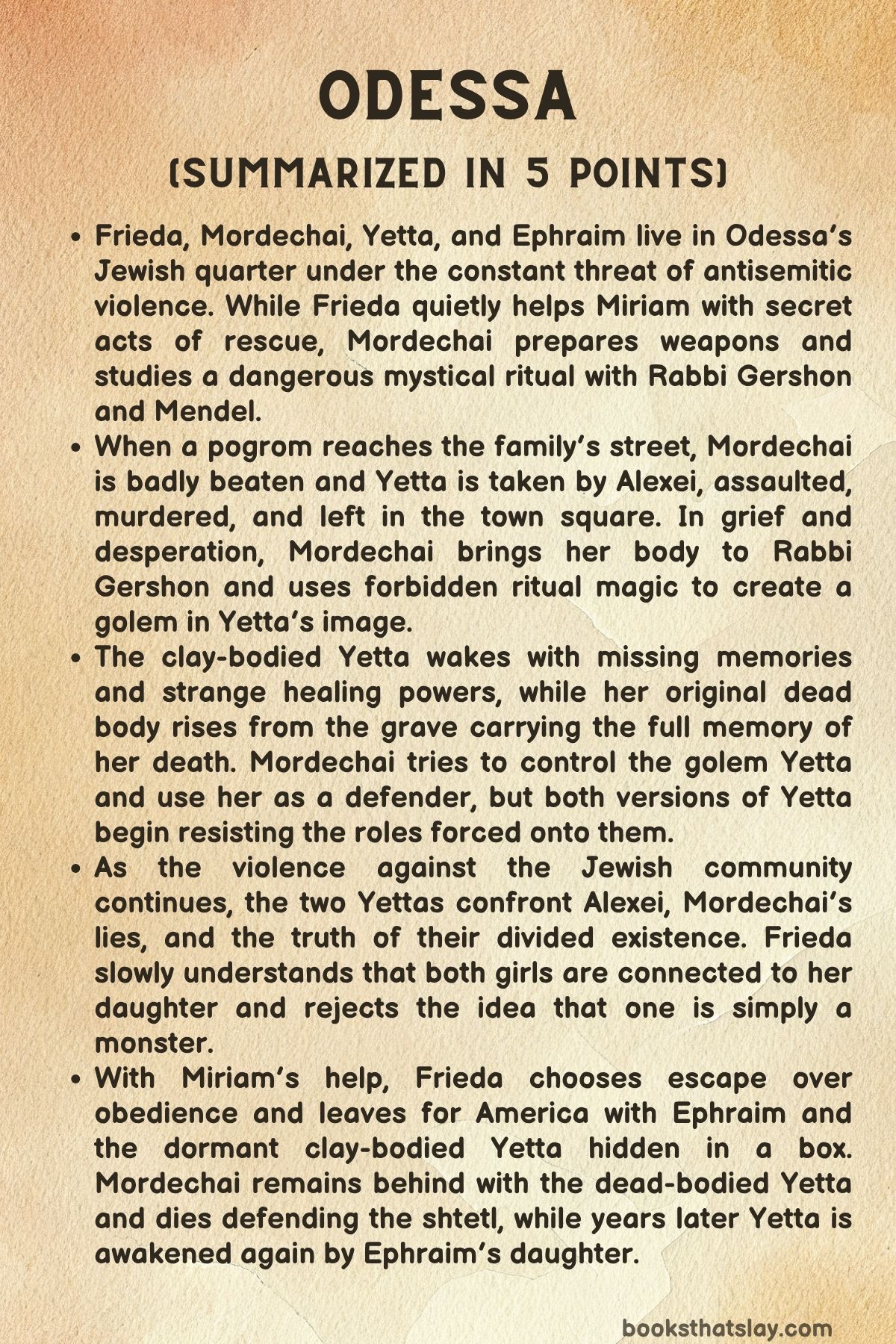
Summary
Frieda begins by going with Miriam to a spring outside the city to immerse herself in the mikvah. The ritual gives her peace, but it also fills her with guilt because she has not told her husband, Mordechai.
Miriam comforts her and secretly gives her three small parcels hidden under cloth. Frieda hides them in her basket and memorizes the names Goldberg, Kreamer, and Bronski so she can deliver them in the Jewish quarter.
On the way home, she sees her daughter Yetta holding little Ephraim, buys fish according to her private rules about numbers, and worries about being stopped. Then she notices Mordechai leaving his furniture shop early with an old red book and meeting the rabbi in secret.
Mordechai has spent years preparing for another pogrom. By day he works in a furniture shop, but in the back room he makes weapon parts while Josef the blacksmith completes them.
The men have hidden an armory in the abandoned synagogue because Mordechai believes the community must defend itself. He also works with Rabbi Gershon and Mendel on a dangerous mystical plan involving the Sefer Yetzirah.
Their attempts have failed so far, and the rabbi warns that the ritual requires perfect words, movements, letters, numbers, and timing. Mordechai still believes he has been chosen to save his people.
Yetta, Frieda and Mordechai’s daughter, longs for a life beyond her father’s rules. She secretly meets Benyamin at night, and their hidden intimacy gives her a sense of freedom.
Benyamin is worried by signs of danger: people are being attacked, men are staying out late, and Jews are being pushed out of work at the docks. Yetta resists living in fear, partly because fear already feels like another prison.
As Rosh Hashanah approaches, she tells Frieda she wants to delay marrying Benyamin because marriage seems like another form of confinement.
The family’s unease grows when distant shouts interrupt them. Mordechai barricades the door and shows Frieda a hiding place built inside the wall.
The family spends the night listening as violence moves closer. When attackers reach the house, Mordechai realizes they know about his secret preparations.
He orders Yetta to hide Frieda and Ephraim inside the wall. Yetta obeys, but when she hears Mordechai fighting, she opens the door and sees him badly hurt.
Alexei, a man from town whom Yetta recognizes, mocks Mordechai and accuses him of planning violence. When one man raises a club for a final blow, Yetta rushes out and grabs it.
The attackers turn on Yetta. Alexei taunts Mordechai, then seizes her when she tries to run.
He drags her through streets filled with destruction. Yetta sees murdered neighbors and spots Benyamin alive inside his house, but he turns away in terror.
Alexei takes her to the town square, assaults her, strangles her, and leaves her dead. Frieda remains hidden in the wall with Ephraim, trapped in darkness.
She remembers losing Yetta once as a child and finding her inside the synagogue, singing the Shema aloud. The memory becomes unbearable, and Frieda understands that her daughter is gone.
Mordechai wakes injured but alive, frees Frieda and Ephraim, and searches for Yetta. He finds her body on the great white steps in the town square.
Instead of bringing her home, he carries her to Rabbi Gershon’s house near the mikvah and begs the rabbi to use her in the ritual. Rabbi Gershon and Mendel know this was not the plan.
They had wanted a strong male body to create a defender, and they have never tried the ritual on a human. Mordechai accepts the risk.
The men wash Yetta’s body, gather clay, pray for hours, and use Hebrew letters, numbers, and sacred movements to create a hollow form around her. Mordechai repeats “Avra k’davra,” meaning “I create as I speak.” After the ritual, they uncover a second body inside the clay, identical to Yetta, with the letters for “truth” carved into its forehead.
The new Yetta opens her eyes.
Yetta wakes terrified, naked, and covered in clay. She remembers nothing of the attack.
Mordechai lies and tells her she was found in the forest, hidden in mud and clay, and that the covered corpse nearby is someone else. She senses that the story is wrong, but she wants to believe him.
At home, Ephraim is frightened by her and notices strange marks on her forehead. Later, Yetta cuts herself during a numb, confused moment, and water heals the wound completely.
Mordechai secretly buries the original body, believing Yetta’s soul now lives in the clay body. Rabbi Gershon warns that they must decide what to do about the golem they have made.
Mordechai soon learns that he can command Yetta. When he orders her to be calm, she instantly obeys.
Then the men discover that Yetta’s buried human body has clawed its way out of the grave. The dead-bodied Yetta appears in the rain, bruised, muddy, furious, and full of memories the golem lacks.
She accuses Mordechai of burying her and doing the ritual wrong. Mordechai calls her a demon and commands the clay-bodied Yetta to fight her.
The two Yettas battle, but the dead-bodied version escapes.
Mordechai decides to use Yetta’s strength against the attackers. He brings her into the woods with Jewish men and Benyamin to strike a group of Cossacks.
Yetta kills with terrifying power. When Mordechai orders her to finish the last man, she recognizes him as Alexei.
Her hidden trauma rises, and she freezes. Alexei shoots her in the chest.
At home, it seems she will die, but when Frieda lowers her into water, the wound vanishes. Mordechai tells Frieda that Yetta died and was remade, but he hides the full truth about the second Yetta.
He insists their daughter must never know and must serve as a defender.
In the forest, Yetta meets the dead-bodied version, who reveals that the golem’s wounds appear on her own decaying body. She says they are not separate enemies but split parts of the same person, torn apart by the ritual and by death.
They fight, and the dead-bodied Yetta poisons her, takes the sacred book, reverses the ritual, and buries her alive. Frieda tells Miriam what has happened, and Miriam realizes the men have used dangerous Kabbalistic magic.
Frieda begins to see that both Yettas may be her daughter.
The dead-bodied Yetta returns home pretending to be the clay-bodied one, but Mordechai notices she is cold, ill, decaying, and resistant to his commands. She moves through town at night, biting men connected to the attack and leaving black wounds that spread terror and memory.
She also learns of another planned assault on the Jewish quarter. Frieda later finds the clay-bodied Yetta frozen in the forest.
Rabbi Gershon finally tells Frieda the truth: Mordechai put Yetta’s soul in a clay body but left her dead body unguarded, allowing another spirit or force into it. Frieda rejects the idea that the dead-bodied Yetta is only a demon.
To her, both are Yetta.
During Hanukkah, the barricade around the Jewish quarter leaves people short of food. When Benyamin is captured and displayed in the town square, Mordechai gathers men to fight while Frieda and Miriam help women and children move toward safety.
The clay-bodied Yetta leads the rescue, fighting and healing in the rain. The dead-bodied Yetta is drawn to the square but freezes where she was murdered.
When Alexei attacks the clay-bodied Yetta, the dead-bodied Yetta saves her. Together, they stop him, and the clay-bodied Yetta breaks his back.
A fire begins in the forest, forcing the attackers to retreat.
Frieda accepts both Yettas and decides to leave with Miriam’s help. Miriam has secretly been smuggling Jews out to England and America for years.
There are only two tickets, so Frieda plans to take Ephraim and the clay-bodied Yetta. The dead-bodied Yetta explains that the golem can be made dormant by erasing the aleph from the word “truth” on her forehead, turning it into “death.” She asks Frieda to take Ephraim and carry the sleeping clay body in a box, while she stays behind with Mordechai.
Frieda agrees, tells Mordechai she is leaving for America, and boards the ship with Ephraim, Miriam, and the boxed Yetta. In New York, Yetta sleeps hidden in a synagogue attic.
Mordechai never comes and dies defending the shtetl. Years later, Ephraim’s daughter opens the box, restores the missing letter, and Yetta wakes again.
Characters
Frieda
In Odessa, Frieda is the emotional center of the family, though she begins as someone trained to silence her own instincts. Her life is shaped by rules, rituals, numbers, fear, and the constant work of keeping a household intact under threat.
At first, she seems bound by obedience to Mordechai and by the limits placed on Jewish women in her community, yet her quiet actions reveal a separate moral life. She goes to the mikvah without telling her husband, carries Miriam’s hidden parcels, and senses from the beginning that survival requires more than male plans of defense.
After Yetta’s death and return, Frieda becomes the only person willing to look at the impossible situation without reducing it to strategy or doctrine. She does not see one Yetta as useful and the other as monstrous; she recognizes pain, memory, and daughterhood in both.
Her growth lies in moving from fear-bound loyalty to active protection, even when that means leaving Mordechai behind. Frieda’s final decision to take Ephraim and the dormant golem across the sea is not an escape from love but an act of painful clarity.
Mordechai
Mordechai is driven by terror that has hardened into purpose. He has lived for years under the shadow of an earlier pogrom, and his secret weapon-making shows both courage and obsession.
He is not wrong to believe that danger is coming, and he is not wrong to think the community deserves a way to defend itself. Yet the book presents his tragedy through the way protection becomes control.
Mordechai wants to save his people, then save his daughter, then use his daughter to save his people. Each step feels justified to him because it begins in grief and fear.
His love for Yetta is real, but it becomes tangled with his need to command, explain, conceal, and direct her. He lies to her about her death, uses the obedience built into her new body, and refuses to face the full harm done by the ritual.
Mordechai’s downfall is not simple villainy; it is the failure of a wounded father who cannot accept loss without trying to master it.
Yetta
Yetta is the novel’s central figure of freedom, violation, division, and return. Before the pogrom, she is restless and bold, hungry for movement beyond the rooms and rules that define her life.
Her secret meetings with Benyamin show her desire to claim her own body and future, though the story soon places that desire against a world that punishes Jewish women with terrible force. After her murder, Yetta becomes split into two forms: the clay-bodied golem, who has strength without full memory, and the dead-bodied Yetta, who carries memory without safety or peace.
Neither version is complete alone. The golem Yetta is treated as a miracle and a weapon, while the dead-bodied Yetta is treated as a demon, but both reveal parts of the same wounded self.
Her journey is not simply about revenge or survival. It is about recovering truth from those who hide it, resisting commands that turn her pain into public usefulness, and finding a form of wholeness that no man in the book can give her.
Ephraim
Ephraim represents innocence in a world where innocence cannot protect anyone. As Yetta’s younger brother, he is often seen being held, comforted, hidden, or told stories.
His smallness makes the danger around the family feel sharper, because the violence is not abstract when a child must be pushed into a wall to survive. Ephraim also reflects the emotional cost of secrecy.
He senses that Yetta is different after her return, notices the marks on her forehead, and reacts with fear before the adults can explain anything. Yet he is not simply a symbol of vulnerability.
He becomes the carrier of family memory into the future. His survival allows Frieda’s choice to matter beyond the immediate crisis, and his daughter’s later act of waking Yetta links the next generation to the buried truths of the past.
Through Ephraim, the story shows that children inherit not only safety won by adults but also the silence, grief, and unfinished questions adults leave behind.
Miriam
Miriam is one of the strongest moral presences in the story because she understands survival as practical action rather than public heroism. She begins as Frieda’s guide at the mikvah, but her role expands as the book reveals her hidden work smuggling Jews out of danger.
She is secretive, but unlike Mordechai, her secrecy is not built around control. It is built around protection, movement, and giving people a chance to live.
Miriam also sees through the danger of the men’s mystical project more clearly than they do. Her warning about golem stories reveals her understanding of how power can become disaster when those using it refuse humility.
For Frieda, Miriam is both friend and alternative model of courage. She shows that resistance does not have to look like weapons, barricades, or rituals.
It can look like parcels hidden in baskets, tickets arranged in secret, shelter offered in the storm, and the willingness to help another woman choose life over obedience.
Rabbi Gershon
Rabbi Gershon stands at the uneasy border between faith, scholarship, fear, and responsibility. As a religious leader, he carries sacred knowledge, but his role in the ritual shows how spiritual authority can become dangerous when joined to desperation.
He repeatedly warns Mordechai that the ritual must be exact, and he understands that they are entering unknown territory, especially when Yetta’s body replaces the planned male defender. Yet he still agrees.
This makes him morally complicated rather than purely wise or purely reckless. He knows enough to fear the consequences, but not enough to refuse the act.
Later, he attempts to explain what happened by naming the dead-bodied Yetta as a dybbuk, but Frieda’s response exposes the limits of that explanation. Rabbi Gershon’s character shows the tension between religious language and lived grief.
He can name forces, laws, and errors, but he cannot fully account for what it means when a mother sees two suffering forms of her daughter.
Mendel
Mendel is a figure of caution, discomfort, and limited courage. He is involved in the secret plans with Mordechai and Rabbi Gershon, and he understands the practical and mystical aims behind creating a defender.
Yet when Mordechai brings Yetta’s body, Mendel resists because the act breaks from the original plan. His objection is not enough to stop the ritual, which makes him part of the harm even when he is uneasy about it.
Mendel often seems aware of danger but unwilling or unable to stand apart from the men around him. His remarks about the golem obeying her creator reveal how quickly the group can shift from mourning Yetta to thinking of her as a tool.
In that sense, Mendel helps expose the moral drift of the men’s project. He may not be as forceful as Mordechai, but his participation shows how communities can enable terrible choices through hesitation, rationalization, and silence.
Benyamin
Benyamin is both Yetta’s lover and one of the story’s most painful examples of fear’s damage. Before the attack, he is more anxious than Yetta about the worsening danger, and his worries prove justified.
He loves Yetta, but when he sees her being dragged away, he turns away in terror. This moment shapes how he must be understood afterward.
He is not cruel, but his fear becomes a betrayal with life-changing consequences. After his father’s murder, he is broken by grief and guilt, and his later intimacy with Yetta carries confusion, need, and unresolved trauma.
When he is bitten by the dead-bodied Yetta, he becomes physically marked by the return of what he tried not to face. His capture during Hanukkah places him again in the role of someone who must be rescued, especially by Yetta.
Benyamin’s character shows that love without courage may still fail the beloved, and that survival can leave shame as real as any wound.
Alexei
Within Odessa, Alexei is the clearest human face of antisemitic violence and gendered cruelty. He is not merely part of the mob; he personalizes the attack by recognizing Yetta, humiliating Mordechai, and turning flirtation into accusation and threat.
His violence against Yetta is meant to destroy her body, her freedom, and her father’s sense of protection all at once. Because Yetta once believed he might not hurt her, his betrayal also exposes the danger of mistaking casual attention for safety in a society built on hatred.
Alexei’s later fear when he sees Yetta alive reveals that the people who use terror often depend on their victims remaining silent, dead, or disbelieved. His final confrontation with both Yettas reverses that power.
He is not redeemed, softened, or made complex in a sympathetic way; he functions as the embodiment of the force the story refuses to excuse.
Josef
Josef the blacksmith has a smaller role, but he matters because he helps make Mordechai’s preparations possible. By completing the weapons that Mordechai begins in the furniture shop, he represents the practical labor behind communal defense.
His presence also shows that Mordechai’s plans are not private fantasy alone; other men in the community share the fear and participate in the effort to prepare for violence. Josef’s work is grounded, physical, and direct, in contrast to the mystical experimentation of Rabbi Gershon and the others.
Through him, the story separates ordinary self-defense from the more dangerous desire to create an obedient supernatural protector. Josef does not dominate the emotional center of the book, but his contribution helps establish the atmosphere of a community living with the knowledge that another attack is not only possible but expected.
Themes
The Cost of Turning Protection into Control
In Odessa, protection often begins as love, responsibility, or communal duty, but the story repeatedly shows how easily it can become control. Mordechai’s fear is understandable: he has seen what pogroms do, he knows the authorities will not protect Jewish families, and he cannot bear the thought of standing helplessly by.
His weapons, armory, and barricade all come from that need. Yet his choices after Yetta’s death reveal the danger of making survival more important than personhood.
He brings her body to the rabbi, remakes her without consent, lies about what happened, and then uses the obedience of her golem body to command her. He calls this protection because he believes she can defend the community, but the language of duty hides the fact that Yetta’s will has been taken from her.
Frieda and Miriam offer another model of protection, one based on escape, shelter, secrecy, and choice. The theme becomes most powerful because the book does not treat protection as false or unnecessary.
It shows that protection is essential, but it becomes destructive when the protected person is denied truth, agency, and the right to decide what survival should mean.
Trauma, Memory, and the Divided Self
Yetta’s split existence gives physical form to the way trauma can divide a person from memory, body, and identity. The clay-bodied Yetta wakes without the knowledge of her own murder, which allows her to function for a time but also leaves her confused and vulnerable to Mordechai’s lies.
The dead-bodied Yetta, by contrast, carries the memories in a decaying form that cannot rest. She remembers the assault, the strangling, the burial, and the betrayal of being left behind.
Neither version is whole because the ritual has separated survival from remembrance. The golem body has strength and healing but lacks the truth; the corpse body has truth and rage but is falling apart.
Their conflict is therefore not only a battle between creature and demon. It is a struggle between denial and memory, between the wish to move forward and the need to face what happened.
The bite that restores memory is violent, but it also forces recognition. Through Yetta, the story suggests that trauma cannot be erased simply because remembering is painful.
A self built on missing truth remains unstable, and healing begins only when the hidden wound is named.
Women’s Resistance Outside Male Power
The men in the story often imagine resistance through weapons, rituals, commands, and public confrontation. Mordechai builds an armory, Rabbi Gershon uses sacred knowledge, Mendel joins the secret project, and the men organize attacks and barricades.
These actions matter, but they are not the only forms of resistance the book respects. Frieda and Miriam create a quieter, more flexible network of survival.
Miriam hides parcels, shelters Frieda, arranges escape routes, and has been helping Jews leave for years. Frieda begins within the boundaries of marriage and motherhood, but she slowly learns to trust her own judgment over Mordechai’s authority.
Their resistance is not passive simply because it is less visible. It protects bodies, preserves futures, and recognizes the needs of women and children who are often left out of heroic plans.
Yetta’s two forms also challenge male power directly. She refuses to remain a weapon, refuses the label of demon, and forces others to confront the truth of what was done to her.
The story’s strongest acts of survival come when women stop waiting for permission and begin making choices that preserve life on their own terms.
Faith, Folklore, and Moral Responsibility
The use of the Sefer Yetzirah, Hebrew letters, ritual movement, and the golem legend gives the story a powerful religious and folkloric frame, but the book is less interested in spectacle than in responsibility. Rabbi Gershon warns that the ritual must be exact, which shows that sacred knowledge is not casual power.
Still, the men proceed under pressure, and when the ritual goes wrong, they try to explain the result in terms they can manage: golem, dybbuk, demon, error. These names matter, but they do not remove moral responsibility.
Mordechai cannot excuse himself by saying grief drove him. Rabbi Gershon cannot excuse himself by saying the ritual was uncertain.
Mendel cannot excuse himself by saying he objected but still remained involved. The story treats faith with seriousness while also questioning what happens when sacred tradition is used to avoid ordinary ethical questions.
Did Yetta consent? Who has the right to command her?
Is survival worth the destruction of truth? By placing mystical creation beside family grief and communal danger, the book shows that religious power without humility can become another form of violence.