The Dinner Party Summary, Characters and Themes
The Dinner Party by Freida McFadden is an interactive psychological thriller built around reader choice, danger, dark humor, and wildly different outcomes. Instead of following one fixed plot, the novel lets readers guide Sloan, a desperate waitress who accepts a suspicious high-paying job at a remote mansion because she needs rent money fast.
The story uses a branching “Pick Your Poison” format, where each decision can lead to survival, death, betrayal, romance, or a strange supernatural twist. It mixes thriller suspense with horror creatures, cannibal elites, revenge, and absurd comedy, creating a fast-moving reading experience shaped by the reader’s decisions.
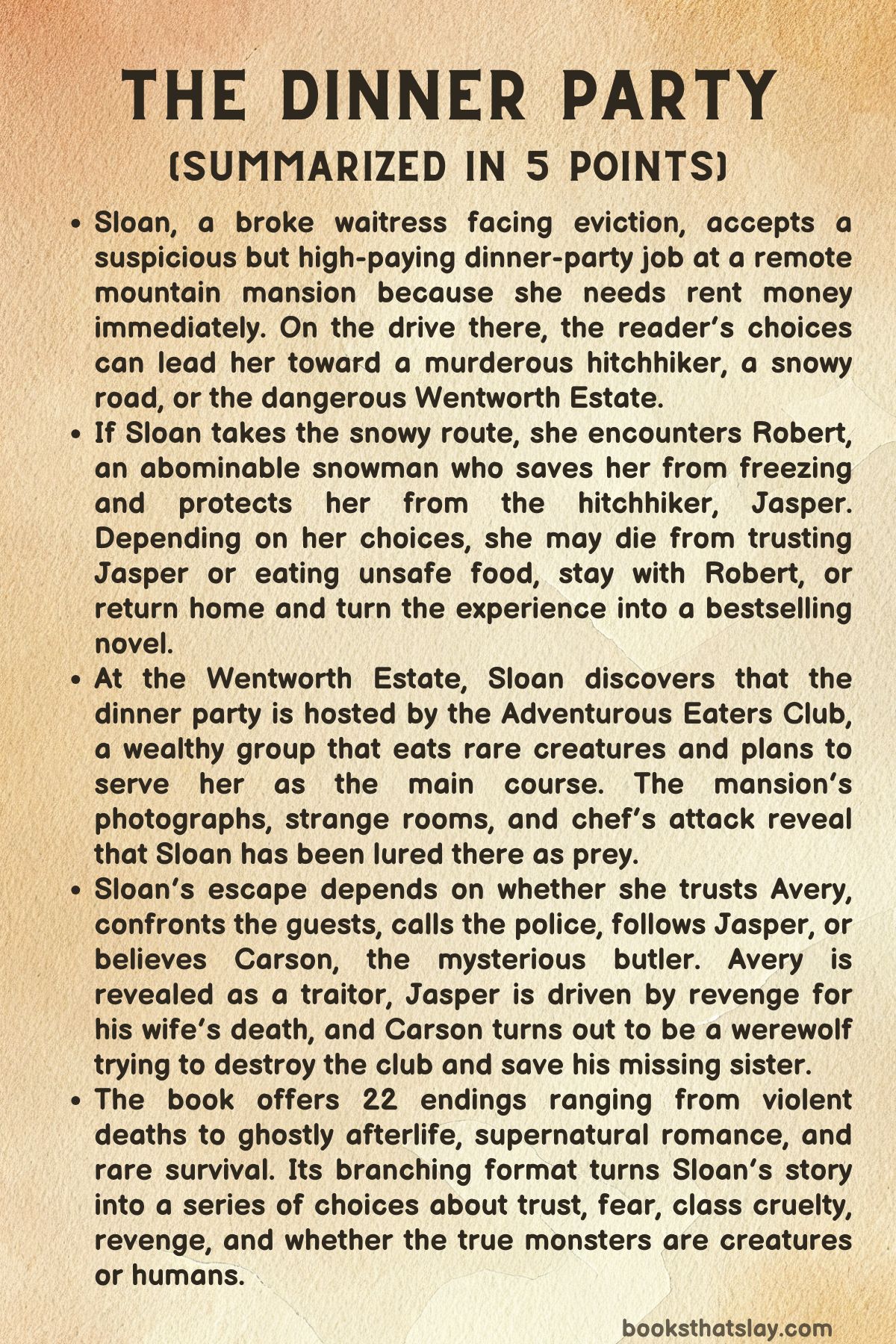
Summary
Sloan is a broke waitress facing eviction after falling behind on rent. She lives with her roommate Blair and Blair’s boyfriend Griff, and her financial situation has become so bad that she is searching online for any possible way to make quick money.
When Blair storms into her room and demands payment, Sloan’s response determines whether her troubles worsen immediately or she gets another chance. If she stands up for herself, Blair throws her belongings into the street and Griff forces her out of the apartment, leaving Sloan homeless in the cold.
If Sloan chooses to calm Blair down, she receives a call from Avery, an old friend who offers her a waitressing job that pays enough to cover two months of rent. The job is at a dinner party on Peyton’s Peak, a remote mountain estate with no cell service, and although it sounds suspicious, Sloan is desperate enough to accept.
Sloan borrows Blair’s silver Audi and begins the drive toward the mountain. On the way, she sees a hitchhiker standing in the cold, a scruffy middle-aged man carrying a duffel bag, and her choice to stop or keep driving sharply changes the course of the story.
If Sloan picks him up, the hitchhiker introduces himself as Jasper and claims he is carrying the ashes of his dead wife, Lorna. He asks Sloan to take him to a cabin, but every choice involving him proves dangerous.
If she refuses to drive down the isolated road to the cabin, Jasper strangles her in the car. If she agrees to go to the cabin and steps inside, he attacks her with an ax and kills her there.
If Sloan ignores Jasper and continues driving, she eventually reaches a fork in the mountain road. The left path looks snowy and unused, while the right path looks dangerous but clearer, forcing Sloan to choose between uncertainty and warning signs.
When Sloan takes the left path, her car gets stuck in the snow. Staying inside leads to her freezing to death after the car runs out of fuel, while getting out brings her face-to-face with a huge white-furred creature with yellow fangs.
Sloan faints and wakes in a cave near a fire. Jasper is tied up nearby, and he begs her to free him, but Sloan senses that something is wrong.
If she unties Jasper, he reveals that he knows her name even though she never told him, then strangles her in the darkness. If she leaves him restrained, the creature returns and reveals that he can speak English.
The creature introduces himself as Robert, an abominable snowman who saved Sloan from freezing and tied up Jasper because he caught him preparing to hurt her. Robert turns out to be lonely rather than immediately hostile, and he tells Sloan that his wife Nicole disappeared years earlier.
Sloan learns that Robert believes Nicole was taken by someone on the mountain. The mystery later connects to the mansion, where a wealthy club displays photographs of rare creatures it has eaten, including a female abominable snowman.
In Robert’s cave, Sloan’s survival depends on what she eats and whom she trusts. If she refuses Robert’s food and searches Jasper’s bag, she finds deadly berries and dies after eating them.
If she searches the cave for food, she eats poisonous mushrooms, hallucinates, and falls off the mountain. If she accepts Robert’s food, she discovers that he serves simple cereal, and their connection may lead either to an unexpected romance or a safe return home.
If Sloan chooses romance with Robert, she stays with him and learns the next morning that he cooked Jasper for breakfast. If she declines his advances, Robert helps her return home, and Sloan later turns the experience into a bestselling novel about a snowman.
If Sloan takes the right road instead of the snowy left path, she reaches the Wentworth Estate, a mansion hidden behind iron gates. The gates close and lock behind her, and she is greeted by Carson, a handsome butler who quietly warns her that she is in danger.
Avery appears and acts as if everything is normal, leading Sloan into a gathering of rich, eccentric guests. Their host, Davenport Wentworth, introduces the group as the Adventurous Eaters Club, a circle of wealthy people who pride themselves on eating rare and exotic animals.
The guests’ behavior soon becomes alarming. One of them nearly admits that Sloan is meant to be served to them, and the dining room walls display framed photographs of unusual animals the club has consumed.
Among those photographs is an abominable snowman, which suggests that Robert’s missing wife Nicole was captured and eaten by the club. Wentworth’s refined manners hide his cruelty, and the mansion gradually reveals itself as a place where the rich turn living beings into trophies and meals.
Sloan may tour the estate and discover strange rooms, including a cage holding a white-furred dire wolf. Wentworth claims the animal is a prehistoric species, but later events suggest a much stranger explanation.
Eventually Sloan reaches the kitchen, where Wentworth introduces Jacques, the chef. When Sloan picks up a polished tray, she sees Jacques reflected behind her with a butcher knife.
If Sloan ignores the warning, Jacques kills her. If she attacks him with the tray and runs, she finds a photograph of herself displayed with the other “meals,” confirming that she is the dinner party’s main course.
Sloan then tries to escape the mansion. Avery pretends to help, but her loyalty is uncertain, and Carson’s earlier warning begins to look more reliable.
If Sloan confronts the dinner guests, they surround her with antique weapons and prepare to kill her. Before they can do so, the dire wolf breaks in and slaughters them, sparing Sloan.
Carson then appears and urges Sloan to leave without contacting the police. If she calls the police anyway, the officers do not believe that a wolf killed the guests, and Sloan is arrested and sentenced to life in prison.
If Sloan leaves with Carson, he drives her home but behaves strangely under the full moon. After she reaches her apartment, Jasper is waiting inside and strangles her.
Jasper then reveals his motive. Sloan once freed animals from a zoo during an activist break-in, and one of the giraffes killed his wife Lorna; since Sloan escaped punishment, Jasper decided to avenge Lorna himself.
If Sloan follows Avery toward a supposed back exit, Avery leads her in circles and betrays her to Wentworth. Avery admits she sold Sloan out for money, and Wentworth kills Sloan.
From there, Sloan may continue as a ghost haunting the mansion. She meets Nicole’s ghost and other animal spirits, and she finds that the afterlife is oddly peaceful because she no longer has to worry about rent.
If Sloan refuses to follow Avery and heads out the front door, Carson knocks Avery unconscious and reveals that she had been betraying Sloan. He tells Sloan that the car is unsafe because Wentworth controls the gates, so he leads her toward a gap in the fence.
On the way, Jasper appears again and claims he knows a safer escape route. If Sloan trusts him, he leads her away and strangles her.
If Sloan stays with Carson, the two escape the estate grounds. Under the full moon, Carson transforms into a werewolf and explains that he took the butler job to investigate the club after his sister disappeared.
The caged dire wolf is implied to be Carson’s sister, and Carson has been trying to destroy the club from within. His wolf form makes him dangerous, but his actions show that he has been protecting Sloan.
Sloan then faces a final emotional choice. If she declines romance, Carson reveals that he is a Bitcoin billionaire and takes her home, but Blair kills Sloan after discovering that her car is missing.
If Sloan chooses Carson romantically, he refuses to sleep with her until marriage. They later have a destination wedding in the Balkans surrounded by wolves.
On their wedding night, Carson warns that werewolves become dangerous when hungry and offers to get food. If Sloan goes to the kitchen herself, she spills gravy, cuts her hand, and Carson loses control in wolf form, killing and eating her.
If Sloan lets Carson bring the food, he returns safely with ice cream, and they settle into bed together. This route gives Sloan the rare happy ending she has been chasing: safety, love, and freedom from the desperate life that pushed her toward Peyton’s Peak in the first place.
Characters
Sloan
Sloan is the central figure of The Dinner Party, and the entire book depends on her choices, instincts, fears, and mistakes. She begins as a financially desperate waitress whose life is already unstable before the supernatural and murderous threats appear.
Her poverty is important because it explains why she accepts a job that clearly sounds unsafe. Sloan does not take risks because she is careless; she takes them because eviction, debt, and public humiliation have narrowed her options.
Sloan’s strongest trait is her survival instinct, though the book repeatedly tests whether that instinct is sharp enough. Sometimes she senses danger correctly, as when she distrusts Jasper, notices Jacques’s reflection, or begins to believe Carson’s warning.
At other times, fear, hunger, guilt, or misplaced trust lead her into fatal decisions. The interactive structure makes Sloan both a character and a mirror for the reader, since her intelligence or foolishness often depends on which path is chosen.
She also has a comic quality that keeps the story from becoming purely grim. Her mistaken ideas about OnlyFans, her obsession with Blair’s Audi, and her absurd romantic options make her feel like someone trapped in a nightmare but still thinking in practical, oddly funny ways.
Sloan’s past as an animal-rights activist adds moral complication to her character. Her decision to free zoo animals may have been idealistic, but it caused Lorna’s death and created Jasper’s revenge plot, showing that good intentions can still produce terrible harm.
Avery
Avery appears at first to be Sloan’s rescuer, because she offers the job that might solve Sloan’s rent crisis. Her friendly tone and shared history with Sloan make her seem trustworthy, which is why her betrayal becomes one of the story’s cruelest turns.
Her character represents the danger of familiar faces in unsafe situations. Sloan is not only tricked by strangers; she is also deceived by someone she has known for years, which makes Avery’s betrayal feel more personal than Wentworth’s open villainy.
Avery’s motive is financial, and that makes her a distorted reflection of Sloan. Both women need money, but Sloan risks herself to earn it, while Avery sells out another person to improve her own life.
This contrast makes Avery morally weak rather than simply cartoonish. She understands enough to feel guilt, but not enough to refuse the deal, and her apology cannot undo the fact that she guides Sloan toward death.
Jasper
Jasper is one of the story’s most persistent threats because he appears across multiple routes and remains dangerous even when other villains take center stage. At first, he seems like a cold, vulnerable hitchhiker, but his helplessness is a trap.
His grief over Lorna’s death has hardened into revenge. He believes Sloan deserves punishment because her animal-rights action indirectly caused his wife to be killed, and this belief turns him into a stalker who sees murder as justice.
Jasper’s duffel bag carries much of his character’s meaning. It contains Lorna’s ashes, nightshade berries, and signs of his obsession, making it less a travel bag than a portable shrine to grief, blame, and planned death.
He is frightening because he uses pity as a weapon. Sloan’s kindness, guilt, or desire to help can all give him access to her, and the book repeatedly shows that compassion without caution can become deadly.
Carson
Carson is introduced as the handsome butler who warns Sloan that she is in danger, placing him between suspicion and attraction from the start. Because the estate is full of deception, Sloan and the reader cannot immediately know whether he is a protector, a predator, or both.
His secret identity as a werewolf changes the meaning of his earlier behavior. The blood, the claw marks, his reaction to the full moon, and his strange urgency all become signs of a hidden nature that is dangerous but not evil.
Carson’s main motivation is loyalty to his missing sister. He infiltrates the Wentworth Estate not for money or adventure, but to find her and destroy the club that has been capturing and consuming rare beings.
In The Dinner Party, Carson becomes the clearest example of a monster who behaves more humanely than the humans around him. His body may transform into something frightening, but his choices are often protective, loyal, and self-controlled.
His romance with Sloan is intentionally strange and comic. He is wealthy, old-fashioned about marriage, and physically dangerous under the wrong conditions, which makes him both a fairy-tale rescuer and a threat that can still kill her.
Robert
Robert, the abominable snowman, first appears as a terrifying creature, but he quickly becomes one of the story’s biggest reversals. Sloan expects him to be violent, yet he is the one who saves her from freezing and protects her from Jasper.
His ordinary name gives him comic warmth and makes him less like a legend than a lonely person. Robert’s speech, manners, cereal, and emotional vulnerability all challenge Sloan’s assumptions about what a monster is supposed to be.
Robert is defined by loneliness and loss. His wife Nicole disappeared years earlier, and his inability to find her has left him isolated in the cave, still hoping for answers but expecting the worst.
His tenderness has limits, however. The route in which he cooks Jasper shows that Robert is still a predator in some sense, even if he is not the villain Sloan first imagines.
Robert’s character helps the story blur the line between horror and absurd romance. He can be Sloan’s savior, lover, meal companion, or inspiration for a bestselling novel, depending on the path chosen.
Blair
Blair is Sloan’s roommate and one of the earliest sources of pressure in the story. She is not a supernatural monster or a murderer in most routes, but her cruelty creates the financial panic that pushes Sloan toward the dangerous job.
Her treatment of Sloan shows how ordinary life can be threatening before the horror plot even begins. Eviction, humiliation, and dependence on someone else’s mercy are presented as real dangers that make Sloan vulnerable to worse ones.
Blair’s attachment to her car is almost comic, but it also shows her selfishness. She cares more about the Audi than Sloan’s safety, and in one route, her anger over the missing vehicle becomes violently absurd.
Blair functions as a domestic antagonist. She represents the life Sloan is trying to escape: unstable housing, disrespect, debt, and a constant sense of being one mistake away from disaster.
Griff
Griff is a smaller character, but his physical presence strengthens Blair’s power over Sloan. He is described as large and intimidating, and Blair uses him as a threat when Sloan tries to assert herself.
His role is less about personality and more about force. He represents the way Sloan’s living situation is stacked against her, because even when she has a legal or moral argument, she lacks the power to make it matter.
Griff also helps establish the book’s darkly comic exaggeration. His footsteps, size, and role as Blair’s enforcer make him feel almost like a domestic monster before the story introduces actual monsters.
Davenport Wentworth
Davenport Wentworth is the polished villain at the center of the estate plot. He hides brutality beneath wealth, manners, and ceremony, making him more disturbing because he treats murder as fine dining.
Within the book, Wentworth represents a form of evil that is organized, expensive, and socially protected. He does not act like a desperate killer; he acts like a host who believes his money gives him permission to consume anything and anyone.
His Adventurous Eaters Club turns living beings into status symbols. The photographs on the wall are not only records of meals but trophies, showing that Wentworth values domination as much as taste.
Wentworth’s politeness makes his violence worse. He can kiss Sloan’s hand, speak elegantly, and still plan to have her butchered, which makes him a strong example of civilized cruelty.
Heinrich van Houten
Heinrich van Houten is one of the clearest signs that something is wrong at the mansion. His slip about Sloan being served exposes the truth before Wentworth is ready to admit it.
His character is useful because he lacks the host’s control. While Wentworth disguises the club’s intentions under etiquette, Heinrich’s excitement reveals the appetite beneath the performance.
Heinrich also shows the entitlement of the dinner guests. He does not see Sloan as a person with a life, needs, and fear; he sees her as something to be purchased, prepared, and enjoyed.
Though he is not as central as Wentworth, Heinrich helps define the group’s moral ugliness. His casual cruelty shows how the club has normalized acts that should horrify any decent person.
Jacques
Jacques is the chef who turns the mansion’s threat from suspicious to immediate. His butcher knife and hidden approach reveal that Sloan is not being paranoid; she is truly being prepared for slaughter.
As a character, Jacques represents professional skill stripped of morality. He is not presented as a wild killer but as someone doing a job, which makes him unsettling in a different way from Jasper or the monsters.
His kitchen is also symbolic. It looks impressive and luxurious, but its tools and enormous oven reveal the practical machinery behind Wentworth’s refined cannibalism.
Jacques’s role is brief but decisive. Once Sloan sees his reflection, the story forces her to choose between social politeness and survival, and that moment becomes one of the book’s sharpest tests of instinct.
Nicole
Nicole is mostly absent from the living action, yet her fate shapes several major revelations. As Robert’s missing wife, she gives his loneliness emotional weight and turns the abominable snowman route into more than a strange romantic detour.
Her implied death at the hands of the Adventurous Eaters Club connects the snowy mountain branch to the mansion branch. The photograph of a female abominable snowman suggests that Nicole was captured, killed, displayed, and eaten.
As a ghost, Nicole also gives the afterlife route a strange sense of community. She is no longer only a victim; she becomes part of a haunted world where the creatures destroyed by human greed still remain.
Nicole’s character deepens the story’s treatment of monsters. She is feared by humans because of what she is, yet the true horror lies in the people who hunted and consumed her.
Lorna
Lorna is Jasper’s dead wife, and although she does not appear alive in the story, her death drives Jasper’s revenge. She was killed by a giraffe Sloan helped release, making her the human cost of Sloan’s earlier activism.
Her role complicates the moral balance of the novel. Sloan may not have intended harm, but Lorna’s death proves that idealistic actions can have victims beyond the intended cause.
For Jasper, Lorna becomes less a remembered person than a justification. He carries her ashes and speaks of honoring her, but his grief has turned into obsession and murder.
Lorna’s presence also creates a dark echo of Robert and Nicole. Both Jasper and Robert have lost wives, but Robert’s grief leaves room for protection and connection, while Jasper’s grief becomes punishment and violence.
The Adventurous Eaters Club
The Adventurous Eaters Club works as a collective villain made up of wealthy people who treat cruelty as sophistication. Their appetite for rare animals and human flesh is framed as a luxury hobby, exposing the moral rot beneath their status.
The club’s evil comes from shared permission. Each member helps normalize the others’ behavior, so murder becomes a social event rather than an individual crime.
They also turn consumption into a performance of class. Their dining room, weapons, rituals, and photographs show that they are not merely eating forbidden things; they are proving that they can access what ordinary people cannot.
As a group, they make the story’s human villains more frightening than its creatures. The snowman and werewolf may look monstrous, but the club’s choices are colder, more deliberate, and far more corrupt.
Themes
Choice, Consequence, and the Illusion of Control
Choice drives the structure and meaning of The Dinner Party, but the book rarely treats choice as simple freedom. Sloan’s decisions matter, yet they often operate inside traps created by poverty, deception, isolation, and other people’s hidden motives.
The reader may choose whether Sloan trusts someone, eats something, fights, flees, or follows a warning, but many options expose how little information she truly has. A choice can look kind and become fatal, while a rude or suspicious choice may save her life.
This makes the story’s interactive format more than a playful device. It turns decision-making into a moral and survival test, asking whether instinct, caution, empathy, or boldness should guide a person under pressure.
The repeated deaths also suggest that consequences are not always fair. Sloan can die because she helps a stranger, because she trusts an old friend, because she calls the police, or because she tries not to damage a borrowed car.
At the same time, the rare good endings reward careful attention. The safest path often requires noticing warning signs, questioning politeness, and understanding that survival sometimes depends on refusing the option that looks socially acceptable.
Poverty, Class, and the Price of Survival
Sloan’s financial desperation is the reason the story can happen. She does not go to Peyton’s Peak because she is reckless by nature; she goes because rent is due, her roommate is threatening eviction, and the job offers enough money to keep her housed.
That economic pressure makes her vulnerable to exploitation. Avery’s offer works because it arrives at the exact moment Sloan feels cornered, and the mansion’s wealthy predators depend on that kind of vulnerability.
The contrast between Sloan and the Adventurous Eaters Club is sharp. Sloan needs money for basic survival, while the guests spend their wealth on the experience of consuming rare beings and, eventually, another person.
Their cannibalism exaggerates class cruelty into horror. They do not merely exploit the poor; they literally plan to eat someone whose disappearance they assume will not matter.
Avery’s betrayal also belongs to this theme. She sells Sloan out for money, showing how financial pressure can corrupt friendship and make one desperate person complicit in another’s destruction.
The book’s class critique is darkly comic, but its foundation is serious. When survival requires money, people with wealth can turn other people’s desperation into a trap.
Trust, Instinct, and Betrayal
Sloan’s survival often depends on deciding whom to trust, but the story keeps making that decision unstable. Familiar people can betray her, frightening creatures can save her, and polite hosts can be killers.
Avery is the clearest example of trust turned dangerous. Because she is Sloan’s old friend, her guidance seems safer than Carson’s whispered warning or the strange atmosphere of the estate.
That assumption proves costly. Avery uses the language of concern while steering Sloan toward death, showing that emotional familiarity can become a weapon when someone chooses self-interest over loyalty.
Jasper also manipulates trust, but he does so through pity. He appears cold, grieving, and helpless, and Sloan’s humane impulse to help him can give him the chance to kill her.
By contrast, Robert and Carson look threatening but repeatedly protect Sloan. The story asks the reader to separate appearance from action, because fear alone is not always accurate and charm is not always safe.
Instinct becomes one of Sloan’s most important tools, but it is not perfect. The book suggests that survival requires more than courage; it requires observing behavior, questioning motives, and accepting that danger may arrive in a friendly voice.
Monsters, Humanity, and Moral Reversal
The novel repeatedly reverses the expected meaning of monstrosity. The abominable snowman and the werewolf look like creatures from horror stories, but they are often more compassionate than the ordinary humans Sloan encounters.
Robert saves Sloan, feeds her, and protects her from Jasper. Carson risks his cover to warn Sloan, fights the cannibal club, and searches for his missing sister.
Their bodies may be frightening, but their actions show loyalty, grief, restraint, and care. The so-called monsters are capable of love and protection, while the refined human guests behave with calculated cruelty.
Wentworth and his club are the real moral monsters. They use manners, wealth, and tradition to disguise murder, treating living beings as rare meals and trophies.
This reversal gives the horror elements a satirical edge. The story is not only asking what kind of creature has fur, claws, or fangs; it is asking what kind of person can look civilized while enjoying another being’s suffering.
Sloan’s shifting reactions to Robert and Carson also show how fear can be revised by experience. Once she sees who protects life and who destroys it, the boundary between human and monster becomes far less important than the choices each character makes.