The Gravewood Summary, Characters and Themes
The Gravewood by Kelly Andrew is a dark fantasy horror novel about survival, hunger, devotion, and the terrifying cost of wanting to save someone who may already be lost. Set around Little Hill, Mercy Ridge, and the infected forest known as the Gravewood, the story follows Shea Parker, a deaf girl trapped by poverty, secrecy, and her mother’s infection.
Her dangerous bond with Oliver Lysander, the ruler of the Mercy Boys, pulls her into a world shaped by the Rot, a blood-drinking curse, rival territories, buried family crimes, and impossible bargains. The novel builds its tension through emotional need as much as physical danger.
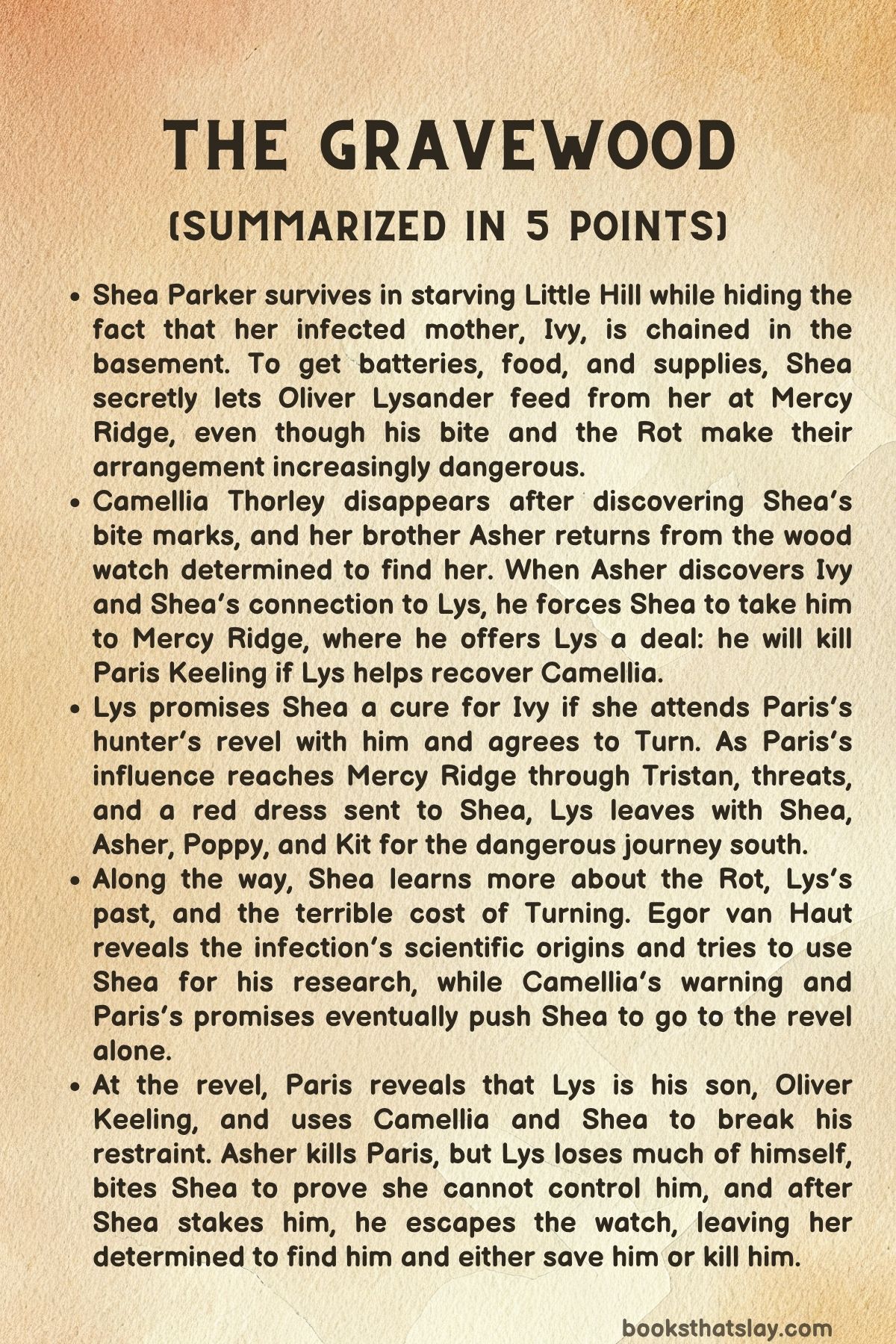
Summary
Shea Parker lives in Little Hill, a starving town near the forest, where survival often depends on theft, secrecy, and the ability to hide weakness from neighbors. She is deaf and depends on hearing aid batteries, which are hard to get in a place where supplies are scarce.
Her home life is even worse than the town knows. Her father, Calhoun, vanished years earlier after illness and grief hollowed out the family, and her mother, Ivy, has become infected by the Rot.
Shea keeps Ivy chained in the basement, feeding her small animals and pretending to others that her mother is simply sick and avoiding people. The lie is brutal, but Shea believes it is the only way to keep Ivy alive and safe from the watch.
Deep in the Gravewood stands Mercy Ridge, an abandoned ski lodge ruled by Oliver Lysander, who leads a group of runaways known as the Mercy Boys. The forest is infected by the Rot, a force spread through water and living things.
Those who drink from the spring-fed source may Turn into cold, hungry, blood-drinking creatures, though not everyone survives the process in the same way. Some fail and become hollows, broken beings consumed by need.
Lys tests recruits for loyalty by sending them to the well, including Tristan Choi from Little Hill. For Lys, Mercy Ridge is both a kingdom and a refuge, though the loyalty around him is always tied to fear.
Shea has already been visiting Lys in secret before the main conflict begins. She lets him feed from her in exchange for batteries and supplies.
His bite makes her numb and euphoric, and that feeling becomes part of the danger. Shea understands that the arrangement gives Lys power over her, but she is also desperate.
Every visit helps her care for Ivy and keeps her household from total collapse. When Shea arrives at Mercy Ridge with a bleeding hand, she is not there because she wants to Turn.
She wants a deal, and she believes Lys may be the only person with enough power to help her.
Camellia Thorley’s disappearance threatens to expose everything Shea has hidden. Camellia had discovered the bite marks on Shea’s wrist and fought with her before vanishing into the Gravewood.
Her older brother, Asher Thorley, returns from service as a wood watch soldier determined to find her. Asher knows Shea from Little Hill, and their history carries pain, resentment, and old promises.
He confronts her, follows her home, and discovers Ivy chained in the cellar. He also sees the marks Lys has left on Shea.
Since Ivy is a contagion risk, Asher uses the secret to force Shea to take him to Mercy Ridge.
When Shea brings Asher to the lodge, she tries to make Lys feed first, hoping blood will calm him before the soldier is revealed. The plan fails.
Cyrus, Lys’s lieutenant, recognizes the danger at once and treats Shea like a traitor. Asher is captured and beaten in front of the Mercy Boys, but instead of begging, he offers Lys a bargain.
Asher is known in the watch as Sunshine, a famous sniper, and he claims he can assassinate Paris Keeling, the ruler of the southern Flatwood. Asher wants Camellia found, Lys wants Paris dead, and Shea wants a cure for Ivy.
Lys turns the conflict into an agreement that binds all three of them together.
Lys claims a cure exists and promises to get it for Shea if she attends the hunter’s revel with him and agrees to Turn. Shea accepts because she values Ivy’s survival above her own safety.
Lys keeps Shea and Asher at Mercy Ridge while watchmen are sent to guard Shea’s house. The lodge grows tense as Cyrus resents Shea’s influence over Lys, seeing her as a weakness and a threat to the order Lys has built.
Lys’s mother, Viola, appears scarred, unstable, and haunted by past violence. Through her, Shea begins to understand that Paris’s power over Lys is not only political.
It is personal and rooted in family damage.
Paris Keeling’s pressure increases. He sends envoys demanding that Lys attend the hunter’s revel, an event Lys has avoided for years.
Lys refuses and answers with violence, but Paris continues to reach into Mercy Ridge. Poppy Zahar, a friend of Shea and Camellia, arrives while searching for answers.
Tristan reveals that Paris pushed him into joining the Mercy Boys and ordered him to attack Shea. Shea and Asher stop him, but the attack proves Paris has already entered Lys’s territory through manipulation.
Paris also sends Shea a red dress for the revel, making it clear he knows about her and understands her importance to Lys.
Lys receives a bottle filled with blood and a threatening message, and he realizes Paris is using Shea as leverage. He decides to leave Mercy Ridge with Shea, Asher, Poppy, and Poppy’s possum, Kit.
The journey south is dangerous, taking them through territory shaped by watch patrols, Keeling’s followers, and Rot-filled woods. On the road, Shea and Asher’s old tensions return.
Asher had once promised to get both of them out of Little Hill, but his enlistment and Shea’s bargain with Lys changed their lives. Shea feels abandoned by him, while Asher sees how far she has gone to survive.
Their relationship is marked by anger, care, guilt, and unresolved affection.
As they travel, Shea also grows closer to Lys. His hunger worsens, and his grip on his humanity becomes weaker.
He can be protective and tender toward her, but he is also dangerous in ways she cannot ignore. His need for blood and the force of the Rot inside him make every moment uncertain.
Shea is drawn to him partly because he sees her desperation without pretending it is shameful, and partly because he offers power in a life where she has had almost none. Yet the closer she gets to him, the clearer it becomes that love, hunger, and control are becoming hard to separate.
The group visits Egor van Haut, a scientist who studies the Rot. Egor explains that the infection came from ancient microbes released from melting ice and spread through groundwater.
His research gives the Rot a scientific horror beneath its almost mythical reputation. Egor also reveals that Lys once had a connection to his son Nel, who failed to Turn properly and became a hollow.
This history exposes another layer of Lys’s guilt and attachment. Egor, however, is not simply a helpful researcher.
He drugs and restrains Shea, hoping to use her bond with Lys for his own cure research. Asher and Poppy intervene, and Lys survives, but the incident leaves him more unstable than before.
Later, Shea finds a coded message from Camellia warning her to stay away from the Flatwood. This proves Camellia is alive or was alive recently, but it also suggests that Paris’s territory is even more dangerous than they feared.
Paris’s people contact Shea directly, offering the possibility of a cure for Ivy if she comes alone. Feeling betrayed by Lys and Asher in different ways, Shea leaves the group and goes to the hunter’s revel by herself in the red dress Paris sent.
On the way, a boy named Max Hansen gives her a ride, unknowingly helping her enter the center of Paris’s trap.
At Paris Keeling’s mansion, Shea is welcomed by Paris himself. He reveals that Asher’s mission was never truly free.
Paris used Camellia to force Asher to lure Lys south. He also reveals the secret at the heart of Lys’s identity: Lys is his son, Oliver Keeling.
This changes the meaning of the conflict. Paris is not merely a rival ruler trying to destroy Mercy Ridge.
He is a father trying to reclaim, shape, and unleash the son he believes was born for monstrous power. Lys arrives at the revel and faces Paris before the gathered crowd.
Paris presents Camellia, now transformed and hungry, as proof of his control. He claims Lys was born different and is meant to bring about an “age of the beast.” He believes Shea’s presence has broken down the restraint Viola taught Lys.
Paris crowns Lys and Shea as hunter and prey, then orders the crowd to hunt Shea. His goal is to make Lys abandon the last parts of himself while trying to save her.
Before the hunt can fully begin, Asher crashes into the revel with a swarm of hollows, turning the event into chaos. Shea escapes through the mansion while Lys kills anyone who reaches her, becoming more monstrous with each act of violence.
Smoke grenades scatter the crowd, and a bell later draws Shea and Poppy to a church. Inside, Shea finds Lys changed almost beyond recognition.
Paris is there with Camellia and offers Shea a place beside Lys if she drinks Rot-infected water. Asher interrupts and shoots Paris with a wooden stake, killing him because Paris broke his promise to protect Camellia.
Paris dies, but his plan has already damaged Lys. Lys leaves the church cold and empty, no longer responding like himself.
His body may still be there, but the person Shea knew seems to be slipping away.
Outside, Egor arrives with armed watch soldiers and turns Asher over as a deserter for bounty money. He then tries to bargain for control of Lys by offering a cure.
Lys proves Shea cannot be used against him by biting her throat. In the haze caused by his venom, Shea stakes him in the chest.
The watch takes Lys away, and Shea collapses at dawn. The choice is devastating because Shea acts against the person she has tried to save, but she also understands that Lys has become a danger to everyone around him.
Shea wakes later at a northern watch facility. Officials question her and admit they have been monitoring her.
They want to use her to locate and neutralize Lys, who has escaped and is now emptying the Gravewood, spreading outbreaks and destruction. Asher faces trial for desertion, Camellia refuses to feed or speak, and Poppy remains with Shea in the infirmary.
Shea refuses to help the watch unless they help her get Asher back. By the end, she decides she will find Lys herself.
If anything remains of the boy she knew, she will try to bring him back. If he is truly gone, she will hunt him down and stake him herself.
Characters
Shea Parker
Shea Parker is the emotional center of the book, shaped by poverty, disability, isolation, and the crushing duty of keeping her infected mother hidden. Her deafness is not treated as a weakness in her character; instead, it shows how much of her life depends on access, resources, and the fragile systems that keep her functioning in a town already stripped of safety.
Her need for hearing aid batteries gives practical force to her arrangement with Lys, but her visits to Mercy Ridge are not only about supplies. Shea is drawn to the numbness and strange comfort of Lys’s bite because her ordinary life offers almost no relief.
She is secretive, defensive, and often reckless, yet her choices come from an intense need to protect Ivy and hold on to the last piece of family she has left. Shea’s greatest conflict is that she keeps trying to save people who may already be beyond saving: Ivy, Camellia, Lys, and even Asher in a different way.
By the end, she becomes harder, more purposeful, and more willing to face the possibility that love sometimes requires destruction rather than rescue.
Oliver Lysander
Oliver Lysander, later revealed as Oliver Keeling, is one of the most dangerous and tragic figures in The Gravewood. As ruler of Mercy Ridge, he presents himself as controlled, elegant, and untouchable, but his authority depends on hunger, fear, and the loyalty of runaways who have nowhere better to go.
Lys is not simply a monster; he is someone raised inside manipulation, prophecy, and parental damage. Viola taught him restraint, while Paris sees him as a weapon meant to bring about a brutal new order.
This split defines Lys’s character. With Shea, he can be protective, intimate, and almost gentle, but those moments exist beside his violence and growing loss of control.
His bond with Shea gives him humanity, yet Paris twists that same bond into a trigger. Lys’s tragedy lies in how badly he wants to be more than what Paris made him, while the Rot and his own hunger keep pulling him toward the role others created for him.
His final transformation leaves open the painful question of whether identity can survive when hunger has taken command.
Asher Thorley
Asher Thorley is driven by loyalty, guilt, and a soldier’s instinct to turn emotion into action. His search for Camellia begins as a brother’s mission, but it also exposes the compromises he has made under Paris’s control.
Asher returns to Little Hill with authority and skill, yet he is not free. Paris has already used Camellia to bend him into a tool, and Asher’s bargain with Lys reflects both desperation and shame.
His history with Shea gives his role added tension. He once promised escape, but he left, and Shea had to survive by making her own dangerous choices.
Asher’s feelings for Shea are tangled with protectiveness, regret, and frustration because he sees the risk Lys poses but cannot offer a clean alternative. His nickname, Sunshine, contrasts sharply with the violence he performs as a sniper and the darkness of the world around him.
Killing Paris becomes both revenge and moral refusal: Paris used Camellia, broke promises, and treated people as pieces on a board. Asher’s arc shows a man trying to reclaim agency after being forced into another person’s plan.
Camellia Thorley
Camellia Thorley is absent for much of the story, but her disappearance shapes the choices of nearly every major character. She is the missing sister, the friend who knew too much, and the proof that the dangers around Little Hill have become impossible to contain.
Before vanishing, she discovers Shea’s bite marks and confronts her, which shows that Camellia is observant, bold, and unwilling to ignore what others hide. Her transformation under Paris’s control turns her into one of the book’s clearest examples of stolen personhood.
When Paris presents her at the revel, hungry and changed, he uses her body and condition as a message to Asher, Shea, and Lys. Camellia’s refusal to feed or speak after the final events is deeply important because it suggests trauma that cannot be neatly solved by rescue.
She survives, but survival does not restore her to who she was before. Through Camellia, the story shows that being found is not the same as being healed.
Poppy Zahar
Poppy Zahar brings loyalty, courage, and emotional steadiness into a story full of betrayal and manipulation. She enters the conflict because she is searching for answers about Camellia, but she quickly becomes one of Shea’s most important allies.
Poppy is not powerful in the same way Lys, Asher, or Paris are, yet she repeatedly acts when others hesitate. Her presence grounds Shea, especially when Shea is surrounded by people who want to use her.
Poppy’s bond with Kit, her possum, also gives her character a practical tenderness that stands out in the harsh setting. She is frightened, but not passive.
She helps stop Tristan’s attack, intervenes during Egor’s betrayal, and stays with Shea at the watch facility after everything falls apart. Poppy represents friendship that does not demand ownership.
Unlike Lys, Asher, Paris, or the watch, she does not try to claim Shea’s choices. She stays close, tells the truth when she can, and offers the kind of support that survives fear.
Paris Keeling
Paris Keeling is the novel’s central manipulator, a ruler who understands power as performance, inheritance, and control. As the head of the southern Flatwood, he commands through spectacle and fear, and the hunter’s revel is the clearest expression of his worldview.
Paris does not merely want obedience; he wants people to accept the roles he assigns them. He turns Asher into a lure, Camellia into leverage, Shea into prey, and Lys into a promised beast.
His cruelty is especially disturbing because it is strategic rather than impulsive. He studies people’s attachments and uses love as a chain.
The revelation that Lys is his son makes Paris’s ambition more personal and more horrifying. He does not want to save Lys or know him as a person; he wants to unleash what he believes Lys was born to become.
Paris’s death at Asher’s hands ends his direct control, but not the damage he caused. His plans continue through Lys’s breakdown, proving that some villains remain dangerous even after they are gone.
Viola
Viola is a damaged but important figure whose past explains much of Lys’s restraint and pain. Scarred and unstable, she carries the evidence of what Paris did to their family, though she cannot always explain it clearly.
Her role in Lys’s life appears to have been one of protection and limitation. While Paris wanted Lys to become a monster, Viola tried to teach him control.
That contrast makes her both a mother and a barrier against Paris’s vision. Viola’s instability does not reduce her significance; instead, it shows how long the family has been living under trauma.
She is a reminder that Lys’s identity did not form in isolation. He was shaped by competing parental forces, one trying to preserve his humanity and one trying to erase it.
Viola’s tragedy is that her love could not fully protect him from the inheritance Paris forced upon him.
Cyrus
Cyrus functions as the hard edge of Mercy Ridge. As Lys’s lieutenant, he protects the order of the lodge and views outsiders through suspicion.
His resentment of Shea comes from more than jealousy; he understands that she changes Lys’s priorities and makes him vulnerable. Cyrus sees Mercy Ridge as a structure that must survive, and Shea’s arrival threatens that structure because Lys responds to her personally rather than politically.
His hostility makes him harsh, but it is rooted in a realistic understanding of danger. A soldier brought into the lodge could destroy them.
A girl Paris can use against Lys could expose them. Cyrus’s role in the story shows how communities built around fear often defend themselves by becoming cruel.
He is loyal to Lys, but that loyalty is tied to control, and he cannot accept anything that makes Lys less predictable.
Ivy Parker
Ivy Parker is both Shea’s mother and Shea’s hidden burden. Her infection turns the family home into a place of secrecy, fear, and moral compromise.
Shea chains Ivy in the basement and feeds her animals not because she lacks love, but because love has become inseparable from containment. Ivy’s condition shows the horror of the Rot on an intimate scale.
It is not only a forest disease or political weapon; it invades kitchens, basements, families, and daily routines. Ivy’s presence also explains the depth of Shea’s desperation.
The promise of a cure matters because Shea cannot accept that her mother’s life has narrowed to hunger and imprisonment. Even when Ivy has little direct action, she shapes Shea’s every bargain.
In The Gravewood, Ivy represents the painful question of how long devotion remains mercy when the person being protected is no longer fully reachable.
Egor van Haut
Egor van Haut is a scientist whose knowledge makes him useful and whose ambition makes him dangerous. His explanation of the Rot gives the horror a biological foundation, connecting it to ancient microbes, melting ice, and groundwater.
Yet Egor’s research is not morally clean. His son Nel’s failed Turning gives him a personal stake in finding answers, but grief has pushed him toward exploitation.
He drugs and restrains Shea because he sees her bond with Lys as a possible route to discovery. Later, he turns Asher over for bounty money and tries to bargain for control of Lys.
Egor is not as theatrical as Paris, but he also treats people as instruments. His character shows that science without conscience can become another form of predation.
He wants a cure, but his methods raise the question of who will be sacrificed to obtain it.
Tristan Choi
Tristan Choi represents the vulnerability of young people trapped between Little Hill, Mercy Ridge, and Paris’s expanding influence. As a recruit, he is tested by Lys and sent to drink from the well, placing him at the mercy of the Rot and the rules of the Mercy Boys.
His later attack on Shea reveals that he has been pushed by Paris, making him another example of a person used as a tool by stronger forces. Tristan is not powerful enough to direct the conflict, but his actions prove that Mercy Ridge has been compromised from within.
His character matters because he shows how easily fear, desperation, and coercion can turn someone into a weapon. Like many runaways in the story, he is searching for belonging, but every available refuge comes with a cost.
Max Hansen
Max Hansen has a smaller role, but his brief appearance is meaningful because he helps Shea reach Paris’s mansion when she chooses to go alone. His presence shows how Shea’s decisions often depend on strangers, chance, and risky movement through dangerous territory.
Max does not carry the emotional weight of the main characters, but he becomes part of the path that leads Shea into Paris’s trap. In a story filled with rulers, soldiers, infected beings, and researchers, Max feels more ordinary, which makes the moment stand out.
He reminds readers that the world around the main conflict is still populated by people who may not fully understand the forces moving around them.
Themes
Hunger as Power and Loss of Self
Hunger in The Gravewood is not only a physical need for blood; it is a force that reshapes identity, loyalty, and morality. The Rot makes hunger visible through the Turned and the hollows, but the same pattern appears in human behavior as well.
Lys hungers for blood, but also for control over his own nature. Shea hungers for relief, safety, batteries, and a cure for Ivy.
Paris hungers for power over his son and over the future he imagines. The more characters give in to these hungers, the more they risk losing the parts of themselves that made choice possible.
Lys’s descent is the strongest example. His feeding begins as something controlled, even intimate, but Paris turns it into a weapon that pushes him toward emptiness.
The hollows show the end point of need without selfhood: bodies driven by appetite after personhood has broken down. The theme becomes especially painful because hunger is not always evil.
Shea’s hunger to save her mother is understandable, even noble in its origin, but it leads her into dangerous bargains. The book treats hunger as both survival instinct and corruption.
Love as Bargain, Burden, and Risk
Love rarely appears as simple comfort in this story. It becomes a bargain, a debt, a weakness others can exploit, and sometimes a reason to commit terrible acts.
Shea loves Ivy, so she chains her in the basement and feeds her animals. Asher loves Camellia, so Paris can force him into betrayal and use him to lure Lys south.
Lys’s attachment to Shea gives him moments of tenderness, but it also gives Paris the exact pressure point he needs. These relationships are powerful because they are morally uncomfortable.
The story does not suggest that love automatically purifies people. Instead, it asks what love becomes when survival is impossible without compromise.
Shea’s devotion to Ivy keeps her moving, but it also traps her in secrecy. Asher’s devotion to Camellia leads him to violence, desertion, and finally murder.
Lys’s desire to protect Shea becomes part of his collapse when Paris turns the hunter’s revel into a public test of his restraint. Love matters deeply in the novel, but it is never safe from manipulation.
The most frightening characters are those, like Paris, who understand that affection can control people better than chains.
Class, Scarcity, and the Cost of Survival
Little Hill is not only a setting; it is a pressure system that shapes Shea before the larger horror fully enters her life. The town’s starvation, lack of supplies, and dependence on the watch create conditions where ordinary morality becomes difficult to maintain.
Shea steals because her home is collapsing. She bargains with Lys because batteries and food are not luxuries for her; they are survival.
Her choices cannot be separated from the poverty around her. Mercy Ridge offers an alternative for runaways, but it is also built on danger, hierarchy, and the Rot.
The Flatwood offers wealth and spectacle under Paris, but its comfort is founded on cruelty. Across these places, the book shows that every refuge has a price.
Scarcity also makes bodies into currency. Shea trades blood for supplies.
Asher trades skill for a chance to find Camellia. Egor trades people’s safety for research.
Paris trades promises for obedience. The theme works because it refuses to judge desperate choices too easily.
In a world where institutions fail, people survive by entering arrangements that may destroy them later.
Control, Inheritance, and the Fight Against Being Defined
Many characters struggle against identities imposed by family, rulers, illness, or institutions. Lys is the clearest example because Paris names him as Oliver Keeling and insists he was born to become a beast.
That claim is not just a revelation of parentage; it is an attempt to define his entire future. Viola’s opposing influence shows that identity can be shaped by care as well as violence, but Lys is caught between both legacies.
Shea also resists being defined by others. The town might see her as a thief, Asher sees her as someone in danger, Lys sees her as desire and weakness, and the watch sees her as a tool to locate him.
Yet Shea keeps making choices that assert her own will, even when those choices are risky or painful. Asher, too, fights against the role Paris forced on him as lure and weapon.
The Rot adds another layer to this theme because infection threatens to erase identity completely. Turning may grant power, but it can also reduce a person to hunger.
The story’s final question rests on this theme: whether Lys can still choose who he is, or whether Paris and the Rot have already decided for him.