The Language of Liars Summary, Characters and Themes
The Language of Liars by S.L. Huang is a science fiction story about language, identity, survival, and the terrible cost of empire. It follows Ro, a young Ponto trainee preparing to become a Linguist, someone capable of entering another being’s mind through complete linguistic understanding.
What begins as a secret mission to help Orro secure the meridian needed for interstellar travel slowly becomes a moral crisis. Ro enters the body of a Star Eater and discovers that the galaxy’s dependence on meridian has been built on deception, exploitation, and the quiet destruction of an entire people.
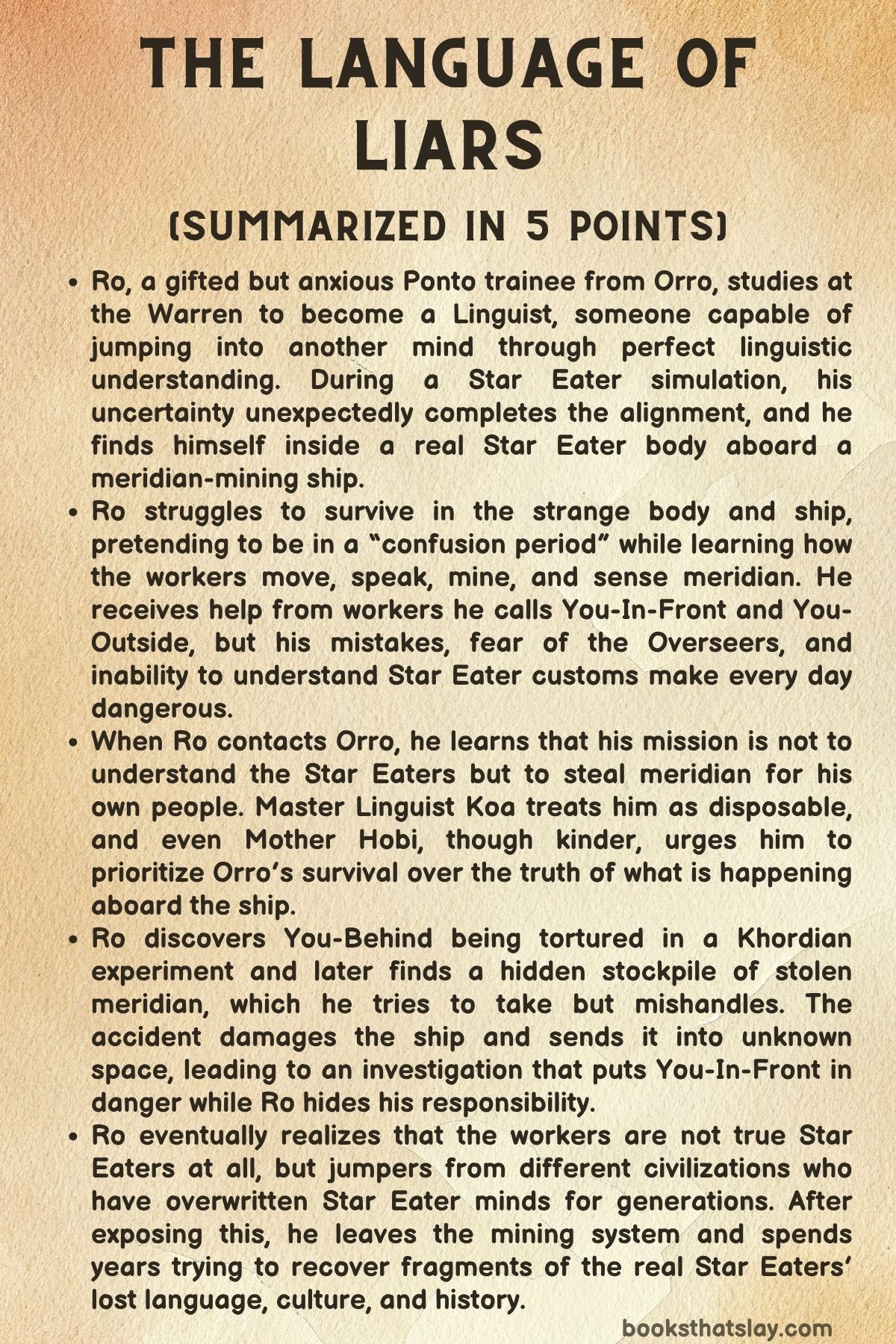
Summary
Ro is a young Ponto from Orro training at the Warren, where rare students are prepared to become Linguists. Linguists are not merely translators.
They are trained to understand another species so completely that they can jump into another mind and take over another body. The Warren’s secret purpose is tied to the survival of Orro and other galactic civilizations, because interstellar travel depends on meridian, a mysterious element that only the Star Eaters can sense and mine.
The Star Eaters remain strange and poorly understood, yet the galaxy relies on them completely.
Ro has talent, especially with language, but he is far from the perfect trainee. He is anxious, scattered, late, and often overwhelmed.
Senior Aga warns him that brilliance means little if he cannot discipline himself enough to use it. Ro feels the pressure of being gifted and unreliable at the same time.
He wants to prove himself, but he is also afraid of what success would demand. Becoming a true Linguist would mean leaving behind his own body forever.
Ro visits his hive before returning to training. His family welcomes him with warmth, especially Lalo and Mother Hobi.
The visit reminds him of everything he stands to lose. Mother Hobi knows the Warren from personal experience, because she was once a trainee herself and failed.
Instead of treating that failure as shameful, she sees it as a kind of escape. She tells Ro that she hopes he never jumps, because doing so would cost him his body, his home, his family, and the future he might have had among his own people.
Back at the Warren, Ro enters a Star Eater practice simulation. He tries to perform correctly, but doubt grows inside him.
He begins to wonder whether he truly wants to become what the Warren wants him to become. That uncertainty unexpectedly completes the necessary linguistic alignment.
Instead of merely training, Ro jumps into a real Star Eater body.
At first, Ro assumes something has gone wrong with the cocoon. Then he realizes that the strange body, strange senses, and alien environment around him are real.
He is aboard mining ship 79, surrounded by Star Eater workers, Overseers, astral orbs, ore centers, and small cell-like rest spaces. He has no real idea how to move, work, speak, or behave.
To survive, he pretends to be going through a Star Eater “confusion period,” a state that gives him an excuse for not knowing basic things.
One worker helps him. Ro mentally calls this worker You-In-Front, because he does not know the worker’s true name.
You-In-Front guides him through the ship and helps him understand the routines of life there. Ro is overwhelmed by the Star Eater body.
There is no smell or aura in the way he expects. The ship feels endless and rigid, and zero gravity makes everything harder.
He struggles with loneliness and fear as he thinks of the Ponto body he has left behind.
As he starts working, Ro learns how Star Eaters sense meridian. At first, this ability fills him with awe.
Then it terrifies him. He is bad at the job.
He gives wrong directions, fails as a spotter, crashes into another worker, and spills meridian. The worker he crashes into, whom he later calls You-Behind, attacks him in anger.
An Overseer stops the fight, but Ro becomes afraid that the Overseer is watching him too closely and might decide he is ill or defective.
You-In-Front continues to help him and moves him to different tasks. Ro keeps making mistakes.
He misunderstands Star Eater grammar and cannot understand what “quota” really means. When he asks about it, he receives fixed answers like “work is life,” as if the workers have only a narrow set of responses available to them.
Their society seems obedient, empty, and difficult to interpret.
Ro also meets You-Outside, a quieter worker who lingers near his cell after his confusion period. You-Outside teaches him how to access the nexus and create astral environments.
Through this connection, Ro begins to feel less alone. You-In-Front later takes him to the edge of the collector ship and shows him how to sense meridian across immense distances.
Through the Star Eater body, Ro experiences the galaxy in a way he never could as a Ponto. He realizes that Star Eaters can guide ships together through space.
This discovery makes them seem far more complex and important than Orro’s training suggested.
Ro eventually contacts Orro through an astral orb, expecting recognition for surviving the jump and gathering information. Instead, Master Linguist Koa humiliates him.
Koa tells Ro that he was a weak trainee who should never have been allowed to continue. When Ro tries to share what he has learned about the Star Eaters, Koa dismisses his discoveries.
He says Ro’s true mission is not to understand the Star Eaters but to steal meridian for Orro.
Ro is shaken. He had believed, or wanted to believe, that linguistic understanding mattered.
Koa makes it clear that Orro’s government values him only as a tool. Ro argues that the Star Eaters matter as people, but Koa insists that both Ro and the Star Eaters are insignificant compared with Orro’s survival.
Ro demands that Mother Hobi replace Koa as his contact.
Mother Hobi is kinder, but she does not deny the reality of the mission. She explains that every government is involved in illegal meridian trade, and Orro’s jumps give it its only advantage against larger powers.
She urges Ro to remain hidden, form relationships only when useful, and focus on Orro’s survival. Ro obeys for a while.
He works, studies the ship, reports to Orro, and delays the theft of meridian.
Then he discovers something horrifying. Following strange vibrations, Ro finds an old medical laboratory where You-Behind is being tortured in an experiment run by a Khordian visitor.
The visitor disappears when Ro enters. Ro frees You-Behind and learns that she had “volunteered” because the conglomerate needed study, though the procedure caused terrible pain.
You-Behind also reveals that she knew the previous mind inside Ro’s current body and has been grieving that loss.
Ro is enraged. He returns to the lab and destroys the equipment.
He also discovers a hidden Khordian stockpile of stolen meridian. Since Orro wants him to steal, he decides to steal from Khord instead of directly from the workers.
But he mishandles the field spheres, and the stored meridian merges into a dangerous eruption. While trying to contain it, Ro accidentally triggers an uncontrolled jump that sends the entire collector ship to an unknown region of space and damages it.
The Overseers investigate. They seize You-In-Front, assuming that worker was involved because of previous suspicions.
Ro is trapped in his cell, filled with guilt. He knows the disaster is his fault, but confessing could expose Orro’s program and endanger millions of his own people.
While hiding in an astral pocket with You-Outside, Ro keeps thinking about reproduction, fear, departure, and the repeated Star Eater phrase usually translated as “the body knows when.” When Mother Hobi appears, Ro realizes that the phrase may have been misunderstood. It may not mean “the body knows when” but “the body knows how.” Since Star Eaters possess genetic memory, this means that reproduction knowledge should still exist inside real Star Eater bodies.
Mother Hobi reacts not with wonder but alarm. She cuts the connection and alerts the conglomerate.
The governments gather through astral projection and treat the discovery as evidence that the Star Eaters have knowingly withheld reproduction from the galaxy. They accuse the workers of conspiring to destroy civilization.
An Overseer restrains You-In-Front and demands answers.
As You-In-Front pleads, Ro notices something strange in the speech: Lower Senti grammar, slang, and gestures. Suddenly, all the inconsistencies make sense.
The workers are not true Star Eaters. Their language has drifted because they are all jumpers from other species, each pretending to be a Star Eater while imitating old reports and one another.
Ro announces the truth publicly.
You-In-Front admits being from Lower Senti. You-Behind admits being from Khord.
Other workers begin naming their own governments. The horrible truth becomes undeniable.
For generations, civilizations have been sending spies into Star Eater bodies, overwriting their minds repeatedly. The so-called confusion periods were not illnesses.
They were replacements. The true Star Eaters have been erased by outsiders who wanted access to meridian.
After this revelation, the galaxy is left with moral ruin and practical crisis. Many false Star Eaters leave the mining ships, including Ro and You-In-Front, whose real name is Jəʊ’hann.
Ro receives desperate messages from his hive begging him to keep mining because Orro may die without meridian. He leaves anyway, unable to continue participating in the destruction.
In the years that follow, Ro and a small group try to reconstruct the lost Star Eaters’ real language, culture, and history from broken records. Their work is slow and uncertain.
The meridian shortage worsens, governments impose austerity, and many who once helped abandon the effort. Ro finds hints that some true Star Eaters may have escaped long ago, but there is no certainty.
He understands that they may never recover the people the galaxy destroyed. Still, he continues the work, not because it can undo the crime, but because forgetting would complete it.
Characters
Ro
Ro is the central figure of The Language of Liars, and his journey is built around the gap between talent and moral readiness. At the beginning, he is brilliant but unstable, gifted with language yet unable to manage the demands placed on him.
His lateness, anxiety, and disorganization make him seem like a poor candidate for a mission that requires discipline and secrecy, but these same flaws also make him human and receptive. Ro is not naturally suited to being a cold instrument of the state.
Once inside the Star Eater body, he experiences fear, loneliness, wonder, guilt, and sympathy in ways his training did not prepare him for. His greatest strength is not his technical ability but his refusal to stop noticing what others dismiss.
He begins by trying to survive, then tries to understand, and finally chooses truth over loyalty to Orro. Ro’s arc is tragic because he loses his home and original life, but it is also morally powerful because he becomes someone who can name a crime even when his own people benefit from it.
Mother Hobi
Mother Hobi is one of the most complicated figures in the book because she combines warmth, fear, love, and political compromise. As Ro’s mother, she understands the cost of the Warren’s mission better than most people.
Her own failed training gives her a personal connection to what Ro faces, and her hope that he never jumps comes from love rather than cowardice. Yet once Ro has crossed into a Star Eater body, Mother Hobi becomes part of the system that uses him.
She is gentler than Koa and more emotionally connected to Ro, but she still accepts the logic that Orro’s survival must come first. Her advice to stay hidden and build useful relationships shows how deeply she has internalized the political reality around meridian.
When Ro discovers the possible mistranslation about reproduction, she reacts as a representative of her government rather than as someone open to the Star Eaters’ truth. This makes her painful to read: she loves Ro, but her love cannot free her from the fear that drives Orro’s choices.
Master Linguist Koa
Koa represents the institutional cruelty of the Warren and the broader political machine behind it. He has no patience for Ro’s fear, curiosity, or ethical hesitation.
Instead of welcoming Ro’s survival and discoveries, he humiliates him, listing his failures and making clear that the mission never cared about real understanding. Koa’s view of language is purely extractive.
For him, linguistic mastery is valuable only because it allows Orro to steal meridian and compete with stronger governments. He treats both Ro and the Star Eaters as expendable parts of a survival strategy.
Koa is not portrayed as a simple villain who enjoys cruelty for its own sake; his danger comes from how completely he believes in necessity. He uses the language of survival to erase responsibility.
Through Koa, the novel shows how education, expertise, and national loyalty can become tools of violence when they are stripped of moral concern.
Senior Aga
Senior Aga appears early as a demanding authority figure who sees Ro’s potential but refuses to excuse his failures. Aga’s scolding reflects the Warren’s harsh standards, where a trainee’s personal struggles matter less than performance.
In one sense, Aga is practical: Ro’s mission requires steadiness, and his inability to keep up could lead to catastrophe. In another sense, Aga’s attitude reveals the Warren’s failure to recognize the emotional burden of what it asks trainees to do.
Aga measures Ro by whether he can become useful, not by whether the mission itself is just. This makes Aga an important part of the system even without being as openly cruel as Koa.
Aga helps establish the pressure that makes Ro feel both chosen and inadequate, setting the emotional foundation for his later crisis.
Lalo
Lalo represents the hive life Ro leaves behind. Although Lalo is not as central to the political revelations, the character matters because Ro’s memory of home is not abstract.
Lalo helps show that Ro belongs to a living community, not simply to Orro as a state. The warmth of the hive gives emotional weight to the sacrifice expected of him.
When Ro thinks about the body and family he has abandoned, the loss is connected to people like Lalo. This makes Ro’s situation more painful because his eventual refusal to continue mining is not a simple rejection of a faceless government.
It also means turning away from people who love him and may suffer because of the meridian crisis. Lalo’s role is quiet but meaningful, grounding Ro’s moral choices in personal loss.
You-In-Front / Jəʊ’hann
You-In-Front, later revealed as Jəʊ’hann, begins as Ro’s guide and protector aboard the mining ship. To Ro, this worker first appears as a helpful Star Eater who calmly assists him through confusion, work, and danger.
Jəʊ’hann’s kindness allows Ro to survive long enough to understand the ship, but it also becomes one of the clues that the official picture of Star Eater life is false. Jəʊ’hann’s small wishes, such as wanting a different shift rather than an entirely different life, show how deeply the workers have adapted to narrow roles.
The later revelation that Jəʊ’hann is from Lower Senti changes the meaning of everything about the character. Jəʊ’hann is both a participant in the crime against the true Star Eaters and a victim of the same system of secrecy and coercion.
The character’s bond with Ro becomes part of the story’s uneasy aftermath, where those who benefited from stolen bodies must decide whether they can help preserve what remains.
You-Behind
You-Behind is first seen through anger and conflict. Ro’s mistake at work causes a meridian spill, and You-Behind attacks him, making her seem dangerous and hostile.
Later, the book gives her anger context. She knew the previous mind inside Ro’s current body and has been grieving that loss.
Her denial of grief reveals how little space the workers have for honest feeling. They live inside a system where minds are replaced, identities vanish, and yet everyone must continue working as if nothing has happened.
Her torture in the Khordian laboratory exposes another layer of exploitation, showing that even the false Star Eaters are used as test subjects by the governments that depend on them. When she admits her Khordian origin, she becomes a key part of the final truth.
You-Behind is harsh because she has been harmed, and her pain helps Ro understand that the ship’s order is built on repeated erasure.
You-Outside
You-Outside is a quieter and more mysterious presence, but the character is essential to Ro’s emotional survival. You-Outside teaches Ro how to use the nexus and create astral environments, giving him a place where he can think and hide.
Unlike the rigid work routines of the ship, the astral pockets offer imagination, privacy, and fragile connection. You-Outside’s presence also helps Ro move beyond pure panic.
Through this relationship, Ro begins to see the workers as individuals with habits, preferences, and hidden depths. You-Outside is not simply a helper; the character represents the possibility that connection can develop even in a world built on lies.
In the later parts of the novel, the conversations with You-Outside help Ro reach the linguistic insight that changes everything. The character’s importance lies in patience and quiet companionship rather than dramatic action.
The Overseers
The Overseers embody surveillance, control, and bureaucratic force aboard the mining ship. They are not always physically violent, but their presence shapes every worker’s behavior.
Ro quickly learns to fear being watched, corrected, or declared defective. The Overseers enforce order without understanding or caring about the inner lives of the workers.
When the collector ship is damaged and displaced, they search for responsibility and seize You-In-Front, showing how authority often chooses a convenient suspect rather than the truth. During the final confrontation, an Overseer restrains You-In-Front and demands answers, turning fear into public pressure.
The Overseers represent systems that keep exploitation functioning day after day. They do not need to understand the full crime to serve it; their role is to maintain production and obedience.
The Khordian Visitor
The Khordian visitor is a direct image of scientific and political exploitation. This figure appears in the old medical laboratory where You-Behind is being tortured under the language of study and necessity.
The visitor’s disappearance when Ro enters suggests secrecy and guilt, but the greater horror is the casual acceptance of pain as a cost of research. The Khordian stockpile of stolen meridian also shows that Orro is not uniquely corrupt.
Other powers are committing their own crimes while claiming survival as justification. The Khordian visitor matters less as an individual personality than as proof of a galactic pattern.
Every government wants meridian, every government hides its actions, and every government is willing to use bodies that are not fully protected by political power.
The True Star Eaters
The true Star Eaters are largely absent by the time Ro understands what has happened, and that absence is the book’s deepest wound. They are first presented as mysterious workers who mine meridian and repeat strange phrases, but the final revelation shows that this image is false.
The actual Star Eaters have been overwritten across generations by jumpers from other civilizations. Their language, culture, reproduction, memory, and social life have been damaged or destroyed by outsiders pretending to be them.
Because they are mostly gone, they cannot fully speak for themselves. Ro’s later work is an attempt to recover fragments of who they were, but the book refuses to make that recovery easy or complete.
The true Star Eaters stand for erased peoples whose destruction is hidden beneath the smooth functioning of civilization.
Themes
Language as Power, Failure, and Responsibility
Language in The Language of Liars is never treated as a neutral skill. The Warren trains Linguists to understand other minds, but that understanding is tied to invasion, possession, and theft.
Ro’s talent gives him access to another species’ body, but it also places him inside a moral trap. The same linguistic precision that allows him to survive on the mining ship eventually allows him to expose the truth.
This makes language both the tool of the crime and the means by which the crime is named. The mistranslation of “the body knows when” becomes especially important because a small grammatical error hides a massive misunderstanding about reproduction, identity, and memory.
Ro’s final realization depends on noticing speech patterns that others ignore: borrowed grammar, slang, gestures, and linguistic drift. The novel treats language as a living record of history.
Lies can be built into translation, but truth can also remain hidden inside broken phrases, accents, and habits of speech.
Survival Used as an Excuse for Harm
Nearly every government in the story justifies its actions through survival. Orro needs meridian to compete with larger powers.
Other civilizations need it to keep interstellar travel alive. The galaxy depends on the Star Eaters’ labor, and that dependence becomes an excuse for secrecy, theft, torture, and identity erasure.
Koa expresses this logic most bluntly when he tells Ro that the survival of Orro matters more than the Star Eaters or even Ro himself. Mother Hobi presents the same idea with more tenderness, but the moral structure is similar.
Fear of collapse makes cruelty sound practical. The book does not pretend that the crisis is fake; without meridian, many people may suffer.
That is what makes the theme difficult. Ro’s choice is not between harm and easy safety.
It is between continuing an atrocity for the sake of his own people and refusing to let survival erase responsibility. The story asks whether a civilization deserves to endure if its endurance depends on destroying others.
Identity, Body, and Erasure
The act of jumping makes identity unstable from the beginning. Ro enters a Star Eater body and must learn its senses, movements, work, and place in the ship.
At first, this seems like one person’s sacrifice for a mission, but the truth is far worse. Jumping is not only travel or disguise; it is replacement.
Every confusion period marks the disappearance of one mind and the arrival of another. You-Behind’s grief for the previous mind in Ro’s body shows that these losses are known, even if no one is allowed to fully acknowledge them.
The workers’ identities are layered with deception: they appear to be Star Eaters, are actually jumpers from other species, and live inside bodies that once belonged to an erased people. This makes the body a site of theft.
The true Star Eaters have not merely been conquered from outside; they have been removed from within. The novel treats this as a devastating form of violence because it destroys memory, culture, reproduction, and selfhood all at once.
Remembering What Cannot Be Restored
The ending refuses easy repair. Once Ro exposes the truth, the galaxy does not suddenly become just, and the lost Star Eaters do not simply return.
Meridian shortages worsen, governments impose austerity, and many people want the mining to continue because their own societies are at risk. Ro and a small group attempt to reconstruct the Star Eaters’ language and culture, but they work with fragments.
Their research may never recover the people who were erased. This theme gives the story its lasting sadness.
Remembering is necessary, but it is not the same as restoration. Ro’s work matters because forgetting would make the crime complete, yet the book does not comfort the reader with the idea that memory can undo destruction.
The hints that some true Star Eaters may have escaped offer a small possibility, not a solution. The moral weight of the ending lies in Ro’s decision to keep trying even when the result may remain incomplete.