The Wrong Catch Summary, Characters and Themes
The Wrong Catch by C.R. Jane, the 3rd book in the Wrong Player series, is a dark college romance centered on obsession, trauma, control, and the strange comfort two damaged people find in each other. The book follows Ophelia Prescott, a young woman whose history of fixation has left her medicated, monitored, and afraid of her own mind, and Matthew “Matty” Adler, a star football player carrying family pressure and dangerous outside threats.
Their relationship begins in secrecy and surveillance, but it grows into something both intense and mutual. Rather than presenting love as simple healing, the story focuses on two people whose broken edges match in ways that are unsettling, passionate, and deeply defining.
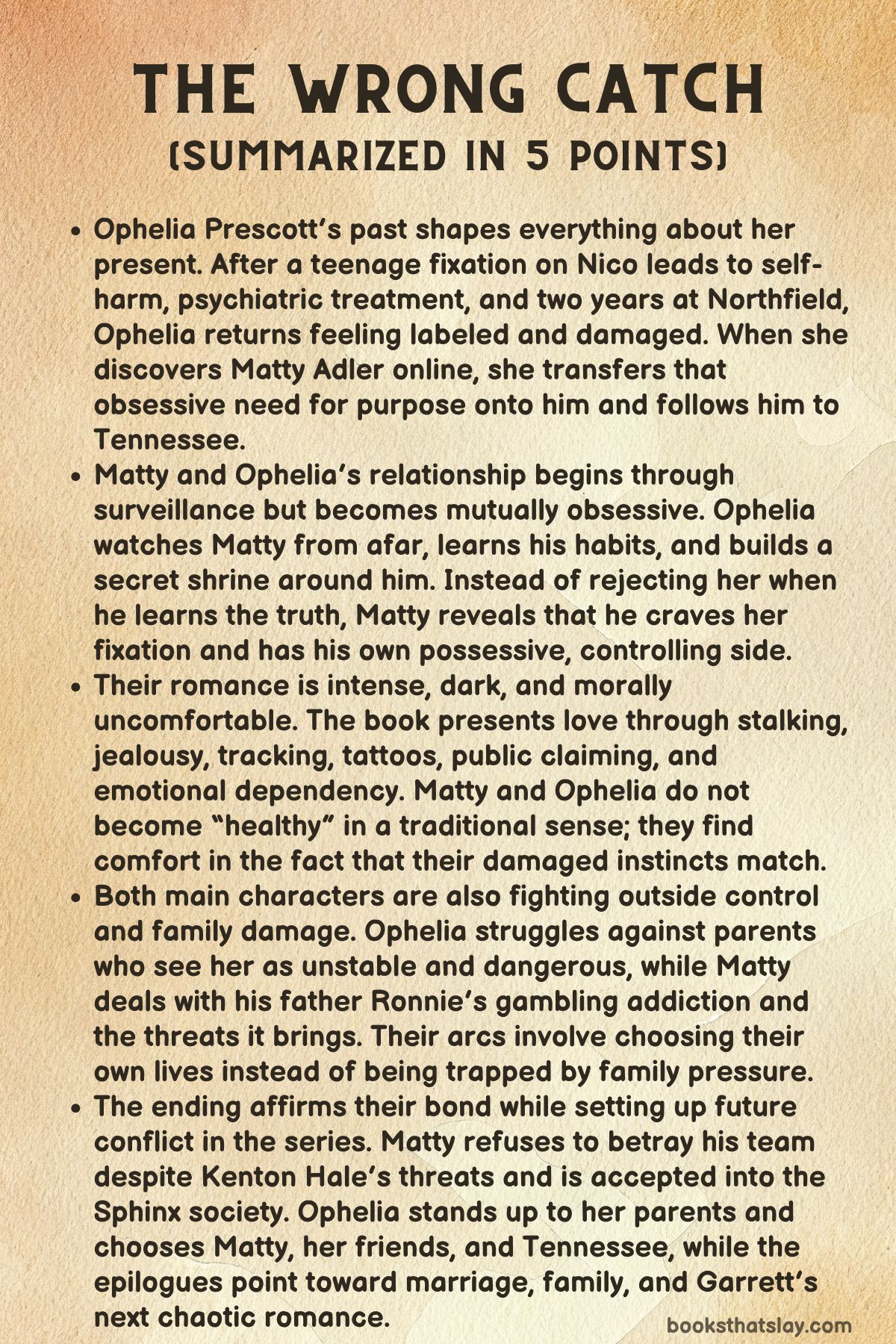
Summary
Ophelia Prescott’s story begins with a pattern she does not fully understand and cannot control. As a teenager, she becomes consumed by a boy named Nico.
To her, the fixation feels like love, destiny, and certainty, but to the adults around her it is alarming. She follows him, steals his hoodie, writes about marrying him, and builds an entire private world around a boy who has not invited that kind of closeness.
Her parents take her to Dr. Whitaker, where her behavior is discussed in clinical terms. Diagnoses, treatment, monitoring, and the possibility of a structured psychiatric facility become part of the conversation.
Ophelia feels exposed and cornered, especially when her parents treat her not simply as a struggling daughter but as a danger they need to manage.
The confrontation at home becomes emotionally crushing. Feeling judged and trapped, Ophelia hurts herself and is sent to Northfield Psychiatric Wellness.
What is supposed to be a temporary stay stretches into two years. By the time she returns, she carries the weight of having been watched, labeled, treated, and separated from ordinary teenage life.
She does not return feeling cured. She returns feeling damaged, different, and permanently marked by what happened.
During senior year, Ophelia tries to build a future, but even college applications remind her how little normal experience she has. She has no neat list of activities, no clear ambitions, and no strong belief that she belongs anywhere.
Then she lands on a University of Tennessee football page and sees Matthew “Matty” Adler, the Tigers’ star tight end. The image gives her something she has been missing: direction.
She convinces herself that Tennessee is where she needs to go. She lies on parts of her application and decides that being near Matty will give her life meaning, even though he has no idea she exists.
Once at Tennessee, Ophelia’s fixation becomes routine. She studies Matty’s life from a distance.
She learns his schedule, his practice habits, his house, his social media patterns, his friends, and the places where she can watch him without being noticed too easily. She sits in her car near the athletic parking lot and observes him, telling herself that this is different from what happened with Nico.
In her mind, she is more careful now, more controlled, and less dangerous. But the old pattern has clearly returned.
Matty notices her too. At first, she is the mysterious blonde girl in the car, the one who appears around practice and watches from a distance.
His teammates Jace, Parker, and Garrett joke about her being a stalker. Matty should be disturbed, and part of him understands the strangeness of the situation, but he also becomes attached to her presence.
Her watching becomes part of his routine. When she misses a practice, he feels unsettled and runs to the parking lot searching for her.
Without speaking to her, he has already begun responding to her attention as if it belongs to him.
Matty’s own life is far from stable. His father, Ronnie, has a gambling addiction and repeatedly uses Matty as a source of money.
Ronnie calls with excuses, lies about expenses, and puts emotional pressure on his son. The situation becomes more dangerous when Ronnie introduces Matty to Kenton Hale, a man connected to betting interests.
Kenton wants inside information about the football team: injuries, performance issues, and details that could help gamblers. Matty refuses because giving that information would betray his teammates and corrupt the sport he loves.
Still, Kenton’s offer and the threat behind it remain a shadow over him.
Ophelia and Matty finally interact in class when she gives him a pencil. The moment is small, but for Ophelia it is overwhelming.
The man she has watched for months is suddenly speaking to her. Matty is struck by her beauty, shyness, and nervous energy.
He tries to learn her name and calls her beautiful, but she panics and avoids giving him too much. The connection between them grows sharper when Ophelia becomes the Tigers mascot, partly because it gives her another way to be close to him.
During a game, Matty discovers that she is the person inside the tiger suit. Instead of exposing her with disgust, he kisses her publicly and announces her name into a microphone, making it clear that if she runs, he will come after her.
The kiss goes viral, forcing Ophelia into attention she never expected. She attends a party with cheerleaders and tries to behave like a normal college student, but Matty finds her there.
When another guy approaches her, Matty becomes jealous and pulls her into a more private encounter. Their physical relationship begins quickly, and both of them become more emotionally dependent on the other.
Ophelia fears that if Matty learns everything she has done, he will see her as sick and leave. Matty, however, is not as different from her as she believes.
His own possessiveness grows. He tracks her, gets Jace to help him access information about her, and starts treating her intensity not as a warning sign but as something he craves.
As Ophelia becomes closer to Matty, she also enters his friend group. Casey, Riley, Natalie, Jace, Parker, and Garrett become part of the larger world she has always wanted but never really had.
For the first time, she feels like she might belong somewhere. Yet the truth remains close behind her.
Emma, another unsettling stalker figure connected to Riley and Jace’s past, appears around Matty, making Ophelia fear that people will see her the same way. Garrett also begins to recognize her as the girl from the practice parking lot, threatening the fragile sense of safety she has built.
Matty and Ophelia’s relationship becomes more intense. She spends nights at his house and slowly confesses pieces of her past.
She begins to feel safe with him in a way she has rarely felt anywhere. Matty marks that bond in an extreme way by tattooing “Mrs. Adler” on her hip, a possessive promise that he sees her as his future wife.
Ophelia accepts the tattoo as proof that he wants her permanently. At the same time, her mother continues to hover through missed therapy appointments, medication checks, and threats of medical leave.
When Ophelia tells her mother she is dating Matty, her mother dismisses the relationship as another dangerous obsession and threatens to bring her home.
The secret breaks open when Garrett realizes Ophelia is the girl who has been watching Matty from the parking lot. He blurts it out, and Ophelia runs in panic.
She is certain Matty will finally reject her and see her as the broken person she fears she is. She returns to her dorm, spiraling and imagining desperate ways to keep him.
But Matty is already there. He has found the shrine she built around him: photos, notes, stolen objects, journals, and proof of everything she has done.
For Ophelia, this is the moment she expects her life to collapse. She confesses that she came to Tennessee because of him, followed him, studied him, stole from him, and had once been sent away for a similar obsession.
Instead of leaving, Matty reacts with fascination and desire. He tells her she is not the only one obsessed.
He does not want a polished version of her; he wants the parts she has been taught to hide. Ophelia’s worst truth becomes, in Matty’s eyes, proof that she belongs with him.
Their relationship becomes more openly mutual in its possessiveness, with both of them accepting that their connection is not ordinary.
While Ophelia and Matty face the truth of their relationship, Matty’s family crisis worsens. Ronnie is badly beaten, apparently because of his gambling debts.
Matty is forced to face the damage his father has caused, not only to himself but to the entire family. He tells his mother that Ronnie needs real help, not more excuses or protection.
Kenton then returns with a more tempting and threatening offer. He promises Matty ten million dollars if he cooperates and threatens to spread damaging rumors if Matty refuses.
Matty still will not betray his team. Jace’s older brother Jagger intervenes, terrifying Kenton enough to make him back off.
Soon afterward, Matty learns that refusing the money was his final Sphinx trial, and he is accepted into the secret society he had been trying to join.
Ophelia’s parents arrive on campus determined to take control of her life again, but this time Matty stands between them and her. He challenges how they have treated her and makes it clear that they do not get to decide her future unless Ophelia allows it.
Ophelia finally pushes back against them. She chooses Matty, her friends, and the life she has built at Tennessee over returning to the role her parents assigned her.
She moves deeper into Matty’s world, sharing a home-like routine with him and the people who have become her chosen circle.
The story closes around Tennessee’s championship run. During a game, Matty sees Ophelia wearing Parker’s jersey over the mascot suit and reacts with public possessiveness.
He tears it off and replaces it with his own jersey in front of the crowd, then kisses her before returning to the field. To him, the strange path that led Ophelia into his life has become the one right catch he never expected.
In the epilogues, Matty and Ophelia remain together after the championship. Their future is openly discussed in terms of marriage, children, and the fulfillment of Ophelia’s fantasies, while Garrett’s next story is teased through the revelation that the woman he married in Vegas is now his professor.
Characters
Ophelia Prescott
Within The Wrong Catch, Ophelia Prescott is the emotional center of the book, and her character is built around the painful difference between wanting love and not knowing how to seek it safely. Her fixation on Nico as a teenager establishes her pattern: she attaches herself to an idea of a person, builds a future in her mind, and treats closeness as something she can create through observation and possession.
Her stay at Northfield Psychiatric Wellness does not erase this pattern. Instead, it leaves her feeling watched, managed, and permanently separated from normal life.
When she finds Matty, she believes she has discovered purpose, but her pursuit of him repeats the old cycle in a more elaborate form. What makes Ophelia compelling is that she is not presented as simply dangerous or innocent.
She is lonely, frightened, obsessive, intelligent, and deeply ashamed. Her growth does not come through becoming conventional; it comes through finally being seen by someone who does not flinch from the parts of her she considers unforgivable.
Her decision to resist her parents near the end shows that she is no longer only a girl being controlled by diagnosis, fear, or family authority. She chooses the life she wants, even if that life is intense and morally uncomfortable.
Matthew “Matty” Adler
Matty Adler begins as the object of Ophelia’s fixation, but the book gradually reveals that he is not a passive fantasy figure. In The Wrong Catch, Matty is a star athlete carrying a public image of charm, strength, and confidence, while privately dealing with pressure from his father, threats tied to gambling, and his own possessive impulses.
His reaction to Ophelia is central to his character. Rather than responding to her attention with simple fear, he becomes attached to being watched.
Her presence satisfies something in him: a desire to be chosen with total focus and no hesitation. As their relationship develops, Matty’s own obsession becomes impossible to ignore.
He tracks Ophelia, seeks information about her, marks her body with the “Mrs. Adler” tattoo, and publicly claims her when he feels challenged. At the same time, he shows loyalty and moral strength in his refusal to betray his team for money.
His love for Ophelia is protective, but it is also controlling. That contradiction defines him.
He is capable of tenderness, devotion, and courage, yet he is also drawn to possession and emotional extremes.
Ronnie Adler
Ronnie Adler is a damaging force in Matty’s life because he turns fatherhood into a repeated demand for money, rescue, and silence. His gambling addiction is not treated as a private weakness that affects only him.
It harms his family, drains Matty emotionally, and brings dangerous people into their lives. Ronnie’s calls and lies show how addiction can make a parent dependent on the child who should have been protected.
Matty’s frustration with him is rooted not only in anger but in exhaustion. Ronnie has made his son responsible for debts and consequences that should never have belonged to him.
When Ronnie is beaten, the violence exposes how far his choices have gone and how little control he has left. He is not a villain in the same direct way Kenton is, but his failures create openings for outside threats.
Ronnie’s character adds pressure to Matty’s arc by forcing him to decide whether loyalty to family means endless rescue or finally demanding accountability.
Kenton Hale
Kenton Hale represents corruption, manipulation, and the way outside money tries to infect college athletics. His approach to Matty is strategic because he knows Matty has pressure points: a father with debts, a valuable career, and a reputation that can be threatened.
Kenton’s offer of ten million dollars is not only a bribe but a test of Matty’s values. He wants access to team information, and he frames betrayal as opportunity.
When Matty refuses, Kenton turns from temptation to intimidation, threatening to damage him with rumors. His role in the book is brief compared with the central romance, but his presence matters because he forces Matty to define what he will not sell.
Kenton also gives the story an external danger that mirrors the emotional intensity of the romance. Just as Ophelia and Matty deal with control and possession in their relationship, Kenton tries to control Matty through leverage, fear, and greed.
Jace
Jace functions as both friend and enabler in Matty’s circle. He jokes about Ophelia being a stalker, but he is also willing to help Matty access information about her, which shows how easily the group normalizes behavior that would alarm outsiders.
His loyalty to Matty is strong, and he often appears as someone who understands the darker edge of the world they occupy. Through his connection to Riley and the past involving Emma, Jace also brings a history of dangerous fixation into the wider story.
He is not simply comic relief or a teammate in the background. His presence helps frame Matty’s behavior as part of a broader culture where possessiveness, secrets, and intense bonds are accepted more easily than they would be elsewhere.
Jace’s older brother Jagger also affects Matty’s arc by stepping in against Kenton, which reinforces Jace’s importance as a bridge between friendship, protection, and hidden power.
Garrett
Garrett is important because he becomes the person who recognizes Ophelia’s secret before the full confession happens. At first, he participates in the teasing around the mysterious girl in the parking lot, but his eventual recognition of Ophelia creates one of the book’s major emotional crises.
When he blurts out the truth, he does not fully understand the panic it will trigger in her. To Ophelia, his realization means exposure, rejection, and the collapse of the life she has built.
Garrett’s role is also interesting because he belongs to Matty’s trusted circle, yet he is not always careful with the emotional weight of what he sees. His presence adds tension because he can turn hidden behavior into public knowledge.
The ending also positions Garrett for a future story, especially with the revelation about his Vegas marriage and his new professor, suggesting that his own romantic chaos is about to become central.
Casey
Casey helps represent the social belonging Ophelia has always lacked. Through Casey, Riley, Natalie, and the wider group, Ophelia begins to experience friendship as something more ordinary than surveillance, therapy, or family control.
Casey’s importance lies less in a dramatic individual arc and more in the atmosphere she helps create around Ophelia. She becomes part of the circle that allows Ophelia to feel included rather than studied.
For a character like Ophelia, who has long believed she is too strange to fit into normal spaces, this acceptance carries real emotional force. Casey’s role also balances the intensity of Matty and Ophelia’s relationship by showing that Ophelia’s new life is not built only around romance.
She gains access to a group, a routine, and a version of college life that feels warmer than anything she had expected.
Riley
Riley’s connection to Jace and the past involving Emma makes her more than a background friend. She helps bring another example of dangerous fixation into the book, which forces Ophelia to confront how others might see her if they knew everything.
Emma’s presence around Matty makes Ophelia afraid because it reflects a version of herself she does not want to be compared to. Riley’s place in the story therefore helps sharpen Ophelia’s insecurity.
At the same time, Riley is part of the friend group that gives Ophelia a sense of belonging. Her role carries a double function: she is connected to a warning from the past, but she is also part of the present community Ophelia wants to keep.
Through Riley, the book shows that obsession is not isolated to one person’s mind; it can affect whole groups, histories, and relationships.
Natalie
Natalie contributes to the sense of group acceptance that slowly changes Ophelia’s life at Tennessee. While she is not at the center of the main conflict, her presence matters because Ophelia’s healing, or at least her movement toward confidence, depends partly on being included by people who are not treating her as a patient or a problem.
Natalie helps make the social circle feel lived in and real. She stands as part of the everyday world Ophelia has been kept away from: parties, friendships, shared routines, and casual loyalty.
For Ophelia, being around Natalie and the others means testing whether she can exist among people without being reduced to her past. Natalie’s role is quieter, but she helps shape the environment that makes Ophelia’s new life feel possible.
Ophelia’s Mother
Ophelia’s mother is one of the most painful figures in the book because her concern is tied closely to control. She has reasons to be afraid for Ophelia, given the severity of what happened with Nico and Ophelia’s mental health history, but her way of responding often makes Ophelia feel more trapped and defective.
The missed therapy appointments, medication checks, threats of medical leave, and dismissal of Matty as another obsession all show a parent who sees danger before she sees growth. Her love is filtered through fear, and that fear becomes suffocating.
She cannot easily recognize that Ophelia is changing or that Ophelia needs autonomy as much as supervision. The confrontation on campus is important because it reverses the old power dynamic.
Ophelia is no longer a young teenager being sent away. She is a young woman choosing who gets access to her life.
Dr. Whitaker
Dr. Whitaker represents the clinical language and institutional response surrounding Ophelia’s behavior. Through this character, the book shows how Ophelia’s obsession is translated into diagnoses, treatment plans, and decisions about placement.
Dr. Whitaker is not necessarily cruel, but the scenes involving professional evaluation contribute to Ophelia’s sense of being observed and categorized. For Ophelia, therapy and treatment are tangled with humiliation, loss of control, and the memory of being sent away.
Dr. Whitaker’s role is important because it shows that Ophelia’s relationship with her own mind has been shaped not only by her behavior but by the way adults responded to it. The character also helps establish the stakes of Ophelia’s fear: if people define her only by her symptoms, then honesty feels dangerous.
Themes
Obsession as Identity and Attachment
Ophelia’s fixation is not treated as a passing crush or a simple romantic excess. It becomes a structure through which she understands herself, her future, and her connection to other people.
With Nico, her obsession is frightening because it is one-sided and detached from reality. With Matty, the same pattern returns, but the response is different because Matty does not reject the intensity.
This creates a complicated emotional question: what happens when the behavior someone has been punished for becomes the very thing another person desires? Ophelia’s obsession gives her direction when she feels empty, but it also narrows her world until Matty becomes the center of everything.
Matty’s matching possessiveness changes the relationship from one-sided surveillance into mutual fixation. The Wrong Catch uses that mutuality to blur the line between acceptance and enablement.
The story does not make their bond normal; instead, it asks the reader to sit with a romance where being fully wanted includes being wanted for the most unsettling parts of the self.
Control, Autonomy, and Being Defined by Others
Ophelia’s life has been shaped by people trying to control her for reasons they believe are protective. Her parents, doctors, medication routines, treatment history, and college threats all become forces that tell her who she is before she gets to define herself.
Her mother sees Matty as another symptom, not as a person Ophelia has chosen. That reaction matters because it shows how easily Ophelia’s past can be used to dismiss her present feelings.
The struggle is not only about whether Ophelia is stable or unstable; it is about whether she is allowed to make decisions after being labeled dangerous. Matty’s defense of her against her parents is powerful because he gives voice to what Ophelia has not been able to say clearly: she is tired of being managed instead of heard.
Yet Matty’s protection also carries its own controlling edge. The book creates tension between freedom and possession, showing that escape from one form of control can lead into another.
Ophelia’s choice at the end is meaningful because it is hers, even if the world she chooses is intense and imperfect.
Love, Possession, and Moral Discomfort
The romance in the story is built on acts that would usually signal danger: stalking, tracking, jealousy, secrecy, possessive marking, and public claiming. Instead of softening those elements into a conventional love story, the book keeps their discomfort visible.
Matty and Ophelia do not love each other because they have overcome obsession in a clean, healthy way. They love each other through obsession.
The tattoo, the shrine, the parking lot watching, and the jersey scene all show love expressed as ownership. For Ophelia, being claimed by Matty feels like safety because it proves he will not abandon her.
For Matty, being watched and wanted with total focus satisfies his own need for devotion. This makes their relationship both emotionally intense and morally uneasy.
The book’s power comes from refusing to separate tenderness from control. Matty can protect Ophelia and still be possessive.
Ophelia can be vulnerable and still invasive. Their relationship asks whether love can feel true even when it grows from impulses that are troubling.
Family Damage, Loyalty, and Breaking Old Patterns
Matty and Ophelia both come from family situations where love is tied to pressure. Ophelia’s parents respond to fear by restricting and defining her, while Matty’s father responds to addiction by exploiting his son.
Ronnie’s gambling turns Matty into a financial resource and emotional safety net, forcing him to carry adult burdens that should not belong to him. Ophelia’s mother, meanwhile, keeps trying to pull her back into treatment-based control, unable to trust her daughter’s ability to choose.
These family pressures shape how both main characters understand loyalty. Matty has to learn that loving his father does not mean saving him from every consequence.
Ophelia has to learn that being someone’s daughter does not mean surrendering her future. The outside threat from Kenton sharpens this theme because Matty’s loyalty to his team is tested against money, fear, and family fallout.
His refusal to provide inside information shows that he still has a moral boundary, even in a story full of blurred emotional ones. Both Matty and Ophelia move toward lives where loyalty is chosen rather than forced.