The Radiant Dark Summary, Characters and Themes
The Radiant Dark by Alexandra Oliva is a speculative family drama about first contact, motherhood, abandonment, faith, ambition, and the long emotional afterlife of one cosmic event. Oliva uses the arrival of an intelligent signal from Ross 128 not only as a science-fiction premise, but as a way to follow one family across generations.
The story begins with Carol Girard missing the sky’s strange flashes while caring for her newborn son, and it expands into decades of broken marriages, scientific breakthroughs, religious movements, parent-child wounds, and humanity’s changing place in the universe. The novel treats cosmic discovery as both public history and private inheritance.
Summary
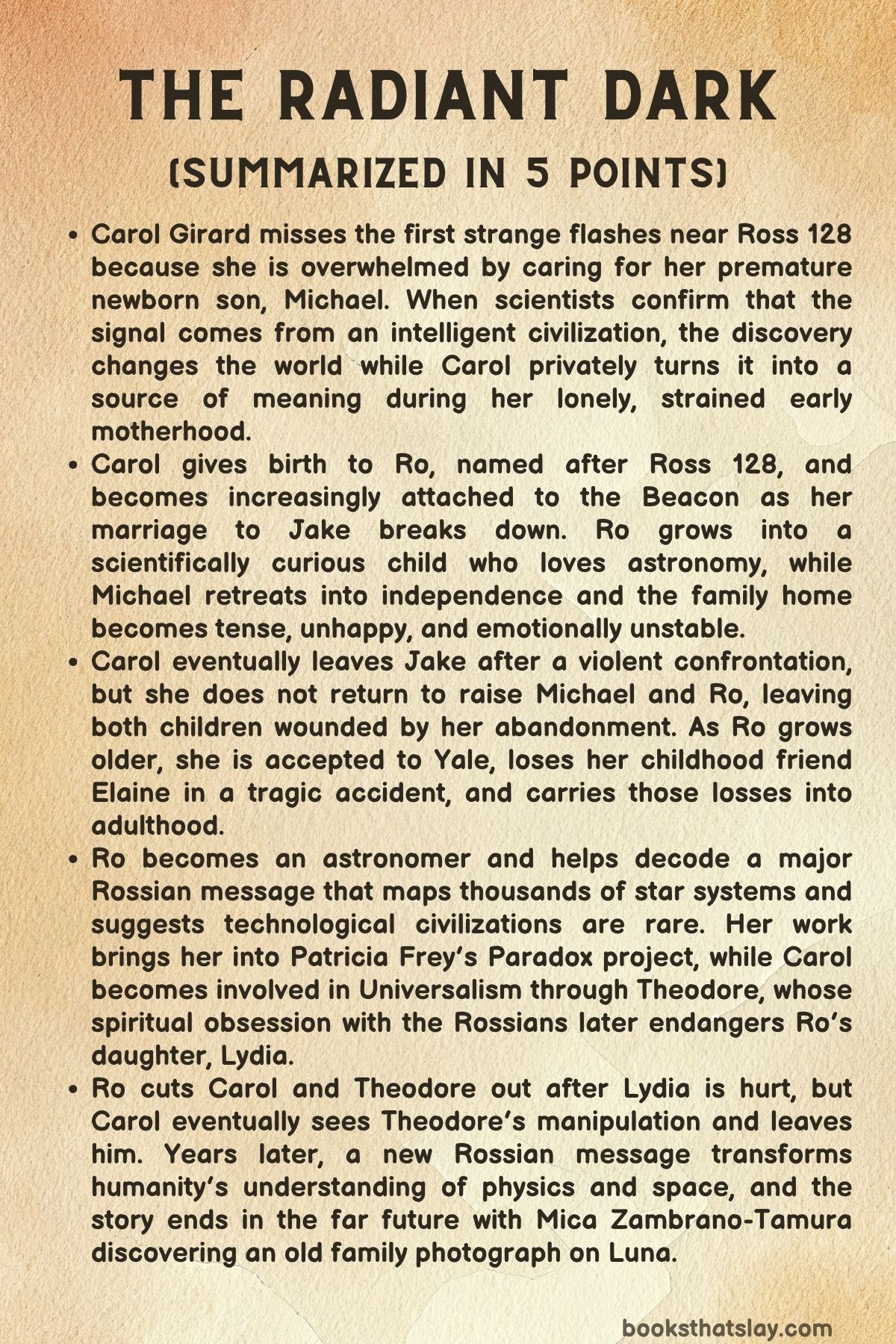
On February 3, 1980, while much of the night side of Earth watches strange flashes near what appears to be Saturn, Carol Girard is too exhausted to notice. Her premature infant son, Michael, was originally due that night, and Carol is buried in the raw, painful routine of new motherhood.
She is physically worn down, emotionally isolated, resentful of her husband Jake, and frightened by how completely motherhood has changed her life. While the world looks upward, Carol is trapped inside a smaller, darker universe of crying, feeding, bodily pain, and guilt.
Scientists soon realize the flashes are not coming from Saturn. Their position aligns with Ross 128, a nearby star about eleven light-years from Earth.
The flashes repeat six times and then stop, but radio telescopes detect an ongoing signal. After weeks of study, President Carter announces that the message contains meaning and appears to come from an intelligent civilization in the Ross 128 system.
Dr. Patricia Frey explains that the signal includes a bitmap image showing a star system and marking one planet as the sender’s home. Humanity now knows it is not alone.
The discovery causes worldwide panic and fascination. People buy supplies, riot, pray, argue, and invent theories.
The beings become known as Rossians, and governments debate whether Earth should answer. Carol absorbs the event in a private, almost mystical way.
The Beacon, as it comes to be called, gives shape to feelings she cannot easily name. On the night of the presidential address, she and Jake have sex for the first time since Michael’s birth.
Soon afterward, Carol discovers she is pregnant again. At first she feels cornered and horrified, as though her life has been taken from her twice.
Gradually, however, she recasts the pregnancy as a kind of gift connected to the Rossians.
Carol gives birth to a daughter shortly before Christmas. She and Jake name the baby Rosanna in honor of Ross 128, though the nickname Ro becomes the name that matters.
As Ro grows, Carol remains deeply attached to news of the Beacon. Earth eventually sends a reply from Arecibo, a message based on mathematics, the solar system, and basic scientific knowledge.
Carol wakes early to witness the transmission, but Michael and Ro wake up too, and she misses the exact moment. Her life continues in ordinary domestic repetition while history happens beyond her reach.
Over time, Carol’s marriage becomes colder. Jake is emotionally distant, and Carol feels erased by the demands of the house and children.
One summer night she stands naked beneath the sky, trying to feel connected to the Beacon in a practice she thinks of as Basking. Jake sees her, and the moment exposes the distance between them.
Carol realizes she might not have married him if she had known the Beacon was coming, though she cannot regret Michael and Ro.
By 1993, Ro is twelve and has grown into a bright, scientifically minded child. She is fascinated by space, astronomy, and the Rossians, but her approach differs from Carol’s.
Carol sees cosmic fate and spiritual meaning, while Ro values precision and evidence. The two-week window opens during which Earth’s earlier reply might finally reach Ross 128, and Carol waits for it with almost religious emotion.
Ro corrects her mother’s assumptions and wants to understand the science properly.
Michael, now thirteen, has become more independent and secretive. He spends long hours in the woods and has built a hidden shelter there.
Carol worries about him but also recognizes that he is finding his own way to survive the tension at home. Ro, meanwhile, feels increasingly distant from her best friend Elaine Kadner, whose interests are shifting toward popularity, puberty, and social performance.
Ro’s longing for space and knowledge makes her feel set apart from the world of school and friendship.
Carol and Jake’s marriage worsens until Carol finally tells him she wants a divorce. They do not know how to manage the practical reality of separation.
During a visit to her sister Donna and Donna’s husband Jonah in Queens, Ro experiences a warmer kind of adult care when she gets her first period and Donna helps her through it. Back at home, Carol tries to force Jake out by moving his belongings into the driveway.
Their confrontation turns violent: Carol slaps Jake, and Jake punches the door beside her head. Michael witnesses the fight and helps Carol leave.
Carol drives away intending to collect Ro, but panic carries her instead to Donna’s. Jake picks Ro up and tells her Carol has left.
Carol promises by phone that she will come for the children, but she never returns to live with them. Ro is left with the wound of abandonment, and the children remain with Jake.
By 1998, Ro is seventeen and living with Jake in the neglected family home. Michael is older, more restless, and preparing to leave on his own travels.
The Beacon, which has been a constant presence throughout Ro’s life, suddenly stops. Ro and Carol both register the silence, but their relationship is too damaged for comfort or closeness.
Carol has spent the years since leaving in unstable work, cheap apartments, and attempts to rebuild herself. She becomes involved in Universalism after meeting Theodore, a charismatic man tied to a Rossian-inspired spiritual movement.
The movement’s language of light, connection, and cosmic purpose appeals to the part of Carol that has always wanted the Beacon to mean something personal.
Ro is accepted to Yale and gives a graduation speech about the Beacon and human connection. Carol attends and announces that Theodore has proposed, which alarms Ro and Michael.
At a graduation party, Ro drives Elaine to another gathering. Elaine gets drunk and high, steals liquor, runs from an apartment, and falls from a second-story landing.
She dies from the fall. Ro is traumatized by the event, and Elaine’s mother, Laura Kadner, is left with devastating grief.
By 2005, Ro is in a PhD program in Arizona, studying astronomy. After years of silence, a new Rossian message arrives.
Ro helps decode it and realizes it is a map of thousands of star systems, marking planets with water, methane, and technological signals. Earth and Ross 128 b appear to be the only technological civilizations shown, suggesting that life may be common while advanced technology is rare.
Ro’s discovery makes her famous. Patricia Frey contacts her and offers her a major role at Paradox, a project connected to interstellar exploration.
Ro leaves her PhD path, moves to Washington, and begins a new career. Her relationship with Charles Zambrano deepens, and they eventually marry.
Carol’s life with Theodore becomes more tightly tied to Universalism. She saves Hector Thomas, the movement’s leader, from an attacker and gains a celebrated role within the group.
Years later, Ro and Charles have a daughter, Lydia. Ro suffers severe postpartum anxiety, rage, exhaustion, and fear, bringing her closer to the kind of suffering Carol once endured.
At Paradox, Patricia Frey is forced out after it is discovered that she secretly sent unauthorized messages to Ross 128, and Ro is pushed into leadership.
Carol and Theodore visit Ro’s family, but Theodore becomes fixated on using Ro’s position to send a Universalist message to the Rossians. When he holds Lydia and pressures Ro, the confrontation turns dangerous.
Lydia falls and is injured, though she survives. Ro cuts Carol and Theodore out of her life.
Carol at first defends Theodore, but Michael helps her understand that he used the baby as leverage. Carol finally leaves him and returns to Donna.
In 2020, Jake tells Ro that he and Laura Kadner are getting married. Ro travels east and reunites with Michael to clear out the old family house.
They sort through the remains of childhood and face old griefs. Laura speaks gently with Ro about Elaine and motherhood, helping Ro begin to accept her place in the family.
Soon after, Paradox’s probe Shu explodes because of a faulty valve. Ro is devastated, but Patricia Frey tells her to learn from failure and build again.
Far away, the Rossians decide it is time to send another message.
In 2034, the new Rossian message reaches Earth. This time, it includes a language primer built from Frey’s secret transmissions and shares advanced knowledge about physics, dark matter, energy, and the structure of the universe.
The message changes humanity’s future. Ro shares the moment with Lydia, inviting her daughter into the wonder of discovery rather than shutting her out.
More than a century later, in 2138, Mica Zambrano-Tamura lives on Luna in a world transformed by Rossian knowledge and human expansion into space. She finds an old family photograph tucked inside a book, showing Carol, Jake, Michael, and Rosanna long ago.
Mica does not yet know who they are, but she knows she can find out, linking private family memory to the larger future made possible by the Beacon.
Characters
Carol Girard
Carol Girard is one of the central emotional figures in The Radiant Dark, and her life shows how a cosmic event can become entangled with private longing, disappointment, and survival. At the beginning of the book, she is a new mother overwhelmed by pain, exhaustion, and loneliness.
She loves Michael, but she is also frightened by how much motherhood has taken from her, and the Beacon reaches her at precisely the moment when she feels most invisible. Because she misses the initial flashes, her relationship with the event is marked by absence from the start; she is always trying to recover a moment that passed her by.
Carol turns the Rossians into a source of meaning, almost a personal mythology, because ordinary domestic life gives her too little comfort or purpose. Her decision to name her daughter Rosanna shows how strongly she wants the cosmic discovery to bless or explain her own choices.
Yet Carol is also deeply flawed. Her resentment of Jake, her emotional instability, and her decision to leave the children create lasting damage, especially for Ro.
The book does not reduce her to a bad mother, but it also does not excuse the pain she causes. Her later involvement with Universalism reveals both her hunger for belonging and her vulnerability to people who know how to manipulate belief.
Her eventual break from Theodore is important because it shows that she can still recognize harm, accept hard truths, and choose a more honest form of survival.
Rosanna “Ro” Girard Zambrano
Ro is the child born under the shadow and promise of the Beacon, and her life becomes the clearest bridge between the family story and humanity’s scientific future. As a girl, she is curious, precise, and intellectually restless.
She loves the Rossian mystery, but unlike Carol, she does not want it softened into destiny or private magic. Ro’s faith is in measurement, decoding, and evidence, which makes her both close to and separate from her mother.
Carol sees Ro as a gift from the Rossians, while Ro grows into someone who wants to understand the universe without turning it into comfort. Her abandonment by Carol leaves a deep wound, shaping her guardedness and her fear of emotional dependence.
Elaine’s death adds another layer of trauma, linking adolescence with guilt, loss, and helplessness. As an adult, Ro’s scientific brilliance gives her access to extraordinary work, but it does not free her from inherited pain.
Her postpartum struggle after Lydia’s birth creates a painful echo of Carol’s early motherhood, forcing Ro to confront the fact that rage, fear, and exhaustion are not signs of moral failure by themselves. What distinguishes Ro is her effort to protect her daughter from the damage she experienced.
In The Radiant Dark, Ro becomes a figure of intellectual courage and emotional repair, someone who carries family wounds into the future without letting them define every choice.
Michael Girard
Michael is quiet, observant, and often emotionally neglected, yet he becomes one of the steadier moral presences in the story. As Carol’s first child, he arrives before the Beacon fully enters public consciousness, but his life is still shaped by its consequences.
He grows up in a household where his mother is consumed by longing and frustration, his father withdraws into silence, and his sister becomes associated with cosmic meaning in a way he never is. Michael’s retreat into the woods as a teenager shows both his loneliness and his resourcefulness.
The hidden shelter he builds is not only a childhood refuge; it is a sign that he has learned to create safety for himself when the adults around him cannot provide it. When Carol and Jake’s fight turns violent, Michael responds with a maturity beyond his years, helping Carol leave even though her departure will hurt him too.
As an adult, he remains independent and somewhat distant, but he also sees people clearly. His role in helping Carol understand Theodore’s manipulation is especially significant.
He does not offer comfort through illusion. Instead, he names the truth plainly and gives Carol a chance to choose differently.
Michael’s strength lies in his clear-eyed loyalty, his capacity to survive without becoming cruel, and his ability to return when his family needs him.
Jake Girard
Jake is a difficult character because much of his harm comes through emotional absence rather than open malice. As Carol’s husband and the children’s father, he often seems unable or unwilling to meet the emotional needs of the people around him.
During Carol’s early motherhood, he does not understand the depth of her isolation, and his silence becomes another pressure inside the home. He is not portrayed simply as a villain, but his passivity has consequences.
The marriage decays because neither he nor Carol can speak honestly or kindly enough to repair it, and their conflict eventually erupts into violence and abandonment. After Carol leaves, Jake becomes the parent who remains, which gives him a practical importance in Ro and Michael’s lives.
Yet staying is not the same as healing. The neglected family house in Ro’s adolescence reflects his own tired, closed-off way of living.
His later relationship with Laura Kadner complicates him further. Marrying Laura connects two families marked by loss, and it forces Ro to reconsider him not only as the father who remained, but as a man still searching for companionship.
Jake’s character represents the damage caused by silence, avoidance, and emotional fatigue, but he also reflects the imperfect endurance of people who continue after family life has broken.
Donna
Donna functions as one of the book’s most important sources of ordinary kindness. She is not attached to the Rossians in the same intense way as Carol or Ro, but her groundedness gives her a quiet power.
When Ro gets her first period in Queens, Donna responds with practical tenderness, offering the kind of calm care that Ro does not always receive at home. Donna’s apartment becomes a place of refuge more than once, especially for Carol after she leaves Jake and again after she finally separates from Theodore.
Unlike the characters who seek cosmic answers or ideological certainty, Donna offers shelter, patience, and presence. Her role shows that healing does not always arrive through revelation or grand transformation.
Sometimes it comes through a sister who opens a door, makes room, and helps someone begin again. Donna also serves as a contrast to Carol.
Where Carol often turns pain into myth or escape, Donna stays close to daily reality. She does not solve every problem, but she gives wounded people a place from which they can make better choices.
Theodore
Theodore is charming, persuasive, and dangerous because he knows how to turn spiritual hunger into obedience. He enters Carol’s life when she is lonely and searching for purpose, and he offers her a language that makes her pain feel chosen rather than accidental.
Through Universalism, he gives Carol access to community, status, and a sense that her long attachment to the Beacon has meaning. Yet his devotion is never innocent.
He becomes increasingly focused on using Ro’s position for the movement’s goals, and his pressure exposes the controlling nature beneath his charisma. The scene involving Lydia reveals him most clearly.
By holding the child while trying to force Ro toward his agenda, Theodore turns a baby into leverage. His actions strip away the noble language of Universalism and show the selfish ambition underneath.
Theodore’s character explores how belief can become coercive when joined with ego, authority, and a hunger for influence. He is not frightening because he is openly monstrous from the beginning; he is frightening because he can appear meaningful, loving, and visionary until power is at stake.
Patricia Frey
Patricia Frey is one of the defining scientific figures in the novel. She begins as the person who helps explain the Rossian message to the world, giving humanity a framework for understanding the first proof of alien intelligence.
Her intelligence, authority, and commitment to discovery make her a mentor figure for Ro, but she is never a simple symbol of perfect scientific discipline. Her secret transmissions to Ross 128 reveal a willingness to cross ethical and institutional boundaries in pursuit of contact.
This choice costs her position and reputation, yet the later Rossian message suggests that her actions also helped create the language bridge that changes humanity’s future. Patricia’s complexity lies in the tension between responsibility and daring.
She understands the stakes of first contact, but she also believes that waiting, caution, and bureaucracy can become their own kind of failure. Her advice to Ro after the probe disaster shows another side of her: she knows that scientific progress includes loss, error, and rebuilding.
Patricia represents ambition guided by wonder, but also the moral risk that comes when one person decides the future cannot wait.
Charles Zambrano
Charles Zambrano gives Ro a form of companionship that is steadier than much of what she knew growing up. His role is not as dramatic as the scientists, believers, or damaged parents around him, but that steadiness matters.
He becomes Ro’s partner as her career rises and as she faces enormous public and professional pressure. Their marriage is part of Ro’s attempt to build an adult life not entirely ruled by abandonment or fear.
Charles is also important because fatherhood and family life with him bring Ro into direct confrontation with postpartum anxiety and rage. He stands within the domestic world that Ro once associated with pain, and his presence helps show how difficult it is for her to separate present love from inherited fear.
Charles does not erase Ro’s trauma, but he is part of the life in which she must learn to live with it honestly. Through him, the story gives Ro a chance to build family not as destiny, not as cosmic symbolism, but as daily effort.
Lydia Zambrano
Lydia is Ro’s daughter and the child through whom Ro must confront the deepest echoes of Carol’s motherhood. Her infancy triggers Ro’s postpartum fear, anger, exhaustion, and shame, making Ro understand parts of Carol’s experience that she once saw only through the wound of abandonment.
Lydia’s injury during Theodore’s confrontation with Ro becomes a turning point because it forces several characters to see the cost of ideology and unresolved family pain. For Ro, Lydia represents both vulnerability and choice.
She cannot control every danger around her daughter, but she can choose boundaries, protection, and honesty. The later moment when Ro shares the 2034 Rossian message with Lydia is especially meaningful.
Carol missed the first flashes and struggled to turn the Beacon into personal meaning; Ro invites Lydia into discovery with openness rather than possession. Lydia becomes a sign that the next generation may inherit wonder without inheriting every form of damage.
Elaine Kadner
Elaine Kadner is Ro’s childhood friend, and her presence captures the painful distance that can grow between children as adolescence changes them at different speeds. While Ro is drawn toward science, space, and large questions, Elaine becomes more interested in social status, rebellion, and the performances of teenage life.
Their friendship does not end in a single clean break; instead, it becomes strained by mismatched desires and growing self-consciousness. Elaine’s death is one of the most traumatic events in Ro’s youth.
The circumstances are chaotic and ordinary in the worst way: drinking, drugs, stolen liquor, panic, and a fall that cannot be undone. Elaine’s death marks Ro with guilt and grief, while also shaping Laura Kadner’s later role in the story.
Elaine is not present for much of the novel’s later timeline, but her absence remains active. She represents the randomness of loss and the way a single teenage night can alter many lives.
Laura Kadner
Laura Kadner begins in the story as Elaine’s grieving mother, but she later becomes connected to Ro’s family through Jake. Her grief gives her a quiet depth, and her later conversation with Ro about Elaine and motherhood becomes one of the book’s gentler moments of emotional repair.
Laura does not demand that Ro forget the past or perform easy acceptance. Instead, she speaks with a kind of lived patience, allowing grief, memory, and family change to exist together.
Her relationship with Jake could have made her seem like an intrusion into Ro’s already damaged family structure, but the story treats her with more care than that. Laura’s presence asks Ro to see that people can carry sorrow and still build new bonds.
She also helps broaden the idea of family beyond blood, marriage, or childhood roles. Through Laura, the novel shows that acceptance is not betrayal of the dead; it can be another way of continuing to live after loss.
Hector Thomas
Hector Thomas, as the leader of Universalism, represents the public face of Rossian-inspired belief. He is important because he shows how the Beacon does not only affect science and government; it also reshapes religion, identity, and the human hunger for cosmic significance.
Carol’s act of saving him gives her status within the movement and strengthens her attachment to Universalism. Hector’s presence gives the group authority and structure, making it easier for people like Theodore to attach personal ambition to spiritual language.
He is less central as an intimate character than Carol, Ro, or Theodore, but his symbolic role is significant. Through him, the book shows how first contact can create institutions that promise unity and meaning while also inviting hierarchy, performance, and control.
Hector stands at the meeting point between sincere awe and organized belief.
Mica Zambrano-Tamura
Mica Zambrano-Tamura appears far in the future, living on Luna in 2138, after Rossian knowledge has changed humanity’s path. Her discovery of the old family photograph gives the story a final generational turn.
She does not yet know who Carol, Jake, Michael, and Rosanna are, but she understands that the answer is recoverable. This matters because so much of the novel concerns missed moments, broken memory, and children trying to understand what their parents did before them.
Mica lives in a world that Carol could barely have imagined and that Ro helped make possible, yet her connection to the past begins with something small and intimate: a photograph hidden inside a book. Mica’s role shows that family history and cosmic history do not remain separate.
The future is built from both great discoveries and fragile personal traces, and even in a spacefaring age, identity still begins with the question of who came before.
Themes
Cosmic Discovery and Private Longing
Within The Radiant Dark, first contact is not treated only as a scientific milestone; it becomes a mirror for private desire. The Beacon arrives when Carol is exhausted, lonely, and unsure who she has become after childbirth.
Because she misses the initial flashes, her relationship with the event is shaped by longing rather than direct experience. She wants the Rossians to mean something for her life, her marriage, and her daughter’s birth.
Ro inherits the same cosmic event differently. For her, the Rossians are not a spiritual answer but an intellectual challenge, a mystery to decode through astronomy, mathematics, and disciplined work.
This contrast gives the theme its power. The same signal can become faith, science, escape, ambition, or inheritance depending on who receives it.
Humanity looks outward and finds another intelligence, but the characters also expose their own inner needs in the process. The universe becomes larger, yet the personal questions remain painfully familiar: Am I alone?
Was my suffering meaningful? Can contact across distance change what has already been broken?
The Beacon answers one question for humanity while opening many others inside a single family.
Motherhood, Inheritance, and Emotional Repetition
Motherhood in the story is shown as love mixed with fear, exhaustion, anger, guilt, and responsibility. Carol’s early experience with Michael is physically and emotionally brutal, and she has no language strong enough to explain how trapped she feels.
Her later decision to leave Michael and Ro becomes the defining wound of their childhood, especially for Ro, who experiences the abandonment as proof that love can vanish when life becomes too hard. Years later, Ro’s own postpartum suffering forces her to face a terrifying resemblance to Carol.
She feels rage, panic, and shame around Lydia, and this echo complicates her judgment of her mother. The novel does not claim that understanding pain erases harm.
Ro can recognize how desperate Carol once felt while still knowing that Carol’s choices damaged her children. The theme rests in that difficult space between explanation and accountability.
Emotional inheritance is not presented as destiny, but it is powerful. Parents pass down fear through absence, silence, and unresolved grief.
Ro’s challenge is to interrupt the pattern, not by becoming a perfect mother, but by choosing protection, honesty, and repair where Carol chose escape.
Belief, Manipulation, and the Need for Meaning
The Rossian signal creates a spiritual vacuum as much as a scientific revolution. People do not only want to know who sent the Beacon; they want to know what it means for them.
Universalism grows from that hunger, offering language of light, connection, and cosmic purpose to people who feel lost inside ordinary life. Carol is especially vulnerable to it because she has long treated the Beacon as a personal sign.
Theodore recognizes this need and uses it. His danger lies in the way he turns belief into pressure, making private devotion serve his own ambition.
The movement’s ideals may sound expansive, but the story shows how easily cosmic language can conceal control. When Theodore tries to use Lydia as leverage, the moral emptiness beneath his mission becomes clear.
The theme is not hostile to wonder or spirituality itself. Characters need meaning, and the universe genuinely has become stranger and more open than before.
The warning is about people who claim authority over that meaning. When awe becomes obedience, and when connection becomes coercion, belief stops enlarging the soul and begins to trap it.
Failure, Repair, and the Long Future
The story repeatedly shows that progress, whether personal or scientific, comes through failure rather than clean triumph. Carol fails her children, yet later finds the strength to leave Theodore.
Ro loses Elaine, struggles with motherhood, and faces professional devastation when the Shu probe explodes. Patricia Frey breaks rules in a way that costs her career, but her unauthorized messages later become part of humanity’s ability to understand the Rossians.
These failures are not erased or made harmless. The damage remains real.
What matters is whether characters learn from collapse or become trapped by it. Ro’s arc is shaped by this lesson.
She cannot undo Carol’s abandonment, Elaine’s death, Lydia’s injury, or the failed probe, but she can decide what to build afterward. The final movement into 2034 and then 2138 expands this idea across generations.
Human beings carry old mistakes into the future, but they also carry photographs, names, discoveries, warnings, and chances for repair. The long future does not free humanity from grief.
Instead, it gives people more room to remember, rebuild, and ask better questions.