Unbound by Peyton Corinne Summary, Characters and Themes
Unbound by Peyton Corinne is a college sports romance about love, trauma, survival, and the frightening work of choosing safety after years of damage. The book follows Bennett Reiner, a controlled and anxious hockey goalie, and Paloma Blake, the woman he has never stopped loving even after she left him without explanation.
Their story moves between the tenderness of their freshman-year bond and the painful distance of their senior year, showing how fear, shame, abuse, and silence can fracture a relationship without killing it. At its center, Unbound, being the 3rd book of the Undone series, is about two wounded people learning that love cannot heal everything alone, but it can become part of a life rebuilt with truth, support, and courage.
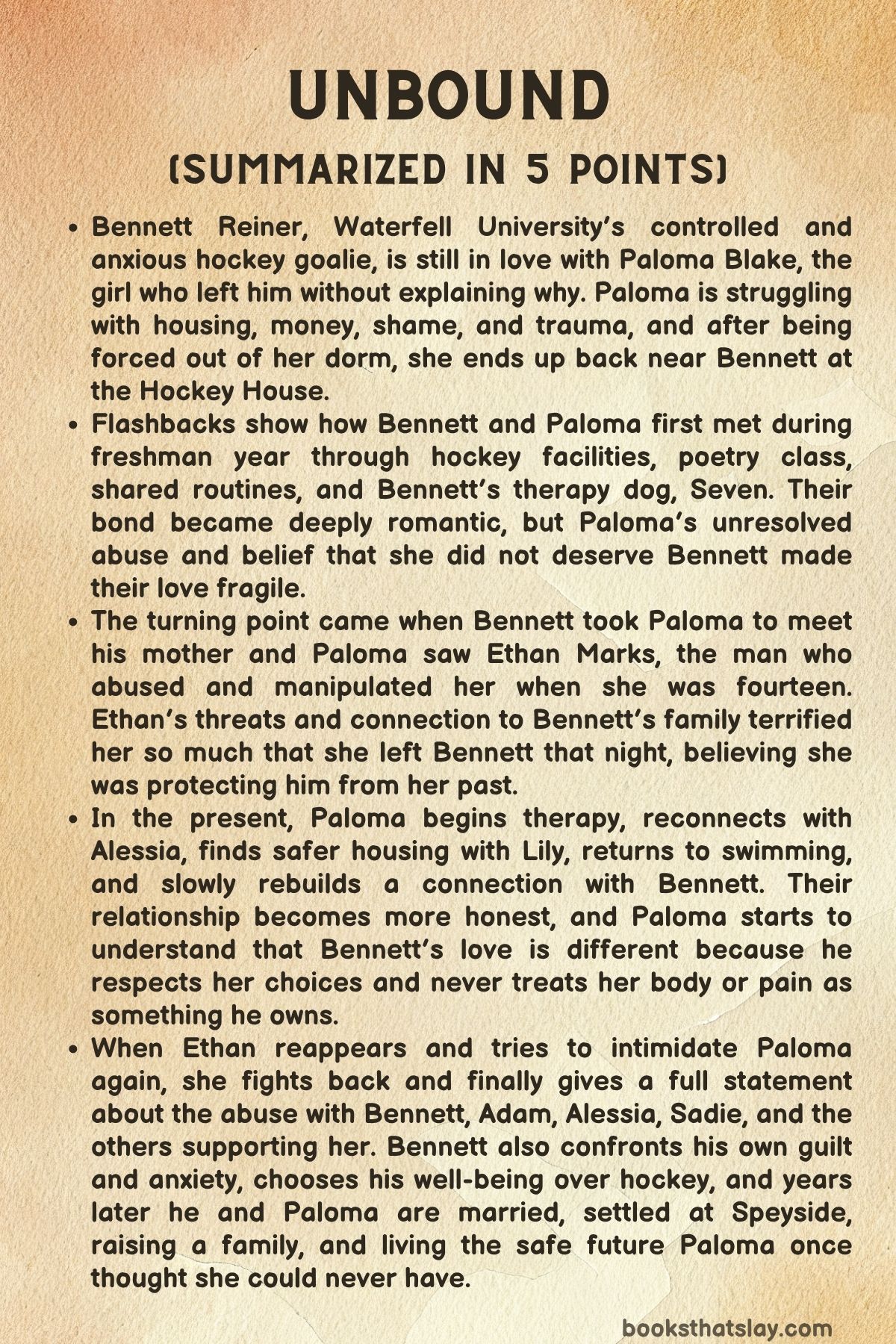
Summary
Bennett Reiner enters the story as Waterfell University’s quiet, disciplined hockey goalie, a young man whose outward control hides deep anxiety and fear of losing the people he loves. He is still emotionally tied to Paloma Blake, the girl who once became the center of his life and then left him without explanation.
Three months before the main events, he finds her drunk and unsteady at a party. Instead of taking advantage of her vulnerability or demanding answers, he brings her to his room, leaves the light on because he knows she fears total darkness, and lets his black Lab, Seven, comfort her.
Bennett understands that Paloma may only ever come to him in broken fragments, yet he still protects every piece she allows him to see.
By senior year, Paloma has disappeared from his daily life again. Bennett tries to continue through hockey practices, routines, classes, and friendships with Rhys and Freddy, but his concern for her never leaves.
Paloma, meanwhile, is fighting to survive on her own. She is short on stability, pride, money, and trust.
After a humiliating job interview where the interviewer crosses boundaries, she sees Sadie Brown happy with Rhys and feels a sharp bitterness. Sadie seems to have reached safety, love, and acceptance, while Paloma still feels stuck in the life she once tried to escape.
Paloma is then pushed into an ice-sports practicum that includes hockey, forcing her back into Bennett’s orbit. She wants to avoid him because he is both the person who makes her feel safest and the person whose goodness makes her feel most ashamed.
Things worsen when her roommate Taylor and their RA use false accusations to get her removed from her dorm. With nowhere to go, Paloma drinks at a bar until the bartender calls Sadie, who arrives with Freddy.
Paloma admits she was planning to sleep in her car. Sadie refuses to leave her there and brings her to the Hockey House.
Bennett senses something is wrong when Seven becomes restless. The next morning, he finds Paloma in the hallway.
His reaction is immediate fear and concern. He takes her into the garage and asks what happened, but Paloma hides behind flirtation and deflection.
She acts casual because vulnerability feels dangerous. Bennett sees through the mask, yet he cannot force her to tell him the truth.
She locks herself away, leaving him with the same helpless ache he has carried for years.
The book then moves back to their freshman year, when Paloma first arrived at Waterfell on scholarship. She was determined to build a different life after a childhood marked by neglect, instability, and her mother’s failures.
Swimming was her place of control and peace, and the Waterfell pool felt like proof that escape was possible. Bennett arrived with Rhys, already burdened by anxiety and strict habits that helped him manage the world.
When his dorm room becomes too overwhelming, his father Adam arranges a townhouse-style campus home where Bennett, Rhys, Freddy, and others can live in a more manageable environment.
Bennett and Paloma first meet in the hockey facilities while she is training as an equipment manager. She accidentally interrupts his post-practice routine, an act that could easily upset him, but she does not laugh at him or treat his needs as strange.
Instead, she offers to learn exactly how he wants his gear handled. That small act of respect becomes the beginning of trust between them.
They meet again in an Intro to Poetry class, where a disagreement over Robert Frost gives them their first real conversation. Bennett loves poetry, while Paloma distrusts it at first, but he gradually helps her see how language can hold emotion without demanding confession.
Adam brings Bennett a therapy dog, Seven, who quickly becomes essential to Bennett’s stability. Seven also bonds with Paloma, who responds to the dog’s calm devotion even when she cannot accept care from people easily.
Through class, hockey routines, walks with Seven, shared poems, and quiet moments, Bennett and Paloma become close. Bennett notices when she is hungry, cold, tired, frightened, or pretending not to hurt.
He feeds her without making her feel small, writes notes and poems for her, and learns the shape of her silences. Paloma is used to being seen through reputation, desire, or judgment, so Bennett’s patient attention unsettles her as much as it comforts her.
Their relationship grows romantic and physical, but Paloma’s trauma shadows every step. Bennett never pushes her beyond what she can give.
When she has nightmares, he comforts her without demanding explanations. He takes her to quiet places, to the pool, to his father’s homes, and eventually to Speyside, the beach house that becomes their sanctuary.
Bennett tells Paloma he loves her, and she loves him too, but love does not erase her belief that she is damaged beyond keeping.
On New Year’s Eve during freshman year, Bennett brings Paloma to meet his mother, Helen. There, Paloma sees Ethan Marks, Helen’s former husband, and freezes.
Ethan is the adult man who abused and manipulated Paloma when she was fourteen. He used attention, power, and emotional control to convince her that she had chosen what happened, leaving her with shame that never belonged to her.
At dinner, Ethan threatens her emotionally, reminding her of his connection to Bennett’s family and making her feel trapped, dirty, and terrified. Paloma cannot tell Bennett the truth.
She believes that staying with him will destroy him and expose her to humiliation, so she leaves that night with only an apology. Bennett is shattered, and Rhys holds him while he breaks down.
In the years that follow, Paloma and Bennett remain caught in a painful cycle. Paloma tries to numb herself through parties, alcohol, and meaningless hookups.
She often punishes herself instead of healing. When she is drunk, afraid, or alone, she sometimes texts Bennett their code, “Walk me home?” He always comes.
He showers her, feeds her, holds her, lets Seven comfort her, and gives her safety for the night. Then she leaves before morning, unable to stay in the tenderness she wants.
Bennett never stops loving her, but the pattern hurts him deeply.
Bennett also struggles with other relationships. He believes Adam failed his mother and suspects emotional complications between Adam and Anna Koteskiy.
He feels abandoned by changes in Rhys’s life after Rhys’s injury and later recovery with Sadie. His fear is not only that Paloma will leave, but that everyone he loves will eventually move forward without him.
His anxiety, routines, hockey identity, and unresolved family pain all press against him.
In the present timeline, Paloma begins therapy with Dr. Sutton and reconnects with Alessia Baudelaire, the woman who helped her escape her old life. Alessia finds her a new apartment with Lily, an anxious and unusual girl who badly needs a roommate.
Lily’s presence gives Paloma a new kind of friendship, one built less on performance and more on shared uncertainty. Paloma also starts swimming again, reclaiming something that once gave her peace.
She shadows Coach Harris with the hockey team and sees Bennett in his element, which reminds her how deeply she still misses him.
Bennett and Paloma try to become friends, but their feelings return quickly. They revisit Speyside, where the old safety between them still exists.
Their physical relationship begins again, this time with more honesty and clearer consent. Paloma slowly admits to herself that Bennett feels different from everyone else because he never takes from her.
He gives her room to choose, to stop, to speak, and to be afraid without being judged.
At a Koteskiy charity gala, Ethan appears again and triggers Paloma’s fear. The truth of why she left Bennett begins to surface.
Paloma panics and runs, but she eventually tells Bennett part of what happened. Later, Ethan follows Paloma and Sadie in an unmarked car and pulls them over.
Paloma has Sadie contact Alessia. Ethan tries to intimidate her again, but Paloma fights back and hits him.
At the station, Alessia, Adam, Bennett, Rhys, and Sadie gather around her. Bennett finally understands that Ethan is the man who hurt her.
In rage and grief, he punches Ethan, then returns to Paloma and promises she is safe.
With Alessia and Adam beside her, Paloma gives a full statement about Ethan, her mother, and the abuse she endured. Speaking the truth does not undo the past, but it removes some of Ethan’s power.
Bennett then spirals into guilt, believing he failed Paloma and failed to see what was in front of him. Paloma, Rhys, Toren, and the others help him through a panic attack.
He begins repairing his relationship with Adam and learns that his assumptions about Adam and Anna were wrong. Adam has made mistakes, but he has also tried to protect and love his son.
Bennett chooses not to play in the final Frozen Four game, placing his mental health above hockey and expectation. Two months later, he gives a poetry reading with Paloma, his friends, Adam, Alessia, Coach Harris, and the team there to support him.
Rhys and Freddy prepare for professional hockey, while Bennett stays to finish his changed major in English and poetry. Paloma continues therapy and swimming, finally facing the past instead of running from it.
Ten years later, Paloma is settled and happy. She coaches a local girls’ hockey team through a program supported by Adam and Max Koteskiy’s foundation.
She and Bennett are married and live near the water at Speyside, the place that once held their safest memories. Bennett is a poetry and literature professor.
They have a daughter, Annie, and another baby on the way. Sadie and Rhys remain close, Alessia has built a life with Adam, and Paloma has turned the sanctuary she once feared she could not keep into a permanent home.
Bennett still sees her as the love of his life, and Paloma finally accepts the love, family, safety, and future she once believed she did not deserve.
Characters
Bennett Reiner
In Unbound, Bennett Reiner is a deeply controlled young man whose calm surface hides fear, anxiety, longing, and an intense capacity for devotion. As Waterfell University’s hockey goalie, he depends on routine, order, and precision, not only because they help him perform but because they help him survive emotionally.
His relationship with Paloma reveals the gentlest parts of him: he notices hunger, fear, coldness, exhaustion, and silence with almost painful accuracy. He does not love Paloma as an idea or conquest; he loves her as someone whose wounds he respects even when he does not understand them.
Bennett’s flaw is that his love can become tangled with guilt and responsibility. He believes he should have seen everything, stopped everything, fixed everything, and protected everyone.
His choice to step away from the final Frozen Four game becomes one of his strongest moments because it proves he is no longer letting hockey, guilt, or outside expectation define his worth. By the end of the book, Bennett becomes a man who still loves intensely but has learned that caring for himself is not a betrayal of the people he loves.
Paloma Blake
Within Unbound, Paloma Blake is the emotional center of the story, a survivor whose sharpness, flirtation, anger, and recklessness all protect a terrified inner self. She enters Waterfell determined to build a life away from her neglectful mother and the abuse that shaped her adolescence, but escape is not the same as healing.
Paloma often believes that her past has made her unclean or unworthy, which is why Bennett’s tenderness frightens her. He sees her with care rather than judgment, and that kind of attention feels almost impossible for her to trust.
Her self-destructive choices are not written as simple rebellion; they come from shame, fear, and the belief that she must punish herself before anyone else can hurt her. Therapy, friendship, swimming, and the final confrontation with Ethan all help her reclaim her voice.
Paloma’s growth is not sudden. It comes through repeated choices to stay, speak, accept help, and believe that love can belong to her without being taken away.
Seven
Seven, Bennett’s black Lab and therapy dog, is one of the book’s most meaningful sources of comfort and emotional stability. He supports Bennett through anxiety, but he also becomes a bridge between Bennett and Paloma.
Seven responds to distress before people can name it, sensing when Paloma is unsafe, when Bennett is unsettled, or when the emotional atmosphere has shifted. His presence allows comfort without pressure, which matters especially for Paloma.
She can accept Seven’s closeness in moments when accepting human care feels too exposed. Seven also represents Bennett’s need for support, showing that Bennett’s control is not effortless and that even the person who protects others needs help staying grounded.
Through Seven, the story gives physical shape to safety, loyalty, and quiet emotional recognition.
Rhys
Rhys is Bennett’s closest friend and one of the strongest stabilizing forces in his life. He understands Bennett’s anxiety, routines, and emotional intensity better than most people, and he is there during some of Bennett’s most vulnerable moments.
When Paloma leaves Bennett after New Year’s Eve, Rhys is the one who holds him through the immediate devastation. Rhys also has his own life beyond Bennett, especially through his relationship with Sadie and his recovery after injury, and this creates tension inside Bennett’s fear of being left behind.
Rhys’s role in the book is not only to support Bennett but also to show that friendship can change without disappearing. He remains loyal, but he also grows, heals, and moves toward his own future.
His presence helps Bennett learn that love does not have to stay frozen in one form to remain real.
Sadie Brown
Sadie Brown is important because she represents both a mirror and a contrast for Paloma. Paloma sees Sadie as someone who has managed to escape the instability and pain they both know too well, which creates envy before it becomes connection.
Sadie’s life with Rhys looks safe in a way Paloma can barely stand to witness at first. Yet Sadie is not simply a symbol of what Paloma lacks; she becomes an active source of care.
When Paloma is drunk, homeless, and planning to sleep in her car, Sadie brings her to the Hockey House instead of leaving her to manage alone. Later, when Ethan follows Paloma, Sadie is there in a moment of danger and helps bring in the support Paloma needs.
Sadie’s importance lies in her refusal to let Paloma’s defensiveness erase her need for help.
Freddy
Freddy brings warmth, loyalty, and balance to the Hockey House. He is part of Bennett’s close circle and helps create the found-family atmosphere that surrounds the team and its friends.
Although he does not carry the same emotional weight as Bennett, Paloma, Rhys, or Sadie, his presence matters because he is one of the people who quietly shows up when needed. He accompanies Sadie when Paloma is stranded and unsafe, and he remains part of the group that gives Bennett and Paloma a wider support system.
Freddy also represents the life moving forward around Bennett: professional hockey, adulthood, and change. His future path reminds Bennett that transitions are inevitable, but they do not have to mean abandonment.
Alessia Baudelaire
Alessia Baudelaire is one of the most powerful adult figures in the story because she offers Paloma the kind of protection and belief she should have received much earlier. She once helped Paloma escape her old life, and in the present she returns as a crucial source of practical and emotional support.
Alessia does not treat Paloma as a problem to be managed; she treats her as a person whose safety matters. She finds Paloma housing with Lily, stands beside her at the police station, and helps her face the truth about Ethan and her mother.
Alessia’s strength is measured not by control but by presence. She gives Paloma room to speak while making sure she does not have to stand alone.
Her eventual life with Adam also suggests that families can be rebuilt in unexpected forms.
Adam Reiner
Adam Reiner is Bennett’s father, and his relationship with Bennett is marked by love, misunderstanding, and unresolved resentment. Bennett believes Adam failed his mother and suspects emotional complications with Anna Koteskiy, which makes him question Adam’s integrity.
Over time, Bennett learns that his view has been incomplete. Adam is imperfect, but he has consistently tried to protect his son and provide what Bennett needs, from better housing at Waterfell to Seven’s presence in his life.
Adam’s role expands when Paloma’s truth comes out. He stands beside her and Alessia, showing that he is not only Bennett’s father but also a man capable of choosing protection over silence.
His repaired bond with Bennett is one of the book’s quieter but important emotional resolutions.
Ethan Marks
Ethan Marks is the source of Paloma’s deepest trauma and the clearest embodiment of manipulation, abuse, and power used without conscience. He harmed Paloma when she was fourteen, exploiting her youth, vulnerability, and desire for attention while making her believe she had chosen what happened.
His cruelty continues years later because he depends on shame to keep her silent. At Helen’s dinner, he does not need physical force to terrify Paloma; his words and family connections are enough to make her feel trapped.
When he reappears and later pulls Paloma over in an unmarked car, he again tries to control the narrative through intimidation. His downfall begins when Paloma refuses to remain silent.
Ethan’s role is not complex in a redemptive sense; he is important because the story shows how abusers maintain power and how truth, support, and legal action can begin to break that power.
Helen
Helen is Bennett’s mother, and her home becomes the place where Paloma’s past crashes into Bennett’s present. Her connection to Ethan places her in a painful position within the story, even though she is not the person who harmed Paloma.
The New Year’s Eve dinner at Helen’s house becomes the turning point that separates Bennett and Paloma for years. Helen’s importance comes through the emotional consequences of proximity: Paloma realizes that Ethan is not safely buried in her past but attached to the family of the person she loves.
Helen also adds complexity to Bennett’s family history, especially in relation to Adam and Bennett’s beliefs about what happened between the adults in his life. She is part of the family structure Bennett must later reexamine with more honesty.
Lily
Lily is Paloma’s anxious, eccentric new roommate, and her presence gives Paloma a fresh start outside the painful environment of her old dorm. Lily needs a roommate, but Paloma also needs a place where she is not treated as disposable.
Their arrangement becomes more than a practical solution. Lily gives Paloma a form of companionship that is awkward, sincere, and free from the heavy history Paloma shares with Bennett and the Hockey House.
Through Lily, Paloma begins to experience ordinary life again: an apartment, a roommate, a routine, and a chance to exist without constantly defending herself. Lily’s character helps show that healing is not built only through dramatic confrontations; it also grows through small, daily experiences of safety.
Dr. Sutton
Dr. Sutton represents Paloma’s movement toward professional help and honest recovery. Therapy is important because Paloma’s trauma cannot be solved only by romance, friendship, or protection.
Bennett’s love matters, but Dr. Sutton’s role shows that Paloma needs a space where her pain can be named without fear of burdening someone who loves her. Beginning therapy marks a major shift in Paloma’s life because it means she is no longer only surviving through avoidance, alcohol, sexual deflection, or running.
Dr. Sutton helps create the conditions for Paloma to recognize what happened to her as abuse rather than a shameful secret she caused. This support makes Paloma’s later decision to tell the truth more believable and grounded.
Coach Harris
Coach Harris is connected to Paloma’s return to the hockey world and her gradual willingness to face spaces she once avoided because of Bennett. By allowing Paloma to shadow the hockey team, Coach Harris places her near the sport and the person she has tried to stay away from, but the experience also helps her reclaim confidence.
Through this role, Paloma sees Bennett in his element again, not only as the boy she hurt or the man she still loves, but as an athlete with discipline, focus, and vulnerability. Coach Harris also becomes part of the support surrounding Bennett later, especially when Bennett’s relationship with hockey changes.
His presence helps frame hockey as both a place of pressure and a community capable of care.
Taylor
Taylor, Paloma’s roommate, plays a smaller but significant antagonistic role because her false accusations help push Paloma into crisis. Paloma is already living with instability, and Taylor’s actions remove one of the few practical protections she has: a dorm room.
The harm Taylor causes is not on the same level as Ethan’s abuse, but it still matters because it exposes how quickly Paloma can be made unsafe by people who see her as easy to dismiss. Taylor’s behavior forces Paloma into homelessness, drinking, and the humiliating admission that she has nowhere to go.
In the larger story, Taylor’s role shows how social cruelty and institutional failures can worsen the life of someone already carrying trauma.
Anna Koteskiy
Anna Koteskiy matters largely through Bennett’s assumptions about Adam and the emotional history he thinks he understands. Bennett suspects there were complications between Adam and Anna, and those suspicions feed his resentment toward his father.
Later, when Bennett learns his assumptions were wrong, Anna becomes part of the larger correction of his family narrative. Her role shows how incomplete information can harden into pain when people do not talk honestly.
Even though Anna is not central to the romance, her presence affects Bennett’s understanding of Adam, loyalty, and the adult relationships around him. She helps reveal that Bennett’s need for certainty can sometimes make him cling to explanations that are not fully true.
Max Koteskiy
Max Koteskiy is most visible through the future created after the main conflict has passed. His foundation with Adam supports the girls’ hockey program where Paloma later coaches, which gives his role a sense of legacy and repair.
The program matters because Paloma, who once found safety in sports and later feared the hockey world because of Bennett, becomes someone who offers young girls a safe and empowering place within it. Max’s connection to that work suggests that the community around Bennett and Paloma does not simply move on from pain but builds something useful from what has been learned.
His role is practical, but it supports one of the book’s clearest signs of healing.
Toren
Toren appears as part of the group that helps Bennett when he spirals into guilt and panic after learning the truth about Ethan. His role may be brief, but it matters because Bennett’s recovery in that moment is communal.
Paloma alone is not responsible for stabilizing him, and Rhys alone does not carry the burden either. Toren’s presence reinforces the idea that Bennett has a wider support system than he realizes.
In a story where both central characters often believe they must manage pain alone, Toren helps show the importance of being surrounded by people who step in when crisis becomes too heavy for one person to hold.
Annie
Annie, Bennett and Paloma’s daughter, appears in the future timeline and represents the life Paloma once believed she could never have. Her presence does not erase the past, but it shows that the past no longer controls Paloma’s entire future.
Annie grows up in the safety of Speyside, surrounded by love, stability, and parents who have chosen healing instead of silence. For Bennett, Annie is part of the family he built with the woman he never stopped loving.
For Paloma, she is proof that love can continue without turning into danger. Annie’s role is symbolic but deeply important because she embodies the peace, home, and continuity Paloma fought to accept.
Themes
Healing Requires Truth, Support, and Time
Trauma in this story is not treated as something that disappears because love arrives. Paloma loves Bennett, and Bennett loves her with rare patience, but her pain remains powerful because it was built through manipulation, shame, fear, and years of silence.
The book shows that healing requires more than a safe romantic relationship. Paloma needs therapy, housing, friendship, legal support, physical safety, and the courage to name what Ethan did to her.
Her progress is slow because she has spent years believing the abuse was somehow her fault. That belief affects her body, her choices, her relationships, and her view of love.
Bennett’s care gives her comfort, but Dr. Sutton, Alessia, Sadie, Lily, and Adam all help create a wider structure of support. Unbound is careful to show that truth is painful before it is freeing.
Paloma’s statement about Ethan does not magically fix her life, but it changes the balance of power. Once the truth is spoken in front of people who believe her, Ethan’s control weakens, and Paloma can begin to see herself as a survivor rather than a ruined person.
Love Is Safest When It Respects Choice
Bennett’s love for Paloma is powerful because it is built on attention and restraint. He notices what she needs, but he does not force her to accept it.
He wants answers, but he does not demand them when she is terrified. He desires her, but the story repeatedly separates intimacy from taking.
This matters because Paloma’s past has taught her that attention can become control and that desire can become harm. Bennett offers a different experience of being wanted.
He leaves lights on, lets Seven comfort her, feeds her, waits for her consent, and accepts her pauses. The romance becomes meaningful because Paloma is allowed to choose, even when her choices hurt Bennett.
The book also shows the limits of love without boundaries. Bennett’s willingness to always come when Paloma calls is beautiful, but it also wounds him because he accepts fragments while denying his own pain.
Their healthier future begins only when both of them become more honest. Safe love is not endless self-sacrifice.
It is care that protects the other person’s agency while also making room for one’s own needs.
Shame Keeps People Silent, but Community Can Break Its Hold
Paloma’s silence is rooted in shame that never belonged to her. Ethan’s abuse was not only physical and emotional; it was also psychological.
He made her feel responsible, dirty, and complicit, which kept her from telling Bennett the truth and from fully accepting care. Shame isolates her from everyone who might help.
It makes her leave Bennett, hide behind flirtation, drink too much, and believe that punishment is what she deserves. The story shows how shame thrives in secrecy.
Ethan depends on Paloma’s fear of being judged, especially because he is tied to Bennett’s family and can make the truth feel socially impossible. What finally breaks that hold is not one heroic action but a network of people refusing to abandon her.
Sadie stays with her during danger. Alessia knows how to protect her.
Adam stands beside her. Bennett returns to her after his rage and promises safety.
Rhys and the others support Bennett as well, proving that community matters for both survivors and those who love them. Shame loses power when truth is met with belief instead of blame.
Choosing Yourself Can Be an Act of Love
Bennett’s decision not to play in the final Frozen Four game is one of the clearest examples of self-preservation in the story. Hockey has shaped his identity, his routines, and his public value at Waterfell, but it cannot remain more important than his mental health.
For much of the book, Bennett measures himself by his ability to protect, perform, and endure. When he learns what happened to Paloma, his guilt almost consumes him because he believes love should have made him capable of preventing the past.
His panic shows how dangerous that belief is. Choosing not to play is not weakness or failure; it is Bennett finally admitting that he is a person before he is an athlete, savior, or caretaker.
Paloma’s arc reflects the same theme in another way. She chooses therapy, chooses to speak, chooses to swim again, and chooses to accept a future she once thought she had forfeited.
By the end, both Bennett and Paloma understand that love is strongest when it includes self-respect. Their future at Speyside is not built on rescue alone but on two people choosing life, healing, and each other with open eyes.