We Call Them Witches Summary, Characters and Themes
We Call Them Witches by India-Rose Bower is a bleak horror novel about family, survival, and the terrible bargains people make when the world collapses. The story follows Sara, a young woman trying to protect her loved ones after witches and strange creatures destroy society almost overnight.
What begins as a desperate escape from the city becomes a long fight to preserve a small pocket of safety through old folklore, wards, herbs, salt, stones, and sacrifice. The book treats magic as something ancient, hungry, and cruel, while showing how fear can turn love into something dangerous.
Summary
When the witches first appear, the world collapses almost instantly. Sara remembers the early nights through screams, panic, and the horrible sounds coming from the neighbouring flat, where Maria and her two sons are attacked by something that seems to be made from mould, pipes, walls, and the material of the building itself.
Sara survives with her sibling Danny, Danny’s wife Lilian, their mother, and the children Noah, Ava, and Isla. They stay indoors at first, listening to the destruction around them, but it soon becomes clear that remaining in the city will only delay their deaths.
The family escapes through the fire escape and moves through a city that has become strange and deadly. The streets and alleys are filled with monstrous beings, and the ordinary world has been taken over by things that do not follow human logic.
They hide in shops, run when they must, and gradually make their way away from the city. Ma’s old knowledge of folklore becomes their only reliable protection.
She knows how to use salt, herbs, rowan, charms, pouches, wards, running water, and adder stones. These protections are not perfect, but they give the family a way to survive when most other people have already died.
Their life becomes a pattern of movement and loss. They find shelters, protect them, wait until the wards weaken or the place becomes unsafe, and then move on again.
At one point they stay in a barn with other survivors and almost believe they have found something like a community. That hope ends when the witches break in.
Sara’s family escapes, but many others are killed. Noah is especially disturbed by this because he had begged the adults to help the people left behind.
The memory remains painful for Sara because survival often means choosing who must be abandoned.
Eventually, the family reaches a cottage in a small village. Compared with the places they have stayed before, the cottage feels almost safe.
It has supplies, space, a garden, two chickens, a bath, and enough room for routines. Danny, Ma, and Lilian set up wards around the house, garden, fields, village green, and a section of stream.
Sara is left with much of the daily care of the children. She tries to keep Noah, Ava, and Isla steady through games, stories, music, and ordinary rituals.
Ava finds a cat and names it Sprinkles, and the children quickly become attached to it. For a while, the cottage begins to feel like a home.
Even there, Sara feels trapped. Danny and Ma still treat her as if she is too young to make important choices, yet she is expected to act like a parent to the children.
Danny constantly checks the ward lines, Ma studies maps and makes charms, and Lilian does what she can to help keep the household together. Sara carries much of the emotional burden of keeping the children calm.
The world outside remains full of witches, but inside the cottage there are small pieces of normal life, and that almost makes the danger worse because it gives everyone something to lose.
One morning, Danny, Ma, and Sara find an unconscious girl lying just outside the wards. Danny immediately distrusts her and thinks she may be dangerous, but Sara argues that they cannot simply leave her outside for the witches.
They tie protective pouches to the girl’s limbs and bring her inside. When she wakes, she says her name is Parsley.
She explains that she came from a commune where her parents and sister lived in tents and followed old pagan and communal customs. She survived after her family was taken by the witches, and her story makes Sara pity her.
Parsley slowly becomes part of the household. Ava and Isla like her quickly, while Noah begins to warm to her after she gives him quartz and teaches him how to make paints.
Sara is drawn to Parsley almost from the beginning, partly because Parsley is close to her age and partly because she seems to understand the loneliness of survival. Danny remains suspicious, especially when witches gather outside the wards soon after Parsley arrives.
He warns Sara not to trust the first young person who appears in their isolated life, but Sara resists his caution.
Parsley tells Sara more about what happened to her family. She had slipped out of the tent and found a strange creature in an old Wendy house.
The creature attacked, tore into the tent, and dragged her family away. Parsley says she was held by the witches for days before she escaped.
Her experience makes her both frightening and vulnerable. She knows more about the witches than most survivors, but she also seems deeply damaged by what happened to her.
Sara and Parsley grow closer despite Danny’s warnings. Ava and Isla tease Sara about liking her, and Sara denies it, though her feelings are obvious.
Parsley discovers a tree house in a neighbouring garden and takes Sara there. Away from the adults and the constant fear of the cottage, they drink old wine, talk, and kiss.
For Sara, the moment feels like the return of something she thought the world had destroyed: desire, hope, happiness, and a future that is not only about staying alive.
The danger around them keeps building. Sara and Parsley find a dying witch sinking into the earth beyond the wards, along with another stick figure like the ones Danny has already found.
Parsley pities the dying creature, while Sara cannot see it as anything but an enemy. Soon after this, Sara becomes ill, and Noah falls sick too.
The wards no longer feel as certain as they once did, and the witches seem to be pressing closer.
While Danny and Ma are away checking or repairing the wards, Lilian sees a witch outside. Sara checks on the children and discovers Noah is missing from his bed.
Downstairs, reflected in the conservatory glass, they see a witch beyond the wards holding Noah. His body is being drawn into the creature’s mossy, bone-filled form.
Sara tries to chase it, but the witch vanishes into the dark. When Danny and Ma return, Parsley says the witches may keep some people alive, as they did with her.
Danny decides to go after Noah with Ma. Sara wants to go too, but Ava and Isla cling to her, and Danny begs her to stay behind to protect them and Lilian.
That night, Parsley prepares to leave because she blames herself for Noah’s abduction. Sara catches her and decides to go with her.
She leaves a note for Lilian and the twins, then follows Parsley across the moors toward the manor where Parsley says the witches held her. The journey takes them through fog, fields, woods, abandoned houses, villages, and empty roads.
They sleep under wards, ration food, and keep moving. Sara is driven by the hope that Noah may still be alive.
Along the way, they encounter signs of how badly the world has changed. In a pub bathroom, they find a corpse arranged in a ritual-like manner.
In an empty house, they find a dead family upstairs. In a tent, they meet a couple named Julian and Ameera, who have survived by using stick poppets as charms.
Their safety proves temporary. Something later mimics Parsley’s voice to lure Sara into the trees, and a huge witch attacks Julian and Ameera, killing them while Sara and Parsley flee.
The journey becomes increasingly strange. In the woods, a witch blocks their way, but Parsley performs a protective hand gesture that her father taught her, and the creature obeys enough to let them pass.
In a village supermarket, Sara and Parsley meet a starving family with two boys. The parents say they heard Noah crying for Sara and tell them that the witches are nesting at a manor up the hill.
They believe there have been fewer attacks because the witches are gathering or hibernating there. Sara and Parsley continue toward the manor and find Danny’s glove on the fence, proving that he reached the place before them.
Inside the manor, Parsley becomes terrified and begs Sara to leave with her. She wants them to run away and start over somewhere else, but Sara refuses because Noah is inside.
They enter through the servants’ area, pass a terrible pit, and search the house. They find evidence that Danny camped in the library, then continue toward the east wing.
When a creature begins emerging from a nest, Sara runs and becomes separated from Parsley. Voices call to her from different directions, including Noah, Danny, Lilian, and the twins, but Sara realizes the house is copying the people she loves in order to trap her.
Parsley pulls Sara into a room, and the truth finally comes out. Parsley admits that she led Noah out of the wards.
The witches had been communicating with her and promised to return her family if she delivered Sara’s family to them. Parsley says she thought they wanted the adults, but they took Noah because he would draw the others in.
She explains that the witches want Sara’s family because they know too much about wards and protection. Parsley has brought Sara as payment.
Sara is horrified and furious, but Parsley argues that Sara would do the same thing to save her own family. Sara gives up her adder stone, and the witches arrive.
Parsley demands her family back, but the creatures give her only crude stick figures. In her desperation, she accepts them as if they are real.
A witch closes a living moth-like cloak around her, and Parsley disappears. The witches then surround Sara.
One whispers into her ear, and Sara blacks out.
Sara wakes in the library with Danny, who has Ma’s adder stone. Danny has been trapped in the manor for days and has lost Ma.
When a witch attacks, Sara uses the protective gesture Parsley taught her, slowing it long enough for Danny to escape with her. They find Noah alive on a bed, pale and weak but breathing.
As they try to leave, Sara sees Ma rooted into the wall, still seeming alive but already claimed by the house and the witches. Danny forces Sara to leave her behind because Noah can still be saved.
Sara, Danny, and Noah escape into the woods. Noah wakes and apologizes, saying he did not want to go.
Later, Sara reads Parsley’s diary and discovers how deeply Parsley had betrayed them. Parsley had mapped the house, listed their supplies, written about Sara, and recorded her guilt and her belief that the witches were gods punishing humanity.
Sara remembers the witches’ whispers and understands that Noah was released because she made a bargain like Parsley’s. To protect her own family, Sara leaves Danny and Noah sleeping, places the adder stone beside Noah, and walks back toward the supermarket family.
She plans to gain their trust, lead the boys out, and keep giving people to the witches so her family will remain safe.
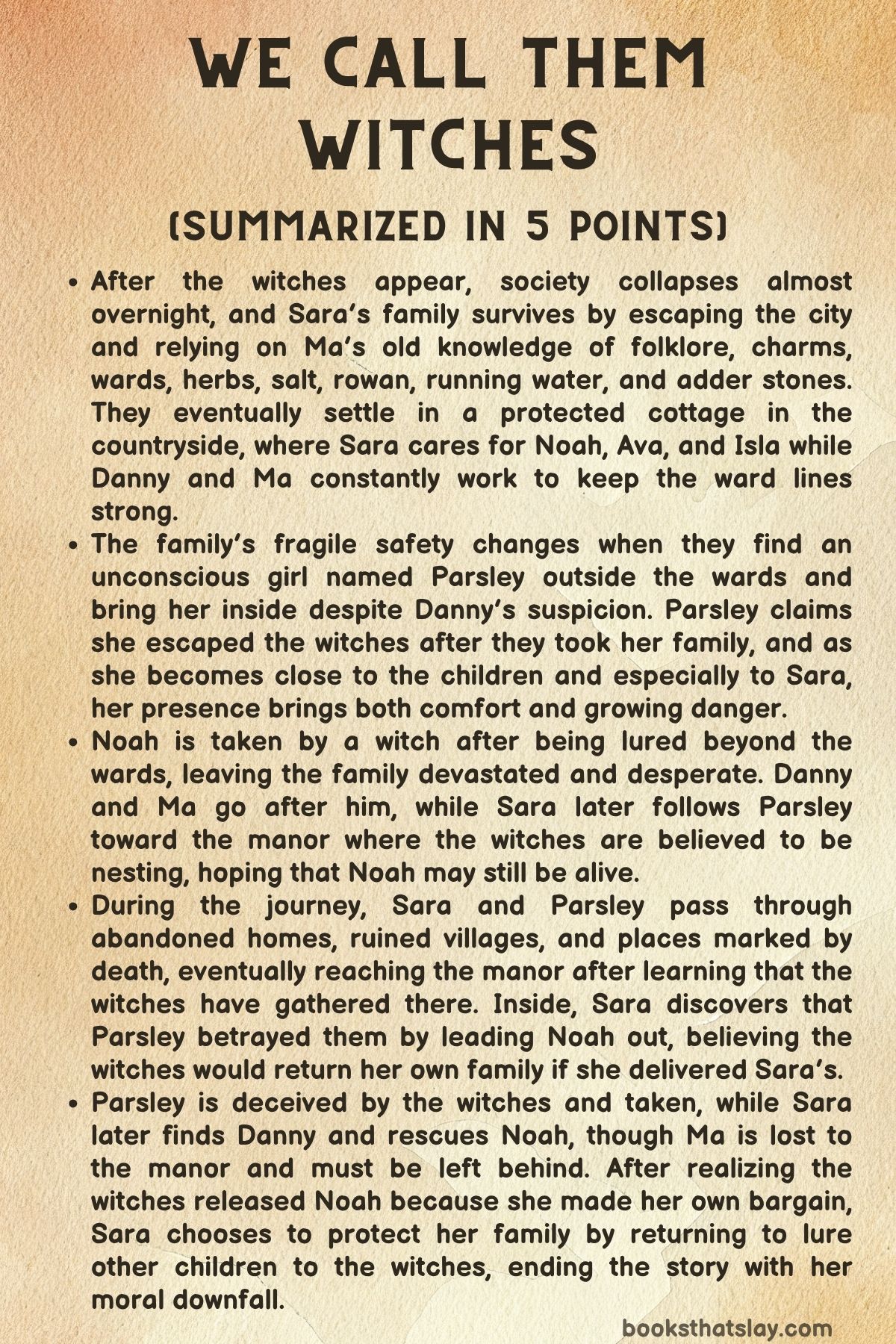
Characters
Sara
Sara is the central figure of the book, and her journey is shaped by fear, responsibility, longing, and moral collapse. At the beginning, she is already living under enormous pressure because she is expected to care for Noah, Ava, and Isla while still being treated by Danny and Ma as someone who cannot make adult decisions.
This contradiction creates much of her frustration. She wants to be trusted, but she is also burdened with the emotional work of keeping the children calm in a world where adults often have no real answers.
In We Call Them Witches, Sara’s love for her family is sincere, but it becomes increasingly dangerous because it teaches her to justify abandonment, secrecy, and eventually betrayal. Her relationship with Parsley gives her a rare feeling of freedom and hope, yet it also exposes how badly she wants connection outside the role of caretaker.
By the end, Sara’s decision to sacrifice other children to protect her own family shows that she has become what she once hated. She is not simply corrupted by the witches; she is changed by the brutal logic of survival.
Parsley
Parsley is one of the most tragic and disturbing characters in the story because she enters the household as someone who appears wounded and helpless, then is revealed as both victim and betrayer. Her past at the commune gives her a strong connection to old beliefs, charms, nature, and ritual, which makes her seem almost suited to the changed world.
At the same time, her survival has left her vulnerable to the witches’ promises. She wants her parents and sister back so badly that she accepts an impossible bargain and helps destroy the safety of Sara’s family.
Her affection for Sara appears real, but it exists alongside manipulation and concealment. This makes her betrayal more painful because she is not presented as purely cruel.
She is desperate, frightened, lonely, and willing to sacrifice others for the people she loves. Parsley’s final acceptance of crude stick figures as her returned family shows how completely grief has broken her judgment.
Her end is horrifying because she gets neither justice nor reunion, only the cruel mockery of the bargain she trusted.
Danny
Danny functions as protector, organiser, and suspicious realist. He is one of the people most responsible for maintaining the family’s survival after the witches appear, and his constant checking of the wards shows his deep fear of failure.
He distrusts Parsley from the beginning, and although his suspicion seems harsh at first, the later events prove that his instincts were right. Danny’s caution comes from experience rather than cruelty.
He has seen shelters fail, communities die, and monsters find ways past protections that should have worked. His relationship with Sara is strained because he still sees her partly as someone to guard, even though she has taken on major responsibilities with the children.
When Noah is taken, Danny immediately acts, choosing to go after him with Ma even though the manor is likely a death trap. His hardest moment comes when he forces Sara to abandon Ma because Noah can still be saved.
Danny’s choices are painful and practical, showing a character who survives by making decisions that leave emotional wounds.
Ma
Ma represents old knowledge, inherited wisdom, and the fragile line between folklore and survival. Before the witches appear, her knowledge of charms, herbs, salt, rowan, adder stones, and warding might have seemed outdated or strange, but after the collapse it becomes the family’s most important defence.
She is not simply a background elder; she is a practical source of protection. Her constant work with maps and charms shows how fully she understands that survival depends on preparation.
Yet Ma’s knowledge also has limits. The witches are ancient and adaptive, and even her skills cannot fully protect the family once betrayal comes from inside the wards.
Her fate in the manor is one of the story’s most painful losses because she is still partly present when Sara finds her rooted into the wall. She becomes a symbol of protection finally overwhelmed.
The family must leave behind the person who helped them survive for so long, proving that knowledge can delay horror but cannot always defeat it.
Lilian
Lilian is quieter than Danny, Ma, and Sara, but her presence is important because she helps hold the household together. As Danny’s wife and the children’s mother figure within the family structure, she is tied closely to the domestic side of survival.
In the cottage, she helps maintain the life that Sara is trying to preserve for Noah, Ava, and Isla. Her role becomes especially important when Danny and Ma are away because she is one of the adults left inside the wards when Noah disappears.
Lilian’s horror at seeing the witch with Noah reflects the helplessness that defines many of the family’s worst moments. She is not shown as a fighter in the same way Danny is, but she represents the emotional cost of trying to keep children alive after society has ended.
Her grief and fear are part of the pressure that eventually pushes Sara toward terrible choices. Lilian’s importance lies in the ordinary love she brings to a world where ordinary family life has become almost impossible.
Noah
Noah is the child whose abduction drives the second half of the story. Before he is taken, he is sensitive, observant, and deeply affected by the moral failures he sees around him.
His memory of the barn, where he begged the adults to help others, shows that he still has a moral clarity the adults are losing. He cannot easily accept that survival means leaving people behind.
This makes his later capture even more devastating because he becomes the person everyone is willing to risk themselves for. Noah’s relationship with Parsley is also important because he begins to trust her after she gives him quartz and teaches him to make paints.
That trust is exploited when she leads him out of the wards. When he later apologizes and says he did not want to go, the moment underlines his innocence.
In the book’s final turn, Noah becomes the reason Sara accepts the witches’ bargain. His life is saved, but his survival comes at the cost of Sara’s moral ruin.
Ava and Isla
Ava and Isla bring moments of tenderness, playfulness, and ordinary childhood into the story, which makes the horror around them feel even harsher. They attach themselves to small comforts, such as the cat Sprinkles, and they tease Sara about Parsley in the way children might in a normal household.
These details matter because the twins show what Sara is trying to protect beyond mere physical survival. She wants them to have routines, games, stories, music, and some feeling of safety.
Their attachment to Sara also affects major decisions. When Noah is taken, they cling to her, and Danny begs Sara to stay behind to protect them and Lilian.
Their fear keeps Sara from immediately joining the search, and their dependence reinforces her role as caretaker. In We Call Them Witches, Ava and Isla are not only vulnerable children; they are reminders of the old world’s emotional bonds.
Their presence makes Sara’s final choice even darker because her love for children does not extend beyond her own family.
The Witches
The witches are the main threat, but they are more than simple monsters. They appear in many forms, often joined with earth, bone, moss, mould, pipes, walls, insects, and household matter.
This makes them feel like the world itself has turned against humanity. They can attack directly, mimic voices, make bargains, create false hope, and use grief as a weapon.
Their intelligence is especially frightening because they understand what people want most. They promise Parsley her family, use Noah to draw in Danny, Ma, and Sara, and later offer Sara the survival of her own loved ones in exchange for other victims.
Within the story, the witches behave almost like ancient forces that punish, feed, and negotiate without human mercy. They do not only kill bodies; they reshape morality.
By the end, their greatest victory is not just that they have taken lives, but that they have taught survivors to betray one another in order to protect their own.
Maria and Her Sons
Maria and her two sons appear only briefly, but their deaths shape the opening horror of the book. Sara remembers their screams from the neighbouring flat, and that memory becomes one of the first signs that the world has changed beyond recognition.
Their attack by a creature made of mould, pipes, and building matter shows that no ordinary shelter is safe. A flat, a wall, or a familiar building can become part of the threat.
Maria and her sons also represent the countless people who die during the first nights without understanding what is happening or having any real chance to defend themselves. Their fate pushes Sara’s family toward escape, but it also stays in the background as a reminder of how random survival can be.
Sara’s family lives not because they are stronger or more deserving, but because they move at the right time and possess knowledge others do not have.
Julian and Ameera
Julian and Ameera represent another possible version of survival. When Sara and Parsley find them, the couple has managed to stay alive in a tent by using stick poppets as protective charms.
Their methods suggest that other people have discovered fragments of defence against the witches, even if they do not fully understand them. For a short time, they seem to offer proof that survival outside Sara’s family is possible.
Their deaths quickly destroy that hope. The attack that kills them shows how fragile every shelter is and how little protection exists once the witches notice someone.
Their presence also foreshadows the truth about the stick figures connected to Parsley’s bargain. What appears to be a charm or symbol of protection can also become a sign of deception, false exchange, and loss.
Julian and Ameera’s deaths harden the atmosphere of the journey and remind Sara that compassion for strangers has become dangerous.
The Supermarket Family
The starving family in the village supermarket appears near the end, but they become crucial because of what Sara chooses to do after Noah is saved. The parents and their two boys are survivors living close to the manor, and they provide information that helps Sara and Parsley understand where the witches are gathering.
They say they have heard Noah crying for Sara and warn that the witches seem to be nesting or hibernating nearby. At first, they seem like another suffering family caught in the same nightmare as Sara’s.
By the end, they become Sara’s intended victims. Her plan to return to them, gain their trust, and lead the boys to the witches shows the full consequence of her bargain.
The supermarket family’s importance lies in their ordinary vulnerability. They are not enemies, villains, or threats.
They are simply people trying to survive, which makes Sara’s decision to use them as payment especially chilling.
Sprinkles
Sprinkles, the cat Ava names, is a small but meaningful presence in the cottage section of the story. The children’s attachment to the cat shows how badly they need comfort and continuity.
In a world filled with wards, monsters, illness, and death, naming and caring for an animal becomes a way to pretend that normal life still exists. Sprinkles helps the cottage feel like a home rather than only a hiding place.
The cat’s role is minor in terms of plot, but emotionally important because it shows what Sara is trying to preserve for the children. Safety is not only walls and charms; it is also routine, affection, play, and the ability to care for something harmless.
Sprinkles therefore becomes part of the fragile domestic peace that Parsley’s betrayal helps destroy.
Themes
Survival and Moral Compromise
Survival in this story is never clean. At first, Sara’s family survives through caution, knowledge, and movement, using charms, wards, salt, herbs, and running water to stay alive while others die.
Yet the longer the world remains broken, the more survival becomes tied to moral compromise. The barn memory shows this early: Sara’s family escapes while other survivors are left to be killed, and Noah’s distress reveals the cost of that choice.
Later, Parsley betrays Sara’s household because she believes sacrificing them may restore her own family. By the end, Sara follows the same logic.
She understands Parsley’s betrayal more fully after making her own bargain with the witches. Her plan to lead the supermarket boys to their deaths is horrifying because it is not driven by hatred.
It comes from love narrowed into selfishness. We Call Them Witches presents survival as a force that can protect the body while destroying the conscience.
The most frightening change is not only that the witches rule the outside world, but that their logic enters the minds of the living.
Family as Protection and Trap
Family is the strongest source of loyalty in the novel, but it also becomes a trap that pushes characters into terrible decisions. Sara’s love for Noah, Ava, Isla, Danny, Lilian, and Ma gives her purpose after the collapse.
Caring for the children keeps her from surrendering to despair, and the cottage becomes meaningful because it shelters the people she loves. Danny’s protection of the family is equally intense, shown in his constant ward-checking and his immediate decision to search for Noah.
Ma’s knowledge is also an act of family devotion, since every charm and ward she makes is meant to keep them alive. Yet this same loyalty narrows their moral world.
Outsiders become risks, burdens, or possible sacrifices. Parsley’s betrayal is rooted in the same family loyalty that drives Sara; she wants her parents and sister back, and that desire makes her willing to deliver another family to the witches.
The story treats family love as powerful but not automatically noble. When fear takes over, devotion can become a reason to abandon, deceive, and harm others.
Folklore, Old Knowledge, and Fragile Safety
The book builds much of its horror around the idea that old folklore is not superstition but practical knowledge. Ma’s understanding of salt, rowan, herbs, pouches, adder stones, charms, wards, and running water gives the family a chance when modern structures fail.
The city, shops, roads, houses, and villages no longer protect anyone. Instead, survival depends on older forms of belief and practice that many people might once have dismissed.
This gives the story a strong sense of ancient rules returning after the collapse of ordinary life. Still, the protections are fragile.
Wards can fail, charms can be misunderstood, and knowledge can be incomplete. Parsley’s hand gesture saves her and Sara in the woods, but Parsley’s broader beliefs also make her vulnerable to the witches’ manipulation.
The stick figures used by Julian and Ameera seem protective, yet similar figures later become part of the witches’ cruel false bargain. Folklore in the story is therefore both useful and dangerous.
It offers tools for survival, but it does not guarantee wisdom, safety, or moral clarity.
Deception, Voice, and False Hope
Deception runs through the story in both supernatural and human forms. The witches imitate voices, offer bargains, and use the desires of their victims against them.
In the manor, Sara hears Noah, Danny, Lilian, and the twins calling from different directions, but the voices are traps created by the house. This use of familiar sound is especially cruel because it turns love into bait.
Parsley’s betrayal works in a similar way. She enters the cottage as someone wounded and in need of rescue, and although her pain is real, she hides the fact that she has been communicating with the witches.
Her affection for Sara becomes mixed with manipulation, making it difficult to separate love from strategy. False hope is the witches’ most effective weapon.
They promise Parsley her family, but give her only crude stick figures. They return Noah to Sara, but only because Sara accepts the logic of payment.
Hope does not disappear in the novel; it becomes corrupted. People keep believing in reunion, safety, and rescue, and the witches use those beliefs to lead them toward betrayal.