Year of the Mer Summary, Characters and Themes
Year of the Mer by L.D. Lewis is a dark fantasy novel about inheritance, power, vengeance, and the danger of bargaining with gods. The story follows Yemaya, an Ixian princess with Mer ancestry, as she inherits a kingdom already weakened by war, religious pressure, noble treachery, and fear of her bloodline.
Her struggle begins as a political crisis but soon expands into a conflict involving sea witches, dead armies, corrupted queens, and old divine grudges. The novel combines royal rebellion, oceanic mythology, and supernatural horror as Yemi tries to reclaim her throne, only to discover that the forces offering her help may be the greatest threat of all. The book is a dark, bloody epic fantasy retelling/sequel to The Little Mermaid—focusing on generational trauma, the costs of power, vengeance, and divine manipulation. It’s the 1st book of the duology by the same name.
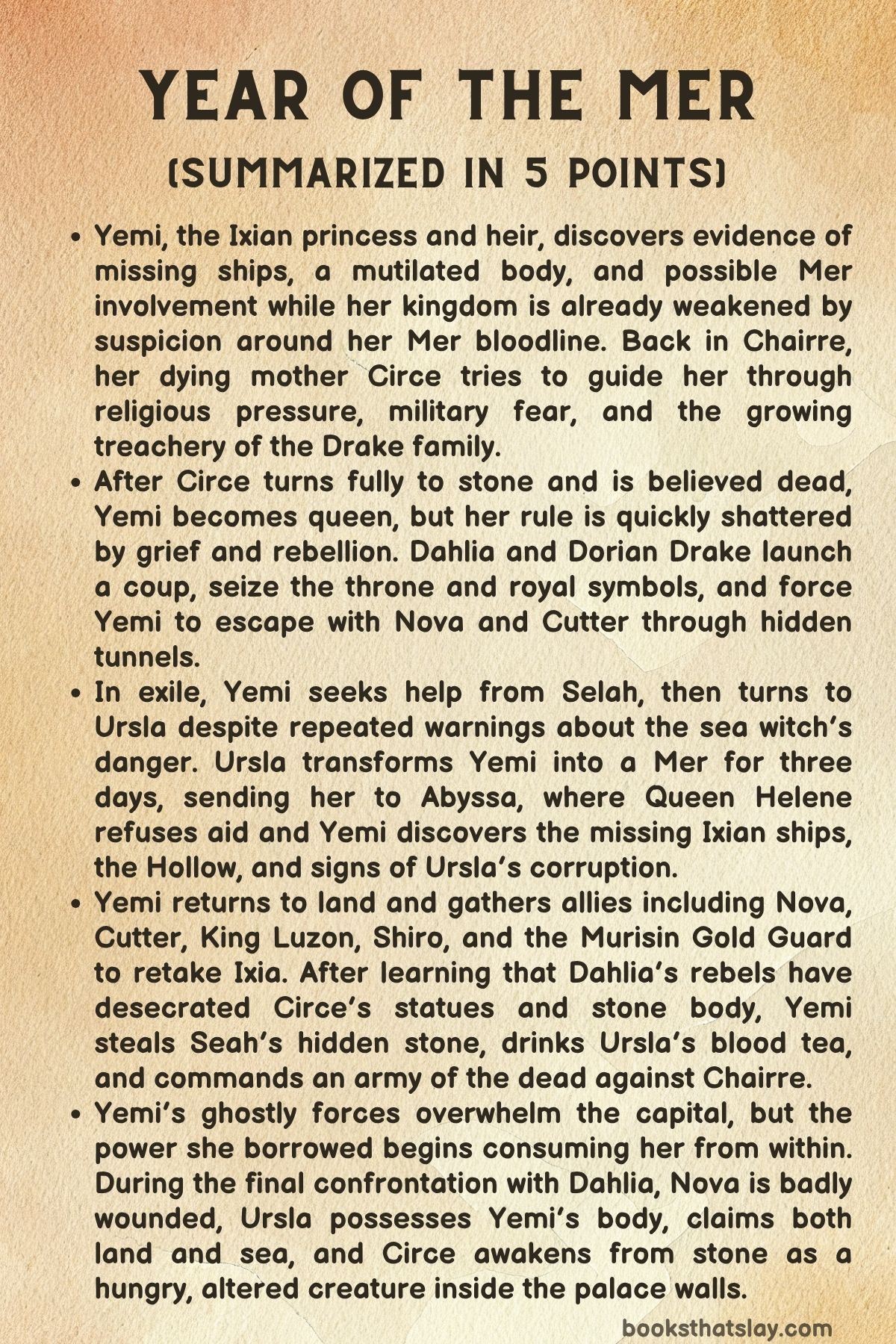
Summary
The story begins with the ancient history of the gods and the creation of the Mer. Long before the events of the main plot, the Old Gods treated human beings as creatures to be raised, worshippers to be harvested, and prey to be consumed.
Their power depended on devotion and fear, and humanity existed beneath them in a cruel order built on hunger. Ursla, a powerful witch, rebelled against this order by saving drowning humans and transforming them into beings who could live under the sea.
These transformed people became the Mer. Through this act, Ursla changed both herself and the world, becoming the Obé, the God of Death.
Yet her rebellion did not make her gentle. She remained driven by hunger, resentment, and a desire for dominion.
In time, the sea god Merrine and the Ursling Peris helped establish a royal Mer bloodline meant to prevent Ursla from ruling the sea. This royal line became part of a long struggle over divinity, succession, and control.
The Mer were not simply a people born of magic; they were the result of betrayal, survival, and divine conflict. Their existence carried the memory of Ursla’s power and the fear that she might one day return to claim both sea and land.
In the present, Yemaya, known as Yemi, is the princess and heir of Ixia. Her family’s bloodline is controversial because her grandmother Arielle was Mer, making Yemi part of a legacy many Ixians distrust.
Ixia has already suffered years of war and political division, and many citizens see the Blackgate line’s Mer ancestry as a curse rather than a strength. Yemi is trained, disciplined, and used to naval command, but she is also under constant scrutiny as the future queen.
While returning from naval exercises, Yemi discovers a mangled corpse on a remote island, along with a torn Ixian flag. Several Ixian ships have gone missing, including the gunship Clodion, and the condition of the body suggests that Mer may be involved.
Yemi and Nova Grey, her guardian and lover, spot Mer nearby, but Yemi chooses not to report the sighting immediately. She understands that the fleet is already uneasy, and open talk of Mer attacks could cause panic or worsen the political tension at home.
Yemi returns to Chairre and reports to her mother, Queen Circe, known as the Bear Queen. Circe is dying from an assassin’s poison that has been slowly turning her body into stone.
Though weakened, she remains politically sharp and deeply aware of the dangers surrounding her daughter. The kingdom is unstable.
The Kept priests want greater influence, military commanders debate whether the threat comes from Kespia, the Mer, or internal enemies, and noble families quietly test the limits of royal power. Among the most dangerous are the Drakes, especially Dorian and Dahlia Drake, who present themselves as loyal while encouraging anti-Blackgate feeling.
Yemi soon witnesses this treachery directly. At a taproom inside the supposedly protected Green Zone, she overhears Dahlia Drake speaking with soldiers who blame the Blackgate family and its Mer blood for Ixia’s suffering.
Dahlia’s words reveal a growing conspiracy built around resentment of Yemi’s inheritance and fear of her ancestry. Yemi confronts her, but the situation is defused before it turns violent.
Circe later warns Yemi that Dahlia is too clever to act alone and may be making herself visible to hide more dangerous conspirators.
Yemi interrogates captured rebels and learns that the Drakes intended to force her abdication. Before she can fully respond, the kingdom enters the Day of Days celebration, a public event honoring Queen Circe.
For a brief moment, Circe appears happy and loved by the people, and the celebration gives Yemi a glimpse of what her mother still means to Ixia. That night, Yemi leaves the festivities with Nova.
At dawn, Nova wakes her with terrible news: Circe has turned completely to stone and is believed dead. The court immediately declares Yemi queen, but she receives the crown in shock, grief, and anger rather than triumph.
Yemi’s first days as queen are filled with pressure. High priest Cerro attempts to bind her rule to the Kept’s religious agenda, while Ursla appears and speaks in warnings, suggesting that Yemi’s time is limited.
Yemi’s grief sharpens into cruelty when she questions prisoners connected to the rebellion. After one insults her family, she orders Nova to cut out his tongue.
The punishment unsettles Nova and creates tension between them, revealing how quickly power, grief, and fear are changing Yemi’s judgment.
The Drakes strike before Yemi can stabilize her rule. Rebel soldiers attack the palace, loyalists are killed, and Dahlia seizes the throne, the crown, and the royal ring.
Dorian threatens Orie and other household survivors, forcing Yemi to surrender the ring. Yemi escapes with Nova and Cutter through hidden tunnels, leaving behind her home, her throne, and her mother’s stone body.
The coup transforms her from queen into fugitive, and her fight becomes not only a struggle to reclaim power but also a test of what she is willing to become.
In exile, Yemi, Nova, and Cutter flee Ixia. Cutter wants to reach Muris and gather support from King Luzon, but Yemi chooses instead to seek Selah, the witch who once treated Circe.
After killing Drake-aligned soldiers near the border, Yemi and Nova separate from Cutter and travel to Amber Lake, where Selah lives in hiding. Selah shelters them, heals them, and warns Yemi not to trust Ursla.
Yemi listens but refuses to abandon the possibility of gaining the sea witch’s help. Selah gives her a medallion meant for Helene, queen of the Mer, and directs her through the Rakelands and the ruined old city of Sol, where Ursla can be summoned.
Yemi and Nova’s journey grows more dangerous as they move farther from familiar territory. Nova visits her cousin Van in the Rakelands and learns that Ursla has somehow chosen Dahlia.
This news complicates matters, because Van is torn between loyalty, faith, and fear of divine will. Yemi and Nova are attacked by black-blooded unnatural enemies connected to Ursla’s followers, but they survive and continue to Sol.
There, Yemi summons Ursla, who agrees to help her reach Abyssa, the Mer kingdom. The price is temporary transformation.
Yemi accepts, and Ursla painfully changes her into a Mer for three days, sending her beneath the sea while Nova remains on land.
In Abyssa, Yemi meets Queen Helene, the sister of her grandmother Arielle. Helene receives her coldly and refuses to help her retake Ixia.
Yemi quickly realizes that Abyssa is not the powerful kingdom she had imagined. It is diminished, isolated, and unable or unwilling to offer real military support.
With help from Lirik, the daughter of Minevra, Yemi discovers Arielle’s hidden cove and learns that Helene ordered Arielle’s memory erased from the city. This erasure suggests grief, shame, and political fear beneath Helene’s rule.
Yemi also discovers the missing Ixian ships in a deep grotto guarded by the Hollow, feral lost Mer who devour others. Commander Hurand, who was transformed into Mer after drowning, is killed there.
The truth behind the missing ships confirms that the danger at sea is real, but it also shows that Abyssa is fractured from within. When Yemi confronts Helene with Selah’s medallion, she sees that the Mer queen is unstable, grieving, and affected by Ursla’s influence.
The sea kingdom offers no salvation. It is another wounded throne haunted by old power.
Yemi returns to Ursla and sees the terrifying scale of the witch-god’s power. Ursla commands a vast graveyard of dead ships and dead souls.
She offers Yemi a way to control an army of the dead for one day. To do so, Yemi must retrieve a stone from Selah and dissolve it in tea made with Ursla’s blood.
Yemi returns to land and reunites with Nova, Cutter, King Luzon, Shiro, and the Murisin Gold Guard. Together, they form a plan to retake Ixia by using Holicrane, Yemi’s abandoned family home, as a base.
During the raid on Holicrane, they capture and kill Dorian Drake. Luc Derring then brings news that Dahlia has strengthened her hold on the capital and that rebels have desecrated statues and the stone body of the Bear Queen.
This drives Yemi into deeper rage.
Convinced that mercy and moderation have failed, Yemi steals the stone from Selah and uses Ursla’s incantation against her. Selah begins turning to stone and admits that she stole the seed of Ursla’s power long ago to weaken her.
She fled to Ixia because Ursla wanted to drown and remake the world. Selah also reveals that Circe may still be alive inside her stone shell.
The revelation comes too late to stop Yemi. After a brutal argument with Nova, Yemi drinks Ursla’s tea and takes command of the dead.
The assault on Chairre begins with supernatural force. Nova and Cutter infiltrate the palace to find Circe while Yemi arrives by sea with ghost ships and an army of dead souls.
Her dead forces overwhelm Chairre, crush Caphree’s rebels, and drive toward the Rock. Inside the palace, Nova finds Orie and Enna alive, but Yemi becomes increasingly consumed by hunger and power.
Her command over death does not leave her untouched. She nearly loses control around Nova’s blood, showing that Ursla’s gift is already changing her.
Yemi finally confronts Dahlia in the throne room. Dahlia fights desperately and appears to be under Ursla’s influence, making her both traitor and pawn.
During the fight, Nova is badly wounded. Yemi’s despair creates an opening for Ursla, who uses the stone inside Yemi to possess her body.
Yemi realizes too late that Ursla manipulated far more than she had understood, including Helene’s corruption and Dahlia’s rise. Nova and Cutter are forced to retreat, leaving Yemi trapped inside herself while Ursla takes control.
Ursla, wearing Yemi’s face, claims both sea and land as her own. She withdraws the army of the dead before sunrise, orders Orie to gather prisoners and senators, and prepares to rule Ixia while keeping Dahlia for herself.
The victory Yemi sought becomes the means of Ursla’s return. In the epilogue, Circe awakens in the masons’ storeroom.
She is no longer stone, but she has changed into something hungry and violent. Trapped behind rubble, she hears blood outside the door and remembers the palace’s hidden tunnels.
Barefoot, starving, and armed with a chisel, the former Bear Queen disappears into the walls, driven by the need to hunt.
Characters
Yemaya
Yemaya, usually called Yemi, is the central figure of the book and the character through whom the story’s political and supernatural conflicts collide. She begins as the Ixian princess and heir, already burdened by the public suspicion attached to her Mer ancestry.
Her royal blood makes her powerful, but it also marks her as controversial in a kingdom still wounded by war and fear. Yemi is intelligent, trained, and brave, yet she is also deeply reactive when her family is threatened.
Her discovery of the mangled body and missing ships shows her caution as a leader because she chooses secrecy over panic, but her later choices show how grief can overpower that discipline.
After Circe’s apparent death, Yemi changes quickly. Her grief becomes anger, and her anger becomes a ruling method.
The order to mutilate a prisoner is an important sign of that shift, because she begins to answer insult with punishment instead of strategy. The coup hardens her further, turning her from a new queen into an exile willing to make dangerous alliances.
Her journey to Ursla is driven by desperation, but it is also shaped by pride. Yemi wants justice, revenge, and restoration, and she increasingly treats those goals as inseparable.
By the end of Year of the Mer, Yemi’s tragedy lies in her belief that she can use monstrous power without being used by it. She sees through many political lies, but she underestimates divine manipulation.
Her love for Nova, loyalty to her mother, and duty to Ixia remain real, yet they are twisted by rage and urgency. Her possession by Ursla is not simply a defeat; it is the result of choices made under unbearable pressure.
Yemi is heroic in courage but dangerous in certainty, and her fall makes her one of the story’s most conflicted figures.
Nova Grey
Nova Grey is Yemi’s guardian, lover, and moral counterweight. She is devoted to Yemi with a loyalty that is both personal and professional, standing beside her through military danger, political collapse, exile, and supernatural threat.
Nova’s role is not limited to protection. She sees Yemi clearly, including the parts of her that others fear or flatter.
This makes her one of the few characters able to challenge Yemi when power and grief begin changing her behavior.
Nova’s reaction to Yemi’s cruelty toward the prisoner shows the tension between love and conscience. She obeys, but the act damages something between them.
Her loyalty does not make her blind. She understands that Yemi is suffering, but she also recognizes that suffering does not excuse every action.
This gives Nova’s character emotional weight because she must balance devotion with fear of what Yemi is becoming. Their argument before Yemi drinks Ursla’s tea is especially important because Nova senses the cost of the bargain even when she cannot stop it.
As the story moves toward the assault on Chairre, Nova becomes both rescuer and witness. She infiltrates the palace, finds survivors, and tries to protect what remains of Yemi’s world.
Her injury during the confrontation with Dahlia becomes the emotional break that allows Ursla to possess Yemi. Nova’s blood, pain, and forced retreat make her part of the tragedy without making her responsible for it.
In Year of the Mer, Nova represents love under strain: loyal enough to stay, honest enough to resist, and wounded by the very person she is trying to save.
Queen Circe
Queen Circe, the Bear Queen, is the fading center of Ixian legitimacy at the start of the story. Her body is slowly turning to stone because of an assassin’s poison, but she remains politically alert and emotionally powerful.
Even while dying, she guides Yemi with caution and insight, especially when explaining that Dahlia Drake may be acting as a visible distraction while deeper conspirators remain hidden. Circe understands court politics because she has survived them, and her advice reflects years of ruling a fragile kingdom.
Her Day of Days celebration shows the public version of Circe: beloved, symbolic, and still able to command affection even in weakness. Her apparent death is the event that destabilizes everything.
Once she turns fully to stone, Yemi inherits not only the crown but also the enemies, burdens, and unfinished wars attached to her mother’s reign. Circe’s stone body becomes a political object as much as a personal loss, especially when rebels desecrate it to attack the Blackgate legacy.
The epilogue transforms Circe from a lost monarch into a frightening unresolved force. Selah’s revelation that she may still be alive inside the stone shell changes the meaning of her death, and her awakening confirms that she has not returned unchanged.
Hungry, violent, and moving through the palace tunnels, Circe becomes a symbol of survival stripped down to instinct. Her return promises future conflict because she may no longer be the wise queen Yemi loved.
Instead, she appears altered by magic, confinement, and hunger.
Ursla
Ursla is the most dangerous power in the story because she combines divine authority, ancient resentment, and extraordinary patience. Her origin is complicated because she once rebelled against the Old Gods by saving drowning humans and creating the Mer.
That act gives her a strange moral ambiguity at first: she was a liberator, but she also became the God of Death. The same power that allowed her to rescue people also made her hungry, possessive, and capable of viewing entire peoples as tools for her own return.
Throughout the book, Ursla works through suggestion, bargains, corruption, and hidden influence. She does not simply attack directly.
She waits for rulers and rebels to weaken themselves, then offers exactly what desperate people want. She affects Helene, chooses Dahlia in some manner, and guides Yemi toward the bargain that will allow possession.
Her manipulation succeeds because she understands grief and ambition. She knows Yemi wants her throne, wants justice for Circe, and wants the strength to defeat those who betrayed her.
Ursla’s offer of the dead army is the clearest example of her method. She gives Yemi what appears to be a temporary weapon, but the true cost is control.
By placing her power inside Yemi through the stone and blood tea, she creates the opening she needs. When Nova is wounded and Yemi breaks emotionally, Ursla takes the throne through Yemi’s body.
Her victory reveals that she has been shaping events across sea and land, using broken queens and ambitious traitors to prepare her return.
Dahlia Drake
Dahlia Drake is one of the main human antagonists, but her role becomes more complicated as the story reveals Ursla’s influence. She begins as a noblewoman who hides treason behind public loyalty.
In the taproom scene, she gives voice to the anti-Blackgate resentment that has been spreading through Ixia. Her political strength lies in her ability to make prejudice sound like patriotism.
She frames Yemi’s Mer blood as the source of national suffering and turns soldiers’ fear into rebellion.
Dahlia’s coup shows that she is not merely a speaker of discontent but an organizer capable of violence and timing. She seizes the palace, takes the crown and royal ring, and forces Yemi into exile.
Her claim to power depends on humiliating the Blackgate line and replacing inherited legitimacy with force. Yet Dahlia is not shown as fully independent.
Van’s warning that Ursla has chosen her and her later behavior in the throne room suggest that her rebellion has been shaped by forces beyond ordinary ambition.
In the final confrontation, Dahlia fights desperately, but she appears less like a mastermind than a person caught in a larger trap. Her betrayal remains real because she willingly participates in the coup and the persecution of Yemi’s family.
Still, Ursla’s influence makes her a tragic instrument as well as an enemy. Dahlia represents the danger of political hatred when it is fed by divine manipulation.
Her choices open the kingdom to disaster, but she is also consumed by the power she helps invite.
Dorian Drake
Dorian Drake serves as Dahlia’s brutal partner in the coup and gives the rebellion its immediate physical threat. Where Dahlia works through rhetoric, planning, and public grievance, Dorian enforces power through intimidation.
His threat against Orie and the household survivors forces Yemi to surrender the royal ring, making him central to the coup’s success. He understands that symbols matter and that taking the ring is a way of stripping Yemi’s rule from her in front of those still loyal to the Blackgate family.
Dorian’s cruelty is practical rather than philosophical. He is dangerous because he turns political rebellion into personal terror.
His presence during the palace takeover shows how quickly noble ambition becomes violence against servants, loyalists, and anyone trapped between competing claims to power. Unlike Dahlia, he is not presented as a complex ideological figure.
He is the armed hand of the Drake betrayal.
His death during the raid on Holicrane gives Yemi and her allies an early victory, but it does not end the rebellion. Instead, it sharpens Yemi’s hunger for a larger reckoning.
Dorian’s capture and killing remove one important enemy while also pushing the story closer to Yemi’s decision to use Ursla’s power. He matters because his violence helps transform Yemi’s campaign from restoration into revenge.
Cutter
Cutter is one of Yemi’s most important allies after the coup, and his value lies in his practicality. When Yemi loses the palace, Cutter helps her escape through hidden tunnels and survive the immediate collapse of her rule.
He thinks in terms of strategy, routes, allies, and military necessity. His first instinct is to reach Muris and gather support from King Luzon, showing that he understands Yemi cannot retake Ixia through anger alone.
Cutter’s loyalty is steady but not sentimental. He is willing to act decisively and violently when needed, yet he is not driven by the same emotional storms that shape Yemi.
This makes him a stabilizing presence in exile and during the planning of the return. He helps connect Yemi’s personal claim to a broader military effort, especially once the Murisin Gold Guard becomes involved.
In the final act, Cutter joins Nova in the palace infiltration, placing himself at the center of the most dangerous part of the mission. When Ursla possesses Yemi, Cutter is forced to retreat with Nova, making him one of the witnesses to the true disaster.
His survival matters because he carries forward knowledge of what has happened. Cutter represents loyal service under impossible conditions, the kind of ally a ruler needs but may not always heed.
Selah
Selah is a witch, healer, and keeper of secrets whose past choices shape the central conflict more than Yemi first realizes. At Amber Lake, she appears as a source of refuge.
She shelters Yemi and Nova, heals them, and offers guidance when they are being hunted. Her warning not to trust Ursla is direct and accurate, but Yemi is too desperate to fully accept it.
Selah’s knowledge makes her valuable, yet her secrecy also makes her difficult to trust.
Her connection to Ursla is revealed when Yemi steals the stone and uses the incantation against her. Selah admits that she stole the seed of Ursla’s power long ago in order to weaken her.
This act was both courageous and dangerous. By taking part of Ursla’s power, Selah delayed catastrophe, but she also carried a hidden burden that eventually becomes the key to Ursla’s return.
Her flight to Ixia was not simply self-preservation; it was an attempt to escape a god who wanted to drown and remake the world.
Selah’s tragedy is that she knows the danger but cannot prevent Yemi from repeating the old pattern of using forbidden power for an urgent cause. Her turning to stone mirrors Circe’s condition and links healing, theft, punishment, and sacrifice.
She is neither simple mentor nor simple deceiver. She is a flawed protector whose secrets leave others vulnerable when truth arrives too late.
Helene
Queen Helene of Abyssa is a ruler shaped by grief, decline, and corruption. As Arielle’s sister and Yemi’s great-aunt, she should represent a possible bridge between Yemi and the Mer.
Instead, she receives Yemi coldly and refuses to help retake Ixia. Her refusal reveals that Abyssa is not the grand undersea power Yemi hoped to find.
The Mer kingdom is diminished, isolated, and politically weakened.
Helene’s erasure of Arielle’s memory from Abyssa is one of the clearest signs of her instability. By ordering Arielle removed from public remembrance, Helene tries to control grief through silence.
This act suggests a ruler unable to face loss honestly. Arielle’s hidden cove becomes a counter-memory, preserving what Helene tried to bury.
Through this, the story presents Abyssa as a kingdom wounded not only by external enemies but also by its own refusal to remember.
Helene’s connection to Ursla makes her even more tragic. She appears affected by the same corrupting influence that later overtakes Dahlia and Yemi.
Her weakness is not only political but spiritual. She is a queen whose grief has left her open to manipulation, and her failure warns Yemi of the danger ahead.
Unfortunately, Yemi recognizes Helene’s damage without understanding that she herself is moving toward a similar fate.
Arielle
Arielle is absent from the present action, but her legacy shapes Yemi’s identity and the political conflict around the Blackgate line. As Yemi’s Mer grandmother and Helene’s sister, she represents the bond between Ixia and Abyssa.
Her bloodline gives Yemi a claim to more than one world, but it also makes her a target for those who fear Mer influence. The prejudice against Yemi’s family is rooted in what Arielle represents: a crossing of boundaries that many Ixians refuse to accept.
Arielle’s hidden cove in Abyssa gives her absence emotional force. Though Helene tried to erase her from the city’s memory, traces of her remain.
The cove becomes proof that personal history cannot be fully destroyed by royal command. For Yemi, discovering this place is not just a family revelation.
It confirms that the Mer side of her inheritance has been shaped by grief, secrecy, and denial.
Arielle matters because she connects the story’s political present to its buried past. Her memory exposes the cost of refusing to acknowledge complicated lineage.
Through her, the book shows that ancestry is not only a source of pride or shame; it is a living force that others can distort, hide, or weaponize.
Lirik
Lirik, Minevra’s daughter, helps Yemi inside Abyssa and gives her access to truths that Helene has tried to conceal. Her importance comes from the fact that she assists Yemi when the official ruler refuses to do so.
In a kingdom marked by silence and decay, Lirik becomes a guide to hidden memory. She helps Yemi see Arielle’s cove and understand the emotional history that has been suppressed beneath Helene’s rule.
Lirik’s role is not as large as Yemi’s or Nova’s, but it is significant because she shows that Abyssa is not entirely lost. There are still Mer willing to act with honesty and compassion, even under a damaged queen.
Her assistance gives Yemi a fuller picture of the Mer kingdom and prevents Abyssa from being reduced to Helene’s coldness or the horror of the Hollow.
Through Lirik, the story suggests that truth often survives through secondary figures rather than official power. She cannot give Yemi an army, but she gives her knowledge.
In this story, knowledge is dangerous and necessary, and Lirik’s willingness to help makes her one of the few undersea characters who offers Yemi something without obvious manipulation.
King Luzon
King Luzon of Muris becomes important as the political ally Yemi needs after she loses Ixia. Cutter initially wants to reach him because Luzon represents organized support rather than desperate wandering.
When Yemi reunites with him, Shiro, and the Murisin Gold Guard, her cause becomes more than a fugitive queen’s personal revenge. It gains military structure and international backing.
Luzon is practical in the way allied rulers often must be. He does not replace Yemi’s agency, but his forces make her return possible.
His presence shows that Ixia’s crisis has consequences beyond its borders. Dahlia’s coup and Ursla’s movements threaten regional stability, making Yemi’s restoration important to more than her own family.
Although Luzon is not the emotional center of the story, he helps ground the rebellion against Dahlia in real political action. His support contrasts with Helene’s refusal.
Where the Mer queen turns Yemi away, Luzon offers practical help. This contrast reinforces how isolated Abyssa has become and how land-based alliances still matter even in a story dominated by sea gods and dead armies.
Orie
Orie is one of the household survivors whose danger during the coup makes the palace takeover more personal and cruel. Dorian’s threat against Orie helps force Yemi to surrender the royal ring, showing that the rebels understand how to use innocent lives as leverage.
Orie represents the vulnerable people caught beneath royal conflict, those who suffer when nobles and soldiers compete for power.
Her survival later gives the palace infiltration emotional importance. When Nova finds Orie and Enna alive, the mission becomes more than a search for Circe.
It becomes proof that Yemi’s household has not been completely erased. Orie’s continued presence also matters after Ursla takes control, because Ursla orders her to gather prisoners and senators.
This places Orie in terrifying proximity to the false Yemi and suggests that surviving the coup does not mean escaping danger.
Orie’s role emphasizes the human cost of dynastic conflict. She does not control armies or gods, but her life is used as pressure by those who do.
Through her, the story keeps attention on the people trapped inside palace walls while rulers, rebels, and divine forces fight above them.
Enna
Enna, like Orie, is part of the household world that Yemi loses during the coup and hopes to recover during the return to Chairre. Her survival inside the palace matters because it shows that not everything connected to the Blackgate home has been destroyed.
The palace is not only a seat of government; it is a place filled with people whose lives are upended by the Drakes’ rebellion.
Enna’s importance comes from what she represents rather than from direct political power. She is one of the living reminders of the world Yemi wants back.
When Nova finds her alive, it briefly suggests that rescue and restoration may still be possible. Yet this hope is undercut by Yemi’s possession and Ursla’s seizure of the throne.
Through Enna, the story shows how victory becomes hollow when the person meant to reclaim the kingdom is no longer in control of herself. Enna survives Dahlia’s rebellion only to face Ursla ruling in Yemi’s body.
Her presence deepens the horror of the ending because the people loyal to Yemi may now be trapped under a ruler wearing Yemi’s face.
Themes
Power Bought Through Desperation
Power in Year of the Mer often arrives when characters are frightened, grieving, or cornered, and that makes every bargain dangerous. Yemi does not seek Ursla because she is naturally reckless; she seeks her because every ordinary path seems blocked.
Her mother is apparently dead, her throne has been stolen, her home has been taken, and her enemies are desecrating everything her family represents. Under those conditions, the dead army appears less like temptation and more like necessity.
That is what makes the theme effective: the story does not present destructive power as obviously foolish from the beginning. It shows how crisis can make a terrible choice feel like the only available one.
Ursla understands this perfectly. She does not need to force Yemi at first because she can let events push her closer to the bargain.
The coup, Dahlia’s rule, the failure of Abyssa, and the insult to Circe’s body all prepare Yemi for surrendering caution. The cost of the bargain is not paid all at once.
It begins with secrecy, then cruelty, then theft, then drinking the tea, and finally possession. The story treats power as something that changes the person holding it, especially when it comes from a source built on hunger.
Yemi wants to command death for one day, but Ursla uses that wish to command Yemi herself.
Inheritance as Burden and Weapon
Yemi’s Mer ancestry gives her a connection to ancient magic, royal history, and the sea, but it also makes her politically vulnerable. Her bloodline is not treated as a private family matter.
It becomes public evidence used by enemies to question her right to rule. The Drakes exploit old fears by framing the Blackgate line’s Mer blood as the reason for Ixia’s wars and instability.
In this way, inheritance becomes a weapon in the hands of those who want power. Yemi cannot simply be a princess or queen; she must constantly answer for what her body and ancestry represent to others.
Arielle’s erased memory in Abyssa expands this theme. On land, Yemi’s Mer inheritance is condemned.
Under the sea, Arielle’s memory is hidden by Helene’s command. Both societies mishandle the same family history in different ways.
Ixia turns it into suspicion, while Abyssa turns it into silence. Yemi is caught between these failures, trying to understand a lineage that has been politicized, feared, and buried.
Circe also passes down more than a crown. She leaves Yemi a kingdom full of enemies, fragile alliances, religious pressure, and unresolved resentment.
The throne is not a clean inheritance but a damaged structure. Yemi’s tragedy is partly that she receives power at the same moment she loses guidance.
The book presents inheritance as something that can grant identity and legitimacy, but also as something others can twist into accusation, shame, and conflict.
Grief Turning Into Violence
Grief moves through the story like a force that can either deepen loyalty or destroy judgment. Yemi’s love for Circe is sincere, and her devastation after the Bear Queen turns to stone is understandable.
Yet the story carefully shows how grief becomes dangerous when it fuses with royal power. Yemi’s mourning quickly becomes anger at prisoners, suspicion of enemies, and a desire for punishment.
When she orders Nova to cut out a prisoner’s tongue, the act reveals that her pain has crossed into cruelty. The injury is not only physical for the prisoner; it damages Yemi’s bond with Nova and foreshadows the harsher choices ahead.
Helene offers another version of grief’s damage. Her erasure of Arielle from Abyssa suggests a queen who cannot bear memory and therefore tries to control it by force.
Rather than healing, she reshapes public truth around her own loss. Dahlia’s grief or resentment is less clearly personal, but she uses collective anger to justify rebellion.
Even Ursla’s ancient hunger carries the residue of betrayal and divine conflict, turning old wounds into a desire to rule.
Circe’s epilogue transformation gives the theme a final horror-filled shape. She returns from stone not as a restored mother but as a hungry presence moving through the walls.
The story repeatedly suggests that suffering does not automatically make characters wiser or nobler. When grief is left untended or manipulated by power, it can become violent, consuming both enemies and loved ones.
The Fragility of Thrones
Royal authority in the story looks grand from a distance but proves frighteningly fragile. Yemi becomes queen after Circe’s apparent death, yet the crown does not protect her from rebellion.
The palace falls, loyalists are murdered, the ring is taken, and Dahlia sits on the throne with alarming speed. This shows that monarchy depends on more than blood.
It requires belief, symbols, soldiers, servants, religious approval, and public obedience. Once enough people doubt or resent the ruler, the throne can be seized by someone bold enough to act.
Abyssa reflects the same weakness in a different form. Helene remains queen, but her kingdom is diminished and isolated.
Her authority has not preserved memory, unity, or strength. The missing ships, the Hollow, and Arielle’s erased place in the city all reveal decay beneath royal command.
Chairre and Abyssa mirror each other as damaged seats of power ruled or claimed by women under supernatural pressure.
Ursla’s final victory makes the fragility of thrones even clearer. She does not need to build a kingdom from nothing.
She takes an existing throne by wearing Yemi’s body and using the symbols already attached to her. The people of Ixia face a terrifying problem: the rightful queen’s face now belongs to an ancient god.
The throne survives, but its meaning has been hollowed out. Power remains visible while truth disappears behind it.