Femme Feral Summary, Characters and Themes
Femme Feral by Sam Beckbessinger is a darkly comic feminist horror novel about rage, menopause, neglected labour and the danger of denying parts of oneself for too long.
It follows Ellie Fourie, an overworked technology executive whose physical changes turn out to be far more dangerous than ordinary hormonal symptoms, and Brenda, an isolated elderly woman investigating a series of mutilated animals across London. Through werewolf mythology, workplace satire, family conflict and an amateur investigation, the novel examines how women’s anger is dismissed, medicalised or forced underground. It ultimately distinguishes between acknowledging anger and allowing it to justify cruelty.
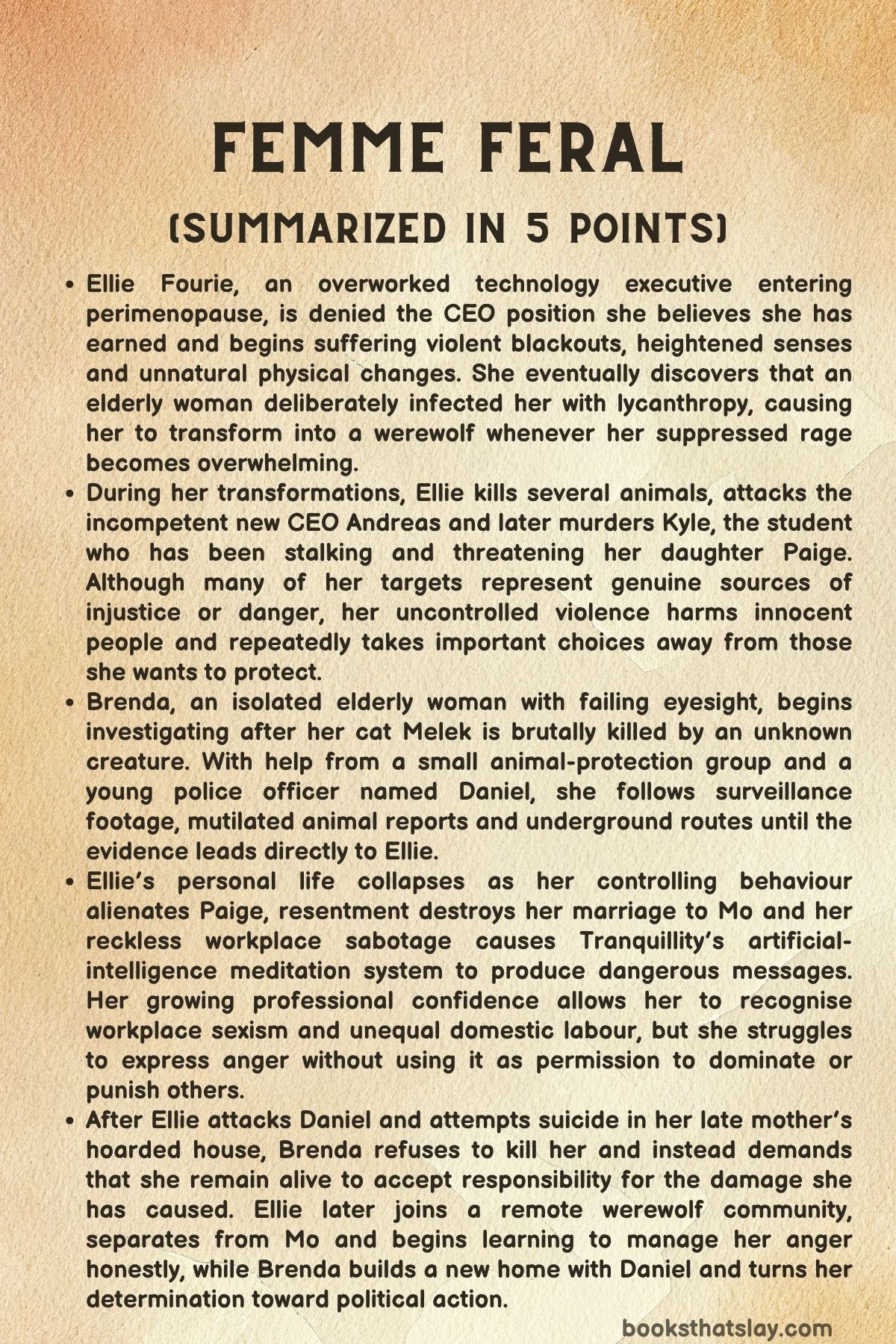
Summary
Forty-four-year-old Ellie Fourie is struck by a cyclist while rushing to work. An elderly stranger named Martine touches Ellie’s bleeding forehead with saliva before disappearing, leaving Ellie unsettled but too preoccupied with responsibilities to think seriously about the encounter.
Ellie has spent years effectively running Tranquillity, a meditation technology company founded by Don. She expects Don’s retirement announcement to include her promotion to CEO, but the board instead appoints Andreas Nicoll, a confident outsider with almost no technology experience.
Ellie receives the title of Chief Product Officer, yet the decision feels like a public declaration that her sacrifices, competence and loyalty are not enough. During the meeting, she experiences intense heat, sweating, confusion and dizziness before collapsing in front of the staff.
At the hospital, a doctor suggests that Ellie is entering perimenopause. Her insomnia, hot flushes, anxiety and disrupted menstrual cycle appear to support the diagnosis, although Ellie is disturbed by how many symptoms can be attributed to a condition she barely understands.
Don explains that his wife Inez’s pancreatic cancer has returned and that he needs to withdraw from daily work. Although Ellie sympathises with him, she remains wounded that even Don did not trust her to lead the company she has helped build.
Resting at home proves impossible because Ellie continues managing work crises, household duties, her daughter Paige and her father-in-law Yusuf. She also remains haunted by guilt over Paige’s teenage eating disorder, which Ellie believes she should have noticed sooner.
Unable to sleep, Ellie wanders through London at night. After teenage boys frighten and mock her near the Emirates Stadium, she runs onto the pitch, where anger and fear trigger an extraordinary physical change beneath the full moon.
Ellie later awakens naked in a park, covered in mud and dried blood, with no memory of the previous hours. Although she feels unusually strong and healthy, she tries to explain the blackout as sleepwalking, panic or another symptom of perimenopause.
Her explanation becomes difficult to sustain when Mo finds animal tissue tangled in her hair. Ellie nevertheless continues hiding the evidence and convincing herself that a medical appointment will eventually provide an ordinary answer.
Elsewhere, eighty-two-year-old Brenda discovers the mutilated remains of Melek, the cat she inherited from her deceased neighbour Rayya. Melek appears to have been torn apart by an animal of extraordinary size and strength.
Brenda is almost blind, financially insecure and increasingly isolated from her family. When the police dismiss the cat’s death, she begins investigating alone, partly because solving the case gives purpose to a life threatened by eviction, disability and loneliness.
Other local residents contact Brenda after their cats and guinea pigs are killed in similarly strange ways. The injuries, enormous puncture wounds and lack of damage to secure enclosures suggest that the attacker is neither an ordinary dog nor a mindless wild animal.
Brenda forms Citizens Against Tabby Slaughter, known as CATS. Deborah and Reggie become her first committed helpers, while veterinarian Paul provides limited information about the wounds and confirms that the attacks are highly unusual.
At Tranquillity, Ellie becomes increasingly furious with Andreas. He ignores technical dangers, spends recklessly, misnames employees and presents Ellie’s idea for personalised artificial-intelligence meditations as though it were his own innovation.
Ellie decides to sabotage the project by placing inexperienced employees in charge and encouraging them to skip testing and safeguards. Millie, a recently hired engineer, unexpectedly develops a convincing prototype, threatening to make Andreas appear successful.
At the same time, Ellie develops intense hunger, rapid body-hair growth, heightened senses, bleeding gums, aching joints and explosive strength. She breaks a workbench with her bare hands after mice startle her, yet continues insisting that everything must be hormonal.
Her behaviour toward her family becomes harsher. She monitors Paige’s eating, resents Mo’s relaxed approach to parenting and care, and cruelly reminds the confused Yusuf that his dead wife will not return.
Brenda’s investigation becomes more organised when Daniel, a young police constable, takes her seriously. Together they review surveillance footage and find an enormous jagged figure moving through the streets on the night of the attacks.
Daniel brings the footage to his superiors, but they dismiss it as inconclusive. Brenda’s history, including a restraining order filed by her abusive former husband, is used to portray her as unstable rather than as a credible witness.
The former husband had killed Brenda’s dog and seriously injured her, yet official records preserved his version of events. Feeling betrayed by the police, Brenda releases the footage online, where she receives ridicule, threats and accusations of staging the animal deaths.
Ellie’s transformations continue. At Hampstead Heath, an experienced werewolf named Grace warns her that animals can smell the change and that she must stop denying what she is becoming.
Ellie dismisses Grace’s words, but later transforms into a wolf-like creature and attacks a teenager named Ollie. In her animal state, she experiences the city through smell, blood, territory and appetite, freed from human shame but also separated from moral restraint.
After another blackout, Ellie finds the body of her neighbour Julia’s Pomeranian in her bathtub. She realises that she broke into the neighbour’s home, killed the dog and possibly ate part of it.
Ellie now understands that the blackouts are dangerous, but she hides the crime rather than seeking help. Her instinct remains to clean, organise and control the evidence as though supernatural violence were another household problem.
Medical treatment provides little relief. A doctor reduces Ellie’s complex experiences to ordinary menopause, focuses on her weight and gives her only limited hormone treatment after she argues for it.
A menopause support group introduces Ellie to Carol, an activist who rejects the claim that women’s anger is merely a hormonal disturbance. Carol argues that exploitation, unequal domestic labour, abusive relationships and political injustice are often the actual sources of distress.
Ellie feels energised by Carol’s anger, political activism and refusal to be pleasant. She also feels an attraction that reconnects her with the bisexual identity she largely set aside after marrying Mo.
Brenda follows reports of animal deaths and Ollie’s attack across London. She eventually enters the Thames Tideway construction system, where she finds enormous tracks and evidence that the predator uses London’s underground tunnels.
The creature chases Brenda through the sewer works. She escapes into an older passage but falls into contaminated water and becomes trapped against a fatberg for approximately three days.
Brenda survives infection, fractures and a damaged hip, but her sight deteriorates further. During her hospital stay, her landlord evicts her and removes her belongings, leaving her without a home or independent life.
Meanwhile, Tranquillity’s artificial-intelligence system absorbs private user recordings without proper filtering. Ellie intentionally allows the unsafe model to proceed toward a public demonstration because she wants Andreas to fail.
During Demo Day, the system produces violent fantasies involving mutilation, murder and revenge. Many of the statements originated in Ellie’s own test recordings, making her private anger publicly audible.
Andreas recognises that Ellie allowed the disaster to happen and orders her to leave. Later, Ellie transforms, stalks him through Nine Elms and savagely attacks him, nearly tearing off his face.
Because Andreas survives the bite, he becomes a werewolf as well. Ellie finally compares the dates of her symptoms and blackouts and accepts that they follow the lunar cycle.
After Andreas is hospitalised, the board appoints Ellie acting CEO. The promotion she wanted is therefore obtained through violence, leaving her success inseparable from guilt.
Carol takes Ellie to meet a community of werewolves, including Grace and Martine. Martine admits that she deliberately infected Ellie after the bicycle accident because she believed Ellie needed release from years of repression.
The women explain that transformation often develops around menopause and that the beast carries anger, grief, appetite and desire that have been denied. Ellie feels violated by Martine’s decision and rejects the group’s belief that the creature must be understood rather than simply controlled.
Ellie attempts to manage lycanthropy through schedules, restraints and isolation. Yet her life becomes more unstable as Tranquillity’s artificial-intelligence disaster unexpectedly turns into the popular Virtual Rage Room, a product that expresses users’ forbidden anger.
Professionally, Ellie becomes decisive and successful, but her family life deteriorates. Mo’s failure to check Yusuf’s injured foot contributes to an infection that requires amputation, worsening Ellie’s resentment over the unequal distribution of care.
Paige is also in danger, although Ellie repeatedly misunderstands the situation. Kyle, a student with whom Paige once had sex, has become obsessed with her and responds to rejection with stalking, threats, surveillance, false accounts and sexual humiliation.
Paige documents the abuse in a folder titled “JUST IN CASE,” but hides the situation from Ellie because she fears that her mother will take over. Ellie mistakenly assumes Kyle is a protective boyfriend and even provides him with information about Paige.
When university staff catch Kyle trying to enter Paige’s residence in disguise, Ellie violates Paige’s boundaries and breaks into her room. She discovers the evidence of months of stalking and realises that her own interference helped Kyle.
Determined to control the next transformation, Ellie chains herself inside an abandoned warehouse. Andreas arrives, now scarred and transformed by the same condition, and the two become wolves during a violent confrontation.
Their aggression changes into sexual attraction, and they mate while transformed. Ellie later confesses the infidelity to Mo, but his immediate expectation that she will organise the work of repairing the marriage makes her recognise another version of the burden she has always carried.
Ellie leaves Mo and stays with Don and the dying Inez. Don apologises for failing to support her promotion and suggests that Ellie turned meditation into a method of suppressing pain rather than honestly experiencing it.
At Tranquillity, Ellie studies Virtual Rage Room recordings and begins questioning the philosophy behind the company. Users are not merely suffering from defective minds; many are reacting to poverty, abuse, illness, loneliness and social breakdown.
A mother then confronts Ellie because a dangerous meditation encouraged her son to use a knife. The confrontation triggers Ellie’s first full transformation outside the lunar cycle.
Ellie destroys the Tranquillity office, injures people in central London and disappears into the sewers while bystanders record her. The public footage proves that extreme emotion can now release the beast at any time.
From the sewers, Ellie travels toward Kyle. She attacks him at his mother’s house and initially considers leaving him alive, but realises that a bite could turn him into a werewolf whose grievances might become even more violent.
Ellie kills Kyle by crushing his skull with a kettlebell. As she returns to human awareness, the ordinary objects in his room force her to recognise that she has killed a damaged young man rather than a simple symbol of evil.
Overcome by guilt, Ellie decides that suicide is the only way to protect others. She goes to her late mother’s hoarded house in Chingford, where the accumulated possessions reflect years of depression, denial and inherited pain.
Ellie attempts to kill herself with a captive-bolt gun and then with gas, but the beast prevents both acts. Her body’s instinct for survival opposes her conscious belief that death is the only responsible solution.
In the hospital, Brenda realises that the polished woman who reclaimed keys found in the sewer is the person shown transforming in the viral videos. With Daniel’s help, she identifies the woman as Eleanor Fourie.
Brenda and Daniel go to the Chingford house to collect proof. Ellie attacks Daniel, tearing away one of his hands, while Brenda enters the dark, cluttered building and fights the creature with pepper spray and her white stick.
When Paige arrives outside calling for her mother, Ellie’s human consciousness begins to reappear. Brenda finds the captive-bolt gun, and Ellie begs her to use it.
Brenda refuses to provide either execution or easy forgiveness. She reminds Ellie of Melek, Daniel and the other victims, but also argues that suicide would leave Paige carrying another generation of guilt.
Brenda asks whether Ellie loves Paige enough to remain alive and accept responsibility. The question reaches the human mind inside the beast, allowing Ellie to return to her ordinary form.
Ellie later enters a remote international werewolf community, where she learns to integrate rather than hate the creature. She uses communal living, meditation, art, physical movement and honest anger to reduce the violence of her transformations.
Tranquillity is sold, while versions of the Virtual Rage Room continue circulating. Andreas, who embraces his violence without responsibility, is eventually killed by another pack after failing to control himself.
Ellie and Mo separate permanently, and Ellie does not expect Paige to forgive her. Daniel survives but loses a hand, while Brenda moves in with Daniel and his grandmother, adopts a dog and begins campaigning for local political office.
In a letter to Paige, Ellie admits her failures and refuses to place responsibility for them on her daughter. She encourages Paige to remain angry when anger is justified, while directing it toward protection, justice and change rather than self-hatred or uncontrolled destruction.
Characters
Ellie Fourie
Ellie is the central character of Femme Feral, a highly capable woman whose identity has been built around usefulness, competence and constant responsibility. She believes that if she manages every detail of work and family life, she can prevent disorder, protect the people she loves and prove that she deserves recognition.
Her anger initially has legitimate causes. She is denied a promotion despite effectively running Tranquillity, carries most of her household’s mental labour, manages Yusuf’s care, monitors Paige’s health and repeatedly compensates for Mo’s passivity.
However, Ellie has converted competence into control. She does not merely help others; she assumes that she knows what they need, often ignoring their independence, privacy and right to make decisions.
Her werewolf transformation gives physical form to everything she has refused to acknowledge. The beast possesses her hunger, sexuality, fear, grief and rage, but it lacks the moral restraint that Ellie’s human identity once provided.
Ellie’s violence cannot be dismissed as an involuntary medical symptom because she repeatedly conceals evidence, sabotages colleagues and uses danger to regain professional authority. Even before fully accepting the supernatural condition, she makes conscious decisions that expose employees and users to harm.
Her attack on Andreas represents revenge against workplace injustice, yet the brutality exceeds any defensible punishment. Her killing of Kyle is similarly complicated because he has terrorised Paige, but Ellie removes the possibility of legal accountability, rehabilitation or Paige’s control over her own response.
Ellie’s eventual growth begins when she stops treating the beast as an external invader. She accepts that its emotions belong to her, even though its actions must not be excused.
Her survival at the end is not presented as innocence or redemption. She chooses to remain alive, acknowledge the people she harmed and learn forms of anger that do not require domination, destruction or self-annihilation.
Brenda
Brenda is an abrasive, intelligent and deeply isolated elderly woman whose investigation provides the novel’s second major narrative path. She is nearly blind, financially unstable and estranged from relatives who find her temper difficult, yet she possesses extraordinary persistence and an unwillingness to accept convenient explanations.
Melek’s death initially gives Brenda a target for private grief. The cat was her final daily companion, and losing him confirms her fear that she could disappear without anyone noticing.
Her investigation grows into an act of public care. While police, neighbourhood groups and online platforms treat animal deaths as trivial, Brenda documents victims, interviews owners and identifies patterns that institutions overlook.
Brenda’s anger is shaped by a lifetime of being disbelieved. Her abusive husband successfully presented himself as the victim, and official records continue to damage her credibility long after the relationship ended.
Her rudeness and deception complicate her moral position. She permits people to think she is a professional investigator, accepts money while lacking official qualifications and sometimes attacks potential allies before they have rejected her.
Nevertheless, Femme Feral refuses to suggest that an unpleasant witness is therefore an unreliable one. Brenda’s evidence remains valid even when her behaviour is imperfect, and her anger often reflects genuine mistreatment rather than instability.
Her relationship with Daniel gradually restores her connection to other people. Being called his friend matters because she is accustomed to being tolerated, managed or dismissed rather than sincerely valued.
In the climax, Brenda becomes the person capable of stopping Ellie without killing her. She offers no sentimental forgiveness, but she recognises that accountability requires survival, and her decision transforms revenge into a demand for responsibility.
Paige Fourie
Paige is Ellie and Mo’s daughter, a university student whose history of anorexia has caused Ellie to view her as permanently vulnerable. Although Paige has worked hard to establish an independent life, her mother continues to examine her eating, appearance and emotional condition for signs of danger.
Paige’s stalking ordeal demonstrates why protective attention is not the same as listening. Ellie notices changes in her daughter but interprets them through old fears, assuming that food, romantic disappointment or university stress must explain everything.
Kyle’s harassment forces Paige to live in constant alertness. She changes routes, preserves evidence and anticipates how authorities might blame or dismiss her, showing the mental and physical burden placed on stalking victims.
Paige conceals the danger partly because she fears Kyle and partly because she fears Ellie’s response. She understands that her mother’s protection may involve taking over, violating privacy and making choices that Paige must then endure.
Her anger after Ellie discovers the evidence is therefore justified. Ellie may be motivated by love, but breaking into Paige’s room and destroying her property repeats the central problem of the stalking: another person believes concern gives them ownership over her boundaries.
Paige’s recovery depends on separating herself from her mother’s guilt and emotional demands. Ellie’s final letter respects this by telling Paige that she does not owe forgiveness and is not responsible for keeping her mother alive.
Mo Fourie
Mo is Ellie’s husband, a kind and affectionate man whose relaxed manner initially appears to balance Ellie’s intensity. He provides warmth within the family and is often better than Ellie at creating moments of comfort, humour and emotional ease.
His passivity, however, places a large amount of invisible labour on Ellie. Because he avoids decisions, unpleasant conversations and detailed planning, Ellie becomes the default manager of the household.
Mo’s failure to examine Yusuf’s foot has severe consequences. The neglect is not malicious, but it reveals how good intentions can coexist with irresponsibility when another person is expected to notice every danger.
He also dismisses Ellie’s behaviour as hormonal before understanding its seriousness. Although her conduct is increasingly alarming, reducing her anger to biology allows him to avoid examining the unequal structure of their marriage.
After Ellie confesses her infidelity, Mo immediately imagines forgiveness through counselling and repair work. His reaction is generous on one level, yet Ellie recognises that he once again assumes she will organise the process.
Mo is not portrayed as an abusive villain. He is a loving but insufficiently accountable partner whose avoidance has been made possible by Ellie’s compulsive competence.
Andreas Nicoll
Andreas is appointed CEO of Tranquillity despite lacking meaningful experience in technology, healthcare or company operations. His confidence, presentation skills and fashionable language convince the board that he represents innovation, while Ellie’s years of practical leadership are treated as ordinary support work.
He casually steals Ellie’s artificial-intelligence concept and presents it as his own vision. Even when he vaguely credits the team, he remains the person receiving authority and admiration for an idea whose dangers he does not understand.
Andreas’s spending on a costly John Lennon song reveals his preference for image over survival. Rather than accepting responsibility for bringing the company close to insolvency, he responds to Ellie’s concern with patronising reassurance.
His narration shows that he genuinely believes himself to be a visionary. This lack of self-awareness makes him more dangerous because he interprets criticism as resistance to creativity rather than evidence of poor judgement.
After Ellie attacks and infects him, Andreas welcomes lycanthropy as freedom from marriage, work and social obligation. Unlike Ellie, he has little interest in examining the consequences of his violence.
His eventual death demonstrates the danger of treating liberation as permission to harm. He embraces appetite without responsibility and therefore becomes a threat even to other werewolves.
Daniel
Daniel is a newly qualified police constable initially assigned to Brenda because his superiors do not take her seriously. His inexperience makes him seem like another dismissive institutional representative, but he distinguishes himself by listening.
He reviews evidence carefully, uses his position to secure surveillance footage and treats animal deaths as worthy of investigation. His respect allows Brenda to participate without being infantilised, even when he notices the extent of her sight loss.
Daniel briefly damages their relationship by accepting institutional claims about Brenda’s stability. His suggestion of counselling echoes a pattern in which anger caused by abuse is treated as a psychological defect.
He later attempts to repair the harm by giving Brenda useful information and continuing the investigation. His willingness to admit uncertainty makes him different from senior officers who protect their authority through dismissal.
Daniel loses a hand when Ellie attacks him, yet he survives and remains connected to Brenda. Their eventual shared household transforms a professional alliance into a chosen family.
Kyle
Kyle is Paige’s stalker, a young man who interprets a single sexual encounter as a permanent emotional claim. When Paige rejects further involvement, he treats her decision as betrayal rather than an exercise of autonomy.
His stalking includes unwanted messages, surveillance, break-ins, threats, online humiliation and the circulation of sexual material. Each act is designed to reduce Paige’s control while allowing Kyle to imagine that he is merely requesting an explanation.
Kyle’s perspective reveals the stories he tells himself to avoid responsibility. He uses loneliness, rejection and self-improvement language to present himself as a wounded person behaving imperfectly rather than as someone conducting a deliberate campaign of fear.
His room contains exercise plans, books and evidence of ordinary adolescent uncertainty. These details do not excuse his conduct, but they prevent Ellie from imagining that she has killed a creature entirely separate from humanity.
Kyle’s death is not framed as a clean victory. Ellie stops him from harming Paige again, but she also denies everyone involved the possibility of legal judgement, truthful confrontation or future change.
Carol
Carol is a politically active werewolf who gives Ellie a language for anger that is social rather than purely medical. She rejects comforting claims that menopause is automatically a spiritual awakening and instead identifies work, marriage, politics and unequal care as sources of women’s distress.
Her activism shows Ellie that anger can produce solidarity and action. Spray-painting a corrupt figure’s property gives Ellie a temporary experience of rebellion that is collective rather than predatory.
Carol also awakens Ellie’s suppressed queer desire. Their attraction reminds Ellie that marriage and motherhood have not erased earlier parts of her identity.
Although Carol understands lycanthropy better than Ellie, she does not fully appreciate how dangerous Ellie has become. Her preference for release and ritual can sound inadequate when placed against the reality of mutilated animals and injured people.
Martine
Martine is the elderly woman who infects Ellie after the bicycle accident. She believes that Ellie’s repression is so severe that transformation will force her to confront the self she has denied.
Her decision is a profound violation of consent. Even if she accurately recognises Ellie’s suffering, she exposes Ellie, her family and strangers to a condition capable of producing lethal violence.
Martine insists that she did not create Ellie’s anger but merely released what already existed. This claim contains psychological truth, yet it also allows her to avoid full responsibility for the consequences of her intervention.
She represents the danger of imposing liberation on another person. A change intended as freedom becomes another form of control when the affected person has no choice.
Grace
Grace first appears as an experienced swimmer who recognises Ellie’s changing body at Hampstead Heath. She understands that the animals gathering around Ellie are responding to a scent associated with transformation.
Her warning is direct because Ellie’s denial has already become dangerous. Grace knows that refusing to name the condition will not prevent it from controlling Ellie’s behaviour.
As part of the werewolf community, Grace represents practical knowledge passed between women whose experiences are not understood by conventional institutions. She also shows that lycanthropy can be managed more safely through recognition and collective support.
Don
Don is the founder of Tranquillity and Ellie’s longtime mentor. He depends heavily on her competence, yet fails to support her appointment as CEO when the decision matters most.
His choice is influenced by Inez’s illness and his desire to withdraw quickly, but urgency does not erase the betrayal. Don benefits from Ellie’s labour while participating in a system that treats an inexperienced male outsider as more naturally suited to leadership.
Later, he apologises and recognises that Ellie used mindfulness as another tool for control. His insight helps her question whether Tranquillity has encouraged people to adapt to suffering instead of challenging its causes.
Don is neither wholly exploitative nor wholly innocent. He cares for Ellie, but affection does not prevent him from undervaluing her or avoiding difficult truths.
Inez
Inez is Don’s wife, whose returning pancreatic cancer changes the direction of his life and the company. Although her illness remains largely outside the workplace plot, it exposes the difference between abstract care and intimate presence.
When Ellie stays with Don and Inez, caring for Inez allows her to experience usefulness without performance or ambition. The work is painful and exhausting, but it is grounded in direct attention rather than the need to control outcomes.
Inez’s approaching death also places Ellie’s professional obsession in perspective. Success cannot solve mortality, and competence cannot protect every person from loss.
Yusuf
Yusuf is Mo’s father, an elderly man living with dementia and physical decline. His confusion requires patience, repetition and forms of care that preserve comfort even when factual accuracy is impossible.
Ellie’s cruel reminder that Noor is dead reveals how exhausted and resentful she has become. Her words are factually correct but emotionally destructive because they force Yusuf to experience grief as though hearing the news for the first time.
The infection in his foot and eventual amputation expose failures within the family’s care arrangements. Yusuf becomes the person who physically pays for Mo’s inattention and Ellie’s overloaded monitoring system.
His condition illustrates the difficult realities of caregiving. Love exists alongside exhaustion, resentment and the forbidden wish that suffering might end.
Millie
Millie is an inexperienced DevOps engineer who initially looks to Ellie for guidance. Ellie helps her navigate the company, creating an expectation that the senior executive will protect rather than exploit her.
Ellie later assigns Millie to the unsafe artificial-intelligence project because she expects her to fail. This decision turns a vulnerable employee into a tool within Ellie’s private war against Andreas.
When Millie succeeds, Ellie fires her impulsively and improperly. Millie’s later release of the unstable system is reckless, but it follows her humiliation and exposes how workplace mistreatment can spread harm through retaliation.
Deborah
Deborah is one of the first people to attend Brenda’s CATS meeting. She is anxious and less confrontational than Brenda, but her willingness to participate gives the investigation its first real structure.
Her insight about London’s extensive surveillance network helps produce the shadow footage. Deborah demonstrates that useful courage does not always appear as confidence or aggression.
She also represents the ordinary citizens who respond when official systems refuse to act. Her contribution allows Brenda’s private obsession to become a collective search for evidence.
Reggie
Reggie is a retired accountant who joins Brenda and Deborah at the first CATS meeting. His methodical temperament helps balance Brenda’s impatience and gives the group a practical foundation.
Although he is not as central as Daniel or Deborah, his presence matters because Brenda expects abandonment and ridicule. Reggie’s participation shows that community can begin with a small number of people simply choosing to take another person’s concern seriously.
Paul
Paul is the veterinarian who examines the mutilated animals. He confirms that the puncture wounds and severed bodies do not fit ordinary attacks, lending professional support to Brenda’s suspicions.
At the same time, he resists becoming an unpaid forensic service for every case she collects. His boundaries are reasonable, but they also reveal how investigations fail when no institution accepts responsibility.
Paul treats Brenda with greater compassion than the police do. His willingness to cremate Melek without charge recognises the emotional importance of an animal whom others regard as disposable.
Jin
Jin is one of Mr Bojangles’s grieving owners. His household’s affectionate decorations and shared memories show that an animal’s death can wound an entire community.
When Jin learns that Brenda is not a professional investigator, he is disappointed but still values the fact that she cared enough to act. His response helps Brenda understand that imperfect help can still matter.
Jin later defends Brenda online, although describing her primarily as a lonely old woman unintentionally reduces her authority. His good intentions reveal how sympathy can become another form of condescension.
Jack
Jack is an eccentric campaigner devoted to slow worms and overlooked urban wildlife. His activism expands the novel’s concern beyond household pets to the fragile ecosystems surviving inside London.
He provides trail cameras that capture further evidence of the creature. Like Brenda, he preserves information that larger organisations ignore because the affected animals appear unimportant.
Jack represents a form of patient environmental care. His work lacks glamour, but it protects living things that modern cities easily destroy without noticing.
Byron
Byron is Ellie’s brother, who expects her to manage the sale and clearance of their late mother’s hoarded house. His assumption reflects the family pattern in which Ellie receives unpleasant responsibilities because she is considered capable.
When Ellie finally refuses, the decision is one of her healthier acts of resistance. It shows that saying no can be different from attacking or abandoning another person.
Byron’s limited role nevertheless helps explain how Ellie became trapped in competence. Every task she successfully accepted made it easier for others to assign her the next one.
Julia
Julia is Ellie’s prejudiced and unpleasant neighbour, as well as the owner of Harold, the Pomeranian killed during one of Ellie’s transformations. Ellie dislikes both Julia and the dog, but that dislike cannot justify the violence committed against them.
Julia’s grief forces Ellie to confront the fact that victims do not have to be admirable to deserve safety. The killing is wrong regardless of whether Ellie finds the owner irritating.
Ollie
Ollie is a teenager attacked by Ellie during a private encounter with Mary on Hampstead Heath. His perspective provides the first direct human view of Ellie’s transformed body.
The attack demonstrates that the beast’s violence is escalating beyond animals. Ollie survives, but his injuries become important evidence linking the mutilations to a creature capable of attacking people.
Theo
Theo is Paige’s former partner and one of the people Ellie initially blames for Paige’s distress. His presence shows how quickly Ellie builds explanations without asking her daughter what has actually happened.
Theo later appears beside Paige when the stalking situation becomes public. Although he remains a minor figure, he helps reveal that Ellie’s assumptions about romantic heartbreak have distracted her from the real danger.
Themes
Suppressed Anger and Responsible Expression
Femme Feral treats anger as an emotion that becomes dangerous when it is either completely denied or accepted as a licence for destruction. Ellie has spent years turning frustration inward, disguising resentment as competence and using productivity to avoid admitting that she feels exploited.
Her transformation gives anger a body strong enough to ignore every social rule that once contained it. The beast attacks irritating animals, professional enemies and Paige’s stalker, selecting targets connected to Ellie’s conscious grievances while responding with violence far beyond proportion.
The novel does not argue that Ellie should return to silence. Her anger about workplace sexism, unequal caregiving, medical dismissal and Paige’s abuse is justified, and refusing to acknowledge those injustices would preserve the conditions that produced her rage.
However, justified emotion does not make every action performed under its influence just. Ellie’s attacks create new victims, remove other people’s choices and eventually threaten those she most wants to protect.
Brenda offers an alternative use of anger. Her fury drives investigation, documentation, political engagement and resistance to institutions that would prefer her to disappear.
The conclusion presents anger as energy requiring direction, not elimination. It can expose abuse, sustain survival and motivate change, but it must remain connected to responsibility, empathy and an awareness of consequences.
Invisible Labour, Caregiving and Control
Ellie’s exhaustion is rooted in the endless labour required to keep other people’s lives functioning. She manages schedules, health appointments, workplace crises, emotional tensions, food, household maintenance and care for Yusuf while others experience her reliability as a natural resource.
This work is difficult to value because its success often looks like nothing happening. Problems are prevented before anyone else sees them, allowing Mo, Don, Byron and colleagues to underestimate how much Ellie is doing.
The burden gives Ellie legitimate reason for resentment, but it also becomes the foundation of her authority. Because she is always the person who knows what must be done, she begins believing that care entitles her to make decisions for everyone.
Her treatment of Paige shows how protection can become control. Ellie monitors food, invades privacy and eventually takes over the stalking crisis, repeating the loss of autonomy Paige is already experiencing from Kyle.
Mo illustrates the opposite failure. His kindness is weakened by avoidance, since refusing to make decisions does not eliminate responsibility but transfers it to someone else.
The novel therefore rejects both total self-sacrifice and passive dependence. Ethical care requires shared labour, direct communication and respect for the cared-for person’s choices, even when fear creates a powerful desire to take control.
Ageing, Menopause and Social Invisibility
Ellie and Brenda occupy different stages of ageing, yet both discover that women become easier for institutions to dismiss once their bodies no longer fit expectations of youth, calmness and usefulness. Ellie’s symptoms are treated as routine hormonal inconvenience, while Brenda’s evidence is attributed to failing sight, age or instability.
Perimenopause destabilises Ellie’s relationship with her body. Hair, hunger, bleeding, heat, desire and strength make her feel unfamiliar to herself, but they also reveal how much of her former identity depended on bodily discipline.
The werewolf condition exaggerates the fear that ageing women become unruly, unattractive or unreasonable. Rather than making Ellie weak, hormonal transition appears alongside increased appetite, sexuality and physical power.
Brenda experiences a harsher form of social disappearance. Losing her licence, home and independent mobility allows officials to treat institutional care as the obvious conclusion of her life.
Her anger is read as evidence that she cannot be trusted, while polite acceptance would make it easier to remove her choices. The novel shows how elderly people are often expected to cooperate with their own erasure.
Both women resist invisibility, but resistance alone is not enough. They must also build relationships in which their experiences are recognised without being romanticised, feared or reduced to medical symptoms.
Monstrosity, Humanity and Accountability
The werewolf operates as both a supernatural creature and an expression of ordinary human impulses. Ellie’s transformed body is terrifying, yet its desires originate in emotions that existed before Martine infected her.
This connection prevents Ellie from separating herself neatly into an innocent woman and an evil beast. The creature chooses targets associated with her resentment, remembers pleasure and sometimes responds to human voices, proving that Ellie remains present within it.
Kyle presents a different form of monstrosity. He appears ordinary, interprets himself as injured and uses familiar language about love, rejection and self-improvement while systematically terrorising Paige.
Andreas also embraces the beast without recognising any need for restraint. His death shows that acknowledging appetite without accepting responsibility is not integration but surrender.
Brenda’s decision not to kill Ellie defines the novel’s understanding of accountability. She does not deny Ellie’s crimes, excuse them through menopause or offer immediate forgiveness.
Instead, she insists that Ellie remain alive to face what she has done. Death would end Ellie’s suffering, but it would leave Paige, Brenda and the other survivors carrying the consequences.
Humanity is therefore not defined by innocence or perfect self-control. It is expressed through the willingness to recognise harm, reject comforting excuses and continue the difficult work of change.