Hunger and Thirst Summary, Characters and Themes
Hunger and Thirst by Claire Fuller is a psychological mystery about guilt, abandonment, artistic creation, and the unstable boundary between supernatural possession and mental illness.
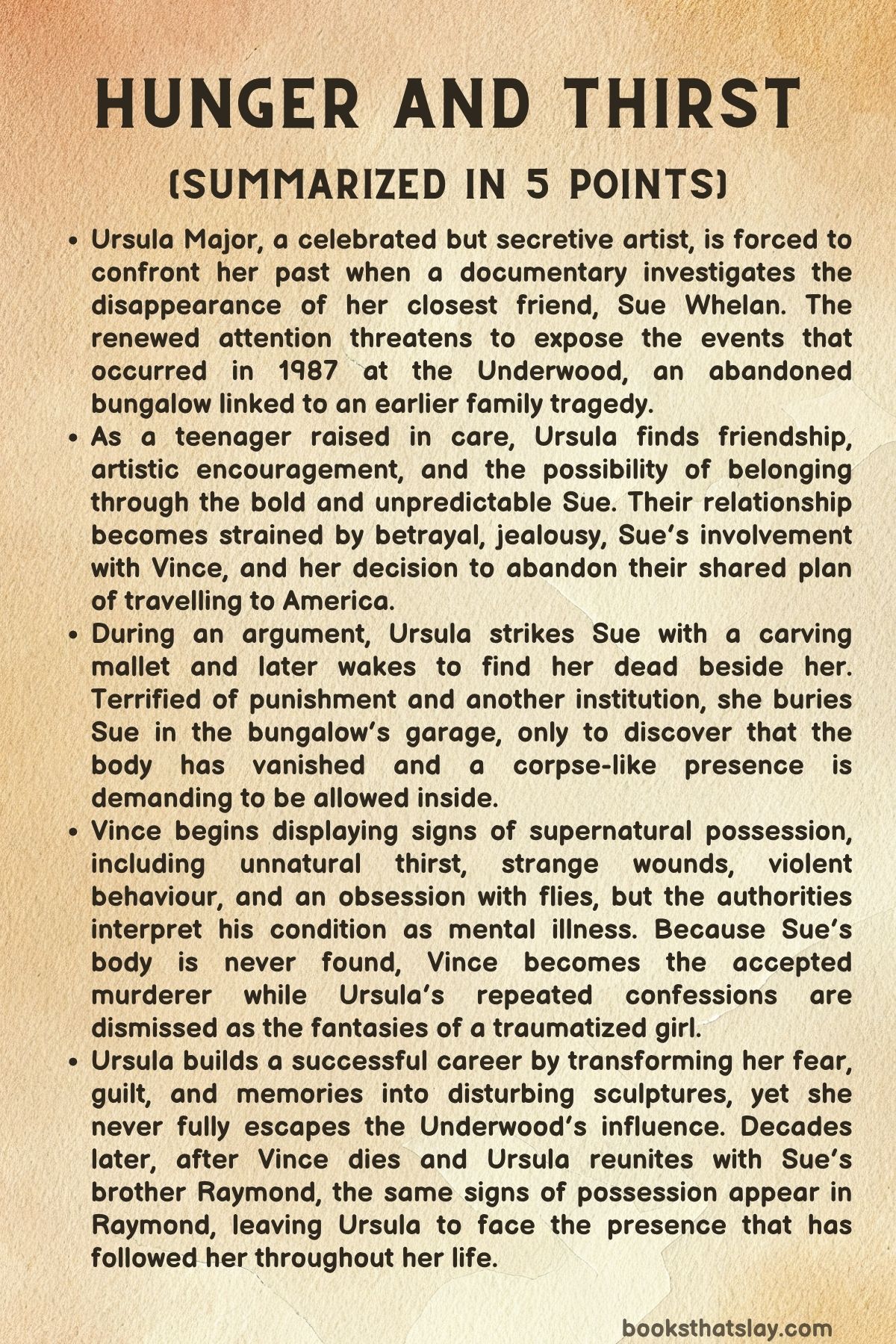
Its narrator, Ursula Major, is a celebrated but secretive artist whose past returns when a documentary examines the disappearance of her closest friend, Sue Whelan. Moving between 1987 and the present, the story follows Ursula from institutional care into an abandoned bungalow associated with a murder-suicide. Her friendship with Sue offers love and freedom, but jealousy, violence, and fear transform that relationship into a lifelong secret. The novel asks whether truth belongs to those who experienced events or those who tell the most convincing version afterward.
Summary
In the present day, internationally successful artist Ursula Major is disturbed by renewed public interest in a decades-old disappearance connected to an abandoned bungalow called the Underwood. Documentary filmmaker Emma Zahini is preparing a programme about the case and repeatedly attempts to interview Ursula, who refuses because she knows that the public version of events bears little resemblance to what she remembers.
In 1987, sixteen-year-old Ursula lives in a halfway house after spending much of her childhood in care. Her social worker, Joy, has found her a job in the post room of a local art school, where Ursula is treated as a useful but nearly invisible worker.
Ursula is fascinated by the Sculpture department and secretly studies the students’ work. When tutor Ms. Barker mistakes her for a student and asks for her opinion of a sculpture, Ursula says it is not hungry enough, revealing an artistic instinct that has never received formal encouragement.
Her workplace is dominated by men who make cruel jokes and expect her to serve them. Sue Whelan, a forceful young office worker with ambitions to make films and travel to America, challenges their behaviour and begins taking an interest in Ursula.
At a staff dinner, maintenance worker Vince mocks Ursula’s body, her unknown parents, and her childhood in care. Ursula frightens him by raising a stolen steak knife and bursting a balloon beside him, while Sue later tells her that men like Vince must be made to pay for their cruelty.
Sue visits Ursula at the halfway house, admires her drawings, and asks to be portrayed. Their connection grows through shared laughter, conversations about horror films, and Sue’s belief that women should resist being reduced to helpless victims.
Vince mentions that he plans to occupy the Underwood, an abandoned bungalow with no active landlord. Ursula, desperate to escape institutions and temporary placements, decides to move there despite Joy’s warning that Vince is angry, unstable, and heavily dependent on alcohol.
Before taking Ursula to the bungalow, Sue brings her to lunch with her family. Ursula is welcomed by Sue’s mother Anita, brother Raymond, Aunt Julie, grandparents, younger sisters, and other relatives, and she is overwhelmed by the noise, warmth, and abundance of the household.
Raymond lives with constant unexplained pain and occasional seizures, though his family often minimizes his suffering. He treats Ursula with kindness, encourages her interest in art, and becomes a source of emotional safety that gradually develops into romantic attraction.
The Underwood contains almost everything left by its former occupants, the Bloodworth family. Clothes, photographs, furniture, food, medicine, baby items, and personal objects remain in place, making the bungalow feel less like an empty property than a home whose inhabitants have vanished without warning.
The bathroom provokes intense fear in Ursula because it recalls a traumatic childhood experience. She remembers travelling through Morocco with her mother, Sadie, who became seriously ill while Ursula locked herself inside a bathroom and refused to open the door.
Sue treats the bungalow as an ideal horror-film location. She explores the rooms, invents stories about the former residents, dresses in their clothes, and swallows several of Mrs. Bloodworth’s old tablets as a dare, demanding that Ursula eventually perform an equally bold act.
The house also transforms Ursula’s art. Inspired by a sculpture student who draws with his entire body, she covers large sheets and walls with dark charcoal figures and begins carving a fallen horse-chestnut branch into an image of one body swallowing another.
These experiments become the foundation of Ursula’s later career as the artist Uschi. Her most famous work, The Lithopedion, is a huge wooden bear containing the figure of a curled stone woman, combining ideas of motherhood, burial, bodily imprisonment, hunger, and preserved death.
Vince eventually reveals that Mrs. Bloodworth was murdered in the garden and that her husband died after jumping from the roof. The full story later proves even more disturbing: Derek Bloodworth killed his wife Jennifer and then jumped while holding their baby, leaving the bungalow associated with the deaths of an entire family.
Sue encourages Ursula to steal tools from the art school and apply as a student, but she also manipulates Ursula’s hunger for approval. Her demand that Ursula complete an unspecified dare creates anxiety because Ursula cannot determine what sacrifice would prove her loyalty.
During a séance intended to contact Sadie, Raymond becomes rigid and speaks in an unfamiliar voice. He says he is thirsty, claims to know what Ursula has done and what she will do, and then collapses into an epileptic seizure.
Although Sue gives the event a medical explanation, Raymond later says that his constant pain disappeared while he felt another presence controlling his body. Ursula begins believing that the Underwood contains something capable of entering people through their deepest wounds.
Sue organizes a short horror film at the bungalow, with Raymond operating the camera, Vince and Sue portraying the Bloodworths, and Ursula providing the cries of a baby. The film reverses the known gender roles by depicting the wife as the possible killer and ends with Sue’s supposedly dead character secretly opening her eyes.
After filming, Vince insults Ursula and publicly reveals private facts about her upbringing and body. Ursula discovers that Sue has shared information she trusted her to protect, leaving her humiliated and uncertain whether their closeness was ever secure.
The next day, Ursula finds Sue and Vince having sex in the garden. Sue appears emotionally distant afterward and insists that the encounter meant nothing, but Ursula sees it as another betrayal and as proof that Sue can discard boundaries whenever she wishes.
Sue later tells Ursula that she intends to travel to America alone. Ursula had built her imagined future around accompanying her, so the announcement revives every previous abandonment and transforms fear into sudden violence.
Holding the mallet she uses for carving, Ursula strikes Sue on the temple. The injury initially appears minor, and Ursula cares for her while repeatedly apologizing.
Sue asks about Sadie, and Ursula finally reveals the truth about Morocco. Seven-year-old Ursula refused to open the bathroom door while her dying mother begged to enter, remained trapped when Sadie collapsed against it, survived for days with almost no water, swallowed a fly because of her hunger, and escaped by throwing carved soap through a high window.
Sue assures Ursula that Sadie’s death was not her fault. The two sleep curled together on the outdoor sofa, but when Ursula wakes the next morning, Sue is cold and dead beside her.
Terrified that adults will arrest her, punish her, and return her to an institution, Ursula does not call for help. She drags Sue’s body into the garage, places it in a hole prepared for the film, covers it with soil, and tries to continue ordinary activities while her mind struggles to comprehend what she has done.
During the following nights, Ursula hears tapping, smells decay, and sees a corpse-like figure resembling Sue outside the bungalow. The voice asks for water and demands to be admitted, while Ursula becomes convinced that opening the door would allow something dangerous to enter.
When Vince returns from Manchester after Sue fails to meet him, Ursula confesses that she killed her. He initially laughs, but she takes him to the garage and discovers that the grave is open and empty.
Vince believes Ursula is dehydrated, exhausted, and experiencing symptoms similar to those of his biological mother, who suffered episodes involving imagined voices and dangers. His explanation briefly gives Ursula a rational framework, but it cannot account for the vanished body.
That night, Vince also smells decay and hears the voice circling the house. When a corpse-like face appears behind the front-door glass, he forces the door open despite Ursula’s attempts to stop him.
The next morning, Ursula finds Vince in the bathroom covered with circular wounds. He says he is thirsty, claims Sue is inside him, retches until a fly emerges from his throat, and tells Ursula that she will be next.
Ursula runs away but returns to a telephone and calls the police. She admits striking and burying Sue, yet her references to ghosts, possession, and flies convince the authorities that she is mentally unwell rather than guilty of murder.
Neither Sue’s body nor Vince can initially be found. Sue’s family assumes she has run away, while Joy arranges medical care and temporary housing for Ursula.
Anita then invites Ursula into the family home, believing she has been traumatized by Sue’s disappearance. Ursula is tormented by receiving comfort from the mother and brother of the young woman she believes she killed.
Vince later appears at the art school nearly naked, severely injured, and behaving with violent force. He takes Ms. Barker hostage and shouts that Ursula will be next before police remove him and place him in a secure psychiatric institution.
With no body and considerable circumstantial evidence against Vince, the police and the Whelan family settle on him as Sue’s killer. Ursula’s repeated confessions are interpreted as the delusions of a frightened teenager protecting the man who manipulated her.
Ursula leaves the family home, survives for a time with John from the halfway house, and begins rebuilding her life through art. She studies, enters sculpture school, graduates with honours, and transforms the images of hunger, burial, bodily fear, and predation from the Underwood into internationally recognized work.
Years later, Ursula reconnects with Raymond, who has become a barrister and has finally been diagnosed with Ehlers-Danlos syndrome. Their friendship becomes a loving relationship, but they avoid discussing Sue because Raymond believes Vince murdered her while Ursula insists that she herself struck and buried Sue.
Their disagreement eventually destroys the relationship. Ursula leaves Raymond and spends twenty-three years creating art, attending therapy, travelling, and protecting herself from publicity and personal intimacy.
Vince is eventually released from psychiatric care and appears at Ursula’s apartment. He hums the same sad piano melody associated with the Underwood, says he is thirsty, claims Sue remains inside him, and deliberately swallows a fly.
He suddenly charges through a closed window. Ursula tries to hold him, but after briefly appearing to return to himself and apologizing, Vince releases his grip and falls to his death.
At Vince’s inquest, Ursula sees Raymond again. They reconnect without resolving their conflicting versions of Sue’s disappearance, and Raymond later proposes marriage.
Emma Zahini’s documentary presents Vince as a violent murderer who killed Sue and manipulated Ursula into accepting responsibility. It reveals private details about Ursula’s childhood, body, emergency call, and career, while turning incomplete testimony and speculation into a coherent public story.
Ursula is disturbed by the documentary’s certainty and by its treatment of Vince as guilty without a trial. She and Raymond visit his grave, where they discover the earth violently disturbed and a broken piece of coffin lying among the scattered soil.
Instead of going directly to the police, Raymond takes Ursula to Anita’s house. There, he moves without his walking stick, hums the Underwood melody, says he is thirsty, and deliberately drinks water containing a fly.
Ursula realizes that the presence she associated with Sue and Vince may now inhabit Raymond. She runs back to London, where the lift begins rising toward her apartment and footsteps approach her door.
After spending thirty-six years believing that punishment was waiting for her, Ursula decides not to escape. She places her hands against the door and waits for Raymond, Sue, the parasite, or whatever has followed her through the decades.
Characters
Ursula Major
At the center of Hunger and Thirst, Ursula Major is shaped by abandonment, institutional care, bodily shame, artistic hunger, and a desperate wish to be chosen. Her early life teaches her that safety is temporary, adults possess the power to remove her without warning, and affection can disappear the moment she becomes inconvenient.
Her attachment to Sue grows with unusual intensity because Sue offers recognition, friendship, rebellion, and an imagined future. When Sue withdraws that future, Ursula experiences the rejection not as a single disappointment but as the repetition of every earlier loss, which helps explain the sudden violence of the mallet strike without excusing it.
Ursula’s guilt is complicated by uncertainty about the precise cause of Sue’s death. She knows she struck Sue, concealed the body, and denied the family the truth, but the apparently minor wound, the missing corpse, and the supernatural events prevent her from constructing a stable account of her own responsibility.
Her hunger functions on physical, emotional, and creative levels. She eats excessively because hunger recalls childhood deprivation, seeks belonging because emotional security has always been scarce, and creates disturbing art because sculpture gives form to experiences that ordinary language cannot contain.
As Uschi, she turns trauma into artistic authority but does not achieve peace. Success allows her to control access to her life, yet her secrecy also preserves the fear that Vince, Sue, the public, or her own memories will eventually find her.
Ursula is both victim and offender, reliable witness and frightened interpreter. Her complexity comes from the fact that she neither fully rejects responsibility nor accepts the simplified guilt assigned to Vince by everyone around her.
Sue Whelan
Sue is charismatic, intelligent, rebellious, and determined to resist the limited future she sees in her mother’s life. She wants to make films, travel to America, reject marriage, and construct stories in which women act rather than merely suffer.
Her boldness gives Ursula confidence. Sue defends her against Vince, encourages her art, supplies tools, challenges her obedience, and introduces her to a family environment that briefly makes belonging seem possible.
At the same time, Sue can be careless with other people’s vulnerabilities. She shares Ursula’s secrets with Vince, treats dangerous actions as dares, turns real violence into entertainment, and assumes that apologies can repair damage that she has not fully tried to understand.
Her behaviour with Vince remains intentionally difficult to interpret. She says she does not want sex with him, later sleeps with him, and appears detached afterward, while Terry eventually claims that she described the encounter as forced.
Sue’s horror film reveals both her creativity and her fascination with blurred boundaries between performance and reality. By opening her eyes after her character’s death, she creates an image that later becomes inseparable from Ursula’s belief that the dead Sue returned.
Sue is not simply the idealized missing girl presented by her family or the reckless victim presented by the documentary. She is loving and cruel, liberating and controlling, perceptive about Ursula’s talent but careless with the emotional dependence she helps create.
Vince
Vince initially appears as a crude, insecure young man whose cruelty gives him temporary power over more vulnerable people. He mocks Ursula’s body and background, drinks heavily, humiliates others, and reacts aggressively whenever he feels rejected.
His history reveals a more damaged figure. He entered care at eight after living with a mentally ill biological mother, later caused or failed to prevent his adoptive sister’s fatal accident, and carries intense shame that he manages through alcohol, self-injury, and hostility.
Vince’s relationship with Sue is marked by resentment, desire, and unequal expectations. He believes sexual access and shared travel plans will confirm that she belongs with him, while Sue treats him as someone she can provoke, dismiss, or abandon.
The novel never completely resolves whether Vince’s later behaviour arises from mental illness, supernatural possession, or both. His wounds, thirst, consumption of flies, violent strength, and connection to the Underwood melody suggest an invading presence, yet his psychiatric history provides a rational explanation that authorities readily accept.
Vince becomes the convenient answer to Sue’s disappearance because his instability makes him easy to fear. The documentary converts suspicion into certainty, using his past actions to establish a pattern without proving that he killed Sue.
His final apology before falling from Ursula’s window suggests that some part of him has remained aware of what happened during his years of confinement. Whether he releases his grip to escape possession, punish himself, or end unbearable suffering remains uncertain.
Raymond Whelan
Raymond is one of the gentlest figures in Hunger and Thirst, yet his kindness exists alongside a determined refusal to accept Ursula’s version of Sue’s death. He offers food, encouragement, artistic validation, and physical tenderness, becoming the closest thing Ursula experiences to a secure home.
His chronic pain and seizures influence both his character and the supernatural mystery. Because his family dismisses his suffering, he understands what it means to inhabit a body that others refuse to believe.
The later diagnosis of Ehlers-Danlos syndrome confirms that Raymond’s complaints were real. This medical recognition contrasts with his refusal to grant similar credibility to Ursula’s account of the Underwood.
Raymond needs Vince to be guilty because that explanation protects his memories of Sue and allows him to love Ursula without seeing her as his sister’s killer. His certainty therefore functions less as objective judgment than as an emotional structure that makes continued life possible.
His relationship with Ursula is tender but dependent on silence. When she insists that they confront their incompatible beliefs, Raymond’s anger exposes the limits of his acceptance, and their love collapses under the weight of the truth they have avoided.
The final signs of possession transform Raymond from protector into possible threat. His vanished pain, humming, thirst, altered movement, and deliberate swallowing of a fly connect him to the voice that spoke through him during the séance decades earlier.
Sadie
Sadie is present mainly through Ursula’s memories, but she remains central to her daughter’s emotional life. She is loving, unconventional, resourceful, and unstable, moving through countries and temporary jobs while trying to survive with her child.
She calls Ursula Little Bear, encourages performance, and creates moments of freedom, yet her unpredictable life also exposes Ursula to danger, hunger, and insecurity. Ursula’s later artistic bear imagery grows from both affection for Sadie and the fear associated with their life together.
Sadie’s death becomes Ursula’s foundational trauma. As a frightened child, Ursula refuses to open the bathroom door, then spends days trapped beside her mother’s body with almost no food or water.
The discovery that Sadie died from dengue fever proves that Ursula did not cause the illness, but factual knowledge cannot erase emotional guilt. The additional revelation that Ursula was conceived through rape adds another layer to Sadie’s decision to keep and love her daughter.
Sadie represents a form of imperfect but deliberate maternal love. Ursula measures herself against that choice and believes that, unlike her mother, she destroyed the person she loved most.
Joy
Joy is Ursula’s social worker and one of the few adults who consistently attempts to protect her. She finds employment and accommodation, brings flowers to celebrate Ursula’s permanent job, retrieves possessions, arranges medical care, and responds whenever Ursula asks for help.
From Ursula’s perspective, however, Joy is also connected to the institutional system that has repeatedly controlled her life. Even compassionate advice can therefore sound like an order, especially when Joy warns her against moving into the Underwood.
Joy’s greatest limitation is that she interprets Ursula’s experience through established professional categories. When Ursula describes a murder, an empty grave, a possessed young man, and a returning corpse, Joy concludes that trauma or mental illness is producing the account.
This response is reasonable, but it leaves Ursula unable to communicate the parts of her experience that do not fit accepted explanations. Joy tries to save her without understanding what she believes she needs to be saved from.
Ursula’s later grief upon learning of Joy’s death shows that she eventually recognizes the depth of her care. Her regret that she never thanked Joy reflects a broader pattern in which love becomes fully visible only after the possibility of answering it has disappeared.
Anita Whelan
Anita is Sue and Raymond’s mother, a woman whose crowded household initially represents everything Ursula has been denied. She offers food, conversation, physical warmth, and temporary shelter without knowing the full truth about Ursula’s past.
Sue sees Anita as a warning about female limitation. She resents her mother for accepting interrupted ambitions, unreliable men, repeated pregnancies, and traditional expectations, while Anita believes Sue must take responsibility for her own decisions.
Anita’s hospitality is genuine but conditional in ways Ursula gradually recognizes. Her dismissive comments about adopted and unwanted children reveal prejudices that would likely alter her treatment of Ursula if she knew the truth.
After Sue disappears, Anita protects herself through the belief that her daughter has run away. Accepting Ursula’s confession would require her to see the vulnerable girl in her home as the person who killed Sue, while blaming Vince allows her to preserve a simpler division between victim and offender.
Her later emotional distance from Ursula suggests that years of uncertainty have not produced complete trust. Even when she receives Ursula after the documentary, politeness replaces the warmth of their earliest meetings.
Aunt Julie
Julie is introduced as a vivid member of Sue’s extended family and as a woman whose inability to have children has been reduced to the disturbing family story of a calcified pregnancy. This history places her within the novel’s repeated images of bodies preserving what cannot be born, released, or properly mourned.
She remembers Sue as capable of being “the very devil,” immediately challenging idealized portrayals of the missing young woman. Her description recognizes Sue’s mischief, aggression, and ability to unsettle others.
Julie is also more willing than Anita to confront the seriousness of Sue’s disappearance. While the rest of the family expects a postcard, Julie insists that continued absence must be treated as evidence that something is wrong.
Her presence prevents the family account from becoming entirely sentimental. She loves Sue but retains a memory of her difficult qualities, making her recollections more complicated than the documentary’s simplified image of an innocent victim.
Emma Zahini
Emma Zahini is the documentary filmmaker who revives public interest in Sue’s disappearance. Her persistence appears professional, but Ursula experiences it as invasion because Emma uses private names, locates her home, contacts people from her past, and treats unresolved suffering as compelling material.
Emma’s documentary creates clarity by removing uncertainty. It arranges rumours, interviews, police notes, personal records, Sue’s unfinished film, and Ursula’s emergency call into a narrative in which Vince is guilty and Ursula is manipulated.
The resulting story is persuasive because it connects genuine evidence, but its coherence depends on ignoring contradictions. Ursula’s confessions are reinterpreted, Vince’s mental illness becomes proof of violence, and Sue’s missing body becomes an absence that the documentary fills with speculation.
Emma represents the power of media to convert private trauma into public ownership. By exposing Ursula’s care history, body, professional identity, and connection to Vince’s death, she repeats the earlier violations that taught Ursula to distrust attention.
John
John is another resident of the halfway house and later gives Ursula a place to sleep when she abandons Sue’s family home. His support is practical rather than emotionally expressive: he buys food, shares his bed, provides drawing materials, and asks little in return.
His terrifying experience at the Underwood gives him independent knowledge that something unusual occurred there. However, he refuses to explain what he saw through the kitchen window, suggesting that fear has made silence his preferred means of survival.
John and Ursula later become physically intimate without creating a romantic partnership. Their relationship reflects loneliness, mutual need, and the temporary shelter two damaged people can offer one another.
His estrangement from his daughter Cherry suggests that he has his own history of loss and failure. Like Ursula, he imagines family while doubting his ability to sustain it.
Alan
Alan manages the estate and maintenance workplace where Ursula begins her adult life. He repeatedly calls the staff a family, but the environment he supervises depends on hierarchy, sexist jokes, enforced participation, and Ursula’s willingness to perform unwanted domestic tasks.
He praises Ursula for fitting in without disturbing the existing order. The compliment reveals that her value comes from obedience rather than talent, ambition, or individuality.
Alan is not openly monstrous, and he shows concern when Ursula later becomes distressed. His character instead represents ordinary institutional complacency, in which harmful behaviour continues because the person in authority values harmony more than justice.
Terry
Terry participates in Sue’s film and later becomes an important documentary witness. As a young man, he is frightened by the Underwood, especially after taking amphetamines that intensify his anxiety and sensitivity to the house.
His later testimony complicates the relationship between Sue and Vince. He claims Sue said Vince forced sex on her and that he advised her to reject Vince in a public place.
Terry’s account may be truthful, but it is filtered through decades of memory and the documentary’s need for motive. His belief that Vince killed Sue becomes one more piece of evidence that feels conclusive only when separated from Ursula’s hidden actions.
He also understands the audience’s attraction to crime programmes. People seek fear, sympathy, and relief while remaining protected from the lives being examined.
Ms. Barker
Ms. Barker is the first trained artist to recognize Ursula’s instinctive intelligence. By asking for her opinion and responding seriously to her criticism, she briefly allows Ursula to imagine herself as someone entitled to judge art rather than merely deliver post.
Years later, she encounters Ursula as a successful sculptor and becomes visibly distressed when Ursula repeats the phrase about work needing to be hungry. Her reaction suggests that the hostage incident with Vince contained information she has never disclosed.
Ms. Barker’s refusal to answer questions preserves one of the novel’s central uncertainties. She may fear Ursula, Vince, the supernatural presence, or her own role in failing to understand what happened.
Her professional success parallels Ursula’s, but the two women avoid sharing exhibitions. Their mutual distance shows how a brief encounter can remain psychologically active long after its visible consequences have ended.
Claudia
Claudia is Ursula’s longtime gallerist and one of the few people who accepts her need for privacy. She supports Ursula’s career without demanding personal access or transforming trauma into publicity.
Her warning about Emma Zahini shows that she understands the danger posed by the documentary. Claudia’s loyalty contrasts with Emma’s investigative entitlement, offering a model of professional partnership based on boundaries.
Although she occupies less narrative space than many other characters, Claudia helps make Ursula’s adult artistic life possible. She represents stability, practical trust, and recognition that does not require possession.
Philippe
Philippe is Raymond’s French friend and part of the social world Ursula enters during their relationship. His presence initially helps make their partnership feel ordinary, adult, and integrated into a wider community.
At his wedding weekend, Philippe speaks emotionally about secrets, marriage, and Sue. Ursula wrongly assumes that Raymond has exposed her private history, and this misunderstanding contributes to the argument that ends their relationship.
Philippe does not intend to cause the rupture. His remarks concern difficulties within his own relationship, but Ursula’s fear of exposure turns them into evidence of betrayal.
His role demonstrates how unspoken guilt distorts interpretation. Because Ursula and Raymond have built their happiness around silence, even an unrelated comment about secrets becomes dangerous.
Jennifer, Derek, and the Bloodworth Baby
The Bloodworth family never appears alive in the main action, yet their deaths shape the setting and symbolism of the story. Their abandoned clothes, medicines, photographs, food, furniture, and baby objects make the Underwood feel frozen at the moment of catastrophe.
Derek murdered Jennifer and then jumped while holding their baby. This sequence establishes a history of domestic violence, family destruction, and death connected to windows, falling, and failed protection.
Sue’s film rewrites the murders by allowing the wife to kill the husband. The reversal reflects Sue’s desire to transform women from victims into agents, but it also turns real suffering into material for performance.
The dead family’s possessions give Ursula access to an imagined home while reminding her that domestic belonging can conceal violence. The bungalow preserves the appearance of family life after the family itself has been destroyed.
Vince’s Adoptive Parents and Sister
Vince’s adoptive parents appear directly only much later, but their influence is present throughout his life. His adoptive father’s disappointment and the family’s refusal to forgive him contribute to his belief that he is permanently contaminated by past failure.
His adoptive sister died after Vince dared her to climb from a window. Whether he intended serious harm or acted with reckless childishness, the event becomes a secret around which his shame and his parents’ rejection develop.
The documentary uses the sister’s death as evidence that Vince possesses a repeated pattern of violence involving young women and windows. This interpretation strengthens the case against him while reducing the emotional and psychological complexity of what happened.
At the inquest, his elderly parents are left to face a public story in which their son is remembered entirely as a murderer. Ursula’s decision to place flowers on his grave grows partly from her recognition of the suffering imposed on them by that certainty.
Dr. and Mrs. Hulse
Dr. and Mrs. Hulse briefly foster Ursula after Sadie’s death, but her records later reveal that they were actually Sadie’s parents and therefore her own grandparents. They conceal the relationship and return her to care after only three months.
Their decision becomes another profound abandonment. Unlike strangers within the system, they possessed a direct family connection and still chose not to keep her.
The discovery alters Ursula’s understanding of her childhood. It proves that people who could have given her a stable home knowingly allowed her to grow up without one.
Their hidden identity reflects the novel’s concern with official records and incomplete narratives. Documents can reveal facts, but they cannot fully explain why people acted as they did or repair the life shaped by those choices.
Hannah, Jess, Andrew, Gran, and Gramps
Sue’s younger sisters Hannah and Jess, baby Andrew, and the grandparents help create the crowded family world that initially attracts Ursula. Their presence represents continuity, shared meals, noise, affection, and the ordinary domestic life she longs to enter.
Gramps assists Ursula by driving her belongings to the Underwood, while Gran later claims to have seen Sue with Vince. Her mistaken sighting briefly encourages the family’s hope that Sue remains alive.
Andrew becomes especially painful for Ursula because he will grow up without knowing his eldest sister. When Anita places him in her arms, Ursula experiences both inclusion and guilt.
Together, these family members show how disappearance affects more than the central investigators or suspects. Sue’s absence becomes embedded in ordinary meals, future memories, sibling relationships, and stories repeated across generations.
Themes
Hunger, Thirst, and Unmet Need
Hunger and thirst appear as bodily emergencies, emotional conditions, artistic impulses, and signs of supernatural invasion. Ursula’s unusual appetite cannot be separated from childhood deprivation, particularly the days she spent trapped beside Sadie’s body with almost no food or water.
Her emotional hunger is equally intense. She wants Sue’s loyalty, Anita’s family, Raymond’s love, artistic recognition, and a permanent place where no authority can suddenly send her away.
This need makes ordinary disappointments feel life-threatening. Sue’s decision to travel alone does not merely cancel a plan; it confirms Ursula’s fear that every person who offers love will eventually withdraw it.
Art becomes another form of appetite. Ursula rejects work that is not hungry enough and creates figures that consume, contain, split, swallow, and preserve one another.
The supernatural presence is also identified through thirst. The voice outside the bungalow, the altered Vince, and the transformed Raymond all ask for water, suggesting that the force survives through endless consumption without satisfaction.
In Hunger and Thirst, need is never fully answered by food, love, fame, or confession. Ursula can eat until she is physically full, become internationally admired, and reunite with Raymond, yet the deeper hunger created by abandonment remains active.
Guilt, Responsibility, and the Uncertainty of Truth
Ursula accepts that she struck Sue, buried her, and concealed the apparent death. What remains uncertain is whether the blow killed Sue, whether another force entered her, and what happened after the body disappeared from the grave.
This uncertainty prevents guilt from becoming a completed moral judgment. Ursula cannot declare herself innocent, but neither can she honestly accept the public conclusion that Vince alone committed the crime.
Her childhood experience with Sadie establishes the same pattern. She believes she caused her mother’s death by refusing to open the door, even though Sadie was already dying from dengue fever and Ursula was a terrified seven-year-old child.
Legal categories such as murder, manslaughter, intention, and diminished responsibility offer possible structures, but Ursula’s experience refuses to fit cleanly inside them. Her fear, immaturity, trauma, jealousy, and later concealment create different degrees of responsibility that cannot be reduced to a single label.
Other characters choose the truth they can emotionally survive. Raymond needs Vince to be guilty, Anita needs Sue to have been an innocent victim, and the documentary needs a coherent villain.
The novel therefore treats truth as both factual and psychological. Evidence matters, but people also organize facts according to grief, fear, shame, loyalty, and the stories that allow them to continue living.
Storytelling, Art, and the Ownership of Experience
Sue turns the Bloodworth murders into a horror film, Ursula turns trauma into sculpture, and Emma Zahini turns disappearance into documentary entertainment. Each woman reshapes suffering through an artistic form, but their purposes and ethical boundaries differ.
Sue uses filmmaking to reverse conventional roles and imagine a wife who kills rather than submits. Her work is creative and politically motivated, yet it also treats a real family’s deaths and her friends’ vulnerabilities as material for experimentation.
Ursula’s art emerges from experiences she cannot explain directly. Bears, swallowed bodies, stone women, human remains, wind, decay, and hidden mechanisms allow her to express guilt and fear without surrendering a literal account of Sue’s death.
Emma’s documentary claims authority through interviews, police records, recordings, photographs, and reconstruction. Because it resembles factual investigation, viewers may forget that selection, omission, music, editing, and narrative order shape its conclusions.
The documentary takes possession of Ursula’s childhood, body, voice, emergency call, professional identity, and relationship with Vince. Her refusal to participate does not preserve silence; it merely allows others to interpret that silence for her.
Art can reveal emotional truth, but it can also exploit, simplify, and condemn. The conflict lies not in whether painful experience should be represented, but in who controls the representation and who bears its consequences.
Abandonment, Belonging, and the Fear of Intimacy
Ursula’s life is structured by repeated experiences of being left. Sadie dies outside the bathroom, her grandparents return her to care, foster placements end, Sue plans to leave for America, and Raymond fails to follow her when she walks away from their relationship.
These losses teach her to desire belonging while distrusting it. She is drawn to Sue’s noisy family, Raymond’s gentleness, John’s bed, the Underwood’s abandoned rooms, and even permanent employment, but each form of security also feels like a trap.
The Underwood offers a distorted version of home. It contains furniture, clothing, family photographs, food, bedrooms, and traces of a baby, yet the family that owned those things has been destroyed by violence.
Ursula’s relationships repeat this contradiction. Sue gives her confidence but betrays her, Raymond makes her feel safe but refuses to believe her, and Anita welcomes her while expressing contempt for children with backgrounds like hers.
Even Ursula’s adult privacy is both protection and isolation. By changing apartments, avoiding neighbours, refusing interviews, and limiting access to her address, she prevents intrusion but also ensures that fear governs her daily life.
Her final decision to remain behind the door marks a significant change. Rather than flee before she can be abandoned or harmed, she chooses to face the approaching presence, accepting that safety gained through permanent escape is not the same as belonging.