In Every Possible Way Summary, Characters and Themes
In Every Possible Way by Alicia Thompson is a romantic fantasy about a woman who has spent years making her life smaller in order to protect herself from disappointment.
After a disastrous birthday date and a violent attack, Jess awakens in Ireland, where she meets Eamonn, the estranged younger brother of the man who insulted her. Their unexpected weekend together challenges everything Jess believes about age, desire, ambition, and second chances. Blending emotional romance with an unexplained crossing between realities, the novel follows two lonely people who must decide whether happiness is something they deserve and whether an impossible connection is worth pursuing in the real world.
Summary
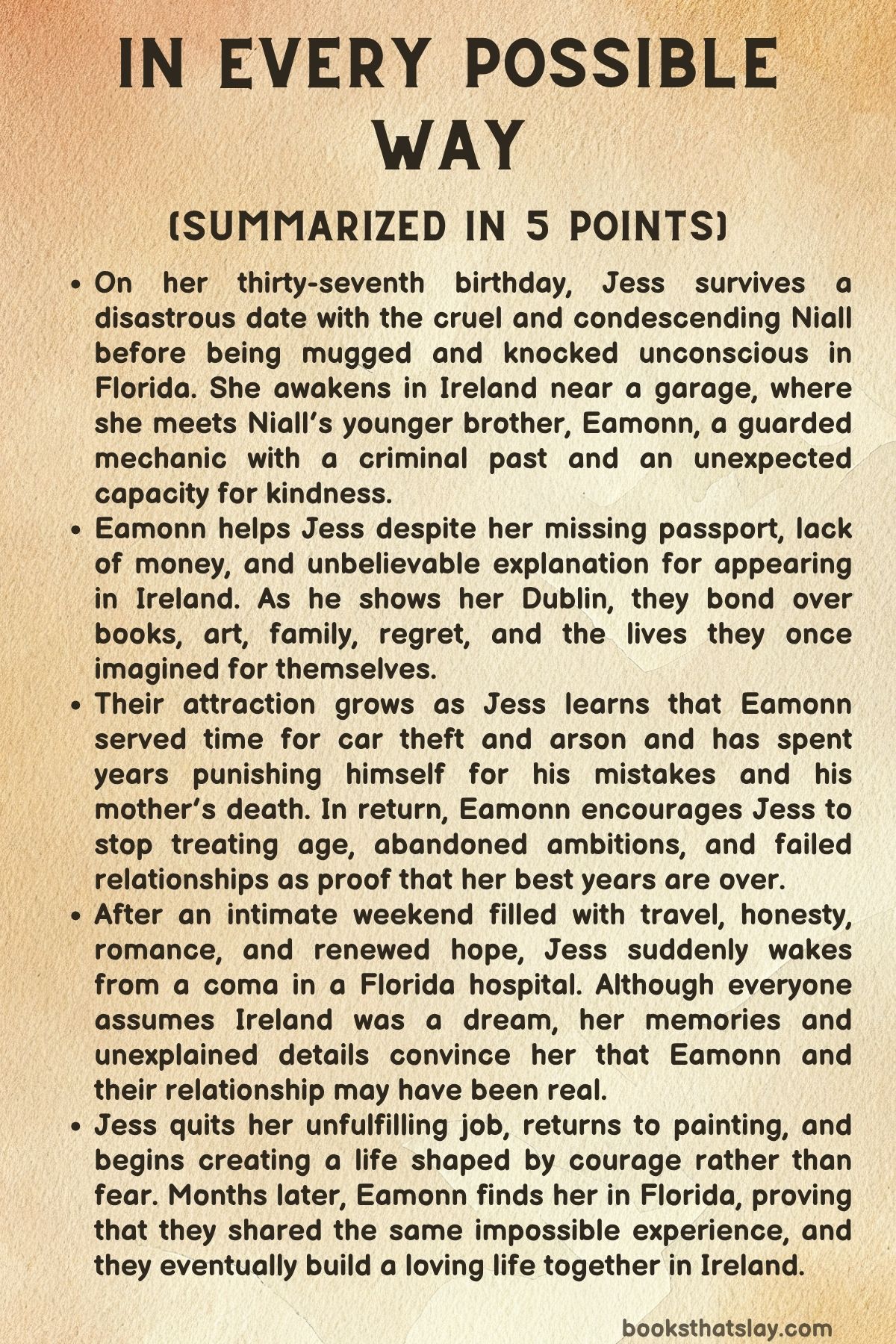
On her thirty-seventh birthday, Jess meets Niall at a Thai restaurant in Florida after connecting with him through a dating app. She arrives hoping that the evening might begin the lasting relationship she has always wanted, but Niall quickly reveals himself to be dismissive, controlling, and casually cruel.
He criticizes her dress, her lack of international travel, her sense of humor, and her appearance. When Jess speaks about wanting a large family, he reacts with hostility and tells her that his younger brother, Eamonn, would never be interested in someone like her.
Jess leaves the restaurant disappointed but not completely defeated. During a phone call with her best friend, Marisol, she admits that she wants a partner who is kind, supportive, enjoyable to talk to, sexually considerate, and capable of loving her without reservation.
Mari sends her money for an entire birthday cake and encourages her to make a wish. Jess catches flower petals blowing through the parking lot and wishes that dreams could come true, but moments later a stranger steals her purse, knocks her down, and leaves her unconscious.
Jess awakens in cold grass beneath a bright daytime sky. Her purse, car, and familiar surroundings are gone, and she soon discovers that she is near a mechanic’s garage in Ireland.
The mechanic is a guarded young man with bright blue eyes, grease-stained clothes, and an abrupt manner. He directs Jess toward a bus stop after she explains that she has no car, although neither of them understands how an apparently penniless American woman has appeared beside his closed garage.
At the bus stop, Jess learns that it is the day after her birthday. She cannot board the bus because she has no money, and her attempts to contact Florida using the mechanic’s phone produce only static.
The mechanic returns with his lunch and shares it with her. When he introduces himself as Eamonn, Jess realizes that he is Niall’s younger brother, making her sudden arrival even more difficult to explain.
Jess claims that she has been travelling and recently dated Niall in Florida. She also tells Eamonn that she was mugged and lost her passport, allowing her to remain close to the truth without revealing that she may have crossed the Atlantic while unconscious.
Eamonn offers to drive her to the American embassy in Dublin. During the journey, Jess learns that he is twenty-nine, eight years younger than she is, while Eamonn hears about her forgotten birthday at work and her disappointment over abandoning her artistic ambitions.
The embassy is closed for the weekend. When Jess breaks down outside its gates, Eamonn returns with a jacket, calms her with humor, and offers to help her find food and shelter.
Eamonn then admits that he has a criminal record and assumes Niall must have warned Jess about him. Jess assures him that she does not consider him dangerous and asks him to show her Dublin rather than abandoning her outside a closed government building.
Their day becomes an informal tour shaped by conversation rather than tourist attractions. At a pub, Eamonn tells Jess the Irish legend of Becfola, a mysterious woman who crosses an invisible boundary into another world and eventually returns.
The story disturbs Jess because it resembles her own experience. She begins wondering whether she has crossed through a temporary opening between realities and whether another doorway might eventually send her back.
As they explore Dublin, Eamonn buys Jess basic necessities and tells stories about his childhood. Jess explains that she studied art but now works as a receptionist at a law firm, where she feels overlooked and unfulfilled.
At St. Stephen’s Green, they catch a runaway dog together. Eamonn’s immediate tenderness toward the animal reveals a nurturing side that he usually hides beneath his guilt and isolation.
Their attraction becomes increasingly obvious. Eamonn tells Jess that she is extremely pretty, while Jess admits that spending the day with him is reviving feelings of hope she had attempted to suppress.
Inside St. Patrick’s Cathedral, they discuss faith, kindness, death, and unusual forms of love. Jess learns that Eamonn’s mother died while he was in prison, and Eamonn hears about Jess’s abortion at nineteen and a later six-year relationship that continued long after it had stopped making her happy.
Eamonn challenges Jess’s belief that she wasted the best years of her life. He argues that unhappy years cannot be her best ones, allowing her to imagine that her future has not already been reduced by age or past decisions.
At Dublin Castle, Eamonn describes his imprisonment. Books gave him mental privacy, education, and a way to help other prisoners, but he still believes that his past prevents him from deserving a better future.
Jess refuses to accept his belief that Niall is automatically the better brother. From her experience, Eamonn is generous, intelligent, accountable, and compassionate, while Niall uses supposedly good intentions to excuse cruelty.
At the Molly Malone statue, Jess persuades Eamonn to sing. He reluctantly performs for nearby tourists but soon becomes confident, playful, and charismatic, revealing the joyful personality that shame has forced him to hide.
They visit a café and a bookstore, where Eamonn’s love of literature becomes clearer. Jess secretly reads the complete Becfola legend and discovers that the woman eventually crosses back through the boundary between worlds.
Later, in a crowded pub, Eamonn begins offering Jess advice about becoming more attractive to Niall. Jess realizes that Eamonn has believed all day that she might still be dating his brother and that his kindness may have been partly motivated by the possibility of reconnecting with his estranged family.
Hurt and ashamed of her incomplete explanations, Jess leaves while Eamonn is away from the table. She wanders alone until she enters a nightclub, where three friendly women encourage her to dance and protect her from an aggressive stranger.
Eamonn finds her across the dance floor. Rather than accepting her claim that leaving was best for him, he asks her to dance and finally confirms that she is single.
Jess impulsively asks to see W. B. Yeats’s grave on the opposite side of Ireland. Eamonn agrees to drive through the night, transforming their time together into a chosen adventure rather than an emergency arrangement.
During the drive, Eamonn finally explains his crime. As a reckless teenager, he and his friends stole cars, used drugs, and eventually burned a stolen vehicle belonging to the garage where he worked.
His mother died during his first year in prison. Murphy, the employer harmed by his actions, nevertheless wrote a character reference and later helped Eamonn rebuild his career, eventually allowing him to purchase the garage.
Jess briefly hears Mari and medical workers speaking around her body in Florida. She realizes that she is lying unconscious in a hospital while simultaneously travelling through Ireland with Eamonn.
When she returns to awareness in Eamonn’s car, she panics and clings to him. Their physical closeness becomes sexual, although Eamonn repeatedly checks her consent and later worries that he took advantage of her fear.
At Yeats’s grave beneath Benbulbin, they discuss what happened and agree that neither regrets it. Eamonn describes the area as a thin place where boundaries between worlds may weaken, giving Jess another possible explanation for her divided existence.
Eamonn teaches Jess to drive his restored Renault and later takes her to his childhood home. The house now belongs to Michael and Frances, an elderly couple who warmly welcome him instead of judging him through his past.
Eamonn repairs their broken boiler and reconnects with memories of his family. Frances gives him a clock that once belonged to his household and tells him that his mother would be proud of the man he has become.
On the return journey, Eamonn stops beside the Irish Sea and persuades a painter to lend Jess some supplies. Jess paints a fairy for him, discovering that her artistic ability has survived years of neglect.
A storm follows them back to the garage, where their restrained attraction finally gives way to an urgent kiss and a passionate sexual encounter. Eamonn then brings Jess into the apartment above his workplace, allowing her into the private life he usually keeps closed.
By candlelight, they cook, read, talk, celebrate Jess’s birthday with stale biscuits, and share increasingly intimate moments. Eamonn admits that he was drawn to Jess from their first meeting and wanted to touch her when he removed flower petals from her hair.
Jess attempts to explain that she may be unconscious in Florida and could disappear when she wakes. Eamonn understands her words metaphorically, believing that she means their connection feels unreal because it exists outside ordinary life.
Jess tells him that she may already be halfway in love with him. She also challenges his belief that happiness, family, and even owning a dog are privileges he forfeited through his youthful crimes.
They fall asleep together while Eamonn promises breakfast, tea, the St. Patrick’s Day parade, and another full day. Jess wakes instead in a Florida hospital after a coma lasting more than forty-eight hours.
Mari believes Ireland was an unusually vivid dream shaped by hospital conversations, forgotten information, and Jess’s emotional needs. Jess cannot accept that explanation because the experience contained places, poems, songs, and personal details she does not remember encountering before.
After returning home, Jess feels more homesick for Eamonn’s apartment than comforted by her familiar surroundings. She searches unsuccessfully for him online, but the garage, family history, and criminal case appear to have no connection to the man she remembers.
The experience nevertheless changes her life. After being scalded by a careless attorney and criticized over contradictory office procedures, Jess quits the law firm and decides to make room for art, dancing, travel, friendship, pleasure, and hope.
At a watercolor workshop, she finds the exact Yeats poem Eamonn recited in bed. Convinced that this detail could not have been created by chance, she applies for a passport and considers travelling to Ireland, though fear eventually causes her to place it in a drawer.
Five months after the coma, Jess leaves another library art class and hears Eamonn’s voice behind her. He is waiting with flowers and remembers every moment they shared.
After Jess vanished from his bed, Eamonn searched for her, rebuilt relationships with his sisters, adopted a dog named Daffodil, and asked Niall to help him enter the United States. He has spent days visiting restaurants, calling law firms, and attending library workshops while trying to locate her.
Their failed searches resulted from changed circumstances and incorrect assumptions. Jess had left her job, while Eamonn’s business was registered under a different surname than the one she had used online.
Jess and Eamonn declare their love and agree that his three remaining days in Florida will become the beginning of their real relationship. They continue through calls, messages, visits, and photographs until Jess eventually moves to Ireland.
A year after their impossible meeting, they prepare to marry above the garage. Jess now works part-time at reception while creating art, and Eamonn has restored his relationships with his family.
Physical objects prove that their shared weekend was more than a dream. Eamonn still possesses Jess’s signed watercolor and the clock from his childhood home, while the tie removed from her dress vanished from Florida.
They never completely explain how Jess’s hospitalized body could coexist with her physical presence in Ireland. Instead, they accept the mystery and focus on the life they consciously build afterward.
Eamonn fashions Jess’s Claddagh wedding ring from metal taken from his Renault. Their happiness comes not merely from supernatural luck but from their willingness to act, risk disappointment, and believe that desire can lead toward a larger life.
Characters
Jess
Jess is the emotional center of In Every Possible Way, and her development begins with the painful recognition that she has confused safety with contentment. At thirty-seven, she has a stable job, an apartment, a close friendship, and basic independence, yet she feels as though she has gradually removed every uncertain possibility from her life.
Her strongest desire is not simply marriage but complete emotional recognition. She wants someone who notices her, listens to her, supports her interests, respects her body, and remains present during difficult moments.
Years of disappointment have trained Jess to apologize for her preferences and criticize herself before others can do it. She minimizes her love of romance novels, her artistic education, her physical attractiveness, and her longing for a family because she fears appearing foolish or demanding.
Niall’s behavior exposes how accustomed she has become to accepting disrespect. Although she eventually challenges him, she initially attempts to remain agreeable even while he criticizes nearly every part of her personality and appearance.
Her time with Eamonn allows her to experience attention without judgment. He remembers what she says, treats her pleasures as meaningful, encourages her art, and responds to her body with admiration rather than assessment.
Jess is also compassionate without being naïve. She does not excuse Eamonn’s crimes, but she distinguishes between responsibility and permanent self-condemnation, recognizing that remorse should create change rather than lifelong emotional imprisonment.
Her experience in Ireland becomes valuable even before she knows whether it was real. Returning to Florida, she quits a job that makes her feel invisible, resumes painting, dances again, considers travel, and stops treating her hopeful nature as a weakness.
Jess’s final courage lies in accepting uncertainty. She cannot prove that Eamonn exists, yet she begins building a fuller life without waiting for proof that love, creativity, or happiness will be permanent.
Eamonn
Eamonn is the romantic lead of In Every Possible Way, but his importance extends beyond his relationship with Jess. His life demonstrates how accountability can become destructive when a person refuses to believe that growth has earned him the right to rejoin the world.
As a teenager, Eamonn used drugs, fought, stole cars, and helped destroy a vehicle belonging to the garage where he worked. He does not minimize these actions, and his willingness to accept responsibility separates him from people such as Niall, who disguises harmful behavior as honesty or concern.
His imprisonment and his mother’s death created the central wound of his adult life. Because she died while he was incarcerated, Eamonn believes that his crime permanently removed his right to family, intimacy, and ordinary happiness.
He rebuilds his external life with remarkable discipline. He quits drugs and smoking, develops mechanical expertise, reads extensively, earns qualifications, purchases the garage, and creates an orderly home above it.
Despite these accomplishments, he remains emotionally isolated. He avoids serious relationships, keeps his sisters at a distance, refuses to adopt the dog he clearly wants, and treats pleasure as something suitable for other people.
Eamonn expresses love most naturally through practical care. He shares food, lends clothing, drives through the night, repairs a boiler, dries Jess’s feet, protects her painting from rain, cooks for her, and remembers the birthday celebration others neglected.
His intelligence frequently appears through literature, history, folklore, and observation rather than formal status. He may feel inferior to Niall’s professional success, but his curiosity and emotional understanding reveal a far richer form of intelligence.
Jess awakens the playful person beneath his restraint. Singing for tourists, joking in the garage, discussing books, and showing her his childhood home allow him to rediscover a version of himself that existed before prison defined his identity.
His journey toward Jess in Florida proves that he has finally rejected passivity. Rather than assuming that disappearance means rejection or punishment, he accepts fear and searches for the woman he loves.
Marisol
Marisol, usually called Mari, is Jess’s closest friend and most dependable connection to her Florida life. She offers the consistent emotional care that Jess does not receive from her parents, colleagues, or former romantic partners.
Mari listens to Jess’s dating frustrations without dismissing her desires. When Jess describes the kind of love she wants, Mari does not ridicule the ideal but encourages her to continue believing that her wishes matter.
Her decision to send Jess money for an entire birthday cake reflects her instinct to answer emotional neglect with generosity. The gesture is humorous, but it also demonstrates that Mari understands how deeply Jess wants to feel celebrated.
Mari’s professional connection to the hospital becomes crucial after the attack. Because Jess arrives without identification, Mari’s recognition ensures that she is not left medically anonymous and that someone remains beside her during the coma.
After Jess wakes, Mari provides a rational explanation for the Irish experience. She suggests that hospital sensations, forgotten cultural knowledge, and subconscious desires combined to create a vivid internal world.
Her skepticism never becomes cruelty. Although she doubts the literal existence of Eamonn, she accepts that the experience has emotional meaning and encourages Jess to use it as permission to want art, adventure, romance, and a larger future.
Mari also gives Jess room to decide what memories remain private. Their friendship is close enough for honesty but secure enough that Jess does not have to turn every intimate moment into a story for someone else’s entertainment.
Niall
Niall serves as a contrast to Eamonn and as a representation of socially acceptable cruelty. He appears professionally successful and outwardly respectable, but his behavior toward Jess reveals arrogance, insecurity, and a need to establish superiority.
During their date, he controls the meal, dismisses her interests, criticizes her appearance, and interprets disagreement as evidence of her emotional deficiency. His comments about her dress, age, travel experience, and body are designed to make her feel fortunate that he is speaking to her at all.
Niall repeatedly presents insults as useful advice. By claiming that he wants Jess to feel more confident or stop criticizing herself, he avoids acknowledging that his own words are humiliating and unkind.
His treatment of Eamonn is equally revealing. Calling his younger brother a waste allows Niall to simplify a complicated family history into a permanent moral ranking in which his own success proves his worth.
However, Niall is not entirely without loyalty. When Eamonn later needs help travelling to Florida, Niall assists with entry permission, transportation, and the search for Jess.
This assistance suggests that the brothers’ relationship contains buried affection alongside resentment. Niall remains deeply flawed, but his later actions create the possibility that he, too, can reconsider the family roles formed after their mother’s death.
Maura
Maura, Eamonn’s late mother, never appears alive in the main action, yet her presence shapes nearly every aspect of her son’s emotional life. She represents love, home, judgment, grief, and the possibility of forgiveness.
Eamonn remembers a childhood that was difficult but often happy under her care. Her household gave him a sense of belonging that disappeared after her death and the scattering of his siblings.
His crime devastated her, and her disappointment becomes more painful to him than the legal punishment itself. Because she died while he was imprisoned, he never had the chance to demonstrate the full extent of his reform.
The delayed arrival of her final letter intensifies his guilt. Her death becomes emotionally linked to his incarceration, causing him to treat future happiness as a betrayal of the mother whose final years he believes he damaged.
Other characters challenge this interpretation. Murphy’s support, Frances’s reassurance, and Jess’s faith in him all suggest that Maura would not want remorse to destroy the rest of her son’s life.
The clock from the family home becomes a symbol of Eamonn’s reclaimed connection to her. Placing it in his apartment allows his mother’s memory to become part of his present rather than only evidence against him.
Murphy
Murphy is Eamonn’s former employer, mentor, and one of the strongest examples of restorative compassion in the novel. Eamonn stole and helped burn a car connected to Murphy’s garage, giving Murphy every reason to reject him permanently.
Instead, Murphy writes a character reference and later helps Eamonn return to mechanical work. His support does not erase the harm Eamonn caused but recognizes that punishment and rehabilitation should not be treated as opposites.
Murphy’s actions demonstrate a belief that people must be allowed to prove they have changed. By helping Eamonn rebuild his career, he gives him the practical foundation for independence and dignity.
The garage eventually becomes Eamonn’s livelihood, home, and place of service to others. Murphy’s decision therefore influences far more than employment; it helps create the life into which Jess later enters.
Murphy also represents the forgiveness Eamonn struggles to offer himself. The person most directly harmed by the crime can recognize his reform, while Eamonn continues behaving as though no sentence could ever be complete.
Michael and Frances
Michael and Frances live in the house where Eamonn spent his childhood. Their welcome allows him to return to a place he associates with both happiness and devastating loss.
Michael recognizes Eamonn as one of Maura’s children rather than identifying him through his criminal past. This description restores his connection to family and community before shame can define the encounter.
Frances quickly treats Jess as Eamonn’s partner and welcomes her into the domestic space. Her questions may be presumptuous, but they also create a temporary vision of Jess and Eamonn as a normal couple with a shared future.
Their home has changed while remaining structurally familiar. This balance helps Eamonn understand that returning does not require the past to remain untouched.
When the boiler fails, Eamonn repairs it with confidence and enthusiasm. Michael and Frances allow him to contribute to the household, changing his role from the troubled boy who lost the home into the capable adult who can care for it.
Frances’s decision to return the family clock is especially important. Her statement that Maura would be proud offers Eamonn a form of maternal reassurance he can never receive directly.
Jess’s Parents
Jess’s parents are successful lawyers whose influence helps explain both her practical stability and her fear of risk. Their professional world values achievement, duty, and measurable security more than emotional openness.
Jess never wanted to follow them into law, partly because she saw how legal institutions could protect powerful clients at the expense of ordinary people. Nevertheless, she remains close to that world by working as a receptionist in a law firm.
Their response to her hospitalization reflects their limitations. They visit their injured daughter but return to a deposition, behaving in a way that is predictable enough to be almost comforting.
They are not presented as openly malicious or uncaring. Their failure lies in emotional absence and in the assumption that fulfilling practical obligations is equivalent to being fully present.
Jess’s decision to quit the law firm is therefore more than a career change. It is also a rejection of the life model she inherited from parents who taught her to value stability even when it required emotional self-denial.
Eamonn’s Siblings
Eamonn’s siblings represent the family life he believes he destroyed and lost. Kathleen, Siobhán, Claire, Niall, and the twins continue living separate lives while he watches from a distance.
His memories of them are filled with small domestic details, such as childhood toys, sleeping arrangements, teasing, and shared experiences. These details show that his distance is not caused by indifference but by unresolved shame.
After prison and their mother’s death, Eamonn assumes that his siblings are better without him. This belief allows him to interpret silence as evidence that he should remain absent rather than risk asking whether reconciliation is possible.
His search for Jess encourages broader emotional change. By the time he reaches Florida, he has begun rebuilding relationships with his sisters, proving that his movement toward romantic love also restores his willingness to accept familial love.
The siblings also complicate the contrast between Eamonn and Niall. Their family history cannot be reduced to one good brother and one bad brother because each responded differently to grief, poverty, instability, and separation.
The Elderly Woman at the Bus Stop
The elderly woman at the bus stop appears briefly but provides an important emotional and supernatural framework for Jess’s experience. She immediately notices Jess’s thin dress and warns her about the cold, offering concern before knowing anything about her.
Her story about feeling outside her body during her wedding introduces the possibility that intense emotion can disturb ordinary perception. She connects love with an experience that is disorienting, physical, and impossible to explain through simple logic.
Her statement that true love is never subtle prepares Jess for the force of her connection with Eamonn. At that point, Jess is still trying to stop wanting romance, making the woman’s certainty seem almost like a challenge from the strange world around her.
The woman also confirms the date and location, forcing Jess to accept that the environment follows a coherent reality. Her ordinary presence makes the extraordinary situation more convincing.
Daffodil
Daffodil, the dog Eamonn adopts after Jess disappears, represents his decision to accept responsibility without treating attachment as a danger. Earlier, he clearly wants a dog but insists that his life cannot accommodate one.
His knowledge of flea treatments, staircases, and animal care reveals that he has already considered adoption carefully. His refusal is therefore emotional rather than practical.
By adopting Daffodil, Eamonn permits himself to become responsible for a living creature that depends on him. The choice proves that he no longer believes his past makes him inherently unsafe or undeserving of trust.
The dog also connects his practical tenderness with his emotional recovery. His natural affection for animals was visible from the moment he caught the runaway dog in Dublin, but Daffodil transforms that temporary instinct into a permanent relationship.
Jess’s Former Partners
Jess’s former partners are not fully developed individual characters, but their behavior establishes the emotional history she carries into the story. The boyfriend connected to her abortion claims to support her choice but refuses to drive her to the appointment, leaving her alone during a vulnerable experience.
His behavior illustrates the difference between verbal support and meaningful action. This distinction later helps Jess recognize the value of Eamonn’s practical care.
Her six-year relationship represents another kind of abandonment. Neither person leaves when affection disappears, allowing familiarity and fear to consume years Jess later believes should have been used to build a family.
These relationships teach Jess to expect partial commitment and emotional passivity. Her attraction to Eamonn becomes transformative because he listens, acts, remembers, and accepts discomfort rather than disappearing when she needs him.
Themes
The Courage to Want More
In Every Possible Way treats desire as an act of courage rather than a sign of dissatisfaction or immaturity. Jess begins the novel embarrassed by the size of her hopes, particularly her wish for lasting love, creative fulfilment, travel, sexual pleasure, and a family.
Repeated disappointment has convinced her that wanting less will protect her. She accepts an unfulfilling job, abandons painting, stops dancing, avoids travel, and nearly decides that emotional survival is the most realistic future available to her.
Her impossible journey challenges that defensive strategy. Eamonn does not merely offer romance; he asks why she stopped doing the things that once made her feel alive.
Jess gradually understands that avoiding disappointment has not removed pain. It has only created a quieter form of unhappiness in which she feels invisible, stagnant, and separated from her own personality.
The transformation continues after she wakes in Florida. Rather than treating Ireland as valuable only if Eamonn was real, she uses the experience to quit her job, return to art, take day trips, change her appearance, dance, and apply for a passport.
Eamonn must develop the same courage from a different position. His fear is not that desire will make him foolish but that it will expose him as someone who wants more than he deserves.
Their reunion becomes possible because both stop waiting for certainty. Jess prepares herself to seek Ireland, while Eamonn crosses the Atlantic with no guarantee that he will find her.
Redemption and Self-Forgiveness
Eamonn’s life raises the question of whether accepting responsibility must include permanent self-punishment. He acknowledges that his teenage actions caused financial damage, emotional pain, and the destruction of trust.
Prison, education, sobriety, work, and service demonstrate genuine reform, yet Eamonn continues treating himself as morally fixed in the worst period of his life. He sees his garage as more than he deserves and regards family, romance, education, and even pet ownership as privileges meant for better people.
His guilt is intensified by his mother’s death. Because she died while he was incarcerated, his grief becomes evidence in an internal trial that never ends.
Jess refuses to confuse remorse with worthlessness. She recognizes that Eamonn’s present actions reveal his character more accurately than crimes he committed as a reckless teenager.
Murphy’s support provides a practical model of forgiveness. As the person harmed by the theft, Murphy can demand accountability while still helping Eamonn build a lawful and useful future.
Michael and Frances offer another form of restoration by welcoming him into his childhood home. Their acceptance shows that returning to a community does not require pretending the past never occurred.
Eamonn’s final growth appears through action. Searching for Jess, reconnecting with his sisters, adopting Daffodil, and planning a shared future prove that he has begun viewing happiness as part of rehabilitation rather than an insult to those he hurt.
Being Seen and Valued
Jess’s loneliness is closely connected to invisibility. Her coworkers rely on her labor without remembering her birthday, her parents fulfil obligations without sustained emotional presence, and former partners offer words without dependable support.
Niall’s attention is equally damaging because he sees Jess only through judgment. He studies her dress, age, body, travel history, and insecurities as flaws to correct rather than parts of a complete person.
Eamonn’s attention feels different because it is rooted in curiosity and memory. He listens when Jess discusses art, romance novels, birthdays, flowers, dancing, food, fear, and family.
His gestures show that he has retained what she shares. The jacket, birthday candle, painting supplies, books, tea, flowers, and long drive are meaningful because each responds to a specific desire or discomfort.
Jess offers Eamonn the same recognition. She sees intelligence beneath his lack of formal confidence, tenderness beneath his guarded manner, and moral growth beneath his criminal record.
Their sexual relationship also reflects mutual attention. Desire is not presented as separate from emotional recognition; physical intimacy becomes another way they listen, respond, and allow themselves to be fully visible.
The novel extends this idea beyond romance. Mari sees Jess’s hopeful nature, Murphy sees Eamonn’s potential, and Frances sees the adult Maura might have been proud to know.
Love therefore becomes less about rescuing another person than about recognizing qualities that shame, routine, and social judgment have hidden from view.
Ordinary Life and Extraordinary Possibility
The supernatural event brings Jess and Eamonn together, but the relationship becomes convincing through ordinary experiences. They share sandwiches, browse shops, drink tea, discuss books, repair household equipment, listen to music, cook pasta, and argue over stale biscuits.
These modest activities allow Jess to reconsider her belief that a meaningful life must feel constantly dramatic. College once seemed large because it contained possibilities, while adulthood feels small because she interprets routine as evidence that nothing will change.
Eamonn values ordinary pleasures because prison deprived him of privacy and choice. Books, apples, weather, a reliable car, a warm apartment, and mechanical work have significance precisely because they fill daily life.
Their perspectives gradually meet. Jess teaches Eamonn that he is allowed to imagine a larger future, while Eamonn teaches Jess that greatness can exist within repeated domestic acts.
The epilogue resolves this theme by combining wonder with routine. Jess and Eamonn never explain the doorway between Florida and Ireland, but their marriage is built through immigration paperwork, long-distance calls, work schedules, family visits, dog care, shared meals, and creative habits.
The magical crossing offers possibility, not a complete solution. The lasting relationship exists because both characters turn one extraordinary weekend into thousands of ordinary decisions.
Their perfect day is therefore not perfect because hardship disappears. It is perfect because they consciously choose a life in which mystery, responsibility, desire, and daily care can exist together.