The Irresistible Urge to Fall for Your Enemy Summary, Characters and Themes
The Irresistible Urge to Fall for Your Enemy by Brigitte Knightley is a fantasy romance centred on two gifted people who have been trained to regard each other as morally unacceptable.
Aurienne Fairhrim is a respected healer devoted to preserving life, while Osric Mordaunt is an assassin whose magical system is slowly destroying itself. Their secret arrangement begins as a financial exchange, with Osric funding vital vaccine research in return for experimental treatment. What follows combines medical mystery, dangerous politics, sharp humour, supernatural folklore, and an attraction neither character wants to acknowledge. Their conflict gradually becomes a study of trust, moral compromise, institutional corruption, and love between enemies. It’s the first book in the Dearly Beloathed series.
Summary
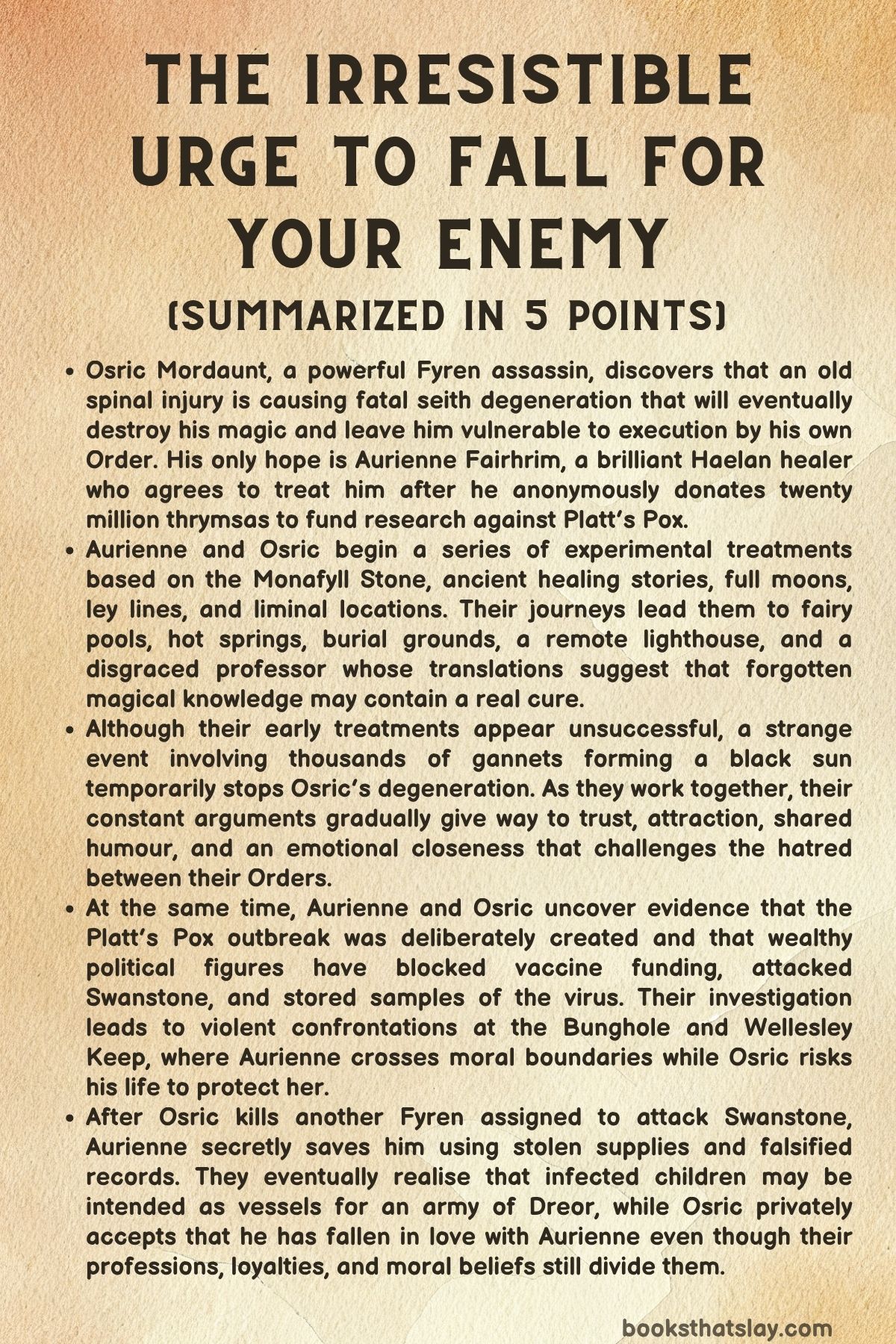
Osric Mordaunt is a wealthy assassin belonging to the Fyren Order, an organisation that values strength, secrecy, and lethal skill. When an old spinal injury causes seith degeneration, he learns that his magical channels will continue to decay until he loses his abilities, his independence, and probably his life.
Weakness is dangerous among the Fyren, so Osric cannot openly seek treatment. His physickers identify Aurienne Fairhrim, the Haelan Order’s foremost specialist in the seith system, as the only person capable of giving him even a small chance of survival.
Aurienne belongs to an Order devoted to healing and considers the Fyren professionally and morally repulsive. Osric therefore needs leverage, and he discovers that the Haelan desperately require twenty million thrymsas to develop an inoculation against Platt’s Pox, a disease spreading rapidly among children.
He secretly enters Swanstone, the Haelan stronghold, and confronts Aurienne in her office. Their first meeting is defined by insults, threats, failed charm, and an accidental misunderstanding involving onions, but Xanthe, Aurienne’s superior, recognises the value of Osric’s offer and orders her to treat him after his donation is confirmed.
Osric sells valuable artworks from his neglected ancestral home, Rosefell Hall, and transfers the money anonymously. Aurienne examines him and discovers that his cervical spine was pulverised during training and repaired so badly that the surrounding seith channels are now collapsing.
Conventional treatment cannot save him. Osric insists that she revive an abandoned research project concerning the Monafyll Stone, an ancient object associated with full moons, mysterious symbols, liminal places, and legends of miraculous healing.
Aurienne considers the idea scientifically unsound, but Xanthe orders her to make a sincere attempt. Their early treatments take them to rural pools, hot springs, burial grounds, shorelines, and other locations linked to old accounts, yet every attempt appears to fail.
Their travels intensify their hostility. Aurienne condemns Osric’s habit of using money and violence to control events, while he accuses her of intellectual pride and of dismissing anything that does not fit accepted academic standards.
A meeting with a strange child on the South Downs introduces them to the hidden world of the Dim Path. Aurienne recognises the child as a Hedgewitch, while Osric responds to the unsettling encounter by considering murder, revealing the sharp difference between their instincts.
The pair eventually seek Professor Widdershins, a disgraced scholar who once claimed that the Monafyll Stone contained writing in a fairy language. Although eccentric and deeply wounded by his academic exile, he gives them access to a damaged cast of the Stone and his surviving translations.
The translations connect different moons with obscure instructions involving exile, light, dreams, crossing waters, hidden dwellings, leaves, shadows, and a blackened sun at land’s end. Aurienne remains suspicious of the evidence, but the new information gives their experiments greater direction.
Their arguments become increasingly personal and physically charged. During one confrontation, anger and desperation bring them close to kissing, forcing Aurienne to recognise that Osric is no longer merely a patient she despises.
Meanwhile, the Platt’s Pox crisis worsens. Swanstone fills with infected children, the Haelan exhaust themselves through constant magical treatment, and Aurienne struggles to maintain emotional distance from patients whose lives and minds are being destroyed.
Osric’s donation allows Élodie’s vaccine research to continue, but evidence emerges that other sources of funding have been deliberately blocked. Armed intruders then attempt to enter Swanstone with incendiary devices, suggesting that someone powerful wants to sabotage the Haelan’s work.
Aurienne asks Osric to investigate the attack. When his own seith nearly stops flowing to his magical tācn, she travels secretly to Rosefell Hall, where she sees the fear and isolation hidden beneath his arrogance.
Rosefell is a decaying mansion occupied by Osric, elderly rescued dogs, Mrs. Parson, and a mysterious critique cricket that followed him from the South Downs. Aurienne removes a seith embolus blocking his power, restoring his ability to work while leaving her troubled that she has helped a professional killer.
Their next treatment takes place at a remote lighthouse at Muckle Flugga. The location meets several conditions from the old accounts, but it is occupied by bandits whom Osric drives away or incapacitates.
At sunset, a vast colony of gannets rises around the lighthouse and forms a living black sun. The birds, the lighthouse beam, the crossing ley lines, and the boundary between land and sea create a strange moment in which ordinary reality seems temporarily weakened.
Aurienne embraces Osric and sends a powerful surge of seith through his damaged channels. No immediate improvement appears, and the effort tears open painful wounds across her hands, but the experience affects them both more deeply than any previous attempt.
Aurienne falls asleep against Osric while recovering, creating a moment of unguarded closeness. Their connection is interrupted when approximately forty bandits surround the waystone, and Osric kills every one of them after they threaten to abduct Aurienne.
Horrified by the massacre, Aurienne again confronts the reality of his profession. She later discovers that the reported healing sites often stand near intersections of ley lines, although the pattern remains too inconsistent to prove anything.
Osric also identifies a criminal named Scrope who may know who financed the Swanstone attack. Aurienne refuses to let him use torture and follows him to a dangerous London pub called the Bunghole while disguised as a sex worker.
With help from women she previously treated, Aurienne persuades Scrope to reveal the name Bardolph Wellesley. Osric becomes openly jealous as Scrope touches and threatens her, then kills the man with a dinner fork after he follows Aurienne outside.
At Rosefell Hall, Aurienne sends the information to Xanthe. Xanthe orders Osric to infiltrate Wellesley Keep, offering Aurienne’s continued medical assistance as compensation, and he reluctantly accepts.
Before the infiltration, Aurienne discovers that Osric’s degeneration has temporarily stopped. The result is medically impossible and appears connected to the lighthouse treatment, giving them their first genuine evidence that the old method may work.
Xanthe arranges for Aurienne to enter Wellesley Keep as a healer summoned to examine Wellesley’s daughter, with Osric disguised as her guard. Inside the brightly illuminated fortress, Osric searches for evidence while Aurienne meets Wellesley.
Wellesley shows little concern for his daughter and instead demands the identity of the anonymous donor who financed the Haelan vaccine research. His desperation confirms that Osric’s donation disrupted a larger plan.
When Wellesley prevents Aurienne from leaving, Osric reveals himself and kills several guards by moving through their internal shadows. Wellesley takes Aurienne hostage, but she uses seith to close his carotid artery, causing him to fall and suffer a fatal head injury.
Osric steals two bottles from a guarded cellar, and Aurienne later identifies them as laboratory containers used to preserve viruses. Testing confirms that they contain Platt’s Pox, proving that the outbreak was deliberately created.
At the Fyren headquarters, Osric learns that Brythe, the assassin responsible for his original spinal injury, has accepted a lucrative mission against another Order. Believing Swanstone and Aurienne to be the targets, Osric attacks Brythe and kills him after failing to obtain the client’s identity.
Because seith degeneration has reduced his ability to feel pain, Osric does not notice that Brythe’s blade remains embedded in his body. He reaches Aurienne during her parents’ anniversary celebration while pretending to be her romantic companion, then nearly dies before she can treat him privately.
Aurienne uses stolen medical supplies and falsified records to keep Osric alive. She recognises that her association with him has turned her into a liar, thief, forger, and participant in violence, yet she cannot regret saving him.
While recovering, Osric spends time among Aurienne’s family and sees her dance with Aedan, a wealthy and respectable former suitor. His jealousy forces him to admit that his feelings for Aurienne have moved far beyond gratitude or physical attraction.
Osric tells Aurienne that he was born outside marriage, raised in poverty, and rejected by his wealthy father. After his father fatally injured his mother, fourteen-year-old Osric killed him and forged documents to inherit Rosefell Hall.
Aurienne understands the pain behind his history without treating it as an excuse for his later actions. She also reveals that Aedan was too perfect for her to love and that a previous relationship ended disastrously.
During a rain-soaked dance on a balcony, Osric and Aurienne agree to kiss so that Aedan and the watching guests will believe their false romance. The performance immediately becomes genuine, exposing tenderness, desire, and vulnerability that neither can easily deny.
Soon afterward, Tristane questions Osric about Brythe’s disappearance and reveals that a wealthy client has been blocking all funding for the Platt’s Pox vaccine. The same client became furious when the anonymous donation allowed the research to continue and now expects Tristane to complete the attack on the Haelan.
Osric reaches Aurienne’s warded tower and warns her. Together they realise that the epidemic, the sabotage of vaccine funding, the attack on Swanstone, the virus stored at Wellesley Keep, and the contract against the Haelan are parts of one coordinated scheme.
Aurienne explains that severe Platt’s Pox leaves some children physically alive but mentally absent. This leads them to fear that the infected children are being prepared as empty vessels for an army of Dreor.
Aurienne agrees to enter the dangerous Færwundor for the next treatment and tells Osric that she trusts him. As they speak through the warded window until dawn, Osric finally admits to himself that he has fallen in love with the healer who was supposed to remain his enemy.
Characters
The characters in The Irresistible Urge to Fall for Your Enemy are shaped by professional loyalties, magical responsibilities, private wounds, and the constant pressure to decide whether inherited moral rules deserve obedience. Even the comic and supporting figures contribute to the contrast between public identity and hidden motivation.
Osric Mordaunt
Osric is a feared Fyren assassin whose confidence, wealth, and lethal competence conceal intense fear of helplessness. Seith degeneration threatens far more than his career because the loss of magic would leave him unable to use waystones, defend himself, or maintain the identity through which he has survived since childhood.
His first instinct is to control circumstances through threats, money, theft, or murder. He treats violence as a practical instrument because the Fyren Order has trained him to regard hesitation as weakness and death as an acceptable solution to inconvenience.
Osric nevertheless displays qualities that challenge Aurienne’s judgment of him. He funds life-saving vaccine research, rescues elderly dogs, protects Aurienne from threats, risks punishment from his own Order, and nearly dies attempting to prevent an attack on Swanstone.
His past explains his obsession with power without excusing his actions. Poverty, illegitimacy, paternal rejection, and his mother’s death taught him that social respectability often protects cruelty, while decisive violence allowed him to escape victimhood.
His humour becomes an important form of intimacy. Ridiculous disguises, crude jokes, invented names, and constant arguments allow him to approach Aurienne emotionally without openly admitting vulnerability.
By the later events of The Irresistible Urge to Fall for Your Enemy, Osric’s central conflict is no longer simply whether he will survive. He must decide whether love can exist alongside the profession that defines him and whether protecting Aurienne requires him to become someone different from the man she first met.
Aurienne Fairhrim
Aurienne is an accomplished Haelan healer, researcher, and administrator whose life is organised around evidence, discipline, and the preservation of life. Her authority at the Centre for Seith Research reflects exceptional intelligence, but it also places enormous responsibility on her during the Platt’s Pox emergency.
Her hostility toward Osric is rooted in genuine moral conviction rather than personal prejudice alone. The Haelan heal victims, while the Fyren create victims, so treating an assassin initially feels like a betrayal of everything her tācn represents.
Aurienne’s scientific caution is one of her greatest strengths. She refuses to label folklore as evidence merely because Osric desperately wants hope, and she repeatedly subjects every supposed improvement to measurement rather than emotion.
That same caution can become rigidity. Her fear of professional humiliation, especially after meeting Widdershins, reveals that institutional approval influences her thinking even when she presents herself as entirely objective.
Her relationship with Osric exposes contradictions within her moral identity. She heals him, lies for him, steals supplies, alters records, causes Wellesley’s death, and helps conceal violent events, yet these choices arise from loyalty, necessity, and compassion rather than selfish ambition.
Aurienne’s attraction to Osric is frightening because it cannot be separated from ethical uncertainty. Loving him would mean accepting that a person can perform terrible acts while also being generous, wounded, funny, protective, and capable of change.
Xanthe
Xanthe is a commanding Haelan leader whose abrasive language and impatience hide fierce devotion to her Order. She understands that moral purity cannot inoculate children, which is why she forces Aurienne to accept Osric’s money and provide him with a genuine attempt at treatment.
Her leadership is practical rather than sentimental. She is prepared to bargain with an assassin, manipulate access to Aurienne’s medical skills, and use deception when those actions protect Swanstone or advance vaccine development.
Xanthe’s anger at the monarchs and wealthy institutions that refuse funding reveals her awareness of systemic injustice. Her temptation to send contaminated letters shows that even a healer can be pushed toward cruelty when political indifference allows children to suffer.
She also acts as a pressure against Aurienne’s intellectual pride. By ordering Aurienne to take the Monafyll experiment seriously, Xanthe insists that professional responsibility includes giving an impossible patient an honest chance.
Élodie
Élodie represents the patient, collaborative side of medical progress. Her vaccine research depends on funding, institutional support, repeated testing, and the willingness to continue working during a crisis that threatens to overwhelm everyone involved.
Her discovery of a viable inoculation candidate gives the Haelan their strongest source of hope. It also confirms the importance of Osric’s donation, because without the money obtained from an assassin, research devoted to saving innocent children might have stopped.
Élodie’s reports about blocked funding help expose the organised nature of the larger conspiracy. She demonstrates that scientific work is never isolated from politics, wealth, and the priorities of those who control resources.
Cath
Cath is a trusted Haelan colleague who provides Aurienne with medical advice and emotional perspective. Although she does not initially know Osric’s identity, she recognises that Aurienne’s secrecy resembles an earlier period when hidden affection placed her at professional and personal risk.
Her reference to Amagris suggests that Aurienne has previously crossed boundaries between accepted society and forbidden magical communities. Cath therefore serves as someone capable of recognising denial before Aurienne is ready to name it herself.
Cath’s willingness to help without demanding every detail shows loyalty, but her warning also establishes limits. She supports Aurienne without pretending that secrecy, obsession, and emotional dependence are harmless.
Warchief Tristane
Tristane embodies the authority and danger of the Fyren Order. She is observant enough to notice Osric’s unexplained absences and powerful enough that he must hide both his illness and his alliance with Aurienne.
Her decision to complete Brythe’s mission demonstrates loyalty to the Fyren contract system rather than concern for the target’s innocence. Once a wealthy client has purchased violence, Tristane treats the assignment as an obligation to be fulfilled.
She is also a direct threat to Osric’s emerging independence. Protecting Aurienne requires him to deceive his Warchief, interfere with Fyren work, and risk being identified as disloyal.
Tristane’s importance lies partly in what she represents: the institutional force that can punish Osric for becoming compassionate. His romance with Aurienne is therefore not only socially forbidden but potentially fatal.
Brythe
Brythe is the powerful Fyren whose maul shattered Osric’s spine during training. Osric initially accepts the injury as an unfortunate consequence of their profession, showing how completely Fyren culture has normalised extreme violence among its own members.
Aurienne’s anger makes him reconsider that acceptance. Her reaction gives Osric permission to view the event not merely as training damage but as an act that permanently altered his body and placed his life at risk.
Brythe’s later contract against another Order connects Osric’s private suffering with the wider conspiracy. Their final battle becomes an act of prevention, revenge, and rebellion against the rules Osric once obeyed.
His refusal to identify the client preserves the mystery, but his death also exposes Osric’s limitations. Even when driven by love and fear, Osric still relies on torture and murder because those remain the methods he understands best.
Professor Widdershins
Professor Widdershins is an eccentric scholar destroyed by academic ridicule after proposing that the Monafyll Stone contained a fairy language. His colander, nocturnal tadpole hunting, and rambling speech make him comic, but his damaged reputation gives him a serious emotional role.
He represents the danger of pursuing ideas that established authorities consider absurd. Aurienne sees him as a possible version of her own future if her association with folklore, Hedgewitches, and a Fyren patient becomes public.
His translations provide the breakthrough that reshapes the treatment plan. Although incomplete and uncertain, they help Aurienne connect the moons with specific locations, images, and conditions.
Widdershins also complicates the opposition between reason and superstition. His work may contain errors, but dismissing him completely would prevent Aurienne and Osric from discovering the conditions that temporarily stop the degeneration.
Leofric
Leofric is a chaotic acquaintance whose inappropriate medical problems and complete lack of restraint repeatedly disrupt serious situations. His arrival at Rosefell Hall forces Aurienne to hide in a wardrobe, while his later clinic visit produces another scene of embarrassment.
His comic presence exposes a more relaxed side of Osric. Around Leofric, the controlled assassin becomes irritated, defensive, and almost ordinary.
Leofric also helps create moments in which Aurienne and Osric laugh together. These interruptions matter because shared amusement weakens the emotional distance that arguments alone cannot maintain.
Mrs. Parson
Mrs. Parson manages Rosefell Hall and accepts Osric’s violence with unsettling calm. She assists with the sale of valuable objects, understands the practical realities of his profession, and appears unsurprised by the secrets surrounding him.
Her loyalty is not blind because it is grounded in long familiarity with Osric’s life. She recognises his fear and wants him to survive, even if his methods and associates would horrify most people.
Through Mrs. Parson, Aurienne sees that Osric is capable of inspiring lasting affection. Her presence makes Rosefell feel less like the lair of a solitary killer and more like the damaged home of a man who has formed an unconventional household.
Bardolph Wellesley
Wellesley is a politically connected nobleman whose power depends on wealth, military protection, and proximity to the Wessexian queen. His fortress is designed to resist Fyren intrusion, suggesting that he understands the dangerous world in which he operates.
His indifference toward his supposedly ill daughter reveals a lack of ordinary parental concern. He summons a healer not because he values the child’s welfare but because he hopes to discover the identity of the anonymous donor.
Wellesley’s possession of preserved Platt’s Pox establishes his connection to the manufactured epidemic. He is therefore not merely corrupt but involved in a plan that treats sick children as raw material for political or magical power.
His death marks an important change in Aurienne. By closing his artery, she directly uses healing knowledge as a weapon, crossing a boundary she once believed separated her completely from Osric.
Scrope
Scrope is a violent criminal whose desire to impress Aurienne makes him careless. His behaviour in the Bunghole reveals how quickly he interprets a woman’s apparent vulnerability as permission to intimidate, touch, and pursue her.
He provides the first direct connection between the Swanstone intrusion and Wellesley. Aurienne obtains the information through conversation and performance, proving that Osric’s preferred methods of torture are not always necessary.
Scrope’s death at Osric’s hands also exposes the danger of possessiveness. Osric protects Aurienne from a genuine threat, but his brutal response shows that jealousy and care are becoming difficult for him to separate.
Aedan
Aedan is a wealthy, considerate Ingenaut who represents the respectable life Aurienne might have chosen. He is socially suitable, admired by her family, and apparently free from the violence and secrecy that surround Osric.
Aurienne’s admission that he was too perfect to love suggests that compatibility on paper cannot create emotional intimacy. Aedan offers safety, but safety alone does not challenge or fully understand her.
His presence also forces Osric to recognise jealousy. Watching Aurienne dance with Aedan makes Osric confront the possibility that she could choose a man whose life does not require moral compromise.
Aedan functions less as a romantic rival with equal narrative weight and more as a contrast. Through him, the story asks whether love should be judged by social suitability, moral simplicity, emotional intensity, or the capacity for mutual recognition.
Sacramore
Sacramore operates within the Fyren world as a buyer of stolen valuables and a source of information. His dealings with Osric demonstrate the economic structure surrounding assassination, theft, and secret contracts.
He helps reveal Brythe’s lucrative mission in the Danelaw. That information allows Osric to recognise the likely threat to Swanstone before the attack occurs.
Sacramore is morally comfortable within the Fyren system and does not share Osric’s growing doubts. His normality within that setting highlights how unusual Osric’s protective choices have become.
Pipplewaithe
Pipplewaithe is Wellesley Keep’s chamberlain and represents the polished administrative surface of a corrupt household. He receives Aurienne and Osric with formal courtesy, creating the appearance of order and respectability.
His behaviour contrasts with the violence and criminal planning concealed inside the fortress. He may not understand the full scale of Wellesley’s activities, but he helps maintain the system that allows them to remain hidden.
After the killings, Pipplewaithe accepts the fabricated explanation that shifts blame toward Kent. His response shows how easily officials can convert uncertainty into political accusation, pushing the Tīendoms closer to war.
The Hedgewitch Child
The strange child encountered on the South Downs speaks through critique crickets, demonstrates impossible knowledge, and disappears without using an ordinary waystone. The encounter provides the first undeniable sign that the secret traditions connected to the Monafyll Stone may be real.
The child also reveals the difference between Aurienne’s curiosity and Osric’s threat response. Aurienne attempts to understand the encounter, while Osric wants to eliminate what he cannot control.
As a representative of the Dim Path, the child expands the magical world beyond the recognised Orders. The appearance suggests that official institutions possess only partial knowledge of seith and that forgotten communities may understand forces dismissed by mainstream scholars.
Corinne and Nym
Corinne and Nym are apprentices working under Aurienne at the Centre for Seith Research. Their presence establishes Aurienne as a teacher and institutional authority rather than simply a gifted individual healer.
They also represent the future of Haelan medicine. Aurienne’s decisions, including her secret experiments and ethical compromises, may eventually affect the standards and knowledge inherited by younger researchers.
Although they remain peripheral to the central relationship, their work reminds readers that Aurienne has responsibilities extending beyond Osric. Every hour spent on his treatment must be balanced against patients, research, administration, and the education of the next generation.
Amagris
Amagris is the Hedgewitch connected to Aurienne’s earlier forbidden relationship. Though absent from the immediate action, this history reveals that Aurienne has previously formed a strong attachment across institutional boundaries.
The relationship appears to have ended badly and contributes to Aurienne’s determination to deny her feelings for Osric. She has learned to associate secrecy and prohibited affection with danger, loss, and professional instability.
Amagris also weakens the idea that Aurienne’s attraction to Osric is entirely unprecedented. Her emotional life has long been drawn toward people who stand outside the systems governing her public identity.
Aurienne’s Parents
Aurienne’s parents provide a warm social environment that contrasts sharply with Rosefell Hall and the Fyren headquarters. Their anniversary celebration is crowded, affectionate, respectable, and filled with relatives who are eager to interpret Osric as Aurienne’s new companion.
Their acceptance of “Mr. Hungwell” creates comic pressure while Osric is seriously injured. More importantly, the family gathering allows him to see Aurienne as a daughter, former romantic prospect, and member of a community rather than only as a healer.
The family’s preference for Aedan reflects conventional expectations about class, stability, and marriage. Their world offers Aurienne security, but it cannot fully account for the complicated person she has become through research, crisis work, and her secret bond with Osric.
Themes
Moral Identity and the Failure of Simple Categories
Aurienne and Osric begin with identities that appear morally absolute: she preserves life, and he takes it. The Irresistible Urge to Fall for Your Enemy gradually challenges this division by placing both characters in situations where professional symbols no longer provide reliable answers.
Osric is responsible for many deaths, yet he also funds vaccine research, rescues animals, protects children indirectly, defends Swanstone, and risks execution by betraying his own Order. His generosity does not erase his violence, but his violence cannot erase every sign of loyalty, fear, compassion, or possible change.
Aurienne’s moral position becomes equally complicated. She heals an assassin, conceals crimes, steals supplies, falsifies records, uses medical knowledge against Wellesley, and accepts assistance obtained through intimidation and murder.
Her actions are not presented as proof that healers and killers are identical. Instead, they show that moral character is revealed through context, intention, responsibility, and the willingness to examine one’s own choices.
The novel refuses easy redemption because Osric remains dangerous even when acting from love. It also refuses easy condemnation because Aurienne’s commitment to purity would have allowed him to die and might have left the Haelan without the money needed to fight the epidemic.
Their relationship therefore becomes a test of whether people should be judged only by their institutions and worst actions. The story suggests that honest judgment requires holding contradiction without pretending that affection automatically removes guilt.
Science, Folklore, and the Limits of Accepted Knowledge
Aurienne’s medical training depends on observation, measurement, controlled reasoning, and evidence that can be repeated. Her resistance to the Monafyll Stone is therefore responsible rather than narrow-minded, because desperate patients can be harmed by claims built on coincidence and hope.
The difficulty arises when accepted science has no treatment to offer. Osric’s degeneration is fatal, and the old accounts, however unreliable, remain the only available path that has not already failed.
Professor Widdershins demonstrates how institutions can protect standards while also punishing intellectual risk. His theories may be incomplete, but academic ridicule has made serious re-examination of his work almost impossible.
The successful pause in Osric’s degeneration does not prove every legend true. Instead, it suggests that folklore may preserve distorted observations of natural or magical processes that earlier societies lacked the language to explain scientifically.
Aurienne’s progress occurs when she stops treating evidence and tradition as enemies. She maps ley lines, compares locations, measures physical changes, studies translations, and tests old conditions through modern instruments.
The theme also concerns humility. Scientific knowledge becomes stronger when it can admit uncertainty, while belief becomes more useful when subjected to careful testing.
Neither Osric’s desperate certainty nor Aurienne’s early dismissal is sufficient on its own. Their partnership advances when urgency, imagination, scepticism, and disciplined observation begin operating together.
Trust, Vulnerability, and Love Between Enemies
Attraction develops through repeated exposure, but trust grows through danger, sacrifice, and the gradual revelation of private weakness. Osric and Aurienne do not fall for idealised versions of one another because each has witnessed the other at their most difficult, frightened, exhausted, and morally compromised.
Osric’s illness strips away the power on which his public identity depends. Asking Aurienne to continue after failed treatments, allowing her to examine his damaged channels, and admitting the history of his mother and father require forms of vulnerability that violence cannot provide.
Aurienne also surrenders control. She allows Osric into her professional life, family home, childhood bedroom, research, and emotional imagination, even though every step threatens her reputation and moral certainty.
Their banter functions as both defence and courtship. Insults let them express attention without admitting affection, while arguments allow them to test whether the other person will remain present after conflict.
The kiss in the rain matters because it begins as a performance and becomes honest. Their bodies acknowledge a connection their professional identities still forbid them to name.
Trust does not mean that Aurienne approves of Osric’s murders or that Osric suddenly shares her ethics. It means they begin believing that the other will act with loyalty when institutions, evidence, and personal safety offer no guarantees.
Love becomes transformative because it creates responsibility rather than comfort. Osric must question the man he has chosen to be, while Aurienne must decide whether loving a dangerous person can coexist with refusing to excuse him.
Institutional Power, Manufactured Crisis, and Exploitation
The Platt’s Pox outbreak initially appears to be a medical disaster, but the discovery of preserved virus at Wellesley Keep reveals deliberate creation and political purpose. Children are infected not through accident but because powerful figures believe their damaged bodies can be converted into useful vessels.
The conspiracy depends on more than one villain. Funding is obstructed across the Tīendoms, armed intruders target Swanstone, wealthy clients employ assassins, political allies protect Wellesley, and misinformation threatens to push kingdoms toward war.
This structure shows how violence can be hidden inside administration, finance, and respectable authority. Wellesley’s polished fortress, royal connections, medical request, and formal chamberlain disguise actions far more destructive than Osric’s openly criminal work.
The Haelan possess knowledge and dedication but lack resources. Their dependence on Osric’s fortune exposes a society in which life-saving research must compete against the preferences of rulers and wealthy patrons.
The Fyren Order is similarly controlled through money. Contracts convert murder into professional obligation, allowing clients to distance themselves from the suffering they purchase.
Disease becomes a method of political engineering because the victims are treated as objects rather than people. Aurienne’s description of children left physically alive but mentally absent makes the conspiracy especially disturbing.
Against this machinery, cooperation becomes resistance. A healer, an assassin, researchers, sex workers, servants, and marginalised scholars each contribute knowledge or action that official systems either ignored or attempted to suppress.