Invitation to Murder Summary, Characters and Themes
Invitation to Murder by Carol Floriani is a cozy mystery centered on Lacey Langdon, a young event planner rebuilding her life in the small town of Willow Bluffs after the sudden deaths of her parents.
Her return places her among old friends, powerful local families, suspicious developers, political rivalries, and the secrets of her own ancestry. When a public ceremony on her great-aunt’s historic estate ends with the discovery of a councilman’s body, Lacey becomes involved in an investigation that connects present-day corruption with a century-old tragedy. The novel combines murder, family history, romance, community gossip, and hidden motives. It’s the 1st book of A Killer Event Mystery series by the author.
Summary
Twenty-eight-year-old Lacey Langdon returns to Willow Bluffs, New Jersey, after her parents are killed in a winter car accident. Leaving New York City behind, she takes over Letter Perfect, the stationery and event-planning business previously operated by her mother, and moves into Riverview Cottage on the historic Vander Horn estate.
The estate belongs to Lacey’s great-aunt, Tessa Langdon Vander Horn, a glamorous former soap-opera star. Tessa has sold most of the property to Cliffside Custom Builders, though she has donated ten acres for a public park.
Lacey’s first major assignment is organizing the groundbreaking ceremony for the development. The event brings together Mayor Ariana Nikolas, builders Jim Barclay and Ron Valenti, ambitious councilman Derek Conover, reporter Natalie Summers, and many influential residents.
Councilman Glenn Hartman, who fiercely opposed the development, is notably absent. Despite last-minute problems, Lacey successfully manages the ceremony and receives praise for displaying the same organizational talent as her mother.
The celebration is interrupted when Police Chief Paul Hennessey arrives and announces that a jogger has found a body beneath the estate’s cliff. The guests are temporarily prevented from leaving while officers take statements and examine the grounds.
Lacey assists the police by providing the guest list and converting rooms in the manor into interview spaces. The dead man is soon identified as Glenn Hartman, and the authorities initially believe he committed suicide by jumping from the cliff.
Aunt Tessa tells Lacey that the estate has already been associated with a similar tragedy. In 1920, Sophie Vander Horn fell in love with Sebastian DesChamps, whose family competed with the Vander Horns in the silk industry.
Sophie’s father, Frits, and her uncle Eduard opposed the relationship and demanded that she marry Lucas Van Dyk. Following a confrontation at the estate, Sebastian supposedly ran to the cliff and killed himself.
Sophie was forced to marry Lucas and remained unhappy for the rest of her life. The similarities between Sebastian’s death and Glenn’s apparent suicide disturb Lacey.
Derek persuades Lacey to accompany him to the cliff so that he can observe the investigation for a college law course. Lacey’s Labrador, Dylan, runs into the woods and uncovers a rock covered with dried blood and strands of hair.
The discovery indicates that Glenn may have been struck before falling from the cliff. His death is reclassified as a homicide, and attention turns toward the people who had personal, political, or financial reasons to silence him.
Glenn’s widow, Angela, asks Lacey to design programs for the memorial service. Angela appears strangely composed and arrives with detailed instructions, causing Lacey to wonder whether her calmness hides anger or guilt.
Derek reveals that Glenn had been having an affair with Gina Velasco, the young secretary at Town Hall. Angela could have wanted revenge, while Gina might have been furious if Glenn had ended their relationship to protect his marriage.
Tessa then reveals that Sebastian may also have been murdered. Lucas allegedly followed him to the cliff, while the Vander Horn family used its power to conceal the truth.
Tessa has shared this history with Julien LaFontaine, her longtime agent. Julien is fascinated by the story and hopes to adapt it for the television drama Edge of Darkness and a Broadway production.
While helping Tessa sort through the manor’s antiques, Lacey discovers a portrait of Sophie wearing a blue-and-white cameo brooch. Sophie’s expression seems sorrowful, and Lacey brings the painting to Riverview Cottage.
Soon afterward, Lacey and Tessa find Gina trespassing near the cliff. Gina claims that she came to see the place where Glenn died, but her unexplained presence makes her appear even more suspicious.
Glenn’s memorial attracts a large crowd. Angela remains controlled, Gina appears in a conspicuous black dress with red shoes, and Chief Hennessey carefully observes the mourners.
After the burial, Tessa leads Lacey, Derek, and Julien to Sophie’s grave. They discover wilted yellow roses, traditionally connected with unrequited love, suggesting that someone else knows the private details of Sophie and Sebastian’s relationship.
Lacey later sees Gina leaving Town Hall with Ron Valenti, who is supposed to be working elsewhere. Their secretive association raises the possibility that Glenn’s death is connected to the development project and its finances.
The mystery becomes more personal when a package arrives at Riverview Cottage addressed to Sophie, although she has been dead for decades. Inside is the blue cameo from the portrait and an antique calling card bearing Sebastian’s name and a message of eternal love.
Tessa confirms that the cameo is authentic and was once stored in a locked drawer in the manor. Although the police treat the delivery as a harmless return of family property, Lacey and Derek believe someone is deliberately reenacting the old romance.
Their investigation leads them to the manor’s library. An accidental movement activates a hidden mechanism, causing a bookcase to swing open and reveal a secret chamber.
Inside, they discover business records, concealed storage areas, Sophie’s keepsake box, and private letters from Sebastian. The letters confirm their devotion and Sebastian’s fear that Sophie would be forced to marry Lucas.
Tessa admits that she knew about the room and explains that Frits and Eduard used the Vander Horn silk company as a front for bootlegging during Prohibition. Illegal liquor was transported to the estate, hidden in the secret chamber, and distributed with the assistance of bribed officials.
Sebastian may have discovered the operation and threatened to expose it. This would have given the Vander Horn brothers a financial motive to remove him and suppress any investigation into his death.
Julien becomes increasingly excited by the historical discoveries. His interest begins to appear unhealthy when he accidentally calls Tessa “Sophie,” although he quickly corrects himself.
Lacey and Derek locate Sebastian’s old death records at Carson’s Funeral Parlor. The documents confirm that he died from severe bleeding and head trauma, but they cannot establish whether he jumped, was pushed, or was attacked.
At Sophie’s grave, they find a vintage man’s coat and another calling card supposedly from Sebastian. Someone is clearly staging messages for Sophie and watching the family closely enough to know where Lacey and Tessa will go.
Derek also discovers that Cliffside Custom Builders has failed to pay large property-tax bills. Construction has stopped, and the company appears to be facing serious financial trouble.
Reporter Natalie Summers takes Lacey to meet Genavieve Leigh, whose father once worked as the Vander Horn family’s chef. Genavieve possesses photographs and blue cameo earrings that closely match Sophie’s brooch.
During a visit to the Edge of Darkness studio, Tessa reveals a major family secret. Sophie’s daughter, Annabella, became pregnant outside marriage and was sent to Italy, where she gave birth to a son who was adopted by a French couple named LaFontaine.
That son was Julien. After spending years investigating his origins, he has only recently discovered that Annabella was his biological mother and that Sophie was his grandmother.
Tessa fears that learning the truth has intensified Julien’s obsession with the estate. He may also believe that his ancestry gives him a moral or financial claim to the Vander Horn property.
Meanwhile, Lacey organizes an engagement party for Ava Pierce and Jason Barclay. Ron arrives with Gina, making their new romantic relationship public.
At the bar, Gina orders a Bloody Mary and carefully warns Jeremy Ellis not to use clam juice because she has a severe shellfish allergy. Jeremy follows her instructions, but Gina soon collapses as her face and throat begin to swell.
Ron explains that Gina’s epinephrine pen is in her purse, which he left in his car. Medical assistance arrives, but Gina dies before she can be saved.
For the second time, one of Lacey’s major events ends with a death. Jeremy is terrified that he accidentally caused Gina’s fatal reaction, while Chief Hennessey orders the drink to be tested.
Derek examines Glenn’s emails and discovers that the councilman wanted more of the estate preserved as public green space. Glenn was preparing to involve state environmental authorities and seek an injunction that could delay the development.
Jim, Ron, and financial adviser Tom Pierce therefore had strong motives to stop him. Gina, because of her position at Town Hall and her relationship with Ron, may also have discovered damaging financial information.
The police laboratory confirms that Gina’s drink contained clam juice. Since she specifically ordered it without that ingredient, her death could not easily be dismissed as an accident.
Sandra Velasco, Gina’s mother, reveals that Gina had received mysterious payments and planned to move into an expensive apartment. She believes Ron was responsible, though Angela’s jealousy also makes Glenn’s widow a possible suspect.
Lacey is followed through the dark streets and finds another calling card on her windshield. The message warns her to beware of darkness, confirming that the person staging the Sebastian messages has begun threatening her directly.
A legal pad found in Gina’s bedroom contains dates marked with check marks. Derek suspects that the dates recorded payments Gina received from someone she was blackmailing.
Ron is eventually arrested for Gina’s murder and for attempting to break into Sandra’s home. Police find Gina’s missing epinephrine pen hidden in his car trunk with his fingerprints on it.
Investigators also uncover false invoices, kickbacks, and evidence that Ron embezzled hundreds of thousands of dollars from Cliffside. Gina discovered the scheme and demanded regular payments in exchange for remaining silent.
Ron placed clam juice in Gina’s drink and hid the medication that might have saved her. His alibi for the time of Glenn’s death is confirmed, however, proving that two different killers are responsible for the two murders.
Lacey’s research shows that Natalie and a man calling himself Stephan Champion recently examined records concerning Sophie. The name resembles Sebastian DesChamps and may have been another identity used by the person sending the cards.
Julien’s behavior becomes steadily more disturbing. He speaks obsessively about the Vander Horn family, calls Tessa “Sophie,” and appears unable to separate his personal history from the romance he hopes to dramatize.
During a birthday dinner for Tessa, the family discovers that Sophie’s cameo has disappeared. Julien arrives carrying yellow roses and leads Lacey and Tessa to an old shed on the estate.
Inside, he has created an elaborate recreation of Sophie and Sebastian’s engagement celebration. Wearing the coat previously left at Sophie’s grave, he calls himself Sebastian, addresses Tessa as Sophie, and calls Lacey Annabella.
Julien possesses the stolen cameo and matching earrings. The discovery of his ancestry has caused a complete psychological collapse, and he now believes he can change the family’s history by forcing others to participate in his fantasy.
Lacey overturns a candelabra and starts a fire, hoping to create a distraction. Julien responds by drawing an antique pistol and forcing Lacey and Tessa toward the manor and then the cliff.
As they move across the grounds, Lacey secretly drops pieces of jewelry to create a trail. At the cliff, Julien confesses that he murdered Glenn.
Glenn’s efforts to stop or alter the development threatened Tessa’s profits. Julien believed that without the money from the sale, she would be unable to finance his Broadway production.
His desire to protect Tessa merged with his belief that she was Sophie and that he was Sebastian. In his distorted view, killing Glenn was both an act of loyalty and a way of preserving the future he had imagined.
Derek arrives after following Lacey’s trail and strikes Julien with Lacey’s softball bat. Police and firefighters reach the scene, Julien is taken into custody, and Lacey and Tessa survive.
Julien is transferred to a psychiatric institution while facing charges related to Glenn’s murder, kidnapping, attempted murder, theft, and the threats against Lacey. His defense is expected to rely on his severe mental illness, but his confession and actions leave little doubt about his responsibility.
With Ron exposed as Gina’s killer and Julien identified as Glenn’s murderer, the separate mysteries are resolved. Lacey begins returning to ordinary life with Derek, Tessa, Jeremy, and her friends, though the experience permanently changes her understanding of the estate and her family.
Tessa finally suggests that Sophie’s portrait should be removed from the cottage and returned to the attic. The decision symbolically places the past back where it belongs rather than allowing it to control the living.
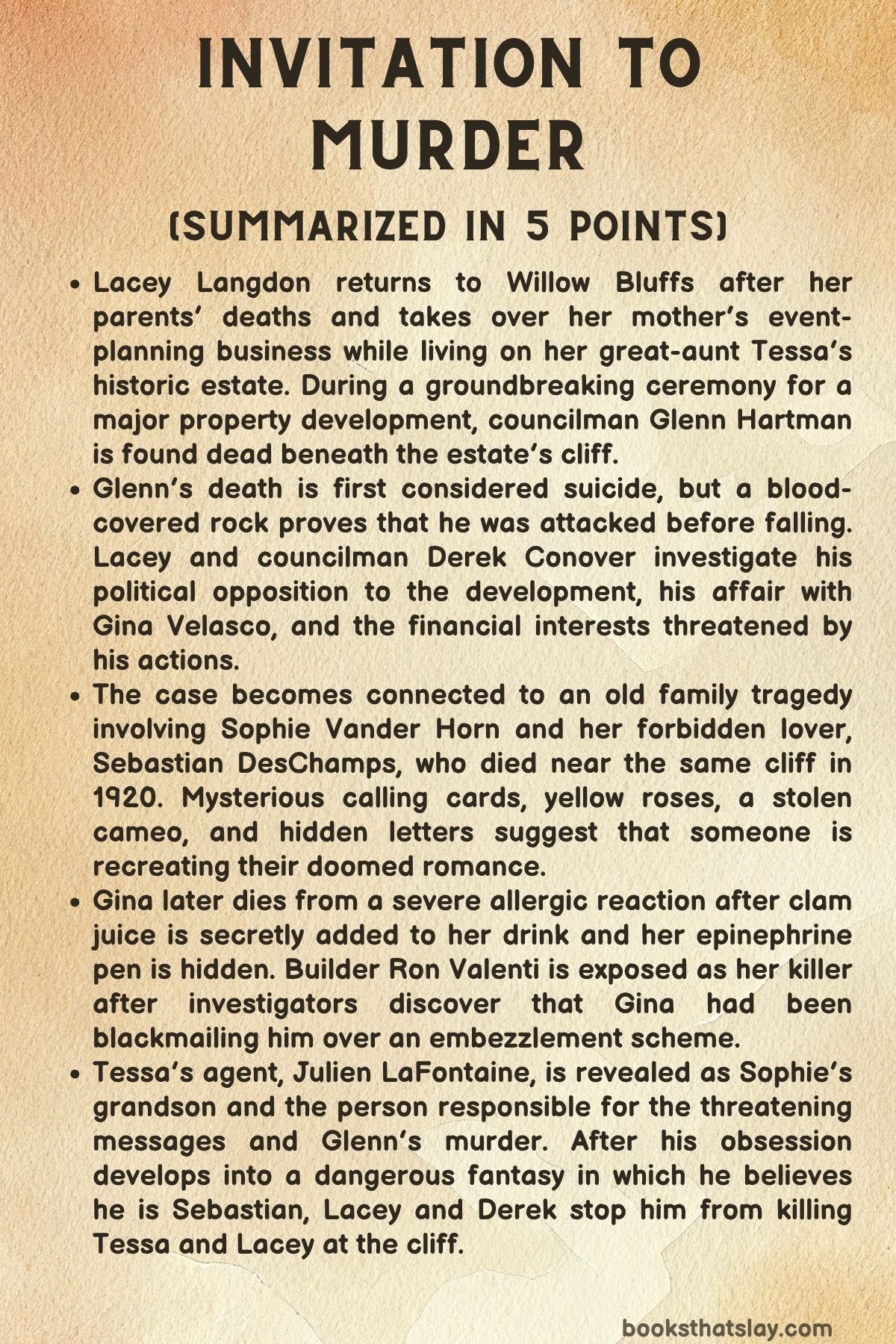
Characters
The characters of Invitation to Murder are shaped by grief, ambition, financial pressure, family loyalty, hidden resentment, and the need to understand the past. Their relationships create two separate murder investigations while also showing how easily private desires can influence public decisions.
Lacey Langdon
At the center of Invitation to Murder, Lacey is a capable but emotionally wounded young woman attempting to rebuild her life after losing both parents. Returning to Willow Bluffs allows her to preserve her mother’s business, yet every visit to the funeral parlor or memory of her parents reminds her that she has not fully processed her grief.
Her event-planning work reveals her practicality, creativity, and ability to remain calm during public emergencies. Even when her groundbreaking ceremony becomes a crime scene and the engagement party ends in Gina’s death, she continues supporting guests, employees, and investigators.
Lacey’s curiosity comes from both compassion and a strong sense of responsibility. She does not investigate merely for excitement; she feels personally connected to the estate, the victims, her assistant Jeremy, and the family secrets being used to frighten her.
She also demonstrates courage under direct threat. During Julien’s abduction, she creates a fire, leaves a jewelry trail, and looks for opportunities to protect Tessa, proving that she can act intelligently even while terrified.
Her journey concerns more than solving murders. By confronting death, family scandal, and personal danger, she gradually becomes less controlled by the loss of her parents and more prepared to create a future of her own.
Derek Conover
Derek begins as an ambitious councilman with a strong interest in politics, law, and local affairs. His eagerness to observe police procedures can sometimes seem intrusive, but it also reflects genuine intellectual curiosity and a desire to understand how evidence creates a legal case.
He becomes Lacey’s closest investigative partner. Derek studies council records, follows financial evidence, researches Cliffside’s unpaid taxes, and connects Glenn’s environmental plans with the builders’ possible motives.
Unlike Lacey, who often responds through instinct and personal observation, Derek prefers documentary proof. Their approaches complement one another, allowing emotional clues, historical discoveries, and financial records to become parts of the same investigation.
Derek is also protective without consistently treating Lacey as helpless. He urges her to contact the police, comes to the cottage after she is threatened, and ultimately follows the trail she creates during the kidnapping.
His growing romantic interest in Lacey develops gradually through shared trust. Their relationship is based not only on attraction but also on cooperation, respect, and the recognition that each possesses abilities the other needs.
Tessa Langdon Vander Horn
Tessa is Lacey’s glamorous great-aunt, a former soap-opera celebrity whose dramatic personality initially makes her seem larger than life. Beneath her polished public image, however, she is deeply attached to the Vander Horn estate and aware that its elegance hides generations of scandal.
She serves as Lacey’s connection to the past. Through Tessa, the truth about Sophie, Sebastian, Prohibition-era bootlegging, Annabella’s pregnancy, and Julien’s ancestry gradually emerges.
Tessa’s weakness is her habit of preserving secrets until circumstances force her to reveal them. Her silence is partly inherited from a family culture that valued reputation above honesty, but it also prevents Lacey from understanding the danger surrounding them.
Her relationship with Julien is especially tragic. She trusts him as her agent and friend, encourages his professional ambitions, and feels responsible for helping him understand his origins, never imagining that the truth will contribute to his psychological collapse.
By the end, Tessa must accept that glamour, money, and family pride cannot protect her from the consequences of secrecy. Her decision to remove Sophie’s portrait shows a desire to stop allowing family history to dominate the present.
Julien LaFontaine
Julien is the novel’s most psychologically complex character. For much of the story, he appears to be Tessa’s loyal, dramatic, and professionally ambitious agent, fascinated by a family legend that offers valuable material for television and theatre.
His discovery that Annabella was his biological mother and Sophie his grandmother changes his interest into a dangerous fixation. The revelation gives him the family connection he has sought for years, but instead of helping him establish a stable identity, it destroys the boundaries between history, fantasy, and reality.
Julien begins interpreting himself as Sebastian and Tessa as Sophie. The calling cards, flowers, coat, cameo, earrings, and staged celebration are attempts to reconstruct the romance and assign new roles to living people.
His murder of Glenn is connected to both money and delusion. He fears that Glenn’s environmental actions will reduce Tessa’s profits and prevent her from financing his Broadway project, so he convinces himself that violence is an act of protection.
Julien’s collapse does not erase his responsibility. He stalks Lacey, steals family property, kills Glenn, kidnaps two women, sets an armed confrontation in motion, and nearly causes further deaths.
At the same time, his story shows how unresolved questions about identity can become destructive when combined with obsession, entitlement, and untreated psychological instability. His tragedy lies in discovering the truth about his birth but losing his ability to live within reality.
Glenn Hartman
Glenn is dead when the central investigation begins, so his character is constructed through the memories, accusations, emails, and motives of others. He was a councilman who opposed the Vander Horn development and wanted more land preserved for public use.
His political position was not merely obstructionist. Glenn intended to involve environmental authorities and seek legal intervention, suggesting that he believed the development threatened the community’s long-term interests.
His private life complicates any image of him as a principled public servant. His affair with Gina betrayed Angela and created emotional damage that made both women appear capable of wanting revenge.
Glenn’s death initially seems connected to political corruption, financial fraud, or marital jealousy. The eventual revelation that Julien killed him for threatening Tessa’s profits shows that Glenn underestimated the personal passions attached to the estate.
Gina Velasco
Gina is introduced through her affair with Glenn and is therefore quickly judged as a romantic rival and possible murderer. Her visit to the cliff, her dramatic appearance at Glenn’s memorial, and her relationship with Ron reinforce the impression that she is reckless and secretive.
Her deeper role becomes clear after her death. Through her work at Town Hall, Gina discovered Ron’s embezzlement and used the information to blackmail him.
Her planned apartment and unexplained payments show that she intended to profit from the crime rather than expose it. She is therefore neither an innocent whistleblower nor simply a victim of circumstance.
Gina’s shellfish allergy makes her physically vulnerable, and Ron turns that private medical fact into a murder method. Her death demonstrates how someone close to a victim can use intimate knowledge to create an apparently accidental tragedy.
Ron Valenti
Ron is a partner in Cliffside Custom Builders and initially appears to be one of several businessmen who might have killed Glenn. His company’s financial problems, unpaid taxes, and conflict with the councilman give him an obvious motive.
His affair with Gina links the political and financial sides of the investigation. Their relationship is not based on trust, because Gina is secretly forcing him to pay for her silence regarding his embezzlement.
Ron’s murder of Gina is calculated. He contaminates her drink with clam juice, removes her epinephrine pen, and repeatedly blames himself for leaving her purse in the car in order to establish an innocent explanation.
His nervous performance after her death reveals his inability to control the story he has created. The discovery of the medication and his fraudulent invoices exposes both his financial crimes and his willingness to kill to preserve them.
Jeremy Ellis
Jeremy is Lacey’s dependable assistant at Letter Perfect. He helps her keep the business functioning during a period when murder investigations, public gossip, and personal threats repeatedly interfere with their work.
Gina’s death affects him deeply because he prepared her drink. Although he followed her instructions, he fears that he may have made a mistake and becomes vulnerable to guilt and suspicion.
Lacey’s defence of Jeremy shows the trust between them. His eventual exoneration provides relief, but his experience also demonstrates how a murderer can manipulate an innocent worker into becoming the apparent cause of a death.
Jessica Santoro
Jessica, the owner of Bean Around, is Lacey’s loyal friend and a source of emotional stability. Her coffee shop functions as a community meeting place where information, gossip, theories, and personal concerns are exchanged.
Jess helps Lacey reconnect with ordinary life outside the estate. Although she participates in speculation about the murders, her greatest importance lies in offering companionship during Lacey’s return to Willow Bluffs.
She represents the supportive side of small-town life. The same close community that spreads rumours can also provide comfort, familiarity, and a sense of belonging.
Police Chief Paul Hennessey
Chief Hennessey is cautious, observant, and unwilling to make public accusations before evidence is established. His initial treatment of Glenn’s death as a possible suicide reflects the information available rather than incompetence.
As new evidence appears, he adjusts the investigation. The bloodied rock, forensic results from Gina’s drink, Ron’s financial records, and the missing epinephrine pen are all handled through formal police procedures.
Hennessey often appears sceptical of Lacey’s concerns about the calling cards, which frustrates her. Nevertheless, he increases patrols, questions relevant witnesses, and takes action once the threats become clearly dangerous.
His character represents institutional restraint. While Lacey and Derek are free to form theories, Hennessey must distinguish suspicion from evidence that can support an arrest and prosecution.
Natalie Summers
Natalie is an ambitious reporter who recognizes that the Vander Horn estate contains both a current crime story and a valuable historical feature. Her repeated questions make Lacey uncertain whether she is an ally, a competitor, or a possible suspect.
She assists the investigation by locating Genavieve Leigh and researching the Vander Horn family. At the same time, her interest in Julien’s ancestry and Sophie’s story demonstrates how journalism can place private family secrets into the public sphere.
Natalie’s curiosity resembles Lacey’s, but her motivation is professional rather than personal. She wants information that can produce a significant story, even when that information may be uncomfortable for the people involved.
Angela Hartman
Angela is Glenn’s widow and one of the first obvious suspects. Her controlled behaviour after his death appears strange, especially after the affair with Gina becomes known.
Her calmness may be understood as self-discipline rather than proof of guilt. She must manage funeral arrangements, protect her children, face public humiliation, and mourn a husband who betrayed her.
Angela’s bitter remark that Gina should have gone over the cliff reveals the intensity of her anger. However, anger alone does not make her a murderer, and the investigation eventually separates her understandable resentment from actual criminal responsibility.
Jim Barclay
Jim is Ron’s business partner and represents the legitimate public face of Cliffside Custom Builders. Glenn’s opposition to the development and the company’s unpaid taxes initially place him under suspicion.
Unlike Ron, Jim is not shown to have created the fraudulent scheme that leads to Gina’s murder. His alibi during Glenn’s death also limits the possibility that he committed the first killing.
Jim’s character illustrates how business partnerships can spread suspicion. Even when one partner is guilty, the other may suffer damage to his reputation, finances, family relationships, and professional future.
Mayor Ariana Nikolas
Mayor Ariana Nikolas is closely involved in Willow Bluffs’ political and civic life. She communicates important information to Lacey and later cooperates with Derek in examining Glenn’s emails and the development plans.
Ariana understands that the murders threaten more than individual families. They also endanger public confidence in Town Hall, the council, the builders, and the future of the estate.
Her willingness to let Derek review official materials shows that she values answers over political protection. She serves as a contrast to the Vander Horn ancestors who concealed wrongdoing to preserve influence.
Sandra Velasco
Sandra is Gina’s grieving mother and one of the strongest voices demanding that her daughter’s death be treated as murder. Her anger may appear uncontrolled, but it is supported by her knowledge that Gina was planning a sudden and expensive change in her life.
She provides crucial information about the apartment, mysterious payments, and Gina’s distrustful relationships. The attempted burglary at her home further confirms that someone fears the evidence among Gina’s belongings.
Sandra’s certainty that Ron is responsible comes from maternal instinct and personal observation rather than forensic proof. In this case, her suspicion is correct, although the police still need physical and financial evidence before acting.
Arthur Taylor
Arthur is the caretaker of the Vander Horn estate and therefore notices movements that visitors might overlook. His report of unidentified people near the grounds suggests that the estate is being watched and entered without permission.
He represents the quiet witnesses who become important in a mystery because of their familiarity with place and routine. Though not a central investigator, his observations help establish that the threatening incidents are deliberate rather than imaginary.
Sophie Vander Horn
Sophie never appears in the present-day action, but her life influences nearly every major character. Her forbidden love, forced marriage, grief, and preserved correspondence turn her into both a historical person and a symbol onto which others project their desires.
For Lacey, Sophie represents the emotional cost of family control. For Tessa, she is part of a painful inheritance, while Julien transforms her into the central figure of his delusion.
Sophie’s story also shows how little power women possessed within wealthy families that prioritized business, marriage alliances, and reputation. Her inability to choose Sebastian shapes the lives of later generations long after her death.
Sebastian DesChamps
Sebastian is remembered as Sophie’s devoted lover and a victim of the Vander Horn family’s power. His death at the cliff was officially treated as suicide, but later evidence suggests that he may have been murdered.
His possible knowledge of the bootlegging operation gives his death a motive beyond romantic conflict. He threatened not only Sophie’s arranged marriage but also the wealth and freedom of her father and uncle.
Julien’s imitation of Sebastian distorts the historical man into a fantasy figure. The real Sebastian appears to have been a young man caught between love, industrial rivalry, family authority, and dangerous criminal secrets.
Sergeant Martinelli and Officer Kowalski
Sergeant Martinelli and Officer Kowalski assist Chief Hennessey throughout the investigations. Martinelli examines the delivered package but initially regards it as a family matter rather than a direct criminal threat.
Kowalski records Lacey’s stalking complaint and participates in the increased police presence around the estate. Their roles show the routine procedural work required behind the more dramatic discoveries made by Lacey and Derek.
Dylan
Dylan, Lacey’s Labrador, has a small but decisive role. By escaping into the woods and uncovering the bloodied rock, he provides the evidence that changes Glenn’s death from an apparent suicide into a murder investigation.
He also gives Lacey companionship during a period of grief and uncertainty. His presence adds warmth to Riverview Cottage while reminding readers that accidental discoveries can redirect an entire case.
Themes
The Continuing Power of the Past
In Invitation to Murder, history remains active because its secrets were never honestly confronted. Sophie and Sebastian’s relationship, the disputed circumstances of Sebastian’s death, the bootlegging operation, Annabella’s concealed pregnancy, and Julien’s adoption all continue influencing people who were born many years later.
The hidden room represents the physical preservation of secrets. Letters, records, keepsakes, and business documents remain sealed away until Lacey and Derek accidentally enter the chamber and force the family to reconsider its past.
The danger does not come from history alone but from the meanings living people assign to it. Lacey studies the past in order to understand it, while Julien uses it to replace reality with a fantasy in which he can become Sebastian and repair an imagined injustice.
Sophie’s portrait also demonstrates this difference. To Lacey, it encourages curiosity and sympathy, but to Julien it becomes part of a false world that permits stalking, theft, kidnapping, and murder.
Returning the portrait to the attic does not erase Sophie’s suffering. Instead, it suggests that the past should be remembered accurately without being allowed to govern every present-day choice.
Grief, Identity, and Emotional Displacement
Lacey and Julien are both responding to profound emotional losses, but their reactions lead them in opposite directions. Lacey mourns her parents by returning home, continuing her mother’s business, and trying to create order through her work.
Her grief is painful but connected to reality. She remembers funerals, feels discomfort at Carson’s Funeral Parlor, and sometimes becomes overwhelmed, yet she accepts support and continues participating in ordinary life.
Julien’s identity crisis is more destructive. After discovering that he was separated from the Vander Horn family through a secret adoption, he becomes consumed by the belief that his lost heritage must be restored.
Instead of accepting Sophie and Sebastian as ancestors with lives separate from his own, he absorbs them into his personality. Tessa becomes Sophie, Lacey becomes Annabella, and he becomes Sebastian, allowing him to avoid the painful truth that the past cannot be rewritten.
The contrast shows that grief and uncertainty do not automatically lead to violence. The crucial difference lies in whether a person can distinguish memory from reality, accept help, and recognize that emotional pain does not grant control over others.
Money, Ambition, and Moral Compromise
Both murders emerge from fears involving money and future opportunity. Ron kills Gina because her blackmail threatens to expose his embezzlement, while Julien kills Glenn because Glenn’s environmental challenge could reduce the estate’s profits and prevent investment in the Broadway production.
The development project attracts public language about progress, housing, parks, and civic improvement. Beneath those promises are unpaid taxes, financial instability, fraudulent invoices, political conflict, and private expectations of profit.
Ron’s actions show gradual moral decline. He begins with false billing and kickbacks, allows Gina to become involved, pays her to remain silent, and finally decides that murder is preferable to exposure.
Julien’s ambition is tied to artistic recognition rather than conventional business success, but it becomes equally dangerous. His production is no longer simply a professional project; it becomes proof of his identity and a way to claim ownership over the Vander Horn story.
Glenn’s efforts to protect additional green space place public interest against private gain. His death reveals how easily civic decisions can become personal when individuals believe money, status, or creative success entitles them to silence opposition.
Appearance, Reputation, and Concealed Truth
Willow Bluffs is filled with carefully managed appearances. Public ceremonies, memorial services, engagement parties, political statements, historic estates, and celebrity identities create polished surfaces that often hide betrayal or criminal behaviour.
The Vander Horn family once protected its reputation by concealing bootlegging, possible murder, forced marriage, and an unmarried pregnancy. Their wealth allowed them to decide which stories would be preserved and which people would be silenced.
Similar behaviour continues in the present. Ron presents himself as a successful builder while stealing from his company, Gina appears to be enjoying a prosperous new life while surviving through blackmail, and Julien performs loyalty while secretly stalking the family.
Angela’s controlled mourning causes suspicion because observers assume grief must have a particular appearance. Gina’s clothing and romantic choices encourage people to judge her before they understand her financial relationship with Ron.
Lacey’s profession adds another dimension because she creates beautiful, orderly events while disasters develop beneath the surface. Her growth depends on learning that maintaining appearances cannot be more important than identifying danger, speaking openly, and confronting facts that powerful people would prefer to hide.