Hunting the Strange Summary, Characters and Themes
Hunting the Strange by Kaitlyn Cavalancia, the sequel to Mystery Royale, is a fantasy story about death magic, family secrets, and the dangerous cost of bringing someone back from the edge. The book follows Mullory as she tries to save Lyric, who is trapped between life and death and still tied to Lord Thorn’s power.
As she searches for answers, Mullory uncovers clues left by her missing mother, learns more about her father’s fate, and faces a magical world full of bargains, hidden motives, and old betrayals. The story builds around loyalty, grief, trust, and the question of how far someone should go to save the people they love.
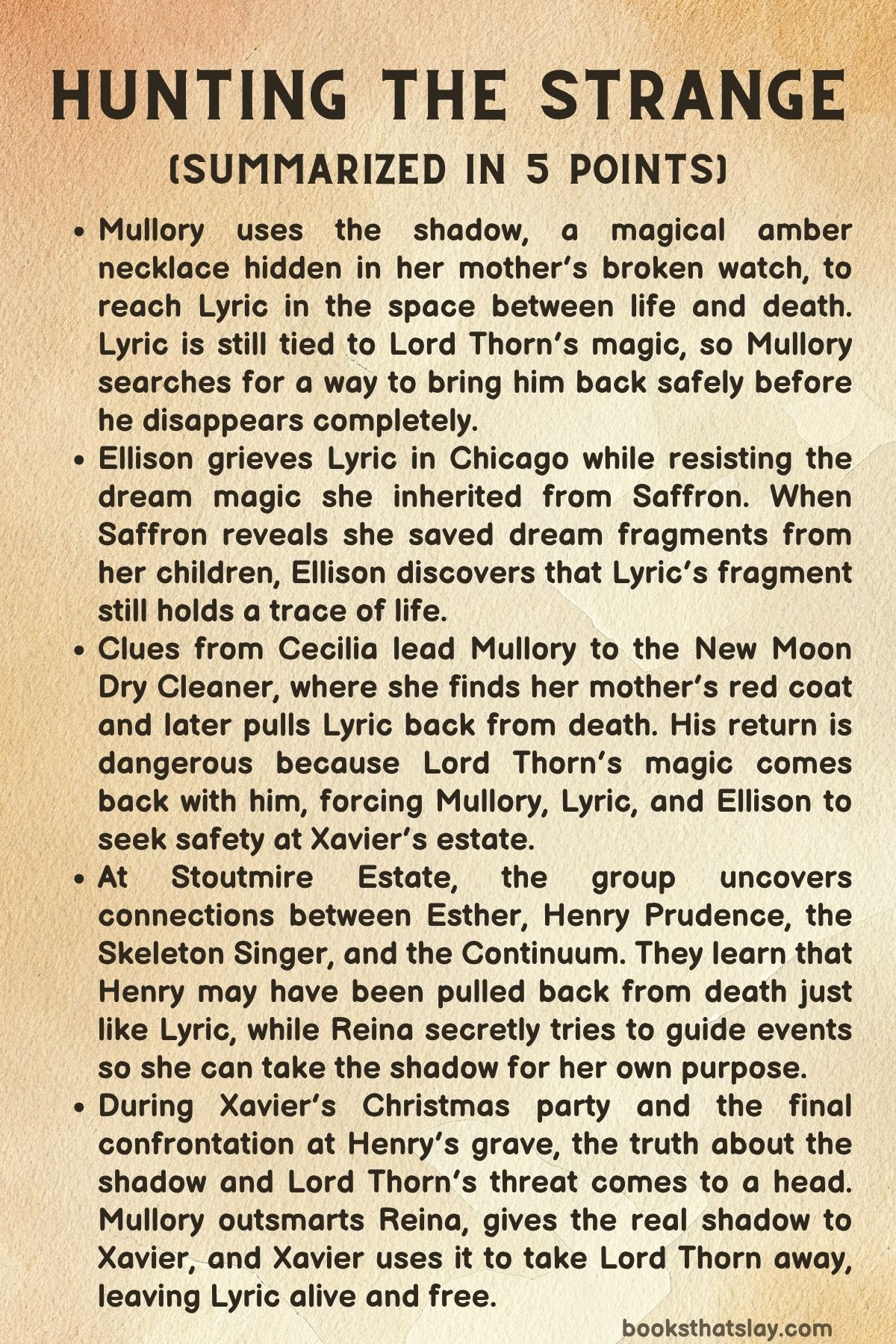
Summary
Mullory is desperate to reach Lyric after he is left caught in the seam between life and death. Her only way to find him is through the shadow, a magical amber necklace hidden inside her mother’s broken watch.
When she uses it, she can reach the strange space where Lyric is fading away. He is still himself, but only barely.
His connection to Lord Thorn’s magic keeps him from fully returning, and Lyric refuses to let Mullory drag him back until that final tie is cut. He knows that if he returns too soon, Lord Thorn may regain control over him or use him again.
Mullory begins searching for help from every person who might know something about the shadow, death magic, or her missing mother, Esther. She looks to Xavier Stoutmire, Mateo, and the clues left behind by Esther, but none of the answers come easily.
At the same time, Xavier’s inherited magic begins leaking from her in dangerous ways, making it harder for the people around her to stay safe. The magic connected to their families is old, complicated, and not fully under anyone’s control.
While Mullory fights to save Lyric, Ellison is in Chicago mourning him. She is weighed down by grief and refuses to accept the dream magic she inherited from her mother, Saffron.
Ellison wants nothing to do with the strange legacy that has shaped her family, but Saffron reveals something important: she preserved dream fragments from all three of her children. Lyric’s fragment still carries a weak trace of him, which proves he is not completely gone.
This discovery gives Ellison hope and also points her toward the truth that Lyric may still be saved.
Mullory receives books and clues from Cecilia, who seems to know more than she is willing to explain directly. These clues lead Mullory to an abandoned New Moon Dry Cleaner, where she finds a red coat left behind by Esther.
The coat appears strange and important, but its meaning is not immediately clear. As Mullory keeps trying to understand the objects and messages her mother left behind, Lyric begins to fall apart in the space between life and death.
With time running out, Mullory uses the shadow to pull him back.
Lyric’s return is not simple. Gran tells Mullory that Esther once made a boy appear in a similar way, suggesting that Mullory has repeated a piece of her mother’s past.
Gran gives Mullory a box that was left years earlier by a mysterious woman. Inside are ordinary-looking objects that clearly have a deeper purpose: a yo-yo, gum, a comb, and a receipt.
The items become part of Esther’s trail, each one pointing toward another clue. Lyric is alive again, but only briefly safe.
Lord Thorn’s magic floods back into him, and Lord Thorn realizes that Lyric has returned.
Ellison tracks Lyric to Mullory’s house and demands to take him away. She is protective of him and distrustful of the situation, but everyone soon understands that none of them are safe where they are.
They decide Xavier’s estate will offer the best protection. Mullory, Lyric, and Ellison leave Gran behind and travel there, hoping the estate can shield them from Lord Thorn and the magical council.
At Stoutmire Estate, they find more trouble waiting. Xavier is missing, Uncle Zolan is staying there without permission, and Edwin admits that Cecilia warned him danger would follow the group.
The strange objects from Esther’s box begin revealing their purpose. The yo-yo exposes a button meant for the red coat, and the coat reveals the symbol of the Skeleton Singer.
This leads Mullory closer to the secrets Esther wanted her to uncover.
Cruz Lagunes and Reina arrive and offer help just before the magical council comes searching for the shadow. Reina has magic that can hide people’s magical traces, and she uses it to conceal Mullory and the others from the Magnus, the Bloodhound, Lord Thorn, and Lawrence.
Cruz’s help comes with a price. Mullory agrees that Reina will keep them hidden, but in return she will owe Cruz an unnamed favor.
The bargain is dangerous, yet Mullory accepts it because Lyric’s life depends on staying hidden.
Mullory continues following Esther’s clues. The Skeleton Singer gives her hints about Esther and Henry Prudence, Mullory’s father.
As the group moves from a Brooklyn coffee shop to Coney Island, they meet the Viper, who reveals that Henry died, but may not be truly dead. Esther may have pulled him back from death just as Mullory pulled back Lyric.
This changes Mullory’s understanding of her family history. Her father’s death is not as clear as she believed, and Esther’s disappearance may be connected to a much larger secret.
The clues also point to the Continuum, a group linked to cheating death, and to the blood-bound lock on the shadow. Mullory learns that Henry was murdered by someone close to him.
Lyric suspects Lord Thorn could be responsible, but the truth remains uncertain. Ellison, meanwhile, enters Saffron’s dreams and discovers that she herself was the mysterious woman who once warned Saffron to save Lyric’s dream fragment.
This creates a strange loop in Ellison’s life and shows that her dream magic has a role she cannot ignore.
Reina, however, is not as loyal as she seems. She secretly alters several clues because she wants the shadow for herself.
Her goal is to free her own mother from the labyrinth, and she believes the shadow can help her do it. Although she helps Mullory and the others hide, her real motives slowly move her toward betrayal.
During Xavier’s Christmas party, the group searches for more answers while disguised by Xavier’s magic. The party creates a temporary cover, but it also draws danger close.
Lord Thorn senses Lyric and attacks. Xavier intervenes and shuts the party down, proving that Lyric cannot stay hidden forever.
After this, Mullory and the others focus on unlocking the shadow. They discover that it requires blood from three people connected to death magic.
Once the lock is opened, the final clues lead them to Henry’s grave in New Jersey.
At the grave, many forces collide. Esther appears, finally bringing Mullory face-to-face with her missing mother.
The magical council arrives, along with Lord Thorn, Xavier, and others who all want control of the shadow or the power tied to it. Reina makes her move and tries to trick Mullory into giving her a fake shadow, but Mullory has already seen through the deception.
Instead, she gives the real shadow to Xavier.
Xavier uses the shadow to take both himself and Lord Thorn away, removing the greatest threat to Lyric. This act saves Lyric and frees him from Lord Thorn’s magic at last.
Esther is reunited with Mullory, and Lyric survives without the power that had been poisoning his return. The story closes with a sense of relief, but not complete resolution.
Reina’s mother remains trapped in the labyrinth, waiting and believing that Mullory will eventually come for her. Even after Lyric is saved, the magic around death, family, and old promises remains unfinished.
Characters
In Hunting the Strange, the characters are shaped by grief, inherited magic, family secrets, and the dangerous desire to undo death. Each character contributes to the book’s central conflict in a different way, whether by protecting someone, hiding the truth, exploiting magic, or searching for a lost loved one.
Mullory
Mullory is the emotional and moral center of the book. Her journey is driven by love, desperation, and a refusal to accept death as final when there is still even the smallest possibility of saving Lyric.
Her use of the shadow shows both her courage and her recklessness, because she is willing to enter the seam between life and death without fully understanding the consequences. Mullory’s greatest strength is her loyalty, but that loyalty also places her in danger, especially when others begin pursuing the shadow for their own purposes.
As the book progresses, she becomes more perceptive and strategic, learning not to trust appearances or easy answers. Her decision to outthink Reina and give the real shadow to Xavier shows that she has grown from someone acting mainly out of panic into someone capable of making difficult, calculated choices.
Mullory is also deeply connected to the mystery of her parents, and her search for Esther and Henry gives her character a strong emotional foundation beyond her bond with Lyric.
Lyric
Lyric is one of the most vulnerable yet resilient characters in the book. His existence between life and death makes him a figure of suffering, uncertainty, and supernatural danger.
Even though Mullory wants to save him, Lyric initially resists being pulled back because he understands that Lord Thorn’s magic still has a hold on him. This shows that he is not merely passive or helpless; he is thoughtful enough to recognize that survival without freedom may only create more pain.
After Mullory brings him back, his return is not a simple victory, because Lord Thorn’s magic floods back into him and turns his life into a continuing threat. Lyric represents the cost of cheating death, as well as the emotional burden carried by someone who has been used by powerful forces.
His survival at the end feels meaningful because he is finally separated from Lord Thorn’s control, allowing him to exist as himself rather than as someone trapped by another person’s magic.
Lord Thorn
Lord Thorn is one of the main sources of danger in the book. He represents control, predatory magic, and the terrifying consequences of power used without compassion.
His connection to Lyric makes him especially threatening because his influence is not distant or abstract; it lives inside Lyric and endangers him even after he returns from death. Lord Thorn’s awareness that Lyric is alive creates constant pressure around the group, forcing them to hide, move, and make bargains with risky allies.
He is frightening because he is persistent and because his magic reaches beyond ordinary limits. His role also deepens the mystery surrounding Henry’s death, since Lyric fears Lord Thorn may have been involved.
By the end, Lord Thorn’s removal through Xavier’s use of the shadow becomes necessary not only to protect Lyric but also to break the larger pattern of magical domination he represents.
Xavier Stoutmire
Xavier Stoutmire is a complicated character whose power makes him both useful and dangerous. His inherited magic leaks uncontrollably, which suggests that even powerful magical bloodlines can become unstable and destructive.
Xavier’s estate becomes a temporary refuge for Mullory, Lyric, and Ellison, but it is not a place of complete safety, since his absence, Uncle Zolan’s presence, and Cecilia’s warnings all suggest hidden risks. Xavier’s intervention at the Christmas party shows that he is capable of decisive action when danger becomes unavoidable.
His final choice to take Lord Thorn and himself away using the shadow makes him one of the most consequential figures in the ending. Xavier is not presented as purely heroic or purely suspicious; instead, he occupies a morally tense space where power, sacrifice, secrecy, and responsibility all meet.
Mateo
Mateo functions as part of Mullory’s support system during the search for answers. Although he is not as central as Mullory, Lyric, or Ellison, his importance lies in the fact that Mullory turns to him when she is trying to understand Lyric’s condition and the dangers surrounding the shadow.
His presence suggests that Mullory’s struggle is not completely isolated, even though many of the most dangerous decisions ultimately fall on her. Mateo helps widen the emotional world of the story by showing that Mullory’s crisis reaches beyond one relationship and pulls in people connected to her search for truth and survival.
Ellison
Ellison is one of the most emotionally layered characters in the book because she is shaped by grief, fear, and inherited power. At first, her grief for Lyric makes her resistant and protective, especially when she tracks him to Mullory’s house and insists on taking him away.
Her actions can seem harsh, but they come from pain and the desire to protect someone she believes has already suffered too much. Ellison’s relationship with dream magic is also important because she resists the power inherited from Saffron before eventually learning that it holds proof Lyric is still faintly alive.
Her entry into Saffron’s dreams reveals a major twist: she herself was the mysterious woman who once warned Saffron to save Lyric’s dream fragment. This makes Ellison not only a grieving sister figure but also a character caught in a strange loop of fate, memory, and responsibility.
Saffron
Saffron is important because her dream magic preserves emotional and magical traces that become essential to Lyric’s survival. By keeping dream fragments from all three of her children, she becomes a guardian of memory, even if the full meaning of her actions is not immediately clear.
Her preservation of Lyric’s fragment proves that he is barely alive, giving Ellison and the others hope when ordinary evidence would suggest he is gone. Saffron’s role is quiet but powerful because she protects through foresight, maternal instinct, and magic rather than direct confrontation.
Her connection to Ellison also shows how inherited magic can be both a burden and a gift, especially when the next generation must decide whether to reject or accept what has been passed down.
Cecilia
Cecilia is a guiding figure whose influence is felt through clues, warnings, and hidden knowledge. She sends Mullory books and information that lead her to the abandoned New Moon Dry Cleaner, making Cecilia a key part of the investigation even when she is not physically present.
Her connection to the red coat and her warning to Edwin show that she understands more about the danger surrounding Mullory’s group than she openly explains. Cecilia’s character creates a sense of mystery because she seems to operate from the edges of the action, pushing the group toward discoveries while also recognizing that those discoveries will attract danger.
She represents the kind of adult figure who knows the past is dangerous but still leaves behind the tools needed to confront it.
Gran
Gran provides family grounding, memory, and emotional stability. Her role becomes especially important when she reveals that Esther once made a boy appear in a way similar to Mullory bringing back Lyric.
This revelation connects Mullory’s actions to an older family pattern and shows that the strange events surrounding the shadow did not begin with her. Gran’s gift of the box left by a mysterious woman gives Mullory access to crucial clues, including the odd objects that later guide the group forward.
Gran represents generational knowledge, but she also shows that older family members may carry only pieces of the truth. Her presence gives Mullory a sense of home before the danger forces her to leave for Xavier’s estate.
Esther
Esther is one of the most important hidden figures in the book because her past actions shape almost everything Mullory is trying to understand. She is connected to the shadow, the mystery of Henry Prudence, and the dangerous possibility of pulling someone back from death.
The revelation that Esther may have brought Henry back in a way that mirrors Mullory saving Lyric makes her both a warning and a source of hope. Esther’s clues guide Mullory through a trail of strange objects, locations, and magical symbols, suggesting that she prepared for a future confrontation long before Mullory fully understood the stakes.
When Esther finally appears at Henry’s grave, her reunion with Mullory gives emotional closure to the long search for the missing mother. She is a character defined by secrecy, sacrifice, and the painful consequences of trying to defy death.
Henry Prudence
Henry Prudence is central to the book’s deeper mystery even though he is largely defined through absence. As Mullory’s father, he represents a missing part of her identity and family history.
The revelation that he died but may not truly be dead connects him directly to the same boundary between life and death that traps Lyric. Henry’s possible return through Esther’s magic makes him a parallel to Lyric, showing that Mullory’s actions are not unique but part of a larger magical pattern.
The discovery that Henry was murdered by someone close adds betrayal and emotional darkness to his story. Henry is important because his fate forces Mullory to confront not only what happened to her family but also the terrible costs of love when it tries to overpower death.
Uncle Zolan
Uncle Zolan adds suspicion and instability to the Stoutmire Estate. His presence as someone squatting there while Xavier is missing makes the estate feel unsafe from the moment the group arrives.
He contributes to the sense that powerful families and magical spaces are full of hidden tensions, not simple protection. While he may not drive the central conflict as strongly as Lord Thorn or Reina, he helps create an atmosphere of distrust around Xavier’s world.
Uncle Zolan’s role suggests that danger does not only come from obvious enemies; it can also come from relatives, opportunists, and people who occupy spaces they may not truly have a right to control.
Edwin
Edwin serves as a messenger of warning and withheld knowledge. His admission that Cecilia warned the group would attract danger shows that he knows more than he initially reveals, or at least that he has been connected to people who understand the threat.
Edwin’s role strengthens the feeling that Mullory and her companions are walking into a trap that others saw coming. He is not a central decision-maker, but his information helps confirm that the danger surrounding the group is not accidental.
Edwin’s character matters because he stands at the edge of secrecy, giving just enough truth to increase the urgency of the situation.
Cruz Lagunes
Cruz Lagunes is a morally ambiguous helper whose assistance comes with a price. He arrives with Reina at a crucial moment and offers protection when the magical council is searching for the shadow.
His bargain with Mullory shows that he understands the value of desperation; he gives the group what they need, but only in exchange for an unnamed future favor. Cruz is not presented as openly villainous, but his willingness to make such a bargain makes him dangerous in a subtler way.
He represents the world of magical deals, where help is rarely free and safety often creates new obligations. His presence expands the book’s magical politics by showing that survival often requires alliances with people whose motives are not fully trustworthy.
Reina
Reina is one of the most complex characters in Hunting the Strange because her betrayal comes from love, desperation, and manipulation rather than simple cruelty. She helps hide the group’s magical traces, making herself genuinely useful, but she is also secretly guiding events to obtain the shadow for her own purpose.
Her desire to free her mother from the labyrinth gives her actions emotional weight, even when those actions are deceptive and harmful. Reina’s manipulation of clues shows intelligence and patience, while her attempt to trick Mullory at the end reveals how far she is willing to go.
She serves as a mirror to Mullory because both are driven by love for someone trapped beyond ordinary reach. The difference is that Mullory ultimately protects others from deception, while Reina chooses betrayal as her path to hope.
Reina’s Mother
Reina’s mother is a haunting presence because she remains trapped in the labyrinth, waiting for rescue. Although she does not take direct action in the main events, her existence explains much of Reina’s desperation and moral compromise.
She represents another form of imprisonment connected to the book’s larger concern with death, separation, and impossible returns. Her belief that Mullory will eventually come for her leaves the ending open and uneasy, suggesting that the consequences of the shadow are not fully finished.
Reina’s mother matters because she turns Reina’s betrayal into something more tragic than selfish ambition; it becomes the act of a daughter trying to save someone she cannot let go.
The Skeleton Singer
The Skeleton Singer is a mysterious guide figure connected to symbols, clues, and hidden knowledge. The symbol revealed through the coat points the group toward this figure, and the Skeleton Singer offers hints about Esther and Henry Prudence.
This character functions like a keeper of strange truths, giving Mullory pieces of the past without fully removing the danger of discovery. The Skeleton Singer adds a gothic and magical quality to the book’s mystery, making the search feel ritualistic and eerie.
Rather than solving everything directly, the Skeleton Singer pushes Mullory deeper into the hidden structure of the story’s world.
The Viper
The Viper is a revealing figure whose information changes how Mullory understands Henry’s fate. At Coney Island, the Viper explains that Henry died but may not truly be dead because Esther pulled him back from death.
This makes the Viper important as a source of dangerous knowledge about the Continuum, the shadow, and the consequences of cheating death. The Viper’s role is not simply to provide answers but to make the mystery darker and more complicated.
Through this character, Mullory learns that death magic has a history, that her family is tied to it, and that saving Lyric may be part of a much larger pattern.
The Magnus
The Magnus represents the authority and threat of the magical council. As one of the figures searching for the shadow, the Magnus adds pressure to the group’s situation and shows that Mullory’s actions have attracted powerful attention.
This character’s importance lies less in personal emotion and more in institutional danger. The Magnus helps embody a world where magical objects are monitored, hunted, and fought over by people with power.
The presence of the Magnus makes it clear that the shadow is not only a family secret or a tool for saving Lyric; it is an object with political and magical significance.
The Bloodhound
The Bloodhound is another threatening figure connected to the search for the shadow. The name itself suggests pursuit, tracking, and relentless pressure, which fits the group’s need to hide their magical traces.
The Bloodhound’s role intensifies the danger because the characters are not merely hiding from one enemy but from a network of magical forces capable of finding them. This character contributes to the suspense by making concealment feel fragile.
Reina’s ability to hide everyone becomes more important because figures like the Bloodhound make discovery feel almost inevitable.
Lawrence
Lawrence appears as part of the dangerous group searching for the shadow. His role places him among the external threats converging on Mullory, Lyric, and their allies.
Though he is not as personally developed as some of the other characters, his presence matters because it adds to the sense that many powerful people want control over the same object. Lawrence helps widen the conflict beyond Mullory’s private grief, showing that the shadow has drawn the attention of a larger magical world.
His pursuit of the group contributes to the atmosphere of pressure and danger surrounding the final confrontation.
The Magical Council
The magical council functions as a collective force of authority, control, and suspicion. Its search for the shadow shows that Mullory’s use of the necklace has consequences beyond her personal desire to save Lyric.
The council’s presence makes the conflict larger and more political, because the shadow is treated as something that must be found, controlled, or taken. The council also creates tension between personal morality and institutional power.
Mullory uses the shadow out of love and desperation, while the council appears more concerned with possession, regulation, and the threat such magic represents. As a group, the council helps define the dangerous magical world surrounding the main characters.
Themes
Grief and the Refusal to Let Go
Grief shapes the emotional world of Hunting the Strange, especially through Mullory and Ellison’s responses to Lyric’s near-death state. Mullory’s grief is active and urgent; she cannot accept Lyric’s fading as final, so she searches for every clue, object, and person that might help her bring him back.
Her grief becomes a force of motion, pushing her into dangerous bargains and uncertain magic. Ellison’s grief is quieter but equally powerful.
Her pain appears through resistance, especially in the way she avoids the dream magic connected to her mother and siblings. Both girls show that grief is not only sadness but also confusion, anger, denial, and desperate hope.
The story treats loss as something that changes people’s choices, often making them brave but also vulnerable. Lyric’s survival does not erase grief; instead, it shows how grief can turn into responsibility.
Those who love him must face what his return costs and what dangers still remain.
The Cost of Cheating Death
Death is not shown as a simple boundary that can be crossed without consequence. Mullory’s use of the shadow to pull Lyric back saves him, but it also exposes him again to Lord Thorn’s magic and alerts dangerous forces to his survival.
Esther’s earlier act of pulling Henry back creates a parallel that suggests this kind of rescue always leaves behind complications. The Continuum, the blood-bound lock, and the repeated attempts to preserve life all suggest that escaping death requires payment, secrecy, or sacrifice.
The story does not present resurrection as a clean victory. Instead, it asks whether love can justify disturbing forces that are meant to remain closed.
Mullory’s actions come from devotion, but each success brings new danger. This theme becomes especially meaningful because the characters are not seeking power for selfish reasons; they are trying to save family and friends.
Even so, the story shows that good intentions do not remove the consequences of unnatural magic.
Family Secrets and Inherited Burdens
Family history controls much of the conflict, even when the younger characters do not fully understand it. Mullory’s search for her mother, her father’s fate, and the truth behind the shadow reveals how deeply the past has shaped her present.
Objects left behind, such as the coat, the box, and the hidden clues, become signs of unfinished family business. Ellison also carries an inheritance through Saffron’s dream magic and the preserved fragments of her siblings.
Xavier’s inherited magic leaking uncontrollably shows that family power can be unstable and frightening rather than purely useful. These inheritances are not limited to magical ability; they include guilt, secrecy, grief, and responsibility.
The older generation’s choices leave the younger characters to solve mysteries they did not create. This theme shows that family can be a source of protection, but it can also trap people inside old mistakes.
Mullory’s journey becomes a search not only for answers but for control over a legacy shaped by silence.
Trust, Betrayal, and Moral Uncertainty
Trust is constantly tested because nearly every alliance carries hidden motives. Mullory depends on Xavier, Mateo, Cruz, Reina, Ellison, and others, yet she must keep questioning what each person wants.
Cruz’s bargain places help and danger side by side, making protection feel conditional. Reina’s betrayal is especially important because her actions come from love for her own mother, not simple cruelty.
This makes betrayal more complex: she harms Mullory’s group, but her motive mirrors Mullory’s own desire to save someone from death or imprisonment. Lord Thorn represents a clearer threat, but the people around Mullory often exist in morally uncertain spaces.
Even Xavier’s final decision to take the shadow and remove Lord Thorn involves sacrifice, secrecy, and risk. The theme suggests that trust is not built through perfect honesty but through choices made under pressure.
Mullory grows by learning to read deception, accept help carefully, and act with courage even when she cannot fully know who deserves her faith.