It’s Hard to Be an Animal Summary, Characters and Themes
It’s Hard to Be an Animal by Robert Isaacs is a comic, thoughtful novel about kindness, loneliness, courage, and the hidden lives of animals.
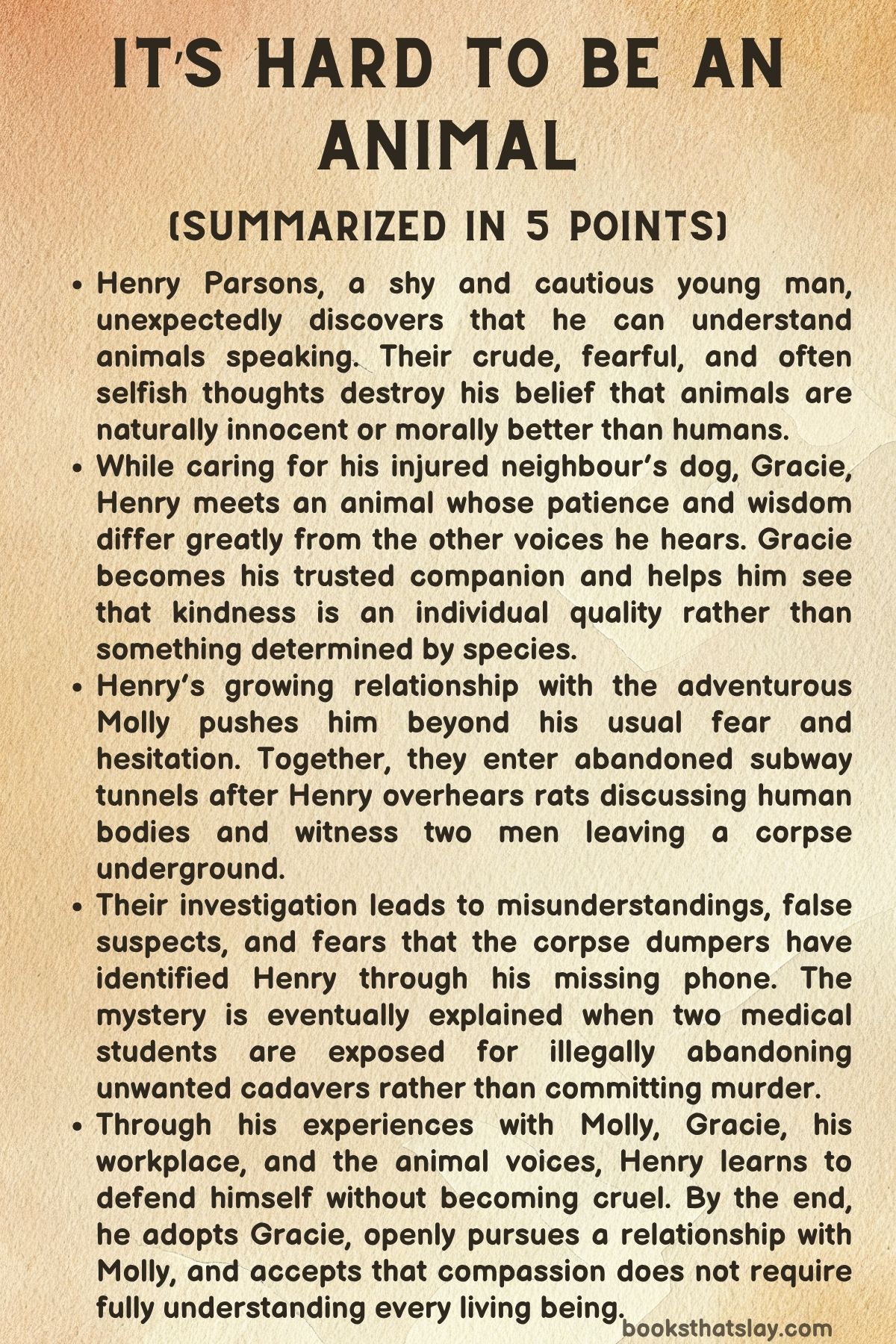
Its central character, Henry Parsons, unexpectedly develops the ability to understand animal speech and discovers that animals are not always innocent, loyal, or morally superior to humans. Their voices expose anger, prejudice, fear, desire, and wisdom in surprising forms. Alongside this strange experience, Henry begins a relationship with the adventurous Molly, cares for an unusually perceptive dog, and becomes involved in a mystery beneath New York City. The book combines absurd humour with serious questions about empathy, dignity, and personal growth.
Summary
Henry Parsons is a shy twenty-eight-year-old man who has spent years avoiding emotional risks after the end of a painful relationship. His co-worker Jackie arranges a coffee date between him and her lively friend Molly, whose energy and playfulness immediately challenge Henry’s cautious habits.
The date goes surprisingly well, especially when they walk through Central Park and take turns guiding each other with their eyes closed. While they watch birds, Henry hears a Magnolia Warbler speak in clear, extremely rude language, ordering them away from its territory.
Molly hears only ordinary birdsong, so Henry assumes that stress or loneliness has caused him to hallucinate. His fear grows when he returns home and hears two distinct voices exchanging elaborate insults, only to discover that the speakers are Lazavik and Dzedka, the betta fish belonging to his Belarusian housemate, Yaryk.
Henry spends a sleepless night wondering whether he is experiencing a serious mental illness. The discovery is especially disturbing because the animals he hears are not gentle or spiritually pure; they are jealous, aggressive, prejudiced, territorial, and sometimes cruel.
At work, Jackie encourages Henry to contact Molly again, convinced that the date was successful. Henry remains doubtful because he considers Molly adventurous and exciting while seeing himself as ordinary, timid, and unlikely to hold her attention.
Henry attempts to discuss the animal voices with his therapist, Murray, but Murray treats everything as a metaphor for suppressed anger and social isolation. His refusal to believe Henry’s literal explanation frustrates Henry, who begins testing whether the voices contain information he could not have invented.
A pigeon uses an unfamiliar term that Henry later confirms is a real word, convincing him that the animals possess independent minds. He also hears subway rats discussing warm bodies, missing eyes, and flesh near the tracks, although he initially assumes they are speaking about dead members of their own species.
Other encounters deepen his disappointment with animal behaviour. A former narcotics dog resents being reassigned as a guide dog, household pets privately insult their owners, and creatures that appear loving or harmless reveal selfish thoughts that humans cannot hear.
During a workplace event, Henry entertains his supervisor Eleanor’s young daughter, Ava, by turning his cubicle into an imaginary veterinary clinic. After treating a paper seagull, Ava observes that many animals are broken and that it is hard to be an animal, giving Henry a new way to understand what he has been hearing.
Henry’s attention returns to the subway rats when he hears them mention sleeves, clothing, and bodies being dragged into an abandoned level beneath West Fourth Street. He realizes that they are eating human corpses and anonymously reports the location to the police, although he cannot explain how he obtained the information.
His growing awareness of animal consciousness also changes his relationship with food. Meals containing meat become increasingly uncomfortable because he can no longer treat animals as silent objects, even when their personalities are unpleasant.
A new responsibility enters Henry’s life when his neighbour, Mrs. Peabody, is struck by a taxi. Before being taken to the hospital, she asks him to collect her noisy Pomeranian, Gracie, from the veterinarian.
Molly abandons her own plans and accompanies Henry to the clinic, turning the errand into another enjoyable outing. The clinic overwhelms Henry because every room is filled with animal fear, confusion, hostility, and pain, while the owners interpret every cry as evidence of affection.
Gracie initially seems likely to be another difficult animal, but Henry soon discovers that she is remarkably different. She calmly observes that good people smell different and later explains that the night sky gives living beings a sense of perspective.
As Mrs. Peabody’s condition worsens, Henry agrees to care for Gracie for several days. Gracie’s patience, fairness, and emotional intelligence gradually make her Henry’s first true animal companion rather than merely another voice he is forced to hear.
Molly joins Henry and Gracie at a dog park, where Henry listens to dogs argue, flirt, complain, and express frustrated instincts. Molly notes that humans have bred dogs for specific work but often confine them in apartments where they cannot fulfil the purposes shaped into them.
When Molly mentions search-and-rescue dogs locating bodies, Henry accidentally reveals part of what he heard beneath West Fourth Street. He claims that he overheard people discussing a corpse, but Molly becomes determined to investigate instead of dismissing the story.
Henry resists because entering the subway tunnels would be dangerous, illegal, and completely unlike him. Molly insists that courage does not mean feeling no fear and tells him that asking her on another date was already a brave act.
They scout the station, buy climbing equipment, and return in the early morning. After climbing down from the platform, they move through an active tunnel and find an entrance leading to a damp, abandoned railway level.
Henry hears rats gathering and realizes that another corpse is about to arrive. He pulls Molly behind a decaying sheet of plywood moments before hundreds of rats rush toward the area.
Two men descend and drag a body across the gravel while speaking in heavy Scottish accents. Henry and Molly remain hidden as the men search the tunnel with flashlights, coming dangerously close to discovering them before leaving the corpse to the rats.
After escaping, Henry discovers that he has lost his phone. He remembers one of the men picking something up and fears that the device will reveal his identity, contacts, and home address.
At an all-night restaurant, Henry finally tells Molly the truth about understanding animals. Rather than rejecting him, she believes him almost immediately and becomes fascinated by the strange ability that has frightened him for days.
Molly spends the night on Henry’s couch, but their increasing closeness is interrupted by a misunderstanding. Henry sees an intimate message on Molly’s phone and assumes she is involved with someone else, while Molly interprets his sudden distance as proof that her impulsive personality has overwhelmed him.
Neither speaks honestly about the real problem. Molly leaves believing that Henry no longer wants a relationship, while Henry convinces himself that withdrawing is the respectful thing to do.
At work, Henry faces another conflict involving Jayden Stroop, an ambitious colleague who has neglected an important account and sent aggressive messages under both their names. Henry repairs the client relationship but remains angry when Jayden receives praise for discovering the accounting problem that Henry actually found.
Henry’s unusual experiences begin changing the way he handles conflict. He ends his unproductive therapy sessions, tells Jackie not to interfere in his private life, and gradually recognizes that avoiding every disagreement has allowed other people to define him.
The danger surrounding the missing phone appears to increase when Henry learns that a Scottish stranger called his mother and obtained his address. He spends a frightened night preparing for an attack, armed only with an old clarinet.
Henry and Molly later use a tracking application and follow three intimidating Scottish men into a crowded pub. Their suspicions prove false when they discover that the men communicate in sign language and could not have been the voices heard in the tunnel.
The mistaken pursuit forces Henry and Molly to discuss their differences honestly. Henry tells her that he cannot become the fearless warrior she may want, while Molly admits that her impulsiveness can frighten cautious people and place both herself and others in unnecessary danger.
Their conversation helps each of them understand that courage and caution are not enemies. Henry needs some of Molly’s willingness to act, while Molly needs the thoughtful restraint that Henry and Gracie provide.
The romantic misunderstanding is finally resolved when Molly explains that the intimate message came from an overly familiar hairdresser. Henry admits that jealousy caused him to withdraw, and Molly reveals that her dating history contains no hidden long-term partner.
Before they can properly kiss, a drunken neighbour crashes through Henry’s window and attacks him. Molly fights back, but Yaryk ends the confrontation by displaying extraordinary combat skills and tying the intruder with the rope from the subway expedition.
The supposed attacker is merely Wilbur, a confused neighbour who entered the wrong apartment and believed Henry was with his wife. The incident becomes another example of Henry imagining an organised threat when the truth is far less sinister.
Henry eventually confronts the professional injustice involving Jayden. When management praises Jayden for Henry’s work, Henry calmly explains the report and later tells Eleanor the truth without trying to humiliate his colleague.
Mrs. Peabody dies from surgical complications, leaving Henry and Yaryk grieving for a neighbour they had not fully appreciated. Her death also raises the question of Gracie’s future, since Mrs. Peabody’s sister sees the dog as an unwanted responsibility.
Henry asks to adopt Gracie permanently, and the sister readily agrees. The decision gives Henry a new sense of home because someone now depends on him and waits for him to return.
His missing phone is eventually mailed back with a friendly note from the Scottish men. They had no intention of harming him and had simply contacted his mother because they wanted to return his property.
The corpse mystery is also resolved. The men are medical students, Callum and Donal MacLeod, who illegally supplied bodies to medical schools and dumped unwanted cadavers in abandoned tunnels to avoid cremation expenses.
The elderly woman Henry saw had already been discovered and processed before entering their possession, explaining why the police appeared to find the same body twice. The men are guilty of treating human remains with shocking disrespect, but they are not murderers.
Around this time, Henry notices that the animal voices have disappeared. Gracie’s final message tells him that home is the happiest ending, leaving him saddened by the loss of an ability that once seemed like a curse.
Henry, Molly, and Gracie attend Mrs. Peabody’s memorial service, where hundreds of people reveal how much quiet good she performed throughout her life. When Gracie begins barking during the service, the minister asks Henry to remove her.
Instead of obeying silently, Henry stands before the congregation and explains that Gracie was Mrs. Peabody’s closest companion and deserves to express her grief. Gracie howls three times, and the mourners understand her sorrow even without Henry translating it.
After the service, Henry tells Molly that he can no longer understand animals. She assures him that the ability was never the only thing that made him valuable.
Walking through Central Park, Henry hears ordinary birdsong and recognizes that beauty can exist beside conflict, territorial behaviour, and cruelty. He takes Molly’s hand, identifies his next action as courtship, and is finally kissed before fear or hesitation can stop him.
Characters
Henry Parsons
Henry is the central character of It’s Hard to Be an Animal, and his emotional development gives the book its structure. At the beginning, he is thoughtful and compassionate but also deeply insecure, conflict-avoidant, and convinced that more energetic people will eventually become bored with him.
His ability to understand animals initially intensifies these insecurities because he worries that he is losing his mind. However, the independence and unfamiliarity of the animals’ thoughts gradually force him to trust his perceptions instead of depending entirely on other people to confirm reality for him.
Henry’s kindness is genuine rather than performative. He helps Mrs. Peabody without hesitation, returns a child’s stuffed toy, treats Gracie as a grieving individual, and refuses to humiliate Jayden even after being repeatedly exploited by him.
His weakness is that he often mistakes passivity for goodness. He allows misunderstandings to continue, permits Jayden to claim credit, assumes Molly has rejected him without asking, and imagines that withdrawing from her life is an act of generosity.
The story gradually teaches Henry that kindness requires honesty and courage. By defending his work, confronting Molly, adopting Gracie, and speaking at the memorial service, he learns that self-advocacy does not have to become aggression.
Henry’s final confidence remains consistent with his gentle personality. He does not transform into a fearless action hero; instead, he becomes capable of acting while afraid, speaking when silence would be easier, and allowing himself to be loved.
Molly
Molly is spontaneous, playful, curious, and unusually willing to accept possibilities that other people would immediately reject. Her openness allows her to believe Henry’s explanation about animal speech without treating him as unstable or demanding conventional proof.
Her adventurousness brings excitement into Henry’s life, but it also contains a dangerous lack of restraint. She proposes entering abandoned subway tunnels, follows suspected criminals, and sometimes treats risk as an opportunity for entertainment.
Molly is not simply a force designed to rescue Henry from shyness. She has insecurities of her own, particularly the fear that her humour and energy make her childish, exhausting, or professionally unsuitable.
Her workplace conflict reveals how often she has been told that adulthood requires suppressing playfulness. Henry’s reassurance matters because he recognizes that her jokes coexist with compassion, responsibility, and emotional intelligence.
Molly’s growth involves accepting that caution is not cowardice. She begins to appreciate Henry’s ability to evaluate danger and understands that courageous people benefit from companions who know when to slow down.
Her relationship with Henry works because neither person completely absorbs the other’s personality. She encourages him to take risks, while he helps her distinguish meaningful bravery from needless recklessness.
Gracie
Gracie is the moral and emotional centre of It’s Hard to Be an Animal. While many animals Henry hears are selfish, vulgar, resentful, or cruel, Gracie speaks with patience and an understanding of human behaviour that often exceeds the insight of the people around her.
Her wisdom never makes her feel unnatural or detached from her identity as a dog. She values scent, touch, companionship, routine, physical closeness, and the security of knowing that someone will return home.
Gracie teaches Henry that animals cannot be divided into simple categories of innocent creatures and corrupt humans. Her goodness is meaningful precisely because other animals demonstrate that compassion is an individual quality rather than an automatic feature of any species.
She also becomes the relationship through which Henry learns sustained responsibility. Caring for her requires adjustments to his routine, emotional commitment, and a willingness to make decisions about another being’s future.
Her grief at Mrs. Peabody’s memorial gives the congregation a direct experience of emotion that requires no supernatural translation. Even after Henry loses his ability, Gracie communicates through sound, behaviour, and presence.
Her final statement about home reflects both her own need and Henry’s transformation. By adopting her, Henry creates the stable emotional bond that he had previously feared he would never possess.
Yaryk
Yaryk is Henry’s cheerful Belarusian housemate, whose theatrical speech and unusual habits provide much of the book’s humour. He appears eccentric but dependable, welcoming Gracie immediately and showing steady concern for Henry’s emotional condition.
His mysterious work trips and unexpected combat abilities suggest that he has a life far more complicated than Henry realizes. The story never fully explains these details, allowing Yaryk to remain both comic and intriguing.
Yaryk’s loyalty becomes clearest when danger enters the apartment. He subdues Wilbur quickly and efficiently, but he does not use his physical power to dominate ordinary situations.
His affection for Gracie reveals a gentle side beneath his mysterious background. He and Henry reach the decision to keep her together, making the apartment feel like a shared home rather than temporary accommodation.
Yaryk also offers an indirect contrast to Henry. He possesses the physical confidence Henry lacks, yet the story does not present strength as a competition between them.
His potential romantic connection with Jackie reinforces the book’s interest in lonely people forming communities. Henry’s decision to introduce them shows that he has become attentive to the emotional needs of others without interfering in the controlling way Jackie sometimes does.
Mrs. Peabody
Mrs. Peabody initially appears to be little more than Henry’s quiet neighbour and Gracie’s owner. Her accident brings Gracie into Henry’s care, but her deeper importance becomes clear only after her death.
The memorial service reveals that she spent years performing acts of generosity without seeking recognition. Her former students and colleagues describe a woman who noticed private suffering and responded in practical ways.
Her decision to provide daily meals to a student whose family lacked food demonstrates a form of compassion based on consistency rather than public praise. She helps because help is needed, not because she wants to be admired.
Henry’s limited knowledge of her life becomes part of the tragedy. He lived near someone whose influence reached hundreds of people but knew almost nothing about her character until she was gone.
Mrs. Peabody therefore represents the unseen moral lives of ordinary individuals. Just as animals possess hidden thoughts, apparently unremarkable people may carry histories of sacrifice, grief, and generosity that neighbours never recognize.
Her relationship with Gracie also challenges the treatment of pets as property. Gracie is not merely something left behind after her death; she is a surviving companion who has lost the person around whom her life was organised.
Jackie
Jackie is Henry’s co-worker, friend, and informal matchmaker. She recognizes his loneliness and arranges his first meeting with Molly because she believes the two possess qualities that can balance each other.
Her enthusiasm is often helpful, but it can also become intrusive. She attempts to manage Henry’s romantic future and sometimes assumes that she understands his needs better than he does.
Henry’s decision to tell her not to interfere is an important moment in his development. Jackie is not malicious, but even well-intentioned control can prevent a timid person from learning to make independent choices.
She also serves as a bridge between Henry’s personal and professional lives. Because she knows both Henry and Molly, she sees their compatibility before either of them is willing to acknowledge it.
Later, Henry notices that Jackie may be lonely herself. His idea of introducing her to Yaryk shows that he has begun seeing her as a complete person rather than only as someone who supports his story.
Jackie’s role demonstrates that friendship can involve encouragement without requiring total agreement. Her confidence in Henry helps him, even when her methods occasionally ignore his boundaries.
Lazavik and Dzedka
Lazavik and Dzedka are betta fish kept in separate wall-mounted tanks because their species is known for aggression. Their elaborate insults provide Henry’s second confirmation that he can understand animals.
At first, they appear to embody pure hostility. Their conversations consist of threats, personal attacks, and extravagant descriptions of the violence they would perform if the glass separating them disappeared.
Lazavik’s illness reveals that their hatred contains emotional attachment. Dzedka immediately abandons the feud and offers sincere wishes for recovery, showing that the constant conflict has become a form of connection.
After Lazavik recovers, the fish admit that their aggression concealed love. Their romantic declarations are as excessive as their earlier insults, suggesting that intense affection and intense hostility can sometimes grow from the same need for attention.
Their relationship parodies conventional romantic transformations while also supporting the book’s concern with hidden interior lives. To Yaryk, they are decorative pets; to Henry, they are individuals experiencing rivalry, fear, devotion, and imagined transcendence.
When their tanks are joined into a suspended globe, they believe they have died and entered heaven together. Their happiness depends on interpretation, demonstrating how limited information can still produce emotionally real experiences.
Jayden Stroop
Jayden represents ambition without responsibility. He avoids difficult work, transfers his obligations to Henry, sends damaging messages under both their names, and then accepts praise for Henry’s discovery.
His behaviour succeeds partly because Henry is reluctant to confront him. Jayden takes advantage of systems that reward confidence and visibility more readily than careful, quiet competence.
He is irritating, dishonest, and professionally selfish, but the book does not reduce him to a completely monstrous figure. Henry eventually offers him advice instead of revenge, suggesting that Jayden’s competitive behaviour may come from insecurity and a distorted understanding of success.
Jayden believes professional life is a contest in which another person’s recognition diminishes his own. Henry rejects this view by defining success through relationships, integrity, and becoming someone others genuinely respect.
The exposure of Jayden’s dishonesty is important because he cannot explain the report he supposedly created. His performance of expertise collapses when actual knowledge is required.
Henry’s treatment of him demonstrates the difference between assertiveness and cruelty. He corrects the record and protects his work without publicly destroying Jayden.
Murray
Murray is Henry’s therapist, but he is unable to respond effectively to Henry’s extraordinary situation. He interprets every report of animal speech as symbolism, regardless of how clearly Henry insists that the experience is literal.
His approach reflects a professional framework that has become too rigid. Because animal speech does not fit his expectations, he reshapes Henry’s account into a familiar discussion of loneliness, anger, and avoidance.
Some of Murray’s interpretations are relevant to Henry’s personality, but his refusal to listen prevents the sessions from being genuinely useful. He speaks about Henry’s inner life without adequately hearing what Henry is actually saying.
Henry’s eventual decision to end regular therapy is not presented as a rejection of all psychological help. It marks his recognition that this particular relationship no longer supports his growth.
By the time he leaves, Henry has begun analysing problems independently and trusting his own conclusions. Murray therefore becomes an accidental measure of Henry’s development.
The failure of the therapeutic relationship also supports the book’s wider concern with communication. Hearing words is not the same as listening, just as hearing an animal’s voice does not automatically produce understanding.
Eleanor
Eleanor is Henry’s supervisor and the mother of Ava. She appears capable of recognizing integrity, although workplace structures initially allow Jayden to receive credit for Henry’s efforts.
Her decision to ask Henry privately for the truth creates the space he needs to advocate for himself. She does not force him into a public confrontation or demand that he humiliate Jayden.
When Henry explains what happened, Eleanor praises his professionalism and promises to correct the record. Her response confirms that speaking honestly can produce justice without creating unnecessary cruelty.
Eleanor’s presence also connects Henry with Ava, whose observation about animals provides the book’s central idea. Through this relationship, the workplace becomes more than the location of Henry’s professional frustrations.
She represents responsible authority when she listens carefully and revises her understanding. Unlike Murray, she allows new information to change her judgment.
Her role is limited but important because Henry’s professional growth requires both personal courage and a supervisor willing to hear the truth.
Ava
Ava is Eleanor’s seven-year-old daughter, whose brief interaction with Henry has lasting significance. She approaches the imaginary veterinary clinic with the seriousness and creativity children often bring to play.
Her comment that many animals are broken and that being an animal is difficult captures an idea Henry has been struggling to understand. Animals may behave badly, but their hostility often exists beside pain, confinement, fear, and frustrated instinct.
Ava’s insight does not excuse cruelty. Instead, it encourages a more compassionate understanding of why living creatures may become angry or defensive.
She also reveals Henry’s ability to connect with children through patience and imagination. His gentleness is not weakness when it allows another person to feel comfortable and creative.
Because Ava reaches the central idea without supernatural powers, the story suggests that empathy depends less on literal translation than on attention. She understands something important simply by considering an animal’s vulnerability.
Her small role demonstrates how a simple statement can reorganise an adult’s thinking. Henry continues to carry her words as he encounters suffering in pets, wild animals, humans, and himself.
Wilfred
Wilfred is part of the workplace leadership that initially misattributes Henry’s success to Jayden. His public praise of Jayden reflects how easily confident self-promotion can overshadow quieter labour.
After learning the truth, Wilfred apologizes to Henry and offers him a valuable brunch certificate. The gesture cannot erase the earlier mistake, but it shows a willingness to admit that the company treated Henry unfairly.
His correction gives Henry a chance to celebrate his achievement with Molly. The professional reward therefore contributes indirectly to the developing relationship.
Wilfred is not portrayed as intentionally corrupt. He accepts an inaccurate version of events because the workplace has not properly examined who completed the work.
His role highlights the importance of making labour visible. Henry’s silence allowed a misleading account to become accepted as fact.
The apology confirms that authority figures can correct mistakes when employees speak clearly. However, the situation also shows that honest workers should not have to depend entirely on managers noticing the truth without assistance.
Jacqueline Strehman
Jacqueline is Mrs. Peabody’s sister and the person legally responsible for decisions concerning Gracie after Mrs. Peabody’s death. She is overwhelmed by practical matters and speaks about the dog with emotional distance.
Her attitude contrasts sharply with Henry’s understanding of Gracie as a grieving individual. Jacqueline treats the adoption primarily as the removal of an unwanted responsibility.
Her suspicious question about whether Gracie comes with a trust fund reveals her practical and somewhat cynical outlook. Henry finds the suggestion offensive because his interest in Gracie is based on affection rather than financial benefit.
Jacqueline is not presented as openly cruel. She is burdened by her sister’s affairs and may lack the emotional connection to Gracie that Henry has developed.
Her quick agreement allows Gracie to remain in a home where she is valued. Although her motives differ from Henry’s, the final outcome serves the dog’s needs.
Through Jacqueline, the story examines how legal ownership can fail to reflect emotional belonging. The person with the right to decide Gracie’s future is not the person who best understands her.
Callum and Donal MacLeod
Callum and Donal MacLeod are the Scottish medical students responsible for placing bodies in the abandoned subway tunnel. Their criminal scheme supplies cadavers to medical schools and disposes of unwanted remains without paying proper fees.
They are initially imagined as murderers because Henry and Molly possess only fragments of information. Their accents, secrecy, physical strength, and handling of the corpse encourage the most frightening possible interpretation.
The truth is less violent but still morally disturbing. They have not killed the people they transport, yet they reduce human bodies to inconvenient materials that can be abandoned and consumed by rats.
Their polite return of Henry’s phone complicates the picture further. They can behave honestly and helpfully in one situation while acting with extreme disrespect in another.
This contradiction prevents them from becoming simple villains. Their actions demonstrate that ordinary individuals can separate areas of life and apply moral standards inconsistently.
The comic news coverage of their crime also exposes society’s willingness to turn indignity into entertainment. Henry cannot laugh easily because he witnessed the physical reality behind the absurd headline.
Wilbur and Jan
Wilbur is the drunken neighbour who crashes through Henry’s window after confusing Henry’s apartment with his own. He believes that his wife, Jan, is with another man and reacts with reckless violence.
His sudden appearance seems to confirm Henry’s fear that the corpse dumpers have found him. The later explanation continues the book’s pattern of replacing imagined conspiracies with embarrassing, ordinary human mistakes.
Wilbur’s behaviour remains dangerous even though it is not connected to the larger mystery. His intoxication, jealousy, and aggression could have caused serious injury.
Jan responds with embarrassment and promises that the damage will be repaired. Her apology helps resolve the immediate conflict without involving the police.
Henry’s decision not to press charges reflects his forgiving nature, although it also raises questions about whether he remains too willing to minimise harm. His growing assertiveness does not completely erase his tendency to avoid prolonged confrontation.
Together, Wilbur and Jan show how domestic disorder can appear far more mysterious from the outside than it actually is. Their role adds comedy while also testing Henry’s response to physical danger.
The Other Speaking Animals
The warbler, subway rats, pigeons, guide dog, police horse, python, veterinary patients, and other animals form a broad secondary cast. Their voices challenge the assumption that animals are naturally innocent, grateful, or morally unified.
The warbler’s territorial rage introduces the difference between beautiful sound and unpleasant meaning. Henry learns that the pleasure humans receive from birdsong does not reveal the intention behind it.
The subway rats provide crucial information, but their enjoyment of the corpses horrifies him. They are witnesses without being moral allies, forcing Henry to separate the usefulness of information from the character of its source.
The guide dog’s resentment and the veterinary patients’ insults expose the limitations of human interpretations. Owners often project devotion onto animals because they cannot hear the frustration beneath familiar sounds.
The police horse demonstrates how attention can feel threatening rather than affectionate, while the python reveals that prejudice is not uniquely human. Each encounter broadens Henry’s understanding without producing a simple theory of animal nature.
Collectively, these animals show that consciousness does not guarantee goodness. The ability to think, feel, and communicate creates the possibility of compassion, but it also creates resentment, cruelty, vanity, and fear.
Themes
The Complexity of Animal Consciousness
It’s Hard to Be an Animal rejects the comforting idea that animals are automatically purer or kinder than humans. Henry’s gift exposes a range of animal thoughts that includes affection, fear, jealousy, prejudice, territorial aggression, sexual desire, resentment, and wisdom.
The contrast between outward appearance and inward speech repeatedly unsettles him. Beautiful birds produce furious threats, beloved pets privately insult their owners, and creatures regarded as loyal may feel trapped by the roles humans have imposed upon them.
Yet the book does not use these discoveries to argue that animals deserve less compassion. Instead, their unpleasant qualities confirm that they possess complicated interior lives rather than existing as decorative symbols of innocence.
Gracie becomes especially important because her goodness is personal rather than automatic. Her patience matters because it is a chosen response within a world where animals, like humans, can behave selfishly.
The theme also questions the human tendency to interpret animals according to emotional convenience. Owners hear affection in every bark because they need to believe that devotion is unconditional, even when the animal may be expressing pain, irritation, or confusion.
By losing the ability at the end, Henry learns that moral attention cannot depend on perfect translation. Animals still deserve care when humans cannot know exactly what they think, because uncertainty does not erase their capacity for experience.
Courage, Caution, and Personal Growth
Henry and Molly represent contrasting forms of courage. Molly acts quickly, seeks excitement, and enters dangerous situations with confidence, while Henry evaluates risks so carefully that he often becomes unable to act at all.
Neither approach is presented as sufficient on its own. Molly’s decision to explore the subway tunnel produces important evidence, but it also places them close to armed or dangerous strangers and leads to the loss of Henry’s phone.
Henry’s caution protects them from some dangers, yet his fear also damages his personal and professional life. He allows Jayden to exploit him, fails to ask Molly about the text message, and assumes that retreat is more virtuous than honest communication.
Their relationship teaches them that courage can include restraint. Molly must learn that wisdom is not cowardice, while Henry must understand that careful thought has value only when it eventually leads to action.
Henry’s development is especially significant because he does not become a different type of person. He remains gentle, anxious, and thoughtful, but these qualities no longer prevent him from defending his work, adopting Gracie, or speaking before a crowded congregation.
The story defines bravery as the willingness to act honestly despite fear. Courage is therefore less about dramatic physical danger than about accepting visibility, expressing desire, setting boundaries, and allowing other people to know one’s real self.
Hidden Lives and Misjudged Appearances
Much of the story depends on the difference between what appears to be true and what remains concealed. Henry initially believes that birdsong expresses beauty, pets naturally adore their owners, and quiet neighbours live uneventful lives.
Animal speech overturns these assumptions by revealing private anger, pain, and desire. However, the human characters also possess hidden dimensions that cannot be understood through appearances alone.
Yaryk seems like a comic and ordinary housemate until he displays highly trained combat abilities. Molly appears completely confident but privately fears that her personality makes her immature and difficult to love.
Mrs. Peabody provides the most powerful example. Henry knows her as a quiet neighbour, yet her memorial reveals decades of private generosity and an influence extending across hundreds of lives.
The mystery beneath the subway follows the same pattern. Henry and Molly imagine murderers, organised criminals, and a threat to Henry’s home, but the truth involves unethical medical students disposing of bodies for financial convenience.
The corrected explanation does not make the behaviour harmless. Instead, it shows that ordinary selfishness and carelessness can create horrors without requiring extraordinary villains.
By repeatedly exposing incorrect assumptions, the book encourages humility. People and animals cannot be reduced to the roles others assign them, because every visible life may contain motives, griefs, loyalties, and contradictions that remain unheard.
Dignity, Compassion, and the Meaning of Home
The treatment of bodies, animals, employees, and grieving individuals connects dignity with the recognition that no living being should be reduced to an object. Henry’s gift makes this reduction increasingly difficult because even unpleasant animals become conscious presences.
His discomfort with meat reflects more than a dietary decision. It arises from an awareness that consumption often depends on emotional distance between the eater and the life that has been transformed into food.
The abandoned corpse represents an even more extreme loss of dignity. Callum and Donal treat human remains as inconvenient inventory, while the news programme converts the resulting scandal into a comic story.
Henry’s reaction is different because he witnessed the rats surrounding the body. Direct knowledge prevents him from forgetting that the corpse belonged to a person whose physical remains deserved respectful treatment.
Gracie faces a similar risk after Mrs. Peabody’s death when Jacqueline discusses her as a burden to be transferred. Henry’s decision to adopt her restores individuality, belonging, and continuity to a life disrupted by loss.
The memorial service brings these ideas together. Henry defends Gracie’s right to grieve because companionship creates emotional claims that legal ownership and formal ceremony do not fully recognise.
Home ultimately becomes the place where another being is expected, protected, and welcomed. For Henry and Gracie, it is not merely an apartment but a relationship built through responsibility, routine, presence, and the promise that neither will be left alone.