Save a Horse, Keep the Cowboy Summary, Characters and Themes
Save a Horse, Keep the Cowboy by Jessica Peterson is a second-chance romance about first love, ambition, regret, and the courage required to rebuild a relationship after years of separation. Country music star Josie Reid returns to her Texas hometown for her best friend’s wedding, knowing she must face Weston Jessup, the cowboy who once promised to follow her dreams and then stayed behind.
Their reunion forces them to reconsider the choices that separated them. Through honest conversations, public vulnerability, renewed attraction, and meaningful changes, they discover that love can survive heartbreak when both people are finally prepared to choose each other completely. It’s the 2nd book of the Summer Lovin’ series by the author.
Summary
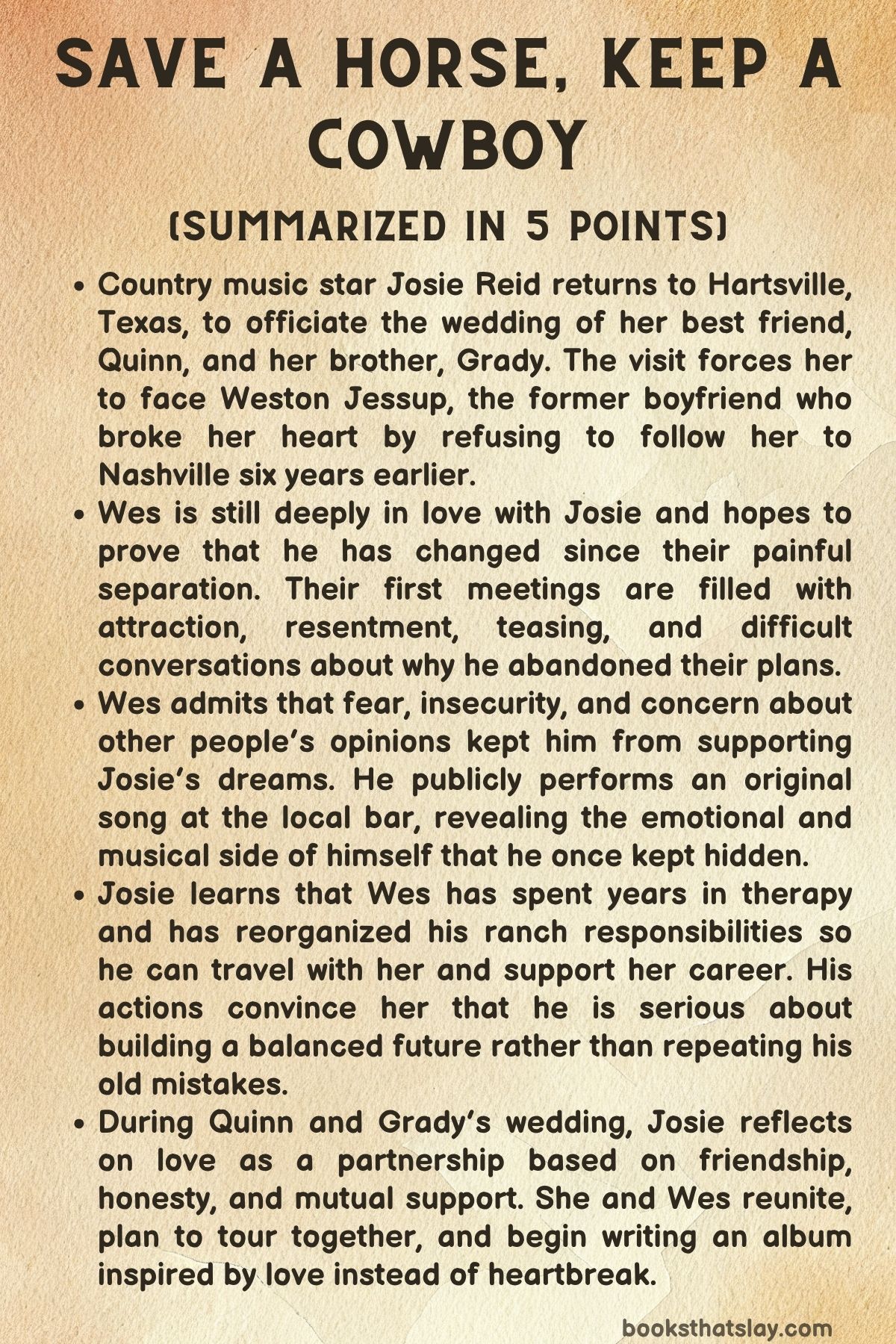
Josie Reid returns to Hartsville, Texas, after spending six years building a successful career as a country music star. She has performed before enormous audiences and faced the pressures of fame, yet returning home frightens her more than any concert because Weston Jessup, her former boyfriend and first love, will be waiting there.
Josie has come home to officiate the wedding of her best friend, Quinn, and her brother, Grady. Although she wants the weekend to be about the couple, she cannot separate Hartsville from memories of Wes, the young man who once understood her better than anyone else.
Wes was supposed to move to Nashville with Josie when she left to pursue music. They had imagined building a life together, writing songs, and supporting each other’s ambitions, but he abandoned the plan at the last moment and allowed her to leave alone.
His decision broke Josie’s heart and convinced her that returning home would only reopen wounds she had worked hard to hide. She transformed that pain into music, creating songs that brought her fame while preserving feelings she never fully resolved.
Shortly after her arrival, Quinn takes Josie to a familiar swimming spot along the Colorado River, where members of the wedding party have gathered. The landscape awakens memories of Josie’s teenage relationship with Wes, including the private moments when he allowed her to see his sensitive and artistic nature.
Wes had always appeared to be a confident cowboy committed to ranching, but Josie knew another side of him. In private, he loved music, wrote songs with her, and expressed emotions he was afraid to reveal before other people.
Josie senses Wes before she sees him and struggles to prepare herself for the encounter. When he climbs from the river, older and more physically imposing than she remembers, her immediate reaction proves that attraction and emotional attachment have survived the years between them.
Wes experiences the same shock when he sees Josie. He has followed her career from a distance, admired her success, and spent years regretting the choice that separated them.
Unlike Josie, Wes has entered the weekend with a clear intention. He wants to demonstrate that he has changed, explain the fears that controlled his younger self, and convince her that he is now capable of becoming the partner she once needed.
Their first conversation contains humor, tension, and obvious attraction. Wes compliments Josie openly, admits that he listens to her music, and reveals that he began wearing a gold chain because she once mentioned that she liked them.
These small details unsettle Josie because they show how closely he has continued to observe her. His emotional directness also contrasts with the guarded young man who once hid his feelings and worried constantly about what other people thought.
When Wes questions whether years away from Texas have weakened her courage, Josie responds by swinging from a rope and dropping into the river. She remains underwater long enough to frighten him, and he immediately jumps in to rescue her.
Josie dismisses his concern and establishes a firm boundary. She tells him that they can survive the wedding weekend peacefully, but she does not intend to rebuild a friendship or pretend that the past did not happen.
Wes accepts her warning without becoming defensive. He continues to express admiration for her career and acknowledges that many of her songs appear to contain sadness connected to their breakup.
His observation makes Josie uncomfortable because it is accurate. When he calls her “Jo,” the intimate nickname he used during their relationship, she swims away and makes it clear that he has not yet earned the right to address her so personally.
Later, the wedding party gathers at the Rattler, Hartsville’s local bar. Wes arrives wearing a backward baseball cap and new Wranglers because he remembers how attractive Josie once found that particular combination.
He also gives her the spicy margarita she used to order. The gesture demonstrates that he remembers small parts of their shared history, even though he was the person who appeared to discard their future.
Josie gradually relaxes enough to discuss her difficulty writing Quinn and Grady’s wedding ceremony. Wes listens without interrupting or dismissing her anxiety, showing a level of patience and emotional attention that he did not possess when they were younger.
He then apologizes for refusing to move to Nashville. Wes explains that he loved Josie but lacked the confidence to leave the familiar world of Hartsville, and he allowed fear, insecurity, and concern about public opinion to determine his decision.
Instead of comforting Josie, the explanation renews her anger. She hears that Wes cared more about protecting his reputation than supporting the woman he claimed to love, and she reminds him that he consciously chose to let her go.
Wes does not excuse his behavior or attempt to shift responsibility. He admits that his decision was wrong and explains that he has spent years trying to understand why he pushed away the person who mattered most to him.
Overwhelmed, Josie leaves the bar and tries to regain control of her emotions. She has repeatedly told herself that she moved beyond the relationship, but being near Wes exposes that belief as something she created for protection.
Most of her songs were inspired by him, including her newest single. She has dated other men and continued moving forward professionally, but no relationship has recreated the trust, desire, and creative connection she once shared with Wes.
Wes follows her into the parking lot but promises to leave if she asks him to. Josie finally admits the central truth behind her anger: she wanted him to choose her when they had the chance to begin their future together.
Wes answers that he is choosing her now. He explains that, as a young man raised entirely within the ranching world, he could not imagine how he would fit into her life in Nashville, and people around him reinforced the belief that artistic ambitions were unrealistic.
He also kept his doubts secret because he feared that expressing them would discourage Josie or cause her to sacrifice her career for him. Although his silence and withdrawal caused terrible damage, Josie begins to understand that his choice resulted from immaturity and fear rather than an absence of love.
Before Wes can explain everything that happened after her departure, Grady interrupts and calls him inside. Wes asks Josie to give him five minutes to prove that he is no longer the man who hid his emotions and surrendered to the expectations of others.
Josie follows him into the bar and watches him walk onto the stage with an acoustic guitar. During their original relationship, Wes refused to perform publicly because music exposed a vulnerable side of himself that he believed conflicted with the identity expected of a Texas cowboy.
In front of the town, Wes performs an original song about Quinn and Grady’s relationship, his own mistakes, and his enduring feelings for Josie. The song is humorous and imperfect, but its emotional honesty matters more than technical excellence.
He celebrates Josie’s courage, praises everything she has achieved, and admits that he spent years pretending to be someone narrower than his true self. By performing openly, he proves that he no longer believes he must choose between being a rancher, a musician, and an emotionally expressive man.
The public performance affects Josie because Wes willingly risks embarrassment and judgment. He reveals to everyone the part of himself that he once shared only with her, showing that his claimed transformation is supported by action.
After leaving the stage, Wes asks Josie to dance. During their conversation, he reveals that he has attended therapy for three years and has worked to understand his insecurity, emotional avoidance, and fear of disappointing his family and community.
Therapy helped him stop treating vulnerability as weakness. It also forced him to recognize that loving Josie required more than regretting the past; he needed to become someone capable of making practical compromises and openly supporting her career.
Josie remembers how safe she once felt with Wes. Fame has introduced her to people who admire her public image or seek advantages from her success, but Wes knew her before the awards, audiences, and professional expectations.
Hope begins to replace some of her anger, and she kisses him. Their physical connection returns immediately, confirming that their attraction has remained as strong as their emotional attachment.
As their passion intensifies, Wes stops the encounter. Although he wants Josie, he refuses to allow their reunion to become an impulsive decision that might leave her feeling used, confused, or regretful.
His restraint gives Josie another reason to believe him. He is not simply attempting to recreate a romantic memory or secure temporary forgiveness; he wants to rebuild their relationship carefully and prove that his commitment extends beyond desire.
They spend the rest of the night dancing. Before leaving, Josie asks Wes to meet her at sunrise in the pasture where they once rode horses together.
After a sleepless night, Wes prepares coffee and rides out to meet her. Josie arrives on Peaches, the horse she has known for years, and the sight reminds Wes of the fearless, independent young woman he first loved.
They race across the ranch, laugh together, and briefly recover the freedom of their younger years. The experience allows them to reconnect without ignoring adulthood, since both understand that affection alone cannot repair the problems that separated them.
During breakfast beneath the trees, Wes reveals the practical changes he has made. He has hired someone to manage many of his ranch responsibilities and intends to reduce his working hours so that the ranch will no longer control every part of his future.
He has already informed his family that he wants the freedom to travel with Josie, support her career, and create music beside her. Rather than offering vague promises, he has reorganized his life before asking her to trust him again.
Josie asks whether he will accompany her on an upcoming West Coast tour. Wes agrees immediately, proving that he is finally ready to enter her world instead of expecting her to remain permanently within his.
His willingness to travel does not require him to abandon ranching or deny his roots. Instead, he creates a flexible life in which his responsibilities, music, personal identity, and relationship can exist together.
Josie accepts that the man before her is different from the frightened young man who stayed behind. They renew their emotional and physical relationship, toast Quinn and Grady with tequila, and confess that they never stopped loving each other.
Josie also allows Wes to call her “Jo” again. The nickname signals that intimacy and trust are returning, although their reconciliation now rests on honest communication and mature choices rather than nostalgia alone.
At Quinn and Grady’s wedding, Josie prepares to officiate the ceremony before family and friends. She remains nervous, but the couple’s happiness and Wes’s presence help her understand what she wants to say about lasting partnership.
Josie reflects on everything Wes has done: attending therapy, expressing his emotions publicly, rearranging his work, preparing to travel, and accepting that supporting her dreams must be part of loving her. His actions convince her that their relationship has a realistic future.
During the ceremony, Josie speaks about the importance of friendship within romantic love. She understands that desire may begin a relationship, but friendship, respect, honesty, and mutual support allow it to survive change.
Quinn and Grady exchange vows and are pronounced married. Wes then escorts Josie down the aisle, creating a quiet public acknowledgment that their own relationship has also begun again.
At the reception, Josie admits that most of her songs have been about Wes. Her heartbreak produced some of her greatest professional success, but continuing to write only about loss would mean remaining emotionally trapped in their separation.
Wes tells her that she should no longer write heartbreak songs about him and encourages her to create love songs instead. His response reflects confidence rather than defensiveness because he now accepts his place in her music and wants to participate in its happier future.
Quinn, who once would have resisted Wes’s attempt to reunite with Josie, recognizes that he has genuinely changed. Her acceptance confirms that his transformation is visible not only to Josie but also to the people who witnessed the damage caused by his earlier decision.
The celebration ends with everyone forming a path of sparklers for the newlyweds. Josie and Wes leave together, joking about his preparations for touring and imagining how their lives will operate beyond the wedding weekend.
They return to Wes’s home and begin working on Josie’s next album. Instead of creating another collection shaped by abandonment and regret, they start writing songs inspired by forgiveness, commitment, and the future they are finally brave enough to build together.
Characters
Josie Reid
Josie Reid is a successful country music performer whose confidence onstage hides unresolved pain connected to her hometown. In Save a Horse, Keep the Cowboy, her return to Hartsville forces her to confront the difference between appearing emotionally independent and actually healing from a formative heartbreak.
Her professional accomplishments demonstrate remarkable courage, discipline, and resilience. After Wes abandoned their plan, she continued to Nashville alone, built a career from her talent, and transformed personal suffering into songs that connected with a large audience.
Josie’s anger toward Wes is not based only on the breakup itself. She believed they understood each other completely, and his last-minute decision made her question whether the private version of him she loved had ever been real.
Her music becomes both an outlet and a protective structure. Writing about loss allows her to process her emotions, but it also keeps Wes present in her life because every successful heartbreak song renews the memory of what happened.
Josie initially relies on boundaries, sarcasm, and emotional distance to protect herself. She insists that she and Wes do not need to become friends, resists his use of her private nickname, and interprets his attention as a possible threat to the stability she has created.
However, she does not reject him merely to punish him. She watches his behavior carefully because she needs evidence that his change is permanent and that he understands the seriousness of the harm he caused.
Her willingness to listen after expressing anger shows maturity. Josie does not excuse Wes’s younger behavior, but she gradually allows herself to understand how fear, limited experience, and social pressure contributed to his decision.
She also demonstrates courage by admitting that she never fully moved on. Acknowledging that her songs, relationships, and emotional life remained connected to Wes requires greater honesty than pretending she no longer cares.
Josie’s reconciliation with him is therefore not an abandonment of independence. She accepts him only after he proves that he can support her career without demanding that she reduce her ambitions or return permanently to the life he chose.
By the wedding, Josie understands love as a partnership built on friendship, respect, and flexibility. She ends the story prepared to write from happiness rather than pain, showing that personal fulfillment does not require her to choose between artistic success and emotional intimacy.
Weston Jessup
Weston Jessup is a rancher, musician, and former boyfriend whose emotional development drives the second-chance romance. His younger self loved Josie deeply but lacked the courage to challenge the expectations attached to his family, hometown, and traditional cowboy identity.
Wes’s refusal to move to Nashville was shaped by insecurity rather than indifference. He could imagine himself working on the ranch because that future was familiar, but he could not imagine how he would belong in Josie’s ambitious and unpredictable professional world.
His greatest failure was not simply staying behind. He concealed his fears, allowed Josie to believe their shared plan remained secure, and then withdrew when honest communication might have given them a chance to make a different decision.
In Save a Horse, Keep the Cowboy, Wes does not ask for forgiveness merely because he regrets losing her. He spends three years in therapy, examines the beliefs that controlled him, and takes responsibility for becoming emotionally capable of a healthy partnership.
His public performance at the Rattler represents an important rejection of his former fear. Music once belonged to the secret side of his personality, but singing before the town proves that he no longer considers emotional openness incompatible with masculinity or ranch life.
Wes also understands that declarations of love are insufficient. He hires help at the ranch, reduces his responsibilities, discusses his plans with his family, and prepares to travel before asking Josie to trust that he will support her.
These practical decisions distinguish his mature love from his younger attachment. He no longer expects Josie to fit herself around the ranch, nor does he believe loving her requires him to reject every part of his own identity.
His restraint after their first kiss also reveals growth. Instead of using physical passion to secure an immediate reunion, he stops because he wants Josie’s choice to emerge from trust rather than temporary excitement.
Wes remains playful, flirtatious, and attentive throughout the story. His memory of Josie’s preferred drink, clothing preferences, music, and nickname shows that she has remained emotionally important to him during their years apart.
His development centers on integration. By accepting himself as a cowboy, artist, emotionally vulnerable man, and supportive partner, he becomes capable of offering Josie a relationship in which neither person must surrender a central part of who they are.
Quinn
Quinn is Josie’s best friend and Grady’s bride, placing her at the center of the event that brings Josie and Wes together again. She understands the history between them and recognizes how deeply Wes’s decision affected Josie.
Her early attempts to reassure Josie reveal loyalty and emotional awareness. Quinn does not dismiss her friend’s fear of returning home, even though she hopes the wedding weekend will create space for celebration rather than renewed pain.
As Josie’s closest friend, Quinn likely sees beyond the public image of a confident country star. She understands that professional success did not erase the emotional consequences of leaving Hartsville alone.
Quinn’s attitude toward Wes provides an external measure of his growth. She would once have opposed his attempt to reunite with Josie because she witnessed the damage he caused, but his sustained effort and visible honesty eventually change her judgment.
Her willingness to reconsider him does not suggest that she forgets the past. Instead, it indicates that she values accountability and believes people can earn trust when change is supported by consistent action.
Quinn’s wedding also offers Josie a model of love grounded in friendship. Her relationship with Grady helps Josie recognize that enduring romance requires companionship, respect, shared joy, and the ability to face difficult realities together.
Although Quinn’s personal romance remains mostly in the background, her happiness shapes the emotional atmosphere of the book. The wedding creates the conditions under which Josie and Wes can compare their failed youthful plans with a more mature understanding of commitment.
Quinn ultimately functions as both friend and witness. Her acceptance gives Josie additional confidence that reconciliation is not simply the result of lingering attraction but a response to real evidence that Wes has become a more dependable man.
Grady Reid
Grady Reid is Josie’s brother and Quinn’s future husband. His wedding brings Josie back to Hartsville and places her in the same social setting as Wes after six years of avoidance.
Grady’s relationship with Quinn appears stable, joyful, and rooted in genuine friendship. Their bond inspires Josie’s ceremony and helps her articulate the kind of partnership she now wants for herself.
As Josie’s brother, Grady belongs to both sides of the emotional situation. He is connected to her pain while also sharing the hometown community and social world in which Wes has spent the years after the breakup.
His interruption during the parking-lot conversation delays Wes’s full explanation, but it also leads directly to the public performance. By calling Wes back inside, Grady unintentionally creates the moment when Wes proves that he is willing to expose his musical and emotional identity before everyone.
The song Wes performs celebrates Grady and Quinn while also acknowledging personal mistakes. Grady therefore becomes part of the setting in which private regret is transformed into a public declaration of change.
His wedding provides an important contrast to Josie and Wes’s earlier relationship. Grady and Quinn are prepared to make vows openly, while the younger Josie and Wes relied on private promises that collapsed when those promises were tested by fear.
Grady’s presence also reconnects Josie to family and home. Her return is not solely about confronting Wes; it is an act of love for her brother and a recognition that Hartsville contains relationships worth preserving despite painful memories.
By the end, Grady’s marriage represents a new beginning for the larger family. His celebration gives Josie and Wes the opportunity to begin their own renewed partnership without taking attention away from the couple whose commitment brought everyone together.
Peaches
Peaches is Josie’s longtime horse and a quiet link between her past and present. Riding Peaches at sunrise allows Josie to return to a familiar part of herself that existed before fame, touring, and public recognition.
The horse also helps create a space where Josie and Wes can reconnect without the pressure of the wedding party or the Hartsville community. Their race across the ranch restores playfulness and reminds them that their relationship once included freedom, friendship, and shared adventure.
Peaches does not merely represent nostalgia. Josie’s confident riding shows that she can return home without becoming the uncertain young woman who left six years earlier.
The sunrise ride places Josie’s independent identity beside Wes’s changed behavior. She arrives on her own terms, while he meets her prepared to discuss the practical future he has already begun arranging.
Through Peaches, the Texas landscape becomes part of Josie’s identity rather than a prison she must escape. She can remain connected to Hartsville while continuing to pursue a career that carries her far beyond it.
Themes
Love Must Be Supported by Action
Love remains present between Josie and Wes throughout their six-year separation, but emotion alone does not make their original relationship sustainable. Wes loved Josie when they were young, yet he failed to communicate his fears, honor their shared plan, or take the practical risks required to follow her.
The renewed relationship succeeds because Wes finally connects feeling with behavior. Therapy, public honesty, changes at the ranch, conversations with his family, and his willingness to tour with Josie provide evidence that his promises are no longer based on temporary emotion.
Josie also demonstrates love through action. She returns for Quinn and Grady’s wedding despite her fear, listens to explanations that initially cause pain, and evaluates Wes according to the person he has become rather than accepting or rejecting him solely because of the past.
Save a Horse, Keep the Cowboy presents commitment as a continuing series of choices. A person may feel devotion privately, but a healthy relationship requires that devotion to influence communication, priorities, schedules, sacrifices, and everyday decisions.
Wes’s decision to stop their physical encounter reinforces this principle. He values the possibility of a lasting future more than immediate satisfaction, demonstrating that respect can be a stronger expression of love than passion.
Their final collaboration on Josie’s album confirms that action remains central to their future. They do not simply declare themselves reunited; they begin creating, traveling, and building a life in which both partners actively support the other.
Vulnerability and Personal Identity
Wes’s younger self believes that emotional openness and artistic expression are incompatible with the masculine identity expected of a Texas rancher. He hides his music, avoids discussing fear, and allows public opinion to influence one of the most important decisions of his life.
This emotional restriction harms both Wes and Josie. Because he cannot admit that Nashville frightens him, Josie receives no opportunity to understand his uncertainty, reassure him, or develop a compromise before their relationship collapses.
His public song at the Rattler marks a rejection of this divided identity. Wes stands before people who know him as a cowboy and reveals that he is also a musician, romantic partner, imperfect man, and person capable of shame and regret.
Therapy helps him understand that vulnerability does not reduce strength. By speaking honestly about his mistakes and needs, he becomes more dependable because Josie no longer has to guess what he feels or fear that he will silently withdraw again.
Josie faces a different challenge involving identity. Fame has encouraged people to see her as a successful public figure, but returning home reconnects her with the private self who still carries grief, longing, and uncertainty.
Their reconciliation becomes possible when both stop protecting simplified versions of themselves. Wes no longer performs emotional toughness, and Josie no longer treats complete independence as proof that she has healed.
The story suggests that mature identity can contain apparent contradictions. A person can be ambitious and rooted, strong and vulnerable, independent and deeply connected to someone else.
Ambition, Compromise, and Partnership
Josie’s career is never presented as an obstacle she should abandon for romance. Her decision to leave Hartsville reflects talent, determination, and a refusal to limit her future according to what other people consider practical.
The original conflict develops because Wes treats Nashville and the ranch as opposing worlds. He believes following Josie would mean surrendering his place in Hartsville, while remaining home appears to require losing the woman he loves.
His eventual solution emerges from flexibility rather than total sacrifice. By delegating ranch duties and working part-time, he creates a structure that allows him to travel, write music, maintain family connections, and participate in Josie’s professional life.
Josie also accepts that a relationship requires space for Wes’s identity. She does not demand that he sell the ranch or reject Hartsville, and she begins imagining a future in which touring and home life can exist beside each other.
Their compromise works because neither partner’s dream is automatically treated as more valuable. Wes must make significant changes because his earlier inflexibility caused the separation, but the final arrangement still respects the life and responsibilities that matter to him.
The theme challenges the idea that romance requires one person to surrender ambition. Partnership becomes strongest when two people treat success as something they can support together rather than a competition between incompatible futures.
By beginning a new album as collaborators, Josie and Wes transform compromise into creation. Their different worlds no longer separate them; those worlds provide the experiences from which they can build a shared artistic and personal life.
Forgiveness, Growth, and Second Chances
Forgiveness in the story is not immediate, effortless, or based only on continued attraction. Josie’s pain remains valid even after she understands that fear and immaturity influenced Wes’s decision.
Wes cannot undo the years they lost or erase the loneliness Josie experienced when she moved to Nashville alone. His responsibility is therefore not to persuade her that the past was less damaging than she remembers, but to show that he has learned from it.
His apology becomes meaningful because it includes accountability. He does not blame his family, hometown, or youth, even though each influenced him, and he accepts that he chose social safety over the relationship.
Josie’s forgiveness develops gradually as words and actions begin to match. She listens to him, watches him perform publicly, learns about his therapy, observes his restraint, and hears the practical plans he has made for joining her life.
The second chance does not restore their teenage relationship exactly as it was. Their earlier bond contained love and creativity, but it lacked the communication, courage, and flexibility necessary to survive major change.
Growth allows them to create a different relationship using the strongest parts of their history. Their shared music, humor, attraction, and understanding remain, while secrecy and rigid expectations are replaced by openness and cooperation.
Josie’s future songs symbolize the completion of this process. She does not erase the heartbreak that shaped her art, but she gains the freedom to write about something beyond loss, proving that forgiveness can honor the past without remaining controlled by it.