She Waits Where Shadows Gather Summary, Characters and Themes
She Waits Where Shadows Gather by Michelle Tang is a supernatural horror novel about marriage, inherited trauma, cultural disconnection, and the consequences of possessive love.
Set mainly inside an ancestral house in Manila, the story follows Avery and Carlos Tam as buried family secrets begin influencing both the living and the dead. What initially appears to be a conventional haunting gradually becomes a more complicated conflict involving curses, time, identity, regret, and sacrifice. Through disturbing supernatural events and an emotionally damaged marriage, the novel asks whether people can change after causing irreversible harm and whether love remains meaningful when it is mixed with deception, fear, and control.
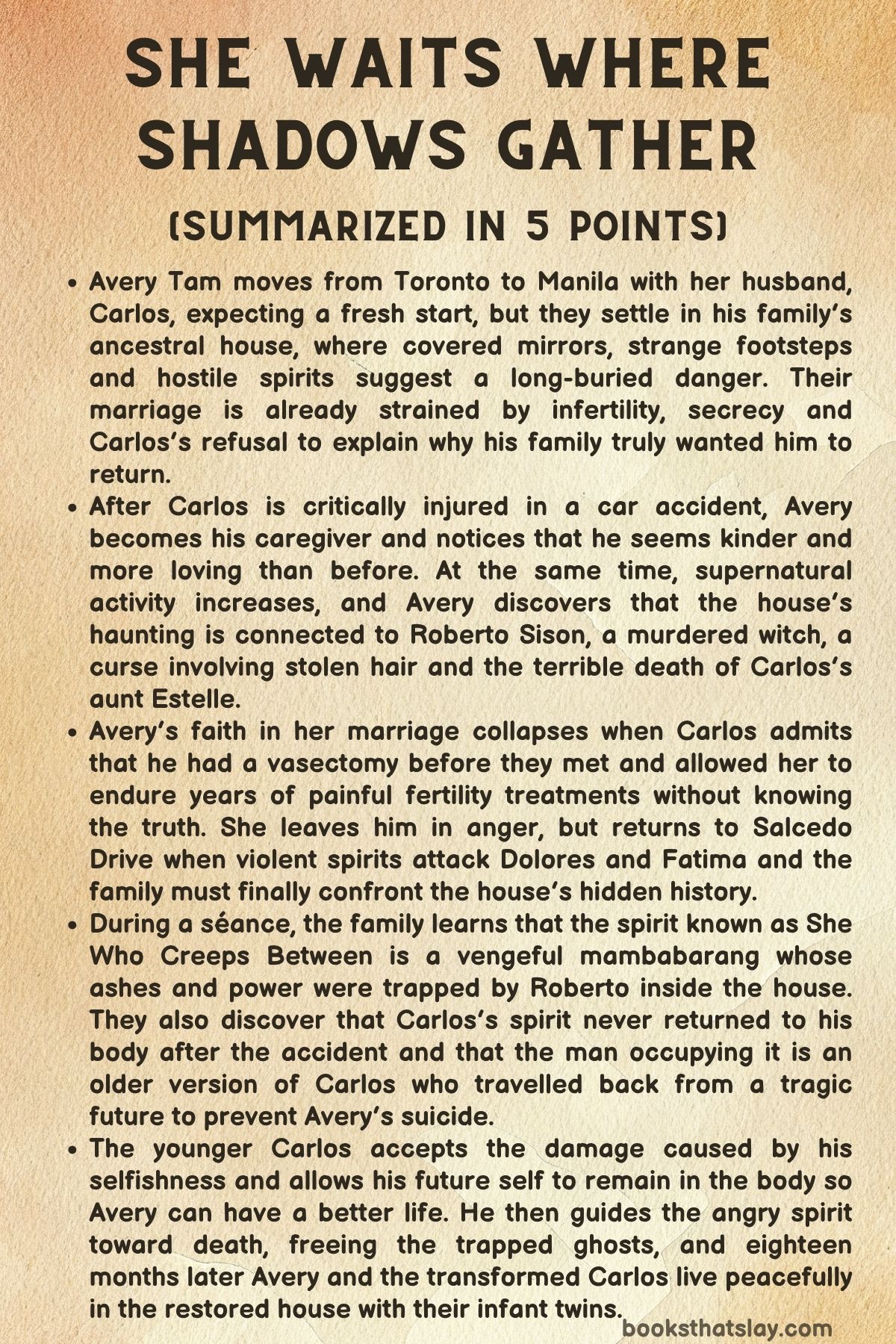
Summary
Avery Tam moves from Toronto to Manila with her husband, Carlos, believing the relocation might offer their troubled marriage a new beginning. Although her parents were born in the Philippines, Avery has never visited the country, and she immediately feels like an outsider within both the city and Carlos’s family.
The couple stays at the old Sison family house on Salcedo Drive, despite the visible alarm of Carlos’s relatives. Avery soon notices covered mirrors, unexplained footsteps, doors opening by themselves, whispers in empty rooms, and the disturbing sensation that something is observing her from inside the walls.
Carlos initially conceals the real reason for their return. His elderly family servant, Dolores, claims to have seen the ghost of Carlos’s grandfather Roberto, and the family wants Carlos, a professional paranormal investigator and television skeptic, to determine whether the house is genuinely haunted.
Although Carlos dismisses supernatural explanations in public, he is privately terrified of the house. His childhood memories of Roberto, the attic, forbidden mirrors, and mysterious voices suggest that he has spent years building his skeptical career as a defence against experiences he cannot explain.
The tension between Avery and Carlos is intensified by their unsuccessful attempts to have a child. Avery has undergone examinations, treatments, injections, and emotional disappointment, while Carlos avoids fertility appointments and behaves as though her desperation for motherhood is an unreasonable burden.
Avery becomes increasingly angry when Carlos arranges a large religious blessing for the house without consulting her. During the gathering, the family learns that three hooded figures recently knocked at the door in the middle of the night, and the visitors are identified as the Kumakatok, supernatural figures believed to announce an approaching death.
Instead of remaining with Avery during an important stage of her fertility cycle, Carlos goes drinking with his production crew. He later drives home recklessly, loses control of the vehicle, and suffers a devastating accident after seeing what appears to be another man with his own face approaching the wreck.
Carlos’s heart stops temporarily, and he remains unconscious after surgery. Avery stays beside him, burdened by guilt, financial uncertainty, and the possibility that caring for him will consume the remaining years in which she might become a mother.
When Carlos eventually returns to Salcedo Drive, he is almost unable to move or communicate. Avery becomes his primary caregiver, but she notices that his expressions have changed; instead of impatience and possessiveness, he looks at her with tenderness, gratitude, and affection.
The changed Carlos seems like the man Avery once believed she married. Their emotional closeness slowly returns, even as the supernatural activity becomes more aggressive and unexplained figures appear in mirrors, corridors, bedrooms, and the spaces between the walls.
Carlos, however, experiences the situation differently. He believes himself trapped inside a damaged body and grows resentful whenever Avery leaves the room, while a malicious female spirit known as She Who Creeps Between encourages his jealousy and tells him that Avery intends to abandon him.
The entity cannot enter Carlos’s room because of a protective charm placed behind the door. Carlos begins communicating with it and asks it to frighten Avery, believing that fear will make his wife depend on him again.
Avery learns that the family’s terror began with the childhood death of Carlos’s aunt Estelle. When Estelle was nine, a strange woman appeared at the house and persuaded the child to surrender a handful of hair, after which Estelle became mysteriously and fatally ill.
Loose hair, insects, mirrors, and strangers consequently became sources of fear within the family. Dolores secretly collects Avery’s fallen hair, apparently trying to prevent it from being used in the same kind of ritual that destroyed Estelle.
As Avery investigates the house, she discovers that Roberto had been involved with witches, curses, ritual objects, and three mirrors that were never supposed to be uncovered or removed. A photograph found in the attic shows the same angry woman Avery and Tessa have seen reflected behind them.
The house gradually attacks Avery’s mind as well as her body. On her thirty-seventh birthday, while drunk, exhausted, and convinced that her future has disappeared, she hears a voice encouraging her to kill herself with Carlos’s unused morphine.
Before Avery can swallow the medication, the physically weakened Carlos drags himself across the floor and stops her. His impossible effort convinces Avery that he genuinely loves her, and his recovery becomes dramatically faster afterward.
Their restored intimacy is soon destroyed when Carlos finally admits that he underwent a vasectomy before meeting Avery. For two years, he allowed her to believe she was responsible for their infertility while she endured painful procedures, spent her savings, and watched her chance of motherhood diminish.
Avery realizes that Carlos deliberately concealed the truth because he feared a child would take her attention away from him. Devastated by the years he stole from her, she strikes him, leaves the house, and wanders through Manila while counting everything she surrendered for their marriage.
Father Michael gives Avery shelter, and Tessa supports her without defending Carlos. Although Avery plans to return to Canada, she decides that she must first remove the supernatural curse and understand what happened inside Salcedo Drive.
Back at the house, the abandoned Carlos gives himself more completely to She Who Creeps Between. The entity attacks Dolores and Fatima, while Carlos, consumed by humiliation and resentment, treats their fear as evidence that he finally possesses power.
Avery, Tessa, Father Michael, and Dolores conduct a séance to confront the dead. Dolores reveals that the woman responsible for Estelle’s death was a mambabarang, a practitioner capable of controlling insects, spirits, and curses through personal objects such as hair.
The mambabarang targeted Roberto’s family in revenge. Estelle resisted an order to steal her mother’s hair and surrendered her own instead, causing insects to grow within her body until her horrific death.
Roberto possesses Dolores during the séance and confesses that he abandoned his dying daughter to pursue revenge. He eventually killed the mambabarang, trapped her magic inside three mirrors, and sealed her ashes in a silver container, hoping to prevent her power, body, and spirit from reuniting.
Years later, Carlos stole the silver box as a child and spilled the ashes beneath the floorboards. The mambabarang then spread through the structure of the house, becoming She Who Creeps Between and influencing Carlos’s thoughts for years.
The séance produces an even greater revelation when Carlos sees his own injured body sitting beside Avery. He understands that he has not been occupying it at all; his spirit failed to return after the accident, and the angry presence called the Broken Man is Carlos himself.
The person controlling his body is another version of Carlos who has travelled from ten years in the future. After Avery died by suicide in the original timeline, that older Carlos spent a decade consumed by grief, remorse, and awareness of the harm caused by his selfishness.
When the future Carlos eventually died, he found an opening leading back to the car accident. He entered his younger body to prevent Avery’s death, knowing that changing the past might cost him his own afterlife.
The future Carlos was responsible for the kindness Avery observed after the accident. He stopped her suicide attempt, confessed the vasectomy, tried to persuade her to leave the dangerous house, and accepted that she deserved freedom even if she never chose him again.
Avery realizes that the changed man she loves is still Carlos, but he is a version shaped by ten years of regret. The younger Carlos watches her grieve for the man he might have become and finally sees how thoroughly his jealousy and dishonesty damaged her.
Instead of fighting to reclaim his body, the younger Carlos allows his future self to remain. He recognizes that Avery deserves the mature and remorseful version of him, although he admits that surrendering his life also allows him to escape the consequences of his actions.
The younger Carlos then confronts the mambabarang, who has fed on his rage since childhood. Rather than attempting to overpower her, he recognizes the exhaustion beneath her hatred and persuades her to stop sustaining herself through vengeance.
Carlos and the mambabarang pass together into death, releasing Estelle, Roberto, and the spirits bound to the house. His final decision becomes both an act of love and an acceptance that he cannot repair his marriage while remaining the person who caused Avery’s suffering.
Eighteen months later, Salcedo Drive has become a peaceful family home. Avery lives there with the future Carlos, who remains in his younger body, and they have infant twins after addressing the vasectomy that once made pregnancy impossible.
Carlos embraces fatherhood, treats Avery with respect, and resumes his television career with an honest belief in the supernatural. Although Avery continues to mourn the younger Carlos and question his final motives, dreams of him suggest that he has found peace, while the transformed house reflects the family’s release from secrecy, resentment, and inherited grief.
Characters
Avery Tam
Avery is the emotional centre of She Waits Where Shadows Gather, and her experience gives the supernatural story its strongest human conflict. She arrives in Manila hoping to repair her marriage, but she is already carrying grief over her sister Noelle, anxiety about infertility, and uncertainty about her connection to Filipino culture.
Her desire to have a child is not presented as a passing wish but as a central part of the future she has imagined. Because Carlos secretly knows conception is impossible, every treatment Avery undergoes becomes evidence of how thoroughly her trust has been exploited.
Avery initially relies on rational explanations for the house’s activity, even when those explanations become increasingly difficult to maintain. Her resistance is partly intellectual, but it is also protective, since admitting that the haunting is real would mean accepting that she has entered a family history she does not understand.
Her caregiving reveals endurance, loyalty, and a dangerous tendency to place her obligations above her own well-being. She remains with Carlos after his accident even though doing so threatens her finances, fertility, independence, and emotional health.
Avery’s suicide attempt emerges from accumulated isolation rather than a single moment of weakness. The supernatural entity influences her, but the despair it uses was created by years of grief, manipulation, financial sacrifice, and emotional neglect.
Her eventual departure from Carlos is therefore an assertion of dignity and bodily autonomy. Even after leaving, however, she returns to confront the haunting because she refuses to allow fear, guilt, or unfinished family violence to control her future.
Younger Carlos Tam
The younger Carlos is one of the most morally difficult figures in She Waits Where Shadows Gather because his cruelty grows from recognizable emotional wounds without being excused by them. He fears abandonment so deeply that he tries to make Avery’s entire emotional life revolve around him.
His vasectomy and subsequent deception expose the controlling nature of his love. He does not merely decide that he does not want children; he removes Avery’s ability to make an informed decision about her own marriage, body, money, and future.
Carlos repeatedly interprets Avery’s independence as rejection. Her exhaustion becomes neglect in his mind, her relationship with Father Michael becomes a reason for jealousy, and her desire for a child becomes evidence that his love is insufficient.
She Who Creeps Between strengthens these thoughts, but she does not create them. Carlos willingly asks the spirit to frighten Avery and later allows it to attack Dolores and Fatima because supernatural power gives him a temporary escape from helplessness.
His final decision shows that some moral awareness remains beneath his possessiveness. By allowing his future self to keep the body and guiding the mambabarang toward death, he accepts that Avery’s happiness may require his absence.
The sacrifice does not erase his betrayal, and Carlos understands that part of him is still avoiding accountability. That unresolved mixture of love, guilt, selfishness, and surrender makes his ending morally complicated rather than simply heroic.
Future Carlos Tam
Future Carlos represents the person the younger Carlos becomes only after suffering the full consequences of his behaviour. Ten years of grief after Avery’s suicide force him to recognize the emotional abuse, dishonesty, and possessiveness he once defended.
His return to the past is motivated by remorse rather than self-preservation. He accepts the possible loss of his afterlife because preventing Avery’s death matters more to him than recovering his career, reputation, or former comforts.
The physical condition of Carlos’s body reflects the difficulty of his possession. His incomplete control causes blackouts and delayed recovery, yet his effort to stop Avery from taking the morphine allows him to establish a stronger connection to the body.
Future Carlos demonstrates love through truth rather than control. He confesses the vasectomy, urges Avery to leave the dangerous house, continues paying his employees, and accepts that Avery may choose a life that does not include him.
His maturity does not make the past disappear. He understands that he is still Carlos and therefore remains responsible for the earlier deception, even though suffering has changed his values and behaviour.
By raising children and rebuilding the marriage, he receives an extraordinary second chance. His responsibility is not merely to enjoy that chance but to prove through daily actions that regret can produce lasting ethical change.
Roberto Sison
Roberto is remembered as both a frightening patriarch and a defender of his family. His supernatural knowledge allows him to identify dangerous forces, yet his pride and desire for revenge repeatedly make those dangers worse.
His greatest failure occurs when Estelle is dying. Instead of remaining with his daughter, he pursues the woman responsible for the curse, allowing vengeance to replace parental love at the moment his family needs him most.
Roberto’s punishment of the mambabarang is also driven by guilt. By dividing her spirit, magic, and remains among mirrors and a silver container, he creates a fragile prison that later collapses because the family never understands its purpose.
His secrecy leaves later generations vulnerable. Carlos grows up fearing him, Tessa knows only fragments of the truth, and Dolores carries the responsibility for protecting the house long after Roberto’s death.
Roberto remains in Salcedo Drive because Estelle cannot move on. His continued presence shows that his power cannot release him from remorse, and his eventual confession requires him to admit that revenge never repaired the loss he caused.
Tessa Sison
Tessa is practical, loyal, direct, and far more willing than Carlos to acknowledge the family’s supernatural history. She exposes Carlos’s initial dishonesty about the reason for returning to Manila because she understands that Avery deserves to know what danger she has entered.
Her relationship with Avery develops into one of the most dependable bonds in the story. She offers protection, cultural explanations, emotional support, and immediate solidarity after learning about Carlos’s vasectomy.
Tessa also acts as a link between childhood memory and present evidence. Her recollection of seeing the woman in the mirror confirms that Avery’s visions are not hallucinations created by exhaustion or stress.
Although Tessa sometimes behaves recklessly, particularly when encouraging the séance, her actions come from a desire to end the family’s silence. She recognizes that avoiding the past has not protected anyone and that the truth must be faced directly.
Her refusal to defend Carlos after his betrayal is especially important. She loves her brother but does not confuse family loyalty with the obligation to excuse abuse.
Dolores
Dolores appears at first to be an elderly servant governed by superstition, but she is eventually revealed as one of the most knowledgeable and influential characters in the novel. Roberto effectively adopted her after witches killed her parents, creating a bond based on rescue, gratitude, trauma, and responsibility.
She spends much of her life guarding the Sison family and the house. Her habit of collecting loose hair, covering mirrors, observing insects, and enforcing household rules reflects knowledge gained through direct exposure to supernatural violence.
Dolores deliberately manipulates events by pretending that Roberto’s ghost has only recently appeared. She brings Carlos back because she believes the younger generation must finally inherit the responsibility she has carried for decades.
Her loyalty to Roberto initially prevents her from acknowledging his mistakes. When Avery suggests that he may have murdered the woman in the photograph, Dolores reacts defensively because accepting his guilt would complicate the identity of the man she regards as her saviour.
As a natural medium, Dolores becomes the voice through which Roberto confesses. Her role in the séance allows hidden history to become shared knowledge, ending the silence that enabled the curse to survive.
She Who Creeps Between
She Who Creeps Between is the spirit of the mambabarang whose ashes were scattered beneath the floorboards. Her name reflects her existence within walls, floors, mirrors, thoughts, and emotional divisions rather than in a stable physical form.
She gains power by encouraging resentment, suspicion, jealousy, and despair. Instead of creating entirely new emotions, she identifies the anger already present in Carlos and Avery and strengthens it until they become vulnerable to destructive choices.
Her influence over Carlos begins in childhood. By presenting Roberto as a cruel captor and herself as a helpless victim, she shapes Carlos’s memories and turns his fear of abandonment into hatred.
The spirit’s revenge began with genuine suffering and inherited rage. Her mother was imprisoned after Roberto exposed her, and she responds by attacking Estelle, binding spirits, and extending punishment across generations.
Her final confrontation with Carlos reveals exhaustion beneath her cruelty. She has repeated her hatred for so long that she no longer understands who she would be without it, making her departure an end to both vengeance and self-imprisonment.
Estelle Sison
Estelle is physically absent from most of the story, yet her death determines the behaviour of the entire family. Her childhood encounter with the mambabarang creates the fear surrounding loose hair, insects, strangers, doors, and supernatural rituals.
Her decision to give her own hair instead of stealing her mother’s shows courage and instinctive self-sacrifice. As a child under supernatural control, she still attempts to protect someone else, even though doing so redirects the curse toward her.
The horror of Estelle’s death leaves Evelyn emotionally damaged and Roberto consumed by guilt. It also creates the secrecy that shapes Carlos’s childhood and prevents later generations from understanding the house.
Estelle’s spirit remains trapped because the mambabarang continues controlling her after death. Her eventual release gives the supernatural conflict its clearest moral resolution, since the innocent child at the centre of the tragedy is finally freed.
Evelyn Sison
Evelyn initially appears judgmental, demanding, and hostile toward Avery. Her comments about language, pregnancy, and family expectations deepen Avery’s sense that she is failing to meet standards she was never given a fair chance to understand.
Her behaviour is partly shaped by unresolved grief over Estelle. As a young woman, Evelyn watched her sister suffer an incomprehensible illness while Roberto disappeared to pursue revenge, leaving her with helplessness and anger she never properly processed.
Evelyn’s emotional distance also affects Carlos. After Estelle’s death, she becomes less available to him, contributing to the abandonment fears that later damage his marriage.
Her growing connection with Avery begins when the two women speak honestly about losing their sisters. Shared grief creates an understanding that cultural expectation and family authority could not achieve.
Evelyn does not become a completely different person, but she becomes more human once her pain is visible. Her development shows how harshness can function as protection around sorrow that has never been openly acknowledged.
Father Michael
Father Michael provides spiritual guidance without demanding unquestioning obedience. Although he participates in blessings, possession discussions, and supernatural investigations, his most important quality is his practical compassion.
When Avery leaves Carlos, Michael gives her shelter, washes her injured feet, treats her hand, and listens without condemning her. He allows her to admit both Carlos’s betrayal and her shame over striking him without reducing her experience to either victimhood or guilt.
Michael also offers interpretations without forcing Avery to accept them. His suggestion that Carlos may have confessed partly to drive her away from danger complicates her understanding while still respecting her anger.
His presence during the attic investigation and séance places him at the boundary between religious belief and local supernatural traditions. He does not dismiss what falls outside conventional doctrine when the evidence becomes undeniable.
Fatima
Fatima enters the house as a new employee, but her sensitivity to supernatural activity quickly makes her important. She hears whispers, notices movement, and understands that the illness affecting Carlos may be connected to forces within the house.
Her fear is justified rather than exaggerated. She becomes a direct target when She Who Creeps Between begins attacking the household, demonstrating how Carlos’s anger harms people with little power over the family conflict.
Fatima also represents the ordinary person drawn into a dangerous legacy without receiving the full truth. Like Avery, she must understand the rules of Salcedo Drive while the people who know its history remain secretive.
Her survival and escape from the entity expose the seriousness of Carlos’s moral decline. He hears her suffering and chooses not to help, turning her terror into evidence of how far he has surrendered to resentment.
Winnie
Winnie is a member of Carlos’s production team and participates in the secret séance. Her camera provides visual evidence of glowing orbs around Carlos and throughout the room, supporting the possibility that several spirits are present simultaneously.
Her involvement also connects Carlos’s commercial paranormal career with the genuine supernatural crisis. The techniques once used to create entertainment become tools for recording phenomena that cannot be dismissed as television staging.
Winnie is curious and willing to take risks, but she lacks the family’s knowledge of the house. Her presence during the séance emphasizes how quickly curiosity can become dangerous when spiritual forces are treated as objects of investigation.
Iris
Iris is initially considered for employment because Carlos prefers her skeptical attitude. His interest in hiring her shows how strongly he wants the household to support his public denial of supernatural activity.
She later assists Avery and Carlos with their twins after the haunting has ended. Her return in the peaceful final period contrasts with the earlier decision to hire Fatima and signals that the house no longer requires servants who understand or fear its supernatural behaviour.
Although Iris has a limited role, her presence helps mark the difference between Salcedo Drive during the curse and after its release. Ordinary domestic life becomes possible once hidden violence is no longer controlling the household.
Dr. Chen
Dr. Chen approaches Carlos’s recovery from a medical perspective but recognizes that the situation does not follow expected patterns. His concern about Carlos’s slow progress increases the family’s fear that the house is draining his strength.
His willingness to mention traditional explanations does not mean that he abandons medicine. Instead, he acknowledges that the family understands illness through both clinical and spiritual frameworks.
Dr. Chen also demonstrates Carlos’s powerlessness after the accident. Carlos believes he is speaking, yet the doctor and family appear to ignore him because his spirit is no longer properly connected to his body.
Noelle
Noelle, Avery’s deceased sister, remains part of Avery’s emotional life even though she does not participate directly in the events. Her death contributes to Avery’s grief and strengthens her longing to create a family of her own.
Avery’s memories of Noelle also help her understand Evelyn. The connection between the two women becomes possible because each knows what it means to live after losing a sister.
Noelle’s absence therefore supports the novel’s larger focus on how the dead continue shaping the choices of the living. Unlike the hostile spirits in the house, her influence survives through memory, love, and unresolved sorrow.
Themes
Love, Possession, and Personal Freedom
Love repeatedly becomes dangerous when it is treated as ownership rather than a relationship between independent people. In She Waits Where Shadows Gather, the younger Carlos believes Avery’s devotion should belong entirely to him, and his fear of losing her attention leads him to conceal his vasectomy and silently watch her endure unnecessary medical treatment.
His behaviour demonstrates that affection does not become ethical merely because the person causing harm experiences genuine emotional need. Carlos may sincerely love Avery, but he uses deception to control her decisions, ensuring that she cannot choose motherhood, leave the marriage with complete knowledge, or determine how to spend her savings and fertile years.
Future Carlos provides a contrasting model of love because he begins accepting Avery’s freedom. He tells the truth even though it may end the marriage, tries to remove her from danger, and accepts that she may eventually find happiness with another person.
The distinction between the two versions of Carlos is therefore not the presence or absence of love but the form that love takes. The younger man tries to secure Avery through dependence, while the older man protects her right to choose, even when her choice may exclude him.
Avery’s development follows the same principle. Her departure is not a rejection of love itself but a refusal to remain inside a relationship where devotion requires the surrender of identity, bodily autonomy, and hope.
Inherited Trauma and Family Secrecy
The suffering inside Salcedo Drive survives because each generation receives fear without receiving a complete explanation. Covered mirrors, collected hair, warnings about insects, and forbidden rooms become household customs, but the reasons behind them are hidden.
Roberto’s secrecy begins the pattern. By trapping the mambabarang’s remains and powers without fully explaining what he has done, he leaves the family dependent on rules that can easily be broken by a curious child.
Carlos grows up surrounded by warnings, frightening memories, and distorted stories about his grandfather. Because nobody gives him a truthful account, She Who Creeps Between can fill the gaps and persuade him that Roberto is simply a cruel and dangerous man.
Evelyn’s grief also passes into the next generation. Her emotional withdrawal after Estelle’s death contributes to Carlos’s fear of abandonment, which later becomes possessiveness within his marriage.
Dolores attempts to protect the family by maintaining silence, yet her secrecy prolongs the danger. Avery’s investigation becomes necessary because inherited customs without honest communication are not enough to prevent repetition.
The eventual séance functions as a shared confrontation with family history. Healing begins only when Roberto admits his failures, Dolores reveals her motives, Carlos understands the source of the voices, and Estelle’s suffering is spoken about openly rather than hidden behind superstition.
Infertility, Bodily Autonomy, and Betrayal
Avery’s infertility struggle is inseparable from questions of consent and control. She believes she and Carlos are facing a shared medical problem, but he knows from the beginning that his vasectomy is the actual reason they cannot conceive.
By concealing this information, Carlos takes more than the possibility of pregnancy. He takes Avery’s ability to make informed choices about treatment, marriage, finances, and the limited reproductive time available to her.
The betrayal is especially severe because Avery repeatedly directs blame toward her own body. She undergoes painful examinations and injections while Carlos permits her to believe that she is failing to achieve the future they supposedly want together.
His motive reveals the selfishness beneath the deception. Carlos fears that a child will compete with him for Avery’s love, so he protects his own emotional security by allowing her to experience physical pain and mounting desperation.
Avery’s fury after the confession is therefore connected to far more than a disagreement about parenthood. She recognizes that her husband has treated her body and time as resources he has the right to manage.
The later birth of the twins does not erase what happened. Instead, it shows what becomes possible only after the truth is acknowledged, the vasectomy is addressed, and Avery’s desire for motherhood is finally treated as a legitimate choice rather than a threat.
Anger, Vengeance, and the Possibility of Release
The supernatural curse is sustained by anger that has outlived its original cause. The mambabarang’s revenge begins with her family’s suffering, but it expands until innocent people such as Estelle, Avery, Fatima, and later generations are forced to pay for conflicts they did not create.
Roberto responds to Estelle’s curse with his own desire for vengeance. Rather than remaining with his dying daughter, he hunts the person responsible and constructs a supernatural prison, turning grief into punishment instead of care.
Carlos repeats the pattern whenever he uses anger to avoid helplessness. After Avery leaves, he permits the spirit to attack Dolores and Fatima because their fear briefly makes him feel powerful, important, and capable of controlling his surroundings.
She Who Creeps Between becomes strong because Carlos continues feeding her the resentment she encourages. The relationship between them shows how anger can feel protective while gradually making a person dependent on the very force destroying them.
The cycle ends through recognition rather than greater violence. Carlos sees that the mambabarang is exhausted by hatred just as he is, and he persuades her that neither of them must continue existing only to punish others.
Their final passage into death does not excuse the suffering they caused. It establishes that release becomes possible when they stop treating pain as a debt that must be transferred to someone else.