Summer State of Mind Summary, Characters and Themes
Summer State of Mind by Kristy Woodson Harvey is a contemporary novel about emotional recovery, complicated families, second chances, and the many forms that parenthood can take.
Set primarily in the close-knit coastal town of Cape Carolina, the book follows neonatal nurse Daisy Stevens, former baseball prospect Mason Thaysden, and Mason’s unconventional aunt Tilley as each confronts a past that has limited the future. An abandoned newborn brings their lives together, creating powerful bonds while raising difficult questions about love, responsibility, truth, and belonging. The story balances romance and family drama with thoughtful examinations of grief, mental health, foster care, and personal reinvention.
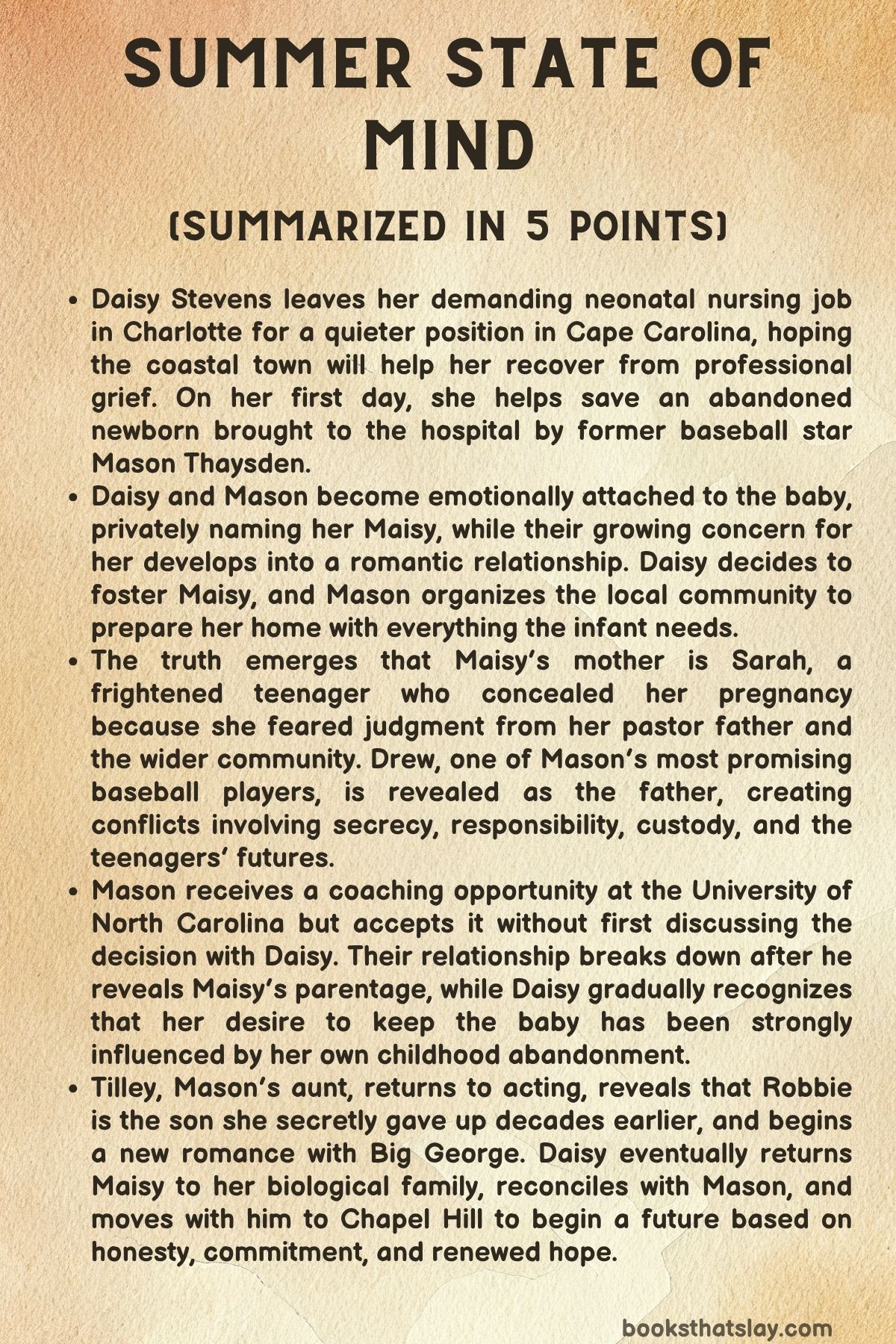
Summary
Daisy Stevens is a thirty-four-year-old neonatal intensive care nurse who has become emotionally exhausted by her work at a major Charlotte trauma center. After caring for a dying infant whose parents could not remain beside him, Daisy begins questioning whether she can continue carrying the grief attached to such cases.
Although she has recently earned a promotion, Daisy applies for a less demanding nursery position at Cape Carolina Regional Medical Center. The seaside town has represented peace to her since childhood, and she convinces herself that moving there is not an act of escape but an attempt to build a more meaningful life.
Cape Carolina is also home to Mason Thaysden, a former high school baseball star whose expected professional career ended after an alcohol-fueled fight with his brother damaged his shoulder. Mason has rebuilt himself as the baseball coach at his former school, but he remains frustrated that the town remembers both his early greatness and his later failures.
During a practice, Mason and his gifted junior pitcher, Drew Christianson, hear a faint cry coming from the school’s recycling dumpster. Mason discovers a newborn girl covered in blood and birth residue, places her beneath his shirt to keep her warm, and orders Drew to drive them to the hospital.
Daisy is working her first shift when Mason arrives carrying the infant. She immediately takes charge, and the medical staff determines that the full-term baby is healthy apart from jaundice and the effects of being left outside shortly after birth.
The baby is temporarily identified as Jane Doe, but Daisy and Mason privately name her Maisy by combining parts of their own names. Their concern for the child creates an immediate emotional connection, while Mason’s instinctive rescue allows him to see himself as a dependable man rather than a former athlete defined by one disastrous mistake.
Mason introduces Daisy to Dogwood, the historic family estate where several generations of the Thaysden and Saxton families live. Daisy is welcomed into a lively household that includes Mason’s parents, his brother Parker, Parker’s wife Amelia, their young twins, various relatives, and Mason’s unpredictable aunt Tilley.
Daisy is especially drawn to the warmth of the family because her own childhood was shaped by loss and abandonment. Her biological mother died when Daisy was young, and Julie, the woman who later became a maternal figure to her, suddenly disappeared when Daisy was thirteen.
Tilley has lived at Dogwood for most of her life and has struggled for decades with grief, delusions, and shifting identities. Her great love, Robert, died in a farming accident, and she has remained devoted to his memory while relying on medication, therapy, family supervision, alcohol, and theatrical personas to manage her pain.
The conversation about Maisy awakens disturbing memories in Tilley. She recalls being young, pregnant, and dependent on her sister Elizabeth’s help, but she retreats into performance whenever the recollections become too threatening.
As Daisy and Mason begin dating, they discover that they share a desire to be seen as more than their pasts. Daisy recognizes Mason’s genuine dedication to his players, while Mason admires Daisy’s confidence, compassion, and willingness to accept his unusual family.
Their relationship develops through imperfect but meaningful dates, including a disrupted restaurant dinner, a quiet evening beneath the stars, and a visit to a local bar. Mason’s reputation as an unreliable bachelor concerns Daisy, yet his present actions suggest that he has matured into a responsible coach, brother, uncle, and friend.
Daisy becomes increasingly attached to Maisy and decides to foster her after learning that no permanent placement has been arranged. She has already completed foster-parent certification, but her new home lacks furniture, supplies, child care, and a suitable nursery.
Mason quickly organizes the Cape Carolina community to help her. Baseball families, friends, and relatives provide everything Daisy needs, transforming her empty house into a home prepared for a baby.
During the preparations, Daisy encounters Julie, who now lives in Cape Carolina and is the mother of one of Mason’s players. Daisy refuses to hear Julie’s explanation, believing that the woman who left her has created a new family and forgotten the child she once claimed to love.
While Mason and Daisy are on the verge of becoming physically intimate, Drew arrives at Mason’s house carrying Sarah, his seriously ill girlfriend. Sarah is the pastor’s daughter, an accomplished student who has been raised under intense expectations of moral perfection.
Daisy recognizes that Sarah is suffering from a dangerous postpartum infection. At the hospital, Sarah admits that she secretly gave birth near the school and placed the baby in the recycling dumpster, intending to return after recovering but becoming too frightened and ill to do so.
Sarah reveals that Drew is Maisy’s father, although he does not know about the pregnancy or the baby. She fears legal punishment, public humiliation, and rejection from her parents, while Daisy struggles with the conflict between professional responsibility, sympathy for Sarah, and her own desire to foster Maisy.
Mason also keeps the truth from Drew because he fears that scandal could ruin the teenager’s recruitment opportunities. Both Daisy and Mason tell themselves they are protecting vulnerable young people, but their silence also protects outcomes they personally want.
Daisy’s foster home is approved, and Maisy is discharged into her care. Daisy immediately begins thinking of the placement as permanent, even though social worker Allison repeatedly warns her that foster care is meant to support reunification whenever a safe biological family can be found.
As Daisy, Mason, and Maisy settle into domestic routines, Mason discovers that he wants a family. Feeding, changing, and comforting the baby make fatherhood feel natural, and his relationship with Daisy becomes more committed.
At the same time, Tilley asks Daisy and Mason to help her audition secretly for a production of Hello, Dolly! Acting was once Tilley’s greatest ambition, but her family fears that the demands of the theater could destabilize her mental health.
Tilley gives an exceptional audition and wins the leading role. The production gives discipline and direction to her imagination, allowing qualities that once contributed to her episodes to become sources of creativity, confidence, and artistic power.
Her sister Elizabeth initially reacts with anger, believing protection requires preventing Tilley from taking emotional risks. Daisy challenges that assumption by asking what might happen if Tilley succeeds, and the family reluctantly agrees to support the production while ensuring that she continues treatment.
Tilley’s progress is interrupted when she holds Maisy and begins calling the infant Robbie. She believes she is holding the child she had with Robert, revealing that Robbie, a man raised as Elizabeth’s son, may actually be Tilley’s biological child.
Mason confronts his mother, Olivia, who indirectly confirms that Tilley became pregnant before Robert’s death. Because Tilley was young, unmarried, mentally unwell, and overwhelmed by grief, Elizabeth raised Robbie as her own while the family concealed his true parentage.
The revelation forces Mason to question whether loving intentions can justify denying someone essential knowledge. He recognizes that his family’s arguments for protecting Robbie resemble his own reasons for keeping Drew unaware that he is Maisy’s father.
Meanwhile, Mason’s coaching earns national attention. Drew receives an offer from the University of North Carolina, and Mason is unexpectedly offered a university position overseeing pitching performance, development, and analytics.
The job represents the professional second chance Mason has wanted for years. He accepts immediately without consulting Daisy, planning to tell her later but failing to understand that making such a major decision alone contradicts the partnership they have begun building.
The truth about Maisy emerges when a school resource officer questions Sarah. Drew realizes that he is the father and that Mason has known, leaving him devastated by the betrayal of both his girlfriend and his trusted coach.
Daisy also feels betrayed because Mason’s disclosure threatens her hope of adopting Maisy. She accuses him of confirming his reputation for unreliability and ends their relationship before he can explain the UNC position.
When Daisy later learns from Amelia that Mason has accepted a job in Chapel Hill, she interprets it as further proof that he intended to leave her. Her reaction is shaped by the childhood belief that people eventually choose a different future and abandon those who trusted them.
The consequences of the revelation quickly spread. Drew’s mother, Cheryl, announces that she and her husband will seek custody of their granddaughter, while Sarah’s parents reject Sarah and force her from their home.
Daisy gives Sarah a place to stay despite knowing that supporting the young mother may make it impossible for her to keep Maisy. As she watches Sarah hold the baby, apologize, and express love, Daisy understands that one desperate decision does not define Sarah’s entire capacity for motherhood.
Drew and Sarah acknowledge that they are not ready to raise Maisy alone. Their plan is for Cheryl and Andy to provide a stable home while the teenagers continue their education and remain actively involved in their daughter’s life.
Daisy gradually accepts that truly loving Maisy means supporting the arrangement that offers the child a safe and connected family, even though it excludes Daisy from the maternal role she wanted. Her foster care has not failed; it has protected Maisy until her relatives can responsibly receive her.
Daisy also learns the fuller truth about Julie. Julie had made serious mistakes and left Daisy’s father after an affair, but because she had never formally adopted Daisy, Daisy’s father was able to prevent further contact.
He gives Daisy a box containing years of letters, cards, and gifts that Julie continued sending. Daisy realizes that Julie did not forget her, though both Julie and her father made choices that caused lasting emotional damage.
Daisy receives further closure when Abbott, the mother of the dying infant Daisy cared for in Charlotte, explains why she could not remain during her son’s final moments. Abbott thanks Daisy for giving the baby the love and comfort she was emotionally unable to provide.
This conversation helps Daisy release some of the judgment she has carried toward frightened or absent parents. She understands that love, grief, fear, and failure can exist together and that caring deeply for her patients is not a professional weakness.
Tilley eventually tells Robbie that she is his biological mother while dressed as Dolly Levi, using the character as protection in case he refuses to believe her. A secret DNA test and the town’s gossip soon force the entire family to admit the truth.
Robbie is deeply hurt that everyone except him knew about his identity. Nevertheless, he recognizes that Elizabeth remains the mother who raised him, while Tilley is the mother who gave birth to him and loved him from a distance.
With the secret finally exposed, Tilley begins releasing the guilt and shame that have trapped her for decades. She also opens herself to a relationship with Big George, a widower who understands grief and does not ask her to erase Robert from her life.
Mason accepts responsibility for failing to communicate with Daisy, Drew, and his team. Rather than retreating into alcohol or self-pity, he remains through the end of the baseball season and plans a public but sincere attempt to repair his relationship.
Daisy returns Maisy to Sarah and the Christiansons, accepting that loving the baby does not give her the right to keep her. The separation is devastating, but Daisy recognizes that she fulfilled the purpose of foster care by giving Maisy safety, stability, and affection during a critical period.
Daisy attends Tilley’s opening night despite her desire to avoid Mason and his family. Tilley performs triumphantly, proving that recovery can include ambition, creativity, risk, and public achievement.
During the performance, Mason uses a romantic musical number to draw Daisy toward the stage. Backstage, they speak honestly: Mason apologizes for accepting the UNC job without consulting her, and Daisy admits that she judged him through his reputation and her fear of abandonment.
They confess their love and agree to build a future that includes direct communication rather than assumptions. Daisy decides to move to Chapel Hill with Mason, where she can return to intensive neonatal nursing and begin a new stage of her life.
Before leaving Cape Carolina, they secretly check on Maisy and see Drew feeding her while Sarah, Cheryl, and Andy remain nearby. The peaceful scene assures Daisy that Maisy is loved, allowing her to release the need to be the central person in the child’s life.
Months later, Mason and Daisy are settled in Chapel Hill and preparing for a shared future that includes marriage and children. Tilley is living in Palm Beach with Big George, writing theater reviews, performing locally, managing her mental health, and planning another theatrical romantic surprise for the family.
Characters
Daisy Stevens
Daisy is the emotional center of Summer State of Mind, and her journey is shaped by a strong caregiving instinct that is both her greatest gift and the source of several serious mistakes. She is skilled, compassionate, and willing to remain beside vulnerable people when others cannot, but she often assumes that providing care gives her the clearest understanding of what another person needs.
Her attachment to Maisy is genuine, yet it becomes connected to Daisy’s unresolved childhood fear of being abandoned. Instead of approaching foster care as temporary protection, she begins treating it as a path toward creating the permanent family she has always wanted.
Daisy’s growth occurs when she learns that love cannot be measured solely by who remains physically present. Julie, Sarah, Abbott, Mason, and Daisy’s father all make damaging choices, but none can be reduced to a simple category of loving or unloving.
By returning Maisy to her biological family, Daisy proves that she can place the child’s needs above her own longing. Her final decision to move with Mason also demonstrates that she is no longer running from pain but actively choosing a future while accepting its uncertainty.
Mason Thaysden
Mason begins the book as a man caught between his former reputation and the person he has worked to become. Cape Carolina remembers him as both a gifted athlete and a reckless young man whose drinking, anger, and poor judgment destroyed a promising professional career.
Coaching has given him purpose, but he initially undervalues that achievement because it does not match the fame he once expected. Through Drew, Mason gradually realizes that helping another young player reach his potential can be as meaningful as personal athletic success.
Finding Maisy exposes a dependable and protective side of Mason that he has not fully recognized. His growing attachment to the baby and his comfortable participation in ordinary domestic routines show that responsibility is no longer something he automatically avoids.
His greatest weakness is his tendency to make decisions for other people while calling it protection. He conceals Drew’s paternity, accepts the UNC job without consulting Daisy, and delays difficult conversations, eventually learning that maturity requires honest communication rather than privately determining what is best for everyone.
Tilley
Within Summer State of Mind, Tilley represents the possibility of rebuilding an identity after grief, illness, secrecy, and years of dependence. Her theatrical behavior initially appears eccentric and unpredictable, but it gradually becomes clear that performance has served as both a refuge and a genuine form of artistic expression.
Tilley’s love for Robert has governed her emotional life for decades. She associates pursuing her own ambitions with his death and believes that loving another man would betray the relationship that shaped her youth.
Her hidden motherhood adds another source of trauma. Allowing Elizabeth to raise Robbie may have been necessary at the time, but being unable to acknowledge him openly deepened Tilley’s confusion, guilt, and tendency to retreat into imagined identities.
Returning to the stage allows her to direct her imagination toward a disciplined creative goal. By performing, telling Robbie the truth, and accepting Big George’s affection, Tilley becomes more fully herself rather than moving between roles designed to protect her from reality.
Maisy
Maisy is an infant without an active narrative voice, yet nearly every major decision in the story is influenced by her existence. Her abandonment in the recycling dumpster brings Daisy and Mason together, exposes Sarah and Drew’s hidden relationship, and reawakens Tilley’s memories of losing the right to raise Robbie.
Different characters project their needs and fears onto Maisy. Daisy sees a child she can protect from abandonment, Mason discovers his capacity for fatherhood, Sarah confronts the consequences of fear, and Cheryl views the baby as a responsibility that the family must claim.
Maisy’s importance lies partly in the way she challenges the idea that love establishes ownership. Daisy and Mason save, nurture, and deeply love her, but their devotion does not automatically outweigh the rights and emotional connections of her biological family.
By the conclusion, Maisy becomes the child who creates a wider community rather than belonging exclusively to one person. Her name remains a tribute to Daisy and Mason, preserving their place in her history even after she leaves their daily care.
Sarah
Sarah is a frightened teenager whose outward success conceals severe emotional isolation. As a pastor’s daughter and accomplished student, she has been taught that failure will carry not only personal consequences but public shame for her family.
Her decision to conceal her pregnancy and leave Maisy in the dumpster is dangerous and morally serious. However, the story does not present the act as evidence that Sarah lacks love; it arises from panic, physical trauma, social pressure, and the belief that no safe adult will help her.
Sarah’s postpartum infection makes the physical consequences of secrecy impossible to ignore. Her parents’ later decision to reject her confirms that her fear of their reaction was not entirely irrational.
Her willingness to apologize, hold Maisy, continue her education, and remain involved in the child’s life demonstrates developing responsibility. Sarah matures when she stops allowing shame to make every decision and begins participating honestly in a family plan centered on Maisy’s welfare.
Drew Christianson
Drew is one of Mason’s most gifted players and represents the professional future Mason once imagined for himself. Mason protects Drew’s pitching arm, guides his recruitment, and invests emotionally in the teenager’s success.
Drew’s relationship with Sarah reveals that athletic talent and academic opportunity do not prevent young people from making unprepared choices. He is unaware of Sarah’s pregnancy and is deprived of the chance to respond because both Sarah and Mason keep the truth from him.
His anger toward Mason is justified because the concealment violates the trust between coach and player. Even when Mason’s motives are protective, Drew recognizes that his future and fatherhood belong to him and should not be managed entirely by other people.
Drew eventually begins caring for Maisy while continuing his education and baseball career. His development suggests that responsibility does not always require abandoning ambition, but it does require accepting the lasting consequences of one’s actions.
Julie
Julie occupies an important place in Daisy’s emotional history because she once became the maternal presence Daisy desperately needed. Her sudden departure left Daisy believing that a mother could deliberately replace one family with another.
Julie did make harmful decisions, including having an affair and leaving her marriage. The later revelation that Daisy’s father prevented contact does not erase those choices, but it proves that Julie’s absence was more complicated than Daisy understood.
The letters, cards, and gifts she sent show that Julie continued loving Daisy even when she could not reach her. Her patience during Daisy’s anger also demonstrates that she is willing to accept responsibility without demanding immediate forgiveness.
Julie helps Daisy recognize that leaving, losing access, and ceasing to love are not always the same thing. Their possible reconciliation gives Daisy a more mature understanding of flawed parenthood and emotional accountability.
Daisy’s Father
Daisy’s father is a loving and devoted parent who nevertheless contributes significantly to his daughter’s abandonment trauma. He raises Daisy after her biological mother’s death and gives her stability, affection, and practical support.
After Julie’s affair and departure, however, his pain leads him to prevent her from contacting Daisy. Because Julie never legally adopted Daisy, he can exclude her while allowing his daughter to believe that Julie simply stopped caring.
His behavior shows how protection can become control when a wounded adult decides what truth a child should receive. He may believe he is shielding Daisy from further disappointment, but he instead allows her to build her identity around a false explanation.
His eventual confession and delivery of Julie’s letters are acts of accountability. Daisy’s willingness to forgive him does not excuse the deception but acknowledges that a good father can also make a decision that causes lasting harm.
Robbie
Robbie grows up believing that Elizabeth is his mother and Tilley is his beloved, eccentric aunt. His natural closeness to Tilley later gains a new meaning when her hidden history is revealed.
Learning that nearly every adult in the family knew the truth except him causes humiliation, anger, and uncertainty. His pain comes not from discovering that Tilley gave birth to him but from realizing that people he trusted collectively controlled his understanding of himself.
Robbie’s response is ultimately generous without being unrealistically easy. He does not reject Elizabeth’s motherhood, because their years of shared life remain genuine, but he also makes room for Tilley as his biological mother.
His ability to hold both relationships at once supports the novel’s rejection of narrow family definitions. Love from one mother does not cancel love from another, though secrecy can damage both.
Elizabeth
Elizabeth is both Tilley’s protective sister and the woman who raises Robbie as her own son. Her decisions are shaped by responsibility, fear, and decades of witnessing Tilley’s most unstable periods.
Taking Robbie provides him with safety and continuity after Robert’s death and during Tilley’s illness. Elizabeth becomes his mother through daily work, commitment, discipline, and enduring affection.
Her protection of Tilley, however, often becomes limiting. She is so focused on preventing another episode that she initially cannot imagine the stage as a healthy space where Tilley might succeed.
Elizabeth’s character demonstrates how caregivers may become overly cautious after years of crisis. Her eventual support of the play and admission of Robbie’s parentage show that love sometimes requires releasing control as well as providing protection.
Amelia
Amelia is one of the most emotionally perceptive members of the Dogwood family. She welcomes Daisy quickly, recognizes her need for community, and uses her resources and relationships to support both Daisy’s foster application and Mason’s coaching career.
Her own family history prepares her to understand unconventional parenthood. She raises twins conceived from Parker and his late wife Greer’s embryos, honoring the woman who came before her without treating that connection as a threat.
Amelia repeatedly encourages other characters to move beyond rigid definitions of love and family. She believes that previous relationships, biological ties, grief, and new commitments can coexist.
She also serves as a practical force within the story, helping organize child care, publicity, celebrations, and family support. Her generosity is active rather than merely emotional, making her one of the people who turn Cape Carolina’s communal ideals into everyday action.
Parker Thaysden
Parker is Mason’s brother and an important reminder of the accident that ended Mason’s athletic career. Their youthful fight contributed to Mason’s shoulder injury, leaving both men connected by guilt and an event neither can undo.
Parker has nevertheless built a stable life and remains committed to Mason’s recovery. Rather than allowing his brother to retreat into shame, he supports Mason’s coaching and later challenges him to fight for Daisy.
His marriage to Amelia also gives the story a model of love after loss. Parker’s devotion to his late wife Greer does not prevent him from building another genuine partnership and raising children with Amelia.
Through Parker, Mason learns that adulthood does not require escaping every reminder of the past. It can involve accepting history, repairing relationships, and allowing new happiness to exist beside earlier sorrow.
Big George
Big George enters Tilley’s life as a man who already understands bereavement, complicated families, and the persistence of past love. His connection to Parker and Amelia allows him to remain part of the family after his daughter Greer’s death.
He does not ask Tilley to stop loving Robert or present himself as a replacement. Instead, he offers companionship based on the understanding that people can carry grief while still choosing new relationships.
George treats Tilley as interesting, desirable, and capable rather than fragile. This matters because much of her family has become accustomed to supervising her and interpreting every unusual behavior through her diagnosis.
His patient affection supports Tilley’s growing independence without pretending that her mental health challenges have disappeared. Their engagement represents mature love grounded in honesty, experience, and acceptance.
Cheryl and Andy Christianson
Cheryl and Andy become central once Maisy’s biological identity is revealed. As Drew’s parents, they see caring for their granddaughter as an unquestionable family responsibility.
Cheryl’s determination can appear controlling because she refuses Mason’s suggestion that Daisy adopt Maisy through an open arrangement. Her position, however, grows from a sincere belief that relatives should not surrender a child when they are capable of providing a stable home.
Their decision creates a painful loss for Daisy but also gives Maisy continuity with Drew and Sarah. They offer the daily structure that the teenagers cannot yet provide while allowing the young parents to continue their education.
Cheryl and Andy represent biological family not as an automatic moral victory but as one legitimate source of commitment. Their home becomes suitable because they choose responsibility, not simply because they share DNA.
Olivia
Olivia understands the history surrounding Tilley, Robert, and Robbie, yet she supports keeping the truth hidden. She believes that disclosure could damage a stable family without changing who performed the work of parenting.
Her reasoning is emotionally understandable because Elizabeth raised Robbie with devotion while Tilley was unable to care for him safely. Nevertheless, Olivia participates in denying Robbie knowledge that fundamentally concerns his own identity.
Her conversation with Mason becomes especially important because it exposes the similarity between family secrecy and his concealment of Drew’s paternity. Olivia forces him to confront the uncomfortable possibility that people often call secrecy protective when it also preserves the life they prefer.
She is neither cruel nor indifferent. Her mistake comes from believing that love gives families the authority to decide which truths another person is permitted to know.
Trina
Trina is a practical and loyal member of the extended family who becomes involved in resolving the uncertainty surrounding Robbie’s birth. Her decision to arrange a secret DNA test reflects both a desire for clarity and the family’s continuing habit of making important choices without the affected person’s consent.
The test eventually confirms the biological relationship, but the information escapes into Cape Carolina’s gossip network before Robbie can process it privately. This outcome demonstrates that even well-intended efforts can become harmful when secrecy, curiosity, and communal involvement combine.
Trina’s role is comparatively small, yet it contributes to one of the book’s central lessons. Truth may be necessary, but the manner and timing of its revelation strongly affect whether it becomes healing or humiliating.
Themes
Abandonment, Fear, and the Decision to Stay
Abandonment shapes Daisy’s understanding of nearly every relationship. Her mother’s death, Julie’s disappearance, the dying infant whose parents left the hospital, and Maisy’s discovery in a dumpster create a personal belief that love is proven by physical presence.
Summer State of Mind gradually challenges this rigid interpretation. Julie continued trying to contact Daisy, Abbott loved her dying child despite being unable to remain beside him, and Sarah’s desperate abandonment of Maisy did not eliminate her emotional bond with the baby.
The novel does not excuse harmful departures. Sarah endangers her newborn, Julie makes choices that damage her family, and Daisy’s father uses his authority to create years of unnecessary pain.
Instead, the story distinguishes between an action and a complete identity. A person may leave during a moment of fear, grief, selfishness, or emotional collapse without becoming permanently incapable of love.
Daisy’s greatest progress occurs when she stops using Maisy to guarantee that she will never again be the person left behind. Returning the baby to her biological family requires Daisy to remain emotionally present even while accepting separation.
Her decision to move with Mason carries a related meaning. She is no longer fleeing Charlotte or withdrawing after conflict; she is choosing partnership while understanding that no relationship can offer absolute protection from change, disappointment, or loss.
Biological Parenthood and Chosen Family
Maisy and Robbie create parallel questions about who should be called a parent. Tilley gives birth to Robbie, but Elizabeth raises him, while Sarah gives birth to Maisy and Daisy becomes the first person to provide sustained daily care.
The novel refuses to declare that biology is irrelevant. Robbie has a right to know that Tilley is his mother, and Drew has a right to know that Maisy is his daughter.
At the same time, genetic connection alone does not perform the work of parenting. Elizabeth becomes Robbie’s mother through years of care, and Daisy becomes deeply significant to Maisy through protection, feeding, comfort, and emotional attachment.
Amelia and Parker’s family further expands this idea. Amelia raises children conceived by Parker and his late wife, showing that family can honor biological history while being built through choice and daily commitment.
Conflict arises when characters assume that one form of parenthood must erase another. Daisy initially views Sarah’s return as a threat, while Tilley fears that acknowledging herself will diminish Elizabeth.
The conclusion offers a broader model. Maisy can belong to her biological relatives while retaining Daisy and Mason as important people in her life, and Robbie can recognize both Elizabeth and Tilley as mothers in different but genuine ways.
Family therefore becomes less about exclusive possession and more about responsibility, honesty, continuity, and the willingness to protect another person without demanding complete ownership.
Second Chances and Reinvention
Daisy, Mason, and Tilley all begin the story believing that an earlier loss has permanently defined the limits of their lives. Daisy feels emotionally damaged by neonatal nursing, Mason believes his greatest opportunity ended with his shoulder injury, and Tilley assumes Robert’s death ended both her theatrical ambitions and her romantic future.
Their second chances do not restore the exact lives they once imagined. Mason does not return as a professional pitcher, Tilley cannot recover her youth with Robert, and Daisy cannot keep Maisy as the daughter she hoped to adopt.
Instead, renewal arrives in altered forms. Mason uses his experience to guide Drew and accepts a university position built around coaching, performance, and analytics.
Tilley returns to the theater as an older woman whose grief and experience strengthen her portrayal of Dolly Levi. She also discovers that loving Big George does not require erasing Robert.
Daisy returns to intensive neonatal care with a healthier understanding of emotional attachment. She accepts that caring deeply can cause pain while still being essential to the work.
These developments present growth as adaptation rather than restoration. A second chance is not an opportunity to repeat the first dream perfectly; it is the ability to recognize value in a future that looks different.
Each character moves forward only after releasing the belief that happiness would betray the past. Their new lives honor what was lost without allowing loss to control every remaining possibility.
Truth, Secrecy, and Ethical Responsibility
Secrets are repeatedly justified as acts of protection. Sarah hides her pregnancy to protect herself from judgment, Mason conceals Drew’s paternity to protect his recruitment, and Tilley’s family hides Robbie’s identity to protect a stable household.
Daisy also keeps Sarah’s secret partly because disclosure could end her chance to adopt Maisy. Although she sincerely cares about Sarah’s welfare, her private desire influences what she considers morally acceptable.
The book shows that secrecy may prevent an immediate crisis while creating deeper harm. Drew loses the opportunity to respond to fatherhood, Robbie becomes the last person to know his own history, and Daisy’s relationship with Mason collapses because major decisions are repeatedly delayed or withheld.
Truth is not presented as automatically gentle. When Maisy’s parentage becomes public, Sarah is rejected by her parents, Drew feels betrayed, and Daisy faces the loss of the baby she loves.
Robbie’s discovery is similarly humiliating because gossip reaches him before his family can explain the situation. The consequences demonstrate that disclosure requires care, timing, privacy, and respect for the person most affected.
Nevertheless, lasting relationships become possible only after the truth is acknowledged. Daisy and Mason reconcile through direct conversation, Robbie rebuilds his understanding of his mothers, and Sarah begins making responsible plans once secrecy no longer controls her life.
Ethical responsibility therefore requires more than good intentions. It demands honest self-examination, recognition of personal motives, and respect for another person’s right to participate in decisions about their own identity and future.